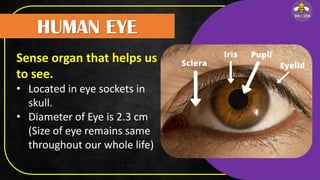
HUMAN EYE
Sense organ that helps us
to see.
• Located in eye sockets in
skull.
• Diameter of Eye is 2.3 cm
(Size of eye remains same
throughout our whole life)
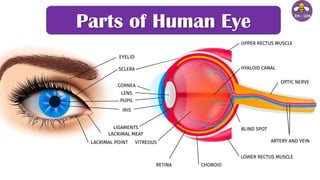
Parts of Human Eye
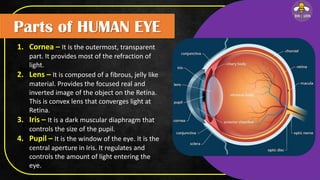
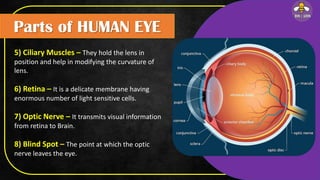
Parts of HUMAN EYE
1. Cornea – It is the outermost, transparent
part. It provides most of the refraction of
light.
2. Lens – It is composed of a fibrous, jelly like
material. Provides the focused real and
inverted image of the object on the Retina.
This is convex lens that converges light at
Retina.
3. Iris – It is a dark muscular diaphragm that
controls the size of the pupil.
4. Pupil – It is the window of the eye. It is the
central aperture in Iris. It regulates and
controls the amount of light entering the
eye.
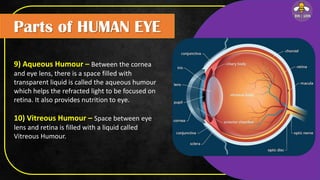
Parts of HUMAN EYE
5) Ciliary Muscles – They hold the lens in
position and help in modifying the curvature of
lens.
6) Retina – It is a delicate membrane having
enormous number of light sensitive cells.
7) Optic Nerve – It transmits visual information
from retina to Brain.
8) Blind Spot – The point at which the optic
nerve leaves the eye.
Parts of HUMAN EYE
9) Aqueous Humour – Between the cornea
and eye lens, there is a space filled with
transparent liquid is called the aqueous humour
which helps the refracted light to be focused on
retina. It also provides nutrition to eye.
10) Vitreous Humour – Space between eye
lens and retina is filled with a liquid called
Vitreous Humour.
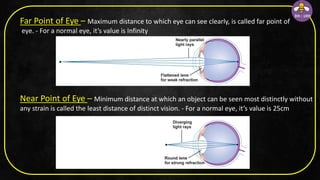
Far Point of Eye – Maximum distance to which eye can see clearly, is called far point of
eye. - For a normal eye, it’s value is Infinity
Near Point of Eye – Minimum distance at which an object can be seen most distinctly without
any strain is called the least distance of distinct vision. - For a normal eye, it’s value is 25cm
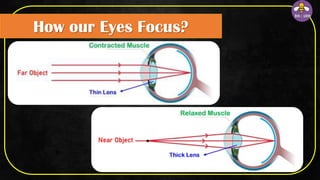
Power of Accommodation
The process by which certain muscles (called ciliary muscles) function
to change the focal length of the eyes so that the image is clearly
formed on the retina is called accommodation of the eye.
• If the object in consideration is at a distance, for the image to form at the retina,
the focal length has to be large. Here, the ciliary muscles relax, thereby thinning
the eye lens. The focal length increases and the image is formed perfectly on the
retina.
• Similarly, in the case of near-lying objects, the ciliary muscles contract and
thereby thickening the lens. This causes a reduction in the focal length for ideal
image formation.
Range of human vision is from 25 cm to infinity
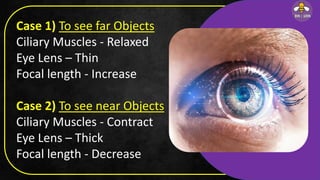
Case 1) To see far Objects
Ciliary Muscles - Relaxed
Eye Lens – Thin
Focal length - Increase
Case 2) To see near Objects
Ciliary Muscles - Contract
Eye Lens – Thick
Focal length - Decrease
How our Eyes Focus?
Myopia
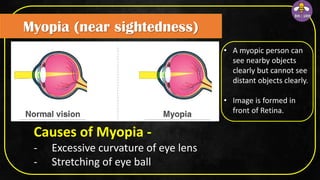
Myopia (near sightedness)
• A myopic person can
see nearby objects
clearly but cannot see
distant objects clearly.
• Image is formed in
front of Retina.
Causes of Myopia -
- Excessive curvature of eye lens
- Stretching of eye ball
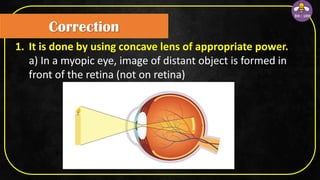
1. It is done by using concave lens of appropriate power.
a) In a myopic eye, image of distant object is formed in
front of the retina (not on retina)
Correction
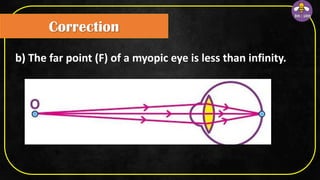
b) The far point (F) of a myopic eye is less than infinity.
Correction
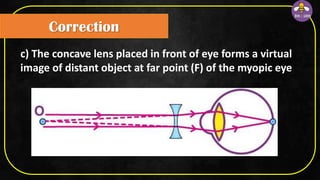
c) The concave lens placed in front of eye forms a virtual
image of distant object at far point (F) of the myopic eye
Correction
Hypermetropia
Causes of Hypermetropia -
- Focal length of eye lens becomes too long.
- Eye ball becomes too small.
Hypermetropia (far sightedness)
- Affected person can see
far objects clearly but
can’t see nearby objects
clearly.
- The near point of eye
moves away.
- Image is formed behind
the retina.
Correction
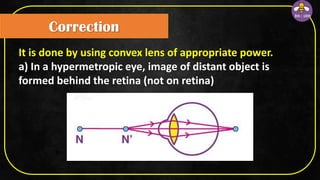
It is done by using convex lens of appropriate power.
a) In a hypermetropic eye, image of distant object is
formed behind the retina (not on retina)
Correction
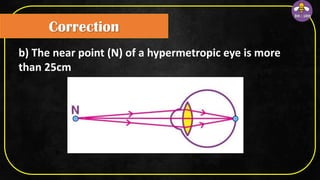
b) The near point (N) of a hypermetropic eye is more
than 25cm
Correction
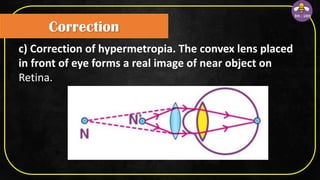
c) Correction of hypermetropia. The convex lens placed
in front of eye forms a real image of near object on
Retina.
Correction
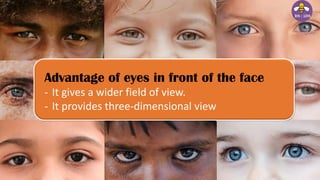
Advantage of eyes in front of the face
- It gives a wider field of view.
- It provides three-dimensional view
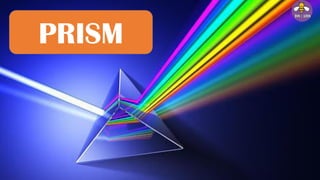
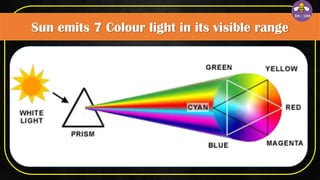
PRISM
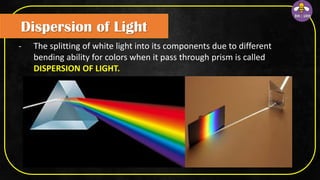
Dispersion of Light
- The splitting of white light into its components due to different
bending ability for colors when it pass through prism is called
DISPERSION OF LIGHT.
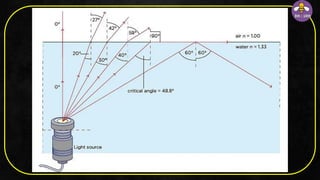
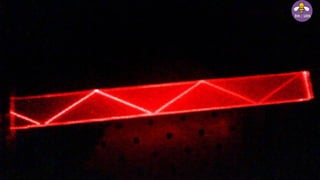
Total Internal Reflection
When light travels from denser medium to rarer
medium with angle of incidence greater than critical
angle then the refracted ray instead of emerging out
again goes into the same medium. This is known as
total internal reflection.
Two conditions:
i. light travels from denser medium to rarer medium
ii. ii. the angle of incidence is greater than critical angle
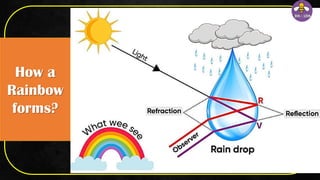
Rainbow Formation
How a
Rainbow
forms?
Sun emits 7 Colour light in its visible range
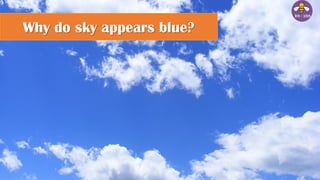
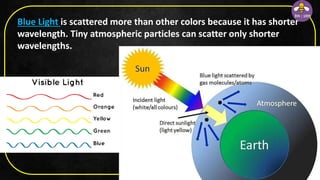
Why do sky appears blue?
Blue Light is scattered more than other colors because it has shorter
wavelength. Tiny atmospheric particles can scatter only shorter
wavelengths.
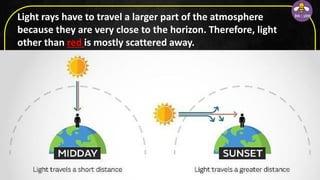
Why do sun appear more reddish
during sunrise and sunset?
Light rays have to travel a larger part of the atmosphere
because they are very close to the horizon. Therefore, light
other than red is mostly scattered away.
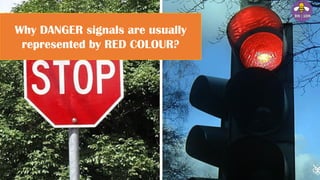
Why DANGER signals are usually
represented by RED COLOUR?
Why YELLOW COLOUR to school bus?
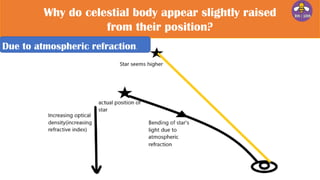
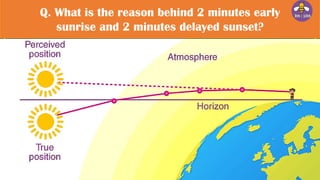
Why do celestial body appear slightly raised
from their position?
Due to atmospheric refraction.
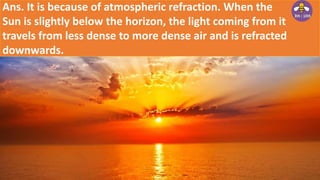
Q. What is the reason behind 2 minutes early
sunrise and 2 minutes delayed sunset?
Ans. It is because of atmospheric refraction. When the
Sun is slightly below the horizon, the light coming from it
travels from less dense to more dense air and is refracted
downwards.
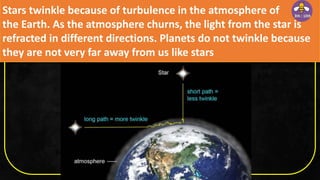
Q. Why do stars twinkle but planets do not?
Stars twinkle because of turbulence in the atmosphere of
the Earth. As the atmosphere churns, the light from the star is
refracted in different directions. Planets do not twinkle because
they are not very far away from us like stars
Class 10 Eye and colourful world notes.pdf

Class 10 Eye and colourful world notes.pdf

  • 2.
    HUMAN EYE Sense organthat helps us to see. • Located in eye sockets in skull. • Diameter of Eye is 2.3 cm (Size of eye remains same throughout our whole life)
  • 3.
  • 4.
    Parts of HUMANEYE 1. Cornea – It is the outermost, transparent part. It provides most of the refraction of light. 2. Lens – It is composed of a fibrous, jelly like material. Provides the focused real and inverted image of the object on the Retina. This is convex lens that converges light at Retina. 3. Iris – It is a dark muscular diaphragm that controls the size of the pupil. 4. Pupil – It is the window of the eye. It is the central aperture in Iris. It regulates and controls the amount of light entering the eye.
  • 5.
    Parts of HUMANEYE 5) Ciliary Muscles – They hold the lens in position and help in modifying the curvature of lens. 6) Retina – It is a delicate membrane having enormous number of light sensitive cells. 7) Optic Nerve – It transmits visual information from retina to Brain. 8) Blind Spot – The point at which the optic nerve leaves the eye.
  • 6.
    Parts of HUMANEYE 9) Aqueous Humour – Between the cornea and eye lens, there is a space filled with transparent liquid is called the aqueous humour which helps the refracted light to be focused on retina. It also provides nutrition to eye. 10) Vitreous Humour – Space between eye lens and retina is filled with a liquid called Vitreous Humour.
  • 7.
    Far Point ofEye – Maximum distance to which eye can see clearly, is called far point of eye. - For a normal eye, it’s value is Infinity Near Point of Eye – Minimum distance at which an object can be seen most distinctly without any strain is called the least distance of distinct vision. - For a normal eye, it’s value is 25cm
  • 8.
    Power of Accommodation Theprocess by which certain muscles (called ciliary muscles) function to change the focal length of the eyes so that the image is clearly formed on the retina is called accommodation of the eye. • If the object in consideration is at a distance, for the image to form at the retina, the focal length has to be large. Here, the ciliary muscles relax, thereby thinning the eye lens. The focal length increases and the image is formed perfectly on the retina. • Similarly, in the case of near-lying objects, the ciliary muscles contract and thereby thickening the lens. This causes a reduction in the focal length for ideal image formation. Range of human vision is from 25 cm to infinity
  • 9.
    Case 1) Tosee far Objects Ciliary Muscles - Relaxed Eye Lens – Thin Focal length - Increase Case 2) To see near Objects Ciliary Muscles - Contract Eye Lens – Thick Focal length - Decrease
  • 10.
  • 11.
  • 12.
    Myopia (near sightedness) •A myopic person can see nearby objects clearly but cannot see distant objects clearly. • Image is formed in front of Retina. Causes of Myopia - - Excessive curvature of eye lens - Stretching of eye ball
  • 13.
    1. It isdone by using concave lens of appropriate power. a) In a myopic eye, image of distant object is formed in front of the retina (not on retina) Correction
  • 14.
    b) The farpoint (F) of a myopic eye is less than infinity. Correction
  • 15.
    c) The concavelens placed in front of eye forms a virtual image of distant object at far point (F) of the myopic eye Correction
  • 16.
  • 17.
    Causes of Hypermetropia- - Focal length of eye lens becomes too long. - Eye ball becomes too small. Hypermetropia (far sightedness) - Affected person can see far objects clearly but can’t see nearby objects clearly. - The near point of eye moves away. - Image is formed behind the retina.
  • 18.
    Correction It is doneby using convex lens of appropriate power. a) In a hypermetropic eye, image of distant object is formed behind the retina (not on retina)
  • 19.
    Correction b) The nearpoint (N) of a hypermetropic eye is more than 25cm
  • 20.
    Correction c) Correction ofhypermetropia. The convex lens placed in front of eye forms a real image of near object on Retina.
  • 21.
    Correction Advantage of eyesin front of the face - It gives a wider field of view. - It provides three-dimensional view
  • 22.
  • 23.
    Dispersion of Light -The splitting of white light into its components due to different bending ability for colors when it pass through prism is called DISPERSION OF LIGHT.
  • 24.
    Total Internal Reflection Whenlight travels from denser medium to rarer medium with angle of incidence greater than critical angle then the refracted ray instead of emerging out again goes into the same medium. This is known as total internal reflection. Two conditions: i. light travels from denser medium to rarer medium ii. ii. the angle of incidence is greater than critical angle
  • 27.
  • 28.
  • 29.
    Sun emits 7Colour light in its visible range
  • 30.
    Why do skyappears blue?
  • 31.
    Blue Light isscattered more than other colors because it has shorter wavelength. Tiny atmospheric particles can scatter only shorter wavelengths.
  • 32.
    Why do sunappear more reddish during sunrise and sunset?
  • 33.
    Light rays haveto travel a larger part of the atmosphere because they are very close to the horizon. Therefore, light other than red is mostly scattered away.
  • 34.
    Why DANGER signalsare usually represented by RED COLOUR?
  • 35.
    Why YELLOW COLOURto school bus?
  • 36.
    Why do celestialbody appear slightly raised from their position? Due to atmospheric refraction.
  • 37.
    Q. What isthe reason behind 2 minutes early sunrise and 2 minutes delayed sunset?
  • 38.
    Ans. It isbecause of atmospheric refraction. When the Sun is slightly below the horizon, the light coming from it travels from less dense to more dense air and is refracted downwards.
  • 39.
    Q. Why dostars twinkle but planets do not?
  • 40.
    Stars twinkle becauseof turbulence in the atmosphere of the Earth. As the atmosphere churns, the light from the star is refracted in different directions. Planets do not twinkle because they are not very far away from us like stars