Planning and Writing and
Assignments for DBS
Students
6 Steps to Success!
Understand
the
Assignment
Get
Organised
Conduct the
Research
Take & Make
Notes
Plan the
Structure
Write
Reference &
Proofread
The Six Steps to Success
Step One (Understand the Assignment)
Analyse and assess the extent to which Reward Management
plays a significant role in attracting new employees, and its
impact on employee retention, performance and motivation.
Terminology Synonym/Clarification
Analyse Break down the issue into its
component parts and discuss
Assess Estimate the value or importance of
something.
Significant Role (And)
Attracting New Employees Recruitment
Impact Effect (Relationship)
Step Two (Get Organised)
You could be required to work on more than one assignment at the
same time, be realistic and give yourself enough time for each.
30 Day
Schedule
Example
2 Days:
Understand
and Organise
8 Days:
Research
9 Days:
Reading
1 Day: Plan
10 Days:
Write
Reward
Management
(Central Theme)
Attracting New
Employees/Recruitment
Retention
Performance
Motivation
Step Three (Research - Strategy)
Section Topic Search Terms
1 Introduction
2 Reward Management Reward Management
3 Reward Management
And Recruiting
Employees
Reward
Management
And Employee And Recruitment
4 Reward Management
And Employee
Retention
Reward
Management
And Employee And Retention
5 Reward Management
And Employee
Performance
Reward
Management
And Employee And Performance
6 Reward Management
And Employee
Motivation
Reward
Management
And Employee And Motivation
7 Conclusion
Step Three (Research – Search Terms)
Step Three (Research – Resources)
Discovery
Search A
Step Three (Research – Discovery)
🙢
Section 6
Reward Management and Employee Motivation
WORD SYNOYM/ALTERNATIVE/FOCUS
Employee Worker
Motivation Engagement/Participation
Step Three (Research – Synonyms/Clarify)
🙢
🙢 These are simple words or symbols that allow us
to broaden or narrow our searches
🙢 Three words used are
▪ and
▪ or
▪ not
Boolean Operators
🙢
🙢 Use AND in a search to:
▪ narrow your results
▪ tell the database that ALL search terms must be
present in the resulting records
▪ example: reward management
AND motivation AND employee
🙢 Google automatically puts an AND
in between your search terms.
AND
🙢
🙢 Use OR in a search to:
▪ connect two or more similar concepts (synonyms)
▪ broaden your results, telling the database that ANY of
your search terms can be present in the resulting
records
▪ example: reward management
OR motivation OR
employee
OR
🙢
🙢 Use NOT in a search to:
▪ exclude words from your search
▪ narrow your search, telling the database to ignore
concepts that may be implied by your search terms
▪ example: Ireland NOT Northern Ireland
NOT
🙢
🙢 These are used when there are different spellings of the
same word.
🙢 We could use OR to list each spelling of a word
organisation OR organization
🙢 Wildcards allow us to use a symbol to replace the
different letter(s).
🙢 In Discovery the symbol ? is used to replace 1 letter. and #
is used to replace 0 or 1 letter
organi?ation = organisation/orgainzation
behavio#r = behaviour/behavior
wom?n = woman or women
Wildcards
🙢
🙢 Phrase searching used to specify that a group of
words/phase must be in exact order.
“purchasing power”
🙢 Truncation is a technique that broadens your search to
include various word endings and spellings.
• To use truncation, enter the root of a word and put the
truncation symbol at the end, Discovery uses *
• Discovery will return results that include any ending of
that root word.
• Examples:
child* = child, childs, children, childrens, childhood
genetic* = genetic, genetics, genetically
Phrases and Truncation
Discovery
Search B
-
Boolean
Applied
motivation or engagement or
participation
Step Three (Research – Discovery)
Step Four (Active Reading and Note Taking)
• You will be primarily sourcing your information from
books, articles (PDF) and credible websites.
• Active reading is taking notes as you read the source in
order to understand and evaluate it.
Active Reading and Note Taking
• Once notes have been taken and you’ve decided to
incorporate this source into your own work, you need to
make sense of the notes.
• Gather the notes taken from various sources and
compare/contrast them.
• At this stage you can add your own interpretation.
• Notes will be used as evidence to back up
your argument/interpretation.
• The most effective way to use others’ views
/ideas to back up your argument is to
paraphrase them.
Tip
Once
downloaded,
you can
highlight and
add notes to
PDFs
(Paraphrasing – A Worked Example)
1. Read
the
Original
2. Take
& Make
Notes
(Paraphrasing – A Worked Example)
3. Write
in your
own
Words
4. Add in
the
Reference
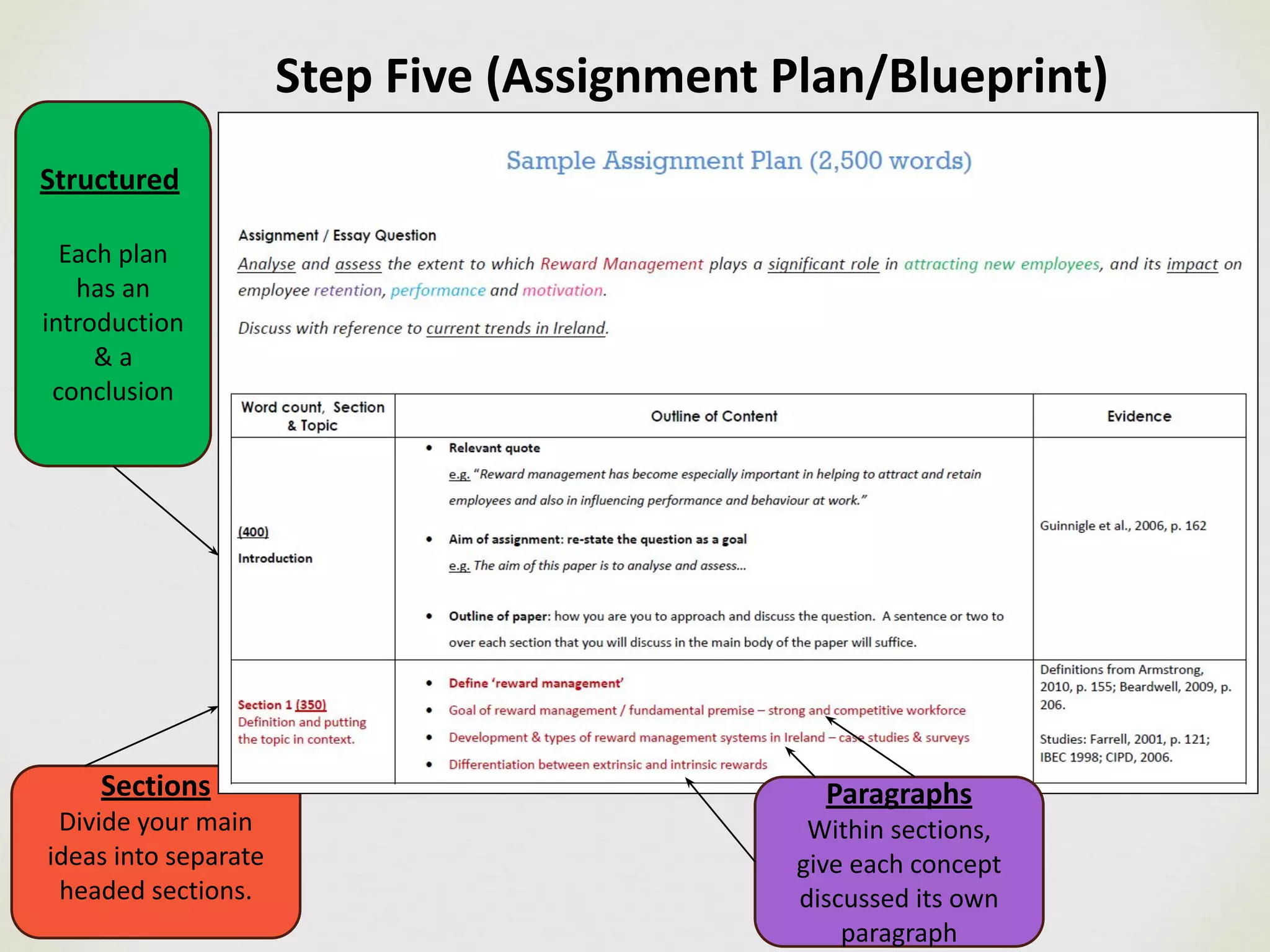
Step Five (Assignment Plan/Blueprint)
Structured
Each plan
has an
introduction
& a
conclusion
Sections
Divide your main
ideas into separate
headed sections.
Paragraphs
Within sections,
give each concept
discussed its own
paragraph
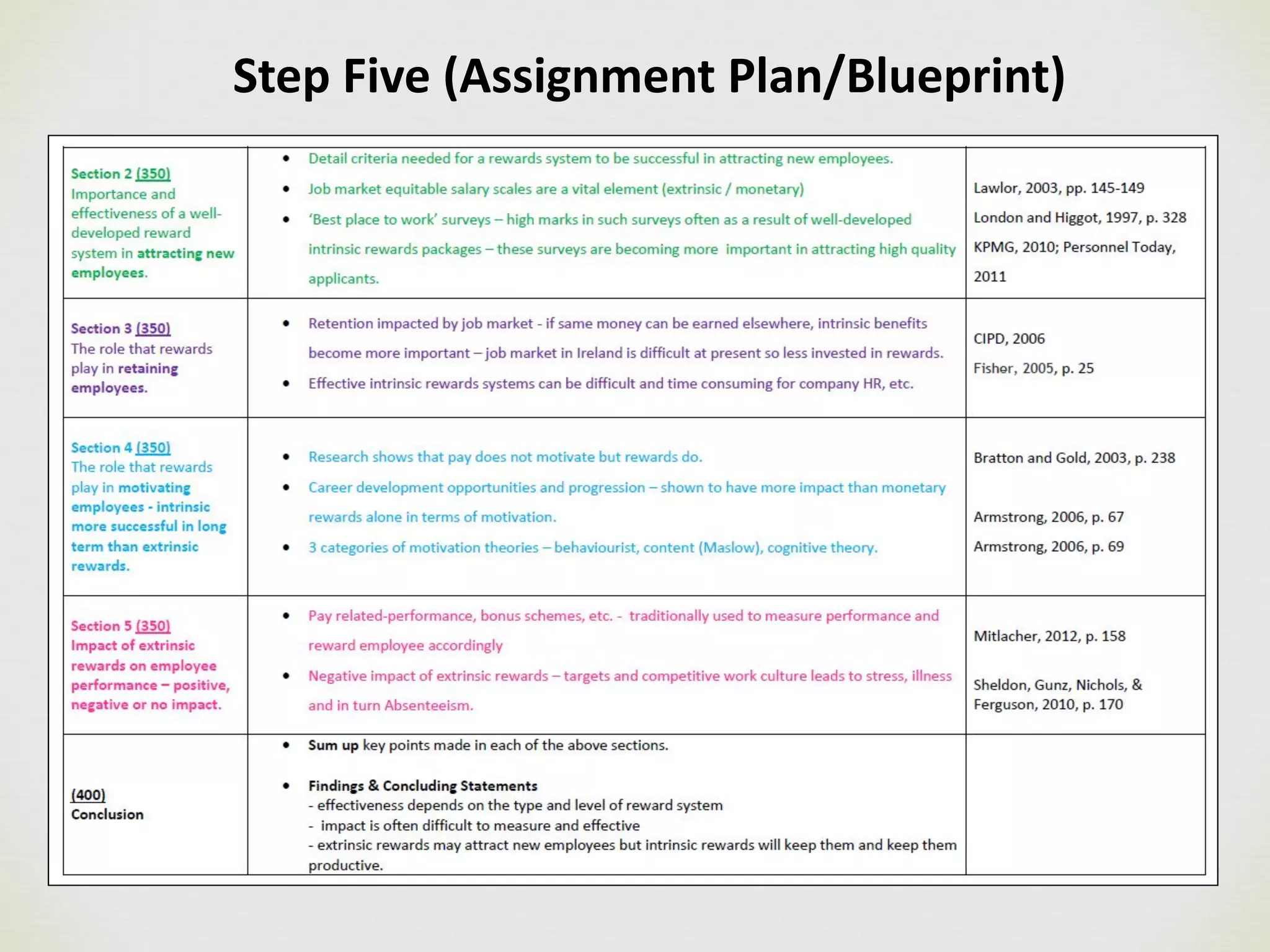
Step Five (Assignment Plan/Blueprint)
Step Six (Writing)
Frist Draft
• Basically you are trying to provide much more insight into the
ideas/theories/viewpoints that you mentioned in the
Assignment Plan.
• Provide evidence (citations) as you articulate or describe
somebody else's ideas (paraphrasing is most effective).
• Pay careful attention to the verb instruction
that was given in the question.
• Begin to write a selected section.
Treat each section as a mini essay
in itself.
Tip
Writing the
introduction
last, means you
know what’s
been discussed
Step Six (Writing)
Second Draft
Refer to your Assignment Plan, have you covered all of the
topics listed?
Yes!
• Confirm your argument follows through logically.
• Change paragraph/sentence order if required.
• Ensure all outside ideas/theories/concepts are referenced.
No?
• Check that you have not gone off topic.
• Summarise and refer to viewpoints/studies/theories,
describe less.
Tip
If a sentence
seems too
long, it
probably is
too long
Tip
More
citations =
more
evidence
Step Six (Writing)
Edit, Reference & Proofread
Edit
• Make sure the structure adheres to the Assignment Plan.
• Ensure that you are not repeating the same word (“therefore”
“however”), use a thesaurus to assist you.
• Confirm that you have used the appropriate language for
your subject and that you used it consistently.
References
• Check that in-text citations have all information required.
• Compile a Reference List using the proper referencing style.
• Ensure that each in-text citation has a corresponding reference list entry,
and visa-versa.
Proofread
• Ensure that all punctuation is correct,
save as Word/PDF.
Tip
Keep your
Assignment
in cloud
based server:
Dropbox
Tip
Use PDF ‘read
out loud’
function to
review
finished
version
The 4 ‘S’s of Good Assignment
Sources
• Good quality academic
sources used.
• Lots of sources used.
• Different viewpoints
articulated if possible.
Substance
• Has the initial question been
answered?
• Has the assignment been an
investigation of the topic, rather
then a mere description?
• Has the stance taken by author
been argued effectively?
Structure
• The assignment should follow
in the same structure as the
question.
• Is there an introduction and
conclusion.
• Does one section follow
logically to the next.
Style
• Use the academic language
style, never in the first person.
Write as a narrator.
• Use the terminology of the
subject area.
• Write objectively.
• If possible open and close with
a snappy/stylish sentence.

Planning and writing assignments (business example) 2021.pptx

  • 1.
    Planning and Writingand Assignments for DBS Students 6 Steps to Success!
  • 2.
    Understand the Assignment Get Organised Conduct the Research Take &Make Notes Plan the Structure Write Reference & Proofread The Six Steps to Success
  • 3.
    Step One (Understandthe Assignment) Analyse and assess the extent to which Reward Management plays a significant role in attracting new employees, and its impact on employee retention, performance and motivation. Terminology Synonym/Clarification Analyse Break down the issue into its component parts and discuss Assess Estimate the value or importance of something. Significant Role (And) Attracting New Employees Recruitment Impact Effect (Relationship)
  • 4.
    Step Two (GetOrganised) You could be required to work on more than one assignment at the same time, be realistic and give yourself enough time for each. 30 Day Schedule Example 2 Days: Understand and Organise 8 Days: Research 9 Days: Reading 1 Day: Plan 10 Days: Write
  • 5.
  • 6.
    Section Topic SearchTerms 1 Introduction 2 Reward Management Reward Management 3 Reward Management And Recruiting Employees Reward Management And Employee And Recruitment 4 Reward Management And Employee Retention Reward Management And Employee And Retention 5 Reward Management And Employee Performance Reward Management And Employee And Performance 6 Reward Management And Employee Motivation Reward Management And Employee And Motivation 7 Conclusion Step Three (Research – Search Terms)
  • 7.
    Step Three (Research– Resources)
  • 8.
    Discovery Search A Step Three(Research – Discovery)
  • 9.
    🙢 Section 6 Reward Managementand Employee Motivation WORD SYNOYM/ALTERNATIVE/FOCUS Employee Worker Motivation Engagement/Participation Step Three (Research – Synonyms/Clarify)
  • 10.
    🙢 🙢 These aresimple words or symbols that allow us to broaden or narrow our searches 🙢 Three words used are ▪ and ▪ or ▪ not Boolean Operators
  • 11.
    🙢 🙢 Use ANDin a search to: ▪ narrow your results ▪ tell the database that ALL search terms must be present in the resulting records ▪ example: reward management AND motivation AND employee 🙢 Google automatically puts an AND in between your search terms. AND
  • 12.
    🙢 🙢 Use ORin a search to: ▪ connect two or more similar concepts (synonyms) ▪ broaden your results, telling the database that ANY of your search terms can be present in the resulting records ▪ example: reward management OR motivation OR employee OR
  • 13.
    🙢 🙢 Use NOTin a search to: ▪ exclude words from your search ▪ narrow your search, telling the database to ignore concepts that may be implied by your search terms ▪ example: Ireland NOT Northern Ireland NOT
  • 14.
    🙢 🙢 These areused when there are different spellings of the same word. 🙢 We could use OR to list each spelling of a word organisation OR organization 🙢 Wildcards allow us to use a symbol to replace the different letter(s). 🙢 In Discovery the symbol ? is used to replace 1 letter. and # is used to replace 0 or 1 letter organi?ation = organisation/orgainzation behavio#r = behaviour/behavior wom?n = woman or women Wildcards
  • 15.
    🙢 🙢 Phrase searchingused to specify that a group of words/phase must be in exact order. “purchasing power” 🙢 Truncation is a technique that broadens your search to include various word endings and spellings. • To use truncation, enter the root of a word and put the truncation symbol at the end, Discovery uses * • Discovery will return results that include any ending of that root word. • Examples: child* = child, childs, children, childrens, childhood genetic* = genetic, genetics, genetically Phrases and Truncation
  • 16.
    Discovery Search B - Boolean Applied motivation orengagement or participation Step Three (Research – Discovery)
  • 17.
    Step Four (ActiveReading and Note Taking) • You will be primarily sourcing your information from books, articles (PDF) and credible websites. • Active reading is taking notes as you read the source in order to understand and evaluate it.
  • 18.
    Active Reading andNote Taking • Once notes have been taken and you’ve decided to incorporate this source into your own work, you need to make sense of the notes. • Gather the notes taken from various sources and compare/contrast them. • At this stage you can add your own interpretation. • Notes will be used as evidence to back up your argument/interpretation. • The most effective way to use others’ views /ideas to back up your argument is to paraphrase them. Tip Once downloaded, you can highlight and add notes to PDFs
  • 19.
    (Paraphrasing – AWorked Example) 1. Read the Original 2. Take & Make Notes
  • 20.
    (Paraphrasing – AWorked Example) 3. Write in your own Words 4. Add in the Reference
  • 21.
    Step Five (AssignmentPlan/Blueprint) Structured Each plan has an introduction & a conclusion Sections Divide your main ideas into separate headed sections. Paragraphs Within sections, give each concept discussed its own paragraph
  • 22.
    Step Five (AssignmentPlan/Blueprint)
  • 23.
    Step Six (Writing) FristDraft • Basically you are trying to provide much more insight into the ideas/theories/viewpoints that you mentioned in the Assignment Plan. • Provide evidence (citations) as you articulate or describe somebody else's ideas (paraphrasing is most effective). • Pay careful attention to the verb instruction that was given in the question. • Begin to write a selected section. Treat each section as a mini essay in itself. Tip Writing the introduction last, means you know what’s been discussed
  • 24.
    Step Six (Writing) SecondDraft Refer to your Assignment Plan, have you covered all of the topics listed? Yes! • Confirm your argument follows through logically. • Change paragraph/sentence order if required. • Ensure all outside ideas/theories/concepts are referenced. No? • Check that you have not gone off topic. • Summarise and refer to viewpoints/studies/theories, describe less. Tip If a sentence seems too long, it probably is too long Tip More citations = more evidence
  • 25.
    Step Six (Writing) Edit,Reference & Proofread Edit • Make sure the structure adheres to the Assignment Plan. • Ensure that you are not repeating the same word (“therefore” “however”), use a thesaurus to assist you. • Confirm that you have used the appropriate language for your subject and that you used it consistently. References • Check that in-text citations have all information required. • Compile a Reference List using the proper referencing style. • Ensure that each in-text citation has a corresponding reference list entry, and visa-versa. Proofread • Ensure that all punctuation is correct, save as Word/PDF. Tip Keep your Assignment in cloud based server: Dropbox Tip Use PDF ‘read out loud’ function to review finished version
  • 26.
    The 4 ‘S’sof Good Assignment Sources • Good quality academic sources used. • Lots of sources used. • Different viewpoints articulated if possible. Substance • Has the initial question been answered? • Has the assignment been an investigation of the topic, rather then a mere description? • Has the stance taken by author been argued effectively? Structure • The assignment should follow in the same structure as the question. • Is there an introduction and conclusion. • Does one section follow logically to the next. Style • Use the academic language style, never in the first person. Write as a narrator. • Use the terminology of the subject area. • Write objectively. • If possible open and close with a snappy/stylish sentence.