Biography Unit High School Ms. Voltz
Biography Research Report & Oral Presentation   Choose a person  Your essay must be 4-6 pages in length It must be typed, double spaced and in 12 point font Please use only Arial or Times New Roman Fonts
Goal Students will learn how to write a biography (non-fiction) with an introduction, body section from research and an outline, a conclusion and a works cited list.
Objectives Students will scan for important facts. Students will develop skills for advanced searching of the Internet. Students will organize cards into a logical and chronological order. Students will develop a thesis statement. Students will determine credible sources on the Internet. Students will identify primary and secondary sources.  Students will integrate quotations into their own writing. Students will write their own biography research report. Students will revise their essays. Students will integrate other people’s works without plagiarizing. Students will demonstrate how to cite articles correctly in MLA format.
California Standards I want you to have these skills by the end of the Biography Unit
California Standards 2.0 Reading Comprehension (Focus on Informational Materials) 2.1 Analyze the structure and format of functional workplace documents, including the graphics and headers, and explain how authors use the features to achieve their purposes. 2.2 Prepare a bibliography of reference materials for a report using a variety of consumer, workplace, and public documents.  Comprehension and Analysis of Grade-Level-Appropriate Text 2.3 Generate relevant questions about readings on issues that can be researched. 2.4 Synthesize the content from several sources or works by a single author dealing with a single issue; paraphrase the ideas and connect them to other sources and related topics to demonstrate comprehension. 2.6 Demonstrate use of sophisticated learning tools by following technical directions (e.g., those found with graphic calculators and specialized software programs and in access guides to World Wide Web sites on the Internet).
California Standards 1.0 Writing Strategies 1.3 Use clear research questions and suitable research methods (e.g., library, electronic media, personal interview) to elicit and present evidence from primary and secondary sources. 1.5 Synthesize information from multiple sources and identify complexities and discrepancies in the information and the different perspectives found in each medium (e.g., almanacs, microfiche, news sources, in-depth field studies, speeches, journals, technical documents). 1.6 Integrate quotations and citations into a written text while maintaining the flow of ideas. 1.7 Use appropriate conventions for documentation in the text, notes, and bibliographies by adhering to those in style manuals (e.g.,  Modern Language Association Handbook, The Chicago Manual of Style). 1.8 Design and publish documents by using advanced publishing software and graphic programs.
California Standards 2.0 Writing Applications  2.3 Write expository compositions, including analytical essays and research reports: a. Marshal evidence in support of a thesis and related claims, including information on all relevant perspectives. b. Convey information and ideas from primary and secondary sources accurately and coherently. c. Make distinctions between the relative value and significance of specific data, facts, and ideas. d. Include visual aids by employing appropriate technology to organize and record information on charts, maps, and graphs. e. Anticipate and address readers' potential misunderstandings, biases, and expectations. f. Use technical terms and notations accurately.
California Standards 1.0 Written and Oral English Language Conventions 1.3 Demonstrate an understanding of proper English usage and control of grammar, paragraph and sentence structure, diction, and syntax. 1.4 Produce legible work that shows accurate spelling and correct use of the conventions of punctuation and capitalization. 1.5 Reflect appropriate manuscript requirements, including title page presentation, pagination, spacing and margins, and integration of source and support material (e.g., in-text citation, use of direct quotations, paraphrasing) with appropriate citations.
Information to Include Early Life   School Life—Education  Young Adult Years  Older Adult years  Experiences  What has been their impact on their own society?  What qualities did this person have that you admire and wish you could achieve?
Biography Research Guidelines   Decide on a topic to research   Research a minimum of 5 articles from the following sources:  Book (1 must be a book) Newspaper  Magazine  Internet   Write a bibliography card for each source
Research Checklist Use  Citation Machine  for help with citing texts in you bibliography.  Database  of bibliographies  Read the articles, underlining the important facts.  Your bibliography must be in MLA format
Note Cards Write out 40 note cards- 1 note card = 1 idea  Make sure to write a topic on the top of each note card with citation information (which book it came from)  These cards will be used when you write your essay and may be used when you give your presentation Turn in these 40 note cards bundled up with a rubber band for a grade.
How do I write my Essay?   Organize your note cards in the order that the paper will be written  Create your own outline based on your cards Fill it in with the facts from your cards.  Write a first draft based on the outline.
Your Essay Must Include Introduction Discussion/Body (where your research information should be located)  The person’s contribution to society and relation to historical context Include your personal opinion about your person’s character and actions in the conclusion
Revising and Editing Rewrite, edit, or add details to the essay Use editing short hand  Check the rubric for standards and expectations Ask at least two friends to edit your paper and make comments.  These comments will be turned in for a grade
Biographies Billie Holiday George Foreman Coretta Scott  King Barry Bonds Vera Wang Marie Curie And about 50 others…
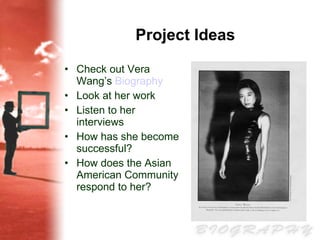
Project Ideas Check out Vera Wang’s  Biography   Look at her work Listen to her interviews How has she become successful? How does the Asian American Community respond to her?
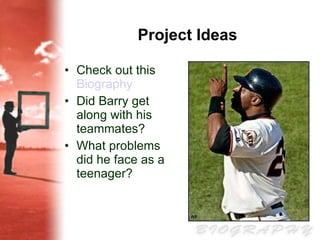
Project Ideas Check out this  Biography   Did Barry get along with his teammates? What problems did he face as a teenager?
Visual Aids Visual aids serve two functions: Enhanced Education Less pressure for the speaker People will have their eyes on your VA not you Visual reminder of the material (for you) Be Creative Posters, models, costumes, props…
Presentation Try to make your presentation fun! Length of presentation: 5-10 minutes Please follow the handout “Rubric” for specific expectations
Paraphrasing  VS.  Plagiarism
Plagiarism is Serious Plagiarism is:  Claiming someone’s work as your own Not citing the author when you use his or her quotes Stealing/Buying an essay from the internet or a person Consequences Taking a zero, phone call home,  and  a detention or Saturday school
Paraphrasing Paraphrasing is: Taking a chunk of an article and putting it in your own words Legitimate when coupled with a citation When do I Paraphrase Consult the  handout Paraphrasing Quotations
How To Paraphrase Read passage until you understand its entire meaning Set the original aside Try to write what you learned (no peeking!)  Check your version with the original Use quotation marks to identify any unique term you have borrowed exactly from the text Cite the source (including the page) on a note card so that you can credit it easily
Paraphrasing Activity Find a partner Choose one biography Read Aloud alternating paragraphs Each person chooses a paragraph Paraphrase the paragraph Switch “paraphrased paragraph” with your partner  Look for errors or duplicate, “verbatim” phrases against original
MLA Style Modern Language Association
MLA Citation MLA Website Documenting Sources In-text Citations Sample Research Essay  Template for Research Essay Citing in MLA Formatting instructions Parenthetical References
Biography Due Dates We will fill out a handout with all dates together If you are absent, talk with your absence buddy to see what you missed
Late Work 1 Day Late –5% 2 Days Late –10% 3 Days Late –20% 4 Days Late –50% Week or more = No Credit All projects have been given to you as of today—Please no Late Work!
 

Biography window

  • 1.
    Biography Unit HighSchool Ms. Voltz
  • 2.
    Biography Research Report& Oral Presentation Choose a person Your essay must be 4-6 pages in length It must be typed, double spaced and in 12 point font Please use only Arial or Times New Roman Fonts
  • 3.
    Goal Students willlearn how to write a biography (non-fiction) with an introduction, body section from research and an outline, a conclusion and a works cited list.
  • 4.
    Objectives Students willscan for important facts. Students will develop skills for advanced searching of the Internet. Students will organize cards into a logical and chronological order. Students will develop a thesis statement. Students will determine credible sources on the Internet. Students will identify primary and secondary sources. Students will integrate quotations into their own writing. Students will write their own biography research report. Students will revise their essays. Students will integrate other people’s works without plagiarizing. Students will demonstrate how to cite articles correctly in MLA format.
  • 5.
    California Standards Iwant you to have these skills by the end of the Biography Unit
  • 6.
    California Standards 2.0Reading Comprehension (Focus on Informational Materials) 2.1 Analyze the structure and format of functional workplace documents, including the graphics and headers, and explain how authors use the features to achieve their purposes. 2.2 Prepare a bibliography of reference materials for a report using a variety of consumer, workplace, and public documents. Comprehension and Analysis of Grade-Level-Appropriate Text 2.3 Generate relevant questions about readings on issues that can be researched. 2.4 Synthesize the content from several sources or works by a single author dealing with a single issue; paraphrase the ideas and connect them to other sources and related topics to demonstrate comprehension. 2.6 Demonstrate use of sophisticated learning tools by following technical directions (e.g., those found with graphic calculators and specialized software programs and in access guides to World Wide Web sites on the Internet).
  • 7.
    California Standards 1.0Writing Strategies 1.3 Use clear research questions and suitable research methods (e.g., library, electronic media, personal interview) to elicit and present evidence from primary and secondary sources. 1.5 Synthesize information from multiple sources and identify complexities and discrepancies in the information and the different perspectives found in each medium (e.g., almanacs, microfiche, news sources, in-depth field studies, speeches, journals, technical documents). 1.6 Integrate quotations and citations into a written text while maintaining the flow of ideas. 1.7 Use appropriate conventions for documentation in the text, notes, and bibliographies by adhering to those in style manuals (e.g., Modern Language Association Handbook, The Chicago Manual of Style). 1.8 Design and publish documents by using advanced publishing software and graphic programs.
  • 8.
    California Standards 2.0Writing Applications 2.3 Write expository compositions, including analytical essays and research reports: a. Marshal evidence in support of a thesis and related claims, including information on all relevant perspectives. b. Convey information and ideas from primary and secondary sources accurately and coherently. c. Make distinctions between the relative value and significance of specific data, facts, and ideas. d. Include visual aids by employing appropriate technology to organize and record information on charts, maps, and graphs. e. Anticipate and address readers' potential misunderstandings, biases, and expectations. f. Use technical terms and notations accurately.
  • 9.
    California Standards 1.0Written and Oral English Language Conventions 1.3 Demonstrate an understanding of proper English usage and control of grammar, paragraph and sentence structure, diction, and syntax. 1.4 Produce legible work that shows accurate spelling and correct use of the conventions of punctuation and capitalization. 1.5 Reflect appropriate manuscript requirements, including title page presentation, pagination, spacing and margins, and integration of source and support material (e.g., in-text citation, use of direct quotations, paraphrasing) with appropriate citations.
  • 10.
    Information to IncludeEarly Life School Life—Education Young Adult Years Older Adult years Experiences What has been their impact on their own society? What qualities did this person have that you admire and wish you could achieve?
  • 11.
    Biography Research Guidelines Decide on a topic to research Research a minimum of 5 articles from the following sources: Book (1 must be a book) Newspaper Magazine Internet Write a bibliography card for each source
  • 12.
    Research Checklist Use Citation Machine for help with citing texts in you bibliography. Database of bibliographies Read the articles, underlining the important facts. Your bibliography must be in MLA format
  • 13.
    Note Cards Writeout 40 note cards- 1 note card = 1 idea Make sure to write a topic on the top of each note card with citation information (which book it came from) These cards will be used when you write your essay and may be used when you give your presentation Turn in these 40 note cards bundled up with a rubber band for a grade.
  • 14.
    How do Iwrite my Essay? Organize your note cards in the order that the paper will be written Create your own outline based on your cards Fill it in with the facts from your cards. Write a first draft based on the outline.
  • 15.
    Your Essay MustInclude Introduction Discussion/Body (where your research information should be located) The person’s contribution to society and relation to historical context Include your personal opinion about your person’s character and actions in the conclusion
  • 16.
    Revising and EditingRewrite, edit, or add details to the essay Use editing short hand Check the rubric for standards and expectations Ask at least two friends to edit your paper and make comments. These comments will be turned in for a grade
  • 17.
    Biographies Billie HolidayGeorge Foreman Coretta Scott King Barry Bonds Vera Wang Marie Curie And about 50 others…
  • 18.
    Project Ideas Checkout Vera Wang’s Biography Look at her work Listen to her interviews How has she become successful? How does the Asian American Community respond to her?
  • 19.
    Project Ideas Checkout this Biography Did Barry get along with his teammates? What problems did he face as a teenager?
  • 20.
    Visual Aids Visualaids serve two functions: Enhanced Education Less pressure for the speaker People will have their eyes on your VA not you Visual reminder of the material (for you) Be Creative Posters, models, costumes, props…
  • 21.
    Presentation Try tomake your presentation fun! Length of presentation: 5-10 minutes Please follow the handout “Rubric” for specific expectations
  • 22.
    Paraphrasing VS. Plagiarism
  • 23.
    Plagiarism is SeriousPlagiarism is: Claiming someone’s work as your own Not citing the author when you use his or her quotes Stealing/Buying an essay from the internet or a person Consequences Taking a zero, phone call home, and a detention or Saturday school
  • 24.
    Paraphrasing Paraphrasing is:Taking a chunk of an article and putting it in your own words Legitimate when coupled with a citation When do I Paraphrase Consult the handout Paraphrasing Quotations
  • 25.
    How To ParaphraseRead passage until you understand its entire meaning Set the original aside Try to write what you learned (no peeking!) Check your version with the original Use quotation marks to identify any unique term you have borrowed exactly from the text Cite the source (including the page) on a note card so that you can credit it easily
  • 26.
    Paraphrasing Activity Finda partner Choose one biography Read Aloud alternating paragraphs Each person chooses a paragraph Paraphrase the paragraph Switch “paraphrased paragraph” with your partner Look for errors or duplicate, “verbatim” phrases against original
  • 27.
    MLA Style ModernLanguage Association
  • 28.
    MLA Citation MLAWebsite Documenting Sources In-text Citations Sample Research Essay Template for Research Essay Citing in MLA Formatting instructions Parenthetical References
  • 29.
    Biography Due DatesWe will fill out a handout with all dates together If you are absent, talk with your absence buddy to see what you missed
  • 30.
    Late Work 1Day Late –5% 2 Days Late –10% 3 Days Late –20% 4 Days Late –50% Week or more = No Credit All projects have been given to you as of today—Please no Late Work!
  • 31.

Editor's Notes

  • #3 This person can be of any cultural background.
  • #11 Found on the “Biography Outline” in essay form Chronological Order Please Have they improved or changed society in anyway? Have they improved or changed society in anyway? Why did you choose this person?
  • #12 staple the card to the front of the article (All except the book)
  • #13 Look for important ideas specified in your “Biography Outline”. MLA format will be discussed at length.
  • #14 Please write your name on the first note card in your bundle!
  • #15 Look over the Biography Outline handout and your outline, are you missing information? If so, do more research.
  • #17 We will learn an editing short hand method
  • #21 People will have their eyes on your VA not you.
  • #26 Look for errors or duplicate “verbatim” phrases
  • #27 Verbatim = Using exactly the same words; corresponding word for word
  • #29 Though there are several different sets of citations regulations, we will focus on MLA
  • #31 Absence You have been given the assignments and expectations well in advance. All Late work will be Marked down. None will be accepted after a week. Only exception is If you are absent for two weeks or more during the Biography Unit.