Referencing
An introduction
What is referencing?
• A standardised way of acknowledging sources
of information and ideas that you have used
in your assignment
• Helps avoid plagiarism (stealing of other's
ideas)
• Enables readers to follow-up and read more
fully the cited author’s arguments
• Shows you have done research
UCT Author-date referencing style
• Examples given here follow the UCT Author-
date: Reference Guide
Two stages of referencing
• In-text citation
– Put brief details in round brackets () within the
body of an essay to indicate every instance that
you have borrowed words or ideas
• Reference list
– Put the full details of all sources used in your work
at the end of your paper
Two ways to cite sources:
• Direct quotation – use someone else’s work
word for word
• Put the words used in “quotation marks”
• Use sparingly
• Paraphrasing – put someone else’s ideas in
your own words
In-text citation - Details to include
If author’s name is not included in the sentence put:
(Author’s surname, year of publication:page number)
In an analysis of equity and efficiency in public education, it was found
that South Africa has elements of both a first world country, and a
third world country (Crouch, 1996:134).
The study found that “South African society embodies both First
World and Third World living standards” (Crouch, 1996:134).
NB: List all authors to a maximum of three separated by a comma but the last
separated by an ampersand &. If more than 3 authors, list the first author followed by
et al.
In-text citation - Details to include (2)
If author’s name is included in the sentence put:
(Year of publication:page number)
In his analysis of equity and efficiency in public education, Crouch
(1996:134) noted that South Africa has elements of both a first world
country, and a third world country.
Crouch (1996:134) states that “South African society embodies both
First World and Third World living standards”.
In-text citation - Details to include (3)
If there is no author, use the first significant words of the
title. Usually, three words are enough for in-text citations.
Use ellipses for longer titles to indicate the omission of
words:
(“First significant words of title …”, year of publication:page number)
South Africa is hopeful for an increase in economic activity with Nigeria
(“SA and Nigeria in deal …”, 2016:3).
“SA and Nigeria in deal …” (2016:3) noted that “SA is optimistic about
further growth of economic ties between the two countries”.
Reference list
• Full details of all the sources mentioned in
your work have to be listed at the end of the
paper.
• Details included in a reference are dependent
on the source type i.e. book, article, website
etc.
Basic structure of UCT Author-date reference
includes:
• Author(s) of resource – Surname & initial
• Date of publication – Year of publication
• Title of resource
• Publication details – Place and name of
publisher for books or volume, issue and page
numbers for journals and URL for an Internet
resource
Referencing - Book
Author(s) – surname & initial Glimcher, P. W.
Date – year of publication 2011.
Title – italicised Foundations of neuroeconomic analysis.
Place of publication – town of publication New York:
Publisher – name of publisher Oxford University Press.
Glimcher, P. W. 2011. Foundations of neuroeconomic analysis.
New York: Oxford University Press.
Note: The names of all authors should appear in the reference list to a maximum of
eight. Add et al. after the eighth name when there are more than eight authors.
Referencing – Chapter in a book
Author(s) of chapter – surname & initial Johansson, A.C.
Date – year of publication 2012.
Title of chapter Financial repression and China’s economic imbalances.
Title of book – italicised & preceded by the word In In Rebalancing and
sustaining growth in China.
Editor(s) of book – initial & surname followed by Ed(s). H. McKay & L.
Song, Eds.
Place of publication – town of publication Canberra:
Publisher – name of publisher ANU E Press.
Page numbers - for the chapter 45-64.
Johansson, A.C. 2012. Financial repression and China’s economic
imbalances. In Rebalancing and sustaining growth in China. H. McKay & L.
Song, Eds. Canberra: ANU E Press. 45-64.
Referencing – Print journal article
Author(s) – surname & initial Fuchs, V.R.
Date – year of publication 2000.
Title of article The future of health economics.
Title of journal – italicised & capitalised (except articles &
prepositions) Journal of Health Economics.
Journal volume and issue number 19(2):
Page number or the beginning and end pages if it covers more
than one page 141-157.
Fuchs, V. R. 2000. The future of health economics.
Journal of Health Economics. 19(2):141-157.
Referencing – Electronic journal with DOI
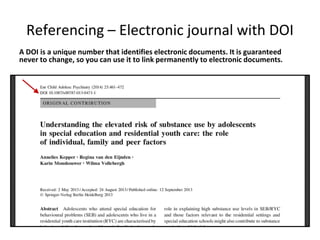
A DOI is a unique number that identifies electronic documents. It is guaranteed
never to change, so you can use it to link permanently to electronic documents.
Referencing – Electronic journal with DOI
Author(s) - Surname & initial Pons-Vignon, N. & Anseeuw, W.
Date – Year of publication 2009.
Title of article – Great expectations: working conditions in South Africa since
the end of apartheid.
Title of journal – italicised & capitalised (except articles & prepositions)
Journal of Southern African Studies.
Journal volume and issue number 35(4):
Page number(s) - for the article 883-899.
DOI - DOI: 10.1080/03057070903313236.
Pons-Vignon, N. & Anseeuw, W. 2009. Great expectations: working conditions
in South Africa since the end of apartheid. Journal of Southern African
Studies. 35(4):883-899. DOI: 10.1080/03057070903313236.
Referencing – Electronic journal with stable URL/permalink
Author(s) - Surname & initial Siebert, W.S.
Date – Year of publication 1987.
Title of article – Black trade unions and the wage gap in South Africa.
Title of journal – italicised & capitalised (except articles & prepositions)
Managerial and Decision Economics.
Journal volume and issue number 8(1):
Page number(s) - for the article 55-65.
Stable URL or permalink - preceded by the word Available: Available:
http://www.jstor.org/stable/2560525
Date retrieved [2015, November 25].
Siebert, W.S. 1987. Black trade unions and the wage gap in South Africa.
Managerial and decision economics. 8(1):55-65. Available:
http://www.jstor.org/stable/2560525 [2015, November 25].
Electronic journal, neither DOI nor stable URL
Author(s) – surname & initial Moll, P.
Date – year of publication 1996.
Title of article Compulsory centralization of collective bargaining in South
Africa.
Title of journal – italicised & capitalised (except articles & prepositions)
American Economic Review.
Journal volume and issue number 86(2):
Page number(s) 326-329.
Database – preceded by the word Available Available: Business Source
Premier
Date retrieved [2013, March 12].
Moll, P. 1996. Compulsory centralization of collective bargaining in South
Africa. American Economic Review. 86(2):326-329. Available: Business
Source Premier [2013, March 12].
Referencing – Print newspaper article
Author(s) - Surname & initial Byforde-Jones, C.
Date – Year of publication 2003.
Title of article Hitches over mixed farming wages.
Title of newspaper – in italics & capitalised (except articles &
prepositions) Natal Witness.
Date – day of publication 2 May:
Page number 11.
Byforde-Jones, C. 2003. Hitches over mixed farming wages. Natal
witness. 2 May:11.
Referencing – Online Newspaper from an electronic database
Author(s) - Surname & initial Paton, C.
Date – Year of publication 2012.
Title of article New farming wage model to be sought.
Title of newspaper – italicised & capitalised (except articles & prepositions)
Business Day.
Date – day of publication 23 November.
Database – preceded by the word Available: Available: LexisNexis
Academic
Date retrieved [2016, February 5].
Paton, C. 2012. New farming wage model to be sought. Business Day.
23 November. Available: LexisNexis Academic [2016, February 5].
Referencing – Online Newspaper article
Author(s) - Surname & initial Maswanganyi, N.
Date – Year of publication 2016.
Title of article SA can avoid a rating downgrade to junk status.
Title of newspaper – italicised & capitalised (except articles & prepositions)
Business Day.
Date – day of publication 9 February.
URL – preceded by the word Available:
Date retrieved [2016, February 11].
Maswanganyi, N. 2016. SA can avoid a rating downgrade to junk
status. Business Day. 9 February. Available:
http://www.bdlive.co.za/economy/2016/02/09/sa-can-avoid-a-rating-
downgrade-to-junk-status [2016, February 5].
Referencing – Online Newspaper (No author)
Title of article Number of foreigners visiting SA rose sharply in
December.
Date – Year of publication 2016.
Title of newspaper – italicised & capitalised (except articles & prepositions)
Business Day.
Date – day of publication 10 February.
URL – preceded by the word Available:
Date retrieved [2016, February 15].
Number of foreigners visiting SA rose sharply in December. 2016.
Business Day. 10 February. Available:
http://www.bdlive.co.za/business/transport/2016/02/10/number-of-
foreigners-visiting-sa-rose-sharply-in-december [2016, February 15].
Referencing - Website (personal authors)
Author(s) - Surname & initial Dreschler, D. & Hallam, D.
Date – Year resource was produced or last updated 2009.
Title of resource - italicised Buying land in developing nations:
challenges and promises.
URL – preceded by the word Available:
Date retrieved - date resource was accessed [2015, March 16].
Dreschler, D. & Hallam, D. 2009. Buying land in developing
nations: challenges and promises. Available:
http://www.voxeu.org/article/buying-land-developing-nations
[2015, March 16].
Referencing - Website (group or corporate author)
Author(s) - Name of organisation Organisation for
Economic Co-operation and Development.
Date – Year resource was produced or last updated 2015.
Title of resource - italicised Health care quality indicators -
primary care.
URL – preceded by the word Available:
Date retrieved - date resource was accessed [2016,
February 9].
Organisation for Economic Co-operation and Development.
2015. Health care quality indicators - primary care.
Available: http://www.oecd.org/els/health-systems/hcqi-
primary-care.htm [2016, February 9].
UCT Author-Date Reference Guide
• More examples of referencing other sources
available in the UCT Author-date: Reference
Guide
• The guide is available from Libraries’ website
Go to: www.lib.uct.ac.za
Hover your mouse on
Research Help
Click on Referencing help
Reference guide
For reference examples - Scroll down
Referencing resources on essay guide
http://libguides.lib.uct.ac.za/c.php?g=454608&p=3105282
maureen.chiware@uct.ac.za

Referencing

  • 1.
  • 2.
    What is referencing? •A standardised way of acknowledging sources of information and ideas that you have used in your assignment • Helps avoid plagiarism (stealing of other's ideas) • Enables readers to follow-up and read more fully the cited author’s arguments • Shows you have done research
  • 3.
    UCT Author-date referencingstyle • Examples given here follow the UCT Author- date: Reference Guide
  • 4.
    Two stages ofreferencing • In-text citation – Put brief details in round brackets () within the body of an essay to indicate every instance that you have borrowed words or ideas • Reference list – Put the full details of all sources used in your work at the end of your paper
  • 5.
    Two ways tocite sources: • Direct quotation – use someone else’s work word for word • Put the words used in “quotation marks” • Use sparingly • Paraphrasing – put someone else’s ideas in your own words
  • 6.
    In-text citation -Details to include If author’s name is not included in the sentence put: (Author’s surname, year of publication:page number) In an analysis of equity and efficiency in public education, it was found that South Africa has elements of both a first world country, and a third world country (Crouch, 1996:134). The study found that “South African society embodies both First World and Third World living standards” (Crouch, 1996:134). NB: List all authors to a maximum of three separated by a comma but the last separated by an ampersand &. If more than 3 authors, list the first author followed by et al.
  • 7.
    In-text citation -Details to include (2) If author’s name is included in the sentence put: (Year of publication:page number) In his analysis of equity and efficiency in public education, Crouch (1996:134) noted that South Africa has elements of both a first world country, and a third world country. Crouch (1996:134) states that “South African society embodies both First World and Third World living standards”.
  • 8.
    In-text citation -Details to include (3) If there is no author, use the first significant words of the title. Usually, three words are enough for in-text citations. Use ellipses for longer titles to indicate the omission of words: (“First significant words of title …”, year of publication:page number) South Africa is hopeful for an increase in economic activity with Nigeria (“SA and Nigeria in deal …”, 2016:3). “SA and Nigeria in deal …” (2016:3) noted that “SA is optimistic about further growth of economic ties between the two countries”.
  • 9.
    Reference list • Fulldetails of all the sources mentioned in your work have to be listed at the end of the paper. • Details included in a reference are dependent on the source type i.e. book, article, website etc.
  • 10.
    Basic structure ofUCT Author-date reference includes: • Author(s) of resource – Surname & initial • Date of publication – Year of publication • Title of resource • Publication details – Place and name of publisher for books or volume, issue and page numbers for journals and URL for an Internet resource
  • 11.
    Referencing - Book Author(s)– surname & initial Glimcher, P. W. Date – year of publication 2011. Title – italicised Foundations of neuroeconomic analysis. Place of publication – town of publication New York: Publisher – name of publisher Oxford University Press. Glimcher, P. W. 2011. Foundations of neuroeconomic analysis. New York: Oxford University Press. Note: The names of all authors should appear in the reference list to a maximum of eight. Add et al. after the eighth name when there are more than eight authors.
  • 12.
    Referencing – Chapterin a book Author(s) of chapter – surname & initial Johansson, A.C. Date – year of publication 2012. Title of chapter Financial repression and China’s economic imbalances. Title of book – italicised & preceded by the word In In Rebalancing and sustaining growth in China. Editor(s) of book – initial & surname followed by Ed(s). H. McKay & L. Song, Eds. Place of publication – town of publication Canberra: Publisher – name of publisher ANU E Press. Page numbers - for the chapter 45-64. Johansson, A.C. 2012. Financial repression and China’s economic imbalances. In Rebalancing and sustaining growth in China. H. McKay & L. Song, Eds. Canberra: ANU E Press. 45-64.
  • 13.
    Referencing – Printjournal article Author(s) – surname & initial Fuchs, V.R. Date – year of publication 2000. Title of article The future of health economics. Title of journal – italicised & capitalised (except articles & prepositions) Journal of Health Economics. Journal volume and issue number 19(2): Page number or the beginning and end pages if it covers more than one page 141-157. Fuchs, V. R. 2000. The future of health economics. Journal of Health Economics. 19(2):141-157.
  • 14.
    Referencing – Electronicjournal with DOI A DOI is a unique number that identifies electronic documents. It is guaranteed never to change, so you can use it to link permanently to electronic documents.
  • 15.
    Referencing – Electronicjournal with DOI Author(s) - Surname & initial Pons-Vignon, N. & Anseeuw, W. Date – Year of publication 2009. Title of article – Great expectations: working conditions in South Africa since the end of apartheid. Title of journal – italicised & capitalised (except articles & prepositions) Journal of Southern African Studies. Journal volume and issue number 35(4): Page number(s) - for the article 883-899. DOI - DOI: 10.1080/03057070903313236. Pons-Vignon, N. & Anseeuw, W. 2009. Great expectations: working conditions in South Africa since the end of apartheid. Journal of Southern African Studies. 35(4):883-899. DOI: 10.1080/03057070903313236.
  • 16.
    Referencing – Electronicjournal with stable URL/permalink
  • 17.
    Referencing – Electronicjournal with stable URL/permalink
  • 18.
    Referencing – Electronicjournal with stable URL/permalink
  • 19.
    Referencing – Electronicjournal with stable URL/permalink Author(s) - Surname & initial Siebert, W.S. Date – Year of publication 1987. Title of article – Black trade unions and the wage gap in South Africa. Title of journal – italicised & capitalised (except articles & prepositions) Managerial and Decision Economics. Journal volume and issue number 8(1): Page number(s) - for the article 55-65. Stable URL or permalink - preceded by the word Available: Available: http://www.jstor.org/stable/2560525 Date retrieved [2015, November 25]. Siebert, W.S. 1987. Black trade unions and the wage gap in South Africa. Managerial and decision economics. 8(1):55-65. Available: http://www.jstor.org/stable/2560525 [2015, November 25].
  • 20.
    Electronic journal, neitherDOI nor stable URL Author(s) – surname & initial Moll, P. Date – year of publication 1996. Title of article Compulsory centralization of collective bargaining in South Africa. Title of journal – italicised & capitalised (except articles & prepositions) American Economic Review. Journal volume and issue number 86(2): Page number(s) 326-329. Database – preceded by the word Available Available: Business Source Premier Date retrieved [2013, March 12]. Moll, P. 1996. Compulsory centralization of collective bargaining in South Africa. American Economic Review. 86(2):326-329. Available: Business Source Premier [2013, March 12].
  • 21.
    Referencing – Printnewspaper article Author(s) - Surname & initial Byforde-Jones, C. Date – Year of publication 2003. Title of article Hitches over mixed farming wages. Title of newspaper – in italics & capitalised (except articles & prepositions) Natal Witness. Date – day of publication 2 May: Page number 11. Byforde-Jones, C. 2003. Hitches over mixed farming wages. Natal witness. 2 May:11.
  • 22.
    Referencing – OnlineNewspaper from an electronic database Author(s) - Surname & initial Paton, C. Date – Year of publication 2012. Title of article New farming wage model to be sought. Title of newspaper – italicised & capitalised (except articles & prepositions) Business Day. Date – day of publication 23 November. Database – preceded by the word Available: Available: LexisNexis Academic Date retrieved [2016, February 5]. Paton, C. 2012. New farming wage model to be sought. Business Day. 23 November. Available: LexisNexis Academic [2016, February 5].
  • 23.
    Referencing – OnlineNewspaper article Author(s) - Surname & initial Maswanganyi, N. Date – Year of publication 2016. Title of article SA can avoid a rating downgrade to junk status. Title of newspaper – italicised & capitalised (except articles & prepositions) Business Day. Date – day of publication 9 February. URL – preceded by the word Available: Date retrieved [2016, February 11]. Maswanganyi, N. 2016. SA can avoid a rating downgrade to junk status. Business Day. 9 February. Available: http://www.bdlive.co.za/economy/2016/02/09/sa-can-avoid-a-rating- downgrade-to-junk-status [2016, February 5].
  • 24.
    Referencing – OnlineNewspaper (No author) Title of article Number of foreigners visiting SA rose sharply in December. Date – Year of publication 2016. Title of newspaper – italicised & capitalised (except articles & prepositions) Business Day. Date – day of publication 10 February. URL – preceded by the word Available: Date retrieved [2016, February 15]. Number of foreigners visiting SA rose sharply in December. 2016. Business Day. 10 February. Available: http://www.bdlive.co.za/business/transport/2016/02/10/number-of- foreigners-visiting-sa-rose-sharply-in-december [2016, February 15].
  • 25.
    Referencing - Website(personal authors) Author(s) - Surname & initial Dreschler, D. & Hallam, D. Date – Year resource was produced or last updated 2009. Title of resource - italicised Buying land in developing nations: challenges and promises. URL – preceded by the word Available: Date retrieved - date resource was accessed [2015, March 16]. Dreschler, D. & Hallam, D. 2009. Buying land in developing nations: challenges and promises. Available: http://www.voxeu.org/article/buying-land-developing-nations [2015, March 16].
  • 26.
    Referencing - Website(group or corporate author) Author(s) - Name of organisation Organisation for Economic Co-operation and Development. Date – Year resource was produced or last updated 2015. Title of resource - italicised Health care quality indicators - primary care. URL – preceded by the word Available: Date retrieved - date resource was accessed [2016, February 9]. Organisation for Economic Co-operation and Development. 2015. Health care quality indicators - primary care. Available: http://www.oecd.org/els/health-systems/hcqi- primary-care.htm [2016, February 9].
  • 27.
    UCT Author-Date ReferenceGuide • More examples of referencing other sources available in the UCT Author-date: Reference Guide • The guide is available from Libraries’ website
  • 28.
    Go to: www.lib.uct.ac.za Hoveryour mouse on Research Help
  • 29.
  • 31.
  • 32.
  • 33.
    Referencing resources onessay guide http://libguides.lib.uct.ac.za/c.php?g=454608&p=3105282
  • 34.