Library Training
Economics 214
1 5 F E B R U A RY 2 0 1 9
PeplerHead
FacultyLibrarian:EconomicandManagementSciences
peplerh@sun.ac.za
In this session we’ll be looking at
Distinguishing between sources
Distinguishing between trustworthy & untrustworthy
information/data
Plagiarism
Databases
2
3
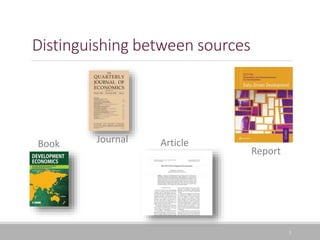
Distinguishing between sources
Book Journal Article
Report
4
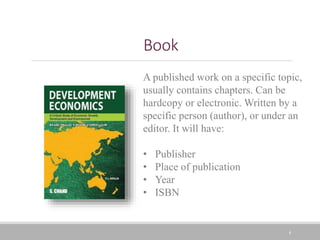
Book
A published work on a specific topic,
usually contains chapters. Can be
hardcopy or electronic. Written by a
specific person (author), or under an
editor. It will have:
• Publisher
• Place of publication
• Year
• ISBN
5
Book - Example
Search the library Catalogue for book on
Development Economics
6
Book Chapter
Be careful of chapter in books that you
find electronically
Example:
Reflexivity and Development Economics
https://link.springer.com/chapter/10.1057/9780230250598_
4
7
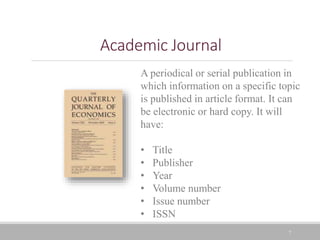
Academic Journal
A periodical or serial publication in
which information on a specific topic
is published in article format. It can
be electronic or hard copy. It will
have:
• Title
• Publisher
• Year
• Volume number
• Issue number
• ISSN
8
Journal - Example
Search the African Finance Journal
9
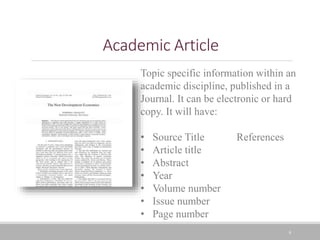
Academic Article
Topic specific information within an
academic discipline, published in a
Journal. It can be electronic or hard
copy. It will have:
• Source Title References
• Article title
• Abstract
• Year
• Volume number
• Issue number
• Page number
10
Article - Example
Cashel-Cordo, P. and Craig, S.G., 1990. The public
sector impact of international resource
transfers. Journal of Development Economics, 32(1),
pp.17-42.
11
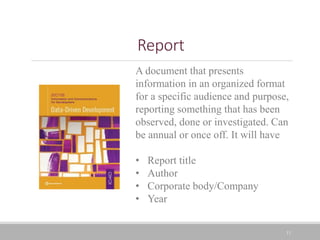
Report
A document that presents
information in an organized format
for a specific audience and purpose,
reporting something that has been
observed, done or investigated. Can
be annual or once off. It will have
• Report title
• Author
• Corporate body/Company
• Year
12
Report - Example
World Health Statistics 2018:
Monitoring Health For the SDG’s
13
Databases – what is it?
A database is an electronic index to journal or
magazine articles, containing citations, abstracts
and often either the full text of the articles, or links
to the full text.
It allows you to search for information using:
Keywords
Titles
Authors
Subjects
14
Evaluating information
Reliability:
From a reputable source/institution- publisher, University, Research Unit,
Company
Authority:
Creator is an expert in their field, and affiliated with a reputable institution
Validity :
The research was conducted in a manner that is commonly accepted in the
field, and is evident in the article
Accuracy:
The information can be verified
15
Reliable websites
Any Website ending in:
.org; .gov; .edu; .ac
Official News sites like :
Moneyweb Business Day;
SA Statistics ; FNB; ABSA; Investec; SA Reserve
Bank; Finforum; Bankmonitor ; Eskom ,
Nationmaster….
16
Evaluating Data
Consider:
Where was the data published?
Who funded the data?
Are authors identified? Affiliations? Credentials?
17
Evaluating Data
Is it original?
Always make sure that you are working with the primary
data
Is it Comprehensive?
Does it tell the full story? If you have unanswered questions,
so will your audience.
Is it Reliable?
Make sure that the source you chose is verified. Strong
sources include data collected by Governmental
Departments, Organizations, Academic Institutions, Official
Bodies
Good news
Using Academic Databases provided by the library will
assist you in finding relevant, credible information for your
assignments. Examples:
Google Scholar
EBSCO Host
ABI/Inform Colletion
New Palgrave Dictionary of Economics
18
Plagiarism
Plagiarism is the theft and use of the ideas, material and
other intellectual property of others that are passed off as
one’s own
This can take multiple forms
19
OBVIOUS FORMS:
Buying / borrowing a paper and
copying it
Hiring somebody to write for you
Cutting and pasting text
Direct translations
Citing sources you didn’t use
LESS OBVIOUS FORMS:
Not giving proper credit
Not referencing images, etc.
Improper paraphrasing
Failing to give a proper reference
Not acknowledging outsourcing (eg.
Data)
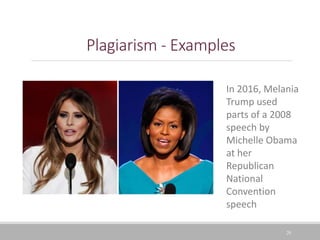
Plagiarism - Examples
20
In 2016, Melania
Trump used
parts of a 2008
speech by
Michelle Obama
at her
Republican
National
Convention
speech
Plagiarism - Examples
21
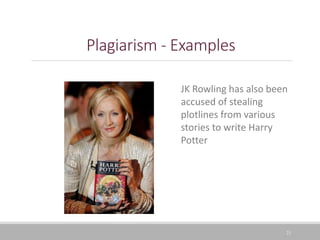
JK Rowling has also been
accused of stealing
plotlines from various
stories to write Harry
Potter
Spot the plagiarism
22
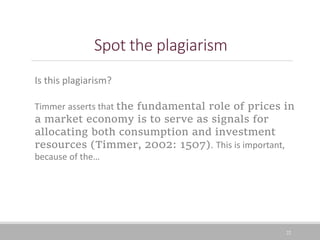
Is this plagiarism?
Timmer asserts that the fundamental role of prices in
a market economy is to serve as signals for
allocating both consumption and investment
resources (Timmer, 2002: 1507). This is important,
because of the…
Spot the plagiarism
23
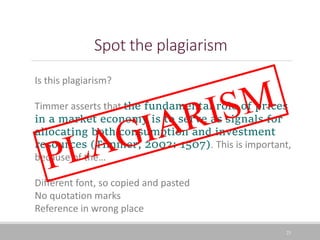
Is this plagiarism?
Timmer asserts that the fundamental role of prices
in a market economy is to serve as signals for
allocating both consumption and investment
resources (Timmer, 2002: 1507). This is important,
because of the…
Different font, so copied and pasted
No quotation marks
Reference in wrong place
Spot the plagiarism
24
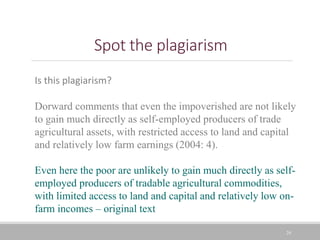
Is this plagiarism?
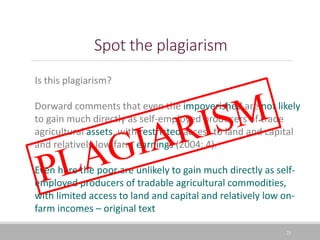
Dorward comments that even the impoverished are not likely
to gain much directly as self-employed producers of trade
agricultural assets, with restricted access to land and capital
and relatively low farm earnings (2004: 4).
Even here the poor are unlikely to gain much directly as self-
employed producers of tradable agricultural commodities,
with limited access to land and capital and relatively low on-
farm incomes – original text
Spot the plagiarism
25
Is this plagiarism?
Dorward comments that even the impoverished are not likely
to gain much directly as self-employed producers of trade
agricultural assets, with restricted access to land and capital
and relatively low farm earnings (2004: 4).
Even here the poor are unlikely to gain much directly as self-
employed producers of tradable agricultural commodities,
with limited access to land and capital and relatively low on-
farm incomes – original text
Spot the plagiarism
26
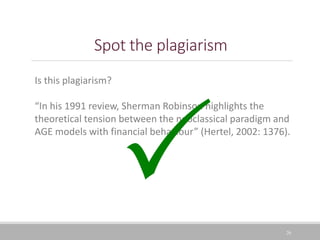
Is this plagiarism?
“In his 1991 review, Sherman Robinson highlights the
theoretical tension between the neoclassical paradigm and
AGE models with financial behaviour” (Hertel, 2002: 1376).
Referencing
27
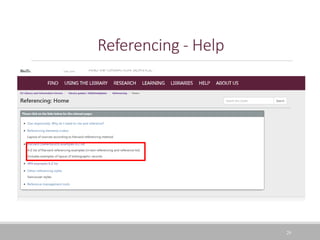
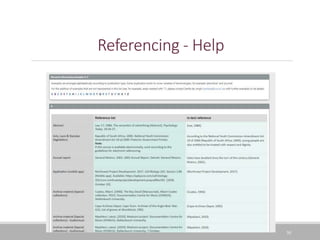
Know the Referencing Style that you are using
Make sure what you are referencing, different material types
are displayed differently in the bibliography
Makes sure that your in-text citations match your bibliography
Most important, be CONSISTENT
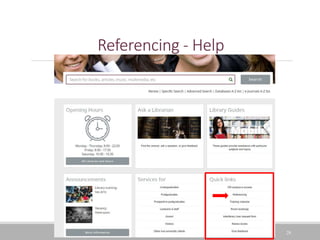
Referencing - Help
28
Referencing - Help
29
Referencing - Help
30
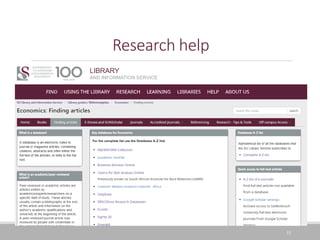
Research help
31
Research help
32
Research help
33
Thank you
34
Email: peplerh@sun.ac.za
Library Guide:
http://libguides.sun.ac.za/Economics
http://libguides.sun.ac.za/StepbyStep

Economics 214 Library Training

  • 1.
    Library Training Economics 214 15 F E B R U A RY 2 0 1 9 PeplerHead FacultyLibrarian:EconomicandManagementSciences peplerh@sun.ac.za
  • 2.
    In this sessionwe’ll be looking at Distinguishing between sources Distinguishing between trustworthy & untrustworthy information/data Plagiarism Databases 2
  • 3.
  • 4.
    4 Book A published workon a specific topic, usually contains chapters. Can be hardcopy or electronic. Written by a specific person (author), or under an editor. It will have: • Publisher • Place of publication • Year • ISBN
  • 5.
    5 Book - Example Searchthe library Catalogue for book on Development Economics
  • 6.
    6 Book Chapter Be carefulof chapter in books that you find electronically Example: Reflexivity and Development Economics https://link.springer.com/chapter/10.1057/9780230250598_ 4
  • 7.
    7 Academic Journal A periodicalor serial publication in which information on a specific topic is published in article format. It can be electronic or hard copy. It will have: • Title • Publisher • Year • Volume number • Issue number • ISSN
  • 8.
    8 Journal - Example Searchthe African Finance Journal
  • 9.
    9 Academic Article Topic specificinformation within an academic discipline, published in a Journal. It can be electronic or hard copy. It will have: • Source Title References • Article title • Abstract • Year • Volume number • Issue number • Page number
  • 10.
    10 Article - Example Cashel-Cordo,P. and Craig, S.G., 1990. The public sector impact of international resource transfers. Journal of Development Economics, 32(1), pp.17-42.
  • 11.
    11 Report A document thatpresents information in an organized format for a specific audience and purpose, reporting something that has been observed, done or investigated. Can be annual or once off. It will have • Report title • Author • Corporate body/Company • Year
  • 12.
    12 Report - Example WorldHealth Statistics 2018: Monitoring Health For the SDG’s
  • 13.
    13 Databases – whatis it? A database is an electronic index to journal or magazine articles, containing citations, abstracts and often either the full text of the articles, or links to the full text. It allows you to search for information using: Keywords Titles Authors Subjects
  • 14.
    14 Evaluating information Reliability: From areputable source/institution- publisher, University, Research Unit, Company Authority: Creator is an expert in their field, and affiliated with a reputable institution Validity : The research was conducted in a manner that is commonly accepted in the field, and is evident in the article Accuracy: The information can be verified
  • 15.
    15 Reliable websites Any Websiteending in: .org; .gov; .edu; .ac Official News sites like : Moneyweb Business Day; SA Statistics ; FNB; ABSA; Investec; SA Reserve Bank; Finforum; Bankmonitor ; Eskom , Nationmaster….
  • 16.
    16 Evaluating Data Consider: Where wasthe data published? Who funded the data? Are authors identified? Affiliations? Credentials?
  • 17.
    17 Evaluating Data Is itoriginal? Always make sure that you are working with the primary data Is it Comprehensive? Does it tell the full story? If you have unanswered questions, so will your audience. Is it Reliable? Make sure that the source you chose is verified. Strong sources include data collected by Governmental Departments, Organizations, Academic Institutions, Official Bodies
  • 18.
    Good news Using AcademicDatabases provided by the library will assist you in finding relevant, credible information for your assignments. Examples: Google Scholar EBSCO Host ABI/Inform Colletion New Palgrave Dictionary of Economics 18
  • 19.
    Plagiarism Plagiarism is thetheft and use of the ideas, material and other intellectual property of others that are passed off as one’s own This can take multiple forms 19 OBVIOUS FORMS: Buying / borrowing a paper and copying it Hiring somebody to write for you Cutting and pasting text Direct translations Citing sources you didn’t use LESS OBVIOUS FORMS: Not giving proper credit Not referencing images, etc. Improper paraphrasing Failing to give a proper reference Not acknowledging outsourcing (eg. Data)
  • 20.
    Plagiarism - Examples 20 In2016, Melania Trump used parts of a 2008 speech by Michelle Obama at her Republican National Convention speech
  • 21.
    Plagiarism - Examples 21 JKRowling has also been accused of stealing plotlines from various stories to write Harry Potter
  • 22.
    Spot the plagiarism 22 Isthis plagiarism? Timmer asserts that the fundamental role of prices in a market economy is to serve as signals for allocating both consumption and investment resources (Timmer, 2002: 1507). This is important, because of the…
  • 23.
    Spot the plagiarism 23 Isthis plagiarism? Timmer asserts that the fundamental role of prices in a market economy is to serve as signals for allocating both consumption and investment resources (Timmer, 2002: 1507). This is important, because of the… Different font, so copied and pasted No quotation marks Reference in wrong place
  • 24.
    Spot the plagiarism 24 Isthis plagiarism? Dorward comments that even the impoverished are not likely to gain much directly as self-employed producers of trade agricultural assets, with restricted access to land and capital and relatively low farm earnings (2004: 4). Even here the poor are unlikely to gain much directly as self- employed producers of tradable agricultural commodities, with limited access to land and capital and relatively low on- farm incomes – original text
  • 25.
    Spot the plagiarism 25 Isthis plagiarism? Dorward comments that even the impoverished are not likely to gain much directly as self-employed producers of trade agricultural assets, with restricted access to land and capital and relatively low farm earnings (2004: 4). Even here the poor are unlikely to gain much directly as self- employed producers of tradable agricultural commodities, with limited access to land and capital and relatively low on- farm incomes – original text
  • 26.
    Spot the plagiarism 26 Isthis plagiarism? “In his 1991 review, Sherman Robinson highlights the theoretical tension between the neoclassical paradigm and AGE models with financial behaviour” (Hertel, 2002: 1376).
  • 27.
    Referencing 27 Know the ReferencingStyle that you are using Make sure what you are referencing, different material types are displayed differently in the bibliography Makes sure that your in-text citations match your bibliography Most important, be CONSISTENT
  • 28.
  • 29.
  • 30.
  • 31.
  • 32.
  • 33.
  • 34.
    Thank you 34 Email: peplerh@sun.ac.za LibraryGuide: http://libguides.sun.ac.za/Economics http://libguides.sun.ac.za/StepbyStep

Editor's Notes

  • #19 Credibility is a combination of Reliability, Authority, Validity and Accuracy
  • #20 Credibility is a combination of Reliability, Authority, Validity and Accuracy
  • #21 Credibility is a combination of Reliability, Authority, Validity and Accuracy
  • #22 Credibility is a combination of Reliability, Authority, Validity and Accuracy
  • #23 Credibility is a combination of Reliability, Authority, Validity and Accuracy
  • #24 Credibility is a combination of Reliability, Authority, Validity and Accuracy
  • #25 Credibility is a combination of Reliability, Authority, Validity and Accuracy
  • #26 Credibility is a combination of Reliability, Authority, Validity and Accuracy
  • #27 Credibility is a combination of Reliability, Authority, Validity and Accuracy
  • #28 Credibility is a combination of Reliability, Authority, Validity and Accuracy
  • #29 Credibility is a combination of Reliability, Authority, Validity and Accuracy
  • #30 Credibility is a combination of Reliability, Authority, Validity and Accuracy
  • #31 Credibility is a combination of Reliability, Authority, Validity and Accuracy
  • #32 Credibility is a combination of Reliability, Authority, Validity and Accuracy
  • #33 Credibility is a combination of Reliability, Authority, Validity and Accuracy
  • #34 Credibility is a combination of Reliability, Authority, Validity and Accuracy