LUCIA PRATAMA
1210733003
Reference words are :
• Involves using certain words or
phrases to replace other words or
phrases such as pronouns and
nouns.
Reference words are used to:
• refer back to people, objects and ideas that
have been mentioned earlier, or
• refer forward to people, objects and ideas
that will be mentioned later.
These words allow the writer to avoid
repeating words, paragraphs, and
sometimes whole sentences.
Reference words include:
• it/they/them
• this/that
• these/those
• the former/the latter/respectively
• who/which/that
• one/ones
• such
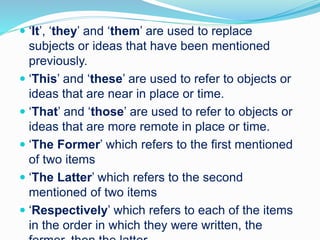
 ‘It’, ‘they’ and ‘them’ are used to replace
subjects or ideas that have been mentioned
previously.
 ‘This’ and ‘these’ are used to refer to objects or
ideas that are near in place or time.
 ‘That’ and ‘those’ are used to refer to objects or
ideas that are more remote in place or time.
 ‘The Former’ which refers to the first mentioned
of two items
 ‘The Latter’ which refers to the second
mentioned of two items
 ‘Respectively’ which refers to each of the items
in the order in which they were written, the
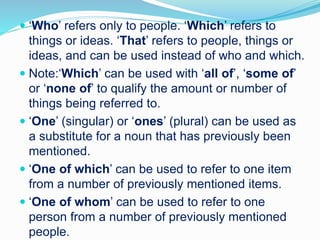
 ‘Who’ refers only to people. ‘Which’ refers to
things or ideas. ‘That’ refers to people, things or
ideas, and can be used instead of who and which.
 Note:‘Which’ can be used with ‘all of’, ‘some of’
or ‘none of’ to qualify the amount or number of
things being referred to.
 ‘One’ (singular) or ‘ones’ (plural) can be used as
a substitute for a noun that has previously been
mentioned.
 ‘One of which’ can be used to refer to one item
from a number of previously mentioned items.
 ‘One of whom’ can be used to refer to one
person from a number of previously mentioned
people.
Reference & Subtitutions
 Reference is a relation between the
meaning of a word and its environment,
where the environment can be the text or
the real world.
 Substitution is a relation between words
such ad as one replaces another word or
phrase. This means that there is no such
thing as ‘situation substitution’ or to put
more concretely.
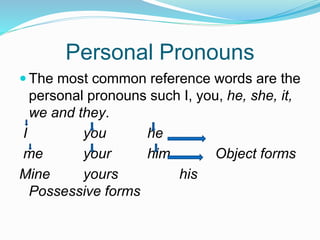
Personal Pronouns
 The most common reference words are the
personal pronouns such I, you, he, she, it,
we and they.
I you he
me your him Object forms
Mine yours his
Possessive forms
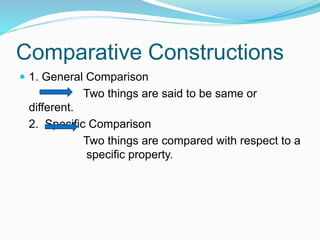
Comparative Constructions
 1. General Comparison
Two things are said to be same or
different.
2. Specific Comparison
Two things are compared with respect to a
specific property.
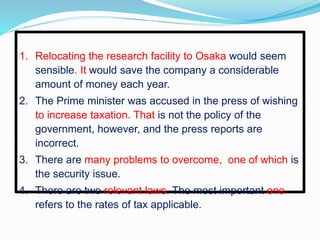
1. Relocating the research facility to Osaka would seem
sensible. It would save the company a considerable
amount of money each year.
2. The Prime minister was accused in the press of wishing
to increase taxation. That is not the policy of the
government, however, and the press reports are
incorrect.
3. There are many problems to overcome, one of which is
the security issue.
4. There are two relevant laws. The most important one
refers to the rates of tax applicable.

Reference words

  • 1.
  • 2.
    Reference words are: • Involves using certain words or phrases to replace other words or phrases such as pronouns and nouns.
  • 3.
    Reference words areused to: • refer back to people, objects and ideas that have been mentioned earlier, or • refer forward to people, objects and ideas that will be mentioned later. These words allow the writer to avoid repeating words, paragraphs, and sometimes whole sentences.
  • 4.
    Reference words include: •it/they/them • this/that • these/those • the former/the latter/respectively • who/which/that • one/ones • such
  • 5.
     ‘It’, ‘they’and ‘them’ are used to replace subjects or ideas that have been mentioned previously.  ‘This’ and ‘these’ are used to refer to objects or ideas that are near in place or time.  ‘That’ and ‘those’ are used to refer to objects or ideas that are more remote in place or time.  ‘The Former’ which refers to the first mentioned of two items  ‘The Latter’ which refers to the second mentioned of two items  ‘Respectively’ which refers to each of the items in the order in which they were written, the
  • 6.
     ‘Who’ refersonly to people. ‘Which’ refers to things or ideas. ‘That’ refers to people, things or ideas, and can be used instead of who and which.  Note:‘Which’ can be used with ‘all of’, ‘some of’ or ‘none of’ to qualify the amount or number of things being referred to.  ‘One’ (singular) or ‘ones’ (plural) can be used as a substitute for a noun that has previously been mentioned.  ‘One of which’ can be used to refer to one item from a number of previously mentioned items.  ‘One of whom’ can be used to refer to one person from a number of previously mentioned people.
  • 7.
    Reference & Subtitutions Reference is a relation between the meaning of a word and its environment, where the environment can be the text or the real world.  Substitution is a relation between words such ad as one replaces another word or phrase. This means that there is no such thing as ‘situation substitution’ or to put more concretely.
  • 8.
    Personal Pronouns  Themost common reference words are the personal pronouns such I, you, he, she, it, we and they. I you he me your him Object forms Mine yours his Possessive forms
  • 9.
    Comparative Constructions  1.General Comparison Two things are said to be same or different. 2. Specific Comparison Two things are compared with respect to a specific property.
  • 10.
    1. Relocating theresearch facility to Osaka would seem sensible. It would save the company a considerable amount of money each year. 2. The Prime minister was accused in the press of wishing to increase taxation. That is not the policy of the government, however, and the press reports are incorrect. 3. There are many problems to overcome, one of which is the security issue. 4. There are two relevant laws. The most important one refers to the rates of tax applicable.