
18/12/2012           It’s not just web, it’s your business


 REFERENCE DATA: E-CRM in Belgium today
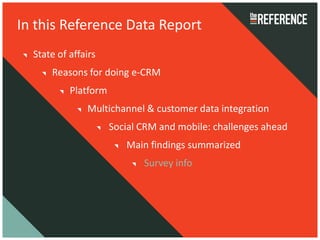
In this Reference Data Report
  State of affairs
      Reasons for doing e-CRM
           Platform
               Multichannel & customer data integration
                      Social CRM and mobile: challenges ahead
                         Main findings summarized
                             Survey info
In this Reference Data Report
  State of affairs
Adoption and awareness
                                                           Still a long way to go…
   ‘e-CRM in my organization is:’               ‘If you have implemented or are implementing an e-CRM
                                                              project, would you consider it:’


                                          35%
                       24%                30%
       41%                                25%
                                          20%                                                     33%
                      35%                                       34%
                                          15%
                                          10%                              19%
                                                    13%
                                           5%                                          1%
                                           0%
             No intention
             Planned or started                  A success Reasonably Struggling No success Too early to
             Up and running                                successfull for success              say


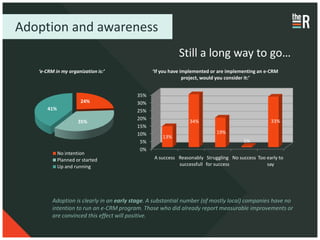
         Adoption is clearly in an early stage. A substantial number (of mostly local) companies have no
         intention to run an e-CRM program. Those who did already report measurable improvements or
         are convinced this effect will positive.
Adoption and awareness
                                                                                    Strategic approach
     ‘If you have implemented or are                               'Our top management views e-CRM as:'
          implementing an e-CRM                60%                         49%
    project, the critical success factors      50%
   during implementation and running           40%
                                               30%      21%
25%                 are:’                      20%                                            13%                   17%
                                               10%                                                                                   1%
        23%       23%                           0%
20%
                                                       Critical       A strategic           An IT tool         Useful, but not     Other
                                                                       enabler                                     critical
15%
                           15%
                                                        'Ownership of e-CRM within our organization lies with:'
10%                                                    47%
                                     10%       50%
                                               40%
 5%                                                                  24%
                                               30%
                                               20%                                  11%                  10%
 0%                                            10%                                                                        4%          4%
                                                0%
                                                     Marketing     Corporate        Sales                IT          Customer    Other (please
                                                                     (top                                             Service      specify)
                                                                  management)

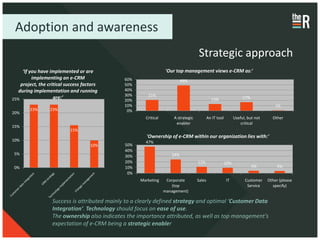
                   Success is attributed mainly to a clearly defined strategy and optimal ‘Customer Data
                   Integration’. Technology should focus on ease of use.
                   The ownership also indicates the importance attributed, as well as top management’s
                   expectation of e-CRM being a strategic enabler
In this Reference Data Report
  State of affairs
      Reasons for doing e-CRM
Reasons for doing e-CRM
                                                                          Adding to the bottom line
                    Revenue generation                                                               Cost reduction
50%                                        42%                            50%                                         42%
40%                                                                       40%                               34%
30%                                                     26%
                                                                          30%
20%                 13%        13%                                        20%                   14%
         7%                                                                        8%
10%                                                                       10%                                                  3%
 0%                                                                        0%
         not      somewhat neutral/not   very           prime                      not       somewhat neutral/not   very       prime
      important   important relevant   important       reason                   important    important relevant   important   reason


                                                 Increasing customer acquisition rates
                                     70%                                        60%
                                     60%
                                     50%
                                     40%
                                     30%                            18%
                                     20%                                                     12%
                                              3%           6%
                                     10%
                                      0%
                                              not      somewhat neutral/not   very           prime
                                           important   important relevant   important       reason

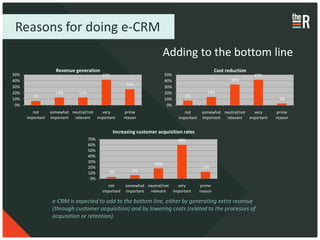
                   e-CRM is expected to add to the bottom line, either by generating extra revenue
                   (through customer acquisition) and by lowering costs (related to the processes of
                   acquisition or retention).
Reasons for doing e-CRM
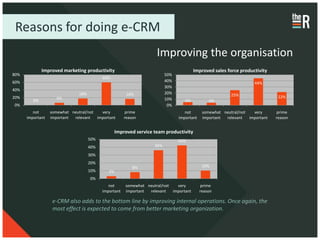
                                                                     Improving the organisation
              Improved marketing productivity                                           Improved sales force productivity
80%                                                                       50%
                                           60%
60%                                                                       40%
                                                                                                                     44%
                                                                          30%
40%
                               18%                      16%               20%                             25%
20%                  6%                                                   10%                                                  22%
         0%                                                                        5%           4%
0%                                                                         0%
         not      somewhat neutral/not   very           prime                      not       somewhat neutral/not   very       prime
      important   important relevant   important       reason                   important    important relevant   important   reason


                                                   Improved service team productivity
                                     50%                                        42%
                                     40%                            36%

                                     30%
                                     20%
                                                           8%                                10%
                                     10%      3%
                                     0%
                                              not      somewhat neutral/not   very           prime
                                           important   important relevant   important       reason

                   e-CRM also adds to the bottom line by improving internal operations. Once again, the
                   most effect is expected to come from better marketing organization.
In this Reference Data Report
  State of affairs
      Reasons for doing e-CRM
           Platforms
Platforms
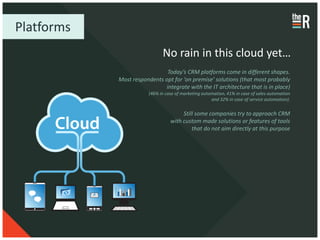
                              No rain in this cloud yet…
                              Today’s CRM platforms come in different shapes.
            Most respondents opt for ‘on premise’ solutions (that most probably
                             integrate with the IT architecture that is in place)
                        (46% in case of marketing automation, 41% in case of sales automation
                                                      and 32% in case of service automation).

                                       Still some companies try to approach CRM
                                  with custom made solutions or features of tools
                                           that do not aim directly at this purpose
In this Reference Data Report
  State of affairs
      Reasons for doing e-CRM
           Platforms
               Multichannel & customer data integration
Multichannel integration
                                                                   We wish we could do more
      'My organization has written down a             ‘Customer data that are generated by different systems and in different
            multichannel strategy:'                                               channels are:’
60%                                           60%
               51%               49%                                           50%
50%                                           50%

40%                                           40%

30%                                           30%
                                                                                                                             21%
20%                                           20%                                                    17%
                                                          12%
10%                                           10%

0%                                             0%
               Yes                No                  Not integrated    Somewhat integrated   Integrated to a high Wholly integrated (e.g.
                                                                                                    degree         in a Data Warehouse)


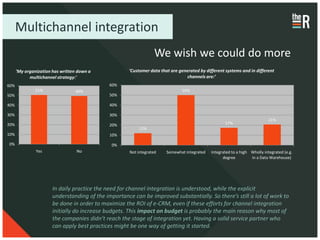
                       In daily practice the need for channel integration is understood, while the explicit
                       understanding of the importance can be improved substantially. So there’s still a lot of work to
                       be done in order to maximize the ROI of e-CRM, even if these efforts for channel integration
                       initially do increase budgets. This impact on budget is probably the main reason why most of
                       the companies didn’t reach the stage of integration yet. Having a solid service partner who
                       can apply best practices might be one way of getting it started.
Customer data integration
           'Channels are integrated so that an
            individual customer or prospect is
                                                            Towards a single view?
          recognized regardless of the channel
                          used:'
                                                                                 Customer retention
    45%                                                               50%
    40%                                                               40%
                                                                      30%      41%
                             40%                                                            33%
    35%                                                               20%
               35%                                                                                      26%
    30%                                                               10%
                                                                       0%
    25%                                                                         Yes      Somewhat       No
                                          25%
    20%
                                                                                 Customer acquisition
    15%                                                               50%
                                                                      40%      47%
    10%                                                                                     29%
                                                                      30%                               24%
     5%                                                               20%
                                                                      10%
     0%
                                                                       0%
                Yes       Somewhat        No
                                                                                Yes      Somewhat       No


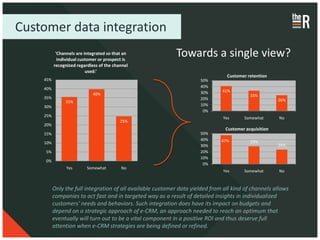
          Only the full integration of all available customer data yielded from all kind of channels allows
          companies to act fast and in targeted way as a result of detailed insights in individualized
          customers’ needs and behaviors. Such integration does have its impact on budgets and
          depend on a strategic approach of e-CRM, an approach needed to reach an optimum that
          eventually will turn out to be a vital component in a positive ROI and thus deserve full
          attention when e-CRM strategies are being defined or refined.
Channel and customer data integration
                                                                Data turned into action
                 'We perform or are planning to perform advanced analytics, visualization and
                                        reporting on our customer data
                      (e.g.: customer analysis & modeling, market segmentation, affinity
                        grouping, churn analysis, customer Lifetime Value analysis, ...)'
        35%
                                                          29%
        30%
                                                                                                 26%
        25%
                                     21%                                       20%
        20%
        15%
        10%
                   4%
         5%
         0%
                  Never       Not yet, but we are Occasionally, ad hoc   Regularly, ad hoc   Systematically
                                planning this


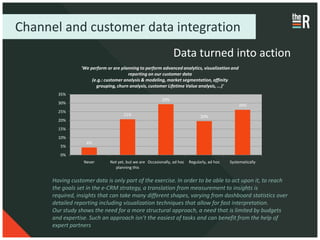
      Having customer data is only part of the exercise. In order to be able to act upon it, to reach
      the goals set in the e-CRM strategy, a translation from measurement to insights is
      required, insights that can take many different shapes, varying from dashboard statistics over
      detailed reporting including visualization techniques that allow for fast interpretation.
      Our study shows the need for a more structural approach, a need that is limited by budgets
      and expertise. Such an approach isn’t the easiest of tasks and can benefit from the help of
      expert partners
In this Reference Data Report
  State of affairs
      Reasons for doing e-CRM
           Platform
               Multichannel & customer data integration
                      Social CRM and mobile: challenges ahead
Social CRM and mobile customers
                                                                         Emerging tools
               ‘Which channels are used for customer communications by your company?’
       20%    18%     17%
       18%
       16%
       14%
                              11%     11%     11%     11%
       12%
                                                               9%
       10%
        8%
        6%                                                             5%
                                                                               4%
        4%                                                                              3%
        2%
        0%


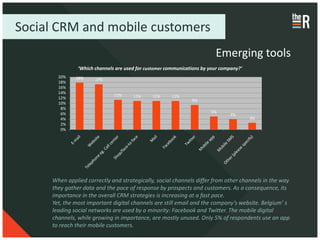
     When applied correctly and strategically, social channels differ from other channels in the way
     they gather data and the pace of response by prospects and customers. As a consequence, its
     importance in the overall CRM strategies is increasing at a fast pace.
     Yet, the most important digital channels are still email and the company’s website. Belgium’ s
     leading social networks are used by a minority: Facebook and Twitter. The mobile digital
     channels, while growing in importance, are mostly unused. Only 5% of respondents use an app
     to reach their mobile customers.
Social CRM and mobile customers

        ‘Looking ahead over the next 12
                                                                                                    The near future
      months, how big a role do you see
      'Social' forming part of your e-CRM               ‘Why do you think your e-CRM strategy will not be (completely)
                   strategy?’                                                    integrated?’
80%                                             60%
                         70%
70%                                                                                 50%
                                                50%
60%
50%                                             40%

40%                                             30%                                                         25%
30%
           18%                                  20%
20%                                   12%                     13%                                                                  13%
10%                                             10%

0%                                              0%
       Completely     Somewhat     Completely         We see Social CRM as     It would be too      We do not see 'social' Other reasons (please
       integrated     integrated    separate          completely seperate     difficult for us to   playing a part in our         specify)
                                                          to an e-CRM        integrate the two              CRM
                                                                                                     strategy/program


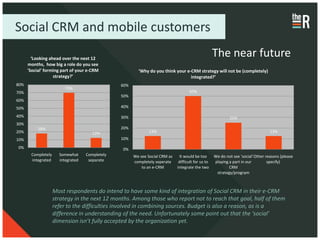
                    Most respondents do intend to have some kind of integration of Social CRM in their e-CRM
                    strategy in the next 12 months. Among those who report not to reach that goal, half of them
                    refer to the difficulties involved in combining sources. Budget is also a reason, as is a
                    difference in understanding of the need. Unfortunately some point out that the ‘social’
                    dimension isn’t fully accepted by the organization yet.
In this Reference Data Report
  State of affairs
      Reasons for doing e-CRM
           Platform
               Multichannel & customer data integration
                      Social CRM and mobile: challenges ahead
                         Main findings summarized
Main findings
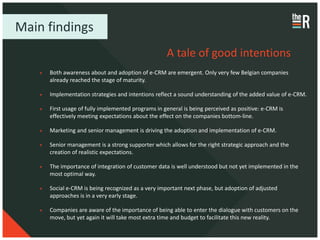
                                                   A tale of good intentions
     Both awareness about and adoption of e-CRM are emergent. Only very few Belgian companies
     already reached the stage of maturity.

     Implementation strategies and intentions reflect a sound understanding of the added value of e-CRM.

     First usage of fully implemented programs in general is being perceived as positive: e-CRM is
     effectively meeting expectations about the effect on the companies bottom-line.

     Marketing and senior management is driving the adoption and implementation of e-CRM.

     Senior management is a strong supporter which allows for the right strategic approach and the
     creation of realistic expectations.

     The importance of integration of customer data is well understood but not yet implemented in the
     most optimal way.

     Social e-CRM is being recognized as a very important next phase, but adoption of adjusted
     approaches is in a very early stage.

     Companies are aware of the importance of being able to enter the dialogue with customers on the
     move, but yet again it will take most extra time and budget to facilitate this new reality.
In this Reference Data Report
  State of affairs
      Reasons for doing e-CRM
           Platform
               Multichannel & customer data integration
                      Social CRM and mobile: challenges ahead
                         Main findings summarized
                             Survey info
Survey information

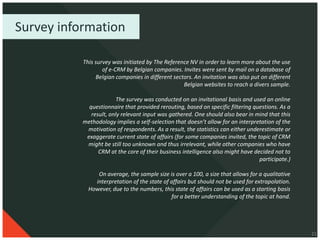
           This survey was initiated by The Reference NV in order to learn more about the use
                   of e-CRM by Belgian companies. Invites were sent by mail on a database of
                Belgian companies in different sectors. An invitation was also put on different
                                                   Belgian websites to reach a divers sample.

                         The survey was conducted on an invitational basis and used an online
             questionnaire that provided rerouting, based on specific filtering questions. As a
              result, only relevant input was gathered. One should also bear in mind that this
           methodology implies a self-selection that doesn’t allow for an interpretation of the
            motivation of respondents. As a result, the statistics can either underestimate or
            exaggerate current state of affairs (for some companies invited, the topic of CRM
            might be still too unknown and thus irrelevant, while other companies who have
                 CRM at the core of their business intelligence also might have decided not to
                                                                                  participate.)

                On average, the sample size is over a 100, a size that allows for a qualitative
               interpretation of the state of affairs but should not be used for extrapolation.
             However, due to the numbers, this state of affairs can be used as a starting basis
                                              for a better understanding of the topic at hand.


                                                                                                  21
Methodology
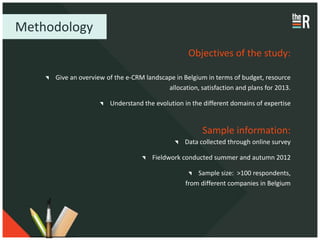
                                                  Objectives of the study:

     Give an overview of the e-CRM landscape in Belgium in terms of budget, resource
                                          allocation, satisfaction and plans for 2013.

                       Understand the evolution in the different domains of expertise


                                                       Sample information:
                                                 Data collected through online survey

                                      Fieldwork conducted summer and autumn 2012

                                                     Sample size: >100 respondents,
                                                 from different companies in Belgium
Survey information
                                                                         Sample Specifics:
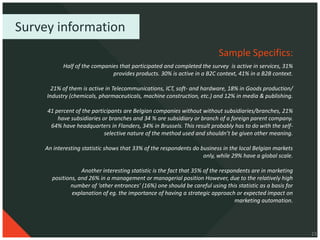
           Half of the companies that participated and completed the survey is active in services, 31%
                              provides products. 30% is active in a B2C context, 41% in a B2B context.

       21% of them is active in Telecommunications, ICT, soft- and hardware, 18% in Goods production/
     Industry (chemicals, pharmaceuticals, machine construction, etc.) and 12% in media & publishing.

     41 percent of the participants are Belgian companies without without subsidiaries/branches, 21%
         have subsidiaries or branches and 34 % are subsidiary or branch of a foreign parent company.
      64% have headquarters in Flanders, 34% in Brussels. This result probably has to do with the self-
                            selective nature of the method used and shouldn’t be given other meaning.

    An interesting statistic shows that 33% of the respondents do business in the local Belgian markets
                                                                   only, while 29% have a global scale.

                  Another interesting statistic is the fact that 35% of the respondents are in marketing
      positions, and 26% in a management or managerial position However, due to the relatively high
             number of ‘other entrances’ (16%) one should be careful using this statistic as a basis for
              explanation of eg. the importance of having a strategic approach or expected impact on
                                                                                 marketing automation.


                                                                                                           23
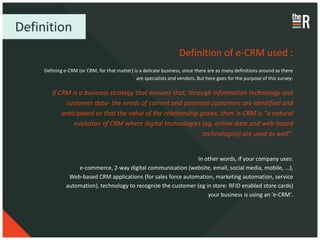
Definition
                                                                   Definition of e-CRM used :
     Defining e-CRM (or CRM, for that matter) is a delicate business, since there are as many definitions around as there
                                               are specialists and vendors. But here goes for the purpose of this survey:

        If CRM is a business strategy that ensures that, through information technology and
             customer data- the needs of current and potential customers are identified and
            anticipated so that the value of the relationship grows, then 'e-CRM is "a natural
                evolution of CRM where digital technologies (eg. online data and web-based
                                                               technologies) are used as well".


                                                                 In other words, if your company uses:
                   e-commerce, 2-way digital communication (website, email, social media, mobile, ...),
                Web-based CRM applications (for sales force automation, marketing automation, service
               automation), technology to recognize the customer (eg in store: RFID enabled store cards)
                                                                      your business is using an 'e-CRM'.
Contacts for the press

                                         More information:

                                                      Anja Cappelle
                                    Managing Director The Reference
                                                 anja@reference.be
                                                      0475 92 88 97
                                                       09 234 05 36


                                                   Vicky Van Daele
                                           vvandaele@reference.be
                                                          Marcom
                                                    0468 11 70 50
                                                      09 234 05 36

                    http://www.reference.be/en/research/ecrm/
Reference Data


More info about our services?
Send your question or RFQ to
     info@reference.be
It’s not just web,
it’s your business

Reference data2012 e-CRM survey

  • 1.
    18/12/2012 It’s not just web, it’s your business REFERENCE DATA: E-CRM in Belgium today
  • 2.
    In this ReferenceData Report State of affairs Reasons for doing e-CRM Platform Multichannel & customer data integration Social CRM and mobile: challenges ahead Main findings summarized Survey info
  • 3.
    In this ReferenceData Report State of affairs
  • 4.
    Adoption and awareness Still a long way to go… ‘e-CRM in my organization is:’ ‘If you have implemented or are implementing an e-CRM project, would you consider it:’ 35% 24% 30% 41% 25% 20% 33% 35% 34% 15% 10% 19% 13% 5% 1% 0% No intention Planned or started A success Reasonably Struggling No success Too early to Up and running successfull for success say Adoption is clearly in an early stage. A substantial number (of mostly local) companies have no intention to run an e-CRM program. Those who did already report measurable improvements or are convinced this effect will positive.
  • 5.
    Adoption and awareness Strategic approach ‘If you have implemented or are 'Our top management views e-CRM as:' implementing an e-CRM 60% 49% project, the critical success factors 50% during implementation and running 40% 30% 21% 25% are:’ 20% 13% 17% 10% 1% 23% 23% 0% 20% Critical A strategic An IT tool Useful, but not Other enabler critical 15% 15% 'Ownership of e-CRM within our organization lies with:' 10% 47% 10% 50% 40% 5% 24% 30% 20% 11% 10% 0% 10% 4% 4% 0% Marketing Corporate Sales IT Customer Other (please (top Service specify) management) Success is attributed mainly to a clearly defined strategy and optimal ‘Customer Data Integration’. Technology should focus on ease of use. The ownership also indicates the importance attributed, as well as top management’s expectation of e-CRM being a strategic enabler
  • 6.
    In this ReferenceData Report State of affairs Reasons for doing e-CRM
  • 7.
    Reasons for doinge-CRM Adding to the bottom line Revenue generation Cost reduction 50% 42% 50% 42% 40% 40% 34% 30% 26% 30% 20% 13% 13% 20% 14% 7% 8% 10% 10% 3% 0% 0% not somewhat neutral/not very prime not somewhat neutral/not very prime important important relevant important reason important important relevant important reason Increasing customer acquisition rates 70% 60% 60% 50% 40% 30% 18% 20% 12% 3% 6% 10% 0% not somewhat neutral/not very prime important important relevant important reason e-CRM is expected to add to the bottom line, either by generating extra revenue (through customer acquisition) and by lowering costs (related to the processes of acquisition or retention).
  • 8.
    Reasons for doinge-CRM Improving the organisation Improved marketing productivity Improved sales force productivity 80% 50% 60% 60% 40% 44% 30% 40% 18% 16% 20% 25% 20% 6% 10% 22% 0% 5% 4% 0% 0% not somewhat neutral/not very prime not somewhat neutral/not very prime important important relevant important reason important important relevant important reason Improved service team productivity 50% 42% 40% 36% 30% 20% 8% 10% 10% 3% 0% not somewhat neutral/not very prime important important relevant important reason e-CRM also adds to the bottom line by improving internal operations. Once again, the most effect is expected to come from better marketing organization.
  • 9.
    In this ReferenceData Report State of affairs Reasons for doing e-CRM Platforms
  • 10.
    Platforms No rain in this cloud yet… Today’s CRM platforms come in different shapes. Most respondents opt for ‘on premise’ solutions (that most probably integrate with the IT architecture that is in place) (46% in case of marketing automation, 41% in case of sales automation and 32% in case of service automation). Still some companies try to approach CRM with custom made solutions or features of tools that do not aim directly at this purpose
  • 11.
    In this ReferenceData Report State of affairs Reasons for doing e-CRM Platforms Multichannel & customer data integration
  • 12.
    Multichannel integration We wish we could do more 'My organization has written down a ‘Customer data that are generated by different systems and in different multichannel strategy:' channels are:’ 60% 60% 51% 49% 50% 50% 50% 40% 40% 30% 30% 21% 20% 20% 17% 12% 10% 10% 0% 0% Yes No Not integrated Somewhat integrated Integrated to a high Wholly integrated (e.g. degree in a Data Warehouse) In daily practice the need for channel integration is understood, while the explicit understanding of the importance can be improved substantially. So there’s still a lot of work to be done in order to maximize the ROI of e-CRM, even if these efforts for channel integration initially do increase budgets. This impact on budget is probably the main reason why most of the companies didn’t reach the stage of integration yet. Having a solid service partner who can apply best practices might be one way of getting it started.
  • 13.
    Customer data integration 'Channels are integrated so that an individual customer or prospect is Towards a single view? recognized regardless of the channel used:' Customer retention 45% 50% 40% 40% 30% 41% 40% 33% 35% 20% 35% 26% 30% 10% 0% 25% Yes Somewhat No 25% 20% Customer acquisition 15% 50% 40% 47% 10% 29% 30% 24% 5% 20% 10% 0% 0% Yes Somewhat No Yes Somewhat No Only the full integration of all available customer data yielded from all kind of channels allows companies to act fast and in targeted way as a result of detailed insights in individualized customers’ needs and behaviors. Such integration does have its impact on budgets and depend on a strategic approach of e-CRM, an approach needed to reach an optimum that eventually will turn out to be a vital component in a positive ROI and thus deserve full attention when e-CRM strategies are being defined or refined.
  • 14.
    Channel and customerdata integration Data turned into action 'We perform or are planning to perform advanced analytics, visualization and reporting on our customer data (e.g.: customer analysis & modeling, market segmentation, affinity grouping, churn analysis, customer Lifetime Value analysis, ...)' 35% 29% 30% 26% 25% 21% 20% 20% 15% 10% 4% 5% 0% Never Not yet, but we are Occasionally, ad hoc Regularly, ad hoc Systematically planning this Having customer data is only part of the exercise. In order to be able to act upon it, to reach the goals set in the e-CRM strategy, a translation from measurement to insights is required, insights that can take many different shapes, varying from dashboard statistics over detailed reporting including visualization techniques that allow for fast interpretation. Our study shows the need for a more structural approach, a need that is limited by budgets and expertise. Such an approach isn’t the easiest of tasks and can benefit from the help of expert partners
  • 15.
    In this ReferenceData Report State of affairs Reasons for doing e-CRM Platform Multichannel & customer data integration Social CRM and mobile: challenges ahead
  • 16.
    Social CRM andmobile customers Emerging tools ‘Which channels are used for customer communications by your company?’ 20% 18% 17% 18% 16% 14% 11% 11% 11% 11% 12% 9% 10% 8% 6% 5% 4% 4% 3% 2% 0% When applied correctly and strategically, social channels differ from other channels in the way they gather data and the pace of response by prospects and customers. As a consequence, its importance in the overall CRM strategies is increasing at a fast pace. Yet, the most important digital channels are still email and the company’s website. Belgium’ s leading social networks are used by a minority: Facebook and Twitter. The mobile digital channels, while growing in importance, are mostly unused. Only 5% of respondents use an app to reach their mobile customers.
  • 17.
    Social CRM andmobile customers ‘Looking ahead over the next 12 The near future months, how big a role do you see 'Social' forming part of your e-CRM ‘Why do you think your e-CRM strategy will not be (completely) strategy?’ integrated?’ 80% 60% 70% 70% 50% 50% 60% 50% 40% 40% 30% 25% 30% 18% 20% 20% 12% 13% 13% 10% 10% 0% 0% Completely Somewhat Completely We see Social CRM as It would be too We do not see 'social' Other reasons (please integrated integrated separate completely seperate difficult for us to playing a part in our specify) to an e-CRM integrate the two CRM strategy/program Most respondents do intend to have some kind of integration of Social CRM in their e-CRM strategy in the next 12 months. Among those who report not to reach that goal, half of them refer to the difficulties involved in combining sources. Budget is also a reason, as is a difference in understanding of the need. Unfortunately some point out that the ‘social’ dimension isn’t fully accepted by the organization yet.
  • 18.
    In this ReferenceData Report State of affairs Reasons for doing e-CRM Platform Multichannel & customer data integration Social CRM and mobile: challenges ahead Main findings summarized
  • 19.
    Main findings A tale of good intentions Both awareness about and adoption of e-CRM are emergent. Only very few Belgian companies already reached the stage of maturity. Implementation strategies and intentions reflect a sound understanding of the added value of e-CRM. First usage of fully implemented programs in general is being perceived as positive: e-CRM is effectively meeting expectations about the effect on the companies bottom-line. Marketing and senior management is driving the adoption and implementation of e-CRM. Senior management is a strong supporter which allows for the right strategic approach and the creation of realistic expectations. The importance of integration of customer data is well understood but not yet implemented in the most optimal way. Social e-CRM is being recognized as a very important next phase, but adoption of adjusted approaches is in a very early stage. Companies are aware of the importance of being able to enter the dialogue with customers on the move, but yet again it will take most extra time and budget to facilitate this new reality.
  • 20.
    In this ReferenceData Report State of affairs Reasons for doing e-CRM Platform Multichannel & customer data integration Social CRM and mobile: challenges ahead Main findings summarized Survey info
  • 21.
    Survey information This survey was initiated by The Reference NV in order to learn more about the use of e-CRM by Belgian companies. Invites were sent by mail on a database of Belgian companies in different sectors. An invitation was also put on different Belgian websites to reach a divers sample. The survey was conducted on an invitational basis and used an online questionnaire that provided rerouting, based on specific filtering questions. As a result, only relevant input was gathered. One should also bear in mind that this methodology implies a self-selection that doesn’t allow for an interpretation of the motivation of respondents. As a result, the statistics can either underestimate or exaggerate current state of affairs (for some companies invited, the topic of CRM might be still too unknown and thus irrelevant, while other companies who have CRM at the core of their business intelligence also might have decided not to participate.) On average, the sample size is over a 100, a size that allows for a qualitative interpretation of the state of affairs but should not be used for extrapolation. However, due to the numbers, this state of affairs can be used as a starting basis for a better understanding of the topic at hand. 21
  • 22.
    Methodology Objectives of the study: Give an overview of the e-CRM landscape in Belgium in terms of budget, resource allocation, satisfaction and plans for 2013. Understand the evolution in the different domains of expertise Sample information: Data collected through online survey Fieldwork conducted summer and autumn 2012 Sample size: >100 respondents, from different companies in Belgium
  • 23.
    Survey information Sample Specifics: Half of the companies that participated and completed the survey is active in services, 31% provides products. 30% is active in a B2C context, 41% in a B2B context. 21% of them is active in Telecommunications, ICT, soft- and hardware, 18% in Goods production/ Industry (chemicals, pharmaceuticals, machine construction, etc.) and 12% in media & publishing. 41 percent of the participants are Belgian companies without without subsidiaries/branches, 21% have subsidiaries or branches and 34 % are subsidiary or branch of a foreign parent company. 64% have headquarters in Flanders, 34% in Brussels. This result probably has to do with the self- selective nature of the method used and shouldn’t be given other meaning. An interesting statistic shows that 33% of the respondents do business in the local Belgian markets only, while 29% have a global scale. Another interesting statistic is the fact that 35% of the respondents are in marketing positions, and 26% in a management or managerial position However, due to the relatively high number of ‘other entrances’ (16%) one should be careful using this statistic as a basis for explanation of eg. the importance of having a strategic approach or expected impact on marketing automation. 23
  • 24.
    Definition Definition of e-CRM used : Defining e-CRM (or CRM, for that matter) is a delicate business, since there are as many definitions around as there are specialists and vendors. But here goes for the purpose of this survey: If CRM is a business strategy that ensures that, through information technology and customer data- the needs of current and potential customers are identified and anticipated so that the value of the relationship grows, then 'e-CRM is "a natural evolution of CRM where digital technologies (eg. online data and web-based technologies) are used as well". In other words, if your company uses: e-commerce, 2-way digital communication (website, email, social media, mobile, ...), Web-based CRM applications (for sales force automation, marketing automation, service automation), technology to recognize the customer (eg in store: RFID enabled store cards) your business is using an 'e-CRM'.
  • 25.
    Contacts for thepress More information: Anja Cappelle Managing Director The Reference anja@reference.be 0475 92 88 97 09 234 05 36 Vicky Van Daele vvandaele@reference.be Marcom 0468 11 70 50 09 234 05 36 http://www.reference.be/en/research/ecrm/
  • 26.
    Reference Data More infoabout our services? Send your question or RFQ to info@reference.be
  • 27.
    It’s not justweb, it’s your business