January 24 2013, Webinar Panel Discussion
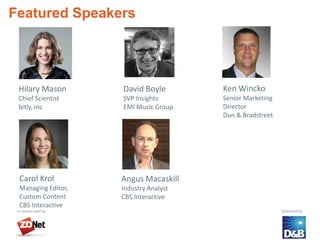
Featured Speakers


 Hilary Mason       David Boyle        Ken Wincko
 Chief Scientist    SVP Insights       Senior Marketing
 bitly, inc         EMI Music Group    Director
                                       Dun & Bradstreet


 Carol Krol         Angus Macaskill
 Managing Editor,   Industry Analyst
 Custom Content     CBS Interactive
 CBS Interactive
Agenda

   Overview of findings from ZDNet’s Big Data Priorities
    2013 Research

   Panel discussion of key findings

   Panel response to questions from audience

   Wrap-up
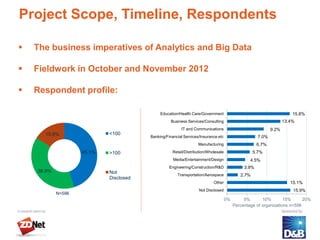
Project Scope, Timeline, Respondents

   The business imperatives of Analytics and Big Data

   Fieldwork in October and November 2012

   Respondent profile:

                                             Education/Health Care/Government                                          15.8%
                                                   Business Services/Consulting                                    13.4%
                                                         IT and Communications                              9.2%
      15.9%                 <100
                                        Banking/Financial Services/Insurance etc                     7.0%
                                                                  Manufacturing                      6.7%
                    45.1%   >100                    Retail/Distribution/Wholesale                  5.7%
                                                    Media/Entertainment/Design                   4.5%
                                                  Engineering/Construction/R&D                3.9%
    38.9%                   Not                       Transportation/Aerospace              2.7%
                            Disclosed
                                                                           Other                                      15.1%
                                                                  Not Disclosed                                        15.9%
            N=596
                                                                                    0%        5%       10%        15%      20%
                                                                                         Percentage of organizations n=596
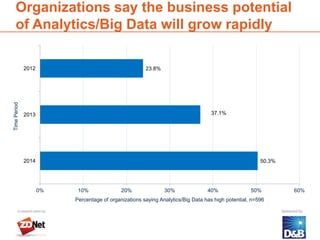
Organizations say the business potential
    of Analytics/Big Data will grow rapidly

              2012                                     23.8%
Time Period


              2013                                                                37.1%


              2014                                                                                     50.3%


                     0%    10%               20%               30%               40%               50%         60%
                          Percentage of organizations saying Analytics/Big Data has high potential, n=596


 5
Audience Poll


What is the potential for Data Analytics/Big Data to have a major
influence on your organization’s business performance this year?

Is it:

    Low
    Moderate
    High
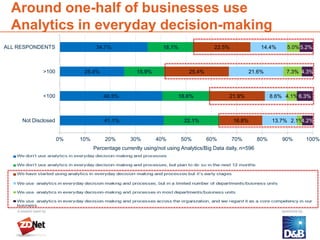
Around one-half of businesses use
  Analytics in everyday decision-making
ALL RESPONDENTS                    34.7%                       18.1%                 22.5%                14.4%     5.0% 5.2%


               >100          25.4%                  15.9%                 25.4%                      21.6%          7.3% 4.3%


               <100                   40.5%                            18.6%               21.9%               8.6% 4.1% 6.3%


       Not Disclosed                  41.1%                             22.1%                16.8%             13.7% 2.1%4.2%


                       0%   10%       20%        30%        40%        50%        60%        70%         80%       90%     100%
                                  Percentage currently using/not using Analytics/Big Data daily, n=596


   8
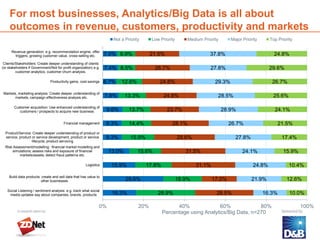
For most businesses, Analytics/Big Data is all about
     outcomes in revenue, customers, productivity and markets
                                                                      Not a Priority     Low Priority       Medium Priority      Major Priority     Top Priority

      Revenue generation: e.g. recommendation engine, offer
        triggers, growing customer value, cross-selling etc.       7.0% 8.9%             21.5%                         37.8%                          24.8%
 Clients/Stakeholders: Create deeper understanding of clients
(or stakeholders if Government/Not for profit organization) e.g.   7.4% 8.5%               26.7%                       27.8%                        29.6%
         customer analytics, customer churn analysis.

                               Productivity gains, cost savings    6.7%   12.6%              24.8%                       29.3%                       26.7%

 Markets, marketing analysis: Create deeper understanding of
        markets, campaign effectiveness analysis etc.              7.8%     13.3%              24.8%                      28.5%                      25.6%

        Customer acquisition: Use enhanced understanding of
           customers / prospects to acquire new business           9.6%       13.7%              23.7%                        28.9%                   24.1%

                                        Financial management       9.3%       14.4%                28.1%                        26.7%                   21.5%
  Product/Service: Create deeper understanding of product or
  service, product or service development, product or service      9.3%        15.9%                    29.6%                      27.8%                  17.4%
                   lifecycle, product servicing
  Risk Assessment/modelling: financial market modelling and
      simulations; assess risks and exposure of financial           13.0%          15.6%                   31.5%                       24.1%               15.9%
          markets/assets; detect fraud patterns etc.

                                                      Logistics      15.9%             17.8%                    31.1%                       24.8%             10.4%

    Build data products: create and sell data that has value to
                        other businesses                                    29.6%                       18.9%           17.0%              21.9%            12.6%

   Social Listening / sentiment analysis: e.g. track what social
    media updates say about companies, brands, products              16.3%                  28.9%                         28.5%                   16.3%       10.0%

                                                               0%                  20%               40%              60%              80%                         100%
                                                                                               Percentage using Analytics/Big Data, n=270

        9
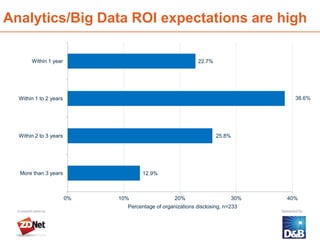
Analytics/Big Data ROI expectations are high

          Within 1 year                                      22.7%


  Within 1 to 2 years                                                              38.6%


  Within 2 to 3 years                                                25.8%


      More than 3 years                12.9%


                          0%   10%                  20%                    30%   40%
                                 Percentage of organizations disclosing, n=233


 10
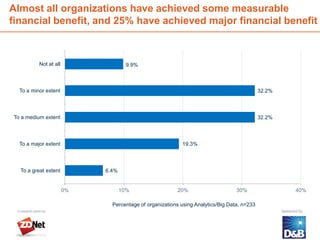
Almost all organizations have achieved some measurable
financial benefit, and 25% have achieved major financial benefit


              Not at all                 9.9%


      To a minor extent                                                                         32.2%


To a medium extent                                                                              32.2%


      To a major extent                                       19.3%


      To a great extent         6.4%


                           0%          10%                  20%                      30%                40%

                                  Percentage of organizations using Analytics/Big Data, n=233


 11
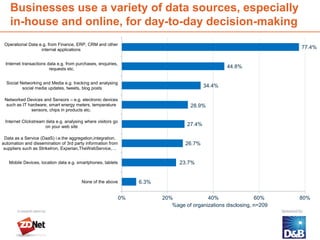
Businesses use a variety of data sources, especially
    in-house and online, for day-to-day decision-making
 Operational Data e.g. from Finance, ERP, CRM and other
                   internal applications                                                                               77.4%


 Internet transactions data e.g. from purchases, enquiries,
                        requests etc.                                                              44.8%


  Social Networking and Media e.g. tracking and analysing
          social media updates, tweets, blog posts                                         34.4%

 Networked Devices and Sensors – e.g. electronic devices
  such as IT hardware, smart energy meters, temperature                              28.9%
              sensors, chips in products etc.

 Internet Clickstream data e.g. analysing where visitors go
                      on your web site                                             27.4%

 Data as a Service (DaaS) i.e.the aggregation,integration,
automation and dissemination of 3rd party information from                         26.7%
 suppliers such as StrikeIron, Experian,TheWebService,…


   Mobile Devices, location data e.g. smartphones, tablets                      23.7%


                                        None of the above          6.3%

                                                              0%          20%              40%                 60%     80%
                                                                             %age of organizations disclosing, n=209


      12
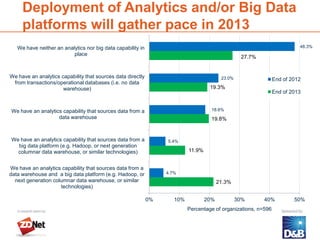
Deployment of Analytics and/or Big Data
       platforms will gather pace in 2013
   We have neither an analytics nor big data capability in                                                                48.3%
                          place
                                                                                                   27.7%


We have an analytics capability that sources data directly                                23.0%                 End of 2012
 from transactions/operational databases (i.e. no data
                      warehouse)                                                    19.3%
                                                                                                                End of 2013


We have an analytics capability that sources data from a                             18.6%
                   data warehouse                                                    19.8%


We have an analytics capability that sources data from a          5.4%
  big data platform (e.g. Hadoop, or next generation
  columnar data warehouse, or similar technologies)                        11.9%


We have an analytics capability that sources data from a
data warehouse and a big data platform (e.g. Hadoop, or           4.7%
  next generation columnar data warehouse, or similar                                    21.3%
                     technologies)

                                                             0%      10%           20%            30%      40%          50%
                                                                           Percentage of organizations, n=596


  13
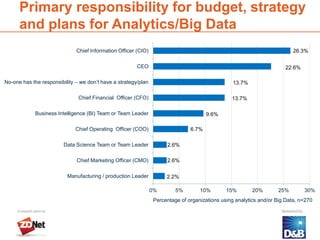
Primary responsibility for budget, strategy
         and plans for Analytics/Big Data
                              Chief Information Officer (CIO)                                                             26.3%

                                                        CEO                                                           22.6%

No-one has the responsibility – we don’t have a strategy/plan                                    13.7%

                               Chief Financial Officer (CFO)                                    13.7%

             Business Intelligence (BI) Team or Team Leader                           9.6%

                              Chief Operating Officer (COO)                    6.7%

                         Data Science Team or Team Leader            2.6%

                              Chief Marketing Officer (CMO)          2.6%

                          Manufacturing / production Leader          2.2%

                                                                0%       5%        10%        15%        20%       25%        30%
                                                                Percentage of organizations using analytics and/or Big Data, n=270


    14
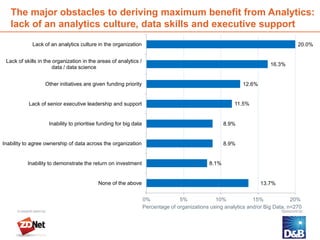
The major obstacles to deriving maximum benefit from Analytics:
   lack of an analytics culture, data skills and executive support
             Lack of an analytics culture in the organization                                                                      20.0%


 Lack of skills in the organization in the areas of analytics /
                                                                                                                        16.3%
                       data / data science


                  Other initiatives are given funding priority                                              12.6%


           Lack of senior executive leadership and support                                               11.5%


                    Inability to prioritise funding for big data                                     8.9%


Inability to agree ownership of data across the organization                                         8.9%


          Inability to demonstrate the return on investment                                   8.1%


                                           None of the above                                                        13.7%


                                                                   0%             5%             10%             15%             20%
                                                                   Percentage of organizations using analytics and/or Big Data, n=270


     15
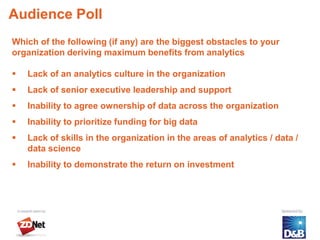
Audience Poll
Which of the following (if any) are the biggest obstacles to your
organization deriving maximum benefits from analytics

   Lack of an analytics culture in the organization
   Lack of senior executive leadership and support
   Inability to agree ownership of data across the organization
   Inability to prioritize funding for big data
   Lack of skills in the organization in the areas of analytics / data /
    data science
   Inability to demonstrate the return on investment
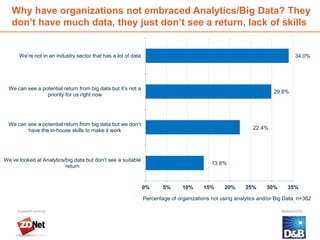
Why have organizations not embraced Analytics/Big Data? They
   don’t have much data, they just don’t see a return, lack of skills


         We’re not in an industry sector that has a lot of data                                                                  34.0%


  We can see a potential return from big data but it’s not a
                                                                                                                        29.8%
                 priority for us right now


  We can see a potential return from big data but we don’t
         have the in-house skills to make it work                                                              22.4%


We’ve looked at Analytics/big data but don’t see a suitable
                                                                                              13.8%
                          return


                                                                  0%      5%      10%      15%     20%      25%      30%      35%

                                                                  Percentage of organizations not using analytics and/or Big Data, n=362


    17
Q&A
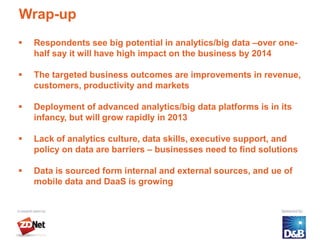
Wrap-up
   Respondents see big potential in analytics/big data –over one-
    half say it will have high impact on the business by 2014

   The targeted business outcomes are improvements in revenue,
    customers, productivity and markets

   Deployment of advanced analytics/big data platforms is in its
    infancy, but will grow rapidly in 2013

   Lack of analytics culture, data skills, executive support, and
    policy on data are barriers – businesses need to find solutions

   Data is sourced form internal and external sources, and ue of
    mobile data and DaaS is growing
THANK YOU FOR JOINING US


January 24 2013, Webinar Panel Discussion

Big Data Priorities: January 24, 2013 Webinar

  • 1.
    January 24 2013,Webinar Panel Discussion
  • 2.
    Featured Speakers HilaryMason David Boyle Ken Wincko Chief Scientist SVP Insights Senior Marketing bitly, inc EMI Music Group Director Dun & Bradstreet Carol Krol Angus Macaskill Managing Editor, Industry Analyst Custom Content CBS Interactive CBS Interactive
  • 3.
    Agenda  Overview of findings from ZDNet’s Big Data Priorities 2013 Research  Panel discussion of key findings  Panel response to questions from audience  Wrap-up
  • 4.
    Project Scope, Timeline,Respondents  The business imperatives of Analytics and Big Data  Fieldwork in October and November 2012  Respondent profile: Education/Health Care/Government 15.8% Business Services/Consulting 13.4% IT and Communications 9.2% 15.9% <100 Banking/Financial Services/Insurance etc 7.0% Manufacturing 6.7% 45.1% >100 Retail/Distribution/Wholesale 5.7% Media/Entertainment/Design 4.5% Engineering/Construction/R&D 3.9% 38.9% Not Transportation/Aerospace 2.7% Disclosed Other 15.1% Not Disclosed 15.9% N=596 0% 5% 10% 15% 20% Percentage of organizations n=596
  • 5.
    Organizations say thebusiness potential of Analytics/Big Data will grow rapidly 2012 23.8% Time Period 2013 37.1% 2014 50.3% 0% 10% 20% 30% 40% 50% 60% Percentage of organizations saying Analytics/Big Data has high potential, n=596 5
  • 6.
    Audience Poll What isthe potential for Data Analytics/Big Data to have a major influence on your organization’s business performance this year? Is it:  Low  Moderate  High
  • 7.
    Around one-half ofbusinesses use Analytics in everyday decision-making ALL RESPONDENTS 34.7% 18.1% 22.5% 14.4% 5.0% 5.2% >100 25.4% 15.9% 25.4% 21.6% 7.3% 4.3% <100 40.5% 18.6% 21.9% 8.6% 4.1% 6.3% Not Disclosed 41.1% 22.1% 16.8% 13.7% 2.1%4.2% 0% 10% 20% 30% 40% 50% 60% 70% 80% 90% 100% Percentage currently using/not using Analytics/Big Data daily, n=596 8
  • 8.
    For most businesses,Analytics/Big Data is all about outcomes in revenue, customers, productivity and markets Not a Priority Low Priority Medium Priority Major Priority Top Priority Revenue generation: e.g. recommendation engine, offer triggers, growing customer value, cross-selling etc. 7.0% 8.9% 21.5% 37.8% 24.8% Clients/Stakeholders: Create deeper understanding of clients (or stakeholders if Government/Not for profit organization) e.g. 7.4% 8.5% 26.7% 27.8% 29.6% customer analytics, customer churn analysis. Productivity gains, cost savings 6.7% 12.6% 24.8% 29.3% 26.7% Markets, marketing analysis: Create deeper understanding of markets, campaign effectiveness analysis etc. 7.8% 13.3% 24.8% 28.5% 25.6% Customer acquisition: Use enhanced understanding of customers / prospects to acquire new business 9.6% 13.7% 23.7% 28.9% 24.1% Financial management 9.3% 14.4% 28.1% 26.7% 21.5% Product/Service: Create deeper understanding of product or service, product or service development, product or service 9.3% 15.9% 29.6% 27.8% 17.4% lifecycle, product servicing Risk Assessment/modelling: financial market modelling and simulations; assess risks and exposure of financial 13.0% 15.6% 31.5% 24.1% 15.9% markets/assets; detect fraud patterns etc. Logistics 15.9% 17.8% 31.1% 24.8% 10.4% Build data products: create and sell data that has value to other businesses 29.6% 18.9% 17.0% 21.9% 12.6% Social Listening / sentiment analysis: e.g. track what social media updates say about companies, brands, products 16.3% 28.9% 28.5% 16.3% 10.0% 0% 20% 40% 60% 80% 100% Percentage using Analytics/Big Data, n=270 9
  • 9.
    Analytics/Big Data ROIexpectations are high Within 1 year 22.7% Within 1 to 2 years 38.6% Within 2 to 3 years 25.8% More than 3 years 12.9% 0% 10% 20% 30% 40% Percentage of organizations disclosing, n=233 10
  • 10.
    Almost all organizationshave achieved some measurable financial benefit, and 25% have achieved major financial benefit Not at all 9.9% To a minor extent 32.2% To a medium extent 32.2% To a major extent 19.3% To a great extent 6.4% 0% 10% 20% 30% 40% Percentage of organizations using Analytics/Big Data, n=233 11
  • 11.
    Businesses use avariety of data sources, especially in-house and online, for day-to-day decision-making Operational Data e.g. from Finance, ERP, CRM and other internal applications 77.4% Internet transactions data e.g. from purchases, enquiries, requests etc. 44.8% Social Networking and Media e.g. tracking and analysing social media updates, tweets, blog posts 34.4% Networked Devices and Sensors – e.g. electronic devices such as IT hardware, smart energy meters, temperature 28.9% sensors, chips in products etc. Internet Clickstream data e.g. analysing where visitors go on your web site 27.4% Data as a Service (DaaS) i.e.the aggregation,integration, automation and dissemination of 3rd party information from 26.7% suppliers such as StrikeIron, Experian,TheWebService,… Mobile Devices, location data e.g. smartphones, tablets 23.7% None of the above 6.3% 0% 20% 40% 60% 80% %age of organizations disclosing, n=209 12
  • 12.
    Deployment of Analyticsand/or Big Data platforms will gather pace in 2013 We have neither an analytics nor big data capability in 48.3% place 27.7% We have an analytics capability that sources data directly 23.0% End of 2012 from transactions/operational databases (i.e. no data warehouse) 19.3% End of 2013 We have an analytics capability that sources data from a 18.6% data warehouse 19.8% We have an analytics capability that sources data from a 5.4% big data platform (e.g. Hadoop, or next generation columnar data warehouse, or similar technologies) 11.9% We have an analytics capability that sources data from a data warehouse and a big data platform (e.g. Hadoop, or 4.7% next generation columnar data warehouse, or similar 21.3% technologies) 0% 10% 20% 30% 40% 50% Percentage of organizations, n=596 13
  • 13.
    Primary responsibility forbudget, strategy and plans for Analytics/Big Data Chief Information Officer (CIO) 26.3% CEO 22.6% No-one has the responsibility – we don’t have a strategy/plan 13.7% Chief Financial Officer (CFO) 13.7% Business Intelligence (BI) Team or Team Leader 9.6% Chief Operating Officer (COO) 6.7% Data Science Team or Team Leader 2.6% Chief Marketing Officer (CMO) 2.6% Manufacturing / production Leader 2.2% 0% 5% 10% 15% 20% 25% 30% Percentage of organizations using analytics and/or Big Data, n=270 14
  • 14.
    The major obstaclesto deriving maximum benefit from Analytics: lack of an analytics culture, data skills and executive support Lack of an analytics culture in the organization 20.0% Lack of skills in the organization in the areas of analytics / 16.3% data / data science Other initiatives are given funding priority 12.6% Lack of senior executive leadership and support 11.5% Inability to prioritise funding for big data 8.9% Inability to agree ownership of data across the organization 8.9% Inability to demonstrate the return on investment 8.1% None of the above 13.7% 0% 5% 10% 15% 20% Percentage of organizations using analytics and/or Big Data, n=270 15
  • 15.
    Audience Poll Which ofthe following (if any) are the biggest obstacles to your organization deriving maximum benefits from analytics  Lack of an analytics culture in the organization  Lack of senior executive leadership and support  Inability to agree ownership of data across the organization  Inability to prioritize funding for big data  Lack of skills in the organization in the areas of analytics / data / data science  Inability to demonstrate the return on investment
  • 16.
    Why have organizationsnot embraced Analytics/Big Data? They don’t have much data, they just don’t see a return, lack of skills We’re not in an industry sector that has a lot of data 34.0% We can see a potential return from big data but it’s not a 29.8% priority for us right now We can see a potential return from big data but we don’t have the in-house skills to make it work 22.4% We’ve looked at Analytics/big data but don’t see a suitable 13.8% return 0% 5% 10% 15% 20% 25% 30% 35% Percentage of organizations not using analytics and/or Big Data, n=362 17
  • 17.
  • 18.
    Wrap-up  Respondents see big potential in analytics/big data –over one- half say it will have high impact on the business by 2014  The targeted business outcomes are improvements in revenue, customers, productivity and markets  Deployment of advanced analytics/big data platforms is in its infancy, but will grow rapidly in 2013  Lack of analytics culture, data skills, executive support, and policy on data are barriers – businesses need to find solutions  Data is sourced form internal and external sources, and ue of mobile data and DaaS is growing
  • 19.
    THANK YOU FORJOINING US January 24 2013, Webinar Panel Discussion