Reference Insights:  Reference at the Dawn of Web 2.0 Janie L. Hermann, Princeton Public Library Technology Training Librarian [email_address]
Web 2.0 is… A Social, Collaborative Web, defined by trends and sites such as: Blogs/RSS - Wikis - Podcasts - Social software – Friendster - MySpace - de.licio.us - furl - Flickr - IM – lastfm - Folksonomies - Mashups - Tagging
Is “The Desk” Going to Disappear? Some are predicting the demise of the traditional reference desk in libraries. Could this happen? Can it be prevented? Should it be prevented? How does reference work stay vital in the Information Age?
Adaptation is the Name of the Game Library reference departments must:  Continually scan the environment to find new ways to remain relevant in a world where information is available 24/7 at the touch of a button.  Promote flexibility and willingness to try new ways of providing service as they are the key to relevancy. Broaden the definition of “reference” in order to expand services offered. Be prepared to live on the cutting edge.
Social Trends Affecting Reference It is a 24x7 world  More choice and options than ever before food, clothing, ISPs, cars, search engines, television stations Self-help (too impatient to wait) Grocery stores, Gas stations, Airlines, and Banks  Need for instant gratification Multi-tasking as a way of life
Technology Trends The Web is the “new normal” Instant everything – including messaging Cell Phones are rapidly morphing in to multi-purpose devices  “ Information Creators” abound web sites, wikis and blogs Wireless access is everywhere RSS pushing information to the desktop
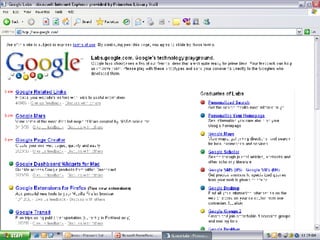
The Google Factor Have you visited the labs lately? http://labs.google.com A plethora of new services that compete with libraries personalized search, search history, news alerts, search sets, etc. Google Scholar  http://www.scholar.com
 
What has Princeton Done? In the past 4 years, we have: Experimented with Roving Reference Joined the QandANJ network  Expanded our definition of reference Revised our email reference policy Incorporated Technology Assistants in to our public service team Begun to offer dedicated telephone reference and other new services
Divide and Conquer Hiring specially trained “technology assistants” Establishing a “Welcome Desk” Retooling email reference Offering dedicated telephone reference Expanding programming Taking the show on the road Offering Reference by Appointment
Technology Assistants  Three “Tech Aides” hired in March 2004 Always on duty daily from 1-9 pm and during busy hours on weekends Work side by side with the librarian at the reference desk They allow the librarian to concentrate on reference work and not worry about computer issues constantly Also assist with teaching classes, tracking statistics, maintaining the Tech Center, setting up equipment and much more!
Technology Assistants cont… In a typical shift a Tech Aide would: Make sure all of our 100 public computers and peripherals are running  Help customers connect to our wireless network Assist with managing SAM  Answer printing questions/deal with printer jams Help customers save their work to CDs, flash drives or floppies Supervise the Technology Center
The “Welcome Desk” A new feature for our new library First point of contact Staffed by librarians ~ 90% of the time Brief questions, directions, ready reference Reader’s Advisory
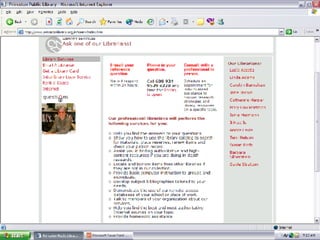
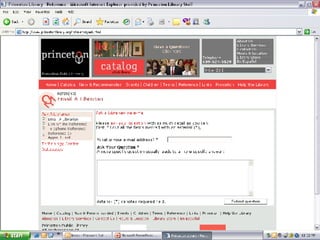
Retooling Email Service Provide a form for users to fill out Advertise it on every page of your site Check for new messages continually (treat email like the telephone) Don’t be restrictive with the type of questions that can be asked Responding within hours, not days
 
 
Dedicated Telephone Reference Begun in January 2005 as a pilot project; now a permanent fixture. Telephones are staffed with a dedicated staff member during busy times – mostly afternoon and early evening. It has been a win-win situation for us Customers are happy to get through right away Librarians feel less stress on the reference desk and give better in-person service
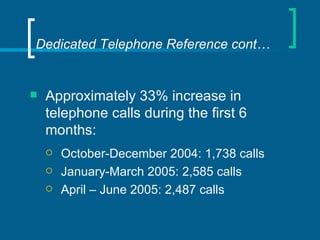
Dedicated Telephone Reference cont… Approximately 33% increase in telephone calls during the first 6 months: October-December 2004: 1,738 calls January-March 2005: 2,585 calls April – June 2005: 2,487 calls
Expanding Programming Tuesday Technology Talks DataBytes Tech Time in the Lab Internet Drop-In SCORE  (Service Corp of Retired Executives) Literacy Volunteers Citizenship Classes Ask-a-Lawyer
Reach Out and Get Out! The “Bringing the mountain to Mohammed” theory Visit local computer user groups, job hunters, PTAs, networking groups Promote reference services and subscription databases by “bringing the show on the road”
Reference by Appointment Academic libraries have been offering this service for many years Complex reference queries are best handled in a private session  Allows time for the librarian to prepare Another “choice” for busy people Eases stress at the reference desk
The Next Frontier Instant Messaging No longer just for “kids” Increasingly being used in business  http://www.librarytechnology.org/ltg-displaytext.pl?RC=10779 Café Reference Service  Extension of the Mohammed theory Roving with notebook PCs or PDAs Is this where the desk disappears? Invisible Librarianship Self-help websites, creating guides, virtual training
Finding the Future: Remain relevant Embrace change and be flexible Evolve with social and technological trends Be readily available, easy to use and respond quickly Provide choices
Web 2.0 Definitions wik·i (wĭk'ē)  n.   A collaborative website whose content can be edited by anyone who has access to it. [From Hawaiian wiki, to hurry, swift] web·log (wĕb'lôg ' , -lŏg ' )  n.   A website that displays in chronological order the postings by one or more individuals and usually has links to comments on specific postings.  RSS An acronym which represents one of three possibilites: Rich Site Summary (RSS 0.91)  RDF Site Summary(RSS 0.9 and 1.0)  Really Simple Syndication (RSS 2.0.0)
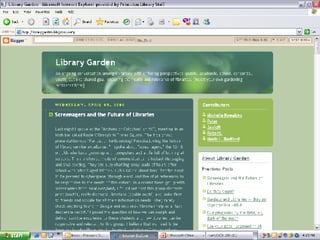
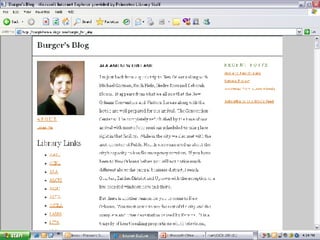
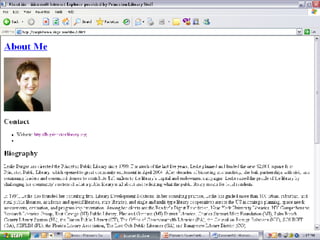
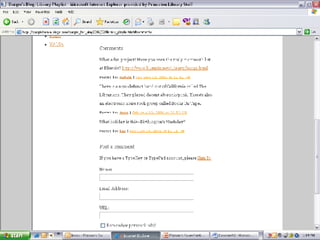
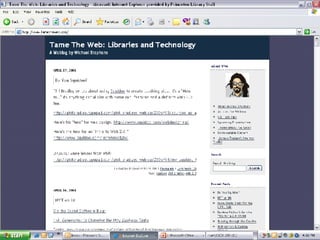
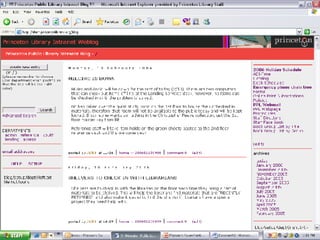
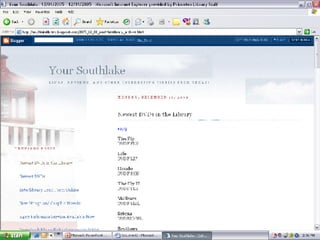
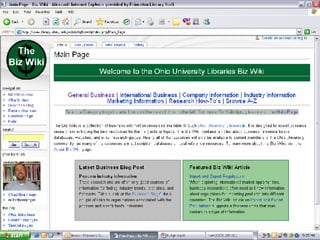
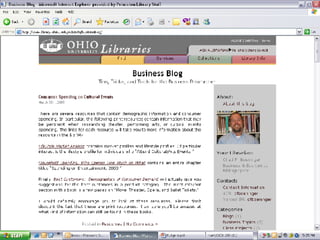
Blogs – A Closer Look A  blog  is a website for which an individual or a group frequently generates text, photos, video, audio files, and/or links. Typically (but not always) updated on a daily or weekly basis.  The term is a shortened form of  weblog . Source: Wikipedia
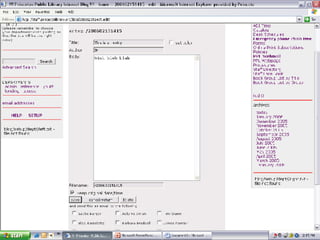
How Blogs differ from traditional sites A blog provides many advantages over a standard web page, including these: Allows for easy creation of new pages: new data is entered into a simple form and then submitted.  Automated templates take care of adding the article to the home page, creating the new full article page (Permalink), and adding the article to the appropriate date- or category-based archive.  Source: Wikipedia
Allows for easy filtering of content for various presentations - by date, category, author, or other attributes.  A blog (usually) allows the administrator to invite and add other authors, whose permissions and access are easily managed.  Readers can comment and converse with the blog author(s) How Blogs differ from traditional sites Source: Wikipedia


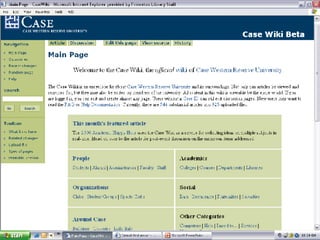
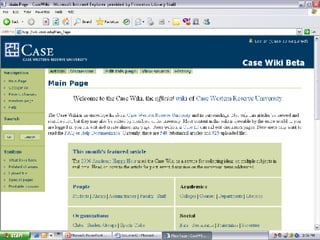
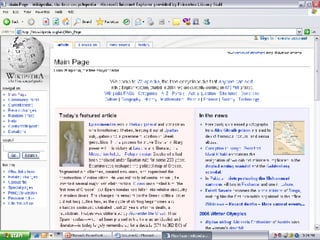
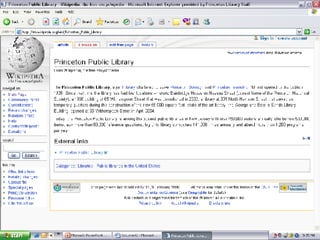
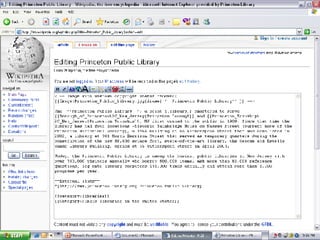
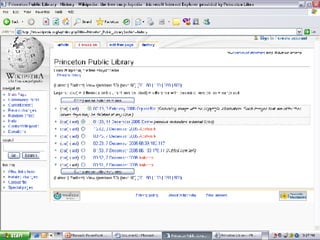
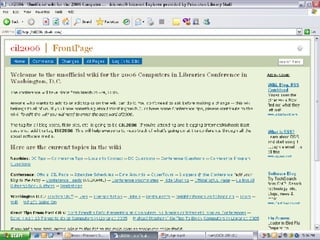
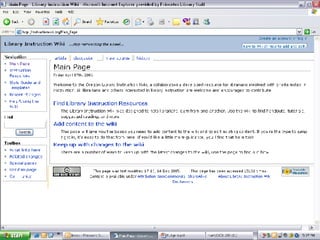
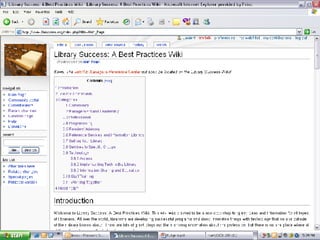
What’s a Wiki? A Web site that can be quickly edited by its visitors with simple formatting rules.  Developed by Ward Cunningham in the mid-1990s to provide collaborative discussions and create a sense of community among users. There are several "Wiki" tools on the market for creating such sites, including www.editme.com, www.seedwiki.com, www.socialtext.com and www.twiki.com  Source: Computer Desktop Encylopedia
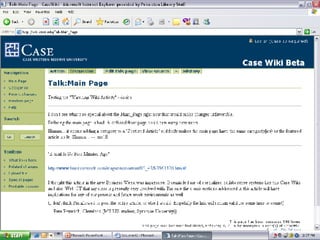
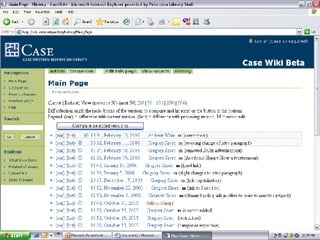
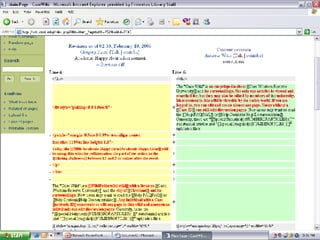
Key Characteristics of a Wiki enables documents to be written collectively (co-authoring)  written in a simple markup language using a web browser every entry and change is recorded and can be viewed in a log a history of changes and older versions is accessible changes can be discussed in a forum a wiki entry can revert to a previous version at any time A single page is referred to as a "wiki page", while the entire body of pages, which are usually highly interconnected via hyperlinks, is "the wiki“.  In effect, it is a very simple, easier-to-use  database .


What about RSS…  Feeds for new books and videos Feeds for programs Feed from a library blog Aggregate.
 

Reference at the Dawn of Web 2.0

  • 1.
    Reference Insights: Reference at the Dawn of Web 2.0 Janie L. Hermann, Princeton Public Library Technology Training Librarian [email_address]
  • 2.
    Web 2.0 is…A Social, Collaborative Web, defined by trends and sites such as: Blogs/RSS - Wikis - Podcasts - Social software – Friendster - MySpace - de.licio.us - furl - Flickr - IM – lastfm - Folksonomies - Mashups - Tagging
  • 3.
    Is “The Desk”Going to Disappear? Some are predicting the demise of the traditional reference desk in libraries. Could this happen? Can it be prevented? Should it be prevented? How does reference work stay vital in the Information Age?
  • 4.
    Adaptation is theName of the Game Library reference departments must: Continually scan the environment to find new ways to remain relevant in a world where information is available 24/7 at the touch of a button. Promote flexibility and willingness to try new ways of providing service as they are the key to relevancy. Broaden the definition of “reference” in order to expand services offered. Be prepared to live on the cutting edge.
  • 5.
    Social Trends AffectingReference It is a 24x7 world More choice and options than ever before food, clothing, ISPs, cars, search engines, television stations Self-help (too impatient to wait) Grocery stores, Gas stations, Airlines, and Banks Need for instant gratification Multi-tasking as a way of life
  • 6.
    Technology Trends TheWeb is the “new normal” Instant everything – including messaging Cell Phones are rapidly morphing in to multi-purpose devices “ Information Creators” abound web sites, wikis and blogs Wireless access is everywhere RSS pushing information to the desktop
  • 7.
    The Google FactorHave you visited the labs lately? http://labs.google.com A plethora of new services that compete with libraries personalized search, search history, news alerts, search sets, etc. Google Scholar http://www.scholar.com
  • 8.
  • 9.
    What has PrincetonDone? In the past 4 years, we have: Experimented with Roving Reference Joined the QandANJ network Expanded our definition of reference Revised our email reference policy Incorporated Technology Assistants in to our public service team Begun to offer dedicated telephone reference and other new services
  • 10.
    Divide and ConquerHiring specially trained “technology assistants” Establishing a “Welcome Desk” Retooling email reference Offering dedicated telephone reference Expanding programming Taking the show on the road Offering Reference by Appointment
  • 11.
    Technology Assistants Three “Tech Aides” hired in March 2004 Always on duty daily from 1-9 pm and during busy hours on weekends Work side by side with the librarian at the reference desk They allow the librarian to concentrate on reference work and not worry about computer issues constantly Also assist with teaching classes, tracking statistics, maintaining the Tech Center, setting up equipment and much more!
  • 12.
    Technology Assistants cont…In a typical shift a Tech Aide would: Make sure all of our 100 public computers and peripherals are running Help customers connect to our wireless network Assist with managing SAM Answer printing questions/deal with printer jams Help customers save their work to CDs, flash drives or floppies Supervise the Technology Center
  • 13.
    The “Welcome Desk”A new feature for our new library First point of contact Staffed by librarians ~ 90% of the time Brief questions, directions, ready reference Reader’s Advisory
  • 14.
    Retooling Email ServiceProvide a form for users to fill out Advertise it on every page of your site Check for new messages continually (treat email like the telephone) Don’t be restrictive with the type of questions that can be asked Responding within hours, not days
  • 15.
  • 16.
  • 17.
    Dedicated Telephone ReferenceBegun in January 2005 as a pilot project; now a permanent fixture. Telephones are staffed with a dedicated staff member during busy times – mostly afternoon and early evening. It has been a win-win situation for us Customers are happy to get through right away Librarians feel less stress on the reference desk and give better in-person service
  • 18.
    Dedicated Telephone Referencecont… Approximately 33% increase in telephone calls during the first 6 months: October-December 2004: 1,738 calls January-March 2005: 2,585 calls April – June 2005: 2,487 calls
  • 19.
    Expanding Programming TuesdayTechnology Talks DataBytes Tech Time in the Lab Internet Drop-In SCORE (Service Corp of Retired Executives) Literacy Volunteers Citizenship Classes Ask-a-Lawyer
  • 20.
    Reach Out andGet Out! The “Bringing the mountain to Mohammed” theory Visit local computer user groups, job hunters, PTAs, networking groups Promote reference services and subscription databases by “bringing the show on the road”
  • 21.
    Reference by AppointmentAcademic libraries have been offering this service for many years Complex reference queries are best handled in a private session Allows time for the librarian to prepare Another “choice” for busy people Eases stress at the reference desk
  • 22.
    The Next FrontierInstant Messaging No longer just for “kids” Increasingly being used in business http://www.librarytechnology.org/ltg-displaytext.pl?RC=10779 Café Reference Service Extension of the Mohammed theory Roving with notebook PCs or PDAs Is this where the desk disappears? Invisible Librarianship Self-help websites, creating guides, virtual training
  • 23.
    Finding the Future:Remain relevant Embrace change and be flexible Evolve with social and technological trends Be readily available, easy to use and respond quickly Provide choices
  • 24.
    Web 2.0 Definitionswik·i (wĭk'ē) n. A collaborative website whose content can be edited by anyone who has access to it. [From Hawaiian wiki, to hurry, swift] web·log (wĕb'lôg ' , -lŏg ' ) n. A website that displays in chronological order the postings by one or more individuals and usually has links to comments on specific postings. RSS An acronym which represents one of three possibilites: Rich Site Summary (RSS 0.91) RDF Site Summary(RSS 0.9 and 1.0) Really Simple Syndication (RSS 2.0.0)
  • 25.
    Blogs – ACloser Look A blog is a website for which an individual or a group frequently generates text, photos, video, audio files, and/or links. Typically (but not always) updated on a daily or weekly basis. The term is a shortened form of weblog . Source: Wikipedia
  • 26.
    How Blogs differfrom traditional sites A blog provides many advantages over a standard web page, including these: Allows for easy creation of new pages: new data is entered into a simple form and then submitted. Automated templates take care of adding the article to the home page, creating the new full article page (Permalink), and adding the article to the appropriate date- or category-based archive. Source: Wikipedia
  • 27.
    Allows for easyfiltering of content for various presentations - by date, category, author, or other attributes. A blog (usually) allows the administrator to invite and add other authors, whose permissions and access are easily managed. Readers can comment and converse with the blog author(s) How Blogs differ from traditional sites Source: Wikipedia
  • 28.
  • 29.
  • 30.
  • 31.
  • 32.
  • 33.
  • 34.
  • 35.
  • 36.
    What’s a Wiki?A Web site that can be quickly edited by its visitors with simple formatting rules. Developed by Ward Cunningham in the mid-1990s to provide collaborative discussions and create a sense of community among users. There are several "Wiki" tools on the market for creating such sites, including www.editme.com, www.seedwiki.com, www.socialtext.com and www.twiki.com Source: Computer Desktop Encylopedia
  • 37.
    Key Characteristics ofa Wiki enables documents to be written collectively (co-authoring) written in a simple markup language using a web browser every entry and change is recorded and can be viewed in a log a history of changes and older versions is accessible changes can be discussed in a forum a wiki entry can revert to a previous version at any time A single page is referred to as a "wiki page", while the entire body of pages, which are usually highly interconnected via hyperlinks, is "the wiki“. In effect, it is a very simple, easier-to-use database .
  • 38.
  • 39.
  • 40.
  • 41.
  • 42.
  • 43.
  • 44.
  • 45.
  • 46.
  • 47.
  • 48.
  • 49.
  • 50.
  • 51.
  • 52.
  • 53.
  • 54.
  • 55.
  • 56.
    What about RSS… Feeds for new books and videos Feeds for programs Feed from a library blog Aggregate.
  • 57.