





Redis in Practice
NoSQL NYC • December 2nd, 2010
    Noah Davis & Luke Melia
About Noah & Luke

Weplay.com
Rubyists
Running Redis in production since mid-2009
@noahd1 and @lukemelia on Twitter
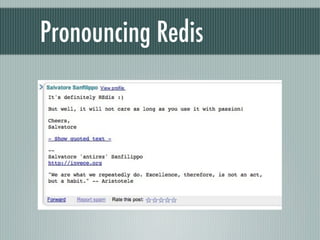
Pronouncing Redis
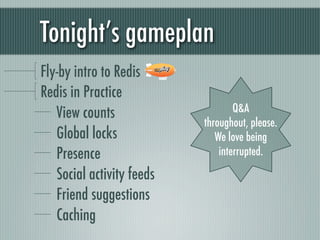
Tonight’s gameplan
Fly-by intro to Redis
Redis in Practice
   View counts                     Q&A
                           throughout, please.
   Global locks               We love being
   Presence                    interrupted.

   Social activity feeds
   Friend suggestions
   Caching
Salvatore
     Sanfilippo
 Original author of Redis.
   @antirez on Twitter.
       Lives in Italy.
Recently hired by VMWare.
  Great project leader.
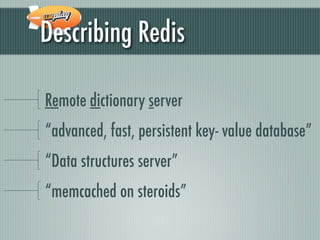
Describing Redis

Remote dictionary server
“advanced, fast, persistent key- value database”
“Data structures server”
“memcached on steroids”
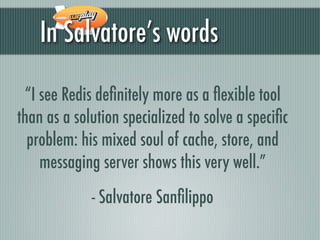
In Salvatore’s words

 “I see Redis definitely more as a flexible tool
than as a solution specialized to solve a specific
  problem: his mixed soul of cache, store, and
    messaging server shows this very well.”
             - Salvatore Sanfilippo
Qualities
Written in C
Few dependencies
Fast
Single-threaded
Lots of clients available
Initial release was March 2009
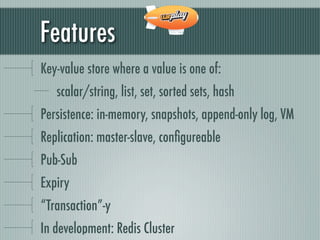
Features
Key-value store where a value is one of:
   scalar/string, list, set, sorted sets, hash
Persistence: in-memory, snapshots, append-only log, VM
Replication: master-slave, configureable
Pub-Sub
Expiry
“Transaction”-y
In development: Redis Cluster
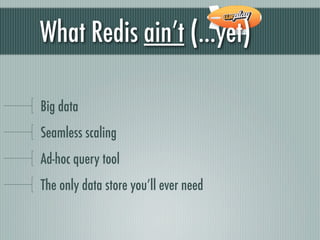
What Redis ain’t (...yet)

Big data
Seamless scaling
Ad-hoc query tool
The only data store you’ll ever need
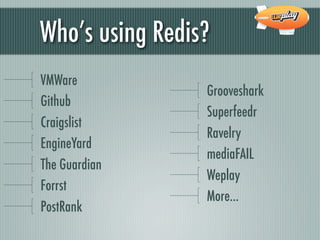
Who’s using Redis?
VMWare
                 Grooveshark
Github
                 Superfeedr
Craigslist
                 Ravelry
EngineYard
                 mediaFAIL
The Guardian
                 Weplay
Forrst
                 More...
PostRank
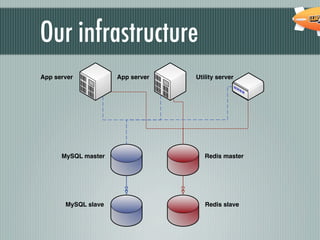
Our infrastructure
App server           App server   Utility server


      MySQL master                   Redis master


       MySQL slave                   Redis slave
Redis in Practice #1

View Counts
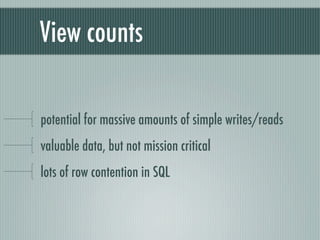
View counts

potential for massive amounts of simple writes/reads
valuable data, but not mission critical
lots of row contention in SQL
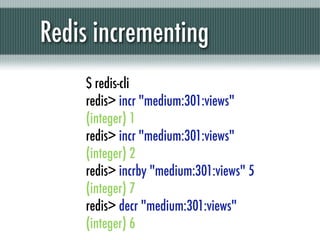
Redis incrementing
    $ redis-cli
    redis> incr "medium:301:views"
    (integer) 1
    redis> incr "medium:301:views"
    (integer) 2
    redis> incrby "medium:301:views" 5
    (integer) 7
    redis> decr "medium:301:views"
    (integer) 6
Redis in Practice #2

Distributed Locks
Subscribe to a Weplay Calendar


                        Subscribe to “ics”
Subscription challenges


Generally static content for long periods of time, but with
short sessions of frequent updates
Expensive to compute on the fly
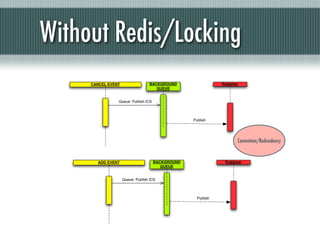
Without Redis/Locking
     CANCEL EVENT                 BACKGROUND                  Pubisher
                                     QUEUE


                Queue: Publish ICS


                                                  Publish


                                                                     Contention/Redundancy


       ADD EVENT                     BACKGROUND                Pubisher
                                        QUEUE


                    Queue: Publish ICS


                                                    Publish
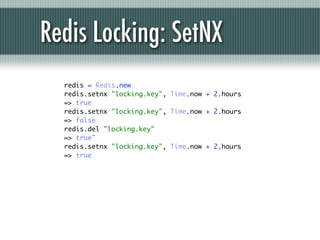
Redis Locking: SetNX
  redis = Redis.new
  redis.setnx "locking.key", Time.now + 2.hours
  => true
  redis.setnx "locking.key", Time.now + 2.hours
  => false
  redis.del "locking.key"
  => true¨
  redis.setnx "locking.key", Time.now + 2.hours
  => true
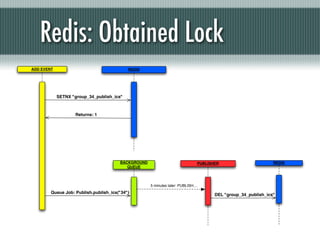
Redis: Obtained Lock
ADD EVENT                                  REDIS


            SETNX "group_34_publish_ics"


                   Returns: 1


                                       BACKGROUND                              PUBLISHER                       REDIS
                                          QUEUE


                                                    5 minutes later: PUBLISH....
        Queue Job: Publish.publish_ics("34")
                                                                                      DEL "group_34_publish_ics"
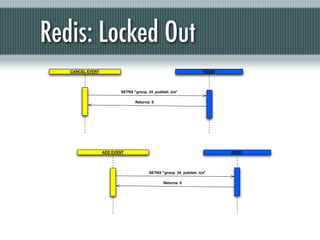
Redis: Locked Out
   CANCEL EVENT                                                  REDIS


                         SETNX "group_34_publish_ics"

                                Returns: 0


                  ADD EVENT                                              REDIS


                                       SETNX "group_34_publish_ics"

                                              Returns: 0
Redis in Practice #3

 Presence
“Who’s online?”
Weplay members told us
they wanted to be able
to see which of their
friends were online...
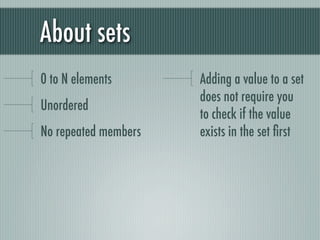
About sets
0 to N elements       Adding a value to a set
                      does not require you
Unordered
                      to check if the value
No repeated members   exists in the set first
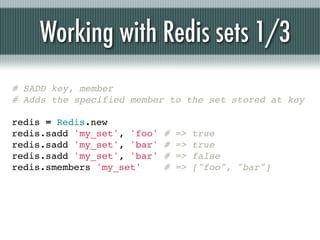
Working with Redis sets 1/3
# SADD key, member
# Adds the specified member to the set stored at key

redis = Redis.new
redis.sadd 'my_set', 'foo'   #   =>   true
redis.sadd 'my_set', 'bar'   #   =>   true
redis.sadd 'my_set', 'bar'   #   =>   false
redis.smembers 'my_set'      #   =>   ["foo", "bar"]
Working with Redis sets 2/3
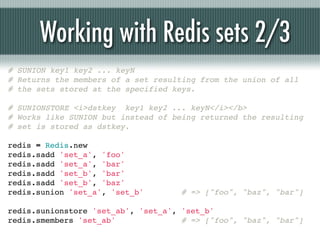
# SUNION key1 key2 ... keyN
# Returns the members of a set resulting from the union of all
# the sets stored at the specified keys.

# SUNIONSTORE <i>dstkey key1 key2 ... keyN</i></b>
# Works like SUNION but instead of being returned the resulting
# set is stored as dstkey.

redis = Redis.new
redis.sadd 'set_a', 'foo'
redis.sadd 'set_a', 'bar'
redis.sadd 'set_b', 'bar'
redis.sadd 'set_b', 'baz'
redis.sunion 'set_a', 'set_b'        # => ["foo", "baz", "bar"]

redis.sunionstore 'set_ab', 'set_a', 'set_b'
redis.smembers 'set_ab'              # => ["foo", "baz", "bar"]
Working with Redis sets 3/3
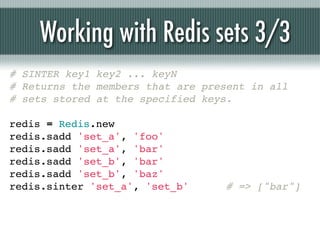
# SINTER key1 key2 ... keyN
# Returns the members that are present in all
# sets stored at the specified keys.

redis = Redis.new
redis.sadd 'set_a', 'foo'
redis.sadd 'set_a', 'bar'
redis.sadd 'set_b', 'bar'
redis.sadd 'set_b', 'baz'
redis.sinter 'set_a', 'set_b'      # => ["bar"]
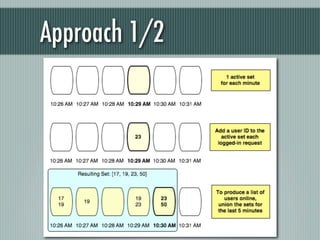
Approach 1/2
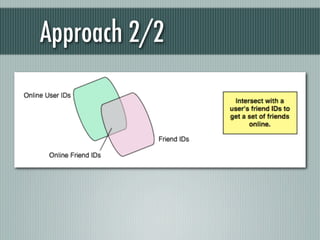
Approach 2/2
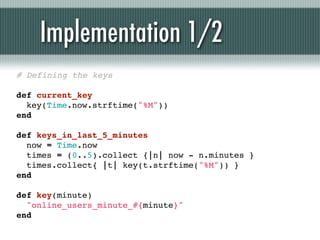
Implementation 1/2
# Defining the keys

def current_key
  key(Time.now.strftime("%M"))
end

def keys_in_last_5_minutes
  now = Time.now
  times = (0..5).collect {|n| now - n.minutes }
  times.collect{ |t| key(t.strftime("%M")) }
end

def key(minute)
  "online_users_minute_#{minute}"
end
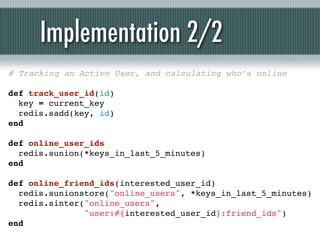
Implementation 2/2
# Tracking an Active User, and calculating who’s online

def track_user_id(id)
  key = current_key
  redis.sadd(key, id)
end

def online_user_ids
  redis.sunion(*keys_in_last_5_minutes)
end

def online_friend_ids(interested_user_id)
  redis.sunionstore("online_users", *keys_in_last_5_minutes)
  redis.sinter("online_users",
               "user:#{interested_user_id}:friend_ids")
end
Redis in Practice #4

Social Activity Feeds
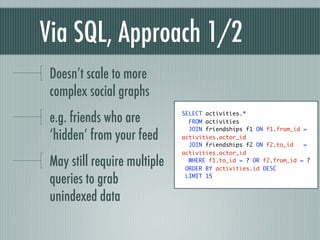
Via SQL, Approach 1/2
 Doesn’t scale to more
 complex social graphs
 e.g. friends who are         SELECT activities.*
                                FROM activities
                                JOIN friendships f1 ON f1.from_id =
 ‘hidden’ from your feed      activities.actor_id
                                JOIN friendships f2 ON f2.to_id   =
                              activities.actor_id
 May still require multiple     WHERE f1.to_id = ? OR f2.from_id = ?
                               ORDER BY activities.id DESC

 queries to grab               LIMIT 15


 unindexed data
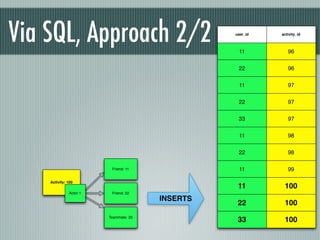
Via SQL, Approach 2/2                             user_id


                                                   11
                                                            activity_id


                                                               96

                                                   22          96

                                                   11          97

                                                   22          97

                                                   33          97

                                                   11          98

                                                   22          98

                          Friend: 11               11          99

    Activity: 100
                                                   11        100
               Actor 1    Friend: 22
                                        INSERTS
                                                   22        100
                         Teammate: 33
                                                   33        100
Large SQL table

Grew quickly
Difficult to maintain
Difficult to prune
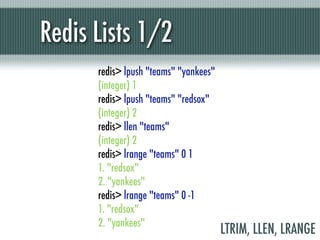
Redis Lists 1/2
      redis> lpush "teams" "yankees"
      (integer) 1
      redis> lpush "teams" "redsox"
      (integer) 2
      redis> llen "teams"
      (integer) 2
      redis> lrange "teams" 0 1
      1. "redsox"
      2. "yankees"
      redis> lrange "teams" 0 -1
      1. "redsox"
      2. "yankees"
                                       LTRIM, LLEN, LRANGE
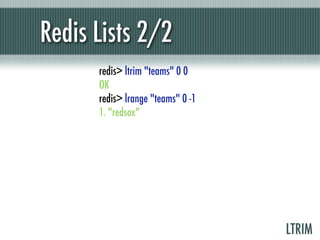
Redis Lists 2/2
      redis> ltrim "teams" 0 0
      OK
      redis> lrange "teams" 0 -1
      1. "redsox"


                                   LTRIM
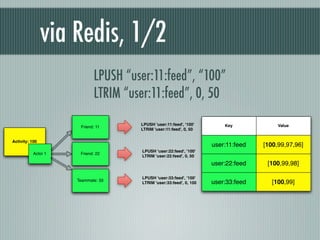
via Redis, 1/2
                            LPUSH “user:11:feed”, “100”
                            LTRIM “user:11:feed”, 0, 50
                                     LPUSH 'user:11:feed', '100'        Key             Value
                      Friend: 11
                                     LTRIM 'user:11:feed', 0, 50

Activity: 100
                                                                    user:11:feed   [100,99,97,96]
                                     LPUSH 'user:22:feed', '100'
           Actor 1    Friend: 22
                                     LTRIM 'user:22:feed', 0, 50
                                                                    user:22:feed    [100,99,98]

                                     LPUSH 'user:33:feed', '100'
                     Teammate: 33
                                     LTRIM 'user:33:feed', 0, 100   user:33:feed      [100,99]
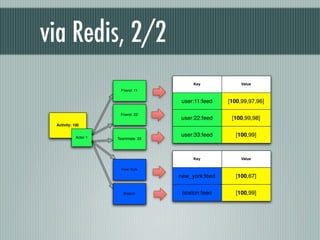
via Redis, 2/2
                                          Key             Value
                       Friend: 11


                                      user:11:feed   [100,99,97,96]

                       Friend: 22
                                     user:22:feed     [100,99,98]
 Activity: 100


            Actor 1
                                     user:33:feed       [100,99]
                      Teammate: 33


                                          Key             Value

                       New York
                                     new_york:feed      [100,67]


                         Boston       boston:feed       [100,99]
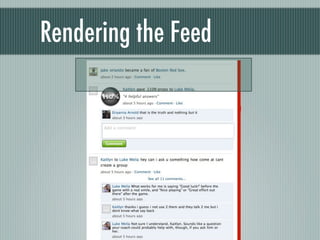
Rendering the Feed
Redis in Practice #5

Friend Suggestions
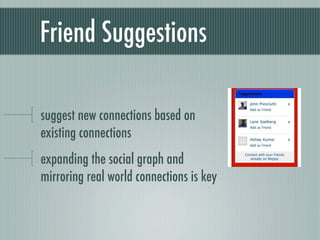
Friend Suggestions

suggest new connections based on
existing connections
expanding the social graph and
mirroring real world connections is key
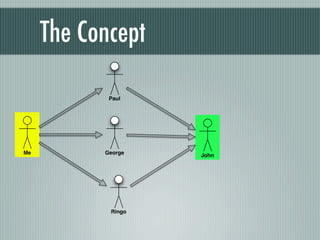
The Concept

            Paul


Me         George   John


            Ringo
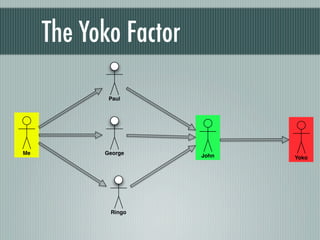
The Yoko Factor

            Paul


Me         George      John   Yoko


            Ringo
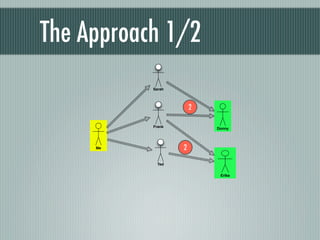
The Approach 1/2
           Sarah


                       2

           Frank           Donny


     Me            2

             Ted

                            Erika
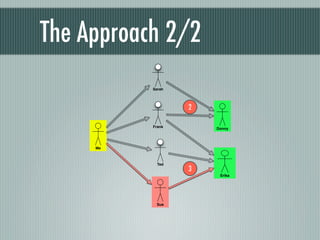
The Approach 2/2
           Sarah


                   2

           Frank       Donny


     Me


             Ted
                   3
                        Erika


            Sue
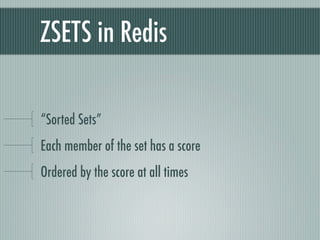
ZSETS in Redis

“Sorted Sets”
Each member of the set has a score
Ordered by the score at all times
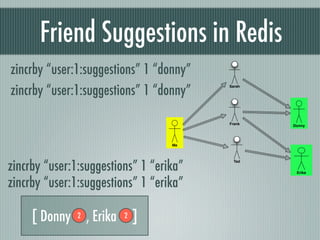
Friend Suggestions in Redis
zincrby “user:1:suggestions” 1 “donny”
                                          Sarah


                                          Frank   Donny


                                     Me


zincrby “user:1:suggestions” 1 “erika”
                                            Ted

                                                   Erika


zincrby “user:1:suggestions” 1 “erika”

     [ Donny   2   , Erika   2   ]
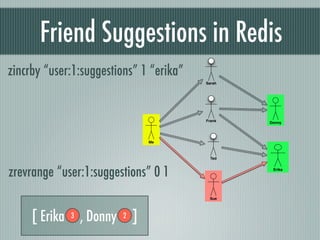
Friend Suggestions in Redis
zincrby “user:1:suggestions” 1 “erika”
                                          Sarah


                                          Frank   Donny


                                     Me


                                            Ted


zrevrange “user:1:suggestions” 0 1                 Erika


                                           Sue


     [ Erika   3   , Donny   2   ]
Redis in Practice #6

  Caching
Suitability for caching
Excellent match for managed denormalization
   ex. friendships, teams, teammates
Excellent match where you would benefit from persistence
and/or replication
Historically, not a good match for a “generational cache,” in
which you want to optimize memory use by evicting least-
recently used (LRU) keys
As an LRU cache
TTL-support since inception, but with unintuitive behavior
   Writing to volatile key replaced it and cleared the TTL
Redis 2.2 changes this behavior and adds key features:
   ability to write to, and update expiry of volatile keys
   maxmemory [bytes], maxmemory-policy [policy]
   policies: volatile-lru, volatile-ttl, volatile-random,
   allkeys-lru, allkeys-random
Easy to adapt


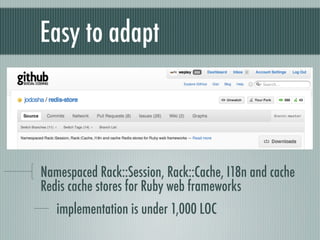
Namespaced Rack::Session, Rack::Cache, I18n and cache
Redis cache stores for Ruby web frameworks
   implementation is under 1,000 LOC
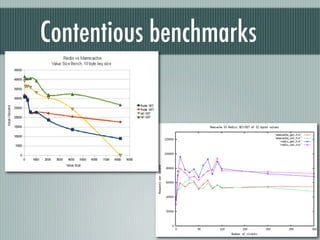
Contentious benchmarks
Any
questions?


                  Thanks!
    Follow us on Twitter: @noahd1 and @lukemelia
   Tell your friends in youth sports about Weplay.com