Kicking Ass With


Redis for real world problems
Dvir Volk, Chief Architect, Everything.me (@dvirsky)
O HAI! I CAN HAS REDIS?
Extremely Quick introduction to Redis
● Key => Data Structure server
● In memory, with persistence
● Extremely fast and versatile
● Rapidly growing (Instagr.am, Craigslist, Youporn ....)
● Open Source, awesome community
● Used as the primary data source in Everything.me:
    ○ Relational Data
    ○ Queueing
    ○ Caching
    ○ Machine Learning
    ○ Text Processing and search
    ○ Geo Stuff
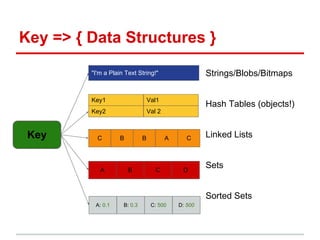
Key => { Data Structures }

         "I'm a Plain Text String!"                    Strings/Blobs/Bitmaps

         Key1                     Val1
                                                       Hash Tables (objects!)
         Key2                     Val 2


 Key       C        B         B           A      C     Linked Lists


            A           B            C         D
                                                       Sets


                                                       Sorted Sets
          A: 0.1     B: 0.3        C: 500     D: 500
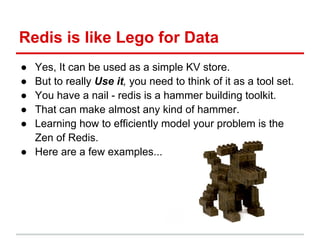
Redis is like Lego for Data
● Yes, It can be used as a simple KV store.
● But to really Use it, you need to think of it as a tool set.
● You have a nail - redis is a hammer building toolkit.
● That can make almost any kind of hammer.
● Learning how to efficiently model your problem is the
  Zen of Redis.
● Here are a few examples...
Pattern 1: Simple, Fast, Object Store
Our problem:
● Very fast object store that scales up well.
● High write throughput.
● Atomic manipulation of object members.

Possible use cases:
● Online user data (session, game state)
● Social Feed
● Shopping Cart
● Anything, really...
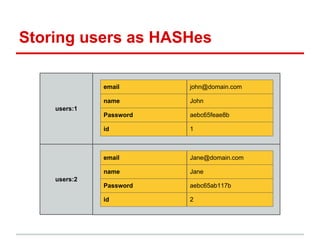
Storing users as HASHes

              email      john@domain.com

              name       John
    users:1
              Password   aebc65feae8b

              id         1


              email      Jane@domain.com

              name       Jane
    users:2
              Password   aebc65ab117b

              id         2
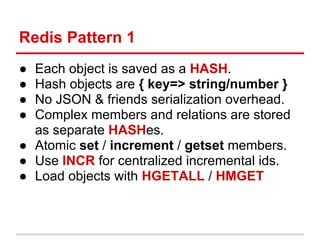
Redis Pattern 1
● Each object is saved as a HASH.
● Hash objects are { key=> string/number }
● No JSON & friends serialization overhead.
● Complex members and relations are stored
  as separate HASHes.
● Atomic set / increment / getset members.
● Use INCR for centralized incremental ids.
● Load objects with HGETALL / HMGET
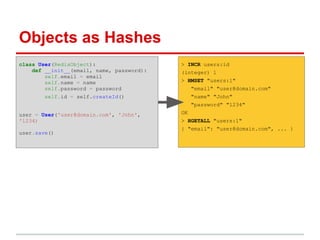
Objects as Hashes
class User(RedisObject):                   > INCR users:id
    def __init__(email, name, password):   (integer) 1
        self.email = email
        self.name = name                   > HMSET "users:1"
        self.password = password                "email" "user@domain.com"
        self.id = self.createId()               "name" "John"
                                                "password" "1234"
user = User('user@domain.com', 'John',     OK
'1234)                                     > HGETALL "users:1"
                                           { "email": "user@domain.com", ... }
user.save()
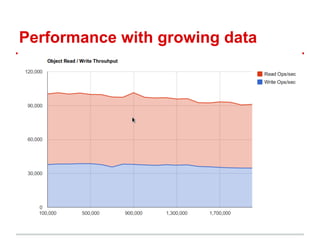
Performance with growing data
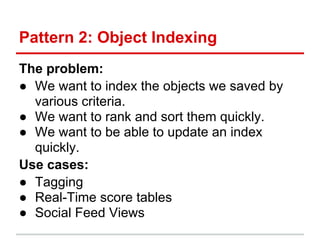
Pattern 2: Object Indexing
The problem:
● We want to index the objects we saved by
  various criteria.
● We want to rank and sort them quickly.
● We want to be able to update an index
  quickly.
Use cases:
● Tagging
● Real-Time score tables
● Social Feed Views
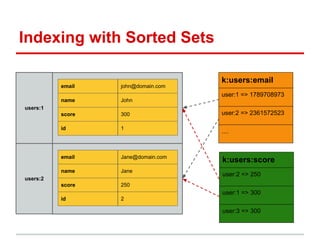
Indexing with Sorted Sets

                                    k:users:email
          email   john@domain.com
                                    user:1 => 1789708973
          name    John
users:1
          score   300               user:2 => 2361572523

          id      1
                                    ....


          email   Jane@domain.com
                                    k:users:score
          name    Jane
                                    user:2 => 250
users:2
          score   250
                                    user:1 => 300
          id      2

                                    user:3 => 300
Redis Pattern
●   Indexes are sorted sets (ZSETs)
●   Access by value O(1), by score O(log(N)). plus ranges.
●   Sorted Sets map { value => score (double) }
●   So we map { objectId => score }
●   For numerical members, the value is the score
●   For string members, the score is a hash of the string.

● Fetching is done with ZRANGEBYSCORE
● Ranges with ZRANGE / ZRANGEBYSCORE on
  numeric values only (or very short strings)
● Deleting is done with ZREM
● Intersecting keys is possible with ZINTERSTORE
● Each class' objects have a special sorted set for ids.
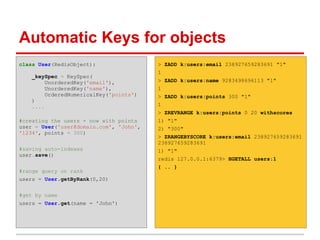
Automatic Keys for objects
class User(RedisObject):                 > ZADD k:users:email 238927659283691 "1"
                                         1
    _keySpec = KeySpec(
        UnorderedKey('email'),           > ZADD k:users:name 9283498696113 "1"
        UnorderedKey('name'),            1
        OrderedNumericalKey('points')    > ZADD k:users:points 300 "1"
    )
    ....                                 1
                                         > ZREVRANGE k:users:points 0 20 withscores
#creating the users - now with points    1) "1"
user = User('user@domain.com', 'John',   2) "300"
'1234', points = 300)
                                         > ZRANGEBYSCORE k:users:email 238927659283691
                                         238927659283691
#saving auto-indexes                     1) "1"
user.save()
                                         redis 127.0.0.1:6379> HGETALL users:1
                                         { .. }
#range query on rank
users = User.getByRank(0,20)


#get by name
users = User.get(name = 'John')
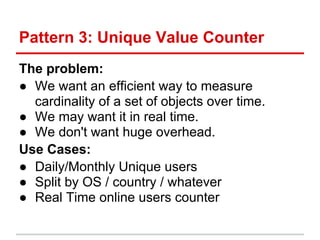
Pattern 3: Unique Value Counter
The problem:
● We want an efficient way to measure
  cardinality of a set of objects over time.
● We may want it in real time.
● We don't want huge overhead.
Use Cases:
● Daily/Monthly Unique users
● Split by OS / country / whatever
● Real Time online users counter
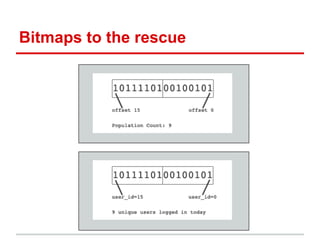
Bitmaps to the rescue
Redis Pattern
● Redis strings can be treated as bitmaps.
● We keep a bitmap for each time slot.
● We use BITSET offset=<object id>
● the size of a bitmap is max_id/8 bytes
● Cardinality per slot with BITCOUNT (2.6)
● Fast bitwise operations - OR / AND / XOR
  between time slots with BITOP
● Aggregate and save results periodically.
● Requires sequential object ids - or mapping
  of (see incremental ids)
Counter API (with redis internals)
counter = BitmapCounter('uniques', timeResolutions=(RES_DAY,))

#sampling current users
counter.add(userId)
> BITSET uniques:day:1339891200 <userId> 1
#Getting the unique user count for today
counter.getCount(time.time())
> BITCOUNT uniques:day:1339891200
 
#Getting the the weekly unique users in the past week
timePoints = [now() - 86400*i for i in xrange(7, 0, -1)]
counter.aggregateCounts(timePoints, counter.OP_TOTAL)
> BITOP OR tmp_key uniques:day:1339891200 uniques:day:1339804800 ....
> BITCOUNT tmp_key


Pattern 4: Geo resolving
The Problem:
● Resolve lat,lon to real locations
● Find locations of a certain class (restaurants)
  near me
● IP2Location search

Use Cases:
● Find a user's City, ZIP code, Country, etc.
● Find the user's location by IP
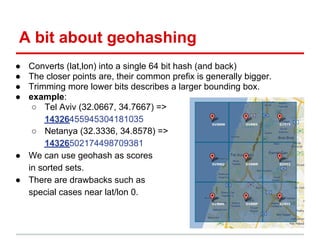
A bit about geohashing
● Converts (lat,lon) into a single 64 bit hash (and back)
● The closer points are, their common prefix is generally bigger.
● Trimming more lower bits describes a larger bounding box.
● example:
   ○ Tel Aviv (32.0667, 34.7667) =>
      14326455945304181035
   ○ Netanya (32.3336, 34.8578) =>
      14326502174498709381
● We can use geohash as scores
  in sorted sets.
● There are drawbacks such as
  special cases near lat/lon 0.
Redis Pattern
● Let's index cities in a sorted set:
   ○ { cityId => geohash(lat,lon) }
● We convert the user's {lat,lon} into a goehash too.
● Using ZRANGEBYSCORE we find the N larger and N
  smaller elements in the set:
   ○ ZRANGEBYSCORE <user_hash> +inf 0 8
   ○ ZREVRANGEBYSCORE <user_hash> -inf 0 8
● We use the scores as lat,lons again to find distance.
● We find the closest city, and load it.
● We can save bounding rects for more precision.
● The same can be done for ZIP codes, venues, etc.
● IP Ranges are indexed on a sorted set, too.
Other interesting use cases
●   Distributed Queue
     ○ Workers use blocking pop (BLPOP) on a list.
     ○ Whenever someone pushes a task to the list (RPUSH) it will be
        popped by exactly one worker.

●   Push notifications / IM
     ○ Use redis PubSub objects as messaging channels between users.
     ○ Combine with WebSocket to push messages to Web Browsers, a-la
       googletalk.

●   Machine learning
    ○ Use redis sorted sets as a fast storage for feature vectors, frequency
       counts, probabilities, etc.
    ○ Intersecting sorted sets can yield SUM(scores) - think log(P(a)) + log
       (P(b))
Get the sources
Implementations of most of the examples in this
slideshow:
https://github.com/EverythingMe/kickass-redis

Geo resolving library:
http://github.com/doat/geodis

Get redis at http://redis.io

Kicking ass with redis

  • 1.
    Kicking Ass With Redisfor real world problems Dvir Volk, Chief Architect, Everything.me (@dvirsky)
  • 2.
    O HAI! ICAN HAS REDIS? Extremely Quick introduction to Redis ● Key => Data Structure server ● In memory, with persistence ● Extremely fast and versatile ● Rapidly growing (Instagr.am, Craigslist, Youporn ....) ● Open Source, awesome community ● Used as the primary data source in Everything.me: ○ Relational Data ○ Queueing ○ Caching ○ Machine Learning ○ Text Processing and search ○ Geo Stuff
  • 3.
    Key => {Data Structures } "I'm a Plain Text String!" Strings/Blobs/Bitmaps Key1 Val1 Hash Tables (objects!) Key2 Val 2 Key C B B A C Linked Lists A B C D Sets Sorted Sets A: 0.1 B: 0.3 C: 500 D: 500
  • 4.
    Redis is likeLego for Data ● Yes, It can be used as a simple KV store. ● But to really Use it, you need to think of it as a tool set. ● You have a nail - redis is a hammer building toolkit. ● That can make almost any kind of hammer. ● Learning how to efficiently model your problem is the Zen of Redis. ● Here are a few examples...
  • 5.
    Pattern 1: Simple,Fast, Object Store Our problem: ● Very fast object store that scales up well. ● High write throughput. ● Atomic manipulation of object members. Possible use cases: ● Online user data (session, game state) ● Social Feed ● Shopping Cart ● Anything, really...
  • 6.
    Storing users asHASHes email john@domain.com name John users:1 Password aebc65feae8b id 1 email Jane@domain.com name Jane users:2 Password aebc65ab117b id 2
  • 7.
    Redis Pattern 1 ●Each object is saved as a HASH. ● Hash objects are { key=> string/number } ● No JSON & friends serialization overhead. ● Complex members and relations are stored as separate HASHes. ● Atomic set / increment / getset members. ● Use INCR for centralized incremental ids. ● Load objects with HGETALL / HMGET
  • 8.
    Objects as Hashes classUser(RedisObject): > INCR users:id def __init__(email, name, password): (integer) 1 self.email = email self.name = name > HMSET "users:1" self.password = password "email" "user@domain.com" self.id = self.createId() "name" "John" "password" "1234" user = User('user@domain.com', 'John', OK '1234) > HGETALL "users:1" { "email": "user@domain.com", ... } user.save()
  • 9.
  • 10.
    Pattern 2: ObjectIndexing The problem: ● We want to index the objects we saved by various criteria. ● We want to rank and sort them quickly. ● We want to be able to update an index quickly. Use cases: ● Tagging ● Real-Time score tables ● Social Feed Views
  • 11.
    Indexing with SortedSets k:users:email email john@domain.com user:1 => 1789708973 name John users:1 score 300 user:2 => 2361572523 id 1 .... email Jane@domain.com k:users:score name Jane user:2 => 250 users:2 score 250 user:1 => 300 id 2 user:3 => 300
  • 12.
    Redis Pattern ● Indexes are sorted sets (ZSETs) ● Access by value O(1), by score O(log(N)). plus ranges. ● Sorted Sets map { value => score (double) } ● So we map { objectId => score } ● For numerical members, the value is the score ● For string members, the score is a hash of the string. ● Fetching is done with ZRANGEBYSCORE ● Ranges with ZRANGE / ZRANGEBYSCORE on numeric values only (or very short strings) ● Deleting is done with ZREM ● Intersecting keys is possible with ZINTERSTORE ● Each class' objects have a special sorted set for ids.
  • 13.
    Automatic Keys forobjects class User(RedisObject): > ZADD k:users:email 238927659283691 "1" 1 _keySpec = KeySpec( UnorderedKey('email'), > ZADD k:users:name 9283498696113 "1" UnorderedKey('name'), 1 OrderedNumericalKey('points') > ZADD k:users:points 300 "1" ) .... 1 > ZREVRANGE k:users:points 0 20 withscores #creating the users - now with points 1) "1" user = User('user@domain.com', 'John', 2) "300" '1234', points = 300) > ZRANGEBYSCORE k:users:email 238927659283691 238927659283691 #saving auto-indexes 1) "1" user.save() redis 127.0.0.1:6379> HGETALL users:1 { .. } #range query on rank users = User.getByRank(0,20) #get by name users = User.get(name = 'John')
  • 14.
    Pattern 3: UniqueValue Counter The problem: ● We want an efficient way to measure cardinality of a set of objects over time. ● We may want it in real time. ● We don't want huge overhead. Use Cases: ● Daily/Monthly Unique users ● Split by OS / country / whatever ● Real Time online users counter
  • 15.
  • 16.
    Redis Pattern ● Redisstrings can be treated as bitmaps. ● We keep a bitmap for each time slot. ● We use BITSET offset=<object id> ● the size of a bitmap is max_id/8 bytes ● Cardinality per slot with BITCOUNT (2.6) ● Fast bitwise operations - OR / AND / XOR between time slots with BITOP ● Aggregate and save results periodically. ● Requires sequential object ids - or mapping of (see incremental ids)
  • 17.
    Counter API (withredis internals) counter = BitmapCounter('uniques', timeResolutions=(RES_DAY,)) #sampling current users counter.add(userId) > BITSET uniques:day:1339891200 <userId> 1 #Getting the unique user count for today counter.getCount(time.time()) > BITCOUNT uniques:day:1339891200   #Getting the the weekly unique users in the past week timePoints = [now() - 86400*i for i in xrange(7, 0, -1)] counter.aggregateCounts(timePoints, counter.OP_TOTAL) > BITOP OR tmp_key uniques:day:1339891200 uniques:day:1339804800 .... > BITCOUNT tmp_key      
  • 18.
    Pattern 4: Georesolving The Problem: ● Resolve lat,lon to real locations ● Find locations of a certain class (restaurants) near me ● IP2Location search Use Cases: ● Find a user's City, ZIP code, Country, etc. ● Find the user's location by IP
  • 19.
    A bit aboutgeohashing ● Converts (lat,lon) into a single 64 bit hash (and back) ● The closer points are, their common prefix is generally bigger. ● Trimming more lower bits describes a larger bounding box. ● example: ○ Tel Aviv (32.0667, 34.7667) => 14326455945304181035 ○ Netanya (32.3336, 34.8578) => 14326502174498709381 ● We can use geohash as scores in sorted sets. ● There are drawbacks such as special cases near lat/lon 0.
  • 20.
    Redis Pattern ● Let'sindex cities in a sorted set: ○ { cityId => geohash(lat,lon) } ● We convert the user's {lat,lon} into a goehash too. ● Using ZRANGEBYSCORE we find the N larger and N smaller elements in the set: ○ ZRANGEBYSCORE <user_hash> +inf 0 8 ○ ZREVRANGEBYSCORE <user_hash> -inf 0 8 ● We use the scores as lat,lons again to find distance. ● We find the closest city, and load it. ● We can save bounding rects for more precision. ● The same can be done for ZIP codes, venues, etc. ● IP Ranges are indexed on a sorted set, too.
  • 21.
    Other interesting usecases ● Distributed Queue ○ Workers use blocking pop (BLPOP) on a list. ○ Whenever someone pushes a task to the list (RPUSH) it will be popped by exactly one worker. ● Push notifications / IM ○ Use redis PubSub objects as messaging channels between users. ○ Combine with WebSocket to push messages to Web Browsers, a-la googletalk. ● Machine learning ○ Use redis sorted sets as a fast storage for feature vectors, frequency counts, probabilities, etc. ○ Intersecting sorted sets can yield SUM(scores) - think log(P(a)) + log (P(b))
  • 22.
    Get the sources Implementationsof most of the examples in this slideshow: https://github.com/EverythingMe/kickass-redis Geo resolving library: http://github.com/doat/geodis Get redis at http://redis.io