REDEFINING ASSUMPTIONS
  Accessibility and Its Stakeholders


   Rui Lopes, Karel Van Isacker, Luís Carriço

              rlopes@di.fc.ul.pt
MOTIVATION

Solving the problems of accessing information without barriers
requires efforts in different fronts.

Stakeholders on accessibility face different problems,
motivations, solutions.

Accessibility field is ineffective if stakeholders target just
individually – the whole is bigger than the sum of the parts.
MOTIVATION


Surveys show that

 • Web       masters play a critical role on accessibility (Lazar et al., 2004)

 • Law   enforcement tends to work on govt. Websites (Yao et al., 2009)

 • ... but   knowledge and abidance rates are very low (Freire et al., 2008)
PROBLEM


Notice that

 • the few surveys that have been done are focused on one
   technology domain – the Web.

 • Stakeholders   are studied (almost) independently.
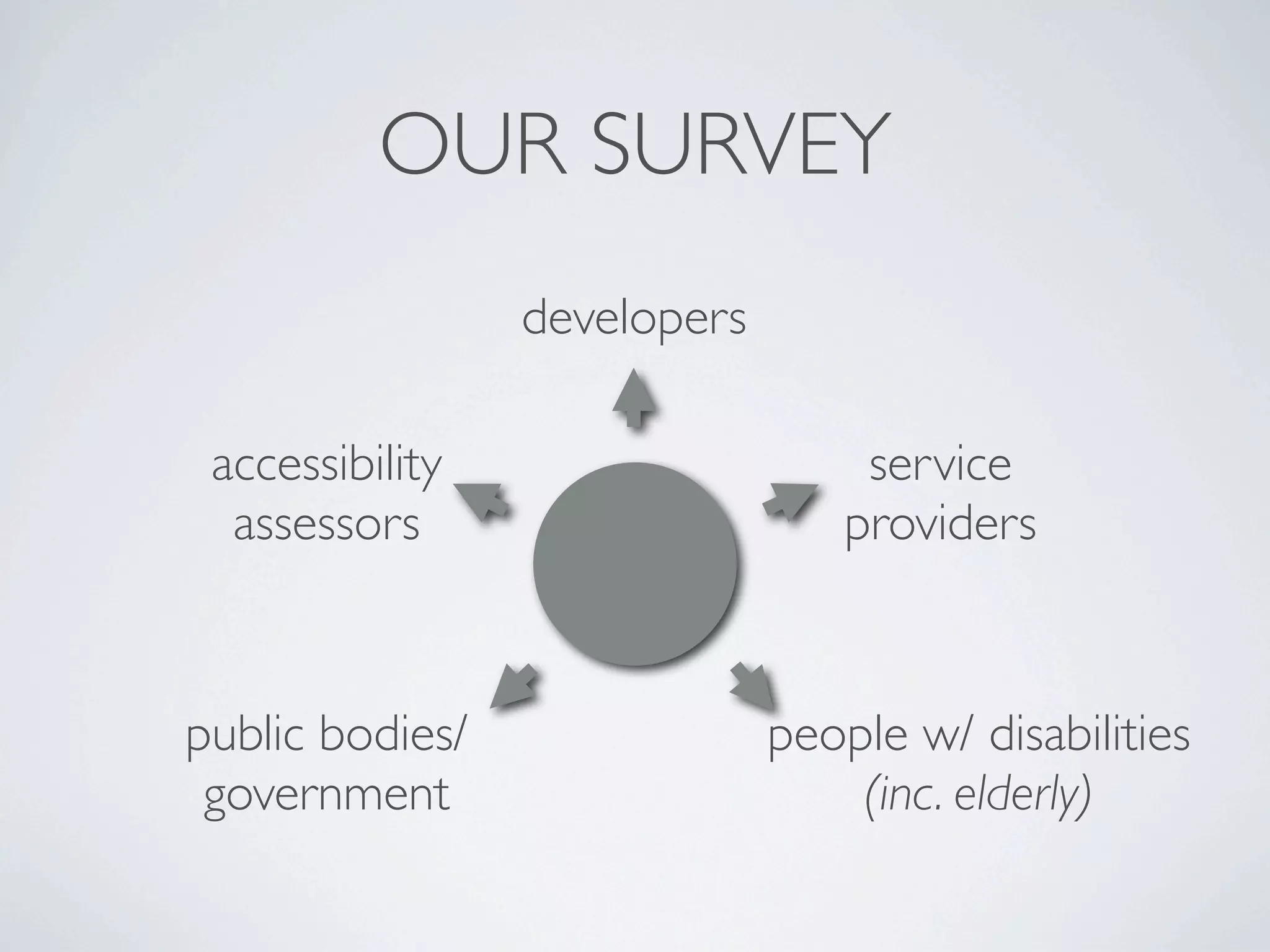
OUR SURVEY
                 developers

 accessibility                     service
  assessors                       providers


public bodies/                people w/ disabilities
 government                       (inc. elderly)
METHODOLOGY


• Questionnaires      for each stakeholder

• Online   & paper / self-answered & face-to-face interviews

•7   languages: cz, en, fr, de, gr, it, pt.

• Demographic    – comprehension, working, expectation on
 accessibility – employment – user behaviour with Internet.
RESULTS – GENERAL


• Survey   took place in several countries, from April to July 2009.

• People with disabilities and elderly mostly through face-to-face
 interviews.

• 408   individuals surveyed (76.2% male).
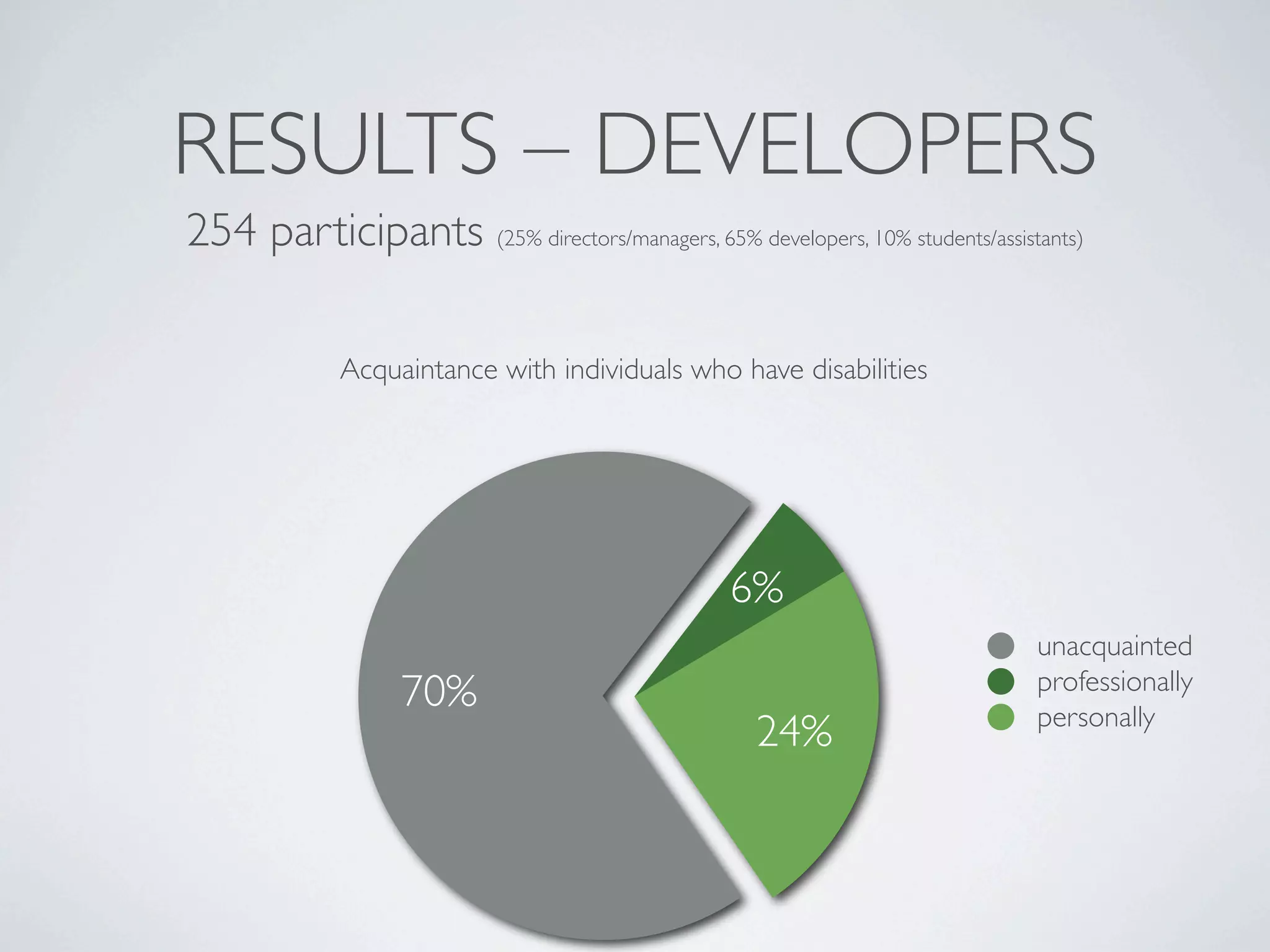
RESULTS – DEVELOPERS
254 participants (25% directors/managers, 65% developers, 10% students/assistants)

              Acquaintance with individuals who have disabilities


                                                 6%
                                                                             unacquainted
                                                                             professionally
                   70%                                                       personally
                                                    24%
RESULTS – DEVELOPERS


They expressed need for more knowledge about assistive
devices & more education through project groups (67%),
workshops (53%), and online training (34%).
RESULTS – DEVELOPERS
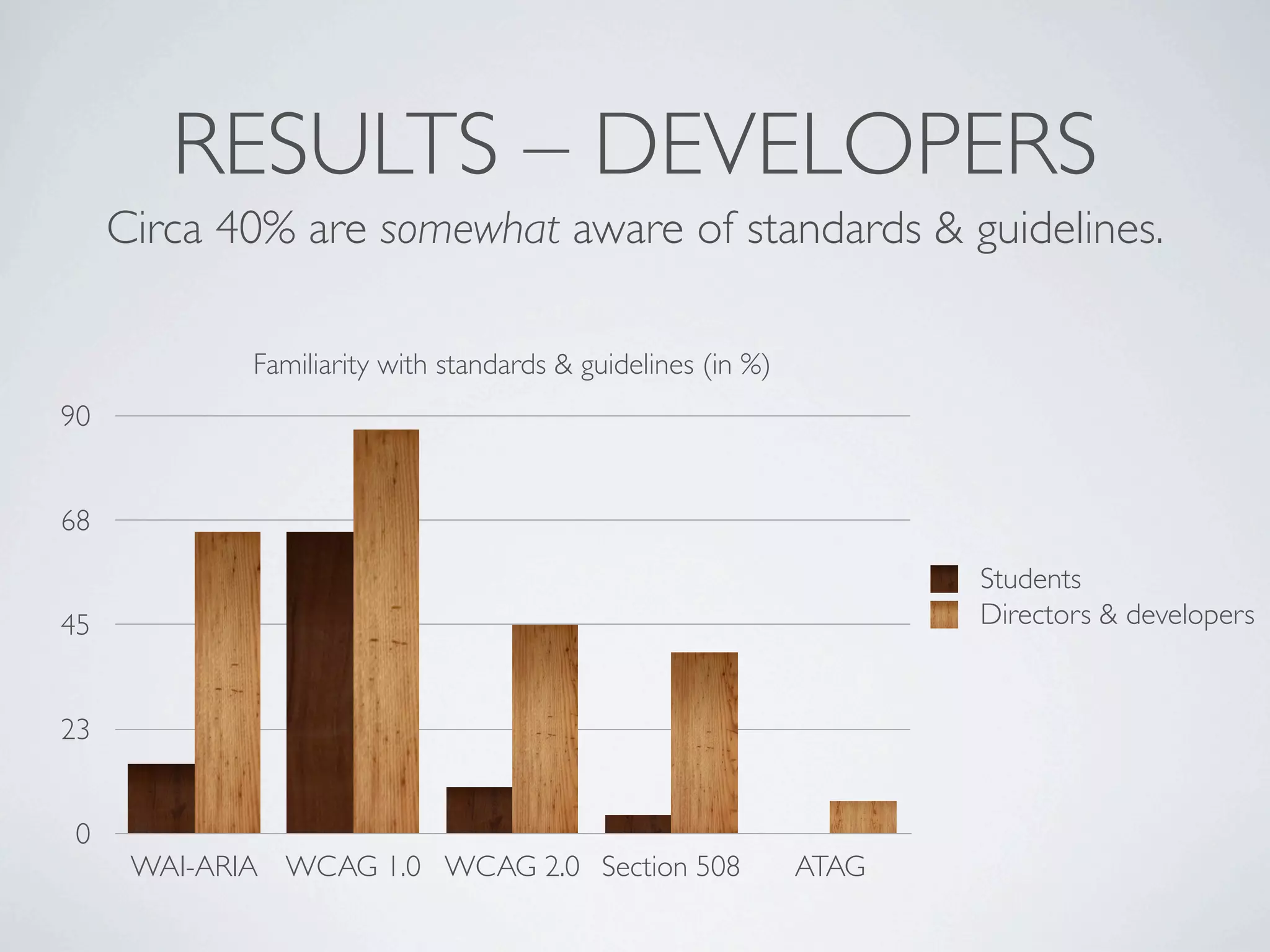
     Circa 40% are somewhat aware of standards & guidelines.

             Familiarity with standards & guidelines (in %)
90


68
                                                                     Students
45                                                                   Directors & developers


23


 0
      WAI-ARIA WCAG 1.0 WCAG 2.0 Section 508                  ATAG
RESULTS – DEVELOPERS
             Knowledge is (not necessarily) power.


“[...] do have a shelf of books on WCAG [...], but hardly any of us
uses it as we lack the time. What we all seek for is an embedded
validator in our day to day developing tools such as Microsoft Visual
Studio [...]”


Accessibility simulation + tailored authoring preferred (70%),
but traditional assessment tools also (48%). Online & download
(49%).
RESULTS – SERVICE PROVIDERS
                41 participants (24% men; between 24-60 years old)


• Primarily
         employed on accessible Web design & consulting,
 mostly working on SME (90%).

• 34%   have some kind of impairment.
RESULTS – SERVICE PROVIDERS
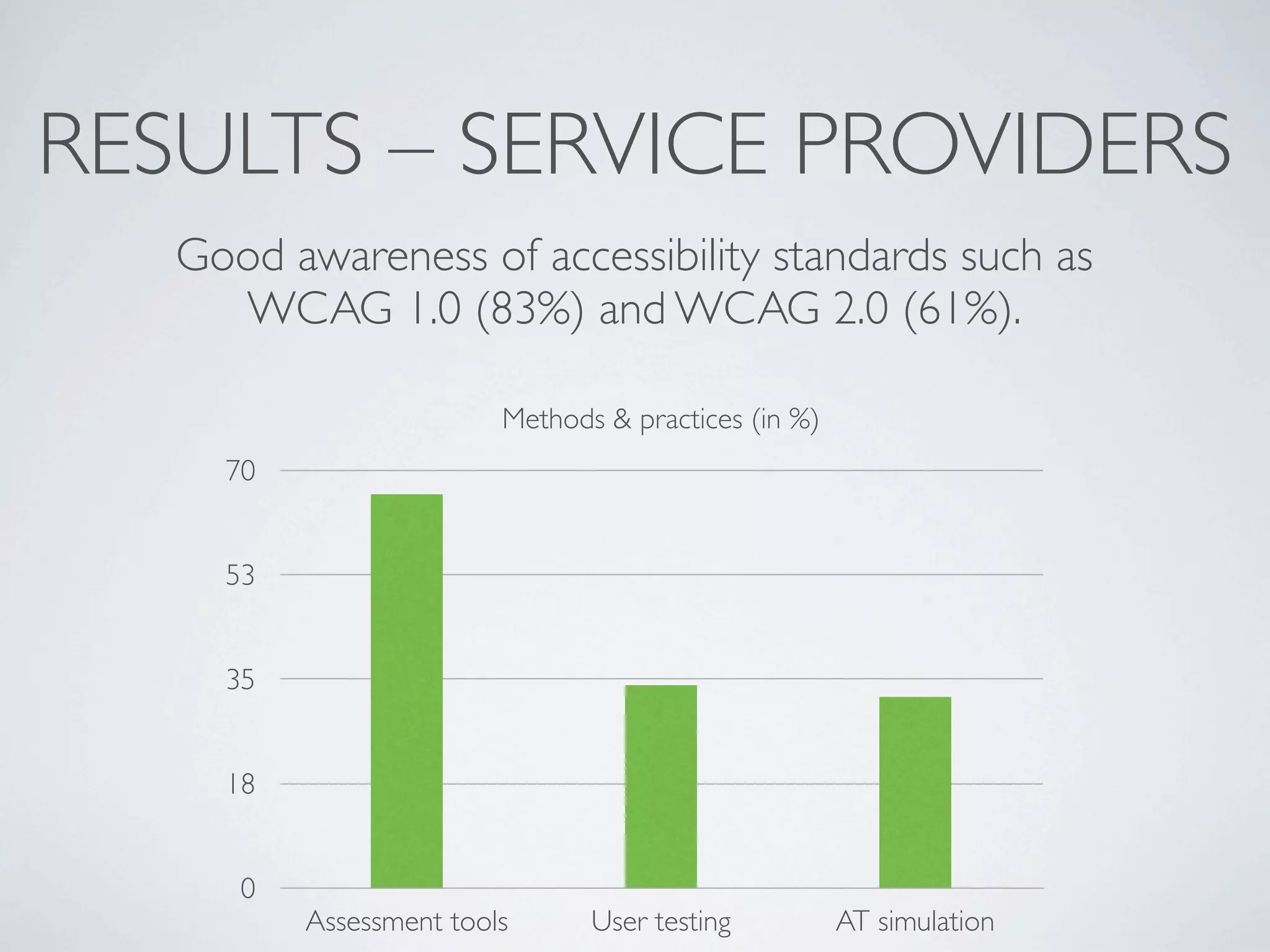
   Good awareness of accessibility standards such as
     WCAG 1.0 (83%) and WCAG 2.0 (61%).

                         Methods & practices (in %)
     70


     53


     35


     18


      0
          Assessment tools      User testing          AT simulation
RESULTS – SERVICE PROVIDERS

• Good  awareness of accessibility standards, e.g., WCAG 1.0
  (83%) and WCAG 2.0 (61%).

• Still, the
          most eager stakeholder for further advancements, such
  as accessibility on mobile Web (66%) and better simulation
  tools (85%).

• Want   to be updated via online resources (83%), as well tools
  availability online.
RESULTS – PUBLIC BODIES
                  18 participants (servants & officials; 28-60 years old; 11 men)


• Theywork for public bodies, governmental agencies and public
 corporations.

• Small
      sample, difficultly obtaining permission through official
 channels...

    • ... but   all subject to laws and regulations on accessibility.
RESULTS – PUBLIC BODIES


• All
    familiar with (HCI-centric) accessibility, but 75% also
 associate term with physical properties.

• Internal
         training takes place (56%), but lack of internal
 expertise identified as a problem (72%).

• Big   interest on events & database of experts to help them.
RESULTS – PUBLIC BODIES


• Evaluation  tools are main entry point to ensure some
 accessibility (67%).

• Little   to no use of end-users and AT-centric testing.

• Highexpectation on certification “stamps”(e.g., WCAG AAA)
 from their superiors/decision makers (78%).
RESULTS – A11Y ASSESSORS
              37 participants (heterogeneous group; 23-54 years old; 24 men)


• Accessibility
              champions in the society: experts, counsellors,
 consulters, professors.

• Most   of them have > 10 years of experience.

•9   have an impairment.

• 11 are members of organisations for people with disabilities
 (inc. all the 9 above).
RESULTS – A11Y ASSESSORS


• High   awareness of standards and guidelines (81%).

• WCAG    1.0 was particularly mentioned due to being the basis
 for laws in several countries.

• Theyhave an active role on Web accessibility (81%) and
 desktop (41%).
RESULTS – A11Y ASSESSORS


• Evaluation  & simulation tools mostly used, with strong feelings
 for disability (77%) and AT simulation (80%).

• Invitations          to events on accessibility issues desired (63%).
 (icchp 2011 shouldn’t have a problem hitting the break-even!!!)
RESULTS – END USERS
  67 participants (75% claim to have a disability; 19-75 years old; 38 men)


                             disability awareness
100

 75

 50

 25

  0
  [..., 29]       [30-39]          [40-49]           [50-59]           [60-...]
RESULTS – END USERS
• Awareness of Web and other domains (e.g. mobile) are posing
 severe access barriers (60%).

• Despite    of that, 75% use technology on an almost daily basis.

• No   key winner on AT usage. Diversity is king.

• Training(60%) falls short of expectations, with reliance on
 friends to help (70%).

• Expressed
          need (73%) of improvements on AT compatibility
 with Web pages.
SUMMARY


• Need   for higher spread of WCAG 2.0.

• Willingness   for AT and disability simulation.

• Advanced   IDE integration.

• WAI   must be replicated on other tech domains.
THANK YOU!
              Rui Lopes
          rlopes@di.fc.ul.pt


check EU FP7 ACCESSIBLE project for some answers
         http://www.accessible-project.eu/

REDEFINING ASSUMPTIONS Accessibility and Its Stakeholders

  • 1.
    REDEFINING ASSUMPTIONS Accessibility and Its Stakeholders Rui Lopes, Karel Van Isacker, Luís Carriço rlopes@di.fc.ul.pt
  • 2.
    MOTIVATION Solving the problemsof accessing information without barriers requires efforts in different fronts. Stakeholders on accessibility face different problems, motivations, solutions. Accessibility field is ineffective if stakeholders target just individually – the whole is bigger than the sum of the parts.
  • 3.
    MOTIVATION Surveys show that • Web masters play a critical role on accessibility (Lazar et al., 2004) • Law enforcement tends to work on govt. Websites (Yao et al., 2009) • ... but knowledge and abidance rates are very low (Freire et al., 2008)
  • 4.
    PROBLEM Notice that •the few surveys that have been done are focused on one technology domain – the Web. • Stakeholders are studied (almost) independently.
  • 5.
    OUR SURVEY developers accessibility service assessors providers public bodies/ people w/ disabilities government (inc. elderly)
  • 6.
    METHODOLOGY • Questionnaires for each stakeholder • Online & paper / self-answered & face-to-face interviews •7 languages: cz, en, fr, de, gr, it, pt. • Demographic – comprehension, working, expectation on accessibility – employment – user behaviour with Internet.
  • 7.
    RESULTS – GENERAL •Survey took place in several countries, from April to July 2009. • People with disabilities and elderly mostly through face-to-face interviews. • 408 individuals surveyed (76.2% male).
  • 8.
    RESULTS – DEVELOPERS 254participants (25% directors/managers, 65% developers, 10% students/assistants) Acquaintance with individuals who have disabilities 6% unacquainted professionally 70% personally 24%
  • 9.
    RESULTS – DEVELOPERS Theyexpressed need for more knowledge about assistive devices & more education through project groups (67%), workshops (53%), and online training (34%).
  • 10.
    RESULTS – DEVELOPERS Circa 40% are somewhat aware of standards & guidelines. Familiarity with standards & guidelines (in %) 90 68 Students 45 Directors & developers 23 0 WAI-ARIA WCAG 1.0 WCAG 2.0 Section 508 ATAG
  • 11.
    RESULTS – DEVELOPERS Knowledge is (not necessarily) power. “[...] do have a shelf of books on WCAG [...], but hardly any of us uses it as we lack the time. What we all seek for is an embedded validator in our day to day developing tools such as Microsoft Visual Studio [...]” Accessibility simulation + tailored authoring preferred (70%), but traditional assessment tools also (48%). Online & download (49%).
  • 12.
    RESULTS – SERVICEPROVIDERS 41 participants (24% men; between 24-60 years old) • Primarily employed on accessible Web design & consulting, mostly working on SME (90%). • 34% have some kind of impairment.
  • 13.
    RESULTS – SERVICEPROVIDERS Good awareness of accessibility standards such as WCAG 1.0 (83%) and WCAG 2.0 (61%). Methods & practices (in %) 70 53 35 18 0 Assessment tools User testing AT simulation
  • 14.
    RESULTS – SERVICEPROVIDERS • Good awareness of accessibility standards, e.g., WCAG 1.0 (83%) and WCAG 2.0 (61%). • Still, the most eager stakeholder for further advancements, such as accessibility on mobile Web (66%) and better simulation tools (85%). • Want to be updated via online resources (83%), as well tools availability online.
  • 15.
    RESULTS – PUBLICBODIES 18 participants (servants & officials; 28-60 years old; 11 men) • Theywork for public bodies, governmental agencies and public corporations. • Small sample, difficultly obtaining permission through official channels... • ... but all subject to laws and regulations on accessibility.
  • 16.
    RESULTS – PUBLICBODIES • All familiar with (HCI-centric) accessibility, but 75% also associate term with physical properties. • Internal training takes place (56%), but lack of internal expertise identified as a problem (72%). • Big interest on events & database of experts to help them.
  • 17.
    RESULTS – PUBLICBODIES • Evaluation tools are main entry point to ensure some accessibility (67%). • Little to no use of end-users and AT-centric testing. • Highexpectation on certification “stamps”(e.g., WCAG AAA) from their superiors/decision makers (78%).
  • 18.
    RESULTS – A11YASSESSORS 37 participants (heterogeneous group; 23-54 years old; 24 men) • Accessibility champions in the society: experts, counsellors, consulters, professors. • Most of them have > 10 years of experience. •9 have an impairment. • 11 are members of organisations for people with disabilities (inc. all the 9 above).
  • 19.
    RESULTS – A11YASSESSORS • High awareness of standards and guidelines (81%). • WCAG 1.0 was particularly mentioned due to being the basis for laws in several countries. • Theyhave an active role on Web accessibility (81%) and desktop (41%).
  • 20.
    RESULTS – A11YASSESSORS • Evaluation & simulation tools mostly used, with strong feelings for disability (77%) and AT simulation (80%). • Invitations to events on accessibility issues desired (63%). (icchp 2011 shouldn’t have a problem hitting the break-even!!!)
  • 21.
    RESULTS – ENDUSERS 67 participants (75% claim to have a disability; 19-75 years old; 38 men) disability awareness 100 75 50 25 0 [..., 29] [30-39] [40-49] [50-59] [60-...]
  • 22.
    RESULTS – ENDUSERS • Awareness of Web and other domains (e.g. mobile) are posing severe access barriers (60%). • Despite of that, 75% use technology on an almost daily basis. • No key winner on AT usage. Diversity is king. • Training(60%) falls short of expectations, with reliance on friends to help (70%). • Expressed need (73%) of improvements on AT compatibility with Web pages.
  • 23.
    SUMMARY • Need for higher spread of WCAG 2.0. • Willingness for AT and disability simulation. • Advanced IDE integration. • WAI must be replicated on other tech domains.
  • 24.
    THANK YOU! Rui Lopes rlopes@di.fc.ul.pt check EU FP7 ACCESSIBLE project for some answers http://www.accessible-project.eu/