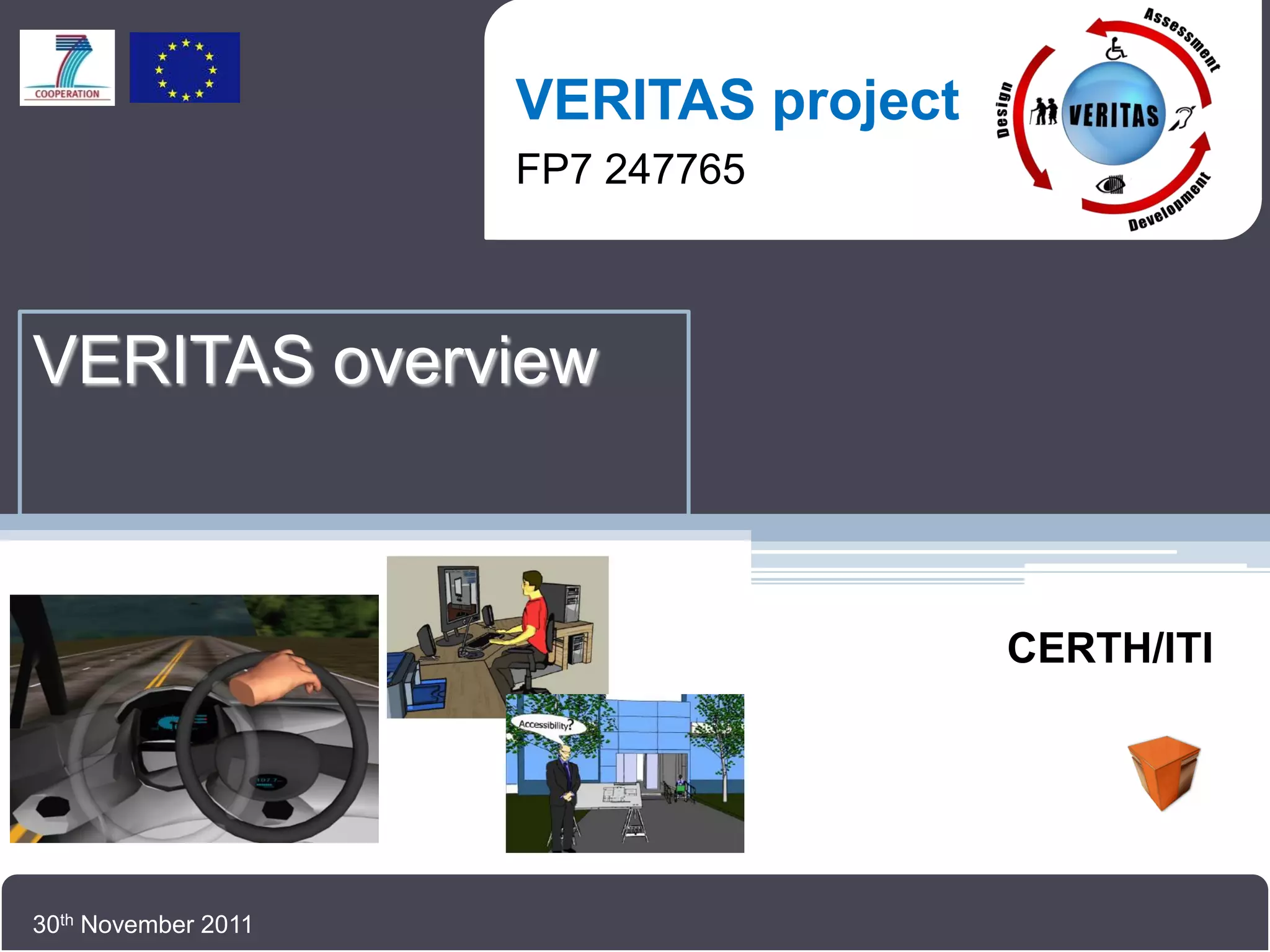
VERITAS project
                     VERITAS project
                     FP7 247765
                     FP7 247765


VERITAS overview


                                         CERTH/ITI


30th November
11-12/01/2010 2011    Kick-off meeting    Brussels, Belgium
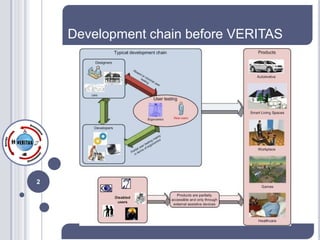
Development chain before VERITAS


2
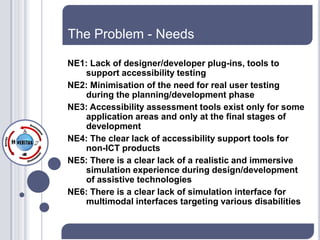
The Problem - Needs

NE1: Lack of designer/developer plug-ins, tools to
   support accessibility testing
NE2: Minimisation of the need for real user testing
   during the planning/development phase
NE3: Accessibility assessment tools exist only for some
   application areas and only at the final stages of
   development
NE4: The clear lack of accessibility support tools for
   non-ICT products
NE5: There is a clear lack of a realistic and immersive
   simulation experience during design/development
   of assistive technologies
NE6: There is a clear lack of simulation interface for
   multimodal interfaces targeting various disabilities
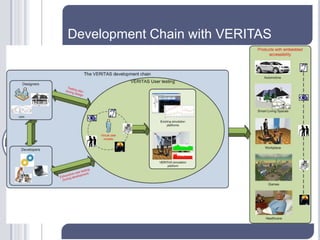
Development Chain with VERITAS
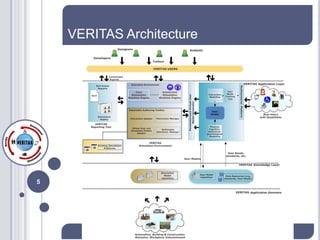
VERITAS Architecture


5
VERITAS Approach

       User Centered Design
       Iterative development and testing
         Virtual user models: Iterative development using
          feedback from the multisensorial platform
         Simulation models: Iterative development with feedback
          from real developers from the five VERITAS application
          sectors
         Iterative pilots: Feedback from real users
       Comprehensive risk analysis and mitigation strategy.
       Involvement of key industrial partners in all stages so as to
6       ensure the applicability of the developed algorithms and
        systems
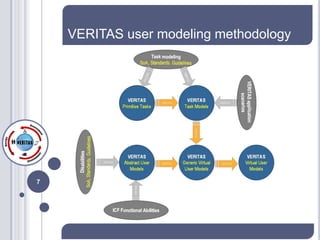
VERITAS user modeling methodology


7
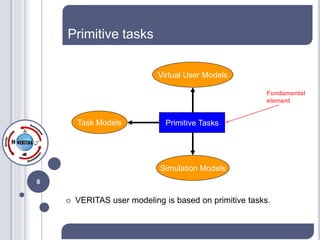
Primitive tasks

                             Virtual User Models

                                                         Fundamental
                                                         element


        Task Models            Primitive Tasks


                             Simulation Models
8


       VERITAS user modeling is based on primitive tasks.
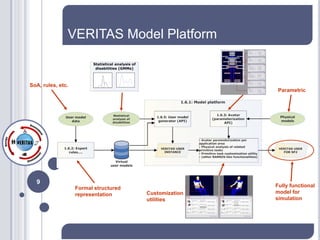
VERITAS Model Platform


SoA, rules, etc.
                                                        Parametric


  9
                   Formal structured                   Fully functional
                   representation      Customization   model for
                                       utilities       simulation
PERSONAS
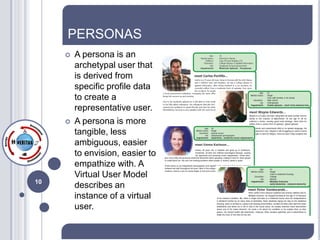
        A persona is an
         archetypal user that
         is derived from
         specific profile data
         to create a
         representative user.
        A persona is more
         tangible, less
         ambiguous, easier
         to envision, easier to
         empathize with. A
         Virtual User Model
10
         describes an
         instance of a virtual
         user.
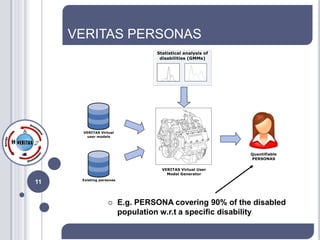
VERITAS PERSONAS


11


            E.g. PERSONA covering 90% of the disabled
             population w.r.t a specific disability
Multi-layered simulation platform
   VERITAS will support three levels of simulation
        Level 1: Low-level constraints satisfaction
             In this level the platform will examine whether the simulation
              models can be properly executed using the task models of the
              target user group
        Level 2: Semi-automated simulation also include several
         environmental variables.
             Execution of the simulation model of the virtual prototype with
              the target user group task models, including simulation of
              several environmental variables.
             Any inaccessible parts of the execution of the simulation model
              will be reported.
        Level 3: Physically-based simulation
             Is a grand research target on its own! VERITAS will focus on
              identifying parameters and specific degrees of freedom in the
              simulation that can be physically simulated and potentially result
              in evaluations that are not possible using Levels 1 and 2
VERITAS Application scenarios
 Application    development and reporting
     Automotive applications
     Smart Living Spaces applications
     “Office” workplace applications
     Infotainment and games applications
     Personal healthcare
 Pilots:
   Iterative Pilots and Pilots Planning
   Pilots for the designers
   Pilots for the end-users
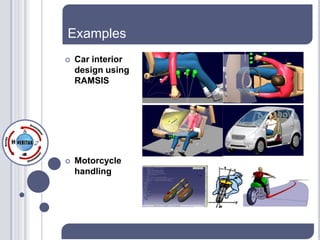
Examples
   Car interior
    design using
    RAMSIS


   Motorcycle
    handling
Demonstrations - Automotive
THANK YOU!

Veritas iti aegis_conf

  • 1.
    VERITAS project VERITAS project FP7 247765 FP7 247765 VERITAS overview CERTH/ITI 30th November 11-12/01/2010 2011 Kick-off meeting Brussels, Belgium
  • 2.
  • 3.
    The Problem -Needs NE1: Lack of designer/developer plug-ins, tools to support accessibility testing NE2: Minimisation of the need for real user testing during the planning/development phase NE3: Accessibility assessment tools exist only for some application areas and only at the final stages of development NE4: The clear lack of accessibility support tools for non-ICT products NE5: There is a clear lack of a realistic and immersive simulation experience during design/development of assistive technologies NE6: There is a clear lack of simulation interface for multimodal interfaces targeting various disabilities
  • 4.
  • 5.
  • 6.
    VERITAS Approach  User Centered Design  Iterative development and testing  Virtual user models: Iterative development using feedback from the multisensorial platform  Simulation models: Iterative development with feedback from real developers from the five VERITAS application sectors  Iterative pilots: Feedback from real users  Comprehensive risk analysis and mitigation strategy.  Involvement of key industrial partners in all stages so as to 6 ensure the applicability of the developed algorithms and systems
  • 7.
    VERITAS user modelingmethodology 7
  • 8.
    Primitive tasks Virtual User Models Fundamental element Task Models Primitive Tasks Simulation Models 8  VERITAS user modeling is based on primitive tasks.
  • 9.
    VERITAS Model Platform SoA,rules, etc. Parametric 9 Formal structured Fully functional representation Customization model for utilities simulation
  • 10.
    PERSONAS  A persona is an archetypal user that is derived from specific profile data to create a representative user.  A persona is more tangible, less ambiguous, easier to envision, easier to empathize with. A Virtual User Model 10 describes an instance of a virtual user.
  • 11.
    VERITAS PERSONAS 11  E.g. PERSONA covering 90% of the disabled population w.r.t a specific disability
  • 12.
    Multi-layered simulation platform  VERITAS will support three levels of simulation  Level 1: Low-level constraints satisfaction  In this level the platform will examine whether the simulation models can be properly executed using the task models of the target user group  Level 2: Semi-automated simulation also include several environmental variables.  Execution of the simulation model of the virtual prototype with the target user group task models, including simulation of several environmental variables.  Any inaccessible parts of the execution of the simulation model will be reported.  Level 3: Physically-based simulation  Is a grand research target on its own! VERITAS will focus on identifying parameters and specific degrees of freedom in the simulation that can be physically simulated and potentially result in evaluations that are not possible using Levels 1 and 2
  • 13.
    VERITAS Application scenarios Application development and reporting  Automotive applications  Smart Living Spaces applications  “Office” workplace applications  Infotainment and games applications  Personal healthcare  Pilots:  Iterative Pilots and Pilots Planning  Pilots for the designers  Pilots for the end-users
  • 14.
    Examples  Car interior design using RAMSIS  Motorcycle handling
  • 15.
  • 16.