Written by: Kaylyn Hirstius
Class: RED4348.
Teacher: Jennifer Bishop
*
*
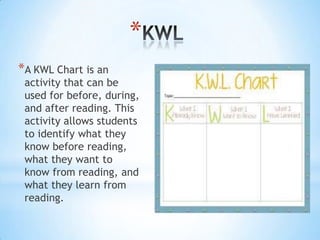
*A KWL Chart is an
activity that can be
used for before, during,
and after reading. This
activity allows students
to identify what they
know before reading,
what they want to
know from reading, and
what they learn from
reading.
*
*
*This strategy groups together words that could be
read together logically. This could be done by the
teacher so students would be able to understand
how to read with fluency. A student could learn
how to do this to help with reading on a regular
basis.
*
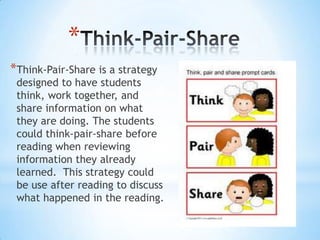
*Think-Pair-Share is a strategy
designed to have students
think, work together, and
share information on what
they are doing. The students
could think-pair-share before
reading when reviewing
information they already
learned. This strategy could
be use after reading to discuss
what happened in the reading.
*
*This strategy is to get
students asking questions
regarding the reading both
during and after reading a
text.
*
*This strategy helps
students make inferences
about information
presented in text. Each
of the four types of
questions that are
possible to answer give
various ways to draw
inferences. On My Own
could be a question used
after reading.
*The four types of
questions:
*Right There
*Author and You
*Think and Search
*On My Own
*
*
*Right There questions are
questions that can be
answered by looking in
the text.
*Author and You questions
ask students to think
about what they know,
what the author states in
the text, and how it fits
together.
*Think and Search
questions can be
answered from different
parts of the text put
together.
*On My Own questions ask
students to use their own
experience to answer the
question.
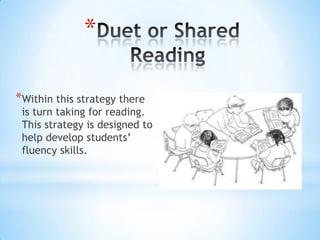
*Within this strategy there
is turn taking for reading.
This strategy is designed to
help develop students’
fluency skills.
*
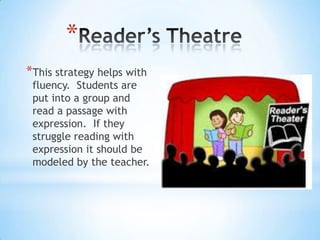
*This strategy helps with
fluency. Students are
put into a group and
read a passage with
expression. If they
struggle reading with
expression it should be
modeled by the teacher.
*
*
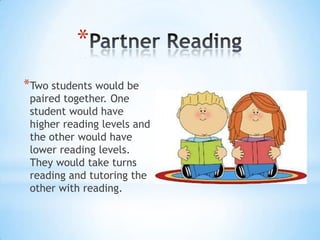
*Two students would be
paired together. One
student would have
higher reading levels and
the other would have
lower reading levels.
They would take turns
reading and tutoring the
other with reading.
*
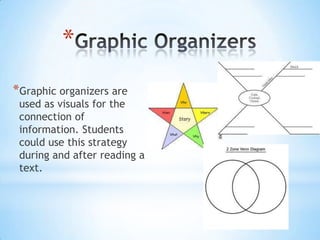
*Graphic organizers are
used as visuals for the
connection of
information. Students
could use this strategy
during and after reading a
text.
*
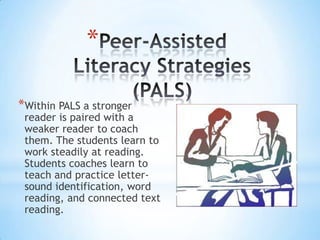
*Within PALS a stronger
reader is paired with a
weaker reader to coach
them. The students learn to
work steadily at reading.
Students coaches learn to
teach and practice letter-
sound identification, word
reading, and connected text
reading.
*
*This strategy is helpful for the students to put the
important information from the reading into a
paragraph.
*
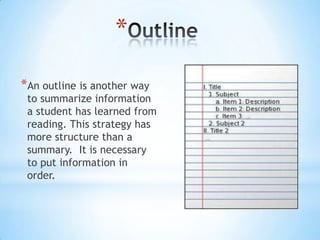
*An outline is another way
to summarize information
a student has learned from
reading. This strategy has
more structure than a
summary. It is necessary
to put information in
order.
*
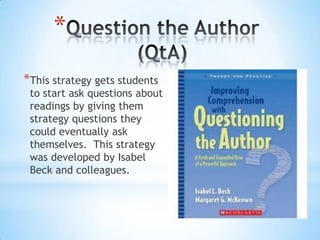
*This strategy gets students
to start ask questions about
readings by giving them
strategy questions they
could eventually ask
themselves. This strategy
was developed by Isabel
Beck and colleagues.
*
*
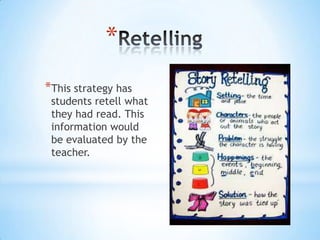
*This strategy has
students retell what
they had read. This
information would
be evaluated by the
teacher.
*
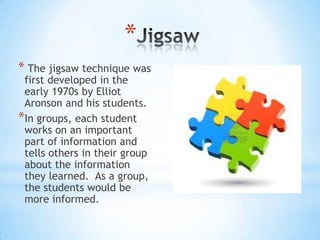
* The jigsaw technique was
first developed in the
early 1970s by Elliot
Aronson and his students.
*In groups, each student
works on an important
part of information and
tells others in their group
about the information
they learned. As a group,
the students would be
more informed.
*
• Bursuck, W. and Damer, M. (2011). Teaching reading to
students who are at risk or have disabilities: A multi-tier
approach. 2nd ed. Pearson: Boston
• Aronson, E., Social Psychology Network. (2000-2014). Jigsaw
Classroom. Retrieved April 7, 2014, from:
http://www.jigsaw.org/
• WETA Public Broadcasting. (2014). Think-Pair-Share.
Retrieved April 7, 2014, from:
http://www.readingrockets.org/strategies/think-pair-share

Reading Strategies: Before, During, and After

  • 1.
    Written by: KaylynHirstius Class: RED4348. Teacher: Jennifer Bishop *
  • 2.
  • 3.
    *A KWL Chartis an activity that can be used for before, during, and after reading. This activity allows students to identify what they know before reading, what they want to know from reading, and what they learn from reading. *
  • 4.
    * *This strategy groupstogether words that could be read together logically. This could be done by the teacher so students would be able to understand how to read with fluency. A student could learn how to do this to help with reading on a regular basis.
  • 5.
    * *Think-Pair-Share is astrategy designed to have students think, work together, and share information on what they are doing. The students could think-pair-share before reading when reviewing information they already learned. This strategy could be use after reading to discuss what happened in the reading.
  • 6.
  • 7.
    *This strategy isto get students asking questions regarding the reading both during and after reading a text. *
  • 8.
    *This strategy helps studentsmake inferences about information presented in text. Each of the four types of questions that are possible to answer give various ways to draw inferences. On My Own could be a question used after reading. *The four types of questions: *Right There *Author and You *Think and Search *On My Own *
  • 9.
    * *Right There questionsare questions that can be answered by looking in the text. *Author and You questions ask students to think about what they know, what the author states in the text, and how it fits together. *Think and Search questions can be answered from different parts of the text put together. *On My Own questions ask students to use their own experience to answer the question.
  • 10.
    *Within this strategythere is turn taking for reading. This strategy is designed to help develop students’ fluency skills. *
  • 11.
    *This strategy helpswith fluency. Students are put into a group and read a passage with expression. If they struggle reading with expression it should be modeled by the teacher. *
  • 12.
    * *Two students wouldbe paired together. One student would have higher reading levels and the other would have lower reading levels. They would take turns reading and tutoring the other with reading.
  • 13.
    * *Graphic organizers are usedas visuals for the connection of information. Students could use this strategy during and after reading a text.
  • 14.
    * *Within PALS astronger reader is paired with a weaker reader to coach them. The students learn to work steadily at reading. Students coaches learn to teach and practice letter- sound identification, word reading, and connected text reading.
  • 15.
  • 16.
    *This strategy ishelpful for the students to put the important information from the reading into a paragraph. *
  • 17.
    *An outline isanother way to summarize information a student has learned from reading. This strategy has more structure than a summary. It is necessary to put information in order. *
  • 18.
    *This strategy getsstudents to start ask questions about readings by giving them strategy questions they could eventually ask themselves. This strategy was developed by Isabel Beck and colleagues. *
  • 19.
    * *This strategy has studentsretell what they had read. This information would be evaluated by the teacher.
  • 20.
    * * The jigsawtechnique was first developed in the early 1970s by Elliot Aronson and his students. *In groups, each student works on an important part of information and tells others in their group about the information they learned. As a group, the students would be more informed.
  • 21.
    * • Bursuck, W.and Damer, M. (2011). Teaching reading to students who are at risk or have disabilities: A multi-tier approach. 2nd ed. Pearson: Boston • Aronson, E., Social Psychology Network. (2000-2014). Jigsaw Classroom. Retrieved April 7, 2014, from: http://www.jigsaw.org/ • WETA Public Broadcasting. (2014). Think-Pair-Share. Retrieved April 7, 2014, from: http://www.readingrockets.org/strategies/think-pair-share