Recurrent miscarriage
Dr. Kang Marcus
O&G Consultant
Hospital Sibu
Recurrent miscarriage
 @ Habitual abortion
 @ Recurrent pregnancy loss
 Definition : 3 or more consecutive miscarriage
Epidemiology
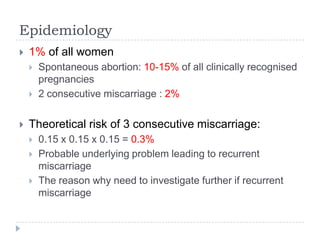
 1% of all women
 Spontaneous abortion: 10-15% of all clinically recognised
pregnancies
 2 consecutive miscarriage : 2%
 Theoretical risk of 3 consecutive miscarriage:
 0.15 x 0.15 x 0.15 = 0.3%
 Probable underlying problem leading to recurrent
miscarriage
 The reason why need to investigate further if recurrent
miscarriage
Recurrent miscarriage
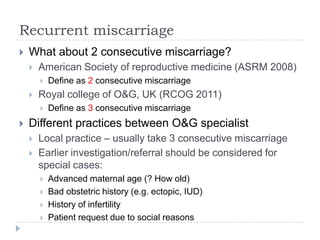
 What about 2 consecutive miscarriage?
 American Society of reproductive medicine (ASRM 2008)
 Define as 2 consecutive miscarriage
 Royal college of O&G, UK (RCOG 2011)
 Define as 3 consecutive miscarriage
 Different practices between O&G specialist
 Local practice – usually take 3 consecutive miscarriage
 Earlier investigation/referral should be considered for
special cases:
 Advanced maternal age (? How old)
 Bad obstetric history (e.g. ectopic, IUD)
 History of infertility
 Patient request due to social reasons
Causes
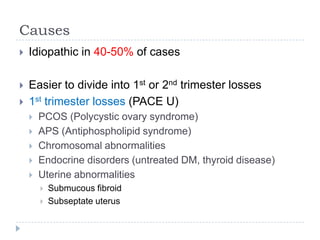
 Idiopathic in 40-50% of cases
 Easier to divide into 1st or 2nd trimester losses
 1st trimester losses (PACE U)
 PCOS (Polycystic ovary syndrome)
 APS (Antiphospholipid syndrome)
 Chromosomal abnormalities
 Endocrine disorders (untreated DM, thyroid disease)
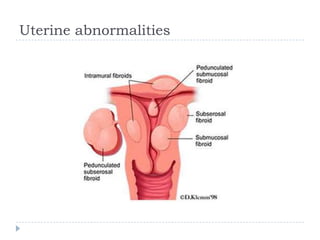
 Uterine abnormalities
 Submucous fibroid
 Subseptate uterus
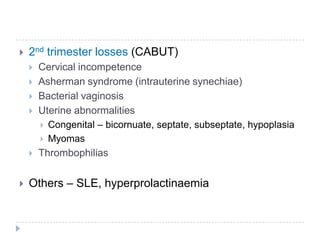
 2nd trimester losses (CABUT)
 Cervical incompetence
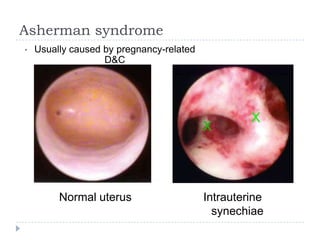
 Asherman syndrome (intrauterine synechiae)
 Bacterial vaginosis
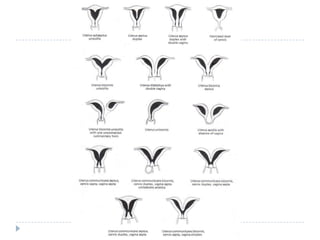
 Uterine abnormalities
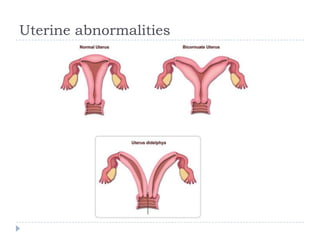
 Congenital – bicornuate, septate, subseptate, hypoplasia
 Myomas
 Thrombophilias
 Others – SLE, hyperprolactinaemia
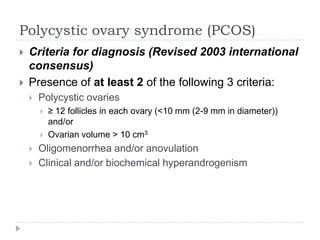
Polycystic ovary syndrome (PCOS)
 Criteria for diagnosis (Revised 2003 international
consensus)
 Presence of at least 2 of the following 3 criteria:
 Polycystic ovaries
 ≥ 12 follicles in each ovary (<10 mm (2-9 mm in diameter))
and/or
 Ovarian volume > 10 cm3
 Oligomenorrhea and/or anovulation
 Clinical and/or biochemical hyperandrogenism
Antiphospholipid syndrome (APS)
 Most important treatable cause of recurrent
miscarriage
 Diagnosed by Revised Sapporo classification (2006):
 At least one clinical criteria and one laboratory criteriaClinical Laboratory
Thrombosis ≥1 documented episodes of:
Arterial
Venous and/or
Small vessel thrombosis
ACA ACA of IgG and/or IgM
isotype in medium/high titre
(> 40 IU) or >99th percentile
Pregnancy
morbidity
≥1 unexplained fetal deaths of ≥ 10
weeks POA
(morphologically normal fetus)
LA Detected
≥1 premature births of ≤ 34th week
POA d/t:
Severe PE or
Placental insufficiency (IUGR)
(morphologically normal neonate)
Anti-
beta2-
glycopr
otein
>99th percentile
≥3 unexplained consecutive
spontaneous abortions < 10 week POA
* On 2 or more occasions
At least 12 weeks apart
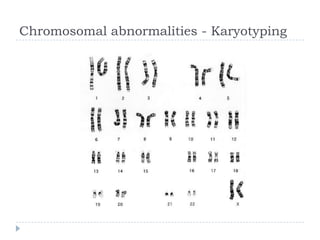
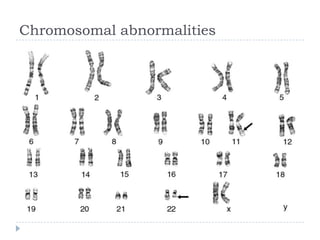
Chromosomal abnormalities - Karyotyping
Chromosomal abnormalities
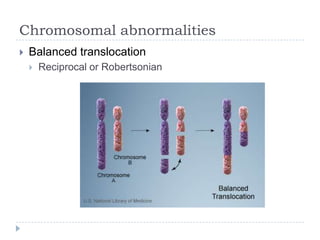
 Balanced translocation
 Reciprocal or Robertsonian
Chromosomal abnormalities
Endocrine factors
 Usually DM or thyroid disease
 Well-controlled DM and treated thyroid dysfunction
are not risk factors for recurrent miscarriage
Uterine abnormalities
Cervical incompetence
 Diagnosis is clinical, usually based on history
 Miscarriage
 2nd-trimester miscarriage
 Subsequent miscarriages are usually earlier
 Preceded by spontaneous rupture of membranes
 Bulging membranes through the cervix prior to onset of labour
 Painless and progressive cervical dilatation
 Fetus alive during miscarriage
 History of cervical surgery (cone biopsy, LLETZ)
 No satisfactory objective test
Asherman syndrome
Normal uterus
• Usually caused by pregnancy-related
D&C
Intrauterine
synechiae
Bacterial vaginosis
 Presence of BV in the first trimester
 Reported as a risk factor for 2nd-trimester miscarriage or
preterm delivery.
 A RCT reported that treatment of BV early in the 2nd-
trimester with oral clindamycin significantly reduces
the incidence of second-trimester miscarriage and
preterm birth in the general population.
 No data to assess the role of antibiotic therapy in
women with a previous second-trimester
miscarriage.
Management
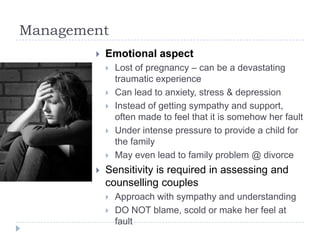
 Emotional aspect
 Lost of pregnancy – can be a devastating
traumatic experience
 Can lead to anxiety, stress & depression
 Instead of getting sympathy and support,
often made to feel that it is somehow her fault
 Under intense pressure to provide a child for
the family
 May even lead to family problem @ divorce
 Sensitivity is required in assessing and
counselling couples
 Approach with sympathy and understanding
 DO NOT blame, scold or make her feel at
fault
Management
 Should refer to hospital with specialist for further
management.
 Preliminary management that can be done in district
hospital/clinics:
 History
 Examination
History
 Full history including:
 Complete obstetric history
 Year of miscarriage
 Gestation
 How was the pregnancy confirmed?
 UPT? Ultrasound?
 Assumed pregnant as missed menses?
 Spontaneous, D&C or termination?
 Life embryo at miscarriage?
 Any complications
 If 2nd timester loss, ask for features of cervical
incompetence
History
 Any surgical history esp uterine instrumentation,
cervical surgery
 Any medical illnesses
 Consanguinity?
Examination
 Features of PCOS
 Features of SLE
 Speculum
 Any features of genital tract infection
Investigations
 PCOS screen
 Se testosterone
 SHBG
 Antiphospholipid antibodies
 Anticardiolipin antibodies (ACA) & Lupus anticoagulant
 Anti-beta2 glycoprotein – if available
 Karyotyping (both couples)
 To detect chromosomal abnormalities i.e. balanced
translocations
 Should be performed on POC of the 3rd and subsequent
consecutive miscarriages
 Parenteral karyotyping of both partners should be performed
when testing of POC reports an unbalanced structural
chormosomal abnormality.
 If karyotype of the miscarried pregnancy is
abnormal, there is a better prognosis for the next
pregnancy
 Risk of miscarriage as a result of fetal aneuploidy
decreases with an increasing number of pregnancy loss
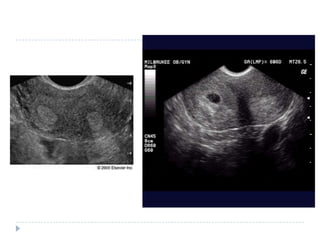
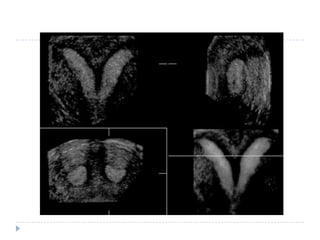
 Pelvic ultrasound – assess uterine anatomy
 HSG can also be used as an initial screening test
 Suspected uterine anomalies may require further
investigations to confirm diagnosis:
 Hysteroscopy
 Laparoscopy
 3D ultrasound
 Thrombophilia screen – for 2nd trimester miscarriage
 Screening for diabetes, thyroid disorders is only
indicated if there is clinical suspicion. Not
recommended as a routine test.
 However, as subclinical hypothyroidism increases risk of
miscarriage, some authors recommend doing TFT
 TORCHES – Not useful
Investigations
 Routine cervical cultures for Chlamydia sp. Or
mycoplasma sp. and vaginal evaluation for bacterial
vaginosis are not useful among healthy women.
Management – Unexplained RM
 Good prognosis for future pregnancy outcome
 75% chance of a eventual live birth in subsequent
pregnancy
 However, prognosis worsens with:
 Increasing maternal age
 Number of previous miscarriages
 Maternal age and number of previous miscarriage
are two independent risk factors for a further
miscarriage.
 Advancing maternal age is associated with a decline in
the number and quality of the remaining oocytes.
Management – Unexplained RM
 Unexplained recurrent miscarriage (idiopathic)
 Role of progesterone
 Role of aspirin
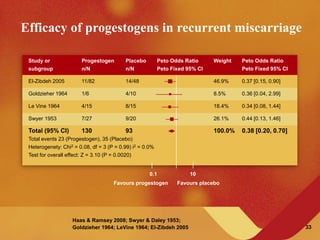
Efficacy of progestogens in recurrent miscarriage
33
Haas & Ramsey 2008; Swyer & Daley 1953;
Goldzieher 1964; LeVine 1964; El-Zibdeh 2005
Study or Progestogen Placebo Peto Odds Ratio Weight Peto Odds Ratio
subgroup n/N n/N Peto Fixed 95% CI Peto Fixed 95% CI
El-Zibdeh 2005 11/82 14/48 46.9% 0.37 [0.15, 0.90]
Goldzieher 1964 1/6 4/10 8.5% 0.36 [0.04, 2.99]
Le Vine 1964 4/15 8/15 18.4% 0.34 [0.08, 1.44]
Swyer 1953 7/27 9/20 26.1% 0.44 [0.13, 1.46]
Total (95% CI) 130 93 100.0% 0.38 [0.20, 0.70]
Total events 23 (Progestogen), 35 (Placebo)
Heterogenety: Chi2 = 0.08, df = 3 (P = 0.99) i2 = 0.0%
Test for overall effect: Z = 3.10 (P = 0.0020)
0.1 10
Favours progestogen Favours placebo
Management – Unexplained RM
 Role of aspirin
 Usually prescribed for women with unexplained recurrent
miscarriage
 Alone or in combination with heparin
 2 recent RCTs – neither treatment improves live birth
rate among these women.
 Use of this empirical treatment is unnecessary and should
be resisted (RCOG, UK April 2011)
Management
 Idiopathic or not investigated
 Start when pregnancy confirmed:
 T. Duphaston 10mg od/bd till 20/52 POA
 Insufficient evidence to evaluate the effect of progesterone
supplementation in pregnancy (RCOG, UK April 2011)
 Lifestyle modification – can increase fertility potential
 Stop smoking
 Reduce alcohol intake
 Reduce BMI (for obese women)
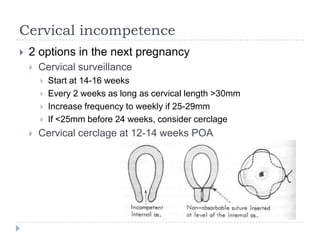
Cervical incompetence
 2 options in the next pregnancy
 Cervical surveillance
 Start at 14-16 weeks
 Every 2 weeks as long as cervical length >30mm
 Increase frequency to weekly if 25-29mm
 If <25mm before 24 weeks, consider cerclage
 Cervical cerclage at 12-14 weeks POA
Management - APS
 Low-dose aspirin and heparin until 36 weeks of
pregnancy
PCOS
 Role of Metformin
 Previously prescribed to reduce risk of recurrent
miscarriage
 Insufficient evidence to evaluate the effect of metformin
supplementation
 Recent meta-analysis of 17 RCTs - metformin has no
effect on sporadic miscarriage risk
 Uncontrolled small studies (no RCTs) – associated with
reduction in miscarriage rate in women with recurrent
miscarriage
Endocrine
 Optimize disease
 Should be stable for around 6 months
 Refer Prepregnancy Clinic when plan to embark on
pregnancy
 Counselling
 Drug adjustment – minimize, safe