Recurrent Pregnancy
Loss
Dr.Narendra Gupta
Vivekanand hospital and fertility
center, Jaipur
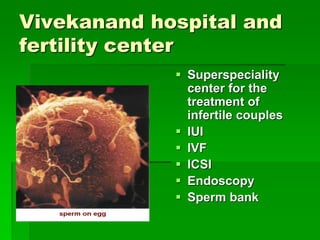
Vivekanand hospital and
fertility center
 Superspeciality
center for the
treatment of
infertile couples
 IUI
 IVF
 ICSI
 Endoscopy
 Sperm bank
Definition
A recurrent pregnancy loss is defined as 3 or more consecutive,
spontaneous pregnancy losses. Pregnancy losses are in the form of
abortions, rhesus isoimmnisation, cervical incompetence and
recurrent preterm labor where the losses occur after 20 weeks of
gestation.
Recurrent abortion or miscarriage where the pregnancy loss is
always under 20 weeks gestation
Recently 2 or more spontaneous abortions/pregnancy loss have
also been put in this category-
i. Since the risk of a recurrent loss is fairly high even after 2 losses
(26%), we are justified to start work-up after 2 losses.
ii. Nowadays women start their reproductive career in their late
twenties or early thirties.They do not have the time to wait for a
third loss.
Recurrent miscarriage affects 1% (0.5-3 %) of all women
Impact of RPL
 RPL results in great
psychological trauma
to the couple specially
the woman.
 They feel devastated
and fear that this
should not happen to
them again.
 It results in severe
anxiety and
depression.
Types of RPL
 Preclinical or very early pregnancy losses-
B-HCG positive pregnancies. This is due to
poor implantation and LPD.
 Clinical pregnancy loss- An ultrasound
evidence of Gestation sac – 10-15 %
 First trimester loss- Almost 80% of RPL
occur in the first 12 weeks
 Midtrimester loss- 12 to 28 weeks
 Late fetal loss- between 28 weeks to term
Approach to a patient with RPL
 A detailed clinical history is useful. Every
miscarriage and gestational age should be
noted
 Very early (< 6 weeks), 7-12 weeks and
more than 12 weeks
 Missed abortion or spontaneous live fetal
expulsion
Clinical Approach
 Try to find out a cause. In more than two
third of the cases an etiological factor can
be found.
Investigations
Investigations should be directed
to find out a cause
Male partner- Semen analysis-look for
OAT and pyospermia
Female partner
 Full blood count
 Blood group
 Thyroid function tests
 HbA1C,Blood sugar/OGTT if
needed
 Karyotyping
 Hormonal profile –
LH,FSH,T1,PRL,DHEAS
 LA and ACA IgG and AgM
 Thrombophilia screen
 Transvaginal sonography
 Hysteroscopy
 Thyroid peroxidase
antibody
 Autoantibody screen
 Total homocysteine
 Rubella status
 Free androgen index
 SHBG
Transvaginal sonography
 TVS at 6 weeks is recommended to detect
cardiac activity
 Cervical length should be carefully
assessed in patients with RPL
 Color flow studies of corpus luteum and
uterine artery are helpful
 Role of 3 D scanning for anatomical
defects of the uterus is undisputed
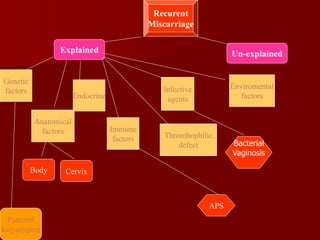
Genetic
factors
Anatomical
factors
Endocrine
Infective
agents
Immune
factors Thrombophilic
defect
Explained Un-explained
Recurent
Miscarriage
Enviromental
factors
Body Cervix
Paternal
karyotyping
APS
Bacterial
Vaginosis
Uterine Abnormalities
 Uterine abnormalities detected on USG
can be further investigated by 3 D scan,
Hysteroscopy or HSG if necessary
 The finding of uterine anomaly does not
necessarily imply causation and surgical
treatment may not be indicated
Diagnosis of Uterine Anomalies
 Transvaginal sonography
 3D Ultrasound
 Laparoscopy
 Hysteroscopy
 MRI
 Hysterosalpingogram (HSG)
Uterine anomalies
 The reported prevalence of uterine anomalies in recurrent
miscarriage populations range between 1.8% and 37.6%.
 The prevalence of uterine malformations appears to be higher
in women with late miscarriages compared with women who
suffer early miscarriages but this may be related to the
cervical weakness that is frequently associated with uterine
malformation.
 untreated uterine anomalies has a term delivery rate of only
50%.
 Open uterine surgery is associated with postoperative
infertility and carries a significant risk of uterine scar rupture
during pregnancy. These complications are less likely to occur
after hysteroscopic surgery but no randomised trial assessing
the benefits of surgical correction of uterine abnormalities on
pregnancy outcome has been performed.
Fibroids
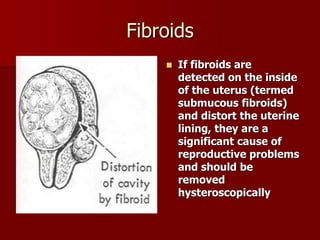
 If fibroids are
detected on the inside
of the uterus (termed
submucous fibroids)
and distort the uterine
lining, they are a
significant cause of
reproductive problems
and should be
removed
hysteroscopically
Uterine anomalies
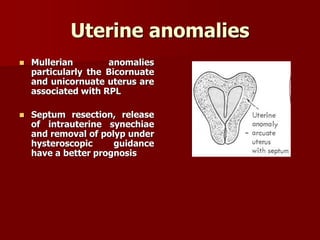
 Mullerian anomalies
particularly the Bicornuate
and unicornuate uterus are
associated with RPL
 Septum resection, release
of intrauterine synechiae
and removal of polyp under
hysteroscopic guidance
have a better prognosis
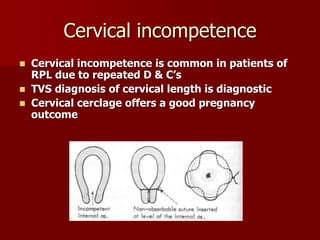
Cervical incompetence
 Cervical incompetence is common in patients of
RPL due to repeated D & C’s
 TVS diagnosis of cervical length is diagnostic
 Cervical cerclage offers a good pregnancy
outcome
Genetic factors
 Chromosome Testing on Fetal (Miscarriage) Tissue
 This can only be done right at the time of miscarriage.
 It is an analysis of the genetic makeup of the fetus.
 It can indicate genetic problems that lead to RPL.
 Many miscarriages are caused by chromosomal abnormalities
that are unlikely to repeat. To know if the problem is likely to
recur, it is necessary to study the genetics of both parents as
well.
 Karyotyping of Parents
 each Chromosome analysis of blood of both parents.
 It can show if there is a potential problem with one of the
parents that leads to miscarriage, but often has to be done in
conjunction with fetal testing to provide answers.
 These tests help rule out the 3% or so of partners that carry a
"hidden" chromosomal problem called a balanced translocation.
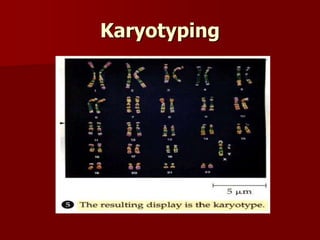
Karyotyping
 It is a display of an individual’s chromosome
pairs.
 Process : Sample of blood is taken.
Cells are chemically stimulated to undergo
mitosis. Mitosis is stopped at metaphase.
Chromosomes are separated out, viewed with a
microscope and photographed.
The photograph is then rearranged to show the
paired chromosomes. Size, shape and banding
pattern are used to pair up the chromosomes.
Karyotyping
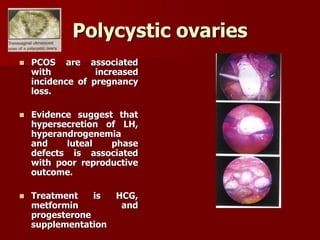
Polycystic ovaries
 PCOS are associated
with increased
incidence of pregnancy
loss.
 Evidence suggest that
hypersecretion of LH,
hyperandrogenemia
and luteal phase
defects is associated
with poor reproductive
outcome.
 Treatment is HCG,
metformin and
progesterone
supplementation
Endometriosis
 Endometriosis not only is responsible
for infertility, it also causes RPL.
 Though exact role is uncertain,
probably it relates to poor egg
quality seen in patients of
endometriosis
Immunology of RPL
 40 % of losses in RSA could be due
to immunology
1. Alloimmune
2. Auto immune
Pregnancy and immunological
miracle of immune tolerance
 Why should the mother tolerate the fetus?
 How does the mother tolerate the fetus ?
Alloimmune
 A conceptus of 3000 gms is tolerated,
protected and nourished by the mother for
280 days
- after birth even 30 gms of say renal tissue
of that conceptus is not tolerated and
immune rejection occurs why?
- Husband’s renal tissue transplanted in the
mother during pregnancy is not accepted
- How his conceptus is accepted?
Alloimmune response
 At fetomaternal interface when the
mother’s immune system senses that a
different system has arrived it mounts a
protective response.
 This is through the syncitiotrophoblast
 Functioning of trophoblast is such that it
will sense only immunologically distinct
identity.
 In fact if it is immunologically similar the
syncitiotrophoblast will not sense and the
mother’s immune sysyem will destroy it.
 This can occur repeatedly and results in
 This can be applied to renal transplants or
any other transplant.
 If transplant scientists can create an
artificial trophoblast like shield around the
donated organ, once again the receptor
will protect it and there will be no
rejection.
 In fact HLA testing will become obsolete
because you will require the donor and the
recipient to be different and not similar as
in the case of the conceptus.
HCG
 The role of HCG is believed to be much beyond
hormones
 It is believed to have a very strong role that
generates changes in the endometrium.
 This explains the abrupt and graded rise of HCG
levels as soon as blastocyst is formed.
 Some perceive HCG as the master of the orchestra
that brings about the entire process of nidation
 Immune substance first thought to be similar to
growth factor
 Subsequently proved to be growth factor itself
progesterone
 Progesterone plays an important role
in immuno-modulation
 Micronised progesterone in varying
doses have proven to be successful in
reducing spontaneous abortion rate
Auto immune
 Many syndrome antibodies are
implicated
 But most influential and consistent
have been anti phospholipid antibody
syndrome.
Diagnosis
 Negative < 10 GPL units
 Low positive 10-20
 Moderately positive 20-100
 Strongly positive > 100
 Once the diagnosis is well established
treatment plans are instituted
 Mainstay is heparin, low dose aspirin
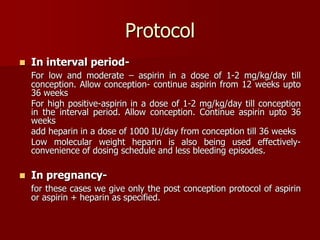
Protocol
 In interval period-
For low and moderate – aspirin in a dose of 1-2 mg/kg/day till
conception. Allow conception- continue aspirin from 12 weeks upto
36 weeks
For high positive-aspirin in a dose of 1-2 mg/kg/day till conception
in the interval period. Allow conception. Continue aspirin upto 36
weeks
add heparin in a dose of 1000 IU/day from conception till 36 weeks
Low molecular weight heparin is also being used effectively-
convenience of dosing schedule and less bleeding episodes.
 In pregnancy-
for these cases we give only the post conception protocol of aspirin
or aspirin + heparin as specified.
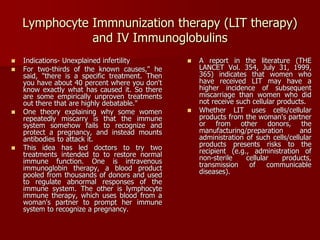
Lymphocyte Immnunization therapy (LIT therapy)
and IV Immunoglobulins
 Indications- Unexplained infertility
 For two-thirds of the known causes," he
said, "there is a specific treatment. Then
you have about 40 percent where you don't
know exactly what has caused it. So there
are some empirically unproven treatments
out there that are highly debatable."
 One theory explaining why some women
repeatedly miscarry is that the immune
system somehow fails to recognize and
protect a pregnancy, and instead mounts
antibodies to attack it.
 This idea has led doctors to try two
treatments intended to to restore normal
immune function. One is intravenous
immunoglobin therapy, a blood product
pooled from thousands of donors and used
to regulate abnormal responses of the
immune system. The other is lymphocyte
immune therapy, which uses blood from a
woman's partner to prompt her immune
system to recognize a pregnancy.
 A report in the literature (THE
LANCET Vol. 354, July 31, 1999,
365) indicates that women who
have received LIT may have a
higher incidence of subsequent
miscarriage than women who did
not receive such cellular products.
 Whether LIT uses cells/cellular
products from the woman's partner
or from other donors, the
manufacturing/preparation and
administration of such cells/cellular
products presents risks to the
recipient (e.g., administration of
non-sterile cellular products,
transmission of communicable
diseases).
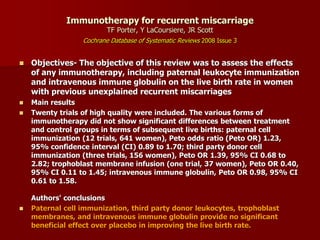
Immunotherapy for recurrent miscarriage
TF Porter, Y LaCoursiere, JR Scott
Cochrane Database of Systematic Reviews 2008 Issue 3
 Objectives- The objective of this review was to assess the effects
of any immunotherapy, including paternal leukocyte immunization
and intravenous immune globulin on the live birth rate in women
with previous unexplained recurrent miscarriages
 Main results
 Twenty trials of high quality were included. The various forms of
immunotherapy did not show significant differences between treatment
and control groups in terms of subsequent live births: paternal cell
immunization (12 trials, 641 women), Peto odds ratio (Peto OR) 1.23,
95% confidence interval (CI) 0.89 to 1.70; third party donor cell
immunization (three trials, 156 women), Peto OR 1.39, 95% CI 0.68 to
2.82; trophoblast membrane infusion (one trial, 37 women), Peto OR 0.40,
95% CI 0.11 to 1.45; intravenous immune globulin, Peto OR 0.98, 95% CI
0.61 to 1.58.
Authors' conclusions
 Paternal cell immunization, third party donor leukocytes, trophoblast
membranes, and intravenous immune globulin provide no significant
beneficial effect over placebo in improving the live birth rate.
Diabetes and thyroid disorders
 Routine screening for occult diabetes and
thyroid disease with oral glucose tolerance
and thyroid function tests in asymptomatic
women presenting with recurrent
miscarriage is uninformative
 well-controlled diabetes mellitus is not a
risk factor for recurrent miscarriage, nor is
treated thyroid dysfunction
Hyperprolactinemia
 There is insufficient evidence to assess the
effect of hyperprolactinaemia as a risk
factor for recurrent miscarriage.
Hyperhomocysteinemia
 Hyperhomocysteinemia is associated with an approximately
2-fold to 3-fold increased risk for pregnancy-induced
hypertension, abruptio placentae, and intrauterine growth
restriction. Cobalamin deficiency is associated with HELLP
syndrome, abruptio placentae, intrauterine growth
restriction, and intrauterine fetal death.
 Deficiencies of the vitamins folic acid, pyridoxine (B6), or
B12 can lead to high homocysteine levels.
 Supplementation with pyridoxine, folic acid, B12 or
trimethylglycine (betaine) reduces the concentration of
homocysteine in the bloodstream.
 Normal fasting homocysteine plasma levels are between 5,0
and 15,9 mmol/l.
Infections
 TORCH (toxoplasmosis rubella, cytomegalovirus
and herpes simplex virus), other [congenital
syphilis and viruses], screening is unhelpful in the
investigation of recurrent miscarriage.
 For an infective agent to be implicated in the
aetiology of repeated pregnancy loss, it must be
capable of persisting in the genital tract and
avoiding detection or must cause insufficient
symptoms to disturb the women. Toxoplasmosis,
rubella, cytomegalovirus, herpes and Listeria
infections do not fulfill these criteria and routine
TORCH screening should be abandoned.
Bacterial vaginosis
 Screening for and treatment of
bacterial vaginosis in early
pregnancy among high risk women
with a previous history of second-
trimester miscarriage or spontaneous
preterm labour may reduce the risk
of recurrent late loss and preterm
birth.
Environmental factors
 Exposture to noxious or toxic substances
are known to be associated with recurrent
miscarriage ( social drugs, cigarettes,
alcohol and caffeine ,anesthetic gases,
petrolium products )
One stop Recurrent miscarriage
clinic
 Dedicated clinic governed by evidence
based guidelines
 More extensive investigations and tailored
treatment
 Supportive care
Investigations
 Full blood count
 Thyroid function tests
 HbA1C
 Karyotyping
 Hormonal profile –
LH,FSH,T1,PRL,DHEAS
 LA and ACA IgG and AgM
 Thrombophilia screen
 TVS
 Hysteroscopy
 TORCH profile
 Thyroid peroxidase
antibody
 Autoantibody screen
 Total homocysteine
 Rubella status
 Free androgen index
 SHBG
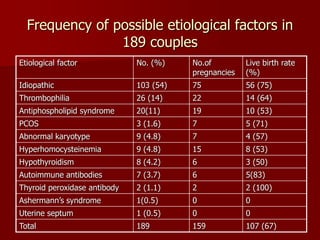
Frequency of possible etiological factors in
189 couples
Etiological factor No. (%) No.of
pregnancies
Live birth rate
(%)
Idiopathic 103 (54) 75 56 (75)
Thrombophilia 26 (14) 22 14 (64)
Antiphospholipid syndrome 20(11) 19 10 (53)
PCOS 3 (1.6) 7 5 (71)
Abnormal karyotype 9 (4.8) 7 4 (57)
Hyperhomocysteinemia 9 (4.8) 15 8 (53)
Hypothyroidism 8 (4.2) 6 3 (50)
Autoimmune antibodies 7 (3.7) 6 5(83)
Thyroid peroxidase antibody 2 (1.1) 2 2 (100)
Ashermann’s syndrome 1(0.5) 0 0
Uterine septum 1 (0.5) 0 0
Total 189 159 107 (67)
For unexplained RPL
 For those women with no documented
abnormality, supporting care, including USG
is valuable.
 Studies have shown this type of therapy to
improve the prognosis,with the rate of live
birth in the subsequent pregnancy upto 86
%,although the outcome is age related.
Obstetric outcome in patients with H/O
recurrent pregnancy loss
 Patients with H/O RPL are more likely to
have
threatened abortion
APH
preterm labour
depressed APGAR at 1 minute
IUGR
Management of pregnancy
 These patients should be followed up in a
specially dedicated facility
 Round the clock assistance should be
available
Last but very important !
 RPL management should have a
back-up of very efficient and
modern neonatal care unit. It should
have a good track record of salvaging
infants weighing more than 1 Kg.
 A sympathetic and caring attitude
along with pediatric care can fulfill
the desire of parenthood of many of
these couples.
Some new messages for clinical practice
 Past performance is important in prognosticating the
outcome.
 Live abortion indicate the anatomical cause. Cervical
encerclage has a very important role in treating incompetent
cervix.
 Chromosomal causes are not always gloomy
 Immunological causes are most prevalent
 APA syndrome has a oxidative stress complex but is easy to
treat.
 Corticosteroids are not used anymore. Aspirin- heparin
combination give best results.
 Pregnancy following treatment of RSA are still high risk
pregnancies
 These patients should be followed very closely and possibility
of them undergoing preterm labor should be kept highest in
our mind. Timely administration of Betamethasone is a must
for fetal lung maturity.
Recurrent pregnancy loss.pptx

Recurrent pregnancy loss.pptx

  • 1.
    Recurrent Pregnancy Loss Dr.Narendra Gupta Vivekanandhospital and fertility center, Jaipur
  • 2.
    Vivekanand hospital and fertilitycenter  Superspeciality center for the treatment of infertile couples  IUI  IVF  ICSI  Endoscopy  Sperm bank
  • 3.
    Definition A recurrent pregnancyloss is defined as 3 or more consecutive, spontaneous pregnancy losses. Pregnancy losses are in the form of abortions, rhesus isoimmnisation, cervical incompetence and recurrent preterm labor where the losses occur after 20 weeks of gestation. Recurrent abortion or miscarriage where the pregnancy loss is always under 20 weeks gestation Recently 2 or more spontaneous abortions/pregnancy loss have also been put in this category- i. Since the risk of a recurrent loss is fairly high even after 2 losses (26%), we are justified to start work-up after 2 losses. ii. Nowadays women start their reproductive career in their late twenties or early thirties.They do not have the time to wait for a third loss. Recurrent miscarriage affects 1% (0.5-3 %) of all women
  • 4.
    Impact of RPL RPL results in great psychological trauma to the couple specially the woman.  They feel devastated and fear that this should not happen to them again.  It results in severe anxiety and depression.
  • 5.
    Types of RPL Preclinical or very early pregnancy losses- B-HCG positive pregnancies. This is due to poor implantation and LPD.  Clinical pregnancy loss- An ultrasound evidence of Gestation sac – 10-15 %  First trimester loss- Almost 80% of RPL occur in the first 12 weeks  Midtrimester loss- 12 to 28 weeks  Late fetal loss- between 28 weeks to term
  • 6.
    Approach to apatient with RPL  A detailed clinical history is useful. Every miscarriage and gestational age should be noted  Very early (< 6 weeks), 7-12 weeks and more than 12 weeks  Missed abortion or spontaneous live fetal expulsion
  • 7.
    Clinical Approach  Tryto find out a cause. In more than two third of the cases an etiological factor can be found.
  • 8.
    Investigations Investigations should bedirected to find out a cause Male partner- Semen analysis-look for OAT and pyospermia Female partner  Full blood count  Blood group  Thyroid function tests  HbA1C,Blood sugar/OGTT if needed  Karyotyping  Hormonal profile – LH,FSH,T1,PRL,DHEAS  LA and ACA IgG and AgM  Thrombophilia screen  Transvaginal sonography  Hysteroscopy  Thyroid peroxidase antibody  Autoantibody screen  Total homocysteine  Rubella status  Free androgen index  SHBG
  • 9.
    Transvaginal sonography  TVSat 6 weeks is recommended to detect cardiac activity  Cervical length should be carefully assessed in patients with RPL  Color flow studies of corpus luteum and uterine artery are helpful  Role of 3 D scanning for anatomical defects of the uterus is undisputed
  • 10.
  • 11.
    Uterine Abnormalities  Uterineabnormalities detected on USG can be further investigated by 3 D scan, Hysteroscopy or HSG if necessary  The finding of uterine anomaly does not necessarily imply causation and surgical treatment may not be indicated
  • 12.
    Diagnosis of UterineAnomalies  Transvaginal sonography  3D Ultrasound  Laparoscopy  Hysteroscopy  MRI  Hysterosalpingogram (HSG)
  • 13.
    Uterine anomalies  Thereported prevalence of uterine anomalies in recurrent miscarriage populations range between 1.8% and 37.6%.  The prevalence of uterine malformations appears to be higher in women with late miscarriages compared with women who suffer early miscarriages but this may be related to the cervical weakness that is frequently associated with uterine malformation.  untreated uterine anomalies has a term delivery rate of only 50%.  Open uterine surgery is associated with postoperative infertility and carries a significant risk of uterine scar rupture during pregnancy. These complications are less likely to occur after hysteroscopic surgery but no randomised trial assessing the benefits of surgical correction of uterine abnormalities on pregnancy outcome has been performed.
  • 14.
    Fibroids  If fibroidsare detected on the inside of the uterus (termed submucous fibroids) and distort the uterine lining, they are a significant cause of reproductive problems and should be removed hysteroscopically
  • 15.
    Uterine anomalies  Mulleriananomalies particularly the Bicornuate and unicornuate uterus are associated with RPL  Septum resection, release of intrauterine synechiae and removal of polyp under hysteroscopic guidance have a better prognosis
  • 16.
    Cervical incompetence  Cervicalincompetence is common in patients of RPL due to repeated D & C’s  TVS diagnosis of cervical length is diagnostic  Cervical cerclage offers a good pregnancy outcome
  • 17.
    Genetic factors  ChromosomeTesting on Fetal (Miscarriage) Tissue  This can only be done right at the time of miscarriage.  It is an analysis of the genetic makeup of the fetus.  It can indicate genetic problems that lead to RPL.  Many miscarriages are caused by chromosomal abnormalities that are unlikely to repeat. To know if the problem is likely to recur, it is necessary to study the genetics of both parents as well.  Karyotyping of Parents  each Chromosome analysis of blood of both parents.  It can show if there is a potential problem with one of the parents that leads to miscarriage, but often has to be done in conjunction with fetal testing to provide answers.  These tests help rule out the 3% or so of partners that carry a "hidden" chromosomal problem called a balanced translocation.
  • 18.
    Karyotyping  It isa display of an individual’s chromosome pairs.  Process : Sample of blood is taken. Cells are chemically stimulated to undergo mitosis. Mitosis is stopped at metaphase. Chromosomes are separated out, viewed with a microscope and photographed. The photograph is then rearranged to show the paired chromosomes. Size, shape and banding pattern are used to pair up the chromosomes.
  • 19.
  • 20.
    Polycystic ovaries  PCOSare associated with increased incidence of pregnancy loss.  Evidence suggest that hypersecretion of LH, hyperandrogenemia and luteal phase defects is associated with poor reproductive outcome.  Treatment is HCG, metformin and progesterone supplementation
  • 21.
    Endometriosis  Endometriosis notonly is responsible for infertility, it also causes RPL.  Though exact role is uncertain, probably it relates to poor egg quality seen in patients of endometriosis
  • 22.
    Immunology of RPL 40 % of losses in RSA could be due to immunology 1. Alloimmune 2. Auto immune
  • 23.
    Pregnancy and immunological miracleof immune tolerance  Why should the mother tolerate the fetus?  How does the mother tolerate the fetus ?
  • 24.
    Alloimmune  A conceptusof 3000 gms is tolerated, protected and nourished by the mother for 280 days - after birth even 30 gms of say renal tissue of that conceptus is not tolerated and immune rejection occurs why? - Husband’s renal tissue transplanted in the mother during pregnancy is not accepted - How his conceptus is accepted?
  • 25.
    Alloimmune response  Atfetomaternal interface when the mother’s immune system senses that a different system has arrived it mounts a protective response.  This is through the syncitiotrophoblast  Functioning of trophoblast is such that it will sense only immunologically distinct identity.  In fact if it is immunologically similar the syncitiotrophoblast will not sense and the mother’s immune sysyem will destroy it.  This can occur repeatedly and results in
  • 26.
     This canbe applied to renal transplants or any other transplant.  If transplant scientists can create an artificial trophoblast like shield around the donated organ, once again the receptor will protect it and there will be no rejection.  In fact HLA testing will become obsolete because you will require the donor and the recipient to be different and not similar as in the case of the conceptus.
  • 27.
    HCG  The roleof HCG is believed to be much beyond hormones  It is believed to have a very strong role that generates changes in the endometrium.  This explains the abrupt and graded rise of HCG levels as soon as blastocyst is formed.  Some perceive HCG as the master of the orchestra that brings about the entire process of nidation  Immune substance first thought to be similar to growth factor  Subsequently proved to be growth factor itself
  • 28.
    progesterone  Progesterone playsan important role in immuno-modulation  Micronised progesterone in varying doses have proven to be successful in reducing spontaneous abortion rate
  • 29.
    Auto immune  Manysyndrome antibodies are implicated  But most influential and consistent have been anti phospholipid antibody syndrome.
  • 30.
    Diagnosis  Negative <10 GPL units  Low positive 10-20  Moderately positive 20-100  Strongly positive > 100  Once the diagnosis is well established treatment plans are instituted  Mainstay is heparin, low dose aspirin
  • 31.
    Protocol  In intervalperiod- For low and moderate – aspirin in a dose of 1-2 mg/kg/day till conception. Allow conception- continue aspirin from 12 weeks upto 36 weeks For high positive-aspirin in a dose of 1-2 mg/kg/day till conception in the interval period. Allow conception. Continue aspirin upto 36 weeks add heparin in a dose of 1000 IU/day from conception till 36 weeks Low molecular weight heparin is also being used effectively- convenience of dosing schedule and less bleeding episodes.  In pregnancy- for these cases we give only the post conception protocol of aspirin or aspirin + heparin as specified.
  • 32.
    Lymphocyte Immnunization therapy(LIT therapy) and IV Immunoglobulins  Indications- Unexplained infertility  For two-thirds of the known causes," he said, "there is a specific treatment. Then you have about 40 percent where you don't know exactly what has caused it. So there are some empirically unproven treatments out there that are highly debatable."  One theory explaining why some women repeatedly miscarry is that the immune system somehow fails to recognize and protect a pregnancy, and instead mounts antibodies to attack it.  This idea has led doctors to try two treatments intended to to restore normal immune function. One is intravenous immunoglobin therapy, a blood product pooled from thousands of donors and used to regulate abnormal responses of the immune system. The other is lymphocyte immune therapy, which uses blood from a woman's partner to prompt her immune system to recognize a pregnancy.  A report in the literature (THE LANCET Vol. 354, July 31, 1999, 365) indicates that women who have received LIT may have a higher incidence of subsequent miscarriage than women who did not receive such cellular products.  Whether LIT uses cells/cellular products from the woman's partner or from other donors, the manufacturing/preparation and administration of such cells/cellular products presents risks to the recipient (e.g., administration of non-sterile cellular products, transmission of communicable diseases).
  • 33.
    Immunotherapy for recurrentmiscarriage TF Porter, Y LaCoursiere, JR Scott Cochrane Database of Systematic Reviews 2008 Issue 3  Objectives- The objective of this review was to assess the effects of any immunotherapy, including paternal leukocyte immunization and intravenous immune globulin on the live birth rate in women with previous unexplained recurrent miscarriages  Main results  Twenty trials of high quality were included. The various forms of immunotherapy did not show significant differences between treatment and control groups in terms of subsequent live births: paternal cell immunization (12 trials, 641 women), Peto odds ratio (Peto OR) 1.23, 95% confidence interval (CI) 0.89 to 1.70; third party donor cell immunization (three trials, 156 women), Peto OR 1.39, 95% CI 0.68 to 2.82; trophoblast membrane infusion (one trial, 37 women), Peto OR 0.40, 95% CI 0.11 to 1.45; intravenous immune globulin, Peto OR 0.98, 95% CI 0.61 to 1.58. Authors' conclusions  Paternal cell immunization, third party donor leukocytes, trophoblast membranes, and intravenous immune globulin provide no significant beneficial effect over placebo in improving the live birth rate.
  • 34.
    Diabetes and thyroiddisorders  Routine screening for occult diabetes and thyroid disease with oral glucose tolerance and thyroid function tests in asymptomatic women presenting with recurrent miscarriage is uninformative  well-controlled diabetes mellitus is not a risk factor for recurrent miscarriage, nor is treated thyroid dysfunction
  • 35.
    Hyperprolactinemia  There isinsufficient evidence to assess the effect of hyperprolactinaemia as a risk factor for recurrent miscarriage.
  • 36.
    Hyperhomocysteinemia  Hyperhomocysteinemia isassociated with an approximately 2-fold to 3-fold increased risk for pregnancy-induced hypertension, abruptio placentae, and intrauterine growth restriction. Cobalamin deficiency is associated with HELLP syndrome, abruptio placentae, intrauterine growth restriction, and intrauterine fetal death.  Deficiencies of the vitamins folic acid, pyridoxine (B6), or B12 can lead to high homocysteine levels.  Supplementation with pyridoxine, folic acid, B12 or trimethylglycine (betaine) reduces the concentration of homocysteine in the bloodstream.  Normal fasting homocysteine plasma levels are between 5,0 and 15,9 mmol/l.
  • 37.
    Infections  TORCH (toxoplasmosisrubella, cytomegalovirus and herpes simplex virus), other [congenital syphilis and viruses], screening is unhelpful in the investigation of recurrent miscarriage.  For an infective agent to be implicated in the aetiology of repeated pregnancy loss, it must be capable of persisting in the genital tract and avoiding detection or must cause insufficient symptoms to disturb the women. Toxoplasmosis, rubella, cytomegalovirus, herpes and Listeria infections do not fulfill these criteria and routine TORCH screening should be abandoned.
  • 38.
    Bacterial vaginosis  Screeningfor and treatment of bacterial vaginosis in early pregnancy among high risk women with a previous history of second- trimester miscarriage or spontaneous preterm labour may reduce the risk of recurrent late loss and preterm birth.
  • 39.
    Environmental factors  Expostureto noxious or toxic substances are known to be associated with recurrent miscarriage ( social drugs, cigarettes, alcohol and caffeine ,anesthetic gases, petrolium products )
  • 40.
    One stop Recurrentmiscarriage clinic  Dedicated clinic governed by evidence based guidelines  More extensive investigations and tailored treatment  Supportive care
  • 41.
    Investigations  Full bloodcount  Thyroid function tests  HbA1C  Karyotyping  Hormonal profile – LH,FSH,T1,PRL,DHEAS  LA and ACA IgG and AgM  Thrombophilia screen  TVS  Hysteroscopy  TORCH profile  Thyroid peroxidase antibody  Autoantibody screen  Total homocysteine  Rubella status  Free androgen index  SHBG
  • 42.
    Frequency of possibleetiological factors in 189 couples Etiological factor No. (%) No.of pregnancies Live birth rate (%) Idiopathic 103 (54) 75 56 (75) Thrombophilia 26 (14) 22 14 (64) Antiphospholipid syndrome 20(11) 19 10 (53) PCOS 3 (1.6) 7 5 (71) Abnormal karyotype 9 (4.8) 7 4 (57) Hyperhomocysteinemia 9 (4.8) 15 8 (53) Hypothyroidism 8 (4.2) 6 3 (50) Autoimmune antibodies 7 (3.7) 6 5(83) Thyroid peroxidase antibody 2 (1.1) 2 2 (100) Ashermann’s syndrome 1(0.5) 0 0 Uterine septum 1 (0.5) 0 0 Total 189 159 107 (67)
  • 43.
    For unexplained RPL For those women with no documented abnormality, supporting care, including USG is valuable.  Studies have shown this type of therapy to improve the prognosis,with the rate of live birth in the subsequent pregnancy upto 86 %,although the outcome is age related.
  • 44.
    Obstetric outcome inpatients with H/O recurrent pregnancy loss  Patients with H/O RPL are more likely to have threatened abortion APH preterm labour depressed APGAR at 1 minute IUGR
  • 45.
    Management of pregnancy These patients should be followed up in a specially dedicated facility  Round the clock assistance should be available
  • 46.
    Last but veryimportant !  RPL management should have a back-up of very efficient and modern neonatal care unit. It should have a good track record of salvaging infants weighing more than 1 Kg.  A sympathetic and caring attitude along with pediatric care can fulfill the desire of parenthood of many of these couples.
  • 47.
    Some new messagesfor clinical practice  Past performance is important in prognosticating the outcome.  Live abortion indicate the anatomical cause. Cervical encerclage has a very important role in treating incompetent cervix.  Chromosomal causes are not always gloomy  Immunological causes are most prevalent  APA syndrome has a oxidative stress complex but is easy to treat.  Corticosteroids are not used anymore. Aspirin- heparin combination give best results.  Pregnancy following treatment of RSA are still high risk pregnancies  These patients should be followed very closely and possibility of them undergoing preterm labor should be kept highest in our mind. Timely administration of Betamethasone is a must for fetal lung maturity.