Recurrent
Pregnancy Loss
Dr Madhulatha Alexander, MD
Professor, Government Medical
College, Nizamabad
Background
• RECURRENT PREGNANCY LOSS (RPL), either early or late in the gestational
period, is a serious problem and has both psychological and social
impacts on the women who suffer from it
• Incidence before 20 weeks 8–20%, 80% of these occurring in the first
12 weeks of pregnancy
- The real rate of miscarriage may be much higher than reported
- Routine TORCH screening abandoned
Epidemiology and the medical causes of miscarriage.Regan L, Rai R
Baillieres Best Pract Res Clin Obstet Gynaecol. 2000 Oct;
Some Definitions
• A pregnancy loss (miscarriage) - the spontaneous demise of a
pregnancy before the fetus reaches viability.
• The term therefore includes all pregnancy losses (PLs) from the time
of conception until 24 weeks of gestation
• Primary RPL R-PL without a previous ongoing pregnancy (viable
pregnancy) beyond 24 weeks’ gestation, while secondary RPL is an
episode of RPL after one or more previous pregnancies progressing
beyond 24 weeks’ gestation.
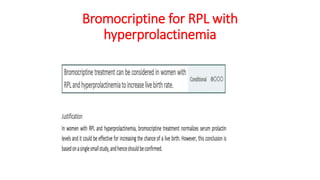
• By definition, “recurrent” pregnancy loss is defined as the loss of
two or more pregnancies.
More definitions…..
• Pregnancy - confirmed by either serum or urine B-HCG, i.e. including non-
visualized pregnancy losses (biochemical).
• Clinical-clinical miscarriage is used when ultrasound examination or histological
evidence has confirmed that an intrauterine pregnancy has existed.
• Ectopic and molar pregnancies ❌
• Implantation failure❌
• Pregnancy losses after spontaneous conception and after ART treatments ✅.
• Recurrent “Early” Pregnancy Loss (REPL) is the loss of two or more pregnancies
before 10 weeks of gestational age
When to Investigate
The decision on when
to start investigations
will have to be
decided by the doctor
and the couple, as the
result of shared
decision-making, and
be compliant with
available resources.
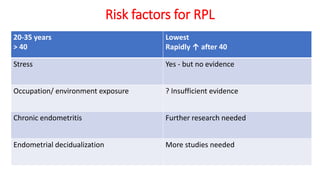
Risk factors for RPL
20-35 years
> 40
Lowest
Rapidly ↑ after 40
Stress Yes - but no evidence
Occupation/ environment exposure ? Insufficient evidence
Chronic endometritis Further research needed
Endometrial decidualization More studies needed
Medical & Family history
• Number of preceding pregnancy losses and female age provide the
best available prognostic information
• (>40% risk after 3 losses)
• Risk of pregnancy loss rapidly ↑after 40 years
Screening for genetic risk factors
Genetic analysis – not routinely recommended – but explanatory
purposes
Cytogenetic analysis of products of conception of third and subsequent
consecutive miscarriages
For genetic analysis- array –CGH is recommended based on reduced
maternal contamination
• Parental genetic testing – not routinely recommended , could be
caried out after individual assessment of risk
• Parental peripheral blood karyotyping of both partners, especially
when POC reports unbalanced structural chromosomal abnormality
Treatment for RPL with genetic background
• All couples with results of abnormal fetal or parental karyotype
should receive genetic counselling
• All couples with results of abnormal fetal or parental karyotype may
be informed possible treatment options available including their
advantages and disadvantages
• No Treatment available
Thrombophilia screening - Hereditary
• Factor 5 Leiden mutation, Protein C , MTHFR mutation
• 2nd trimester abortion – ? screen for inherited thrombophilia ❌
• Unless Research background, / additional risk factors
• No treatment available
Acquired Thrombophilia –Anti Phospholipid
Syndrome
• Treatable cause
• Therefore, the authors concluded that it is justifiable to offer testing for
APS to all women with a history of two or more, consecutive or non
consecutive, pregnancy losses (van den Boogaard et al., 201 )
3 Antibodies
Lupus anticoagulant (LA),
Anticardiolipin antibodies ACA- IgG, IgM
β2 glycoprotein I antibodies
(aβ2GPI, IgG, IgM)
Revised Sapporo classification criteria
for the APS
• Clinical criteria
• 1. Vascular thrombosis- confirmed by imaging or
HPE
2. Pregnancy morbidity
1. One /> unexplained deaths of a morphologically
normal fetus at or beyond the 10th week of gestation
2. One /> premature births of a morphologically normal
neonate before the 34th week of gestation because
of: (i) eclampsia or severe preeclampsia (ii)
placental insufficiency
3. Three /> unexplained consecutive spontaneous
abortions before the 10th week of gestation, .
•
- Laboratory criteria
- Two positive tests at least 12 weeks apart for
either LA or ACA IgG &/or IgM class present in a
medium or high titre over 40g/L or ml/L or above
99th percentile
•
--Anti-β2 glycoprotein-I antibody of IgG and/or
IgM isotype in serum or plasma, present on 2
or more occasions, at least 12 weeks apart,.
•
Definite APS is present if at least one of the clinical criteria and one of the
laboratory criteria are met, with the first measurement of the laboratory test
performed at least 12 weeks from the clinical manifestation
Treatment- Antiphospholipid syndrome
Immunological screening
• HLA determination in women with RPL is not recommended in clinical
practice
• Anti HV antibodies directed against male specific minor
histocompatibility antigens –NOT RECOMMENDED
• Cytokines testing, polymorphisms should not be used/tested in
women with RPL
• ANA –could be considered for explanatory purposes
• NK testing – insufficient evidence
Metabolic & Endocrine factors
1) Thyroid abnormalities
2) PCOS
3) Prolactin deficiency
4) Luteal Phase Insufficiency
5) Androgens
6) Vitamin D
7) Luteinizing Hormone
8) Hyperhomocysteinemia
Metabolic & Endocrine
factors
• Thyroid peroxidase (TPO)
antibodies (TPO-Ab) - disturbed
folliculogenesis, spermatogenesis,
fertilization and embryogenesis
• In the RPL group, the incidence of
subclinical hypothyroidism was
significantly higher in the TPOAb
positive group compared to the
TPOAb negative group (52 vs
16%).
Thyroid autoantibodies
• In women with RPL, thyroid peroxidase autoantibodies (TPOAb) are
mostly studied, and shown to be more relevant than antibodies
against the thyroid gland (Marai et al., 2004).
Isolated hypothyroxemia
• Defined as a normal TSH concentration in conjunction with FT4
concentrations in the lower 5th or 10th percentile of the reference
range (Stagnaro-Green et al., 2011).
• Associated with an increased risk of obstetric complications and child
neurocognitive impairment, although other studies reported no
association (Lazarus et al., 2014).
• A recent meta-analysis found an association of isolated
hypothyroxinaemia with placental abruption, but not with pregnancy
loss (Chan and Boelaert, 2015).
Hyperthyroidism
• Hyperthyroidism-sporadic pregnancy loss, pre-eclampsia, preterm
delivery, and congestive heart failure.
• However, no studies were found that described or searched for an
association between hyperthyroidism and recurrent pregnancy loss
(RPL).
Recommendations – Thyroid abnormalities
Treat/ not Evidence
Overt Hypothyroidism (
Before/early preg)
Treat – levothyroxine Strong
Subclinical hypothroidism Conflicting results
If Sub clinical hypothyroidism and
RPL – get pregnant, check TSH
If hypothyroid - treat GPP
Euthyroid, with thyroid antibodies No evidence to treat
PCOS
Uncertainty for an association between PCOS and pregnancy loss could
be explained by several factors suggested to be associated with both
PCOS and pregnancy loss, including obesity, hyperinsulinemia, LH
hypersecretion, hyperandrogenism, and thrombophilia (Homburg,
2006, Kazerooni et al., 2013, Ke, 2014).
Metformin/ insulin
Prolactin deficiency
Prolactin may play an important role in maintaining corpus luteum
function and progesterone secretion, although the mechanism is still
unclear (Li et al., 2013).
Bromocriptine for RPL with
hyperprolactinemia
Luteal phase insufficiency
• Insufficient progesterone exposure to maintain a regular secretory
endometrium and is allowed for normal embryo implantation and
growth (Palomba et al., 2015).
• Progesterone is essential for secretory transformation of the
endometrium that permits implantation as well as maintenance of
early pregnancy. Luteal phase insufficiency can be caused by several
endocrinopathies, including stress, PCOS, and prolactin disorders (Ke,
2014).
Treatment for RPL with Luteal phase deficiency
Role of Progesterone in RPL
• “Pregnancy hormone”, is crucial in the maintenance of pregnancy
• In early pregnancy, progesterone is responsible for preparing the
endometrium for implantation and maintenance of the gestational sac
in the uterus
• Start during the luteal phase and continue
Dydrogesterone
• Dydrogesterone could be effectively used to prevent miscarriage in women with a
history of idiopathic recurrent miscarriage
• Available evidence is insufficient to recommend the use of vaginal progestogens
(capsule, suppository, micronized, or gel) for the treatment of threatened or
recurrent miscarriage.
• There is insufficient evidence to support the use of injectable progestogens in
miscarriage prevention and treatment.
• There is no evidence to support the use of combination progestogens in the
prevention and treatment of threatened and idiopathic recurrent miscarriage.
Progestogen monotherapy administered in the appropriate dose is recommended
• Manufacturer dosage: 10–20 mg daily, until the 20th week of pregnancy. Treatment should preferably start before
conception.
Androgens
• Elevated androgen levels are associated with the retardation of
endometrial development in luteal phase, and have been assessed as
a possible cause of (recurrent) pregnancy loss.
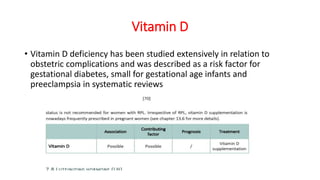
Vitamin D
• Vitamin D deficiency has been studied extensively in relation to
obstetric complications and was described as a risk factor for
gestational diabetes, small for gestational age infants and
preeclampsia in systematic reviews
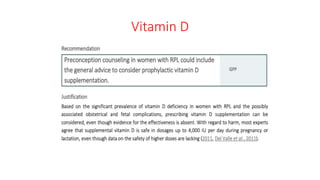
Vitamin D
Luteinizing hormone
• High serum concentrations of luteinizing hormone (LH) (≥10 IU/L) in
the early to mid-follicular phase, with or without PCOS, have been
associated with an increased prevalence of pregnancy loss in several
reports, both after spontaneous conception and ART (Kaur and
Gupta, 2016).
Hyperhomocysteinemia
• Hyperhomocysteinemia (HHcy), - a risk factor for venous
thromboembolism, and adverse pregnancy outcomes (neural tube
defects, pre-eclampsia, and placental abruption).
Ovarian reserve testing
• Ovarian reserve can be assessed with measurements of FSH, estrogen
(E2), inhibin B, and anti-Müllerian hormone (AMH), or ultrasound
investigation to determine antral follicle count (AFC) and ovarian
volume.
Male factor
• Since there is also clear evidence that sperm DNA damage is caused
by unhealthy lifestyles (such as smoking, obesity and excessive
exercise), clinicians could make couples aware of these risks.
• Antioxidants- no ↑ live birth
• Prospective studies are needed to elucidate these trends further.
• From the literature searched on male factors and RPL few studies
were retrieved, therefore, the search was extended to include studies
on single miscarriage.
Anatomical Investigations
• Three-dimensional US allows visualization of the internal and external
contour of the uterus, has high sensitivity and specificity, non-invasive
(Saravelos et al., 2008, Caliskan et al., 2010). STRONG
• It appears to be very accurate for the diagnosis and classification of
congenital uterine malformations and may conveniently become the
only mandatory step in the assessment of the uterine cavity in
women with a history of RPL, although further studies are required
for confirmation (Ghi et al., 2009)
Other investigations
• 1) Sonohysterography – uterine malformations, tubal factor
• 2) Mullerian anomaly- Kidneys , Urinary tract needs evaluation
• 3) MRI- not recommended as 1st line, but alternative – 3D USG not
available
CONDITIONAL
Treatment of RPL with uterine abnormalities
Treatment Recommendations
Hysteroscopic resection improves outcome Needs further evaluation
Metroplasty – bicorporeal uterus with normal cervix(
Bicornuate Uterus)
NO – Strong
Uterine reconstruction for hemi uterus ( Unicornuate) NO – Strong
Metroplasty – bicorporeal uterus with double cervix(
Didelphic Uterus)
Insufficient evidence
Hysteroscopic removal of sub mucosal fibroids or
endometrial polyps
Insufficient evidence
Intramural fibroids ( distort cavity) Insufficient evidence
Surgical removal of intrauterine adhesions,
precautions for recurrence
Insufficient evidence
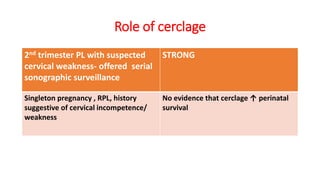
Role of cerclage
2nd trimester PL with suspected
cervical weakness- offered serial
sonographic surveillance
STRONG
Singleton pregnancy , RPL, history
suggestive of cervical incompetence/
weakness
No evidence that cerclage ↑ perinatal
survival
Treatment of Unexplained RPL
Lymphocyte immunization therapy No May have serious adverse effects
IV Ig No
Prednisolone NO Some adverse effects
Folic acid No Prevents NTD , not RPL
Anticoagulants/ aspirin No
Vaginal progesterone No No ↑ live birth rates
Intralipid therapy No Insufficient evidence
Granulocyte colony stimulating
factor
No Insufficient
Endometrial scratching – in luteal
phase , prior to IVF/ICSI
NO
Multivitamins
Health behavior modifications
FACTOR
Smoking cessation Yes
BMI Obesity
Caffeine Not all studies, unclear
Exercise Conflicting results
Alchohol Xs--yes
Other lifestyle changes Intercourse, soft drugs – cannabis , Xray's
Organization of care- RPL
Clinic
Staffing
First visit
Equipment / location
Appropriate evaluation
Care – psychological needs
Treatment plan
Research
THANK YOU

RPL pptx.pptx

  • 1.
    Recurrent Pregnancy Loss Dr MadhulathaAlexander, MD Professor, Government Medical College, Nizamabad
  • 2.
    Background • RECURRENT PREGNANCYLOSS (RPL), either early or late in the gestational period, is a serious problem and has both psychological and social impacts on the women who suffer from it • Incidence before 20 weeks 8–20%, 80% of these occurring in the first 12 weeks of pregnancy - The real rate of miscarriage may be much higher than reported - Routine TORCH screening abandoned Epidemiology and the medical causes of miscarriage.Regan L, Rai R Baillieres Best Pract Res Clin Obstet Gynaecol. 2000 Oct;
  • 3.
    Some Definitions • Apregnancy loss (miscarriage) - the spontaneous demise of a pregnancy before the fetus reaches viability. • The term therefore includes all pregnancy losses (PLs) from the time of conception until 24 weeks of gestation • Primary RPL R-PL without a previous ongoing pregnancy (viable pregnancy) beyond 24 weeks’ gestation, while secondary RPL is an episode of RPL after one or more previous pregnancies progressing beyond 24 weeks’ gestation. • By definition, “recurrent” pregnancy loss is defined as the loss of two or more pregnancies.
  • 4.
    More definitions….. • Pregnancy- confirmed by either serum or urine B-HCG, i.e. including non- visualized pregnancy losses (biochemical). • Clinical-clinical miscarriage is used when ultrasound examination or histological evidence has confirmed that an intrauterine pregnancy has existed. • Ectopic and molar pregnancies ❌ • Implantation failure❌ • Pregnancy losses after spontaneous conception and after ART treatments ✅. • Recurrent “Early” Pregnancy Loss (REPL) is the loss of two or more pregnancies before 10 weeks of gestational age
  • 6.
    When to Investigate Thedecision on when to start investigations will have to be decided by the doctor and the couple, as the result of shared decision-making, and be compliant with available resources.
  • 7.
    Risk factors forRPL 20-35 years > 40 Lowest Rapidly ↑ after 40 Stress Yes - but no evidence Occupation/ environment exposure ? Insufficient evidence Chronic endometritis Further research needed Endometrial decidualization More studies needed
  • 8.
    Medical & Familyhistory • Number of preceding pregnancy losses and female age provide the best available prognostic information • (>40% risk after 3 losses) • Risk of pregnancy loss rapidly ↑after 40 years
  • 9.
    Screening for geneticrisk factors Genetic analysis – not routinely recommended – but explanatory purposes Cytogenetic analysis of products of conception of third and subsequent consecutive miscarriages For genetic analysis- array –CGH is recommended based on reduced maternal contamination • Parental genetic testing – not routinely recommended , could be caried out after individual assessment of risk • Parental peripheral blood karyotyping of both partners, especially when POC reports unbalanced structural chromosomal abnormality
  • 10.
    Treatment for RPLwith genetic background • All couples with results of abnormal fetal or parental karyotype should receive genetic counselling • All couples with results of abnormal fetal or parental karyotype may be informed possible treatment options available including their advantages and disadvantages • No Treatment available
  • 11.
    Thrombophilia screening -Hereditary • Factor 5 Leiden mutation, Protein C , MTHFR mutation • 2nd trimester abortion – ? screen for inherited thrombophilia ❌ • Unless Research background, / additional risk factors • No treatment available
  • 12.
    Acquired Thrombophilia –AntiPhospholipid Syndrome • Treatable cause • Therefore, the authors concluded that it is justifiable to offer testing for APS to all women with a history of two or more, consecutive or non consecutive, pregnancy losses (van den Boogaard et al., 201 ) 3 Antibodies Lupus anticoagulant (LA), Anticardiolipin antibodies ACA- IgG, IgM β2 glycoprotein I antibodies (aβ2GPI, IgG, IgM)
  • 13.
    Revised Sapporo classificationcriteria for the APS • Clinical criteria • 1. Vascular thrombosis- confirmed by imaging or HPE 2. Pregnancy morbidity 1. One /> unexplained deaths of a morphologically normal fetus at or beyond the 10th week of gestation 2. One /> premature births of a morphologically normal neonate before the 34th week of gestation because of: (i) eclampsia or severe preeclampsia (ii) placental insufficiency 3. Three /> unexplained consecutive spontaneous abortions before the 10th week of gestation, . • - Laboratory criteria - Two positive tests at least 12 weeks apart for either LA or ACA IgG &/or IgM class present in a medium or high titre over 40g/L or ml/L or above 99th percentile • --Anti-β2 glycoprotein-I antibody of IgG and/or IgM isotype in serum or plasma, present on 2 or more occasions, at least 12 weeks apart,. • Definite APS is present if at least one of the clinical criteria and one of the laboratory criteria are met, with the first measurement of the laboratory test performed at least 12 weeks from the clinical manifestation
  • 14.
  • 15.
    Immunological screening • HLAdetermination in women with RPL is not recommended in clinical practice • Anti HV antibodies directed against male specific minor histocompatibility antigens –NOT RECOMMENDED • Cytokines testing, polymorphisms should not be used/tested in women with RPL • ANA –could be considered for explanatory purposes • NK testing – insufficient evidence
  • 16.
    Metabolic & Endocrinefactors 1) Thyroid abnormalities 2) PCOS 3) Prolactin deficiency 4) Luteal Phase Insufficiency 5) Androgens 6) Vitamin D 7) Luteinizing Hormone 8) Hyperhomocysteinemia
  • 17.
    Metabolic & Endocrine factors •Thyroid peroxidase (TPO) antibodies (TPO-Ab) - disturbed folliculogenesis, spermatogenesis, fertilization and embryogenesis • In the RPL group, the incidence of subclinical hypothyroidism was significantly higher in the TPOAb positive group compared to the TPOAb negative group (52 vs 16%).
  • 18.
    Thyroid autoantibodies • Inwomen with RPL, thyroid peroxidase autoantibodies (TPOAb) are mostly studied, and shown to be more relevant than antibodies against the thyroid gland (Marai et al., 2004).
  • 19.
    Isolated hypothyroxemia • Definedas a normal TSH concentration in conjunction with FT4 concentrations in the lower 5th or 10th percentile of the reference range (Stagnaro-Green et al., 2011). • Associated with an increased risk of obstetric complications and child neurocognitive impairment, although other studies reported no association (Lazarus et al., 2014). • A recent meta-analysis found an association of isolated hypothyroxinaemia with placental abruption, but not with pregnancy loss (Chan and Boelaert, 2015).
  • 20.
    Hyperthyroidism • Hyperthyroidism-sporadic pregnancyloss, pre-eclampsia, preterm delivery, and congestive heart failure. • However, no studies were found that described or searched for an association between hyperthyroidism and recurrent pregnancy loss (RPL).
  • 21.
    Recommendations – Thyroidabnormalities Treat/ not Evidence Overt Hypothyroidism ( Before/early preg) Treat – levothyroxine Strong Subclinical hypothroidism Conflicting results If Sub clinical hypothyroidism and RPL – get pregnant, check TSH If hypothyroid - treat GPP Euthyroid, with thyroid antibodies No evidence to treat
  • 22.
    PCOS Uncertainty for anassociation between PCOS and pregnancy loss could be explained by several factors suggested to be associated with both PCOS and pregnancy loss, including obesity, hyperinsulinemia, LH hypersecretion, hyperandrogenism, and thrombophilia (Homburg, 2006, Kazerooni et al., 2013, Ke, 2014).
  • 23.
  • 24.
    Prolactin deficiency Prolactin mayplay an important role in maintaining corpus luteum function and progesterone secretion, although the mechanism is still unclear (Li et al., 2013).
  • 25.
    Bromocriptine for RPLwith hyperprolactinemia
  • 26.
    Luteal phase insufficiency •Insufficient progesterone exposure to maintain a regular secretory endometrium and is allowed for normal embryo implantation and growth (Palomba et al., 2015). • Progesterone is essential for secretory transformation of the endometrium that permits implantation as well as maintenance of early pregnancy. Luteal phase insufficiency can be caused by several endocrinopathies, including stress, PCOS, and prolactin disorders (Ke, 2014).
  • 27.
    Treatment for RPLwith Luteal phase deficiency
  • 28.
    Role of Progesteronein RPL • “Pregnancy hormone”, is crucial in the maintenance of pregnancy • In early pregnancy, progesterone is responsible for preparing the endometrium for implantation and maintenance of the gestational sac in the uterus • Start during the luteal phase and continue
  • 29.
    Dydrogesterone • Dydrogesterone couldbe effectively used to prevent miscarriage in women with a history of idiopathic recurrent miscarriage • Available evidence is insufficient to recommend the use of vaginal progestogens (capsule, suppository, micronized, or gel) for the treatment of threatened or recurrent miscarriage. • There is insufficient evidence to support the use of injectable progestogens in miscarriage prevention and treatment. • There is no evidence to support the use of combination progestogens in the prevention and treatment of threatened and idiopathic recurrent miscarriage. Progestogen monotherapy administered in the appropriate dose is recommended • Manufacturer dosage: 10–20 mg daily, until the 20th week of pregnancy. Treatment should preferably start before conception.
  • 30.
    Androgens • Elevated androgenlevels are associated with the retardation of endometrial development in luteal phase, and have been assessed as a possible cause of (recurrent) pregnancy loss.
  • 31.
    Vitamin D • VitaminD deficiency has been studied extensively in relation to obstetric complications and was described as a risk factor for gestational diabetes, small for gestational age infants and preeclampsia in systematic reviews
  • 32.
  • 33.
    Luteinizing hormone • Highserum concentrations of luteinizing hormone (LH) (≥10 IU/L) in the early to mid-follicular phase, with or without PCOS, have been associated with an increased prevalence of pregnancy loss in several reports, both after spontaneous conception and ART (Kaur and Gupta, 2016).
  • 34.
    Hyperhomocysteinemia • Hyperhomocysteinemia (HHcy),- a risk factor for venous thromboembolism, and adverse pregnancy outcomes (neural tube defects, pre-eclampsia, and placental abruption).
  • 35.
    Ovarian reserve testing •Ovarian reserve can be assessed with measurements of FSH, estrogen (E2), inhibin B, and anti-Müllerian hormone (AMH), or ultrasound investigation to determine antral follicle count (AFC) and ovarian volume.
  • 36.
    Male factor • Sincethere is also clear evidence that sperm DNA damage is caused by unhealthy lifestyles (such as smoking, obesity and excessive exercise), clinicians could make couples aware of these risks. • Antioxidants- no ↑ live birth • Prospective studies are needed to elucidate these trends further. • From the literature searched on male factors and RPL few studies were retrieved, therefore, the search was extended to include studies on single miscarriage.
  • 37.
    Anatomical Investigations • Three-dimensionalUS allows visualization of the internal and external contour of the uterus, has high sensitivity and specificity, non-invasive (Saravelos et al., 2008, Caliskan et al., 2010). STRONG • It appears to be very accurate for the diagnosis and classification of congenital uterine malformations and may conveniently become the only mandatory step in the assessment of the uterine cavity in women with a history of RPL, although further studies are required for confirmation (Ghi et al., 2009)
  • 38.
    Other investigations • 1)Sonohysterography – uterine malformations, tubal factor • 2) Mullerian anomaly- Kidneys , Urinary tract needs evaluation • 3) MRI- not recommended as 1st line, but alternative – 3D USG not available CONDITIONAL
  • 39.
    Treatment of RPLwith uterine abnormalities Treatment Recommendations Hysteroscopic resection improves outcome Needs further evaluation Metroplasty – bicorporeal uterus with normal cervix( Bicornuate Uterus) NO – Strong Uterine reconstruction for hemi uterus ( Unicornuate) NO – Strong Metroplasty – bicorporeal uterus with double cervix( Didelphic Uterus) Insufficient evidence Hysteroscopic removal of sub mucosal fibroids or endometrial polyps Insufficient evidence Intramural fibroids ( distort cavity) Insufficient evidence Surgical removal of intrauterine adhesions, precautions for recurrence Insufficient evidence
  • 40.
    Role of cerclage 2ndtrimester PL with suspected cervical weakness- offered serial sonographic surveillance STRONG Singleton pregnancy , RPL, history suggestive of cervical incompetence/ weakness No evidence that cerclage ↑ perinatal survival
  • 41.
    Treatment of UnexplainedRPL Lymphocyte immunization therapy No May have serious adverse effects IV Ig No Prednisolone NO Some adverse effects Folic acid No Prevents NTD , not RPL Anticoagulants/ aspirin No Vaginal progesterone No No ↑ live birth rates Intralipid therapy No Insufficient evidence Granulocyte colony stimulating factor No Insufficient Endometrial scratching – in luteal phase , prior to IVF/ICSI NO
  • 42.
  • 43.
    Health behavior modifications FACTOR Smokingcessation Yes BMI Obesity Caffeine Not all studies, unclear Exercise Conflicting results Alchohol Xs--yes Other lifestyle changes Intercourse, soft drugs – cannabis , Xray's
  • 44.
    Organization of care-RPL Clinic Staffing First visit Equipment / location Appropriate evaluation Care – psychological needs Treatment plan Research
  • 45.

Editor's Notes

  • #5 Non(biochemical pregnancy losses and/or resolved and treated pregnancies of unknown location). In the non-visualized pregnancy loss group, pregnancy losses after gestational week 6 are included, where an ultrasound examination was only done after complete expulsion of the embryo and trophoblast or no ultrasound was done after heavy bleeding: it includes pregnancies that would have been classified as clinical miscarriages in case an earlier ultrasound scan had been done visualized loss
  • #8 Heavy metals, lack of moicronutrients, pesticide Endomet decidualisation- endomet changes in early preg -embryos – checkpoint – permit normal, - rapid demise of abnormal
  • #10 Comparative genomic hybridization (CGH), also referred to as chromosomal microarray analysis (CMA), and array CGH (aCGH), is a method of genetic testing that may identify small deletions and duplications of the subtelomers, each pericentromeric region and other chromosome regions
  • #12   blood can form clots too easily
  • #14  The revised Sapporo criteria have improved face validity over the Sapporo criteria with respect to time requirements. The time requirement between 2 positive LAC tests was revised from 6 weeks to 12 weeks, resulting in a theoretical reduction in false-positive tests.
  • #15 Good partipatory conference
  • #16 Human hantavirus (HV) antibody
  • #18 , supporting an important role for thyroid hormone disorders and thyroid autoimmunity in subfertility and pregnancy loss (Vissenberg et al., 2015). Subclinical hypothyroidism is defined biochemically as a normal serum free thyroxine (T4) concentration in the presence of an elevated serum thyroid-stimulating hormone (TSH) concentration.
  • #30 DYDRO good bioavailability, few SE.highly selective for the progesterone receptor, lacks estrogenic, androgenic, anabolic, and corticoid properties;26,50 most studies including no masculinization of the female fetus27 or congenital abnormalities. However, given the poor bioavailability of oral micronized progesterone, high doses may be required, which may result in drowsiness20 and liver toxicity
  • #38 3D –USG BEST high sensitivity, specificity, septate uterus bet bicorporeal uterus with normal cervix
  • #42 the theory is that the procedure will liberate cytokines and chemo-attractants of importance for subsequent embryo implantation.
  • #44 -Indirect evidence from infertile couples Overweight- 25-30-minimal Underweight -? Similarly, we found no evidence that using soft drugs (e.g. cannabis) could be a risk factor for pregnancy loss in women with RPL. However, avoiding soft drugs is in general recommended, and especially during pregnancy. Smoking, alcohol, excessive exercise, unhealthy body weight -Indirect evidence from infertile couples