Purpose of Recruitmentin a Global Context
Recruitment is the process of attracting a
pool of qualified talent from around the world
to meet an organization's strategic goals.
A great example of this is Microsoft's
expansion into India. By setting up offices
there, they were able to strategically recruit
and leverage the vast local talent pool in the
IT sector.
3.
Purpose of Selectionin a Global Context
Selection is the process of choosing
the best candidate from the
applicant pool. In a global context,
this means ensuring the chosen
person not only has the right skills
but also a strong cultural fit.
For instance, when choosing a leader for a new
office in Dubai, it's vital that the individual
understands and respects Middle Eastern
business etiquette to build successful
relationships.
4.
Types of Recruitment
Thereare three main types of global recruitment
1. Internal recruitment involves promoting an
existing employee, which can be great for
morale and company knowledge.
2. External recruitment is hiring from outside
the company.
3. Third-country recruitment is hiring a
citizen from a country other than the home
country or the host country—a common
practice in organizations like the United
Nations.
. Types of Selection
Global selection uses a variety of methods.
1. Interviews allow for personal evaluation but can be subject to
cultural biases.
2. Psychometric tests assess personality and cognitive abilities more
objectively.
3. Assessment centers use group exercises and simulations to evaluate
candidates in a hands-on environment. It's important to use a mix of
these to get a full picture of a candidate.
5.
Recruitment Methods inDifferent Countries
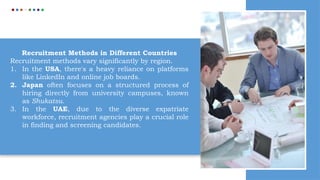
Recruitment methods vary significantly by region.
1. In the USA, there's a heavy reliance on platforms
like LinkedIn and online job boards.
2. Japan often focuses on a structured process of
hiring directly from university campuses, known
as Shukatsu.
3. In the UAE, due to the diverse expatriate
workforce, recruitment agencies play a crucial role
in finding and screening candidates.
6.
Selection Methods inDifferent Countries
Different countries also favor different selection methods.
• In the USA, behavioral interviews, often using the STAR (Situation, Task, Action,
Result) method, are very popular.
• Germany places a strong emphasis on technical skills and often includes rigorous
technical tests.
• In contrast, Japan frequently uses group assessments to evaluate a candidate's ability to
work as a team member.
Your
Company
June
2024
7.
Google is famousfor
its creative and
innovative hiring
practices, using
unique problem-
solving tests to find
candidates who can
"think outside the
box."
8.
Toyota focuses on
teamwork,often
using group tasks in
their selection
process to ensure
candidates align with
their collaborative
culture.
9.
Unilever is knownfor
tailoring its recruitment
strategies specifically for
emerging markets,
adapting to local talent
pools and needs.
10.
Resume Building byRegion
Resumes, or CVs, are structured differently around the world.
• In the USA, resumes typically focus on achievements and
quantifiable results.
• In the UK, CVs place a greater emphasis on qualifications
and academic background.
• In the Middle East, it's still common for CVs to include
personal details such as age, marital status, or a photograph.
"Your resume is your first impression. Make it count."
11.
"Your appearance isa reflection of your inner self-confidence."
Interview Styles by Region
Interview styles also differ.
• USA interviews are often direct and conversational.
• In Japan, it's common for candidates to show modesty
and respect, avoiding bold self-promotion.
• In the Middle East, interviews may start with more
personal, relationship-based discussions to build
rapport before moving to professional topics.
12.
Sample Interview Questionsby Region
• For a role in the USA, a question like "Tell me
about a time you showed leadership" is
standard.
• In a Japanese context, you might ask, "How have
you contributed to a team's success?"
• In the Middle East, a question like, "How do you
build trust with colleagues?" might be more
effective, focusing on relationship-building.
13.
Art of Behavioral
Interviews
Masterthe art of behavioral interviews by practicing and
preparing specific examples that highlight your skills,
experiences, and problem-solving abilities.
14.
Legal & ComplianceFactors
Global hiring is governed by a complex web of laws.
• In Europe, organizations must comply with GDPR
(General Data Protection Regulation) regarding
candidate data.
• In the USA, complex visa laws dictate who can be
hired from abroad.
• In countries like Australia, labor regulations place
specific requirements on employment contracts and
working conditions.
15.
Your
Company
June
2024
Role of TechnologyTechnology has transformed global
recruitment.
01.
ATS (Applicant Tracking Systems)
streamline the application process
02.
03. AI can be used to screen
resumes more efficiently.
Remote interview platforms
make it possible to connect with
candidates anywhere in the
world, saving time and money.
16.
Tips, Opportunities, Skills,
Networking
Forpostgraduate students aiming for
international careers,
• Pursue internships abroad to gain firsthand
experience.
• Use LinkedIn for professional networking.
• Attend global conferences to meet industry
leaders, and focus on developing essential
skills like adaptability and cross-cultural
communication.