CHEERDANCE
CHEERDANCE
Is coined from the words, CHEER and
DANCE.
To cheer is to shout out words or phrases that
may help motivate and boost the morale of a
playing team and perform better during a
game.
Dance, on the other hand, is a physical activity
where one expresses emotions or gestures
while performing bodily movements usually in
time with rhythm.
CHEERDANCE
Cheerdancing rooted from cheerleading
- performance of a routine, usually
dominated by gymnastic skills such as
jumps, tumbling skills, lifts and tosses
combined with shouting of cheers and
yells to lead the crowd to cheer for a
certain team during a game or sport.
CHEERDANCE
Today, cheerdancing is identified as
one of the most spectacular events in
one of the biggest collegiate sports
events in the country, the UAAP
(University Athletic Association of
the Philippines).
History
Ivy league college sporting events.
Cheerleading/Cheerdance originated in USA. In the
1980s at Princeton University, Thomas Peebles
together with other students supported a local
American Football team w/ cheers.
On 2 November 1898, standing in front of a crowd of
sport fans, Johnny Campbell, a medical student,
started conducting the cheer on the spur of the
moment. He was so effective that the team won and
he made history as the first cheerleader.
History
It might hard to believe that the first cheerleading
was mainly performed by men. It was not until
World War II that women dominated this activity.
1923, at University of Minnesota, Women
participated.
Since then, nearly 90% of competitions have been
girls.
In the year 1951 after the war, National Cheerleaders
Association was established and the founder is
Laurence “Herkie” Hurkimer.
1965, Fred Gastoff invented the Vinyl pom-pom.
History
The Dallas Cowboys Cheerleaders soon gained the spotlight
with their revealing outfits and sophisticated dance moves,
debuting in the 1972-1973.
In 1970 they established cheerleaders as “American Leon of
Wholesome sex appeal.”
In 1980s is the beginning of modern cheerleading.
The Baltimore Colts cheerleading group, formed in 1960,
was the first professional team.
History
From the 1970s on, the popularity of cheerleading
continued to rise, and the female dancers acted as
supporters not only for American football or
basketball teams, but also swimming and track-and-
field competitors.
In the 1980s and the 1990s, cheerleading started
gaining popularity in various other countries, such as
Japan, Chile, The United Kingdom, Germany and in
Scandinavia. This discipline started to flourish in the
USA as well, as evidenced by the massive number of
competitions held nearly every weekend in many
American towns and cities.
ARMS/HAND MOVEMENTS
Beginning stance and cheer stance
“T” and half “T” positions
Clasp, clap, overhead clasp, low clasp
Touchdown, low touchdown
High “V” and low “V”
Tabletop and punch, etc.
“L” and diagonal positions
LEGS/FEET POSITIONS
Feet Together
Feet Apart
Dig (front and side)
Hitch, Liberty, and Scale
Lunge (front and side)
Knees and Hips position
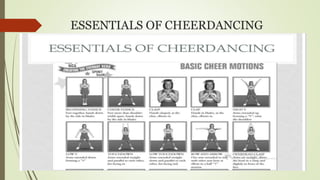
ESSENTIALS OF CHEERDANCING
CHEERDANCE BASICS (GYMNASTIC
SIDE)
JUMPS
Tuck
Star/spread eagle
Pike
Split
Hurdle Jump/Hurkie
Toe Touch Jump
CHEERDANCE BASICS (GYMNASTIC
SIDE)
Pyramids
Composition: Flyer Base Spotter
Levels: One-and-a-half high
Two-high
Two-and-a-half high
STEPS IN EXECUTING A PYRAMID
Setting up (Preparing to lift)
•Load (Actual lift)
•Hit (Striking for a final pause)
•Dismount (To move down by the
flyer)
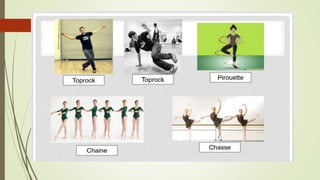
CHEERDANCE BASICS (DANCE SIDE)
Hip Hop Basics Jazz/Classical Dance Basics:
• Bounce (Downrock) ● Tendu (point)
• Groove (Toprock) ● Pliē (knees slightly bent)
• Power moves: ● Grand Plie (full knees bent)
- Pump ● Relevē (heels raised)
- Lock ● Piquē (Raising a knee)
- Point ● Battement (Kicks)
- Curl ● Ball Change and Chassē
• Freezes ● Piroutte and Chainē (Turns)
CHEERDANCE BASICS (CHEER SIDE)
Cheering is the very essence of cheerdance
performances. To cheer is to make
someone or a team motivated and
encouraged. It boosts, salutes or acclaims
the morale of individuals and teams. In
cheerdance, cheering needs to be strong,
loud, and metered so that it will be
delivered in time with rhythm or the music
played.

CHEERDANCE ppt.pptx

  • 1.
  • 2.
    CHEERDANCE Is coined fromthe words, CHEER and DANCE. To cheer is to shout out words or phrases that may help motivate and boost the morale of a playing team and perform better during a game. Dance, on the other hand, is a physical activity where one expresses emotions or gestures while performing bodily movements usually in time with rhythm.
  • 3.
    CHEERDANCE Cheerdancing rooted fromcheerleading - performance of a routine, usually dominated by gymnastic skills such as jumps, tumbling skills, lifts and tosses combined with shouting of cheers and yells to lead the crowd to cheer for a certain team during a game or sport.
  • 4.
    CHEERDANCE Today, cheerdancing isidentified as one of the most spectacular events in one of the biggest collegiate sports events in the country, the UAAP (University Athletic Association of the Philippines).
  • 5.
    History Ivy league collegesporting events. Cheerleading/Cheerdance originated in USA. In the 1980s at Princeton University, Thomas Peebles together with other students supported a local American Football team w/ cheers. On 2 November 1898, standing in front of a crowd of sport fans, Johnny Campbell, a medical student, started conducting the cheer on the spur of the moment. He was so effective that the team won and he made history as the first cheerleader.
  • 6.
    History It might hardto believe that the first cheerleading was mainly performed by men. It was not until World War II that women dominated this activity. 1923, at University of Minnesota, Women participated. Since then, nearly 90% of competitions have been girls. In the year 1951 after the war, National Cheerleaders Association was established and the founder is Laurence “Herkie” Hurkimer. 1965, Fred Gastoff invented the Vinyl pom-pom.
  • 7.
    History The Dallas CowboysCheerleaders soon gained the spotlight with their revealing outfits and sophisticated dance moves, debuting in the 1972-1973. In 1970 they established cheerleaders as “American Leon of Wholesome sex appeal.” In 1980s is the beginning of modern cheerleading. The Baltimore Colts cheerleading group, formed in 1960, was the first professional team.
  • 8.
    History From the 1970son, the popularity of cheerleading continued to rise, and the female dancers acted as supporters not only for American football or basketball teams, but also swimming and track-and- field competitors. In the 1980s and the 1990s, cheerleading started gaining popularity in various other countries, such as Japan, Chile, The United Kingdom, Germany and in Scandinavia. This discipline started to flourish in the USA as well, as evidenced by the massive number of competitions held nearly every weekend in many American towns and cities.
  • 9.
    ARMS/HAND MOVEMENTS Beginning stanceand cheer stance “T” and half “T” positions Clasp, clap, overhead clasp, low clasp Touchdown, low touchdown High “V” and low “V” Tabletop and punch, etc. “L” and diagonal positions
  • 10.
    LEGS/FEET POSITIONS Feet Together FeetApart Dig (front and side) Hitch, Liberty, and Scale Lunge (front and side) Knees and Hips position
  • 11.
  • 12.
  • 14.
    CHEERDANCE BASICS (GYMNASTIC SIDE) JUMPS Tuck Star/spreadeagle Pike Split Hurdle Jump/Hurkie Toe Touch Jump
  • 15.
    CHEERDANCE BASICS (GYMNASTIC SIDE) Pyramids Composition:Flyer Base Spotter Levels: One-and-a-half high Two-high Two-and-a-half high
  • 16.
    STEPS IN EXECUTINGA PYRAMID Setting up (Preparing to lift) •Load (Actual lift) •Hit (Striking for a final pause) •Dismount (To move down by the flyer)
  • 17.
    CHEERDANCE BASICS (DANCESIDE) Hip Hop Basics Jazz/Classical Dance Basics: • Bounce (Downrock) ● Tendu (point) • Groove (Toprock) ● Pliē (knees slightly bent) • Power moves: ● Grand Plie (full knees bent) - Pump ● Relevē (heels raised) - Lock ● Piquē (Raising a knee) - Point ● Battement (Kicks) - Curl ● Ball Change and Chassē • Freezes ● Piroutte and Chainē (Turns)
  • 20.
    CHEERDANCE BASICS (CHEERSIDE) Cheering is the very essence of cheerdance performances. To cheer is to make someone or a team motivated and encouraged. It boosts, salutes or acclaims the morale of individuals and teams. In cheerdance, cheering needs to be strong, loud, and metered so that it will be delivered in time with rhythm or the music played.