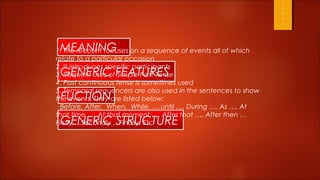


MEANING
1. The recount focuses on a sequence of events all of which
relate to a particular occasion
2. It introduces specific participants
 GENERIC FEATURES
3. frequent uses of Simple Past Tense
4. Past continuous tense is sometimes used
5. Temporal sequencers are also used in the sentences to show
 FUCTION
the events. They are listed below:
· Before, After, When, While, … until …, During …, As …, At
that time …, At that moment …, After that …, After then …
 GENERIC STRUCTURE
Firstly …Secondly …Finally, Etc
RECOUNT TEXT                     How could I Hide my face?
            One afternoon a month ago, I was very hungry. As I didn’t cook anything to eat
        lunch, I decided to go to a café introduction that provides my boarding house.
                    1. Orientation : an about a hundred meters from
                      the setting and introduces participant
               I changedEvents : account that tells what happened,
                      2. my trousers and shirt then left for the café by myself because my
                      in a sequence
        roommate hadn’t come yet from the school. As soon as I got to the café, I ordered
        the meal withEventvegetable soup that seemed very delicious in the hot day, and
                      · fresh 1
        also a glass of tea. When they were served, I ate up eagerly the meal and soup and
                      · Event 2
        drank the tea. I was 3
                      · Event satisfied and it was the time to pay. I grabbed my trousers
        pocket and I was shocked. My hands didn’t feel there was any wallet there. I felt so
                      · Etc
        embarrassed that I didn’t dare to see the faces of the customers. My body stayed
                      3. Reorientation (optional) : Closing of events
        still on the chair and began sweating.
             I tried to control myself in front of the people. I collected my courage to come
        to the cashier to say something. Feeling uneasy, I told her that I left my wallet in the
        other trousers at the boarding house and promised to take it and come back soon.
        Some customers looked at me. I thought I must hide my face. She nodded and said
        it was not a matter.

           Finally, I ran to the house and got back with the money. I gave it to her and
        came out of the café. What a relief! It should not happen again to me
The past perfect expresses an activity that was completed before another
activity or time in the past.
    Example :
    1. My parents had already eaten by the time I got home.
    2. Until yesterday, I had never heard about it.
    3. The thief simply walked in. Someone had forgotten to lock the door.

   If either before or after is used in the sentence, the past perfect is often not
necessary because the time relationship is already clear. The simple past may be
used.
   Example :
   1. Sam had already left when we got there
   2. Sam had left before we got there
   3. After the guests had left, I went to bed
Questions
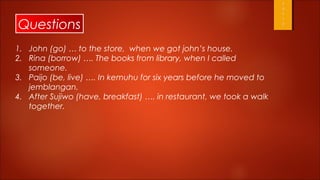
1. John (go) … to the store, when we got john’s house.
2. Rina (borrow) …. The books from library, when I called
   someone.
3. Paijo (be, live) …. In kemuhu for six years before he moved to
   jemblangan.
4. After Sujiwo (have, breakfast) …. in restaurant, we took a walk
   together.
Questions
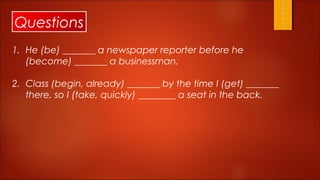
1. He (be) _______ a newspaper reporter before he
   (become) _______ a businessman.

2. Class (begin, already) _______ by the time I (get) _______
   there, so I (take, quickly) ________ a seat in the back.
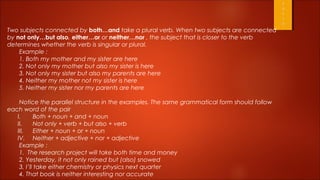
Two subjects connected by both…and take a plural verb. When two subjects are connected
by not only…but also, either…or or neither…nor , the subject that is closer to the verb
determines whether the verb is singular or plural.
    Example :
    1. Both my mother and my sister are here
    2. Not only my mother but also my sister is here
    3. Not only my sister but also my parents are here
    4. Neither my mother not my sister is here
    5. Neither my sister nor my parents are here

    Notice the parallel structure in the examples. The same grammatical form should follow
each word of the pair
   I.       Both + noun + and + noun
   II.      Not only + verb + but also + verb
   III.     Either + noun + or + noun
   IV. Neither + adjective + nor + adjective
    Example :
    1. The research project will take both time and money
    2. Yesterday, it not only rained but (also) snowed
    3. I’ll take either chemistry or physics next quarter
    4. That book is neither interesting nor accurate
Questions
1.   He does not have a pen. He does not have paper.
2.   John has a Lamborghini. Marry has a Lamborghini.
3.   You can have tea, or you can have coffee.
4.   Arthur is absent. Ricardo is absent.
Combining Independent Clauses with Conjunction

A conjunction may be used to connect two independent clauses.
   Punctuation :
   1. Usually a comma immediately precedes the conjunction
   2. Sometimes in short sentences the comma is omitted
   3. sometimes in informal writing a conjunction may begin a sentence

   Example :
   1. I was raining hard, and there was a strong wind
   2. I was raining hard and there was a strong wind
   3. I was raining hard. And there was a strong wind
In addition to and, but, or, and nor, other conjunction are used to
   connect two independent clauses :
  so (meaning therefore, as a result)
  for (meaning because)
  yet (meaning but, nevertheless)
  A comma almost always precedes so, far, and yet when they are
  used as conjunction
  Example :
  1. He was so tired, so he went to bed
  2. The child hid behind his mother’s skirt, for he was afraid of the dog
  3. He did not study, yet he passed the exam
Questions
1.   The box is too heavy to bring, .… I call the taxi
2.   The days were short, …. it was not December
3.   Last week peggy bought a car, … she used to taking the bus to
     school
4.   I’ve finally finished painting the house, …. Now I can go fishing
5.   We have to wear warm clothes, …. It’s winter now.
6.   Bob used to live in the dorm, …. A couple of weeks ago he moved
     into an apartment.
A Noun-Clause is a group of words which contains a Subject and a
  Predicate of its own and does the work of a noun.

Example :

• No one knows who he is.

• I did not know what he would do next.

• How the budget got in is a mystery.

• Pay careful attention to what I am going to
say.

• I do not understand how all it happened.
Recount

Recount

  • 2.
    MEANING 1. The recountfocuses on a sequence of events all of which relate to a particular occasion 2. It introduces specific participants GENERIC FEATURES 3. frequent uses of Simple Past Tense 4. Past continuous tense is sometimes used 5. Temporal sequencers are also used in the sentences to show FUCTION the events. They are listed below: · Before, After, When, While, … until …, During …, As …, At that time …, At that moment …, After that …, After then … GENERIC STRUCTURE Firstly …Secondly …Finally, Etc
  • 3.
    RECOUNT TEXT How could I Hide my face? One afternoon a month ago, I was very hungry. As I didn’t cook anything to eat lunch, I decided to go to a café introduction that provides my boarding house. 1. Orientation : an about a hundred meters from the setting and introduces participant I changedEvents : account that tells what happened, 2. my trousers and shirt then left for the café by myself because my in a sequence roommate hadn’t come yet from the school. As soon as I got to the café, I ordered the meal withEventvegetable soup that seemed very delicious in the hot day, and · fresh 1 also a glass of tea. When they were served, I ate up eagerly the meal and soup and · Event 2 drank the tea. I was 3 · Event satisfied and it was the time to pay. I grabbed my trousers pocket and I was shocked. My hands didn’t feel there was any wallet there. I felt so · Etc embarrassed that I didn’t dare to see the faces of the customers. My body stayed 3. Reorientation (optional) : Closing of events still on the chair and began sweating. I tried to control myself in front of the people. I collected my courage to come to the cashier to say something. Feeling uneasy, I told her that I left my wallet in the other trousers at the boarding house and promised to take it and come back soon. Some customers looked at me. I thought I must hide my face. She nodded and said it was not a matter. Finally, I ran to the house and got back with the money. I gave it to her and came out of the café. What a relief! It should not happen again to me
  • 4.
    The past perfectexpresses an activity that was completed before another activity or time in the past. Example : 1. My parents had already eaten by the time I got home. 2. Until yesterday, I had never heard about it. 3. The thief simply walked in. Someone had forgotten to lock the door. If either before or after is used in the sentence, the past perfect is often not necessary because the time relationship is already clear. The simple past may be used. Example : 1. Sam had already left when we got there 2. Sam had left before we got there 3. After the guests had left, I went to bed
  • 5.
    Questions 1. John (go)… to the store, when we got john’s house. 2. Rina (borrow) …. The books from library, when I called someone. 3. Paijo (be, live) …. In kemuhu for six years before he moved to jemblangan. 4. After Sujiwo (have, breakfast) …. in restaurant, we took a walk together.
  • 7.
    Questions 1. He (be)_______ a newspaper reporter before he (become) _______ a businessman. 2. Class (begin, already) _______ by the time I (get) _______ there, so I (take, quickly) ________ a seat in the back.
  • 8.
    Two subjects connectedby both…and take a plural verb. When two subjects are connected by not only…but also, either…or or neither…nor , the subject that is closer to the verb determines whether the verb is singular or plural. Example : 1. Both my mother and my sister are here 2. Not only my mother but also my sister is here 3. Not only my sister but also my parents are here 4. Neither my mother not my sister is here 5. Neither my sister nor my parents are here Notice the parallel structure in the examples. The same grammatical form should follow each word of the pair I. Both + noun + and + noun II. Not only + verb + but also + verb III. Either + noun + or + noun IV. Neither + adjective + nor + adjective Example : 1. The research project will take both time and money 2. Yesterday, it not only rained but (also) snowed 3. I’ll take either chemistry or physics next quarter 4. That book is neither interesting nor accurate
  • 9.
    Questions 1. He does not have a pen. He does not have paper. 2. John has a Lamborghini. Marry has a Lamborghini. 3. You can have tea, or you can have coffee. 4. Arthur is absent. Ricardo is absent.
  • 10.
    Combining Independent Clauseswith Conjunction A conjunction may be used to connect two independent clauses. Punctuation : 1. Usually a comma immediately precedes the conjunction 2. Sometimes in short sentences the comma is omitted 3. sometimes in informal writing a conjunction may begin a sentence Example : 1. I was raining hard, and there was a strong wind 2. I was raining hard and there was a strong wind 3. I was raining hard. And there was a strong wind
  • 11.
    In addition toand, but, or, and nor, other conjunction are used to connect two independent clauses : so (meaning therefore, as a result) for (meaning because) yet (meaning but, nevertheless) A comma almost always precedes so, far, and yet when they are used as conjunction Example : 1. He was so tired, so he went to bed 2. The child hid behind his mother’s skirt, for he was afraid of the dog 3. He did not study, yet he passed the exam
  • 12.
    Questions 1. The box is too heavy to bring, .… I call the taxi 2. The days were short, …. it was not December 3. Last week peggy bought a car, … she used to taking the bus to school 4. I’ve finally finished painting the house, …. Now I can go fishing 5. We have to wear warm clothes, …. It’s winter now. 6. Bob used to live in the dorm, …. A couple of weeks ago he moved into an apartment.
  • 13.
    A Noun-Clause isa group of words which contains a Subject and a Predicate of its own and does the work of a noun. Example : • No one knows who he is. • I did not know what he would do next. • How the budget got in is a mystery. • Pay careful attention to what I am going to say. • I do not understand how all it happened.