










Period to the
present
Present Perfect
Simple and
Continuous
A: I’ve lived in Rome for 20 years.


     Where does ‘A’ live now?
A: I’ve lived in Rome for 20 years.
   Before coming to Rome,
   I lived in London.
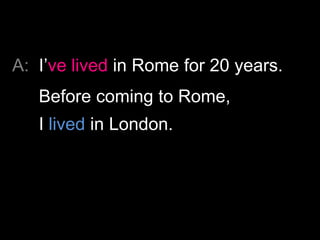
A: I’ve lived in Rome for 20 years.
   Before coming to Rome,
   I lived in London.
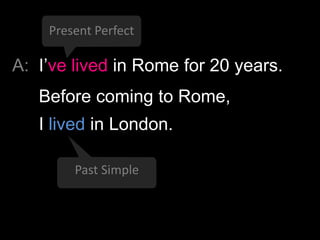
Present Perfect

A: I’ve lived in Rome for 20 years.
   Before coming to Rome,
   I lived in London.

        Past Simple
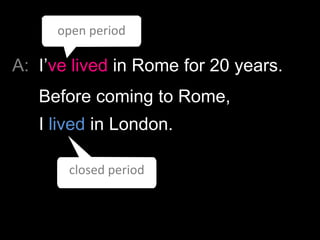
open period

A: I’ve lived in Rome for 20 years.
   Before coming to Rome,
   I lived in London.

       closed period
this grammar is only about
defining the duration of periods
for other meanings of
     the Present Perfect, eg.
   Have you ever been to Paris?
        I’ve lost my keys.
Someone’s been eating my sandwich.
     see your grammar book
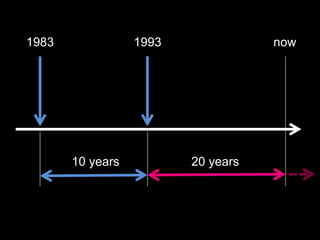
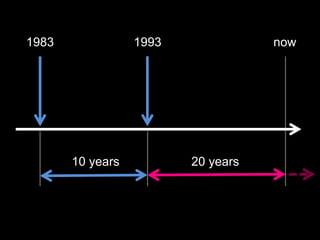
1983              1993              now


       10 years          20 years
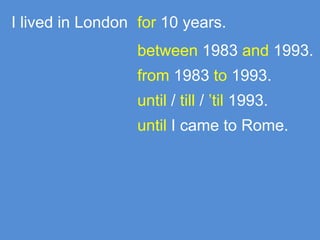
I lived in London for 10 years.
                  between 1983 and 1993.
                  from 1983 to 1993.
                  until / till / ’til 1993.
                  until I came to Rome.
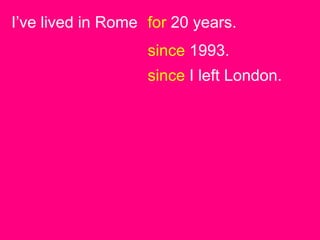
I’ve lived in Rome for 20 years.
                   since 1993.
                   since I left London.
1983              1993              now


       10 years          20 years
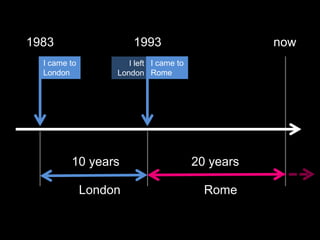
1983                   1993                         now
  I came to           I left I came to
  London           London Rome


         10 years                        20 years

              London                       Rome
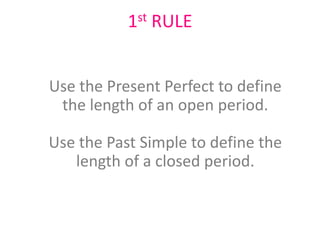
1st RULE


Use the Present Perfect to define
 the length of an open period.

Use the Past Simple to define the
   length of a closed period.
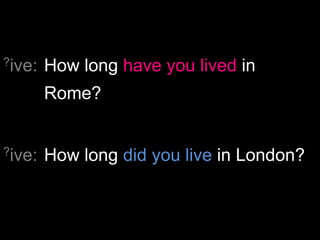
?ive:   How long have you lived in
        Rome?


?ive:   How long did you live in London?
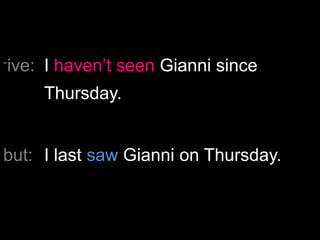
-ive:   I haven’t seen Gianni since
        Thursday.


but: I last saw Gianni on Thursday.
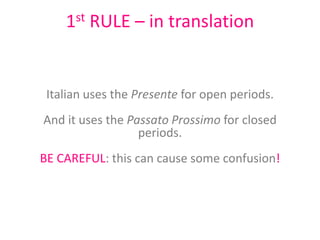
1st RULE – in translation


 Italian uses the Presente for open periods.
And it uses the Passato Prossimo for closed
                  periods.
BE CAREFUL: this can cause some confusion!
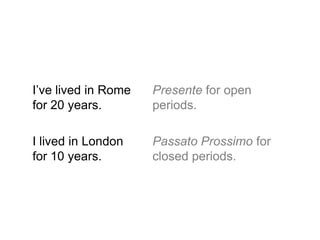
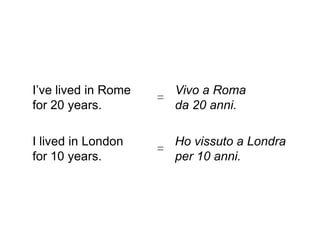
I’ve lived in Rome   Presente for open
for 20 years.        periods.

I lived in London    Passato Prossimo for
for 10 years.        closed periods.
I’ve lived in Rome     Vivo a Roma
                     =
for 20 years.          da 20 anni.

I lived in London      Ho vissuto a Londra
                     =
for 10 years.          per 10 anni.
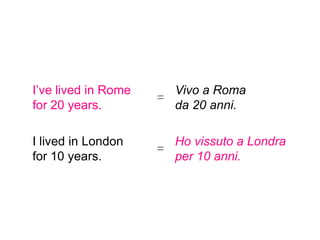
I’ve lived in Rome     Vivo a Roma
                     =
for 20 years.          da 20 anni.

I lived in London      Ho vissuto a Londra
                     =
for 10 years.          per 10 anni.
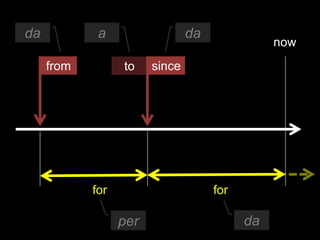
prepositions
and 1 adverb
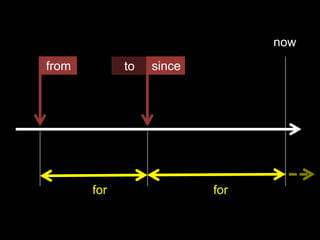
now
from         to   since


       for                for
da           a                  da
                                                now
     from         to    since


            for                      for

                  per                      da
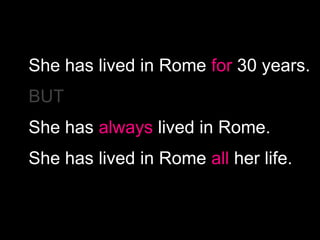
She has lived in Rome for 30 years.
BUT
She has always lived in Rome.
She has lived in Rome all her life.
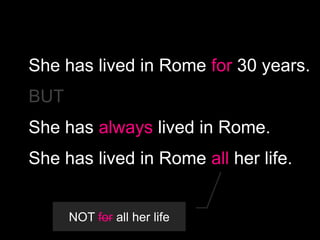
She has lived in Rome for 30 years.
BUT
She has always lived in Rome.
She has lived in Rome all her life.


      NOT for all her life
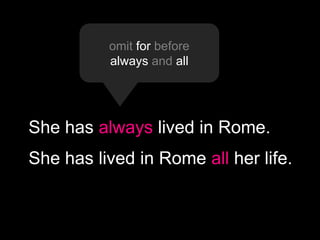
omit for before
          always and all


She has always lived in Rome.
She has lived in Rome all her life.
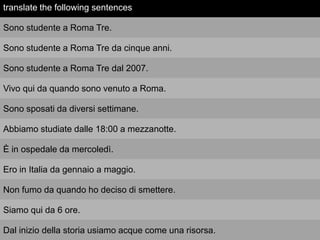
translate the following sentences

Sono studente a Roma Tre.

Sono studente a Roma Tre da cinque anni.

Sono studente a Roma Tre dal 2007.

Vivo qui da quando sono venuto a Roma.

Sono sposati da diversi settimane.

Abbiamo studiate dalle 18:00 a mezzanotte.

È in ospedale da mercoledì.

Ero in Italia da gennaio a maggio.

Non fumo da quando ho deciso di smettere.

Siamo qui da 6 ore.

Dal inizio della storia usiamo acque come una risorsa.
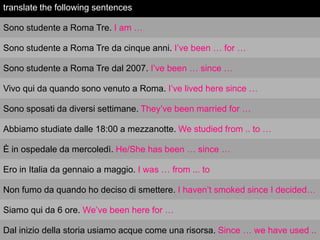
translate the following sentences

Sono studente a Roma Tre. I am …

Sono studente a Roma Tre da cinque anni. I’ve been … for …

Sono studente a Roma Tre dal 2007. I’ve been … since …

Vivo qui da quando sono venuto a Roma. I’ve lived here since …

Sono sposati da diversi settimane. They’ve been married for …

Abbiamo studiate dalle 18:00 a mezzanotte. We studied from .. to …

È in ospedale da mercoledì. He/She has been … since …

Ero in Italia da gennaio a maggio. I was … from ... to

Non fumo da quando ho deciso di smettere. I haven’t smoked since I decided…

Siamo qui da 6 ore. We’ve been here for …

Dal inizio della storia usiamo acque come una risorsa. Since … we have used ..
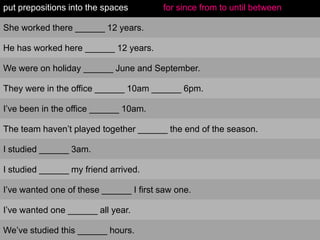
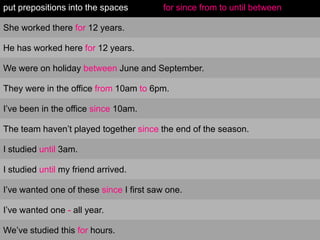
put prepositions into the spaces        for since from to until between

She worked there ______ 12 years.

He has worked here ______ 12 years.

We were on holiday ______ June and September.

They were in the office ______ 10am ______ 6pm.

I’ve been in the office ______ 10am.

The team haven’t played together ______ the end of the season.

I studied ______ 3am.

I studied ______ my friend arrived.

I’ve wanted one of these ______ I first saw one.

I’ve wanted one ______ all year.

We’ve studied this ______ hours.
put prepositions into the spaces          for since from to until between

She worked there for 12 years.

He has worked here for 12 years.

We were on holiday between June and September.

They were in the office from 10am to 6pm.

I’ve been in the office since 10am.

The team haven’t played together since the end of the season.

I studied until 3am.

I studied until my friend arrived.

I’ve wanted one of these since I first saw one.

I’ve wanted one - all year.

We’ve studied this for hours.
Present Perfect
Continuous
form
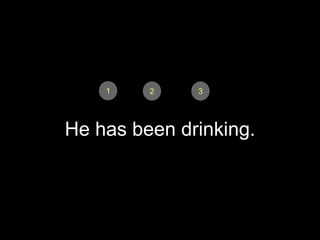
He has been drinking.
1    2    3


He has been drinking.
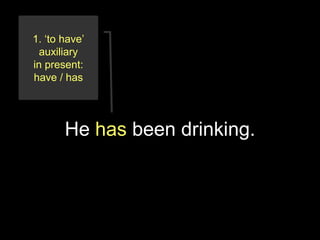
1. ‘to have’
  auxiliary
in present:
have / has


       He has been drinking.
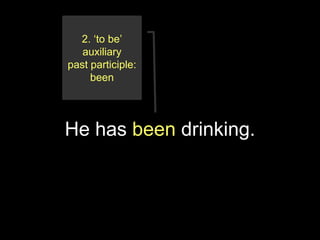
2. ‘to be’
   auxiliary
past participle:
     been


He has been drinking.
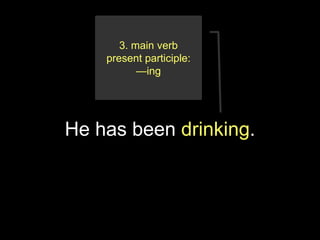
3. main verb
    present participle:
           —ing


He has been drinking.
period to the present
It’s been raining for 3 hours.
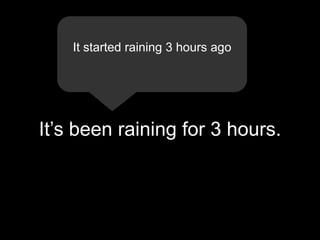
It started raining 3 hours ago


It’s been raining for 3 hours.
It started raining 3 hours ago
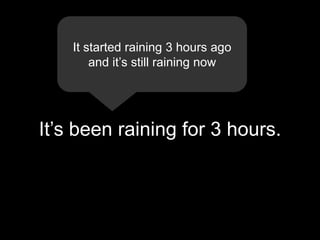
        and it’s still raining now


It’s been raining for 3 hours.
this is the same concept as the
     Present Perfect Simple
I live in Rome (present duration)
+ for 20 years (period)
I live in Rome (present duration)
+ for 20 years (period)

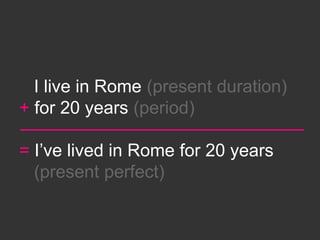
= I’ve lived in Rome for 20 years
  (present perfect)
It’s raining (present duration)
+ for 3 hours (period)
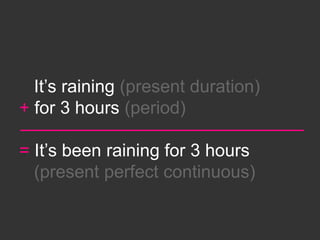
It’s raining (present duration)
+ for 3 hours (period)

= It’s been raining for 3 hours
  (present perfect continuous)
the Present Perfect Simple
     describes longer,
     more permanent
         periods
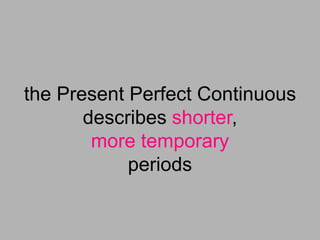
the Present Perfect Continuous
       describes shorter,
        more temporary
            periods
Present Perfect Simple
            vs.
Present Perfect Continuous
1. state verbs
I know her.
I know her.
-- how long --
I know her.
+ only 5 minutes
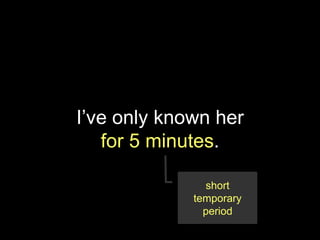
I’ve only known her
   for 5 minutes.
I’ve only known her
   for 5 minutes.

               short
             temporary
               period
‘simple’
  anyway


I’ve only known her
   for 5 minutes.
state verbs never
used in continuous
       tenses


I’ve only known her
   for 5 minutes.
2. long period
She works at IBM.
She works at IBM.
  -- how long --
She works at IBM.
   + 10 years
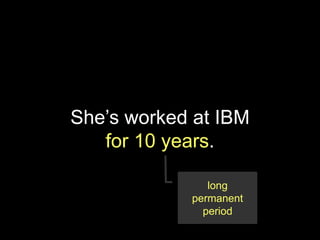
She’s worked at IBM
   for 10 years.
She’s worked at IBM
   for 10 years.

               long
            permanent
              period
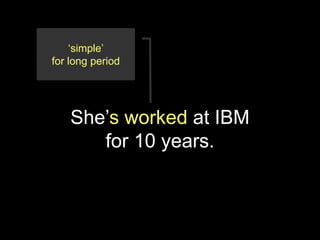
‘simple’
for long period


    She’s worked at IBM
       for 10 years.
BUT


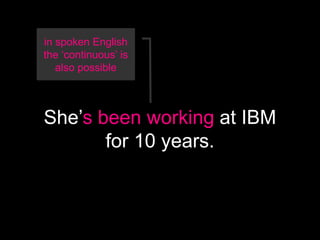
She’s been working at IBM
       for 10 years.
in spoken English
the ‘continuous’ is
   also possible


She’s been working at IBM
       for 10 years.
3. short periods
We’re waiting
We’re waiting
-- how long --
We’re waiting
+ 15 minutes
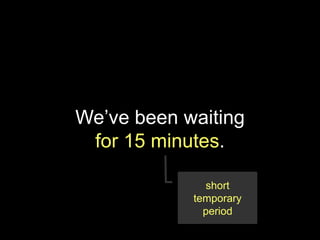
We’ve been waiting
 for 15 minutes.
We’ve been waiting
 for 15 minutes.

              short
            temporary
              period
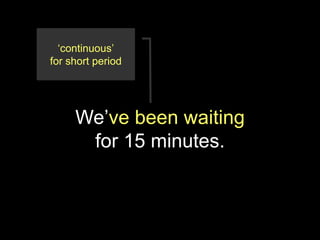
‘continuous’
for short period


     We’ve been waiting
      for 15 minutes.
summary
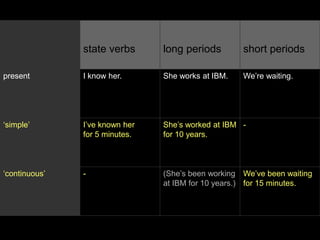
state verbs      long periods        short periods

present        I know her.      She works at IBM.   We’re waiting.


‘simple’       I’ve known her   She’s worked at IBM -
               for 5 minutes.   for 10 years.


‘continuous’   -                (She’s been working We’ve been waiting
                                at IBM for 10 years.) for 15 minutes.
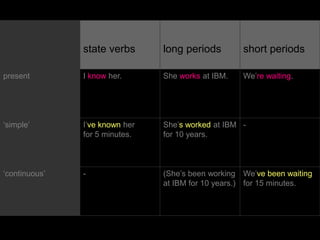
it’s the present tense verb that
             decides
state verbs      long periods        short periods

present        I know her.      She works at IBM.   We’re waiting.


‘simple’       I’ve known her   She’s worked at IBM -
               for 5 minutes.   for 10 years.


‘continuous’   -                (She’s been working We’ve been waiting
                                at IBM for 10 years.) for 15 minutes.
put these sentences in present perfect simple or continuous

I [study] economics ___ 3 years.

He [always like] Pink Floyd.

It [snow] ___ 10 o’clock.

How long [you wait]?

They [play] ___ 40 minutes.

She [work] as a waitress ___ she left school.

We [say] that ___ ages.

She [live] the same house ___ all her life.

They [live] together ___ 1995.

I [listen] to music ___ all day.

He [not sleep] well ___ he lost his job.
put these sentences in present perfect simple or continuous

I [study] economics ___ 3 years. I’ve been studying … for …

He [always like] Pink Floyd. He’s always liked …

It [snow] ___ 10 o’clock. It’s been snowing since …

How long [you wait]? How long have you been waiting?

They [play] ___ 40 minutes. They’ve been playing for …

She [work] as a waitress ___ she left school. She’s been working … since …

We [say] that ___ ages. We’ve been saying … for …

She [live] the same house ___ all her life. She’s lived … for …

They [live] together ___ 1995. They’ve lived … since …

I [listen] to music ___ all day. I’ve been listening … for …

He [not sleep] well ___ he lost his job. He hasn’t been sleeping … since …
www.davidnicholson.it

Period to the present

  • 1.
    Period to the present PresentPerfect Simple and Continuous
  • 2.
    A: I’ve livedin Rome for 20 years.
  • 3.
    A: I’ve livedin Rome for 20 years. Where does ‘A’ live now?
  • 4.
    A: I’ve livedin Rome for 20 years. Before coming to Rome, I lived in London.
  • 5.
    A: I’ve livedin Rome for 20 years. Before coming to Rome, I lived in London.
  • 6.
    Present Perfect A: I’velived in Rome for 20 years. Before coming to Rome, I lived in London. Past Simple
  • 7.
    open period A: I’velived in Rome for 20 years. Before coming to Rome, I lived in London. closed period
  • 8.
    this grammar isonly about defining the duration of periods
  • 9.
    for other meaningsof the Present Perfect, eg. Have you ever been to Paris? I’ve lost my keys. Someone’s been eating my sandwich. see your grammar book
  • 10.
    1983 1993 now 10 years 20 years
  • 11.
    I lived inLondon for 10 years. between 1983 and 1993. from 1983 to 1993. until / till / ’til 1993. until I came to Rome.
  • 12.
    I’ve lived inRome for 20 years. since 1993. since I left London.
  • 13.
    1983 1993 now 10 years 20 years
  • 14.
    1983 1993 now I came to I left I came to London London Rome 10 years 20 years London Rome
  • 15.
    1st RULE Use thePresent Perfect to define the length of an open period. Use the Past Simple to define the length of a closed period.
  • 16.
    ?ive: How long have you lived in Rome? ?ive: How long did you live in London?
  • 17.
    -ive: I haven’t seen Gianni since Thursday. but: I last saw Gianni on Thursday.
  • 18.
    1st RULE –in translation Italian uses the Presente for open periods. And it uses the Passato Prossimo for closed periods. BE CAREFUL: this can cause some confusion!
  • 19.
    I’ve lived inRome Presente for open for 20 years. periods. I lived in London Passato Prossimo for for 10 years. closed periods.
  • 20.
    I’ve lived inRome Vivo a Roma = for 20 years. da 20 anni. I lived in London Ho vissuto a Londra = for 10 years. per 10 anni.
  • 21.
    I’ve lived inRome Vivo a Roma = for 20 years. da 20 anni. I lived in London Ho vissuto a Londra = for 10 years. per 10 anni.
  • 22.
  • 23.
    now from to since for for
  • 24.
    da a da now from to since for for per da
  • 25.
    She has livedin Rome for 30 years.
  • 26.
    She has livedin Rome for 30 years. BUT She has always lived in Rome. She has lived in Rome all her life.
  • 27.
    She has livedin Rome for 30 years. BUT She has always lived in Rome. She has lived in Rome all her life. NOT for all her life
  • 28.
    omit for before always and all She has always lived in Rome. She has lived in Rome all her life.
  • 29.
    translate the followingsentences Sono studente a Roma Tre. Sono studente a Roma Tre da cinque anni. Sono studente a Roma Tre dal 2007. Vivo qui da quando sono venuto a Roma. Sono sposati da diversi settimane. Abbiamo studiate dalle 18:00 a mezzanotte. È in ospedale da mercoledì. Ero in Italia da gennaio a maggio. Non fumo da quando ho deciso di smettere. Siamo qui da 6 ore. Dal inizio della storia usiamo acque come una risorsa.
  • 30.
    translate the followingsentences Sono studente a Roma Tre. I am … Sono studente a Roma Tre da cinque anni. I’ve been … for … Sono studente a Roma Tre dal 2007. I’ve been … since … Vivo qui da quando sono venuto a Roma. I’ve lived here since … Sono sposati da diversi settimane. They’ve been married for … Abbiamo studiate dalle 18:00 a mezzanotte. We studied from .. to … È in ospedale da mercoledì. He/She has been … since … Ero in Italia da gennaio a maggio. I was … from ... to Non fumo da quando ho deciso di smettere. I haven’t smoked since I decided… Siamo qui da 6 ore. We’ve been here for … Dal inizio della storia usiamo acque come una risorsa. Since … we have used ..
  • 31.
    put prepositions intothe spaces for since from to until between She worked there ______ 12 years. He has worked here ______ 12 years. We were on holiday ______ June and September. They were in the office ______ 10am ______ 6pm. I’ve been in the office ______ 10am. The team haven’t played together ______ the end of the season. I studied ______ 3am. I studied ______ my friend arrived. I’ve wanted one of these ______ I first saw one. I’ve wanted one ______ all year. We’ve studied this ______ hours.
  • 32.
    put prepositions intothe spaces for since from to until between She worked there for 12 years. He has worked here for 12 years. We were on holiday between June and September. They were in the office from 10am to 6pm. I’ve been in the office since 10am. The team haven’t played together since the end of the season. I studied until 3am. I studied until my friend arrived. I’ve wanted one of these since I first saw one. I’ve wanted one - all year. We’ve studied this for hours.
  • 33.
  • 34.
  • 35.
    He has beendrinking.
  • 36.
    1 2 3 He has been drinking.
  • 37.
    1. ‘to have’ auxiliary in present: have / has He has been drinking.
  • 38.
    2. ‘to be’ auxiliary past participle: been He has been drinking.
  • 39.
    3. main verb present participle: —ing He has been drinking.
  • 40.
  • 41.
    It’s been rainingfor 3 hours.
  • 42.
    It started raining3 hours ago It’s been raining for 3 hours.
  • 43.
    It started raining3 hours ago and it’s still raining now It’s been raining for 3 hours.
  • 44.
    this is thesame concept as the Present Perfect Simple
  • 45.
    I live inRome (present duration)
  • 46.
    I live inRome (present duration) + for 20 years (period)
  • 47.
    I live inRome (present duration) + for 20 years (period) = I’ve lived in Rome for 20 years (present perfect)
  • 48.
  • 49.
    It’s raining (presentduration) + for 3 hours (period)
  • 50.
    It’s raining (presentduration) + for 3 hours (period) = It’s been raining for 3 hours (present perfect continuous)
  • 51.
    the Present PerfectSimple describes longer, more permanent periods
  • 52.
    the Present PerfectContinuous describes shorter, more temporary periods
  • 53.
    Present Perfect Simple vs. Present Perfect Continuous
  • 54.
  • 55.
  • 56.
    I know her. --how long --
  • 57.
    I know her. +only 5 minutes
  • 58.
    I’ve only knownher for 5 minutes.
  • 59.
    I’ve only knownher for 5 minutes. short temporary period
  • 60.
    ‘simple’ anyway I’veonly known her for 5 minutes.
  • 61.
    state verbs never usedin continuous tenses I’ve only known her for 5 minutes.
  • 62.
  • 63.
  • 64.
    She works atIBM. -- how long --
  • 65.
    She works atIBM. + 10 years
  • 66.
    She’s worked atIBM for 10 years.
  • 67.
    She’s worked atIBM for 10 years. long permanent period
  • 68.
    ‘simple’ for long period She’s worked at IBM for 10 years.
  • 69.
    BUT She’s been workingat IBM for 10 years.
  • 70.
    in spoken English the‘continuous’ is also possible She’s been working at IBM for 10 years.
  • 71.
  • 72.
  • 73.
  • 74.
  • 75.
    We’ve been waiting for 15 minutes.
  • 76.
    We’ve been waiting for 15 minutes. short temporary period
  • 77.
    ‘continuous’ for short period We’ve been waiting for 15 minutes.
  • 78.
  • 79.
    state verbs long periods short periods present I know her. She works at IBM. We’re waiting. ‘simple’ I’ve known her She’s worked at IBM - for 5 minutes. for 10 years. ‘continuous’ - (She’s been working We’ve been waiting at IBM for 10 years.) for 15 minutes.
  • 80.
    it’s the presenttense verb that decides
  • 81.
    state verbs long periods short periods present I know her. She works at IBM. We’re waiting. ‘simple’ I’ve known her She’s worked at IBM - for 5 minutes. for 10 years. ‘continuous’ - (She’s been working We’ve been waiting at IBM for 10 years.) for 15 minutes.
  • 82.
    put these sentencesin present perfect simple or continuous I [study] economics ___ 3 years. He [always like] Pink Floyd. It [snow] ___ 10 o’clock. How long [you wait]? They [play] ___ 40 minutes. She [work] as a waitress ___ she left school. We [say] that ___ ages. She [live] the same house ___ all her life. They [live] together ___ 1995. I [listen] to music ___ all day. He [not sleep] well ___ he lost his job.
  • 83.
    put these sentencesin present perfect simple or continuous I [study] economics ___ 3 years. I’ve been studying … for … He [always like] Pink Floyd. He’s always liked … It [snow] ___ 10 o’clock. It’s been snowing since … How long [you wait]? How long have you been waiting? They [play] ___ 40 minutes. They’ve been playing for … She [work] as a waitress ___ she left school. She’s been working … since … We [say] that ___ ages. We’ve been saying … for … She [live] the same house ___ all her life. She’s lived … for … They [live] together ___ 1995. They’ve lived … since … I [listen] to music ___ all day. I’ve been listening … for … He [not sleep] well ___ he lost his job. He hasn’t been sleeping … since …
  • 85.