RECONSTRUCTIVE
PERIODONTAL SURGERY
Prepared by:
Roshna T. Mustafa
Regeneration:
The reproduction or reconstruction of a lost or
injured part (new cementum, new PDL & new
alv. Bone). (fully restore the architecture &
function of the part)
Such results occur with surgical treatment of
defects with the use of bone grafting materials,
guided tissue regeneration (GTR) procedures,
or use of enamel matrix derivative (EMD).
Regenerative surgical techniques:
Can be achieved by:
1- Non-graft-associated new attachment
and
2- Graft-associated new attachment
1- Non-graft-associated new attachment:
( removal of junctional & pocket epithelium)
Used in
a- 3 walls defect. b- periodontal abscess.
Rational and techniques:
• Removal of junctional and Pocket Epithelium.
• Prevention of Epithelial Migration.
• The Use of Biodegradable Membranes.
• Clot Stabilization, Wound Protection, and Space
Creation.
• Biomodification of the Root Surface.
Guided tissue regeneration
(GTR):
• It prevent the epithelial migration along
the cemental wall of the pocket by
placing barriers of different types to
cover the bone and periodontal
ligament, thus temporarily separating
them from the gingival epithelium
Membrane –blocks epithelium and
the gingival connective tissue;
allows nutrients to pass;
titanium reinforced if needed.
Healing from bone and
PDL
Membranes classification
• Resorbable
• Non-resorbable
Membranes classification
Non-resorbable membranes
First membranes used
Require a second surgical procedure
Most extensive evaluated membranes
Gold standard
Guided Tissue Regeneration
(GTR)
• Resorbable membranes
• Bioabsorbable or biodegradable
• Polylactid acid, Polyglycolic acid
• Good handling characteristics, remains intact for 8
to 10 or 16 to 24 weeks then gradually resorbs.
• Collagen membranes. Perdominantly type I collagen
• Excellent handling, biodegrades in 16 or more
weeks.
Collagen membranes
Initially used as gel or matrix to fill or cover
periodontal defects
Various collagen subtypes: Predominantly type I
Derived from different animal sources:
bovine, porcine; tendon, dermis
2- Graft-associated new
attachment:
Bone graft materials have been used to facilitate bone
formation within a given space by occupying that space
and allowing the subsequent bone growth to take place.
The considerations that govern the selection of a
material have been defined as follows"':
1- Biologic acceptability
2- Predictability
3- Clinical feasibility
4- Minimal operative hazards
5- Minimal postoperative sequelae
6- Patient acceptance
Once the material is placed in the bony
defect it may act in either ways:
1- Ostegenesis: refers to the formation or development of
new bone by cells contained in the graft.
2- osteoinduction: is a chemical process by which
molecules contained in the graft (bone morphogenetic
proteins or BMPs) convert the neighboring cells into
osteoblasts, which in turn form bone.
3- osteoconduction: is a physical effect by which the
matrix of the graft forms a scaffold that favors outside cells
to penetrate the graft and form new bone.
All grafting techniques require
• Pre-surgical scaling & root planning
• Occlusal adjustment as needed.
• and exposure of the defect with a full-
thickness flap.
Types of grafting
materials
Origin:
1- Autogenous: Autograft (harvested from
patients’ own bone)
2- Allograft: (from another individual of the
same species).
3- Xenograft: (grafts taken from donors of
another species).
4- Synthetic: Alloplast (synthetic bone
substitutes)
Autogenous bone graft:
• Bone graft whereby bone is removed
and transplanted within the same
individual ( from one site to another)
• a gold standard is generally found to be
the most successful for a number of
reasons:
1- the individual’s immune system
recognises it’s own tissue therefore not
triggering defence against the graft
2- there is a sufficient source of bone
available, whether it is cancellous or
cortical bone, ready for transfer.
3- it has the most bone healing
characteristics
Autogenous bone provides osteogenesis,
osteoconduction and osteoinduction and
is the only material to provide all three
characteristics.
Advantages of autograft:
• Biocompatible
• Osteoinductive
• Osteoconductive
• High osteogeniec potential
• Adequate mechanical strength
• Available in both cortical and cancellous
types
Disadvantages of autograft:
• Need for additional surgery to procure
the tissue
• Increase in operative time and cost
• Donor site morbidity and postoperative
pain
• Increased risk of fracture to donor site
• Limited amount of tissue can be
procured
• High variability in quality of harvested
bone tissue
Intraoral autogenous graft:
• Commonly obtained from edentulous area
of the jaw, healing extraction sites,
maxillary tuberosities or the mandibular
retromolar area.
• Generally cancellous bone is preferred as
graft material but cortical bone applied as
small chips, or mixed with blood prior to
placement in the defect was also reported
to be effective in producing regeneration in
periodontal infra bony defect.
Extraoral autogenous graft:
• Schallhorn (1967) introduced the use of
iliac crest marrow graft in the treatment
of furcation and infra bony defect.
• Due to morbidity associated with the
donor site and that root resorption
sometimes result, iliac crest marrow
grafts are not used in regenerative
periodontal therapy.
Allografts:
• Allografts are harvested from genetically non-identical members of
same species.
• A disadvantage : antigenicity (graft rejection), this can be avoided with
freezing or ionising radiation, chemicals
Types:
• Mineralized or Demineralized
1- FREEZE-DRIED BONE ALLOGRAFT
FDBA: is a mineralized bone graft (osteoconductive)
2- DEMINERALIZED FREEZE-DRIED BONE ALLOGRAFT
DFDBA: Hydrochloric acid demineralization exposes the bone
inductive proteins, collectively called bone morphogenic proteins
(BMP). (OSTEOINDUCTIVE)
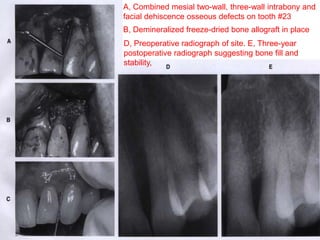
A, Combined mesial two-wall, three-wall intrabony and
facial dehiscence osseous defects on tooth #23
B, Demineralized freeze-dried bone allograft in place
D, Preoperative radiograph of site. E, Three-year
postoperative radiograph suggesting bone fill and
stability,
Xenograft:
• Xenografts are derived from different
species other than human.
• They are considered to be
biocompatible with human recipients
and have osteoconductive properties.
• Bovine-derived bone grafts (particulate
and blocks) have successfully been
used for the treatment of human
intrabony defects and ridge
augmentation
Alloplastic materials:
• Are synthetic, inorganic, biocompatible and/or
bioactive bone graft substitute which are claimed
to promote bone healing through
osteoconduction.
• high abundance relative to natural materials, no
risk of disease transmission and the very low
antigenicity
• can be made available in both resorbable and
nonresorbable forms and can be customized with
varying levels of porosity and pore sizes
• Alloplastic materials are mainly
osteoconductive without intrinsic
potential for osteogenesis or
osteoinduction and have been used
successfully in periodontal
reconstructive surgery
There are four types:
1- hydroxyapatite (HA)
2- beta tricalcium phosphate (ß-TCP)
3- Polymers
4- bioactive glasses (bioglass)
Thank you

13404723.pptx

  • 1.
  • 2.
    Regeneration: The reproduction orreconstruction of a lost or injured part (new cementum, new PDL & new alv. Bone). (fully restore the architecture & function of the part) Such results occur with surgical treatment of defects with the use of bone grafting materials, guided tissue regeneration (GTR) procedures, or use of enamel matrix derivative (EMD).
  • 3.
    Regenerative surgical techniques: Canbe achieved by: 1- Non-graft-associated new attachment and 2- Graft-associated new attachment
  • 4.
    1- Non-graft-associated newattachment: ( removal of junctional & pocket epithelium) Used in a- 3 walls defect. b- periodontal abscess. Rational and techniques: • Removal of junctional and Pocket Epithelium. • Prevention of Epithelial Migration. • The Use of Biodegradable Membranes. • Clot Stabilization, Wound Protection, and Space Creation. • Biomodification of the Root Surface.
  • 5.
    Guided tissue regeneration (GTR): •It prevent the epithelial migration along the cemental wall of the pocket by placing barriers of different types to cover the bone and periodontal ligament, thus temporarily separating them from the gingival epithelium
  • 6.
    Membrane –blocks epitheliumand the gingival connective tissue; allows nutrients to pass; titanium reinforced if needed. Healing from bone and PDL
  • 7.
  • 8.
    Membranes classification Non-resorbable membranes Firstmembranes used Require a second surgical procedure Most extensive evaluated membranes Gold standard
  • 9.
    Guided Tissue Regeneration (GTR) •Resorbable membranes • Bioabsorbable or biodegradable • Polylactid acid, Polyglycolic acid • Good handling characteristics, remains intact for 8 to 10 or 16 to 24 weeks then gradually resorbs. • Collagen membranes. Perdominantly type I collagen • Excellent handling, biodegrades in 16 or more weeks.
  • 10.
    Collagen membranes Initially usedas gel or matrix to fill or cover periodontal defects Various collagen subtypes: Predominantly type I Derived from different animal sources: bovine, porcine; tendon, dermis
  • 13.
    2- Graft-associated new attachment: Bonegraft materials have been used to facilitate bone formation within a given space by occupying that space and allowing the subsequent bone growth to take place. The considerations that govern the selection of a material have been defined as follows"': 1- Biologic acceptability 2- Predictability 3- Clinical feasibility 4- Minimal operative hazards 5- Minimal postoperative sequelae 6- Patient acceptance
  • 14.
    Once the materialis placed in the bony defect it may act in either ways: 1- Ostegenesis: refers to the formation or development of new bone by cells contained in the graft. 2- osteoinduction: is a chemical process by which molecules contained in the graft (bone morphogenetic proteins or BMPs) convert the neighboring cells into osteoblasts, which in turn form bone. 3- osteoconduction: is a physical effect by which the matrix of the graft forms a scaffold that favors outside cells to penetrate the graft and form new bone.
  • 15.
    All grafting techniquesrequire • Pre-surgical scaling & root planning • Occlusal adjustment as needed. • and exposure of the defect with a full- thickness flap.
  • 16.
    Types of grafting materials Origin: 1-Autogenous: Autograft (harvested from patients’ own bone) 2- Allograft: (from another individual of the same species). 3- Xenograft: (grafts taken from donors of another species). 4- Synthetic: Alloplast (synthetic bone substitutes)
  • 17.
    Autogenous bone graft: •Bone graft whereby bone is removed and transplanted within the same individual ( from one site to another) • a gold standard is generally found to be the most successful for a number of reasons: 1- the individual’s immune system recognises it’s own tissue therefore not triggering defence against the graft
  • 18.
    2- there isa sufficient source of bone available, whether it is cancellous or cortical bone, ready for transfer. 3- it has the most bone healing characteristics Autogenous bone provides osteogenesis, osteoconduction and osteoinduction and is the only material to provide all three characteristics.
  • 19.
    Advantages of autograft: •Biocompatible • Osteoinductive • Osteoconductive • High osteogeniec potential • Adequate mechanical strength • Available in both cortical and cancellous types
  • 20.
    Disadvantages of autograft: •Need for additional surgery to procure the tissue • Increase in operative time and cost • Donor site morbidity and postoperative pain • Increased risk of fracture to donor site • Limited amount of tissue can be procured • High variability in quality of harvested bone tissue
  • 21.
    Intraoral autogenous graft: •Commonly obtained from edentulous area of the jaw, healing extraction sites, maxillary tuberosities or the mandibular retromolar area. • Generally cancellous bone is preferred as graft material but cortical bone applied as small chips, or mixed with blood prior to placement in the defect was also reported to be effective in producing regeneration in periodontal infra bony defect.
  • 22.
    Extraoral autogenous graft: •Schallhorn (1967) introduced the use of iliac crest marrow graft in the treatment of furcation and infra bony defect. • Due to morbidity associated with the donor site and that root resorption sometimes result, iliac crest marrow grafts are not used in regenerative periodontal therapy.
  • 23.
    Allografts: • Allografts areharvested from genetically non-identical members of same species. • A disadvantage : antigenicity (graft rejection), this can be avoided with freezing or ionising radiation, chemicals Types: • Mineralized or Demineralized 1- FREEZE-DRIED BONE ALLOGRAFT FDBA: is a mineralized bone graft (osteoconductive) 2- DEMINERALIZED FREEZE-DRIED BONE ALLOGRAFT DFDBA: Hydrochloric acid demineralization exposes the bone inductive proteins, collectively called bone morphogenic proteins (BMP). (OSTEOINDUCTIVE)
  • 24.
    A, Combined mesialtwo-wall, three-wall intrabony and facial dehiscence osseous defects on tooth #23 B, Demineralized freeze-dried bone allograft in place D, Preoperative radiograph of site. E, Three-year postoperative radiograph suggesting bone fill and stability,
  • 25.
    Xenograft: • Xenografts arederived from different species other than human. • They are considered to be biocompatible with human recipients and have osteoconductive properties. • Bovine-derived bone grafts (particulate and blocks) have successfully been used for the treatment of human intrabony defects and ridge augmentation
  • 26.
    Alloplastic materials: • Aresynthetic, inorganic, biocompatible and/or bioactive bone graft substitute which are claimed to promote bone healing through osteoconduction. • high abundance relative to natural materials, no risk of disease transmission and the very low antigenicity • can be made available in both resorbable and nonresorbable forms and can be customized with varying levels of porosity and pore sizes
  • 27.
    • Alloplastic materialsare mainly osteoconductive without intrinsic potential for osteogenesis or osteoinduction and have been used successfully in periodontal reconstructive surgery
  • 28.
    There are fourtypes: 1- hydroxyapatite (HA) 2- beta tricalcium phosphate (ß-TCP) 3- Polymers 4- bioactive glasses (bioglass)
  • 29.