IJRET: International Journal of Research in Engineering and Technology eISSN: 2319-1163 | pISSN: 2321-7308
__________________________________________________________________________________________
Volume: 03 Issue: 05 | May-2014, Available @ http://www.ijret.org 1
DESIGN AND ANALYSIS OF A PATCH ANTENNA FOR BLUETOOTH
APPLICATION
Ankit Dixit1
, O.P. Singh2
, G.R. Mishra3
1
Department of Electronics & Comm. Engg., Amity University, Lucknow Campus, India
2
Department of Electronics & Comm. Engg., Amity University, Lucknow Campus, India
3
Department of Electronics & Comm. Engg., Amity University, Lucknow Campus, India
Abstract
This paper analyzes the patch antenna for Bluetooth application. After analyzing its various parameters the proposed design is
created using simulator software HFSS. The parameters considered for the presented design are the gain, radiation pattern, VSWR,
and directivity. Through simulation results it was inferred that the design is optimum and the parameters are calculated.
Keywords: Patch Antenna, Bluetooth, Gain, Radiation Pattern, VSWR, Directivity.
----------------------------------------------------------------------***--------------------------------------------------------------------
1. INTRODUCTION
Patch antenna is a type of radio antenna; it can be mounted on
a flat surface usually rectangular surface. The rectangular sheet
can also be referred as patch of metals. To mount this, the large
ground surface is required which is called ground plane. The
combination is usually placed inside a plastic housing. This
protects the antenna from certain damages. The major
advantages of patch antenna are its ease in modification,
customization and fabrication. In this paper the Bluetooth
application has been chosen for the analysis of its various
parameters which includes the gain, radiation pattern, VSWR,
and directivity; there may be many other parameters for
analysis but author is focused some important characteristic of
patch antenna. As the frequency of Bluetooth ranges from 2.4
GHz to 2.458 GHz hence the analysis is carried out in the
respective frequency range only.
2. DESIGN PROCEDURE
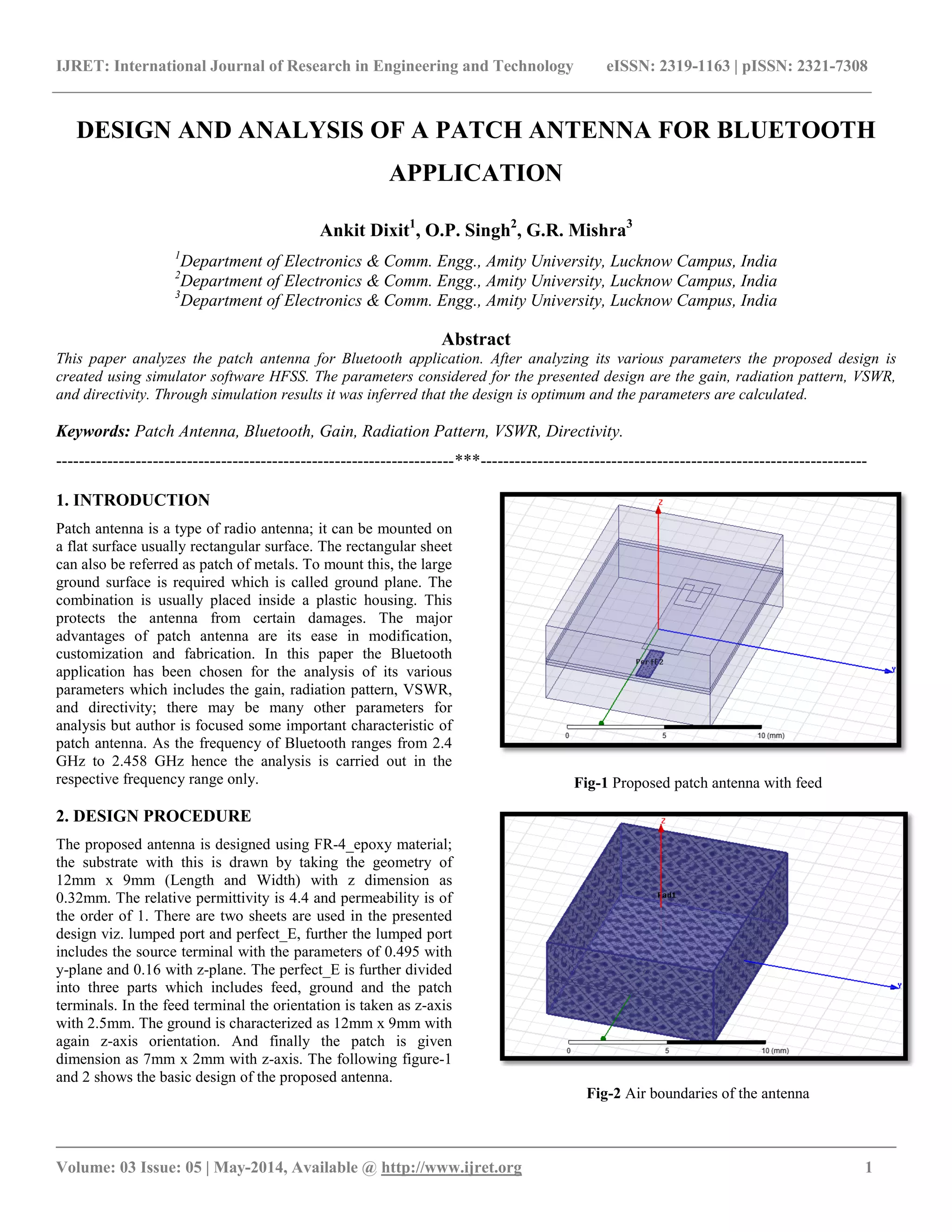
The proposed antenna is designed using FR-4_epoxy material;
the substrate with this is drawn by taking the geometry of
12mm x 9mm (Length and Width) with z dimension as
0.32mm. The relative permittivity is 4.4 and permeability is of
the order of 1. There are two sheets are used in the presented
design viz. lumped port and perfect_E, further the lumped port
includes the source terminal with the parameters of 0.495 with
y-plane and 0.16 with z-plane. The perfect_E is further divided
into three parts which includes feed, ground and the patch
terminals. In the feed terminal the orientation is taken as z-axis
with 2.5mm. The ground is characterized as 12mm x 9mm with
again z-axis orientation. And finally the patch is given
dimension as 7mm x 2mm with z-axis. The following figure-1
and 2 shows the basic design of the proposed antenna.
Fig-1 Proposed patch antenna with feed
Fig-2 Air boundaries of the antenna
IJRET: International Journal of Research in Engineering and Technology eISSN: 2319-1163 | pISSN: 2321-7308
__________________________________________________________________________________________
Volume: 03 Issue: 05 | May-2014, Available @ http://www.ijret.org 2
3. SIMULATION RESULTS
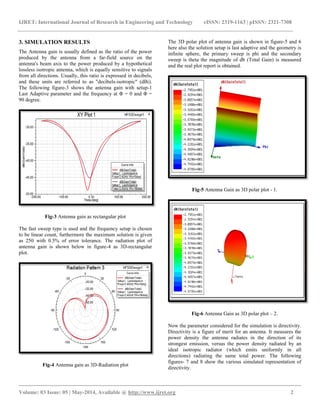
The Antenna gain is usually defined as the ratio of the power
produced by the antenna from a far-field source on the
antenna's beam axis to the power produced by a hypothetical
lossless isotropic antenna, which is equally sensitive to signals
from all directions. Usually, this ratio is expressed in decibels,
and these units are referred to as "decibels-isotropic" (dBi).
The following figure-3 shows the antenna gain with setup-1
Last Adaptive parameter and the frequency at Φ = 0 and Φ =
90 degree.
Fig-3 Antenna gain as rectangular plot
The fast sweep type is used and the frequency setup is chosen
to be linear count, furthermore the maximum solution is given
as 250 with 0.5% of error tolerance. The radiation plot of
antenna gain is shown below in figure-4 as 3D-rectangular
plot.
Fig-4 Antenna gain as 3D-Radiation plot
The 3D polar plot of antenna gain is shown in figure-5 and 6
here also the solution setup is last adaptive and the geometry is
infinite sphere, the primary sweep is phi and the secondary
sweep is theta the magnitude of db (Total Gain) is measured
and the real plot report is obtained.
Fig-5 Antenna Gain as 3D polar plot - 1.
Fig-6 Antenna Gain as 3D polar plot – 2.
Now the parameter considered for the simulation is directivity.
Directivity is a figure of merit for an antenna. It measures the
power density the antenna radiates in the direction of its
strongest emission, versus the power density radiated by an
ideal isotropic radiator (which emits uniformly in all
directions) radiating the same total power. The following
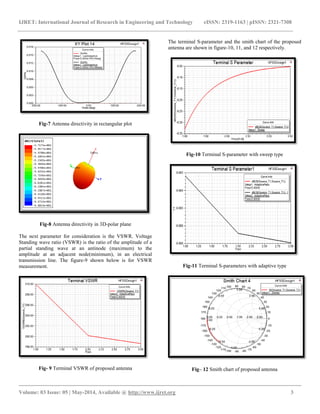
figures- 7 and 8 show the various simulated representation of
directivity.
IJRET: International Journal of Research in Engineering and Technology eISSN: 2319-1163 | pISSN: 2321-7308
__________________________________________________________________________________________
Volume: 03 Issue: 05 | May-2014, Available @ http://www.ijret.org 3
Fig-7 Antenna directivity in rectangular plot
Fig-8 Antenna directivity in 3D-polar plane
The next parameter for consideration is the VSWR. Voltage
Standing wave ratio (VSWR) is the ratio of the amplitude of a
partial standing wave at an antinode (maximum) to the
amplitude at an adjacent node(minimum), in an electrical
transmission line. The figure-9 shown below is for VSWR
measurement.
Fig- 9 Terminal VSWR of proposed antenna
The terminal S-parameter and the smith chart of the proposed
antenna are shown in figure-10, 11, and 12 respectively.
Fig-10 Terminal S-parameter with sweep type
Fig-11 Terminal S-parameters with adaptive type
Fig– 12 Smith chart of proposed antenna
IJRET: International Journal of Research in Engineering and Technology eISSN: 2319-1163 | pISSN: 2321-7308
__________________________________________________________________________________________
Volume: 03 Issue: 05 | May-2014, Available @ http://www.ijret.org 4
The convergence of the proposed antenna by solving the
interpolating type sweep-1 with fast adaptive setup as port P1
is represented in figure-13 as shown below. After analyzing the
plot it is clear that the proposed antenna converged
appropriately for the specified values and parameters.
Fig-13 Convergence of proposed antenna
The antenna and its other far field quantities viz. radiation
patterns are analyzed and the obtained simulation results are
shown below in figure-14 and 15.
Fig-14 Antenna rE(theta) in rectangular plot
Fig-15 Antenna rE(phi) in rectangular plot.
4. CONCLUSIONS
In this paper the novel design of microstrip antenna is
proposed. The parameters of analysis were the gain, VSWR,
directivity, and the radiation pattern. The values can be easily
seen from the respective plot. After analyzing the simulation
results it was concluded that the optimized and improved
results were obtained. And since the frequency chosen in this
design was 2.4 GHz hence this design is appropriate for the
Bluetooth application.
REFERENCES
[1] Abd-Elrazzak, M.M. et. al., “Design of circular patch
antennas for bluetooth, HIPERLAN, and X band (8.4
GHz) applications”, IEEE International Symposium on
Antennas Propagation and EM Theory (ISAPE), Dec.
2010, pp. 236 – 239.
[2] Wei Zhou et. al., “Planar monopole antenna with
Archimedean spiral slot for WiFi/Bluetooth and LTE
applications”, IEEE Loughborough Antennas and
Propagation Conference (LAPC), Nov. 2013, pp. 186 –
189.
[3] Abd-Elrazzak, M.M et. al., “A design of a circular
microstrip patch antenna for Bluetooth and HIPERLAN
applications”, IEEE 9th Asia-Pacific Conference on
Communications, Sept. 2003, pp. 974 - 977.
[4] Awad, N.M. et. al., “Bluetooth/uwb circular patch
antenna with dual band notches”, IEEE conference of
Applied Electrical Engineering and Computing
Technologies (AEECT), Dec. 2013, pp. 1 – 4.
[5] Saluja, R. et. al., “Analysis of bluetooth patch antenna
with different feeding techniques using simulation and
optimization”, IEEE International Conference on
Recent Advances in Microwave Theory and
Applications. Nov. 2008, pp. 742 – 744.
IJRET: International Journal of Research in Engineering and Technology eISSN: 2319-1163 | pISSN: 2321-7308
__________________________________________________________________________________________
Volume: 03 Issue: 05 | May-2014, Available @ http://www.ijret.org 5
[6] Yi-Chieh Lee et. al., “A High printed antenna at 2.4-
GHz operation”, IEEE Asia-Pacific Microwave
Conference, Dec. 2008, pp. 1 – 4.
[7] Liang-Che Chou et. al., “Uni-Planar Dual-Band
Monopole Antenna for 2.4/5 GHz WLAN Operation in
the Laptop Computer”, IEEE Transactions on Antennas
and Propagation, Volume: 55, Issue: 12, December
2007, pp. 3739 – 3741.
[8] Thomas A. Milligan, “Modern Antenna Design”, John
Wiley & Sons, 2nd Edition, 2005
[9] Zhijun Zhang, “Antenna Design for Mobile Devices”,
John Wiley & Sons, 2011
[10] Balanis, “Antenna Theory: Analysis and Design”, John
Wiley & Sons, 2nd Edition 2007.
[11] Constantine A. Balanis, “Antenna Theory: Analysis and
Design ”, John Wiley & Sons,3rd Edition, 2012.
BIOGRAPHIES
Ankit Dixit, is presently pursuing his M.
Tech. studies in the Department of
Electronics and Communication Engg.,
Amity University Uttar Pradesh,
Lucknow Campus. He received his
B.tech. Degree in Electronics &
Communication Engineering from
Institute Of Engineering and Technology, Uttar Pradesh
Technical University, in 2011. He has presented several papers
in the national conferences. His research area of interest
includes antenna design, microwave circuits, digital
communication and RF circuits.
Dr. O. P. Singh obtained his Ph.D. in
Electronics Engineering from IIT, BHU.
He is presently working as Professor and
Head of Department of Electronics &
Communication Engineering, Amity
School of Engineering & Technology,
Amity University Uttar Pradesh Lucknow
Campus. He is life member of Indian Society of Remote
Sensing (ISRS) and Material Research Society of India
(MRSI).He has presented several papers in National
Seminar/Conferences and also published papers in
National/international Journals. His area of interest includes
Microwave Remote Sensing Digital System, Signal Processing.
Dr. Ganga Ram Mishra obtained his
M.Sc. Electronics degree from Gorakhpur
University and Ph. D in Electronics from
Avadh University. He has over eleven
years experience and presently working as
faculty members in Department of
Electronics & Communication
Engineering, Amity School of Engineering & Technology,
Amity University Uttar Pradesh Lucknow Campus. He is life
member of Institution of Electronics & Telecommunication
Engineers (IETE), Material Research Society of India (MRSI)
and member of IET, UK .He was actively involved in
foundation of Professional Activity Center IETE Gorakhpur
and worked as elected member of IETE Lucknow Center
during 2008-2010 and nominated as local center nominee for
IETE Students’ Forum (ISF) at Amity University Lucknow
Campus. He has presented several papers in National
Seminar/Conferences and published papers in
National/international Journals. His area of interest includes
Digital System Design, Microprocessor Based System Design,
Signal Processing, Embedded Systems and VLSI Design.

Design and analysis of a patch antenna for bluetooth application

  • 1.
    IJRET: International Journalof Research in Engineering and Technology eISSN: 2319-1163 | pISSN: 2321-7308 __________________________________________________________________________________________ Volume: 03 Issue: 05 | May-2014, Available @ http://www.ijret.org 1 DESIGN AND ANALYSIS OF A PATCH ANTENNA FOR BLUETOOTH APPLICATION Ankit Dixit1 , O.P. Singh2 , G.R. Mishra3 1 Department of Electronics & Comm. Engg., Amity University, Lucknow Campus, India 2 Department of Electronics & Comm. Engg., Amity University, Lucknow Campus, India 3 Department of Electronics & Comm. Engg., Amity University, Lucknow Campus, India Abstract This paper analyzes the patch antenna for Bluetooth application. After analyzing its various parameters the proposed design is created using simulator software HFSS. The parameters considered for the presented design are the gain, radiation pattern, VSWR, and directivity. Through simulation results it was inferred that the design is optimum and the parameters are calculated. Keywords: Patch Antenna, Bluetooth, Gain, Radiation Pattern, VSWR, Directivity. ----------------------------------------------------------------------***-------------------------------------------------------------------- 1. INTRODUCTION Patch antenna is a type of radio antenna; it can be mounted on a flat surface usually rectangular surface. The rectangular sheet can also be referred as patch of metals. To mount this, the large ground surface is required which is called ground plane. The combination is usually placed inside a plastic housing. This protects the antenna from certain damages. The major advantages of patch antenna are its ease in modification, customization and fabrication. In this paper the Bluetooth application has been chosen for the analysis of its various parameters which includes the gain, radiation pattern, VSWR, and directivity; there may be many other parameters for analysis but author is focused some important characteristic of patch antenna. As the frequency of Bluetooth ranges from 2.4 GHz to 2.458 GHz hence the analysis is carried out in the respective frequency range only. 2. DESIGN PROCEDURE The proposed antenna is designed using FR-4_epoxy material; the substrate with this is drawn by taking the geometry of 12mm x 9mm (Length and Width) with z dimension as 0.32mm. The relative permittivity is 4.4 and permeability is of the order of 1. There are two sheets are used in the presented design viz. lumped port and perfect_E, further the lumped port includes the source terminal with the parameters of 0.495 with y-plane and 0.16 with z-plane. The perfect_E is further divided into three parts which includes feed, ground and the patch terminals. In the feed terminal the orientation is taken as z-axis with 2.5mm. The ground is characterized as 12mm x 9mm with again z-axis orientation. And finally the patch is given dimension as 7mm x 2mm with z-axis. The following figure-1 and 2 shows the basic design of the proposed antenna. Fig-1 Proposed patch antenna with feed Fig-2 Air boundaries of the antenna
  • 2.
    IJRET: International Journalof Research in Engineering and Technology eISSN: 2319-1163 | pISSN: 2321-7308 __________________________________________________________________________________________ Volume: 03 Issue: 05 | May-2014, Available @ http://www.ijret.org 2 3. SIMULATION RESULTS The Antenna gain is usually defined as the ratio of the power produced by the antenna from a far-field source on the antenna's beam axis to the power produced by a hypothetical lossless isotropic antenna, which is equally sensitive to signals from all directions. Usually, this ratio is expressed in decibels, and these units are referred to as "decibels-isotropic" (dBi). The following figure-3 shows the antenna gain with setup-1 Last Adaptive parameter and the frequency at Φ = 0 and Φ = 90 degree. Fig-3 Antenna gain as rectangular plot The fast sweep type is used and the frequency setup is chosen to be linear count, furthermore the maximum solution is given as 250 with 0.5% of error tolerance. The radiation plot of antenna gain is shown below in figure-4 as 3D-rectangular plot. Fig-4 Antenna gain as 3D-Radiation plot The 3D polar plot of antenna gain is shown in figure-5 and 6 here also the solution setup is last adaptive and the geometry is infinite sphere, the primary sweep is phi and the secondary sweep is theta the magnitude of db (Total Gain) is measured and the real plot report is obtained. Fig-5 Antenna Gain as 3D polar plot - 1. Fig-6 Antenna Gain as 3D polar plot – 2. Now the parameter considered for the simulation is directivity. Directivity is a figure of merit for an antenna. It measures the power density the antenna radiates in the direction of its strongest emission, versus the power density radiated by an ideal isotropic radiator (which emits uniformly in all directions) radiating the same total power. The following figures- 7 and 8 show the various simulated representation of directivity.
  • 3.
    IJRET: International Journalof Research in Engineering and Technology eISSN: 2319-1163 | pISSN: 2321-7308 __________________________________________________________________________________________ Volume: 03 Issue: 05 | May-2014, Available @ http://www.ijret.org 3 Fig-7 Antenna directivity in rectangular plot Fig-8 Antenna directivity in 3D-polar plane The next parameter for consideration is the VSWR. Voltage Standing wave ratio (VSWR) is the ratio of the amplitude of a partial standing wave at an antinode (maximum) to the amplitude at an adjacent node(minimum), in an electrical transmission line. The figure-9 shown below is for VSWR measurement. Fig- 9 Terminal VSWR of proposed antenna The terminal S-parameter and the smith chart of the proposed antenna are shown in figure-10, 11, and 12 respectively. Fig-10 Terminal S-parameter with sweep type Fig-11 Terminal S-parameters with adaptive type Fig– 12 Smith chart of proposed antenna
  • 4.
    IJRET: International Journalof Research in Engineering and Technology eISSN: 2319-1163 | pISSN: 2321-7308 __________________________________________________________________________________________ Volume: 03 Issue: 05 | May-2014, Available @ http://www.ijret.org 4 The convergence of the proposed antenna by solving the interpolating type sweep-1 with fast adaptive setup as port P1 is represented in figure-13 as shown below. After analyzing the plot it is clear that the proposed antenna converged appropriately for the specified values and parameters. Fig-13 Convergence of proposed antenna The antenna and its other far field quantities viz. radiation patterns are analyzed and the obtained simulation results are shown below in figure-14 and 15. Fig-14 Antenna rE(theta) in rectangular plot Fig-15 Antenna rE(phi) in rectangular plot. 4. CONCLUSIONS In this paper the novel design of microstrip antenna is proposed. The parameters of analysis were the gain, VSWR, directivity, and the radiation pattern. The values can be easily seen from the respective plot. After analyzing the simulation results it was concluded that the optimized and improved results were obtained. And since the frequency chosen in this design was 2.4 GHz hence this design is appropriate for the Bluetooth application. REFERENCES [1] Abd-Elrazzak, M.M. et. al., “Design of circular patch antennas for bluetooth, HIPERLAN, and X band (8.4 GHz) applications”, IEEE International Symposium on Antennas Propagation and EM Theory (ISAPE), Dec. 2010, pp. 236 – 239. [2] Wei Zhou et. al., “Planar monopole antenna with Archimedean spiral slot for WiFi/Bluetooth and LTE applications”, IEEE Loughborough Antennas and Propagation Conference (LAPC), Nov. 2013, pp. 186 – 189. [3] Abd-Elrazzak, M.M et. al., “A design of a circular microstrip patch antenna for Bluetooth and HIPERLAN applications”, IEEE 9th Asia-Pacific Conference on Communications, Sept. 2003, pp. 974 - 977. [4] Awad, N.M. et. al., “Bluetooth/uwb circular patch antenna with dual band notches”, IEEE conference of Applied Electrical Engineering and Computing Technologies (AEECT), Dec. 2013, pp. 1 – 4. [5] Saluja, R. et. al., “Analysis of bluetooth patch antenna with different feeding techniques using simulation and optimization”, IEEE International Conference on Recent Advances in Microwave Theory and Applications. Nov. 2008, pp. 742 – 744.
  • 5.
    IJRET: International Journalof Research in Engineering and Technology eISSN: 2319-1163 | pISSN: 2321-7308 __________________________________________________________________________________________ Volume: 03 Issue: 05 | May-2014, Available @ http://www.ijret.org 5 [6] Yi-Chieh Lee et. al., “A High printed antenna at 2.4- GHz operation”, IEEE Asia-Pacific Microwave Conference, Dec. 2008, pp. 1 – 4. [7] Liang-Che Chou et. al., “Uni-Planar Dual-Band Monopole Antenna for 2.4/5 GHz WLAN Operation in the Laptop Computer”, IEEE Transactions on Antennas and Propagation, Volume: 55, Issue: 12, December 2007, pp. 3739 – 3741. [8] Thomas A. Milligan, “Modern Antenna Design”, John Wiley & Sons, 2nd Edition, 2005 [9] Zhijun Zhang, “Antenna Design for Mobile Devices”, John Wiley & Sons, 2011 [10] Balanis, “Antenna Theory: Analysis and Design”, John Wiley & Sons, 2nd Edition 2007. [11] Constantine A. Balanis, “Antenna Theory: Analysis and Design ”, John Wiley & Sons,3rd Edition, 2012. BIOGRAPHIES Ankit Dixit, is presently pursuing his M. Tech. studies in the Department of Electronics and Communication Engg., Amity University Uttar Pradesh, Lucknow Campus. He received his B.tech. Degree in Electronics & Communication Engineering from Institute Of Engineering and Technology, Uttar Pradesh Technical University, in 2011. He has presented several papers in the national conferences. His research area of interest includes antenna design, microwave circuits, digital communication and RF circuits. Dr. O. P. Singh obtained his Ph.D. in Electronics Engineering from IIT, BHU. He is presently working as Professor and Head of Department of Electronics & Communication Engineering, Amity School of Engineering & Technology, Amity University Uttar Pradesh Lucknow Campus. He is life member of Indian Society of Remote Sensing (ISRS) and Material Research Society of India (MRSI).He has presented several papers in National Seminar/Conferences and also published papers in National/international Journals. His area of interest includes Microwave Remote Sensing Digital System, Signal Processing. Dr. Ganga Ram Mishra obtained his M.Sc. Electronics degree from Gorakhpur University and Ph. D in Electronics from Avadh University. He has over eleven years experience and presently working as faculty members in Department of Electronics & Communication Engineering, Amity School of Engineering & Technology, Amity University Uttar Pradesh Lucknow Campus. He is life member of Institution of Electronics & Telecommunication Engineers (IETE), Material Research Society of India (MRSI) and member of IET, UK .He was actively involved in foundation of Professional Activity Center IETE Gorakhpur and worked as elected member of IETE Lucknow Center during 2008-2010 and nominated as local center nominee for IETE Students’ Forum (ISF) at Amity University Lucknow Campus. He has presented several papers in National Seminar/Conferences and published papers in National/international Journals. His area of interest includes Digital System Design, Microprocessor Based System Design, Signal Processing, Embedded Systems and VLSI Design.