Session 4: “Recognition as a first step”
Informality in artisanal mining
Professor Gavin Hilson, University of Surrey
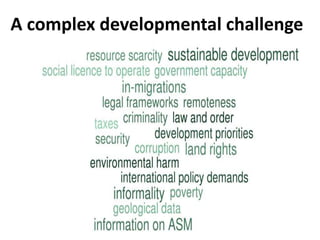
A complex developmental challenge
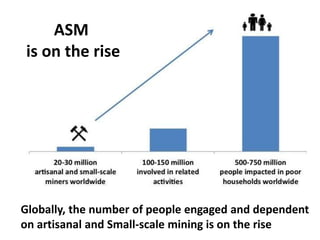
ASM
is on the rise
Globally, the number of people engaged and dependent
on artisanal and Small-scale mining is on the rise
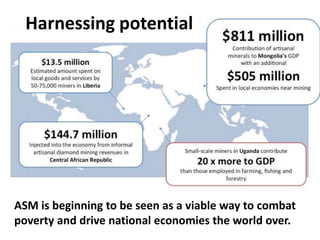
ASM is beginning to be seen as a viable way to combat
poverty and drive national economies the world over.
Harnessing potential
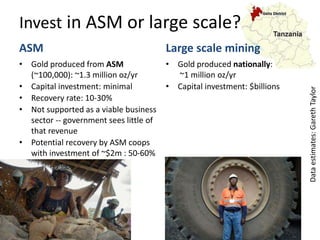
Invest in ASM or large scale?
• Gold produced from ASM
(~100,000): ~1.3 million oz/yr
• Capital investment: minimal
• Recovery rate: 10-30%
• Not supported as a viable business
sector -- government sees little of
that revenue
• Potential recovery by ASM coops
with investment of ~$2m : 50-60%
• Gold produced nationally:
~1 million oz/yr
• Capital investment: $billions
ASM
Dataestimates:GarethTaylor
Large scale mining
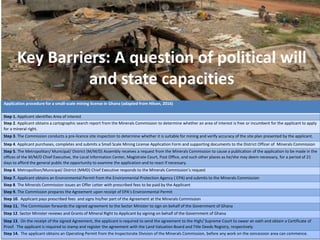
Application procedure for a small-scale mining license in Ghana (adapted from Hilson, 2016)
Step 1. Applicant identifies Area of interest
Step 2. Applicant obtains a cartographic search report from the Minerals Commission to determine whether an area of interest is free or incumbent for the applicant to apply
for a mineral right.
Step 3. The Commission conducts a pre-licence site inspection to determine whether it is suitable for mining and verify accuracy of the site plan presented by the applicant.
Step 4. Applicant purchases, completes and submits a Small Scale Mining License Application Form and supporting documents to the District Officer of Minerals Commission
Step 5. The Metropolitan/ Municipal/ District (M/M/D) Assembly receives a request from the Minerals Commission to cause a publication of the application to be made in the
offices of the M/M/D Chief Executive, the Local Information Center, Magistrate Court, Post Office, and such other places as he/she may deem necessary, for a period of 21
days to afford the general public the opportunity to examine the application and to react if necessary.
Step 6. Metropolitan/Municipal/ District (MMD) Chief Executive responds to the Minerals Commission’s request
Step 7. Applicant obtains an Environmental Permit from the Environmental Protection Agency ( EPA) and submits to the Minerals Commission
Step 8. The Minerals Commission issues an Offer Letter with prescribed fees to be paid by the Applicant
Step 9. The Commission prepares the Agreement upon receipt of EPA’s Environmental Permit
Step 10. Applicant pays prescribed fees and signs his/her part of the Agreement at the Minerals Commission
Step 11. The Commission forwards the signed agreement to the Sector Minister to sign on behalf of the Government of Ghana
Step 12. Sector Minister reviews and Grants of Mineral Right to Applicant by signing on behalf of the Government of Ghana
Step 13. On the receipt of the signed Agreement, the applicant is required to send the agreement to the High/ Supreme Court to swear an oath and obtain a Certificate of
Proof. The applicant is required to stamp and register the agreement with the Land Valuation Board and Title Deeds Registry, respectively.
Step 14. The applicant obtains an Operating Permit from the Inspectorate Division of the Minerals Commission, before any work on the concession area can commence.
Key Barriers: A question of political will
and state capacities
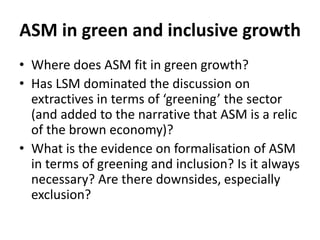
ASM in green and inclusive growth
• Where does ASM fit in green growth?
• Has LSM dominated the discussion on
extractives in terms of ‘greening’ the sector
(and added to the narrative that ASM is a relic
of the brown economy)?
• What is the evidence on formalisation of ASM
in terms of greening and inclusion? Is it always
necessary? Are there downsides, especially
exclusion?
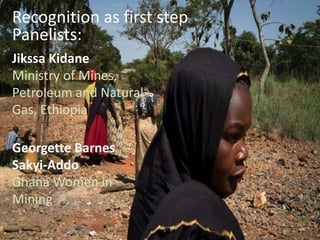
Jikssa Kidane
Ministry of Mines,
Petroleum and Natural
Gas, Ethiopia
Georgette Barnes
Sakyi-Addo
Ghana Women in
Mining
Recognition as first step
Panelists: