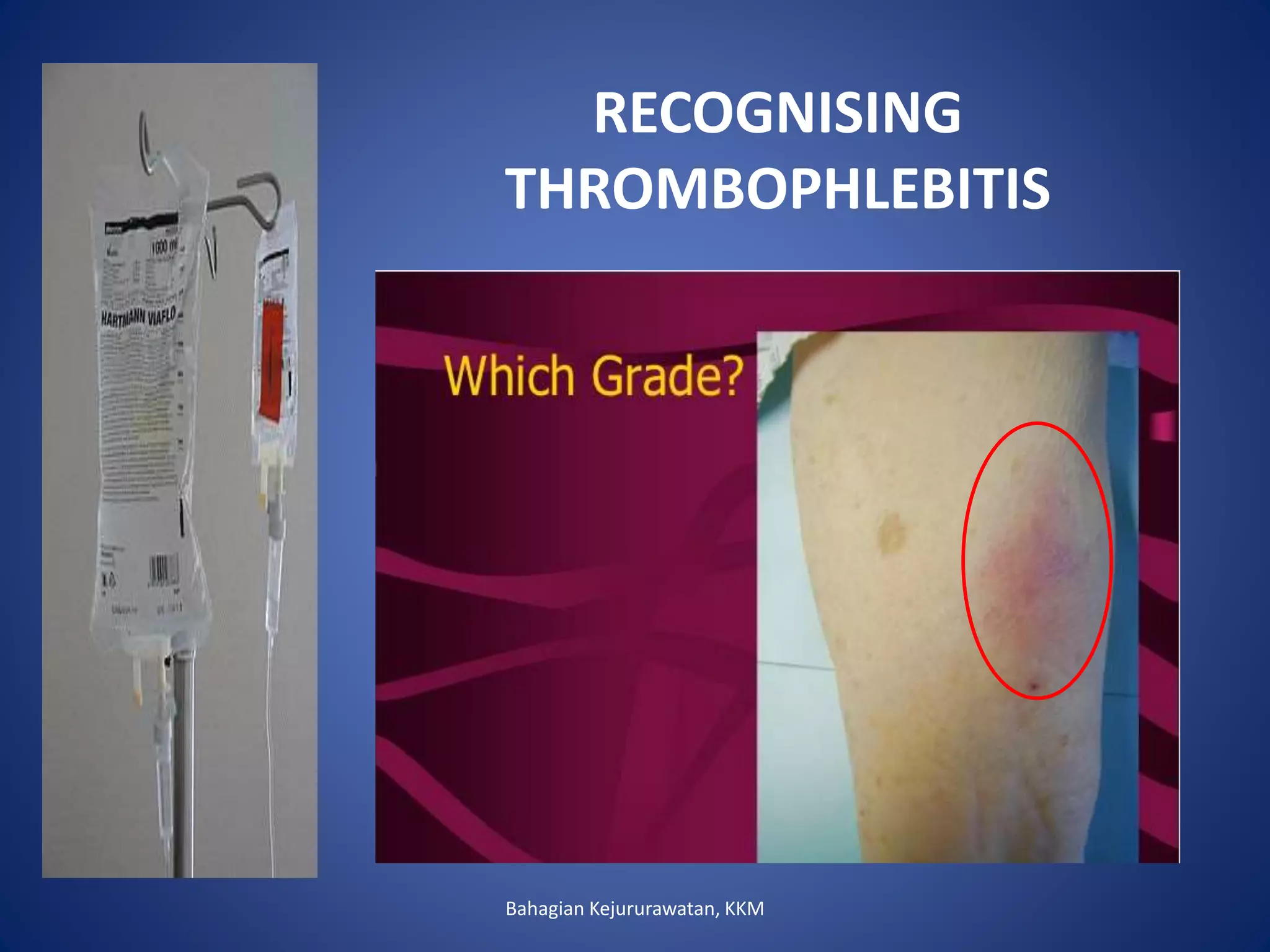
RECOGNISING
THROMBOPHLEBITIS
Bahagian Kejururawatan, KKM
DEFINITION
• Thrombophlebitis is the inflammation of a
vein with blood clot formation inside the vein
at the site of the inflammation.
Thrombophlebitis also is known as phlebitis,
phlebo thrombosis and venous thrombosis.
• http://www.mayoclinic.org>syc-203... retrieved 25/03/2018
INTRODUCTION
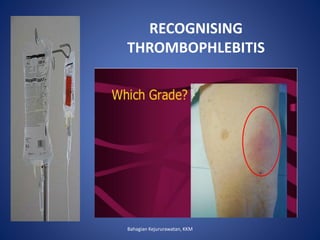
• Thrombophlebitis frequently occurs with an
intravenous cannula.
• Either the cannula or the infusion, including
drugs, may have caused the inflammation.
• The common sites coincide with those of
common medical interventions (arm or neck
with external jugular vein cannulation).
INTRODUCTION
• The MOH has been closely monitoring the
incidence of thrombophlebitis among adult in-
patients since 2003 under QAP.
• The standard set has been reviewed in 2014
from 0.9% to ≤ 0.5%
• Periodically based on the data collection over
the years.
SIGNS AND SYMPTOM
• Pain at cannulation site
• Redness and inflammation of the skin along a
vein.
• Warmth of the skin and tissue around the vein.
• Tenderness and pain that worsens with added
pressure.
• Pain in the limb.
• Darkening of the skin over the vein.
• Hardening of the vein.
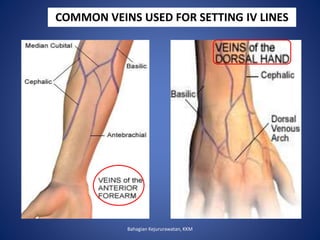
COMMON VEINS USED FOR SETTING IV LINES
Bahagian Kejururawatan, KKM
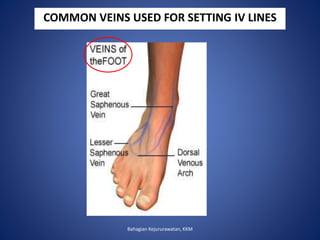
COMMON VEINS USED FOR SETTING IV LINES
Bahagian Kejururawatan, KKM
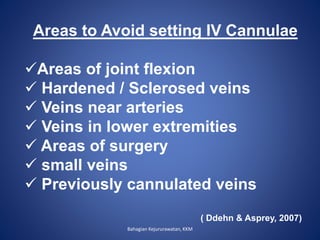
Areas to Avoid setting IV Cannulae
Areas of joint flexion
 Hardened / Sclerosed veins
 Veins near arteries
 Veins in lower extremities
 Areas of surgery
 small veins
 Previously cannulated veins
( Ddehn & Asprey, 2007)
Bahagian Kejururawatan, KKM
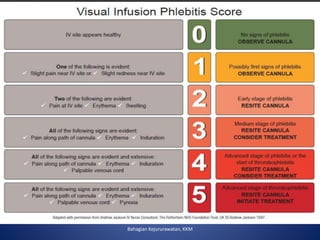
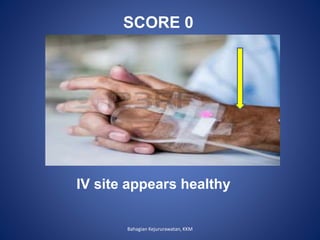
SCORE 0
IV site appears healthy
Bahagian Kejururawatan, KKM
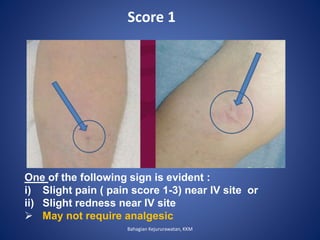
One of the following sign is evident :
i) Slight pain ( pain score 1-3) near IV site or
ii) Slight redness near IV site
 May not require analgesic
Score 1
Bahagian Kejururawatan, KKM
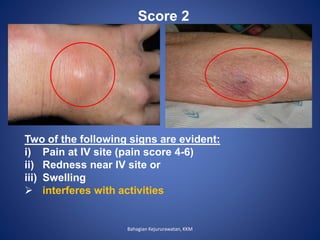
Score 2
Two of the following signs are evident:
i) Pain at IV site (pain score 4-6)
ii) Redness near IV site or
iii) Swelling
 interferes with activities
Bahagian Kejururawatan, KKM
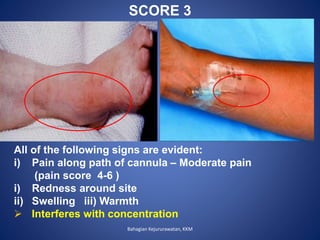
SCORE 3
All of the following signs are evident:
i) Pain along path of cannula – Moderate pain
(pain score 4-6 )
i) Redness around site
ii) Swelling iii) Warmth
 Interferes with concentration
Bahagian Kejururawatan, KKM
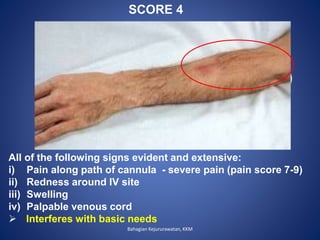
SCORE 4
All of the following signs evident and extensive:
i) Pain along path of cannula - severe pain (pain score 7-9)
ii) Redness around IV site
iii) Swelling
iv) Palpable venous cord
 Interferes with basic needs
Bahagian Kejururawatan, KKM
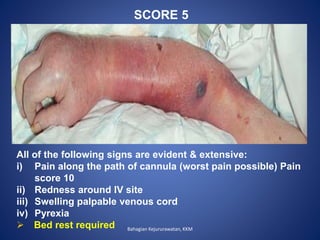
SCORE 5
All of the following signs are evident & extensive:
i) Pain along the path of cannula (worst pain possible) Pain
score 10
ii) Redness around IV site
iii) Swelling palpable venous cord
iv) Pyrexia
 Bed rest required Bahagian Kejururawatan, KKM
NURSING RESPONSIBILITIES :-
1. Hand Hygiene :-
Hands are decontaminated immediately
before and after each episode of patient
contact using the correct hand hygiene
technique. (5 moments of hand hygiene)
Bahagian Kejururawatan, KKM
2. Observe aseptic technique :-
 Alcohol wipes are used to
decontaminate port and surrounding
area, and allowed to dry prior to the
administration fluid or injections via
the cannula.
 Patency is maintained.
Bahagian Kejururawatan, KKM
3. Monitoring :-
Monitor intravenous therapy
Check the infusion and the IV cannulation
site at least every 4 hours or when necessary
Flow of fluid
IV site: erythema, wetness, and edema
Phlebitis
Infiltration
Assess for chills, fever, headache, nausea,
vomiting, anxiousness, and dyspnea.
 Cannula should be removed where it is no
longer indicated.
Bahagian Kejururawatan, KKM
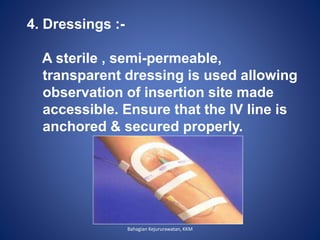
4. Dressings :-
A sterile , semi-permeable,
transparent dressing is used allowing
observation of insertion site made
accessible. Ensure that the IV line is
anchored & secured properly.
Bahagian Kejururawatan, KKM
5. Cannula replacement :-
 Resite cannula after 72 hours or
as clinically indicated
eg. blood transfusion eg. Size 18G
 Document each time after change
of IV site
Bahagian Kejururawatan, KKM
7. Documentation :-
Document in Thrombophlebitis
observation chart and in the
Patient’s case notes the date and
time of removal of cannula and
signature of the nurse undertaking
the task.
Bahagian Kejururawatan, KKM
BORANG THROMBOPHLEBITIS
Borang BKJ-BOR-PPK-10 Pind. 1/2018
Borang BKJ-BOR-PPK-11 Pind. 1/2018
Borang BKJ-BOR-PPK-12 Pind 1/2018
Borang BKJ NNIA-2 pind.1/2018
( Hyperlink )
Bahagian Kejururawatan, KKM
Where: Data will be collected from every
ward of the hospital.
Who: Data will be collected by ward manager,
staff nurse / personnel in-charge of the ward.
How frequent: Monthly data collection.
Who should verify: All performance data must
be verified by the Head of
Department / KPJH /Hospital
Director.
How to collect: Data will be collected from
Form BKJ-BOR-PPK-10 Pind 1/2018 & record
book / patient casenote.
INDICATOR AND FORMULA
Indicator:
Incidence of Thrombophlebitis Among In-patients with
cannulation
Formula :
Numerator : Number Incidence of Thrombophleblitis ( Score 2- 5) x 100
Denominator : Total number of inserted peripheral IV cannula
(Indicator monitoring is every three monthly.)
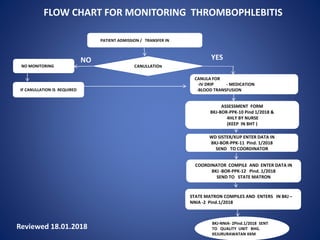
FLOW CHART FOR MONITORING THROMBOPHLEBITIS
PATIENT ADMISSION / TRANSFER IN
CANULLATION
CANULA FOR
-IV DRIP - MEDICATION
-BLOOD TRANSFUSION
NO MONITORING
ASSESSMENT FORM
BKJ-BOR-PPK-10 Pind 1/2018 &
4HLY BY NURSE
(KEEP IN BHT )
WD SISTER/KUP ENTER DATA IN
BKJ-BOR-PPK-11 Pind. 1/2018
SEND TO COORDINATOR
COORDINATOR COMPILE AND ENTER DATA IN
BKJ -BOR-PPK-12 Pind. 1/2018
SEND TO STATE MATRON
IF CANULLATION IS REQUIRED
STATE MATRON COMPILES AND ENTERS IN BKJ –
NNIA -2 Pind.1/2018
BKJ-NNIA- 2Pind.1/2018 SENT
TO QUALITY UNIT BHG.
KEJURURAWATAN KKM
NO YES
Reviewed 18.01.2018
Bahagian Kejururawatan, KKM
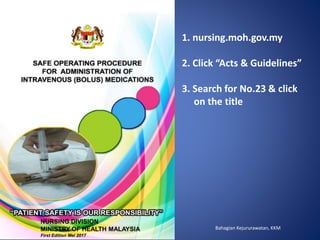
NURSING DIVISION
MINISTRY OF HEALTH MALAYSIA
First Edition Mei 2017
1. nursing.moh.gov.my
2. Click “Acts & Guidelines”
3. Search for No.23 & click
on the title
THANK YOU FOR YOUR ATTENTION !
Bahagian Kejururawatan, KKM

Recognising thrombophlebitis

  • 1.
  • 2.
    DEFINITION • Thrombophlebitis isthe inflammation of a vein with blood clot formation inside the vein at the site of the inflammation. Thrombophlebitis also is known as phlebitis, phlebo thrombosis and venous thrombosis. • http://www.mayoclinic.org>syc-203... retrieved 25/03/2018
  • 3.
    INTRODUCTION • Thrombophlebitis frequentlyoccurs with an intravenous cannula. • Either the cannula or the infusion, including drugs, may have caused the inflammation. • The common sites coincide with those of common medical interventions (arm or neck with external jugular vein cannulation).
  • 4.
    INTRODUCTION • The MOHhas been closely monitoring the incidence of thrombophlebitis among adult in- patients since 2003 under QAP. • The standard set has been reviewed in 2014 from 0.9% to ≤ 0.5% • Periodically based on the data collection over the years.
  • 5.
    SIGNS AND SYMPTOM •Pain at cannulation site • Redness and inflammation of the skin along a vein. • Warmth of the skin and tissue around the vein. • Tenderness and pain that worsens with added pressure. • Pain in the limb. • Darkening of the skin over the vein. • Hardening of the vein.
  • 6.
    COMMON VEINS USEDFOR SETTING IV LINES Bahagian Kejururawatan, KKM
  • 7.
    COMMON VEINS USEDFOR SETTING IV LINES Bahagian Kejururawatan, KKM
  • 8.
    Areas to Avoidsetting IV Cannulae Areas of joint flexion  Hardened / Sclerosed veins  Veins near arteries  Veins in lower extremities  Areas of surgery  small veins  Previously cannulated veins ( Ddehn & Asprey, 2007) Bahagian Kejururawatan, KKM
  • 9.
  • 10.
    SCORE 0 IV siteappears healthy Bahagian Kejururawatan, KKM
  • 11.
    One of thefollowing sign is evident : i) Slight pain ( pain score 1-3) near IV site or ii) Slight redness near IV site  May not require analgesic Score 1 Bahagian Kejururawatan, KKM
  • 12.
    Score 2 Two ofthe following signs are evident: i) Pain at IV site (pain score 4-6) ii) Redness near IV site or iii) Swelling  interferes with activities Bahagian Kejururawatan, KKM
  • 13.
    SCORE 3 All ofthe following signs are evident: i) Pain along path of cannula – Moderate pain (pain score 4-6 ) i) Redness around site ii) Swelling iii) Warmth  Interferes with concentration Bahagian Kejururawatan, KKM
  • 14.
    SCORE 4 All ofthe following signs evident and extensive: i) Pain along path of cannula - severe pain (pain score 7-9) ii) Redness around IV site iii) Swelling iv) Palpable venous cord  Interferes with basic needs Bahagian Kejururawatan, KKM
  • 15.
    SCORE 5 All ofthe following signs are evident & extensive: i) Pain along the path of cannula (worst pain possible) Pain score 10 ii) Redness around IV site iii) Swelling palpable venous cord iv) Pyrexia  Bed rest required Bahagian Kejururawatan, KKM
  • 16.
    NURSING RESPONSIBILITIES :- 1.Hand Hygiene :- Hands are decontaminated immediately before and after each episode of patient contact using the correct hand hygiene technique. (5 moments of hand hygiene) Bahagian Kejururawatan, KKM
  • 17.
    2. Observe aseptictechnique :-  Alcohol wipes are used to decontaminate port and surrounding area, and allowed to dry prior to the administration fluid or injections via the cannula.  Patency is maintained. Bahagian Kejururawatan, KKM
  • 18.
    3. Monitoring :- Monitorintravenous therapy Check the infusion and the IV cannulation site at least every 4 hours or when necessary Flow of fluid IV site: erythema, wetness, and edema Phlebitis Infiltration Assess for chills, fever, headache, nausea, vomiting, anxiousness, and dyspnea.  Cannula should be removed where it is no longer indicated. Bahagian Kejururawatan, KKM
  • 19.
    4. Dressings :- Asterile , semi-permeable, transparent dressing is used allowing observation of insertion site made accessible. Ensure that the IV line is anchored & secured properly. Bahagian Kejururawatan, KKM
  • 20.
    5. Cannula replacement:-  Resite cannula after 72 hours or as clinically indicated eg. blood transfusion eg. Size 18G  Document each time after change of IV site Bahagian Kejururawatan, KKM
  • 21.
    7. Documentation :- Documentin Thrombophlebitis observation chart and in the Patient’s case notes the date and time of removal of cannula and signature of the nurse undertaking the task. Bahagian Kejururawatan, KKM
  • 22.
    Bahagian Kejururawatan, KKM BORANGTHROMBOPHLEBITIS Borang BKJ-BOR-PPK-10 Pind. 1/2018 Borang BKJ-BOR-PPK-11 Pind. 1/2018 Borang BKJ-BOR-PPK-12 Pind 1/2018 Borang BKJ NNIA-2 pind.1/2018 ( Hyperlink )
  • 23.
    Bahagian Kejururawatan, KKM Where:Data will be collected from every ward of the hospital. Who: Data will be collected by ward manager, staff nurse / personnel in-charge of the ward. How frequent: Monthly data collection. Who should verify: All performance data must be verified by the Head of Department / KPJH /Hospital Director. How to collect: Data will be collected from Form BKJ-BOR-PPK-10 Pind 1/2018 & record book / patient casenote.
  • 24.
    INDICATOR AND FORMULA Indicator: Incidenceof Thrombophlebitis Among In-patients with cannulation Formula : Numerator : Number Incidence of Thrombophleblitis ( Score 2- 5) x 100 Denominator : Total number of inserted peripheral IV cannula (Indicator monitoring is every three monthly.)
  • 25.
    FLOW CHART FORMONITORING THROMBOPHLEBITIS PATIENT ADMISSION / TRANSFER IN CANULLATION CANULA FOR -IV DRIP - MEDICATION -BLOOD TRANSFUSION NO MONITORING ASSESSMENT FORM BKJ-BOR-PPK-10 Pind 1/2018 & 4HLY BY NURSE (KEEP IN BHT ) WD SISTER/KUP ENTER DATA IN BKJ-BOR-PPK-11 Pind. 1/2018 SEND TO COORDINATOR COORDINATOR COMPILE AND ENTER DATA IN BKJ -BOR-PPK-12 Pind. 1/2018 SEND TO STATE MATRON IF CANULLATION IS REQUIRED STATE MATRON COMPILES AND ENTERS IN BKJ – NNIA -2 Pind.1/2018 BKJ-NNIA- 2Pind.1/2018 SENT TO QUALITY UNIT BHG. KEJURURAWATAN KKM NO YES Reviewed 18.01.2018
  • 26.
    Bahagian Kejururawatan, KKM NURSINGDIVISION MINISTRY OF HEALTH MALAYSIA First Edition Mei 2017 1. nursing.moh.gov.my 2. Click “Acts & Guidelines” 3. Search for No.23 & click on the title
  • 27.
    THANK YOU FORYOUR ATTENTION ! Bahagian Kejururawatan, KKM