Topics:
• Max speed of reciprocating pump
• Slip of reciprocating pump
• Volumetric efficiency of reciprocating pump
Maximum speed
• The maximum speed of the pump can be found out by:
wkt, 𝜔 =
2𝜋𝑁
60
so, 𝑁 =
60𝜔
2𝜋
Example:
Cont.
Cont.
Slip
• Slip of a reciprocating pump is defined as the difference between the
theoretical and the actual discharge.
i.e. Slip = Theoretical discharge - Actual discharge
= Qth- Qa
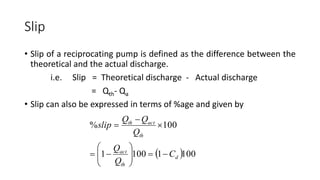
• Slip can also be expressed in terms of %age and given by
 10011001
100%
d
th
act
th
actth
C
Q
Q
Q
QQ
slip










Slip
• Slip Where Cd is known as co-efficient of discharge and is defined as
the ratio of the actual discharge to the theoretical discharge.
Cd = Qa / Qth.
• Value of Cd when expressed in percentage is known as volumetric
efficiency of the pump. Its value ranges between 95---98 %.
Percentage slip is of the order of 2% for pumps in good conditions.
Negative sleep
• It is not always that the actual discharge is lesser than the theoretical
discharge. In case of a reciprocating pump with long suction pipe,
short delivery pipe and running at high speed, inertia force in the
suction pipe becomes large as compared to the pressure force on the
outside of delivery valve. This opens the delivery valve even before
the piston has completed its suction stroke. Thus some of the water is
pushed into the delivery pipe before the delivery stroke is actually
commenced. This way the actual discharge becomes more than the
theoretical discharge.
• Thus co-efficient of discharge increases from one and the slip
becomes negative.
Volumetric Efficiency
• volumetric efficiency (VE) can be determined with reasonable
accuracy (within 1 percent), if all factors are known.
• Also evident is that VE is dependant upon the fluid compressibility,
application pressure, pump C/D ratio (pumping chamber clearance to
displacement ratio), and pump valve slip.
• Therefore, since fluid compressibility, pump C/D ratio, and pump
valve slip are known by fluid properties and pump dimensions and
characteristics, the actual fixed displaced volume per complete cycle
(rpm) is dependant upon pressure and not pump speed.
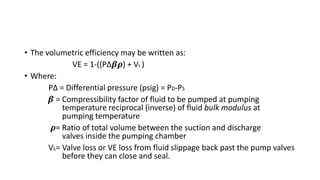
• The volumetric efficiency may be written as:
VE = 1-((P∆𝜷𝝆) + VL )
• Where:
P∆ = Differential pressure (psig) = PD-PS
𝜷 = Compressibility factor of fluid to be pumped at pumping
temperature reciprocal (inverse) of fluid bulk modulus at
pumping temperature
𝝆= Ratio of total volume between the suction and discharge
valves inside the pumping chamber
VL= Valve loss or VE loss from fluid slippage back past the pump valves
before they can close and seal.
Example:
• Problem-1: A single-acting reciprocating pump discharge 0.018 m3 /s
of water per second when running at 60 rpm. Stroke length is 50 cm
and the diameter of the piston is 22 cm. If the total lift is 15 m,
determine:
a) Theoretical discharge of the pump
b) Slip and percentage slip of the pump
c) Co-efficient of discharge
d) Power required running the pump
Solution:
L = 0.5 m
Qa = 0.018m3 /s
D = 0.22 m
N = 60 rpm
Hst = 15 m
• (a)
60460
2 LN
D
N
LAQth 







Cont.
Qth = (π/4)x(0.22)2x(0.5x60/60)
Qth = 0.019 m3 /s
(b) Slip = Qth - Qa
Slip = 0.019 – 0.018
= 0.001 m3 /s
Percentage slip = (Qth - Qa)/ Qth
= (0.019-0.018)/0.019
= 0.0526 or 5.26%

Reciprocating Pump

  • 1.
    Topics: • Max speedof reciprocating pump • Slip of reciprocating pump • Volumetric efficiency of reciprocating pump
  • 2.
    Maximum speed • Themaximum speed of the pump can be found out by: wkt, 𝜔 = 2𝜋𝑁 60 so, 𝑁 = 60𝜔 2𝜋
  • 3.
  • 4.
  • 5.
  • 6.
    Slip • Slip ofa reciprocating pump is defined as the difference between the theoretical and the actual discharge. i.e. Slip = Theoretical discharge - Actual discharge = Qth- Qa • Slip can also be expressed in terms of %age and given by  10011001 100% d th act th actth C Q Q Q QQ slip          
  • 7.
    Slip • Slip WhereCd is known as co-efficient of discharge and is defined as the ratio of the actual discharge to the theoretical discharge. Cd = Qa / Qth. • Value of Cd when expressed in percentage is known as volumetric efficiency of the pump. Its value ranges between 95---98 %. Percentage slip is of the order of 2% for pumps in good conditions.
  • 8.
    Negative sleep • Itis not always that the actual discharge is lesser than the theoretical discharge. In case of a reciprocating pump with long suction pipe, short delivery pipe and running at high speed, inertia force in the suction pipe becomes large as compared to the pressure force on the outside of delivery valve. This opens the delivery valve even before the piston has completed its suction stroke. Thus some of the water is pushed into the delivery pipe before the delivery stroke is actually commenced. This way the actual discharge becomes more than the theoretical discharge. • Thus co-efficient of discharge increases from one and the slip becomes negative.
  • 9.
    Volumetric Efficiency • volumetricefficiency (VE) can be determined with reasonable accuracy (within 1 percent), if all factors are known. • Also evident is that VE is dependant upon the fluid compressibility, application pressure, pump C/D ratio (pumping chamber clearance to displacement ratio), and pump valve slip. • Therefore, since fluid compressibility, pump C/D ratio, and pump valve slip are known by fluid properties and pump dimensions and characteristics, the actual fixed displaced volume per complete cycle (rpm) is dependant upon pressure and not pump speed.
  • 10.
    • The volumetricefficiency may be written as: VE = 1-((P∆𝜷𝝆) + VL ) • Where: P∆ = Differential pressure (psig) = PD-PS 𝜷 = Compressibility factor of fluid to be pumped at pumping temperature reciprocal (inverse) of fluid bulk modulus at pumping temperature 𝝆= Ratio of total volume between the suction and discharge valves inside the pumping chamber VL= Valve loss or VE loss from fluid slippage back past the pump valves before they can close and seal.
  • 11.
    Example: • Problem-1: Asingle-acting reciprocating pump discharge 0.018 m3 /s of water per second when running at 60 rpm. Stroke length is 50 cm and the diameter of the piston is 22 cm. If the total lift is 15 m, determine: a) Theoretical discharge of the pump b) Slip and percentage slip of the pump c) Co-efficient of discharge d) Power required running the pump
  • 12.
    Solution: L = 0.5m Qa = 0.018m3 /s D = 0.22 m N = 60 rpm Hst = 15 m • (a) 60460 2 LN D N LAQth        
  • 13.
    Cont. Qth = (π/4)x(0.22)2x(0.5x60/60) Qth= 0.019 m3 /s (b) Slip = Qth - Qa Slip = 0.019 – 0.018 = 0.001 m3 /s Percentage slip = (Qth - Qa)/ Qth = (0.019-0.018)/0.019 = 0.0526 or 5.26%