1
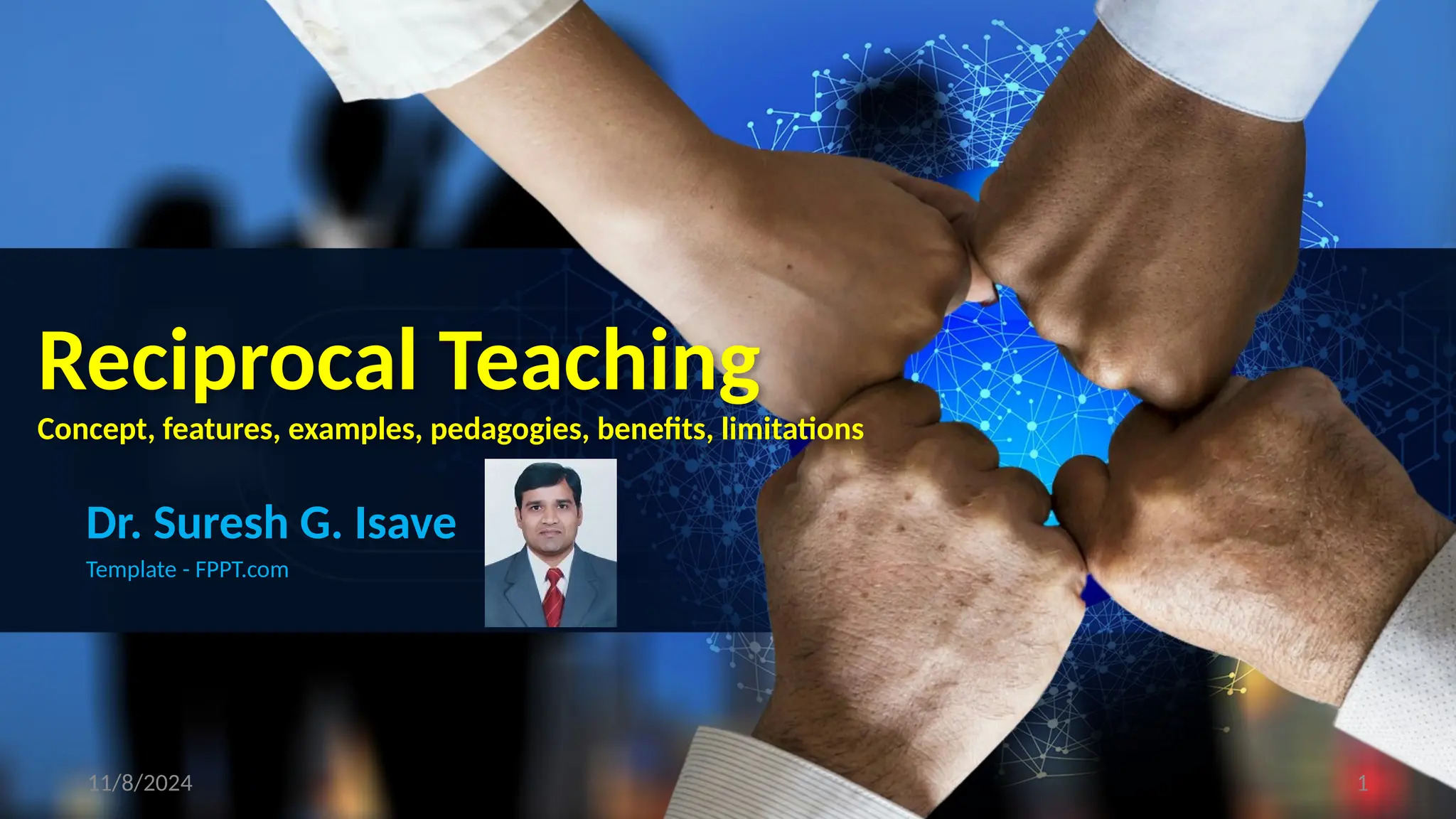
Reciprocal Teaching
Concept, features, examples, pedagogies, benefits, limitations
Dr. Suresh G. Isave
Template - FPPT.com
11/8/2024
2
Meaning of Reciprocal
• A reciprocal action or arrangement involves two
people or groups of people who behave in the same
way or agree to help each other and give each other
advantages. – Cambridge Dictionary
• Mutual, Give and Take, one-another, operating for
both, equally or to a similar degree
11/8/2024
3
Concept of Reciprocal Teaching
• Reciprocal teaching is an instructional strategy where
students take turns assuming the role of the teacher to
help facilitate learning.
• It involves an interactive process between students and
the teacher, where students actively engage in
discussing and explaining content to their peers, which
in turn enhances their own understanding.
• Group study
11/8/2024
4
Cognitive strategies Reciprocal Teaching
• Predicting: Students make predictions about the content they
are about to read, based on titles, pictures, or prior knowledge.
• Questioning: Students generate questions about the material
to deepen their understanding and guide further reading.
• Clarifying: Students work together to clarify confusing words,
phrases, or concepts in the text.
• Summarizing: Students summarize key points of the material
they have read, either individually or as a group.
11/8/2024
5
Features of Reciprocal Teaching
• Student-led discussions: After initial teacher’s moderation,
students take turns leading the discussion and teaching their
peers.
• Active engagement: Students are actively involved in reading,
analyzing, and interpreting texts.
• Collaborative learning: Peer interaction fosters collaboration and
allows students to learn from one another.
• Teacher facilitation: While students lead discussions, the teacher
provides ongoing support and guidance as needed.
11/8/2024
6
Reciprocal teaching – Illustration
• Reading Comprehension (Classroom Setting)
• In a group of students, one student reads a passage,
and the others alternate between taking on different
roles (predictor, questioner, summarizer, clarifier).
They discuss the content, making predictions, asking
questions, summarizing, and clarifying difficult
concepts.
11/8/2024
7
Reciprocal teaching – Illustration
• Peer Teaching in Math
• In a group, one student explains a math concept (e.g.,
solving quadratic equations) while the others ask
questions and provide feedback. Then, roles switch,
and another student teaches the group a new
concept.
11/8/2024
8
Reciprocal teaching – Illustration
• Science Experiments
• Two students design an experiment together. One
explains the procedure while the other helps with
execution, then they switch roles.
11/8/2024
9
Reciprocal teaching – Illustration
• History Debate
• Students take on roles of different historical figures or perspectives and
teach each other about their assigned roles, defending their positions
through debate.
• Example:
• Student A: “I represent the Union during the Civil War. I argue that
preserving the Union was essential to preventing the collapse of the
country.”
• Student B: “I represent the Confederacy. My position is that states’
rights are fundamental, and the Union should not dictate our policies.”
11/8/2024
10
Reciprocal teaching strategies
• Cooperative learning
• Collaborative Learning
• Project-Based Learning,
• Problem Based Learning
• Service Learning,
• Experiential Learning
• Social Constructivism
• Socratic Method
• Debate
• Group discussion
• Jurisprudential Model
• Inquiry based learning
• Jigsaw Technique
• Game based Learning
11/8/2024
11
Reciprocal teaching strategies
• Change in pattern
• Self respect
• Social skills
• Communication
• Active learning
• Flaws in understanding
• Personal differences
• Non acceptance
• Dominance
• Discipline
11/8/2024
12
Thank You
Subscribe and Share YouTube channel
Teacher Education Simplified
https://www.youtube.com/channel/UCXQFbVKH376q84WWlXGu7ew
11/8/2024

Reciprocal Teaching - Concept and Implication

  • 1.
    1 Reciprocal Teaching Concept, features,examples, pedagogies, benefits, limitations Dr. Suresh G. Isave Template - FPPT.com 11/8/2024
  • 2.
    2 Meaning of Reciprocal •A reciprocal action or arrangement involves two people or groups of people who behave in the same way or agree to help each other and give each other advantages. – Cambridge Dictionary • Mutual, Give and Take, one-another, operating for both, equally or to a similar degree 11/8/2024
  • 3.
    3 Concept of ReciprocalTeaching • Reciprocal teaching is an instructional strategy where students take turns assuming the role of the teacher to help facilitate learning. • It involves an interactive process between students and the teacher, where students actively engage in discussing and explaining content to their peers, which in turn enhances their own understanding. • Group study 11/8/2024
  • 4.
    4 Cognitive strategies ReciprocalTeaching • Predicting: Students make predictions about the content they are about to read, based on titles, pictures, or prior knowledge. • Questioning: Students generate questions about the material to deepen their understanding and guide further reading. • Clarifying: Students work together to clarify confusing words, phrases, or concepts in the text. • Summarizing: Students summarize key points of the material they have read, either individually or as a group. 11/8/2024
  • 5.
    5 Features of ReciprocalTeaching • Student-led discussions: After initial teacher’s moderation, students take turns leading the discussion and teaching their peers. • Active engagement: Students are actively involved in reading, analyzing, and interpreting texts. • Collaborative learning: Peer interaction fosters collaboration and allows students to learn from one another. • Teacher facilitation: While students lead discussions, the teacher provides ongoing support and guidance as needed. 11/8/2024
  • 6.
    6 Reciprocal teaching –Illustration • Reading Comprehension (Classroom Setting) • In a group of students, one student reads a passage, and the others alternate between taking on different roles (predictor, questioner, summarizer, clarifier). They discuss the content, making predictions, asking questions, summarizing, and clarifying difficult concepts. 11/8/2024
  • 7.
    7 Reciprocal teaching –Illustration • Peer Teaching in Math • In a group, one student explains a math concept (e.g., solving quadratic equations) while the others ask questions and provide feedback. Then, roles switch, and another student teaches the group a new concept. 11/8/2024
  • 8.
    8 Reciprocal teaching –Illustration • Science Experiments • Two students design an experiment together. One explains the procedure while the other helps with execution, then they switch roles. 11/8/2024
  • 9.
    9 Reciprocal teaching –Illustration • History Debate • Students take on roles of different historical figures or perspectives and teach each other about their assigned roles, defending their positions through debate. • Example: • Student A: “I represent the Union during the Civil War. I argue that preserving the Union was essential to preventing the collapse of the country.” • Student B: “I represent the Confederacy. My position is that states’ rights are fundamental, and the Union should not dictate our policies.” 11/8/2024
  • 10.
    10 Reciprocal teaching strategies •Cooperative learning • Collaborative Learning • Project-Based Learning, • Problem Based Learning • Service Learning, • Experiential Learning • Social Constructivism • Socratic Method • Debate • Group discussion • Jurisprudential Model • Inquiry based learning • Jigsaw Technique • Game based Learning 11/8/2024
  • 11.
    11 Reciprocal teaching strategies •Change in pattern • Self respect • Social skills • Communication • Active learning • Flaws in understanding • Personal differences • Non acceptance • Dominance • Discipline 11/8/2024
  • 12.
    12 Thank You Subscribe andShare YouTube channel Teacher Education Simplified https://www.youtube.com/channel/UCXQFbVKH376q84WWlXGu7ew 11/8/2024