ReCertifying Active
Directory
@harmj0y and @tifkin_
TL;DR
- Background
- Attacks against AD CS
- Defenses
- Incident Response
2
1
Background
...
3
Active Directory Certificate Services
▪ A server role
▪ Microsoft’s public key infrastructure
(PKI) implementation
▫ Used by organizations for smart cards, SSL
certificates, code signing, etc.
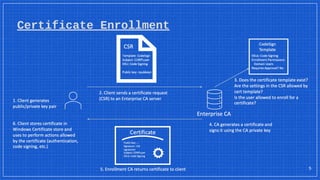
▪ Clients send certificate signing requests
(CSRs) to a certificate authority(CA),
which signs issued certificates using the
private key for the CA certificate 4
Certificate Enrollment
5
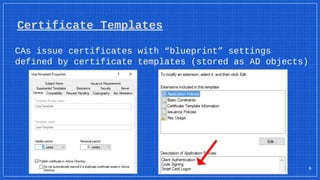
Certificate Templates
CAs issue certificates with “blueprint” settings
defined by certificate templates (stored as AD objects)
6
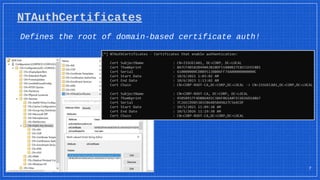
NTAuthCertificates
7
Defines the root of domain-based certificate auth!
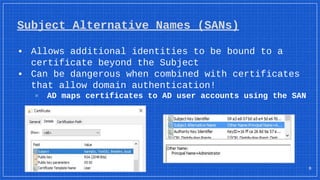
Subject Alternative Names (SANs)
▪ Allows additional identities to be bound to a
certificate beyond the Subject
▪ Can be dangerous when combined with certificates
that allow domain authentication!
▫ AD maps certificates to AD user accounts using the SAN
8
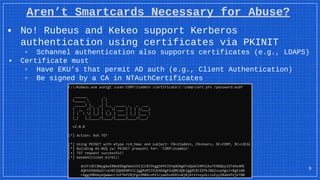
Aren’t Smartcards Necessary for Abuse?
▪ No! Rubeus and Kekeo support Kerberos
authentication using certificates via PKINIT
▫ Schannel authentication also supports certificates (e.g., LDAPS)
▪ Certificate must
▫ Have EKU’s that permit AD auth (e.g., Client Authentication)
▫ Be signed by a CA in NTAuthCertificates
9
2
Attacks Against AD CS
...
10
And How to Defend
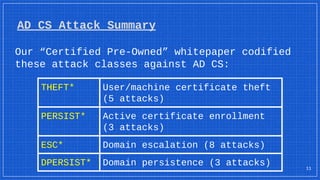
AD CS Attack Summary
11
Our “Certified Pre-Owned” whitepaper codified
these attack classes against AD CS:
THEFT* User/machine certificate theft
(5 attacks)
PERSIST* Active certificate enrollment
(3 attacks)
ESC* Domain escalation (8 attacks)
DPERSIST* Domain persistence (3 attacks)
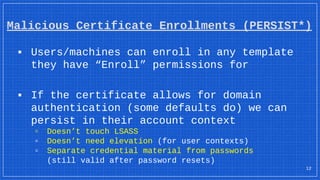
Malicious Certificate Enrollments (PERSIST*)
▪ Users/machines can enroll in any template
they have “Enroll” permissions for
▪ If the certificate allows for domain
authentication (some defaults do) we can
persist in their account context
▫ Doesn’t touch LSASS
▫ Doesn’t need elevation (for user contexts)
▫ Separate credential material from passwords
(still valid after password resets)
12
13
THEFT*/PERSIST* Defense: Overview
▪ Detect non-LSASS reading of DPAPI-encrypted keys
▫ Monitor file opens/reads of DPAPI files (SACLs*?)
■ (Local)AppData folders:
Microsoft[Crypto | Protect | Vault | Credentials]
▪ Monitor certificate auth/enrollment events
▫ EIDs 4886/4887, EID 4768 (more on these later)
▪ Monitor for Certificate Authentication events
▫ EID 4768 with PKINIT certificate information
(more on this later)
▪ “Honey Credentials” in certificate form
14
*https://medium.com/@cryps1s/detecting-windows-endpoint-compromise-with-sacls-cd748e10950
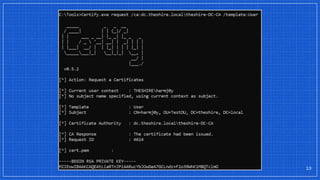
Requirements:
1. Low-privileged user can enroll in the template
2. No “Issuance Restrictions”
3. [PKINIT] Client Authentication EKU, Smart Card Logon
EKU, Any Purpose EKU, or No EKU
4. The ENROLLEE_SUPPLIES_SUBJECT flag set on the template
▫ Template’s AD object has msPKI-Certificate-Name-Flag set to 1 in its bitmask
ESC1 - ENROLLEE_SUPPLIES_SUBJECT
15
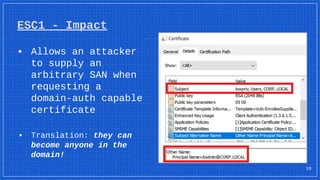
ESC1 - Impact
▪ Allows an attacker
to supply an
arbitrary SAN when
requesting a
domain-auth capable
certificate
▪ Translation: they can
become anyone in the
domain!
16
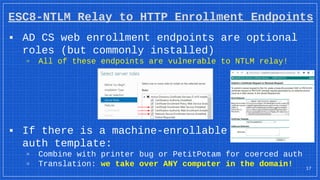
ESC8-NTLM Relay to HTTP Enrollment Endpoints
▪ AD CS web enrollment endpoints are optional
roles (but commonly installed)
▫ All of these endpoints are vulnerable to NTLM relay!
▪ If there is a machine-enrollable
auth template:
▫ Combine with printer bug or PetitPotam for coerced auth
▫ Translation: we take over ANY computer in the domain! 17
ESC* Defense: Hardening
18
▪ Audit/harden CA settings for every CA!
▫ Manager/Enroll/Control rights
▪ Audit/harden certificate template settings
▫ Enroll/Control rights
▪ Harden AD CS HTTP enrollment endpoints
▫ Remove them if not needed
▫ Enable NTLM(-relay) protections
■ HTTPS + channel binding or remove NTLM
authentication from IIS
■ Ideally, disable NTLM completely at the host
level and throughout the domain :)
19
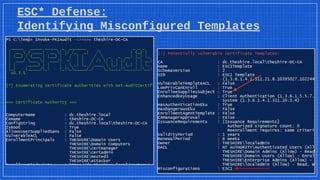
ESC* Defense:
Identifying Misconfigured Templates
20
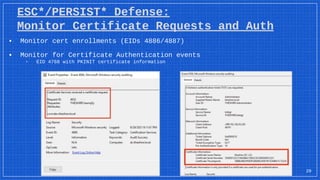
ESC*/PERSIST* Defense:
Monitor Certificate Requests and Auth
▪ Monitor cert enrollments (EIDs 4886/4887)
▪ Monitor for Certificate Authentication events
▫ EID 4768 with PKINIT certificate information
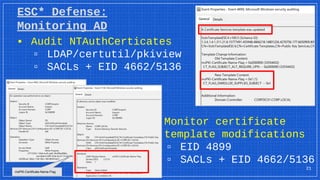
ESC* Defense:
Monitoring AD
▪ Audit NTAuthCerticates
▫ LDAP/certutil/pkiview
▫ SACLs + EID 4662/5136
21
▪ Monitor certificate
template modifications
▫ EID 4899
▫ SACLs + EID 4662/5136
msPKI-Certificate-Name-Flag
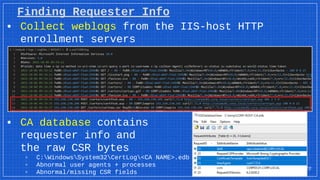
Finding Requester Info
▪ Collect weblogs from the IIS-host HTTP
enrollment servers
▪ CA database contains
requester info and
the raw CSR bytes
▫ C:WindowsSystem32CertLog<CA NAME>.edb
▫ Abnormal user agents + processes
▫ Abnormal/missing CSR fields
22
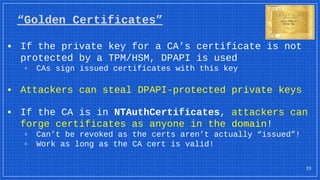
“Golden Certificates”
▪ If the private key for a CA’s certificate is not
protected by a TPM/HSM, DPAPI is used
▫ CAs sign issued certificates with this key
▪ Attackers can steal DPAPI-protected private keys
▪ If the CA is in NTAuthCertificates, attackers can
forge certificates as anyone in the domain!
▫ Can’t be revoked as the certs aren’t actually “issued”!
▫ Work as long as the CA cert is valid!
23
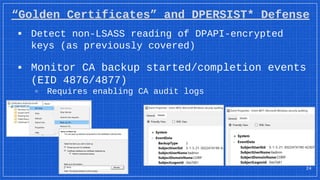
“Golden Certificates” and DPERSIST* Defense
▪ Detect non-LSASS reading of DPAPI-encrypted
keys (as previously covered)
▪ Monitor CA backup started/completion events
(EID 4876/4877)
▫ Requires enabling CA audit logs
24
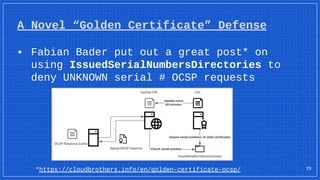
A Novel “Golden Certificate” Defense
▪ Fabian Bader put out a great post* on
using IssuedSerialNumbersDirectories to
deny UNKNOWN serial # OCSP requests
25
*https://cloudbrothers.info/en/golden-certificate-ocsp/
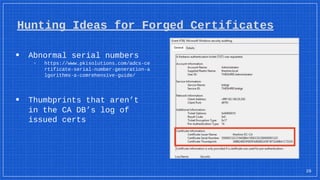
▪ Abnormal serial numbers
▫ https://www.pkisolutions.com/adcs-ce
rtificate-serial-number-generation-a
lgorithms-a-comrehensive-guide/
▪ Thumbprints that aren’t
in the CA DB’s log of
issued certs
26
Hunting Ideas for Forged Certificates
High Level Architecture Guidance
▪ Treat CAs as Tier 0 Assets!
▪ Hardware protect CA keys
▪ Internal root CAs should be offline, with
subordinate CAs doing issuance
▫ A proper architecture is worth investing in!
27
A Note on Response
...
28
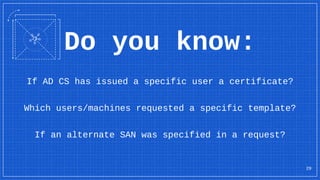
Do you know:
If AD CS has issued a specific user a certificate?
Which users/machines requested a specific template?
If an alternate SAN was specified in a request?
29
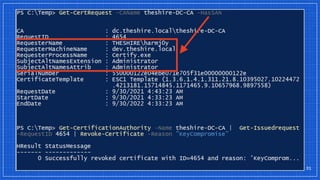
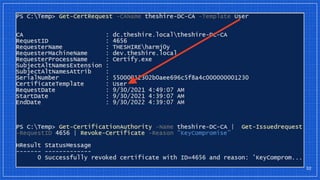
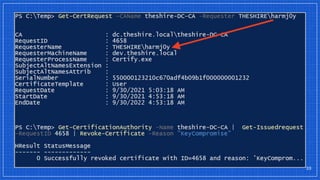
AD CS Response
▪ If you have AD CS and a computer/user is
compromised, you need to be able to
answer these questions!
▫ PSPKIAudit can help here
▪ Organizations also need to streamline the
certificate revocation process
▫ Possible through the GUI or PSPKI
▪ Make plans for how to respond to a
compromised subordinate/root CA 30
31
32
33
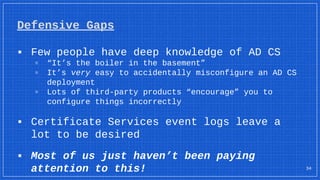
Defensive Gaps
34
▪ Few people have deep knowledge of AD CS
▫ “It’s the boiler in the basement”
▫ It’s very easy to accidentally misconfigure an AD CS
deployment
▫ Lots of third-party products “encourage” you to
configure things incorrectly
▪ Certificate Services event logs leave a
lot to be desired
▪ Most of us just haven’t been paying
attention to this!
Summary
▪ AD CS is dangerous if not handled properly
▪ Attack tooling (and knowledge) is now out there!
▪ Defenses:
▫ Develop an AD CS incident response plan
▫ Audit relevant AD CS event logs
▫ Audit/triage certificate issues with PSPKIAudit
▪ Our whitepaper has complete details
▫ https://bit.ly/3xLziQ9
35
Acknowledgements
▪ Previous work (see the paper for complete
details):
▫ Benjamin Delpy, PKISolutions, Christoph Falta, CQURE,
Keyfactor, @Elkement, Carl Sörqvist, Brad Hill
▫ Risk-Insight’s Similar Work/Findings:
■ https://www.riskinsight-wavestone.com/en/2021/06/microsoft-adcs-abusing-pki-in-active-directory-environment/
▪ Ceri Coburn and Charlie Clark for related Rubeus
additions
▪ Special thanks to Mark Gamache for collaborating
with us on parts of this work 36
Thanks!
ANY QUESTIONS?
You can find us at:
@harmj0y | @tifkin_
[will | lee] @specterops.io
AD CS Whitepaper: https://bit.ly/3xLziQ9
37

ReCertifying Active Directory

  • 1.
  • 2.
    TL;DR - Background - Attacksagainst AD CS - Defenses - Incident Response 2
  • 3.
  • 4.
    Active Directory CertificateServices ▪ A server role ▪ Microsoft’s public key infrastructure (PKI) implementation ▫ Used by organizations for smart cards, SSL certificates, code signing, etc. ▪ Clients send certificate signing requests (CSRs) to a certificate authority(CA), which signs issued certificates using the private key for the CA certificate 4
  • 5.
  • 6.
    Certificate Templates CAs issuecertificates with “blueprint” settings defined by certificate templates (stored as AD objects) 6
  • 7.
    NTAuthCertificates 7 Defines the rootof domain-based certificate auth!
  • 8.
    Subject Alternative Names(SANs) ▪ Allows additional identities to be bound to a certificate beyond the Subject ▪ Can be dangerous when combined with certificates that allow domain authentication! ▫ AD maps certificates to AD user accounts using the SAN 8
  • 9.
    Aren’t Smartcards Necessaryfor Abuse? ▪ No! Rubeus and Kekeo support Kerberos authentication using certificates via PKINIT ▫ Schannel authentication also supports certificates (e.g., LDAPS) ▪ Certificate must ▫ Have EKU’s that permit AD auth (e.g., Client Authentication) ▫ Be signed by a CA in NTAuthCertificates 9
  • 10.
    2 Attacks Against ADCS ... 10 And How to Defend
  • 11.
    AD CS AttackSummary 11 Our “Certified Pre-Owned” whitepaper codified these attack classes against AD CS: THEFT* User/machine certificate theft (5 attacks) PERSIST* Active certificate enrollment (3 attacks) ESC* Domain escalation (8 attacks) DPERSIST* Domain persistence (3 attacks)
  • 12.
    Malicious Certificate Enrollments(PERSIST*) ▪ Users/machines can enroll in any template they have “Enroll” permissions for ▪ If the certificate allows for domain authentication (some defaults do) we can persist in their account context ▫ Doesn’t touch LSASS ▫ Doesn’t need elevation (for user contexts) ▫ Separate credential material from passwords (still valid after password resets) 12
  • 13.
  • 14.
    THEFT*/PERSIST* Defense: Overview ▪Detect non-LSASS reading of DPAPI-encrypted keys ▫ Monitor file opens/reads of DPAPI files (SACLs*?) ■ (Local)AppData folders: Microsoft[Crypto | Protect | Vault | Credentials] ▪ Monitor certificate auth/enrollment events ▫ EIDs 4886/4887, EID 4768 (more on these later) ▪ Monitor for Certificate Authentication events ▫ EID 4768 with PKINIT certificate information (more on this later) ▪ “Honey Credentials” in certificate form 14 *https://medium.com/@cryps1s/detecting-windows-endpoint-compromise-with-sacls-cd748e10950
  • 15.
    Requirements: 1. Low-privileged usercan enroll in the template 2. No “Issuance Restrictions” 3. [PKINIT] Client Authentication EKU, Smart Card Logon EKU, Any Purpose EKU, or No EKU 4. The ENROLLEE_SUPPLIES_SUBJECT flag set on the template ▫ Template’s AD object has msPKI-Certificate-Name-Flag set to 1 in its bitmask ESC1 - ENROLLEE_SUPPLIES_SUBJECT 15
  • 16.
    ESC1 - Impact ▪Allows an attacker to supply an arbitrary SAN when requesting a domain-auth capable certificate ▪ Translation: they can become anyone in the domain! 16
  • 17.
    ESC8-NTLM Relay toHTTP Enrollment Endpoints ▪ AD CS web enrollment endpoints are optional roles (but commonly installed) ▫ All of these endpoints are vulnerable to NTLM relay! ▪ If there is a machine-enrollable auth template: ▫ Combine with printer bug or PetitPotam for coerced auth ▫ Translation: we take over ANY computer in the domain! 17
  • 18.
    ESC* Defense: Hardening 18 ▪Audit/harden CA settings for every CA! ▫ Manager/Enroll/Control rights ▪ Audit/harden certificate template settings ▫ Enroll/Control rights ▪ Harden AD CS HTTP enrollment endpoints ▫ Remove them if not needed ▫ Enable NTLM(-relay) protections ■ HTTPS + channel binding or remove NTLM authentication from IIS ■ Ideally, disable NTLM completely at the host level and throughout the domain :)
  • 19.
  • 20.
    20 ESC*/PERSIST* Defense: Monitor CertificateRequests and Auth ▪ Monitor cert enrollments (EIDs 4886/4887) ▪ Monitor for Certificate Authentication events ▫ EID 4768 with PKINIT certificate information
  • 21.
    ESC* Defense: Monitoring AD ▪Audit NTAuthCerticates ▫ LDAP/certutil/pkiview ▫ SACLs + EID 4662/5136 21 ▪ Monitor certificate template modifications ▫ EID 4899 ▫ SACLs + EID 4662/5136 msPKI-Certificate-Name-Flag
  • 22.
    Finding Requester Info ▪Collect weblogs from the IIS-host HTTP enrollment servers ▪ CA database contains requester info and the raw CSR bytes ▫ C:WindowsSystem32CertLog<CA NAME>.edb ▫ Abnormal user agents + processes ▫ Abnormal/missing CSR fields 22
  • 23.
    “Golden Certificates” ▪ Ifthe private key for a CA’s certificate is not protected by a TPM/HSM, DPAPI is used ▫ CAs sign issued certificates with this key ▪ Attackers can steal DPAPI-protected private keys ▪ If the CA is in NTAuthCertificates, attackers can forge certificates as anyone in the domain! ▫ Can’t be revoked as the certs aren’t actually “issued”! ▫ Work as long as the CA cert is valid! 23
  • 24.
    “Golden Certificates” andDPERSIST* Defense ▪ Detect non-LSASS reading of DPAPI-encrypted keys (as previously covered) ▪ Monitor CA backup started/completion events (EID 4876/4877) ▫ Requires enabling CA audit logs 24
  • 25.
    A Novel “GoldenCertificate” Defense ▪ Fabian Bader put out a great post* on using IssuedSerialNumbersDirectories to deny UNKNOWN serial # OCSP requests 25 *https://cloudbrothers.info/en/golden-certificate-ocsp/
  • 26.
    ▪ Abnormal serialnumbers ▫ https://www.pkisolutions.com/adcs-ce rtificate-serial-number-generation-a lgorithms-a-comrehensive-guide/ ▪ Thumbprints that aren’t in the CA DB’s log of issued certs 26 Hunting Ideas for Forged Certificates
  • 27.
    High Level ArchitectureGuidance ▪ Treat CAs as Tier 0 Assets! ▪ Hardware protect CA keys ▪ Internal root CAs should be offline, with subordinate CAs doing issuance ▫ A proper architecture is worth investing in! 27
  • 28.
    A Note onResponse ... 28
  • 29.
    Do you know: IfAD CS has issued a specific user a certificate? Which users/machines requested a specific template? If an alternate SAN was specified in a request? 29
  • 30.
    AD CS Response ▪If you have AD CS and a computer/user is compromised, you need to be able to answer these questions! ▫ PSPKIAudit can help here ▪ Organizations also need to streamline the certificate revocation process ▫ Possible through the GUI or PSPKI ▪ Make plans for how to respond to a compromised subordinate/root CA 30
  • 31.
  • 32.
  • 33.
  • 34.
    Defensive Gaps 34 ▪ Fewpeople have deep knowledge of AD CS ▫ “It’s the boiler in the basement” ▫ It’s very easy to accidentally misconfigure an AD CS deployment ▫ Lots of third-party products “encourage” you to configure things incorrectly ▪ Certificate Services event logs leave a lot to be desired ▪ Most of us just haven’t been paying attention to this!
  • 35.
    Summary ▪ AD CSis dangerous if not handled properly ▪ Attack tooling (and knowledge) is now out there! ▪ Defenses: ▫ Develop an AD CS incident response plan ▫ Audit relevant AD CS event logs ▫ Audit/triage certificate issues with PSPKIAudit ▪ Our whitepaper has complete details ▫ https://bit.ly/3xLziQ9 35
  • 36.
    Acknowledgements ▪ Previous work(see the paper for complete details): ▫ Benjamin Delpy, PKISolutions, Christoph Falta, CQURE, Keyfactor, @Elkement, Carl Sörqvist, Brad Hill ▫ Risk-Insight’s Similar Work/Findings: ■ https://www.riskinsight-wavestone.com/en/2021/06/microsoft-adcs-abusing-pki-in-active-directory-environment/ ▪ Ceri Coburn and Charlie Clark for related Rubeus additions ▪ Special thanks to Mark Gamache for collaborating with us on parts of this work 36
  • 37.
    Thanks! ANY QUESTIONS? You canfind us at: @harmj0y | @tifkin_ [will | lee] @specterops.io AD CS Whitepaper: https://bit.ly/3xLziQ9 37