Topic: Issue of EEO & Issue in Compensation policy
Guidance By:
Majmudar Sir
Prepared By:
Jay Raval
Submitted To:
Department of Business Administration,
Bhavnagar University
Bhavnagar
Subject: I.H.P.P
22
Learning Objectives
 Meaning of EEO
 Briefly review and discuss major anti-discrimination laws.
 Increase awareness of workplace harassment,
 Learn techniques for identifying and preventing workplace
discrimination, harassment, and retaliation.
EEO
 Equal Employment Opportunity means equal
access to jobs and benefits and services for all
employees and prospective employees in the
workplace.
 EEO aims to ensure fair and equitable outcomes
in all areas of employment which relate to
recruitment, selection, access to information,
supervision and management.
3
Discrimination
 Direct discrimination is any action that specifically excludes a
person or a group of people from a benefit or opportunity, or
significantly reduces their chances of obtaining it, because a
personal characteristic irrelevant to the situation is applied as
a barrier.
 Indirect, covert, or systemic discrimination are rules,
practices and decisions that appear neutral, but in fact
significantly reduce the chance of an individual `from
obtaining a benefit or opportunity.
 For example, an employer who says they need a person
over 180cm tall to do a job may discriminate against women
and some ethnic groups who are less likely to be this height.
4
55
Anti-Discrimination Laws
 Title VII of the Civil Rights Act of 1964 (Title VII):
 Is the major law prohibiting discrimination in employment.
 Title VII prohibits discrimination based on race, Gender, color,
religion, national origin, and retaliation.
 The Equal Pay Act of 1963 (EPA):
 Protects men and women who perform substantially equal
work from Gender-based wage discrimination.
 The Age Discrimination In Employment Act of 1967 (ADEA):
 Protects employees and job applicants who are 40 years of
age or older from employment discrimination based on age.
66
Anti-Discrimination Laws
 The Rehabilitation Act of 1973:
 Applicable sections prohibit discrimination in employment
against qualified individuals with disabilities.
 Also, requires employers to provide “reasonable
accommodation” to qualified individuals with disabilities who are
employees or applicants for employment.
 The Civil Rights Act of 1991:
 Provides the right to a jury trial and monetary damages in cases
of employment discrimination.
 Genetic Information Nondiscrimination Act of 2008
77
Anti-Discrimination Laws
 The NO FEAR ACT (became effective on October 1, 2003):
 Prohibits discrimination and retaliation against workers for
participating in the EEO process or whistle-blower activities.
 Requires agencies to train employees and post statistical data
on EEO complaints on agency’s public website.
88
Workplace Harassment Defined
 Harassment is any unwelcome verbal or physical conduct based on
race, color, religion, national origin, age, disability or retaliation that
is sufficiently offensive to alter the conditions of the victim’s
employment. This standard is met when:
 Workplace harassment
 Psychological harassment
 Racial harassment
 Religious harassment
99
Way of Harassment
 Verbal (unwelcome comments, yelling, offensive jokes or
stories);
 Visual (offensive pictures, photos, cartoons, posters,
calendars, magazines or objects);
 Physical (unwelcome touching, hugging, stroking, or
suggestive gestures); and
 Written (unwelcome letters, notes or e-mails of a
personal nature).
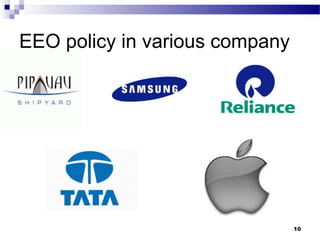
EEO policy in various company
10
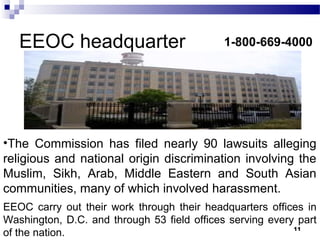
EEOC headquarter
11
1-800-669-4000
•The Commission has filed nearly 90 lawsuits alleging
religious and national origin discrimination involving the
Muslim, Sikh, Arab, Middle Eastern and South Asian
communities, many of which involved harassment.
EEOC carry out their work through their headquarters offices in
Washington, D.C. and through 53 field offices serving every part
of the nation.
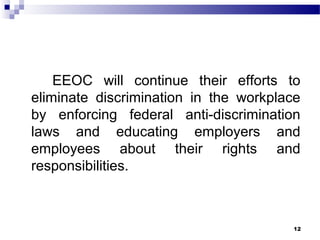
EEOC will continue their efforts to
eliminate discrimination in the workplace
by enforcing federal anti-discrimination
laws and educating employers and
employees about their rights and
responsibilities.
12
Issues in compensation
Policy
13
Compensation Policy
 Compensation is a systematic approach of
providing monetary value to employees in
exchange for work performed. It may be help to
achieve several purposes, such as recruitment,
job performance and job satisfaction.
14
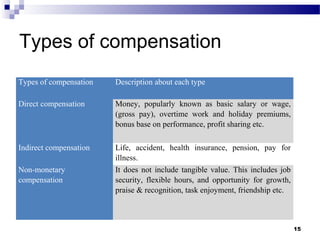
Types of compensation
15
Types of compensation Description about each type
Direct compensation Money, popularly known as basic salary or wage,
(gross pay), overtime work and holiday premiums,
bonus base on performance, profit sharing etc.
Indirect compensation Life, accident, health insurance, pension, pay for
illness.
Non-monetary
compensation
It does not include tangible value. This includes job
security, flexible hours, and opportunity for growth,
praise & recognition, task enjoyment, friendship etc.
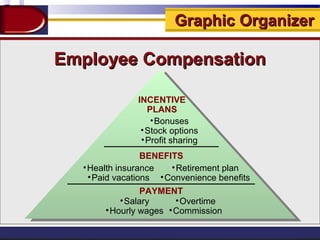
Graphic OrganizerGraphic Organizer
Chapter 8 • Beginning a New Job Succeeding in the World of Work
INCENTIVE
PLANS
•Bonuses
•Stock options
•Profit sharing
BENEFITS
•Health insurance
•Paid vacations
PAYMENT
•Salary
•Hourly wages
•Retirement plan
•Convenience benefits
•Overtime
•Commission
Employee CompensationEmployee Compensation
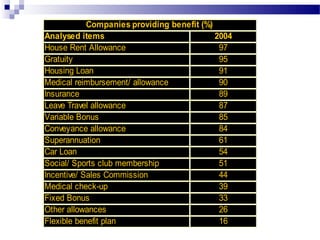
Analysed items 2004
House Rent Allowance 97
Gratuity 95
Housing Loan 91
Medical reimbursement/ allowance 90
Insurance 89
Leave Travel allowance 87
Variable Bonus 85
Conveyance allowance 84
Superannuation 61
Car Loan 54
Social/ Sports club membership 51
Incentive/ Sales Commission 44
Medical check-up 39
Fixed Bonus 33
Other allowances 26
Flexible benefit plan 16
Companies providing benefit (%)
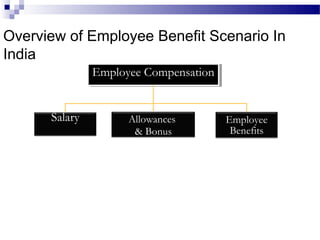
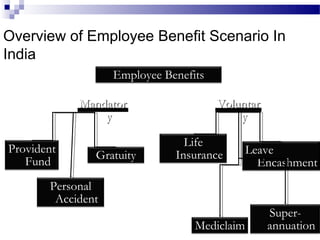
Overview of Employee Benefit Scenario In
India
Employee CompensationEmployee CompensationEmployee CompensationEmployee Compensation
SalarySalary AllowancesAllowances
& Bonus& Bonus
EmployeeEmployee
BenefitsBenefits
Overview of Employee Benefit Scenario In
India
Employee BenefitsEmployee Benefits
MandatorMandator
yy
VoluntarVoluntar
yy
ProvidentProvident
FundFund GratuityGratuity
PersonalPersonal
AccidentAccident
MediclaimMediclaim
LeaveLeave
EncashmentEncashment
LifeLife
InsuranceInsurance
Super-Super-
annuationannuation
Employee Benefits
 Why benefits?
 Types of benefits
Legally required benefits
Security and retirement benefits
Health coverage
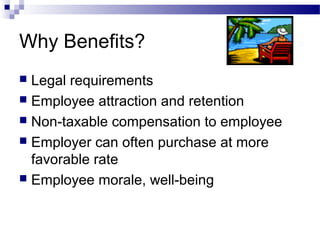
Why Benefits?
 Legal requirements
 Employee attraction and retention
 Non-taxable compensation to employee
 Employer can often purchase at more
favorable rate
 Employee morale, well-being
Legally Required Benefits
 Workers’ compensation
 Social security
 Overtime Pay
 Continuation of health coverage
Workers’ Compensation:
Coverage
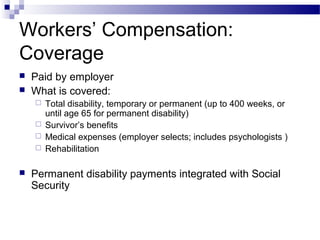
 Paid by employer
 What is covered:
 Total disability, temporary or permanent (up to 400 weeks, or
until age 65 for permanent disability)
 Survivor’s benefits
 Medical expenses (employer selects; includes psychologists )
 Rehabilitation
 Permanent disability payments integrated with Social
Security
Social Security: Overview
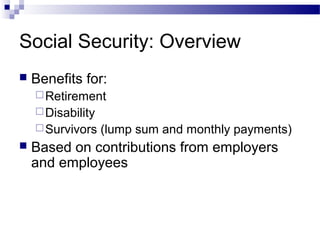
 Benefits for:
Retirement
Disability
Survivors (lump sum and monthly payments)
 Based on contributions from employers
and employees
Security and Retirement
Benefits
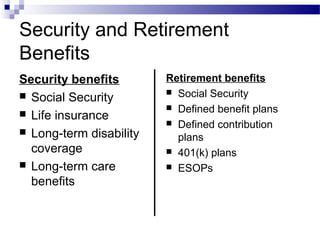
Security benefits
 Social Security
 Life insurance
 Long-term disability
coverage
 Long-term care
benefits
Retirement benefits
 Social Security
 Defined benefit plans
 Defined contribution
plans
 401(k) plans
 ESOPs
Overtime Pay
27
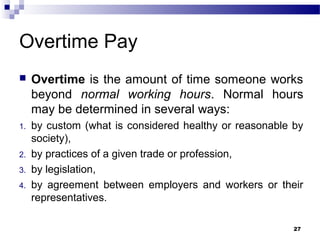
 Overtime is the amount of time someone works
beyond normal working hours. Normal hours
may be determined in several ways:
1. by custom (what is considered healthy or reasonable by
society),
2. by practices of a given trade or profession,
3. by legislation,
4. by agreement between employers and workers or their
representatives.
Health Coverage
 The basic issue: cost containment
 Basic medical coverage
 Other coverage
 Mental health
 Vision
 Dental
 Wellness programs
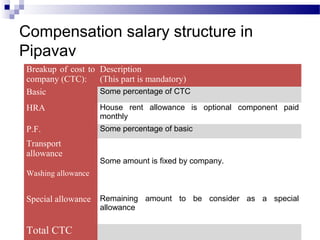
Compensation salary structure in
Pipavav
29
Breakup of cost to
company (CTC):
Description
(This part is mandatory)
Basic Some percentage of CTC
HRA House rent allowance is optional component paid
monthly
P.F. Some percentage of basic
Transport
allowance
Some amount is fixed by company.
Washing allowance
Special allowance Remaining amount to be consider as a special
allowance
Total CTC
Issues in compensation Policy
 Fair compensation
 Retain current employee for a long time
30
Thank You…
31

Issue of Equal Employment Opportunity & Issue in Compensation policy

  • 1.
    Topic: Issue ofEEO & Issue in Compensation policy Guidance By: Majmudar Sir Prepared By: Jay Raval Submitted To: Department of Business Administration, Bhavnagar University Bhavnagar Subject: I.H.P.P
  • 2.
    22 Learning Objectives  Meaningof EEO  Briefly review and discuss major anti-discrimination laws.  Increase awareness of workplace harassment,  Learn techniques for identifying and preventing workplace discrimination, harassment, and retaliation.
  • 3.
    EEO  Equal EmploymentOpportunity means equal access to jobs and benefits and services for all employees and prospective employees in the workplace.  EEO aims to ensure fair and equitable outcomes in all areas of employment which relate to recruitment, selection, access to information, supervision and management. 3
  • 4.
    Discrimination  Direct discriminationis any action that specifically excludes a person or a group of people from a benefit or opportunity, or significantly reduces their chances of obtaining it, because a personal characteristic irrelevant to the situation is applied as a barrier.  Indirect, covert, or systemic discrimination are rules, practices and decisions that appear neutral, but in fact significantly reduce the chance of an individual `from obtaining a benefit or opportunity.  For example, an employer who says they need a person over 180cm tall to do a job may discriminate against women and some ethnic groups who are less likely to be this height. 4
  • 5.
    55 Anti-Discrimination Laws  TitleVII of the Civil Rights Act of 1964 (Title VII):  Is the major law prohibiting discrimination in employment.  Title VII prohibits discrimination based on race, Gender, color, religion, national origin, and retaliation.  The Equal Pay Act of 1963 (EPA):  Protects men and women who perform substantially equal work from Gender-based wage discrimination.  The Age Discrimination In Employment Act of 1967 (ADEA):  Protects employees and job applicants who are 40 years of age or older from employment discrimination based on age.
  • 6.
    66 Anti-Discrimination Laws  TheRehabilitation Act of 1973:  Applicable sections prohibit discrimination in employment against qualified individuals with disabilities.  Also, requires employers to provide “reasonable accommodation” to qualified individuals with disabilities who are employees or applicants for employment.  The Civil Rights Act of 1991:  Provides the right to a jury trial and monetary damages in cases of employment discrimination.  Genetic Information Nondiscrimination Act of 2008
  • 7.
    77 Anti-Discrimination Laws  TheNO FEAR ACT (became effective on October 1, 2003):  Prohibits discrimination and retaliation against workers for participating in the EEO process or whistle-blower activities.  Requires agencies to train employees and post statistical data on EEO complaints on agency’s public website.
  • 8.
    88 Workplace Harassment Defined Harassment is any unwelcome verbal or physical conduct based on race, color, religion, national origin, age, disability or retaliation that is sufficiently offensive to alter the conditions of the victim’s employment. This standard is met when:  Workplace harassment  Psychological harassment  Racial harassment  Religious harassment
  • 9.
    99 Way of Harassment Verbal (unwelcome comments, yelling, offensive jokes or stories);  Visual (offensive pictures, photos, cartoons, posters, calendars, magazines or objects);  Physical (unwelcome touching, hugging, stroking, or suggestive gestures); and  Written (unwelcome letters, notes or e-mails of a personal nature).
  • 10.
    EEO policy invarious company 10
  • 11.
    EEOC headquarter 11 1-800-669-4000 •The Commissionhas filed nearly 90 lawsuits alleging religious and national origin discrimination involving the Muslim, Sikh, Arab, Middle Eastern and South Asian communities, many of which involved harassment. EEOC carry out their work through their headquarters offices in Washington, D.C. and through 53 field offices serving every part of the nation.
  • 12.
    EEOC will continuetheir efforts to eliminate discrimination in the workplace by enforcing federal anti-discrimination laws and educating employers and employees about their rights and responsibilities. 12
  • 13.
  • 14.
    Compensation Policy  Compensationis a systematic approach of providing monetary value to employees in exchange for work performed. It may be help to achieve several purposes, such as recruitment, job performance and job satisfaction. 14
  • 15.
    Types of compensation 15 Typesof compensation Description about each type Direct compensation Money, popularly known as basic salary or wage, (gross pay), overtime work and holiday premiums, bonus base on performance, profit sharing etc. Indirect compensation Life, accident, health insurance, pension, pay for illness. Non-monetary compensation It does not include tangible value. This includes job security, flexible hours, and opportunity for growth, praise & recognition, task enjoyment, friendship etc.
  • 16.
    Graphic OrganizerGraphic Organizer Chapter8 • Beginning a New Job Succeeding in the World of Work INCENTIVE PLANS •Bonuses •Stock options •Profit sharing BENEFITS •Health insurance •Paid vacations PAYMENT •Salary •Hourly wages •Retirement plan •Convenience benefits •Overtime •Commission Employee CompensationEmployee Compensation
  • 18.
    Analysed items 2004 HouseRent Allowance 97 Gratuity 95 Housing Loan 91 Medical reimbursement/ allowance 90 Insurance 89 Leave Travel allowance 87 Variable Bonus 85 Conveyance allowance 84 Superannuation 61 Car Loan 54 Social/ Sports club membership 51 Incentive/ Sales Commission 44 Medical check-up 39 Fixed Bonus 33 Other allowances 26 Flexible benefit plan 16 Companies providing benefit (%)
  • 19.
    Overview of EmployeeBenefit Scenario In India Employee CompensationEmployee CompensationEmployee CompensationEmployee Compensation SalarySalary AllowancesAllowances & Bonus& Bonus EmployeeEmployee BenefitsBenefits
  • 20.
    Overview of EmployeeBenefit Scenario In India Employee BenefitsEmployee Benefits MandatorMandator yy VoluntarVoluntar yy ProvidentProvident FundFund GratuityGratuity PersonalPersonal AccidentAccident MediclaimMediclaim LeaveLeave EncashmentEncashment LifeLife InsuranceInsurance Super-Super- annuationannuation
  • 21.
    Employee Benefits  Whybenefits?  Types of benefits Legally required benefits Security and retirement benefits Health coverage
  • 22.
    Why Benefits?  Legalrequirements  Employee attraction and retention  Non-taxable compensation to employee  Employer can often purchase at more favorable rate  Employee morale, well-being
  • 23.
    Legally Required Benefits Workers’ compensation  Social security  Overtime Pay  Continuation of health coverage
  • 24.
    Workers’ Compensation: Coverage  Paidby employer  What is covered:  Total disability, temporary or permanent (up to 400 weeks, or until age 65 for permanent disability)  Survivor’s benefits  Medical expenses (employer selects; includes psychologists )  Rehabilitation  Permanent disability payments integrated with Social Security
  • 25.
    Social Security: Overview Benefits for: Retirement Disability Survivors (lump sum and monthly payments)  Based on contributions from employers and employees
  • 26.
    Security and Retirement Benefits Securitybenefits  Social Security  Life insurance  Long-term disability coverage  Long-term care benefits Retirement benefits  Social Security  Defined benefit plans  Defined contribution plans  401(k) plans  ESOPs
  • 27.
    Overtime Pay 27  Overtimeis the amount of time someone works beyond normal working hours. Normal hours may be determined in several ways: 1. by custom (what is considered healthy or reasonable by society), 2. by practices of a given trade or profession, 3. by legislation, 4. by agreement between employers and workers or their representatives.
  • 28.
    Health Coverage  Thebasic issue: cost containment  Basic medical coverage  Other coverage  Mental health  Vision  Dental  Wellness programs
  • 29.
    Compensation salary structurein Pipavav 29 Breakup of cost to company (CTC): Description (This part is mandatory) Basic Some percentage of CTC HRA House rent allowance is optional component paid monthly P.F. Some percentage of basic Transport allowance Some amount is fixed by company. Washing allowance Special allowance Remaining amount to be consider as a special allowance Total CTC
  • 30.
    Issues in compensationPolicy  Fair compensation  Retain current employee for a long time 30
  • 31.

Editor's Notes

  • #3 Give them an orientation of why we are doing this training: EEO has always been important to the Department and it makes good business sense to have DHHS be a place that is free of discrimination. We are anxious to be a model Agency and to attract and keep the best employees, we must make sure that we want to keep a environment that people would like to work in and grow.
  • #7 EEO process is very expensive for the Agency, we have to pay the salaries of all parties- the complainant, the witnesses, management officials, investigative costs, transcription costs and if the Government loses the case, the cost of the attorney fees. The maximum amount for damages have been capped at $300, 000. It has been very rare to see this amount being paid.
  • #8 Prior to the passage of the No Fear Law, the money that was paid for judgments came out of the Treasury, but the No Fear Law changed that; the judgment must be paid out of the Agency budget now.
  • #9 Harassment covers a wide range of behaviours of an offensive nature. Workplace harassment Workplace harassment is the odious dealing through pitiless, malevolent, hurtful or embarrassing attempts to undermine an individual worker or groups of workers. It is almost unseen and the executive leaders (managers) are almost reluctant or unconscious about it in the third world countries.[11 Psychological harassment This is humiliating, intimidating or abusive behaviour which is often difficult to detect leaving no evidence other than victim reports or complaints. This characteristically lowers a person’s self-esteem or causes them torment. This can take the form of verbal comments, engineered episodes of intimidation, aggressive actions or repeated gestures. Falling into this category is workplace harassment by individuals or groups mobbing. Racial harassment Main article: Racial harassment The targeting of an individual because of their race or ethnicity. The harassment may include words, deeds, and actions that are specifically designed to make the target feel degraded due to their race or ethnicity. Religious harassment Verbal, psychological or physical harassment is used against targets because they choose to practice a specific religion. Religious harassment can also include forced and involuntary conversions.[15]
  • #11 TATA: Reliance: They believe in equal opportunities for all and our policies ensure that equal opportunity is provided to all regardless of race, color, religion, sex or disability. They believe in providing a working environment which fosters mutual respect and trust amongst employees which is free from any harassment. They believe work-life balance to be one of the key motivators for employees and hence our working hours, holiday, leave structures are designed to take care of this aspect.  Women employees are taken care of by allowing them time-off from work in the time of their need.  As big as our dreams are, they do realize that it will remain incomplete without ‘Our People’ who are our family hence they invest first in them before they invest in our business. What they have set out to achieve in the coming few years time is unprecedented. The targets and locations are challenging, but nothing is impossible for people who work in teams facilitated by structures, systems, policies and processes which enable them to achieve the impossible. Working at Reliance is not a job, it’s a mission and it’s a calling. OCT. 1998--Apple Computer has joined the ranks of other progressive companies by adding employment protection to their equal opportunity statement. This policy was three years in the coming; Apple Lambda started working for it in Sept, 1995.
  • #19 Gratuity: For whom? Engaged in Factories, Mines, Plantations, Railways, Shops and establishments notified by Government In service for 5 successive years What benefit? 15 days wages for each year of service Maximum limit Rs 3,50,000/ 7 days wages per season for seasonal occupation Superannuation For whom? Non-mandatory, defined by company policy What benefit? Can be defined benefit(certain formula of last drawn salary) /defined contribution(certain %age of salary every month contributed to a fund) Can be different for different grades
  • #25 http://www.state.tn.us/labor-wfd/wc_2007legislation.pdf