The ‘Second-Chance’ Workforce
How to Use Background Screening to Hire Ex-Offenders
Should you hire someone who has been
convicted of a crime?
You probably
ALREADY HAVE.
More than 1 in 4
Americans has
a criminal record
12 million
have felony convictions
Should employers do their part to give citizens
A FAIR SECOND CHANCE?
Between
60% and 75%
of ex-offenders are still
unemployed one year
after release.
Can employers risk hiring
these second-chance
workers?
Negligent hiring
is a real risk.
Public policy encourages
RE-ENTRY INTO THE WORKFORCE.
Title VII
Fair Credit
Reporting Act Ban the Box EEOC Guidance
But what does your
INSURER SAY?
Many operate under the
assumption that past
behavior is predictive of
future behavior.
So what happens to your liability policy
if you hire an ex-offender who then
inflicts damage on your business,
employees, or customers?
TO HIRE OR NOT TO HIRE?
Somewhere between a blanket policy
and indiscriminate hiring is a fair and effective process.
BLANKET
POLICY
indiscriminate
hiring
6 Key Elements
of a Fair and Effective Background Screening Process
Know your rights and
compliance obligations
as an employer
Make decisions based
on job-related factors
and business necessity
Be consistent
Avoid blanket policies
Build individualized
assessments into your
process
Follow the 2-step
adverse action process
1
4 5
2 3
6
KNOW YOUR RIGHTS
as an employer.
Employers have a right to
use background screening in
making employment decisions
and rejecting applicants.
This right has been
affirmed many times
in law, case law, and
regulation.
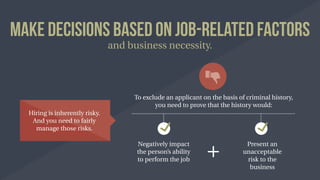
Make Decisions Based on Job-Related Factors
and business necessity.
Hiring is inherently risky.
And you need to fairly
manage those risks.
To exclude an applicant on the basis of criminal history,
you need to prove that the history would:
Negatively impact
the person’s ability
to perform the job
Present an
unacceptable
risk to the
business
Be consistent.
The scope and specific items researched in a background check
for a role should be consistent for every applicant, and used consistently in decision-making.
Avoid blanket policies.
Both EEOC Guidance and Ban
the Box laws in various state and
local jurisdictions target the use
of simple “check box” criminal
background checks.
Build individualized assessments
into your process.
If the background check
reveals that an applicant has a
criminal history, it’s time for an
individualized assessment.
nature of
the
specific
offense
time elapsed
since the
offense
what the
applicant
has done
subsequent to
the offense
specific
requirements
of the job in
question
Look at the Green Factors:
Follow the
2-step adverse action process
Notify the applicant of
the company’s decision to
be excluded based on the
results of the background
check.
Give the applicant an
opportunity to respond
with mitigating information
before making any adverse
hiring decision.
1 2
It’s your call.
Following these guidelines should reduce the
risk of excluding someone with a criminal background.
Or, you may find that
the applicant you took a
chance on is one of your
best employees.
LEARN MORE.
Take advantage of these additional resources to improve your hiring process.
Visit proformascreening.com to download your copies.
Ebook GUIDE INFOGRAPHIC
1 in 4
Make Better Hiring Decisions
www.proformascreening.com (866) 276-6161
Employment Background Checks | Drug Testing | Verifications

The 'Second-Chance' Workforce

  • 1.
    The ‘Second-Chance’ Workforce Howto Use Background Screening to Hire Ex-Offenders
  • 2.
    Should you hiresomeone who has been convicted of a crime?
  • 3.
  • 4.
    More than 1in 4 Americans has a criminal record 12 million have felony convictions
  • 5.
    Should employers dotheir part to give citizens A FAIR SECOND CHANCE? Between 60% and 75% of ex-offenders are still unemployed one year after release. Can employers risk hiring these second-chance workers? Negligent hiring is a real risk.
  • 6.
    Public policy encourages RE-ENTRYINTO THE WORKFORCE. Title VII Fair Credit Reporting Act Ban the Box EEOC Guidance
  • 7.
    But what doesyour INSURER SAY? Many operate under the assumption that past behavior is predictive of future behavior. So what happens to your liability policy if you hire an ex-offender who then inflicts damage on your business, employees, or customers?
  • 8.
    TO HIRE ORNOT TO HIRE? Somewhere between a blanket policy and indiscriminate hiring is a fair and effective process. BLANKET POLICY indiscriminate hiring
  • 9.
    6 Key Elements ofa Fair and Effective Background Screening Process Know your rights and compliance obligations as an employer Make decisions based on job-related factors and business necessity Be consistent Avoid blanket policies Build individualized assessments into your process Follow the 2-step adverse action process 1 4 5 2 3 6
  • 10.
    KNOW YOUR RIGHTS asan employer. Employers have a right to use background screening in making employment decisions and rejecting applicants. This right has been affirmed many times in law, case law, and regulation.
  • 11.
    Make Decisions Basedon Job-Related Factors and business necessity. Hiring is inherently risky. And you need to fairly manage those risks. To exclude an applicant on the basis of criminal history, you need to prove that the history would: Negatively impact the person’s ability to perform the job Present an unacceptable risk to the business
  • 12.
    Be consistent. The scopeand specific items researched in a background check for a role should be consistent for every applicant, and used consistently in decision-making.
  • 13.
    Avoid blanket policies. BothEEOC Guidance and Ban the Box laws in various state and local jurisdictions target the use of simple “check box” criminal background checks.
  • 14.
    Build individualized assessments intoyour process. If the background check reveals that an applicant has a criminal history, it’s time for an individualized assessment. nature of the specific offense time elapsed since the offense what the applicant has done subsequent to the offense specific requirements of the job in question Look at the Green Factors:
  • 15.
    Follow the 2-step adverseaction process Notify the applicant of the company’s decision to be excluded based on the results of the background check. Give the applicant an opportunity to respond with mitigating information before making any adverse hiring decision. 1 2
  • 16.
    It’s your call. Followingthese guidelines should reduce the risk of excluding someone with a criminal background. Or, you may find that the applicant you took a chance on is one of your best employees.
  • 17.
    LEARN MORE. Take advantageof these additional resources to improve your hiring process. Visit proformascreening.com to download your copies. Ebook GUIDE INFOGRAPHIC 1 in 4
  • 18.
    Make Better HiringDecisions www.proformascreening.com (866) 276-6161 Employment Background Checks | Drug Testing | Verifications