











RECENT ADVANCES IN
SKELETAL MATURITY
STUDIES
JERUN JOSE
 INTRODUCTION
 HISTORY
 METHODS TO STUDY GROWTH
 RECENT ADVANCES IN GROWTH STUDIES
Modified CVMI
Modified Hagg and Taranger
Maxillary canine eruption and skeletal maturity
CONTENTS
Serum Dehydroepiandrosterone and skeletal maturity
Serum PTHrP and skeletal maturity
IGF-1 and skeletal maturity
GCF and Alkaline phosphatase activity in skeletal maturity
Masseter muscle conduction velocity and direction of mandibular growth
 CONCLUSION
 REFERENCES
 Growth of the craniofacial skeleton is a complex
mechanism. In growth studies we are assessing
pattern of growth, sites of growth, amount and rate
of growth, direction and factors influencing growth.
INTRODUCTION
Proffit
1. Measurement approaches
2. Experimental approaches
METHODS TO STUDY GROWTH
Text book of craniofacial growth , Sridhar Premkumar
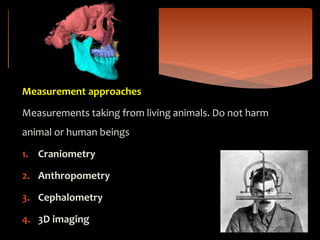
Measurement approaches
Measurements taking from living animals. Do not harm
animal or human beings
1. Craniometry
2. Anthropometry
3. Cephalometry
4. 3D imaging
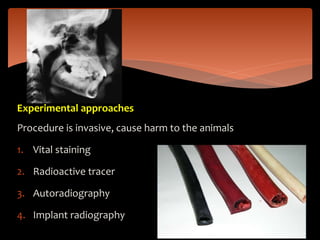
Experimental approaches
Procedure is invasive, cause harm to the animals
1. Vital staining
2. Radioactive tracer
3. Autoradiography
4. Implant radiography
Sarnat in 1986 classified the growth measurement
methods as
1. Direct measurements
2. Indirect measurements
Direct measurements
 Anthropometry
 Vital staining
 Histological methods
 Histochemical methods
 Implants
Indirect measurements
 Impressions and casts
 Photographs
 Radioautographs
 Radiographs
 Serial cephalometric radiography and implantation
 Hippocratus in BC 450 studied about human skull forms.
 Leminus in 1567 first mentioned the red staining
properties of root of madder in bone.
 Duhamel introduced implants in the study of growth of
bones in 1742
History
 Robinson and Sarnat in 1955 used serial cephalometric
radiography along with implant in pig for growth study of
mandible.
 Mcnamara and Graber (1975) and Bjork in 1963 used implants
in humans for growth study.
 CVM indicators by Lamparski in 1972
 Leonard s Fishman, in 1982 developed skeletal maturity
indicator using handwrist radiography.
RECENT ADVANCES IN GROWTH
STUDIES
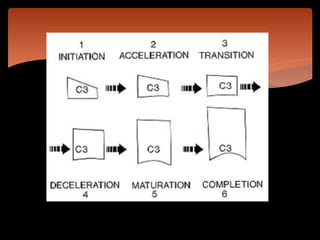
 Proposed by Lamparski (1972)
 1st modification by Hassel and Farman in 1995
 The method of Hassel and Farman uses the second
through the fourth vertebrae to avoid the defect in the
original method.
Modified cervical vertebrae
maturation
Skeletal maturation evaluation using cervical vertebrae.AJODO, Jan 1995
SEMIN IN ORTHOD-
2005
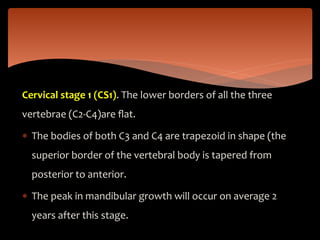
Cervical stage 1 (CS1). The lower borders of all the three
vertebrae (C2-C4)are flat.
 The bodies of both C3 and C4 are trapezoid in shape (the
superior border of the vertebral body is tapered from
posterior to anterior.
 The peak in mandibular growth will occur on average 2
years after this stage.
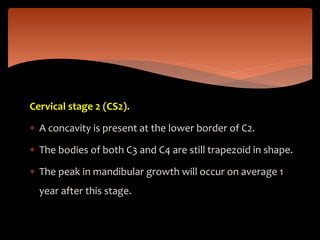
Cervical stage 2 (CS2).
 A concavity is present at the lower border of C2.
 The bodies of both C3 and C4 are still trapezoid in shape.
 The peak in mandibular growth will occur on average 1
year after this stage.
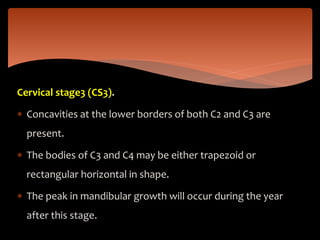
Cervical stage3 (CS3).
 Concavities at the lower borders of both C2 and C3 are
present.
 The bodies of C3 and C4 may be either trapezoid or
rectangular horizontal in shape.
 The peak in mandibular growth will occur during the year
after this stage.
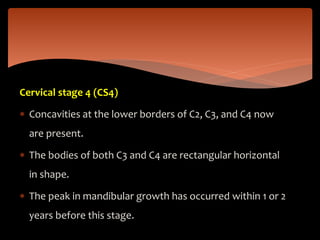
Cervical stage 4 (CS4)
 Concavities at the lower borders of C2, C3, and C4 now
are present.
 The bodies of both C3 and C4 are rectangular horizontal
in shape.
 The peak in mandibular growth has occurred within 1 or 2
years before this stage.
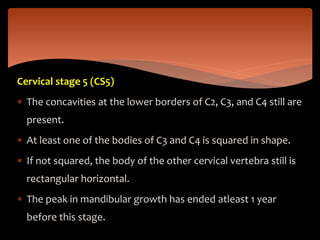
Cervical stage 5 (CS5)
 The concavities at the lower borders of C2, C3, and C4 still are
present.
 At least one of the bodies of C3 and C4 is squared in shape.
 If not squared, the body of the other cervical vertebra still is
rectangular horizontal.
 The peak in mandibular growth has ended atleast 1 year
before this stage.
Cervicalstage6(CS6)
 The concavities at the lower borders of C2, C3, and C4 still
are evident.
 At least one of the bodies of C3 and C4 is rectangular
vertical in shape.
 If not rectangular vertical, the body of the other cervical
vertebra is squared
 The peak in mandibular growth has ended at least 2 years
before this stage.
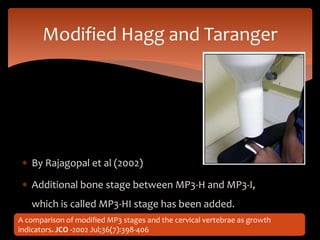
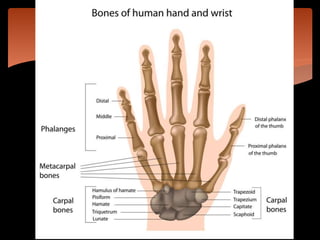
 By Rajagopal et al (2002)
 Additional bone stage between MP3-H and MP3-I,
which is called MP3-HI stage has been added.
Modified Hagg and Taranger
A comparison of modified MP3 stages and the cervical vertebrae as growth
indicators. JCO -2002 Jul;36(7):398-406
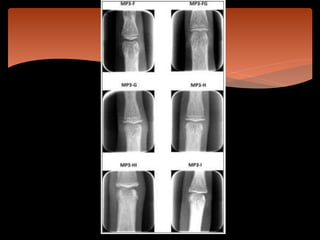
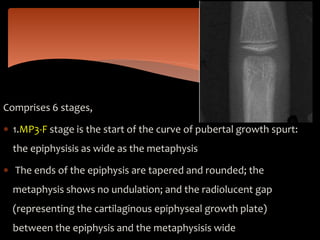
Comprises 6 stages,
 1.MP3-F stage is the start of the curve of pubertal growth spurt:
the epiphysisis as wide as the metaphysis
 The ends of the epiphysis are tapered and rounded; the
metaphysis shows no undulation; and the radiolucent gap
(representing the cartilaginous epiphyseal growth plate)
between the epiphysis and the metaphysisis wide
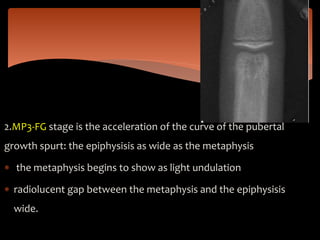
2.MP3-FG stage is the acceleration of the curve of the pubertal
growth spurt: the epiphysisis as wide as the metaphysis
 the metaphysis begins to show as light undulation
 radiolucent gap between the metaphysis and the epiphysisis
wide.
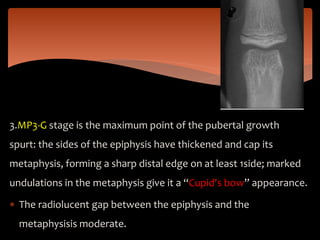
3.MP3-G stage is the maximum point of the pubertal growth
spurt: the sides of the epiphysis have thickened and cap its
metaphysis, forming a sharp distal edge on at least 1side; marked
undulations in the metaphysis give it a “Cupid's bow” appearance.
 The radiolucent gap between the epiphysis and the
metaphysisis moderate.
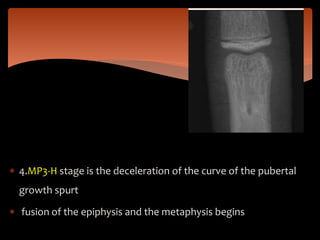
 4.MP3-H stage is the deceleration of the curve of the pubertal
growth spurt
 fusion of the epiphysis and the metaphysis begins
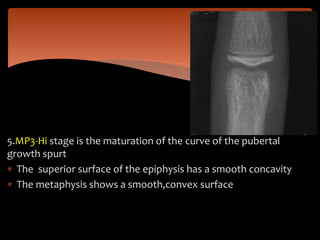
5.MP3-Hi stage is the maturation of the curve of the pubertal
growth spurt
 The superior surface of the epiphysis has a smooth concavity
 The metaphysis shows a smooth,convex surface
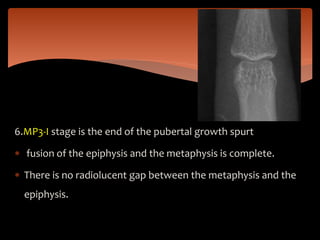
6.MP3-I stage is the end of the pubertal growth spurt
 fusion of the epiphysis and the metaphysis is complete.
 There is no radiolucent gap between the metaphysis and the
epiphysis.
 Hagg and Taranger reported that all canines and
premolars are usually erupted by the end of the pubertal
growth spurt .
 This was confirmed with the hand wrist.
Eruption of maxillary canine and
skeletal maturity
AJODO 2008
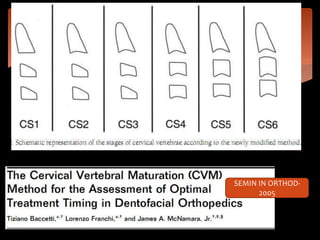
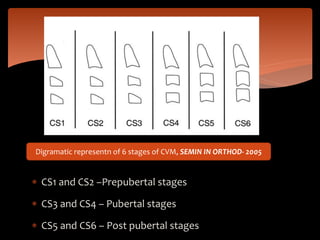
 CS1 and CS2 –Prepubertal stages
 CS3 and CS4 – Pubertal stages
 CS5 and CS6 – Post pubertal stages
Digramatic representn of 6 stages of CVM, SEMIN IN ORTHOD- 2005
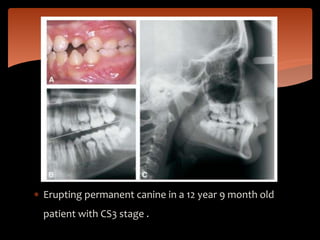
 Erupting permanent canine in a 12 year 9 month old
patient with CS3 stage .
 In 56.6% of patients, the canine erupts in the dental
arch at least 1 year before the pubertal growth spurt.
 Puberty is a neuro endocrinal event with the pituitary and
hypothalamus playing a major role in its initation.
 Both the pituitary and hypothalamus are together called
gonadostat.
 In puberty, gonadotropin releasing hormone is secreted
from the hypothalamus, which stimulates the pituitary to
secrete gonadotropins (FSH, LH)
SERUM DEHYDRO EPIANDROSTERONE
SULPHATE AND SKELETAL MATURATION
EJO- 2012, VOL 34
 These gonadotropins stimulate the gonads to secrete the sex
steroids testosterone and estrogen, which inturn affects
skeletal maturity in puberty.
 For the gondaotropins to iniate its action, it requires
stimulation from the adrenal gland.
 Adrenal gland secretes steroids like dehydroepiandrosterone
(DHEA) and its sulphated conjugate dehydroepiandrosterone
sulphate (DHEAS). Auches and Rainey 2004
 They are present in circulation approximately 3 years prior
to puberty.
 This period is termed as adrenarche
 These steroids can stimulate growth and proliferation of
epiphyseal cartilage and potentiate action of growth
hormone (GH)
 DHEAS has been foud to enhance bone deposition to
increse bone mineral density, and to maintain the
cancellous and cortical bone mass by way of protective
action in osteoblasts.
 Serum levels of DHEAS are high in neonates, after which
there is a decrease , then a rapid increase in the serum
levels from 7 years of age in females and 8 years of age in
males, with a gradual increase until it attains adult value.
Serum PTHrP and skeletal maturation
 Parathyroid hormone related protein (PTHrP)
regulate multiple steps in the development of the
growth plate and seconadary cartilage at the head of
condyle during skeletal morphogenesis.
2013,vol- 143
 Compared with Bacceti`s cervical vertebrae stages.
 There were low levels of serum PTHrP levels at the pre
pubertal stage (CS1) of circumpubertal development with
an increase in the mean serum PTHrP levels from CS1 to
peak levels in late puberty(CS5).
 There was a decline between CS5 andCS6, with the values at
the post pubertal stage (CS6) less than those values at the
pre pubertal stage (CS1)
 Normal assay range of PTHrP was 0.5-15ng/mL.
 ELISA test was used in the study.
 Also found that serum PTHrP levels were at their peak 2
years later than the peak height velocity.
 Showed a reduction in the mean serum PTHrP levels from
14.5ng per milli liter of blood in the late pubertal stage to
8.3ng per milli liter in the post pubertal stage.
 Insulin-like growth factorI (IGF-I) is a polypeptide
hormone synthesized mainly by the liver.
 It is a member of a group of hormones termed insulin-
like growth factors.
Insulin like growth factor 1 and
skeletal maturity
2012, Vol 142
 It is considered a mediator of growth-hormone
function.
 It is involved in the growth of almost every organ and
plays a major role in postnatal growth and precisely in
the process of longitudinal bone growth.
 Salmon and Daughaday were the first to discover IGF-I as a
mediator of growth-hormone function, which was termed
the sulphation factor.
 Several studies reported that its serum levels in children and
adolescents followed a pattern that was closely related to
the pubertal growth curve.
 Low in the prepubertal stages followed by a sharp
increase at puberty and, after pubertal growth had
ceased, returning to lower base line values.
 ELISA is used for detection of IGF 1
 Masoud et al used radioimmuno assay for detection of
IGF1 in their studies.
AJODO- 2009
 Different assays were comparably accurate, especially in
healthy subjects.
 The radioimmunoassay technique requires special
laboratories that should have been equipped for
radiation control.
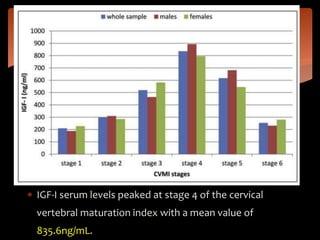
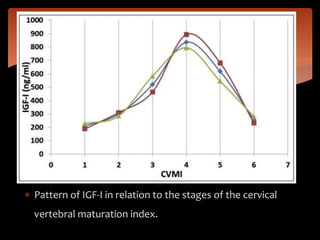
 IGF-I serum levels peaked at stage 4 of the cervical
vertebral maturation index with a mean value of
835.6ng/mL.
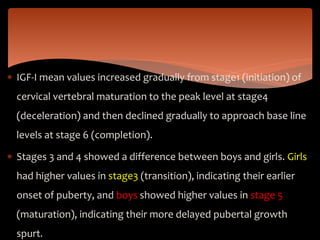
 IGF-I mean values increased gradually from stage1 (initiation) of
cervical vertebral maturation to the peak level at stage4
(deceleration) and then declined gradually to approach base line
levels at stage 6 (completion).
 Stages 3 and 4 showed a difference between boys and girls. Girls
had higher values in stage3 (transition), indicating their earlier
onset of puberty, and boys showed higher values in stage 5
(maturation), indicating their more delayed pubertal growth
spurt.
 Pattern of IGF-I in relation to the stages of the cervical
vertebral maturation index.
 Gingival crevicular fluid (GCF) is a potential source of
biomarkers, with molecular constituents that derive
mainly from serum, and also from the interstitial fluids of
periodontal tissues.
Gingival crevicular fluid protein content
and alkaline phosphatase activity in
relation to pubertal growth phase
ANGLE ORTHOD-2012
 ALP is an enzyme that is necessary for bone
mineralization, with its activity shown to be
correlated with local tissue remodeling during
orthodontic tooth movement and periodontal
inflammation.
 This study was proposed as a non invasive diagnostic aid for
the determination of optimal treatment timing in functional
jaw orthopedics.
 Both the volume and total protein content of the GCF have
been used extensively to calculate the concentrations of the
different GCF constituents, for their normalization.
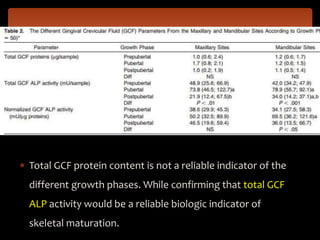
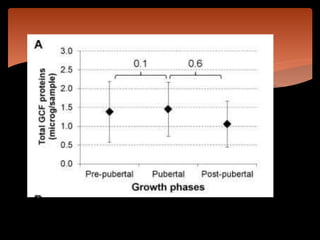
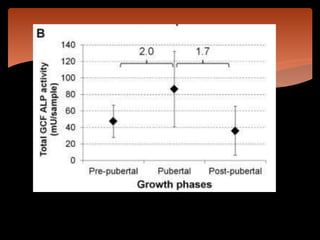
 Total GCF protein content is not a reliable indicator of the
different growth phases. While confirming that total GCF
ALP activity would be a reliable biologic indicator of
skeletal maturation.
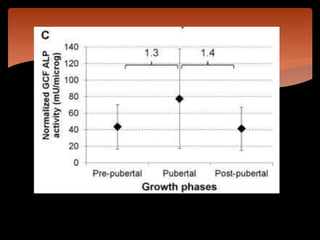
 GCF ALP activity is a promising diagnostic tool for
identification of the growth phases in individual subjects
when expressed as the total, rather than the normalized
 Moss and Rankow reported that the function of the
stomatognathic muscle affects the growing
cranioface and plays a role in its morphogenesis
Masseter muscle conduction velocity
and direction of mandibular growth
AJODO- 2005
 Human skeletal muscle fibers are classified into 2 types—-fast-
twitch (F type or type 1) and slow twitch (S type or type 2) —
based on contractility and tissue images, and muscle function is
characterized by the composition ratio of these types of muscle
fibers.
 There is a strong correlation between the muscle conduction
velocity (MCV) measured by using an electromyogram and the
muscle fiber composition,
 MCV increases as the proportion of type II fibers
increases.
 It has been reported that the diameter of muscle fiber
is proportional to MCV
 Ogata et al reported that a long face, in which the lower facial
height is long, has a lower conduction velocity of the masseter
muscle in maximum voluntary contraction and more type 1 fibers
than a short face.
 Therefore, by understanding the muscle fiber composition of the
masseter muscle in childhood, it might be possible to predict the
direction of growth of the mandible or vertical craniofacial
morphology with non invasive methods.
PROCEDURE
 The subjects sat on a dental chair in a shielded room, and head
positions were adjusted so that the Frankfort horizontal plane
became parallel to the floor.
 They were asked not to change their head positions on biting.
 Once they were relaxed, they were asked to perform 100%
maximum voluntary contraction (MVC) to measure the MCV of
the masseter muscle.
 Bite-taking was done before performing MVC by using a silicon
impression in the rest position of the mandible.
 The MCV of the masseter muscle was measured when the subject
clenched the silicon, to protect the teeth and periodontium and to
increase the reproducibility of occlusion and muscle position.
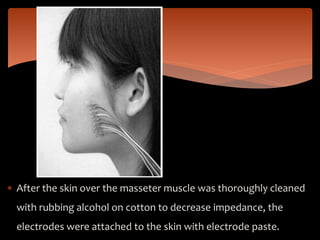
 After the skin over the masseter muscle was thoroughly cleaned
with rubbing alcohol on cotton to decrease impedance, the
electrodes were attached to the skin with electrode paste.
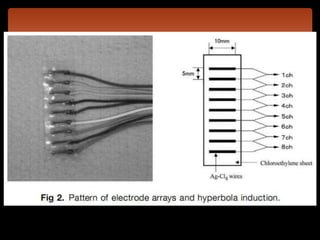
 The position and direction of the left masseter muscle
were confirmed through manipulation when the subject
clenched her teeth, and electrodes were attached to the
center of the left masseter muscle and at a point where
the bottom of the electrode reached 5 mm above the
mandibular plane.
 The long axes of the electrode arrays were arranged to be
parallel to the running direction of the masseter muscle.
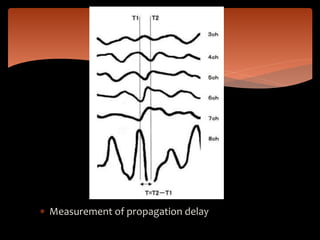
 The subjects were asked to continuously perform voluntary
contraction for approximately 3 seconds, and wave forms of the
action potential were recorded.
 Measurement of propagation delay
 MCV of the masseter muscle was low in a long face, when the
lower facial height is long, compared with that in a short face.
 A strong correlation between MCV and the composition ratio of
muscle fibre.
 The proportion of type I fibers might be higher in a long face
than in a short face.
 For growth modification to be successful, it is
absolutely essential that it start at the right time. So
we need more accurate growth assessment methods
in our profession.
CONCLUSION
 Text book of craniofacial growth by Sridhar Premkumar.
 Tiziano Baccetti, Lorenzo Franchi, Simona De Lisa, Veronica
Giuntin.Eruption of the maxillary canines in relation to skeletal
maturity. Am J Orthod Dentofacial Orthop 2008;133:748-51
 SophieGray, Hamza Bennani. Morphometric analysis of cervical
vertebrae in relation to mandibular growth. Am J Orthod
Dentofacial Orthop 2016;149:92-8
REFERENCES
 Ramy Abdul Rahman Ishaq, Sanaa Abou Zeid Soliman. Insulin-like
growth factor I: A biologic maturation indicator. Am Jorthod
Dentofacial Orthop 2012; 142: 654 -61
 Masakatsu Konno, Koshi Sato. Relationship between the direction of
mandibular growth and masseter muscle conduction velocity. Am J
Orthod Dentofacial Orthop 2005; 128:35-44
 Mohammed Zahid Hussain, Ashok Kumar Talapaneni. Serum PTHrP
level as a biomarker in assessing skeletal maturation during
circumpubertal development.
 Sharmila Surendran and Eapen Thomas. Tooth mineralization
stages as a diagnostic tool for assessment of skeletal maturity.
AmJ Orthod Dentofacial Orthop 2014;145:7-14
 Rajagopal and Kansal. A comparison of modified MP3 stages
and the cervical vertebrae as growth indicators. JCO -2002
Jul;36(7):398-406
 Sridhar premkumar, Bhadrinadh. Assesment of DHEAS in
subjects during pre pubertal, pubertal and adult stages of
skeletal maturation. EJO 2002, vol 34
 Hassal and Farman , Skeletal maturation evaluation using
cervical vertebrae. AJODO, Jan 1995
 BaccettiT, FranchiL, McNamaraJA. The cervical vertebral
maturation method for the assessment of optimal treatment
timing in dentofacialorthopedics. SeminOrthod 2005; 11: 119-
29.

Recent advances in skeletal maturity studies

  • 1.
    RECENT ADVANCES IN SKELETALMATURITY STUDIES JERUN JOSE
  • 2.
     INTRODUCTION  HISTORY METHODS TO STUDY GROWTH  RECENT ADVANCES IN GROWTH STUDIES Modified CVMI Modified Hagg and Taranger Maxillary canine eruption and skeletal maturity CONTENTS
  • 3.
    Serum Dehydroepiandrosterone andskeletal maturity Serum PTHrP and skeletal maturity IGF-1 and skeletal maturity GCF and Alkaline phosphatase activity in skeletal maturity Masseter muscle conduction velocity and direction of mandibular growth  CONCLUSION  REFERENCES
  • 4.
     Growth ofthe craniofacial skeleton is a complex mechanism. In growth studies we are assessing pattern of growth, sites of growth, amount and rate of growth, direction and factors influencing growth. INTRODUCTION
  • 5.
    Proffit 1. Measurement approaches 2.Experimental approaches METHODS TO STUDY GROWTH Text book of craniofacial growth , Sridhar Premkumar
  • 6.
    Measurement approaches Measurements takingfrom living animals. Do not harm animal or human beings 1. Craniometry 2. Anthropometry 3. Cephalometry 4. 3D imaging
  • 7.
    Experimental approaches Procedure isinvasive, cause harm to the animals 1. Vital staining 2. Radioactive tracer 3. Autoradiography 4. Implant radiography
  • 8.
    Sarnat in 1986classified the growth measurement methods as 1. Direct measurements 2. Indirect measurements
  • 9.
    Direct measurements  Anthropometry Vital staining  Histological methods  Histochemical methods  Implants
  • 10.
    Indirect measurements  Impressionsand casts  Photographs  Radioautographs  Radiographs  Serial cephalometric radiography and implantation
  • 11.
     Hippocratus inBC 450 studied about human skull forms.  Leminus in 1567 first mentioned the red staining properties of root of madder in bone.  Duhamel introduced implants in the study of growth of bones in 1742 History
  • 12.
     Robinson andSarnat in 1955 used serial cephalometric radiography along with implant in pig for growth study of mandible.  Mcnamara and Graber (1975) and Bjork in 1963 used implants in humans for growth study.  CVM indicators by Lamparski in 1972  Leonard s Fishman, in 1982 developed skeletal maturity indicator using handwrist radiography.
  • 13.
    RECENT ADVANCES INGROWTH STUDIES
  • 14.
     Proposed byLamparski (1972)  1st modification by Hassel and Farman in 1995  The method of Hassel and Farman uses the second through the fourth vertebrae to avoid the defect in the original method. Modified cervical vertebrae maturation Skeletal maturation evaluation using cervical vertebrae.AJODO, Jan 1995
  • 16.
  • 17.
    Cervical stage 1(CS1). The lower borders of all the three vertebrae (C2-C4)are flat.  The bodies of both C3 and C4 are trapezoid in shape (the superior border of the vertebral body is tapered from posterior to anterior.  The peak in mandibular growth will occur on average 2 years after this stage.
  • 18.
    Cervical stage 2(CS2).  A concavity is present at the lower border of C2.  The bodies of both C3 and C4 are still trapezoid in shape.  The peak in mandibular growth will occur on average 1 year after this stage.
  • 19.
    Cervical stage3 (CS3). Concavities at the lower borders of both C2 and C3 are present.  The bodies of C3 and C4 may be either trapezoid or rectangular horizontal in shape.  The peak in mandibular growth will occur during the year after this stage.
  • 20.
    Cervical stage 4(CS4)  Concavities at the lower borders of C2, C3, and C4 now are present.  The bodies of both C3 and C4 are rectangular horizontal in shape.  The peak in mandibular growth has occurred within 1 or 2 years before this stage.
  • 21.
    Cervical stage 5(CS5)  The concavities at the lower borders of C2, C3, and C4 still are present.  At least one of the bodies of C3 and C4 is squared in shape.  If not squared, the body of the other cervical vertebra still is rectangular horizontal.  The peak in mandibular growth has ended atleast 1 year before this stage.
  • 22.
    Cervicalstage6(CS6)  The concavitiesat the lower borders of C2, C3, and C4 still are evident.  At least one of the bodies of C3 and C4 is rectangular vertical in shape.  If not rectangular vertical, the body of the other cervical vertebra is squared  The peak in mandibular growth has ended at least 2 years before this stage.
  • 23.
     By Rajagopalet al (2002)  Additional bone stage between MP3-H and MP3-I, which is called MP3-HI stage has been added. Modified Hagg and Taranger A comparison of modified MP3 stages and the cervical vertebrae as growth indicators. JCO -2002 Jul;36(7):398-406
  • 26.
    Comprises 6 stages, 1.MP3-F stage is the start of the curve of pubertal growth spurt: the epiphysisis as wide as the metaphysis  The ends of the epiphysis are tapered and rounded; the metaphysis shows no undulation; and the radiolucent gap (representing the cartilaginous epiphyseal growth plate) between the epiphysis and the metaphysisis wide
  • 27.
    2.MP3-FG stage isthe acceleration of the curve of the pubertal growth spurt: the epiphysisis as wide as the metaphysis  the metaphysis begins to show as light undulation  radiolucent gap between the metaphysis and the epiphysisis wide.
  • 28.
    3.MP3-G stage isthe maximum point of the pubertal growth spurt: the sides of the epiphysis have thickened and cap its metaphysis, forming a sharp distal edge on at least 1side; marked undulations in the metaphysis give it a “Cupid's bow” appearance.  The radiolucent gap between the epiphysis and the metaphysisis moderate.
  • 29.
     4.MP3-H stageis the deceleration of the curve of the pubertal growth spurt  fusion of the epiphysis and the metaphysis begins
  • 30.
    5.MP3-Hi stage isthe maturation of the curve of the pubertal growth spurt  The superior surface of the epiphysis has a smooth concavity  The metaphysis shows a smooth,convex surface
  • 31.
    6.MP3-I stage isthe end of the pubertal growth spurt  fusion of the epiphysis and the metaphysis is complete.  There is no radiolucent gap between the metaphysis and the epiphysis.
  • 32.
     Hagg andTaranger reported that all canines and premolars are usually erupted by the end of the pubertal growth spurt .  This was confirmed with the hand wrist. Eruption of maxillary canine and skeletal maturity AJODO 2008
  • 33.
     CS1 andCS2 –Prepubertal stages  CS3 and CS4 – Pubertal stages  CS5 and CS6 – Post pubertal stages Digramatic representn of 6 stages of CVM, SEMIN IN ORTHOD- 2005
  • 34.
     Erupting permanentcanine in a 12 year 9 month old patient with CS3 stage .
  • 35.
     In 56.6%of patients, the canine erupts in the dental arch at least 1 year before the pubertal growth spurt.
  • 36.
     Puberty isa neuro endocrinal event with the pituitary and hypothalamus playing a major role in its initation.  Both the pituitary and hypothalamus are together called gonadostat.  In puberty, gonadotropin releasing hormone is secreted from the hypothalamus, which stimulates the pituitary to secrete gonadotropins (FSH, LH) SERUM DEHYDRO EPIANDROSTERONE SULPHATE AND SKELETAL MATURATION EJO- 2012, VOL 34
  • 37.
     These gonadotropinsstimulate the gonads to secrete the sex steroids testosterone and estrogen, which inturn affects skeletal maturity in puberty.  For the gondaotropins to iniate its action, it requires stimulation from the adrenal gland.  Adrenal gland secretes steroids like dehydroepiandrosterone (DHEA) and its sulphated conjugate dehydroepiandrosterone sulphate (DHEAS). Auches and Rainey 2004
  • 38.
     They arepresent in circulation approximately 3 years prior to puberty.  This period is termed as adrenarche  These steroids can stimulate growth and proliferation of epiphyseal cartilage and potentiate action of growth hormone (GH)
  • 39.
     DHEAS hasbeen foud to enhance bone deposition to increse bone mineral density, and to maintain the cancellous and cortical bone mass by way of protective action in osteoblasts.  Serum levels of DHEAS are high in neonates, after which there is a decrease , then a rapid increase in the serum levels from 7 years of age in females and 8 years of age in males, with a gradual increase until it attains adult value.
  • 40.
    Serum PTHrP andskeletal maturation  Parathyroid hormone related protein (PTHrP) regulate multiple steps in the development of the growth plate and seconadary cartilage at the head of condyle during skeletal morphogenesis. 2013,vol- 143
  • 41.
     Compared withBacceti`s cervical vertebrae stages.  There were low levels of serum PTHrP levels at the pre pubertal stage (CS1) of circumpubertal development with an increase in the mean serum PTHrP levels from CS1 to peak levels in late puberty(CS5).  There was a decline between CS5 andCS6, with the values at the post pubertal stage (CS6) less than those values at the pre pubertal stage (CS1)
  • 42.
     Normal assayrange of PTHrP was 0.5-15ng/mL.  ELISA test was used in the study.  Also found that serum PTHrP levels were at their peak 2 years later than the peak height velocity.  Showed a reduction in the mean serum PTHrP levels from 14.5ng per milli liter of blood in the late pubertal stage to 8.3ng per milli liter in the post pubertal stage.
  • 43.
     Insulin-like growthfactorI (IGF-I) is a polypeptide hormone synthesized mainly by the liver.  It is a member of a group of hormones termed insulin- like growth factors. Insulin like growth factor 1 and skeletal maturity 2012, Vol 142
  • 44.
     It isconsidered a mediator of growth-hormone function.  It is involved in the growth of almost every organ and plays a major role in postnatal growth and precisely in the process of longitudinal bone growth.
  • 45.
     Salmon andDaughaday were the first to discover IGF-I as a mediator of growth-hormone function, which was termed the sulphation factor.  Several studies reported that its serum levels in children and adolescents followed a pattern that was closely related to the pubertal growth curve.
  • 46.
     Low inthe prepubertal stages followed by a sharp increase at puberty and, after pubertal growth had ceased, returning to lower base line values.  ELISA is used for detection of IGF 1  Masoud et al used radioimmuno assay for detection of IGF1 in their studies. AJODO- 2009
  • 47.
     Different assayswere comparably accurate, especially in healthy subjects.  The radioimmunoassay technique requires special laboratories that should have been equipped for radiation control.
  • 48.
     IGF-I serumlevels peaked at stage 4 of the cervical vertebral maturation index with a mean value of 835.6ng/mL.
  • 49.
     IGF-I meanvalues increased gradually from stage1 (initiation) of cervical vertebral maturation to the peak level at stage4 (deceleration) and then declined gradually to approach base line levels at stage 6 (completion).  Stages 3 and 4 showed a difference between boys and girls. Girls had higher values in stage3 (transition), indicating their earlier onset of puberty, and boys showed higher values in stage 5 (maturation), indicating their more delayed pubertal growth spurt.
  • 50.
     Pattern ofIGF-I in relation to the stages of the cervical vertebral maturation index.
  • 51.
     Gingival crevicularfluid (GCF) is a potential source of biomarkers, with molecular constituents that derive mainly from serum, and also from the interstitial fluids of periodontal tissues. Gingival crevicular fluid protein content and alkaline phosphatase activity in relation to pubertal growth phase ANGLE ORTHOD-2012
  • 52.
     ALP isan enzyme that is necessary for bone mineralization, with its activity shown to be correlated with local tissue remodeling during orthodontic tooth movement and periodontal inflammation.
  • 53.
     This studywas proposed as a non invasive diagnostic aid for the determination of optimal treatment timing in functional jaw orthopedics.  Both the volume and total protein content of the GCF have been used extensively to calculate the concentrations of the different GCF constituents, for their normalization.
  • 54.
     Total GCFprotein content is not a reliable indicator of the different growth phases. While confirming that total GCF ALP activity would be a reliable biologic indicator of skeletal maturation.
  • 58.
     GCF ALPactivity is a promising diagnostic tool for identification of the growth phases in individual subjects when expressed as the total, rather than the normalized
  • 59.
     Moss andRankow reported that the function of the stomatognathic muscle affects the growing cranioface and plays a role in its morphogenesis Masseter muscle conduction velocity and direction of mandibular growth AJODO- 2005
  • 60.
     Human skeletalmuscle fibers are classified into 2 types—-fast- twitch (F type or type 1) and slow twitch (S type or type 2) — based on contractility and tissue images, and muscle function is characterized by the composition ratio of these types of muscle fibers.  There is a strong correlation between the muscle conduction velocity (MCV) measured by using an electromyogram and the muscle fiber composition,
  • 61.
     MCV increasesas the proportion of type II fibers increases.  It has been reported that the diameter of muscle fiber is proportional to MCV
  • 62.
     Ogata etal reported that a long face, in which the lower facial height is long, has a lower conduction velocity of the masseter muscle in maximum voluntary contraction and more type 1 fibers than a short face.  Therefore, by understanding the muscle fiber composition of the masseter muscle in childhood, it might be possible to predict the direction of growth of the mandible or vertical craniofacial morphology with non invasive methods.
  • 63.
    PROCEDURE  The subjectssat on a dental chair in a shielded room, and head positions were adjusted so that the Frankfort horizontal plane became parallel to the floor.  They were asked not to change their head positions on biting.  Once they were relaxed, they were asked to perform 100% maximum voluntary contraction (MVC) to measure the MCV of the masseter muscle.
  • 64.
     Bite-taking wasdone before performing MVC by using a silicon impression in the rest position of the mandible.  The MCV of the masseter muscle was measured when the subject clenched the silicon, to protect the teeth and periodontium and to increase the reproducibility of occlusion and muscle position.
  • 65.
     After theskin over the masseter muscle was thoroughly cleaned with rubbing alcohol on cotton to decrease impedance, the electrodes were attached to the skin with electrode paste.
  • 66.
     The positionand direction of the left masseter muscle were confirmed through manipulation when the subject clenched her teeth, and electrodes were attached to the center of the left masseter muscle and at a point where the bottom of the electrode reached 5 mm above the mandibular plane.  The long axes of the electrode arrays were arranged to be parallel to the running direction of the masseter muscle.
  • 68.
     The subjectswere asked to continuously perform voluntary contraction for approximately 3 seconds, and wave forms of the action potential were recorded.
  • 69.
     Measurement ofpropagation delay
  • 70.
     MCV ofthe masseter muscle was low in a long face, when the lower facial height is long, compared with that in a short face.  A strong correlation between MCV and the composition ratio of muscle fibre.  The proportion of type I fibers might be higher in a long face than in a short face.
  • 71.
     For growthmodification to be successful, it is absolutely essential that it start at the right time. So we need more accurate growth assessment methods in our profession. CONCLUSION
  • 72.
     Text bookof craniofacial growth by Sridhar Premkumar.  Tiziano Baccetti, Lorenzo Franchi, Simona De Lisa, Veronica Giuntin.Eruption of the maxillary canines in relation to skeletal maturity. Am J Orthod Dentofacial Orthop 2008;133:748-51  SophieGray, Hamza Bennani. Morphometric analysis of cervical vertebrae in relation to mandibular growth. Am J Orthod Dentofacial Orthop 2016;149:92-8 REFERENCES
  • 73.
     Ramy AbdulRahman Ishaq, Sanaa Abou Zeid Soliman. Insulin-like growth factor I: A biologic maturation indicator. Am Jorthod Dentofacial Orthop 2012; 142: 654 -61  Masakatsu Konno, Koshi Sato. Relationship between the direction of mandibular growth and masseter muscle conduction velocity. Am J Orthod Dentofacial Orthop 2005; 128:35-44  Mohammed Zahid Hussain, Ashok Kumar Talapaneni. Serum PTHrP level as a biomarker in assessing skeletal maturation during circumpubertal development.
  • 74.
     Sharmila Surendranand Eapen Thomas. Tooth mineralization stages as a diagnostic tool for assessment of skeletal maturity. AmJ Orthod Dentofacial Orthop 2014;145:7-14  Rajagopal and Kansal. A comparison of modified MP3 stages and the cervical vertebrae as growth indicators. JCO -2002 Jul;36(7):398-406  Sridhar premkumar, Bhadrinadh. Assesment of DHEAS in subjects during pre pubertal, pubertal and adult stages of skeletal maturation. EJO 2002, vol 34
  • 75.
     Hassal andFarman , Skeletal maturation evaluation using cervical vertebrae. AJODO, Jan 1995  BaccettiT, FranchiL, McNamaraJA. The cervical vertebral maturation method for the assessment of optimal treatment timing in dentofacialorthopedics. SeminOrthod 2005; 11: 119- 29.