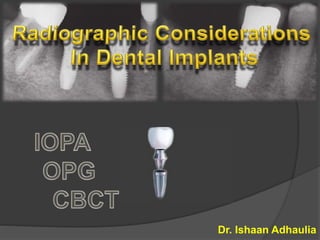
Dr. Ishaan Adhaulia
Contents
 Introduction
 Phases of imaging
 Imaging modalities
 Periapical Radiography
 Digital Radiography
 Panoramic Radiography
 Cone Beam Computed Tomography
 Radiographic indications/contraindications for Implant placement
 References
Introduction
 The term “implant” itself remains ambiguous.
 According to the Academy of Osseointegration a
dental implant is defined as “an artificial material or
tissue that shows biocompatibility upon its surgical
implantation.” [this definition has been authorized
by American College of Prosthodontists & American
Academy Of Periodontology]
 According to GPT 8 – Any object or material such
as an alloplastic or other tissue, which is partially or
completely inserted or grafted into the body for
therapeutic, diagnostic, prosthetic or experimental
purposes.
Introduction
 Multiple factors influence the selection of radiographic
technique for a particular case including cost, availability,
radiation exposure, and case type.
 The widespread use of dental implants in partially and
completely edentulous patients has brought about a need to
preoperatively depict and quantify the accurate bone height,
colour and location of vital anatomic structures by radiographic
examination
 Diagnostic imaging must always be interpreted in conjunction
with a good clinical examination.
 The decision is a balance between these factors and the
desire to minimize risk of complications to the patient.
Key parameters in implant planning with
radiographic aids
 Bone Height (craniocaudal dimension)
 Faciolingual/faciopalatal width
 Mesiodistal dimension
 Bone morphology
 Presence & prominence of anatomic features:
Sublingual & Submandibular fossae // Incisive &
canine fossae
 Neuarovascular canals & foramina, including:
Mandibular canal & the mental foramen // Incisive
canal & foramen // Mandibular lingual canals &
foramina // Greater Palatine canal & foramen
 Cortical thickness & density
 Extent and morphology of the alveolar recess of the
maxillary sinus base
Phases of imaging for dental implant surgery
Phase pre surgical implant imaging
Phase surgical and intra-operative implant imaging
Phase post-prosthetic imaging
Pre-Surgical Implant
Imaging
 To assess the overall status of the remaining dentition
 To identify & characterize the location and nature of the
edentulous regions, particularly to determine the quality,
quantity and angulations of bone
 The pre-surgical radiographic evaluation should provide
information about the height and width of the bone, the
degree of corticalization, the density of mineralization
and the amount of cancellous bone in the areas
considered
 To determine the relationship of critical structures to the
prospective implant site and to detect regional anatomic
abnormalities and pathologies.
Surgical and Intra-operative Implant
Imaging.
 Evaluates the sites during and immediately
after the surgery
 Assist in the optimal position and
orientation of dental implants
 To evaluate the healing and integration
phase of implant surgery
 Ensures the abutment position and
prosthesis fabrication are correct
Post-prosthetic implant imaging
 It commences just after the prosthesis
placement and continues as long as the
implants remain in the jaws.
OBJECTIVES
 Evaluate the long term maintenance of
implant rigid fixation and function
 Evaluate crestal bone levels around each
implant
 Evaluate the implant overall
Why do we need pre-prosthetic imaging
?
 Identify normal v/s abnormal
 Identify anatomic variants
 Determine bone quality
 Determine bone quantity
 Identify ideal implant positioning
 Use for surgical templates
Various Imaging Modalities
 Analogue Intra-Oral Radiography
- Intra Oral Peri-Apical Radiography
 Digital Intra-Oral Radiography
- RVG Sensor
 Panoramic Imaging Modalities
 Three Dimensional Imaging Modalities
The decision to image the patient is based on the
patient’s clinical needs and its availability while keeping
in mind that the dentists should follow the ALARA
principle which states that the diagnostic imaging
technique selected should include the lowest possible
radiation dose to the patient.
Intra-Oral Periapical
Radiography Indications
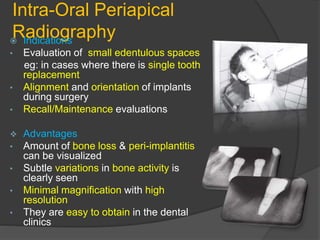
• Evaluation of small edentulous spaces
eg: in cases where there is single tooth
replacement
• Alignment and orientation of implants
during surgery
• Recall/Maintenance evaluations
 Advantages
• Amount of bone loss & peri-implantitis
can be visualized
• Subtle variations in bone activity is
clearly seen
• Minimal magnification with high
resolution
• They are easy to obtain in the dental
clinics
Disadvantages
 Two dimensional radiographic modality : vital information on
the width of the available bone is not obtained.
 They are susceptible to unpredictable magnification of
anatomic structures, which does not allow reliable imaging
 Distortion is particularly accentuated in edentulous areas,
where missing teeth and Resorption of the Alveolus
necessitates film placement at significant angulations
 Poor identification of vital structures : studies have shown, in
the evaluation of the true location of the mental foramen,
less than 50% of IOPA’s depict the correct location of the
mental foramen. Other studies have shown because of
insufficient cortical bone around the Mandibular canal (MC),
only 28% of IOPA’s will identify the MC.
How to avoid these inherent
disadvantages.
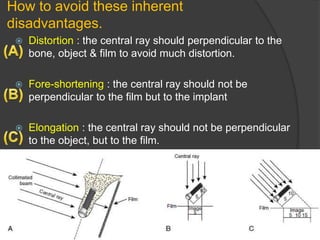
 Distortion : the central ray should perpendicular to the
bone, object & film to avoid much distortion.
 Fore-shortening : the central ray should not be
perpendicular to the film but to the implant
 Elongation : the central ray should not be perpendicular
to the object, but to the film.
Digital radiography
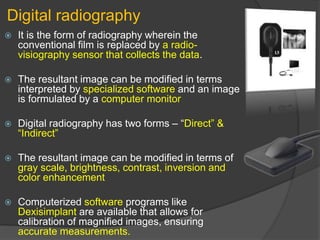
 It is the form of radiography wherein the
conventional film is replaced by a radio-
visiography sensor that collects the data.
 The resultant image can be modified in terms
interpreted by specialized software and an image
is formulated by a computer monitor
 Digital radiography has two forms – “Direct” &
“Indirect”
 The resultant image can be modified in terms of
gray scale, brightness, contrast, inversion and
color enhancement
 Computerized software programs like
Dexisimplant are available that allows for
calibration of magnified images, ensuring
accurate measurements.
Indications
 Excellent for implant follow up
 Intraoral radiography of limited area
 Bone Density evaluation (CADIA
software)
 Useful in endodontic treatment
Advantages
 Digital radiography has got less radiation
 It provides the operator with a superior
resolution of imaging with slightly better
perception of low contrast details.
 Instantaneous speed of image formation is
highly useful during surgical placement of
implants and the prosthetic verification of
component placement.
Disadvantages
 Size and thickness of the film
 Misuse of image manipulation
 Manipulation and developing time is
sometimes long
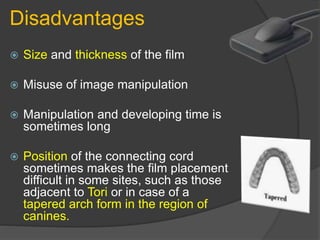
 Position of the connecting cord
sometimes makes the film placement
difficult in some sites, such as those
adjacent to Tori or in case of a
tapered arch form in the region of
canines.
Panoramic Radiography (OPG)
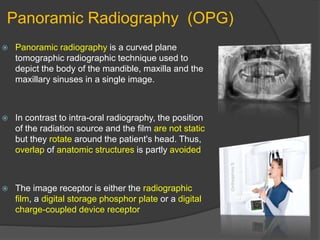
 Panoramic radiography is a curved plane
tomographic radiographic technique used to
depict the body of the mandible, maxilla and the
maxillary sinuses in a single image.
 In contrast to intra-oral radiography, the position
of the radiation source and the film are not static
but they rotate around the patient's head. Thus,
overlap of anatomic structures is partly avoided
 The image receptor is either the radiographic
film, a digital storage phosphor plate or a digital
charge-coupled device receptor
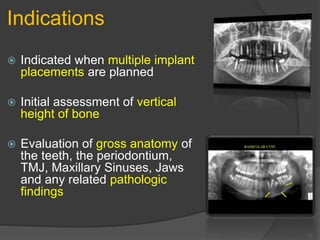
Indications
 Indicated when multiple implant
placements are planned
 Initial assessment of vertical
height of bone
 Evaluation of gross anatomy of
the teeth, the periodontium,
TMJ, Maxillary Sinuses, Jaws
and any related pathologic
findings
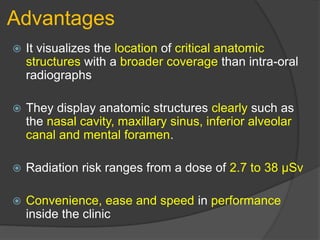
Advantages
 It visualizes the location of critical anatomic
structures with a broader coverage than intra-oral
radiographs
 They display anatomic structures clearly such as
the nasal cavity, maxillary sinus, inferior alveolar
canal and mental foramen.
 Radiation risk ranges from a dose of 2.7 to 38 µSv
 Convenience, ease and speed in performance
inside the clinic
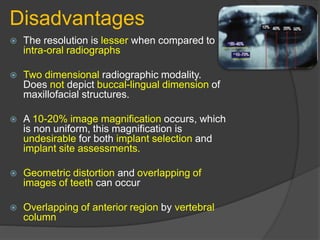
Disadvantages
 The resolution is lesser when compared to
intra-oral radiographs
 Two dimensional radiographic modality.
Does not depict buccal-lingual dimension of
maxillofacial structures.
 A 10-20% image magnification occurs, which
is non uniform, this magnification is
undesirable for both implant selection and
implant site assessments.
 Geometric distortion and overlapping of
images of teeth can occur
 Overlapping of anterior region by vertebral
column
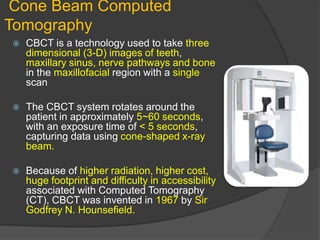
Cone Beam Computed
Tomography
 CBCT is a technology used to take three
dimensional (3-D) images of teeth,
maxillary sinus, nerve pathways and bone
in the maxillofacial region with a single
scan
 The CBCT system rotates around the
patient in approximately 5~60 seconds,
with an exposure time of < 5 seconds,
capturing data using cone-shaped x-ray
beam.
 Because of higher radiation, higher cost,
huge footprint and difficulty in accessibility
associated with Computed Tomography
(CT), CBCT was invented in 1967 by Sir
Godfrey N. Hounsefield.
Cone Beam Computed Tomography
 CBCT images are a result of data collected by
numerous detectors and ionizing chambers in the
CBCT unit.
 The data collected by the detectors correspond to
a composite of the absorption characteristics of the
tissues and structures imaged.
 This information is transformed into images (raw
data) that are reformatted into a voxel (digital)
volume for evaluation and analysis.
 Thus the smaller the voxel size, the greater the
resolution and quality of the image, however, the
greater the resultant radiation dose.
 A voxel size of 0.2 to 0.3 mm is considered ideal
because it allows for an equitable trade-off
between image quality and absorbed radiation
dose
Medical CT v/s CBCT
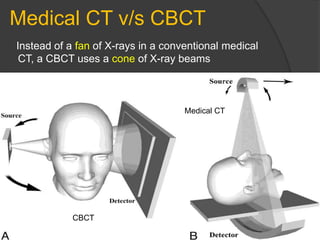
Instead of a fan of X-rays in a conventional medical
CT, a CBCT uses a cone of X-ray beams
CBCT
Medical CT
Medical CT v/s CBCT – a better
understanding
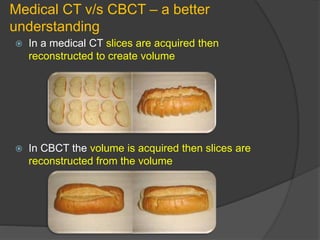
 In a medical CT slices are acquired then
reconstructed to create volume
 In CBCT the volume is acquired then slices are
reconstructed from the volume
Indications for Implantology
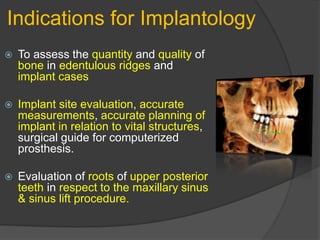
 To assess the quantity and quality of
bone in edentulous ridges and
implant cases
 Implant site evaluation, accurate
measurements, accurate planning of
implant in relation to vital structures,
surgical guide for computerized
prosthesis.
 Evaluation of roots of upper posterior
teeth in respect to the maxillary sinus
& sinus lift procedure.
Contraindications for CBCT
 Patients with Claustrophobia
 Parkinson’s Disease
 Tremors
 Disabling conditions that might cause to
patient to be un-cooperative
Advantages
 Rapid Scanning Time
 Beam limitation (cone shaped beam)
 Image Accuracy
 No superimposing of images
 Almost 0% magnification
 Minimal Distortion
 Lower cost
 More feasible compared to the CT
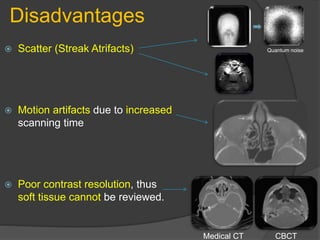
Disadvantages
 Scatter (Streak Atrifacts)
 Motion artifacts due to increased
scanning time
 Poor contrast resolution, thus
soft tissue cannot be reviewed.
Medical CT CBCT
Quantum noise
Radiographic Indications for Implant
placement
 Full Edentulism (Reduced stability and retention of dentures)
 Partial Edentulism (periodontal inflammatory conditions to be
treated first)
 Single Tooth Replacement (use of auto/allografts at the time of
tooth extraction or after either soft or hard tissue healing)
 Extreme Jaw Bone Resorption in Mandible (6mm bone height and
5mm vestibulo-oral bone width is necessary for implant placement)
 Extreme Jaw Bone Resorption in Maxilla (7mm bone height and
4mm vestibulo-oral bone width is necessary to support implants)
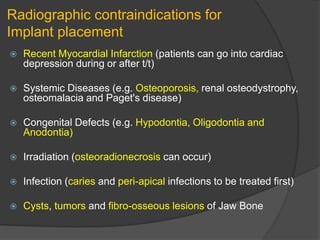
Radiographic contraindications for
Implant placement
 Recent Myocardial Infarction (patients can go into cardiac
depression during or after t/t)
 Systemic Diseases (e.g. Osteoporosis, renal osteodystrophy,
osteomalacia and Paget's disease)
 Congenital Defects (e.g. Hypodontia, Oligodontia and
Anodontia)
 Irradiation (osteoradionecrosis can occur)
 Infection (caries and peri-apical infections to be treated first)
 Cysts, tumors and fibro-osseous lesions of Jaw Bone
Refrences
 Radiographic planning and assessment of
endosseous implants – R. Jacobs & D. van
Steenberghe
 Mischs Contemporary Implant Dentistry
 NCBI articles / Web
Radiographic considerations in dental implants

Radiographic considerations in dental implants

  • 1.
  • 2.
    Contents  Introduction  Phasesof imaging  Imaging modalities  Periapical Radiography  Digital Radiography  Panoramic Radiography  Cone Beam Computed Tomography  Radiographic indications/contraindications for Implant placement  References
  • 3.
    Introduction  The term“implant” itself remains ambiguous.  According to the Academy of Osseointegration a dental implant is defined as “an artificial material or tissue that shows biocompatibility upon its surgical implantation.” [this definition has been authorized by American College of Prosthodontists & American Academy Of Periodontology]  According to GPT 8 – Any object or material such as an alloplastic or other tissue, which is partially or completely inserted or grafted into the body for therapeutic, diagnostic, prosthetic or experimental purposes.
  • 4.
    Introduction  Multiple factorsinfluence the selection of radiographic technique for a particular case including cost, availability, radiation exposure, and case type.  The widespread use of dental implants in partially and completely edentulous patients has brought about a need to preoperatively depict and quantify the accurate bone height, colour and location of vital anatomic structures by radiographic examination  Diagnostic imaging must always be interpreted in conjunction with a good clinical examination.  The decision is a balance between these factors and the desire to minimize risk of complications to the patient.
  • 5.
    Key parameters inimplant planning with radiographic aids  Bone Height (craniocaudal dimension)  Faciolingual/faciopalatal width  Mesiodistal dimension  Bone morphology  Presence & prominence of anatomic features: Sublingual & Submandibular fossae // Incisive & canine fossae  Neuarovascular canals & foramina, including: Mandibular canal & the mental foramen // Incisive canal & foramen // Mandibular lingual canals & foramina // Greater Palatine canal & foramen  Cortical thickness & density  Extent and morphology of the alveolar recess of the maxillary sinus base
  • 6.
    Phases of imagingfor dental implant surgery Phase pre surgical implant imaging Phase surgical and intra-operative implant imaging Phase post-prosthetic imaging
  • 7.
    Pre-Surgical Implant Imaging  Toassess the overall status of the remaining dentition  To identify & characterize the location and nature of the edentulous regions, particularly to determine the quality, quantity and angulations of bone  The pre-surgical radiographic evaluation should provide information about the height and width of the bone, the degree of corticalization, the density of mineralization and the amount of cancellous bone in the areas considered  To determine the relationship of critical structures to the prospective implant site and to detect regional anatomic abnormalities and pathologies.
  • 8.
    Surgical and Intra-operativeImplant Imaging.  Evaluates the sites during and immediately after the surgery  Assist in the optimal position and orientation of dental implants  To evaluate the healing and integration phase of implant surgery  Ensures the abutment position and prosthesis fabrication are correct
  • 9.
    Post-prosthetic implant imaging It commences just after the prosthesis placement and continues as long as the implants remain in the jaws. OBJECTIVES  Evaluate the long term maintenance of implant rigid fixation and function  Evaluate crestal bone levels around each implant  Evaluate the implant overall
  • 10.
    Why do weneed pre-prosthetic imaging ?  Identify normal v/s abnormal  Identify anatomic variants  Determine bone quality  Determine bone quantity  Identify ideal implant positioning  Use for surgical templates
  • 11.
    Various Imaging Modalities Analogue Intra-Oral Radiography - Intra Oral Peri-Apical Radiography  Digital Intra-Oral Radiography - RVG Sensor  Panoramic Imaging Modalities  Three Dimensional Imaging Modalities The decision to image the patient is based on the patient’s clinical needs and its availability while keeping in mind that the dentists should follow the ALARA principle which states that the diagnostic imaging technique selected should include the lowest possible radiation dose to the patient.
  • 12.
    Intra-Oral Periapical Radiography Indications •Evaluation of small edentulous spaces eg: in cases where there is single tooth replacement • Alignment and orientation of implants during surgery • Recall/Maintenance evaluations  Advantages • Amount of bone loss & peri-implantitis can be visualized • Subtle variations in bone activity is clearly seen • Minimal magnification with high resolution • They are easy to obtain in the dental clinics
  • 13.
    Disadvantages  Two dimensionalradiographic modality : vital information on the width of the available bone is not obtained.  They are susceptible to unpredictable magnification of anatomic structures, which does not allow reliable imaging  Distortion is particularly accentuated in edentulous areas, where missing teeth and Resorption of the Alveolus necessitates film placement at significant angulations  Poor identification of vital structures : studies have shown, in the evaluation of the true location of the mental foramen, less than 50% of IOPA’s depict the correct location of the mental foramen. Other studies have shown because of insufficient cortical bone around the Mandibular canal (MC), only 28% of IOPA’s will identify the MC.
  • 14.
    How to avoidthese inherent disadvantages.  Distortion : the central ray should perpendicular to the bone, object & film to avoid much distortion.  Fore-shortening : the central ray should not be perpendicular to the film but to the implant  Elongation : the central ray should not be perpendicular to the object, but to the film.
  • 15.
    Digital radiography  Itis the form of radiography wherein the conventional film is replaced by a radio- visiography sensor that collects the data.  The resultant image can be modified in terms interpreted by specialized software and an image is formulated by a computer monitor  Digital radiography has two forms – “Direct” & “Indirect”  The resultant image can be modified in terms of gray scale, brightness, contrast, inversion and color enhancement  Computerized software programs like Dexisimplant are available that allows for calibration of magnified images, ensuring accurate measurements.
  • 16.
    Indications  Excellent forimplant follow up  Intraoral radiography of limited area  Bone Density evaluation (CADIA software)  Useful in endodontic treatment
  • 17.
    Advantages  Digital radiographyhas got less radiation  It provides the operator with a superior resolution of imaging with slightly better perception of low contrast details.  Instantaneous speed of image formation is highly useful during surgical placement of implants and the prosthetic verification of component placement.
  • 18.
    Disadvantages  Size andthickness of the film  Misuse of image manipulation  Manipulation and developing time is sometimes long  Position of the connecting cord sometimes makes the film placement difficult in some sites, such as those adjacent to Tori or in case of a tapered arch form in the region of canines.
  • 19.
    Panoramic Radiography (OPG) Panoramic radiography is a curved plane tomographic radiographic technique used to depict the body of the mandible, maxilla and the maxillary sinuses in a single image.  In contrast to intra-oral radiography, the position of the radiation source and the film are not static but they rotate around the patient's head. Thus, overlap of anatomic structures is partly avoided  The image receptor is either the radiographic film, a digital storage phosphor plate or a digital charge-coupled device receptor
  • 20.
    Indications  Indicated whenmultiple implant placements are planned  Initial assessment of vertical height of bone  Evaluation of gross anatomy of the teeth, the periodontium, TMJ, Maxillary Sinuses, Jaws and any related pathologic findings
  • 21.
    Advantages  It visualizesthe location of critical anatomic structures with a broader coverage than intra-oral radiographs  They display anatomic structures clearly such as the nasal cavity, maxillary sinus, inferior alveolar canal and mental foramen.  Radiation risk ranges from a dose of 2.7 to 38 µSv  Convenience, ease and speed in performance inside the clinic
  • 22.
    Disadvantages  The resolutionis lesser when compared to intra-oral radiographs  Two dimensional radiographic modality. Does not depict buccal-lingual dimension of maxillofacial structures.  A 10-20% image magnification occurs, which is non uniform, this magnification is undesirable for both implant selection and implant site assessments.  Geometric distortion and overlapping of images of teeth can occur  Overlapping of anterior region by vertebral column
  • 23.
    Cone Beam Computed Tomography CBCT is a technology used to take three dimensional (3-D) images of teeth, maxillary sinus, nerve pathways and bone in the maxillofacial region with a single scan  The CBCT system rotates around the patient in approximately 5~60 seconds, with an exposure time of < 5 seconds, capturing data using cone-shaped x-ray beam.  Because of higher radiation, higher cost, huge footprint and difficulty in accessibility associated with Computed Tomography (CT), CBCT was invented in 1967 by Sir Godfrey N. Hounsefield.
  • 24.
    Cone Beam ComputedTomography  CBCT images are a result of data collected by numerous detectors and ionizing chambers in the CBCT unit.  The data collected by the detectors correspond to a composite of the absorption characteristics of the tissues and structures imaged.  This information is transformed into images (raw data) that are reformatted into a voxel (digital) volume for evaluation and analysis.  Thus the smaller the voxel size, the greater the resolution and quality of the image, however, the greater the resultant radiation dose.  A voxel size of 0.2 to 0.3 mm is considered ideal because it allows for an equitable trade-off between image quality and absorbed radiation dose
  • 25.
    Medical CT v/sCBCT Instead of a fan of X-rays in a conventional medical CT, a CBCT uses a cone of X-ray beams CBCT Medical CT
  • 26.
    Medical CT v/sCBCT – a better understanding  In a medical CT slices are acquired then reconstructed to create volume  In CBCT the volume is acquired then slices are reconstructed from the volume
  • 27.
    Indications for Implantology To assess the quantity and quality of bone in edentulous ridges and implant cases  Implant site evaluation, accurate measurements, accurate planning of implant in relation to vital structures, surgical guide for computerized prosthesis.  Evaluation of roots of upper posterior teeth in respect to the maxillary sinus & sinus lift procedure.
  • 28.
    Contraindications for CBCT Patients with Claustrophobia  Parkinson’s Disease  Tremors  Disabling conditions that might cause to patient to be un-cooperative
  • 29.
    Advantages  Rapid ScanningTime  Beam limitation (cone shaped beam)  Image Accuracy  No superimposing of images  Almost 0% magnification  Minimal Distortion  Lower cost  More feasible compared to the CT
  • 30.
    Disadvantages  Scatter (StreakAtrifacts)  Motion artifacts due to increased scanning time  Poor contrast resolution, thus soft tissue cannot be reviewed. Medical CT CBCT Quantum noise
  • 31.
    Radiographic Indications forImplant placement  Full Edentulism (Reduced stability and retention of dentures)  Partial Edentulism (periodontal inflammatory conditions to be treated first)  Single Tooth Replacement (use of auto/allografts at the time of tooth extraction or after either soft or hard tissue healing)  Extreme Jaw Bone Resorption in Mandible (6mm bone height and 5mm vestibulo-oral bone width is necessary for implant placement)  Extreme Jaw Bone Resorption in Maxilla (7mm bone height and 4mm vestibulo-oral bone width is necessary to support implants)
  • 32.
    Radiographic contraindications for Implantplacement  Recent Myocardial Infarction (patients can go into cardiac depression during or after t/t)  Systemic Diseases (e.g. Osteoporosis, renal osteodystrophy, osteomalacia and Paget's disease)  Congenital Defects (e.g. Hypodontia, Oligodontia and Anodontia)  Irradiation (osteoradionecrosis can occur)  Infection (caries and peri-apical infections to be treated first)  Cysts, tumors and fibro-osseous lesions of Jaw Bone
  • 33.
    Refrences  Radiographic planningand assessment of endosseous implants – R. Jacobs & D. van Steenberghe  Mischs Contemporary Implant Dentistry  NCBI articles / Web