CS8091 / Big Data Analytics
III Year / VI Semester
UNIT III - ASSOCIATION AND
RECOMMENDATION SYSTEM
Advanced Analytical Theory and Methods:
Association Rules - Overview - Apriori
Algorithm - Evaluation of Candidate Rules -
Applications of Association Rules - Finding
Association& finding similarity -
Recommendation System: Collaborative
Recommendation- Content Based
Recommendation - Knowledge Based
Recommendation- Hybrid Recommendation
Approaches
Content Based Recommendation
 The recommendation task then consists of
determining the items that match the user’s
preferences best.
 It must rely on additional information about
items and user preferences.
 In practical settings, technical descriptions of the
features and characteristics of an item.
Content Based Recommendation
 Example:
 systems that recommend news articles by comparing
the main keywords of an article in question with the
keywords that appeared in other articles that the user
has rated highly in the past.
 recommending textually described items and for
“learning” the user profile automatically
Content Based Recommendation
 Content representation and content similarity:
 The simplest way to describe catalog items is to
maintain an explicit list of features for each item (also
often called attributes, characteristics, or item profiles).
 For a book recommender, one could, for instance, use
the genre, the author’s name, the publisher, or anything
else that describes the item.
Content Based Recommendation
 Content representation and content similarity:
 When the user’s preferences are described in terms of
his or her interests using exactly this set of features,
the recommendation task consists of matching item
characteristics and user preferences.
 content-based systems typically work by evaluating
how strongly a not-yet-seen item is “similar” to items
the active user has liked in the past.
Content Based Recommendation
 The vector space model and TF-IDF:
 To use a list of relevant keywords that appear within
the document.
 The main idea, of course, is that such a list can be
generated automatically from the document content
itself or from a free-text description thereof.
Content Based Recommendation
 The vector space model and TF-IDF:
 In a first, and very naıve, approach, one could set up a list of all
words that appear in all documents and describe each document
by a Boolean vector.
 1 indicates that a word appears in a document and a 0 that the
word does not appear.
 To solve the shortcomings of the simple Boolean approach,
documents are typically described using the TF-IDF encoding
format
Content Based Recommendation
 The vector space model and TF-IDF:
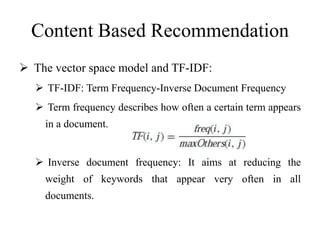
 TF-IDF: Term Frequency-Inverse Document Frequency
 Term frequency describes how often a certain term appears
in a document.
 Inverse document frequency: It aims at reducing the
weight of keywords that appear very often in all
documents.
Content Based Recommendation
 The vector space model and TF-IDF:
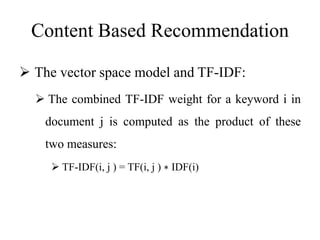
 The inverse document frequency for I,
 N be the number of all recommendable
documents, n(i) be the number of documents from
N in which keyword i appears
Content Based Recommendation
 The vector space model and TF-IDF:
 The combined TF-IDF weight for a keyword i in
document j is computed as the product of these
two measures:
 TF-IDF(i, j ) = TF(i, j ) ∗ IDF(i)
Content Based Recommendation
 Improving the vector space model/limitations:
 Stop words and stemming:
 Prepositions and articles such as “a”, “the”, or “on”, which
can be removed from the document vectors because they
will appear in nearly all documents.
 Stemming: to replace variants of the same word by their
common stem. The word “stemming” would, for instance,
be replaced by “stem”, “went” by “go”, and so forth.
Content Based Recommendation
 Similarity-based retrieval:
 recommend items that are similar to those the user
liked in the past.
 The task for a recommender system is again – based
on a user profile – to predict, for the items that the
current user has not seen, whether he or she will like
them.
Content Based Recommendation
 Similarity-based retrieval - Nearest neighbors:
 Method for estimating to what extent a certain
document will be of interest to a user is simply to
check whether the user liked similar documents in
the past.
Content Based Recommendation
 Similarity-based retrieval - Nearest neighbors:
 Two pieces of information are required:
 First, we need some history of “like/dislike” statements
made by the user about previous items.
 Second, a measure is needed that captures the similarity of
two documents. In most reported approaches, the cosine
similarity measure is used to evaluate whether two
document vectors are similar.
Content Based Recommendation
 Similarity-based retrieval - Nearest neighbors:
 A k-nearest-neighbor method (kNN) has been
implemented, for instance, in the personalized and
mobile news access system.
 the kNN method was used to model the short-term
interests of the users, which is of particular importance
in the application domain of news recommendation
Content Based Recommendation
 Similarity-based retrieval - Nearest neighbors:
 On arrival of a new message, the system looks for
similar items in the set of stories that were recently
rated by the user.
 At the same time, when relying on nearest neighbors,
it is also possible to set an upper threshold for item
similarity to prevent the system from recommending
items that the user most probably has already seen.
Content Based Recommendation
 Similarity-based retrieval - Nearest neighbors:
The kNN method was implemented as part of a
multistrategy user profile technique.
 The short-term profile, as described earlier, allows
the system to provide the user with information on
topics of recent interest.
Content Based Recommendation
 Similarity-based retrieval - Nearest neighbors:
 For the long-term model, the system described by
Billsus et al. (2000) therefore collects information over
a longer period of time (e.g., several months) and also
seeks to identify the most informative words in the
documents by determining the terms that consistently
receive high TF-IDF scores in a larger document
collection.
Content Based Recommendation
 Similarity-based retrieval - Relevance feedback:
 A particular aspect of SMART (System for the
Mechanical Analysis and Retrieval of Text) was that
users could not only send (keyword-based) queries to
the system but could also give feedback on whether
the retrieved items were relevant.
 The system could then internally extend the query to
improve retrieval results in the next round of retrieval
Content Based Recommendation
 Similarity-based retrieval - Relevance feedback:
 The main practical challenges – as with most content-
based methods – are
 a certain number of previous item ratings is needed to
build a reasonable user model and
 user interaction is required during the retrieval phase
Content Based Recommendation
 Similarity-based retrieval - Relevance feedback:
 The first point can be partially automated by trying to
capture the user ratings implicitly.
 The second point, interactive query refinement also
opens new opportunities for gathering information
about the user’s real preferences and may help the user
to “learn” which vocabulary to use to retrieve
documents that satisfy his or her information needs.
Content Based Recommendation
 Other text classification methods:
 Another way of deciding whether or not a document
will be of interest to a user is to view the problem as a
classification task, in which the possible classes are
“like” and “dislike”.
 Machine learning techniques can be applied such that
an intelligent system can automatically decide whether
a user will be interested in a certain document.
Content Based Recommendation
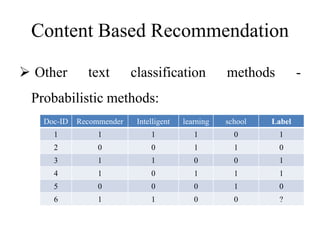
 Other text classification methods - Probabilistic
methods:
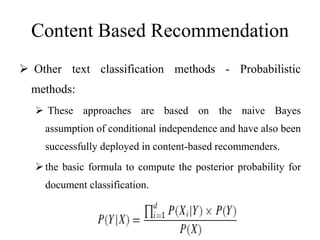
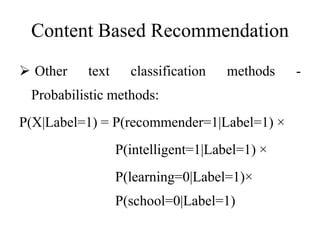
 These approaches are based on the naive Bayes
assumption of conditional independence and have also been
successfully deployed in content-based recommenders.
the basic formula to compute the posterior probability for
document classification.
Content Based Recommendation
 Other text classification methods -
Probabilistic methods:
 Documents are represented by Boolean feature
vectors that describe whether a certain term
appeared in a document; the feature vectors are
limited to the 128 most informative words.
Content Based Recommendation
 Other text classification methods -
Probabilistic methods:
Doc-ID Recommender Intelligent learning school Label
1 1 1 1 0 1
2 0 0 1 1 0
3 1 1 0 0 1
4 1 0 1 1 1
5 0 0 0 1 0
6 1 1 0 0 ?
Content Based Recommendation
 Other text classification methods -
Probabilistic methods:
P(X|Label=1) = P(recommender=1|Label=1) ×
P(intelligent=1|Label=1) ×
P(learning=0|Label=1)×
P(school=0|Label=1)
Content Based Recommendation
 Other text classification methods - Probabilistic methods:
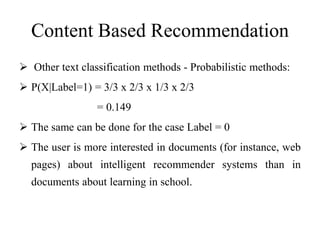
 P(X|Label=1) = 3/3 x 2/3 x 1/3 x 2/3
= 0.149
 The same can be done for the case Label = 0
 The user is more interested in documents (for instance, web
pages) about intelligent recommender systems than in
documents about learning in school.
Content Based Recommendation
 Other text classification methods - On feature
selection:
 The process of choosing a subset of the available
terms is called feature selection.
 Feature selection is based on domain knowledge
and lexical information from WordNet.
Content Based Recommendation
 Other text classification methods - On feature selection:
 Another option is to apply frequency-based feature selection and
use domain- or task-specific heuristics to remove words that are
“too rare” or appear “too often” based on empirically chosen
thresholds.
 The typical measures for determining the utility of a keyword
are the χ2 test, the mutual information measure, or Fisher’s
discrimination index

CS8091_BDA_Unit_III_Content_Based_Recommendation

  • 1.
    CS8091 / BigData Analytics III Year / VI Semester
  • 2.
    UNIT III -ASSOCIATION AND RECOMMENDATION SYSTEM Advanced Analytical Theory and Methods: Association Rules - Overview - Apriori Algorithm - Evaluation of Candidate Rules - Applications of Association Rules - Finding Association& finding similarity - Recommendation System: Collaborative Recommendation- Content Based Recommendation - Knowledge Based Recommendation- Hybrid Recommendation Approaches
  • 3.
    Content Based Recommendation The recommendation task then consists of determining the items that match the user’s preferences best.  It must rely on additional information about items and user preferences.  In practical settings, technical descriptions of the features and characteristics of an item.
  • 4.
    Content Based Recommendation Example:  systems that recommend news articles by comparing the main keywords of an article in question with the keywords that appeared in other articles that the user has rated highly in the past.  recommending textually described items and for “learning” the user profile automatically
  • 5.
    Content Based Recommendation Content representation and content similarity:  The simplest way to describe catalog items is to maintain an explicit list of features for each item (also often called attributes, characteristics, or item profiles).  For a book recommender, one could, for instance, use the genre, the author’s name, the publisher, or anything else that describes the item.
  • 6.
    Content Based Recommendation Content representation and content similarity:  When the user’s preferences are described in terms of his or her interests using exactly this set of features, the recommendation task consists of matching item characteristics and user preferences.  content-based systems typically work by evaluating how strongly a not-yet-seen item is “similar” to items the active user has liked in the past.
  • 7.
    Content Based Recommendation The vector space model and TF-IDF:  To use a list of relevant keywords that appear within the document.  The main idea, of course, is that such a list can be generated automatically from the document content itself or from a free-text description thereof.
  • 8.
    Content Based Recommendation The vector space model and TF-IDF:  In a first, and very naıve, approach, one could set up a list of all words that appear in all documents and describe each document by a Boolean vector.  1 indicates that a word appears in a document and a 0 that the word does not appear.  To solve the shortcomings of the simple Boolean approach, documents are typically described using the TF-IDF encoding format
  • 9.
    Content Based Recommendation The vector space model and TF-IDF:  TF-IDF: Term Frequency-Inverse Document Frequency  Term frequency describes how often a certain term appears in a document.  Inverse document frequency: It aims at reducing the weight of keywords that appear very often in all documents.
  • 10.
    Content Based Recommendation The vector space model and TF-IDF:  The inverse document frequency for I,  N be the number of all recommendable documents, n(i) be the number of documents from N in which keyword i appears
  • 11.
    Content Based Recommendation The vector space model and TF-IDF:  The combined TF-IDF weight for a keyword i in document j is computed as the product of these two measures:  TF-IDF(i, j ) = TF(i, j ) ∗ IDF(i)
  • 12.
    Content Based Recommendation Improving the vector space model/limitations:  Stop words and stemming:  Prepositions and articles such as “a”, “the”, or “on”, which can be removed from the document vectors because they will appear in nearly all documents.  Stemming: to replace variants of the same word by their common stem. The word “stemming” would, for instance, be replaced by “stem”, “went” by “go”, and so forth.
  • 13.
    Content Based Recommendation Similarity-based retrieval:  recommend items that are similar to those the user liked in the past.  The task for a recommender system is again – based on a user profile – to predict, for the items that the current user has not seen, whether he or she will like them.
  • 14.
    Content Based Recommendation Similarity-based retrieval - Nearest neighbors:  Method for estimating to what extent a certain document will be of interest to a user is simply to check whether the user liked similar documents in the past.
  • 15.
    Content Based Recommendation Similarity-based retrieval - Nearest neighbors:  Two pieces of information are required:  First, we need some history of “like/dislike” statements made by the user about previous items.  Second, a measure is needed that captures the similarity of two documents. In most reported approaches, the cosine similarity measure is used to evaluate whether two document vectors are similar.
  • 16.
    Content Based Recommendation Similarity-based retrieval - Nearest neighbors:  A k-nearest-neighbor method (kNN) has been implemented, for instance, in the personalized and mobile news access system.  the kNN method was used to model the short-term interests of the users, which is of particular importance in the application domain of news recommendation
  • 17.
    Content Based Recommendation Similarity-based retrieval - Nearest neighbors:  On arrival of a new message, the system looks for similar items in the set of stories that were recently rated by the user.  At the same time, when relying on nearest neighbors, it is also possible to set an upper threshold for item similarity to prevent the system from recommending items that the user most probably has already seen.
  • 18.
    Content Based Recommendation Similarity-based retrieval - Nearest neighbors: The kNN method was implemented as part of a multistrategy user profile technique.  The short-term profile, as described earlier, allows the system to provide the user with information on topics of recent interest.
  • 19.
    Content Based Recommendation Similarity-based retrieval - Nearest neighbors:  For the long-term model, the system described by Billsus et al. (2000) therefore collects information over a longer period of time (e.g., several months) and also seeks to identify the most informative words in the documents by determining the terms that consistently receive high TF-IDF scores in a larger document collection.
  • 20.
    Content Based Recommendation Similarity-based retrieval - Relevance feedback:  A particular aspect of SMART (System for the Mechanical Analysis and Retrieval of Text) was that users could not only send (keyword-based) queries to the system but could also give feedback on whether the retrieved items were relevant.  The system could then internally extend the query to improve retrieval results in the next round of retrieval
  • 21.
    Content Based Recommendation Similarity-based retrieval - Relevance feedback:  The main practical challenges – as with most content- based methods – are  a certain number of previous item ratings is needed to build a reasonable user model and  user interaction is required during the retrieval phase
  • 22.
    Content Based Recommendation Similarity-based retrieval - Relevance feedback:  The first point can be partially automated by trying to capture the user ratings implicitly.  The second point, interactive query refinement also opens new opportunities for gathering information about the user’s real preferences and may help the user to “learn” which vocabulary to use to retrieve documents that satisfy his or her information needs.
  • 23.
    Content Based Recommendation Other text classification methods:  Another way of deciding whether or not a document will be of interest to a user is to view the problem as a classification task, in which the possible classes are “like” and “dislike”.  Machine learning techniques can be applied such that an intelligent system can automatically decide whether a user will be interested in a certain document.
  • 24.
    Content Based Recommendation Other text classification methods - Probabilistic methods:  These approaches are based on the naive Bayes assumption of conditional independence and have also been successfully deployed in content-based recommenders. the basic formula to compute the posterior probability for document classification.
  • 25.
    Content Based Recommendation Other text classification methods - Probabilistic methods:  Documents are represented by Boolean feature vectors that describe whether a certain term appeared in a document; the feature vectors are limited to the 128 most informative words.
  • 26.
    Content Based Recommendation Other text classification methods - Probabilistic methods: Doc-ID Recommender Intelligent learning school Label 1 1 1 1 0 1 2 0 0 1 1 0 3 1 1 0 0 1 4 1 0 1 1 1 5 0 0 0 1 0 6 1 1 0 0 ?
  • 27.
    Content Based Recommendation Other text classification methods - Probabilistic methods: P(X|Label=1) = P(recommender=1|Label=1) × P(intelligent=1|Label=1) × P(learning=0|Label=1)× P(school=0|Label=1)
  • 28.
    Content Based Recommendation Other text classification methods - Probabilistic methods:  P(X|Label=1) = 3/3 x 2/3 x 1/3 x 2/3 = 0.149  The same can be done for the case Label = 0  The user is more interested in documents (for instance, web pages) about intelligent recommender systems than in documents about learning in school.
  • 29.
    Content Based Recommendation Other text classification methods - On feature selection:  The process of choosing a subset of the available terms is called feature selection.  Feature selection is based on domain knowledge and lexical information from WordNet.
  • 30.
    Content Based Recommendation Other text classification methods - On feature selection:  Another option is to apply frequency-based feature selection and use domain- or task-specific heuristics to remove words that are “too rare” or appear “too often” based on empirically chosen thresholds.  The typical measures for determining the utility of a keyword are the χ2 test, the mutual information measure, or Fisher’s discrimination index