PRODUCT
RECALL
Republic of the Philippines
Department of Health
Food and Drug Administration
Republic of the Philippines
Department of Health
Food and Drug Administration
What is
PRODUCT
RECALL?
A recall is when a product
is removed from the
market… because it is
either defective or
potentially harmful.
– US FDA
Permanent removal of therapeutic
goods from supply or use for
reasons relating to deficiencies in
the quality, safety or efficacy of
goods. – Therapeutic Goods
Administration, Australia
4
There should be a system
to recall from the
market, promptly and
effectively, products
known or suspected to be
defective. – WHO
In order to protect public health… necessary to
implement urgent measures such as the recall of
one or more defective batch(es) of a medicinal
product from the market.
– European Medicines Agency (EMA)
Republic of the Philippines
Department of Health
Food and Drug Administration
BUREAU CIRCULAR
NO. 8, S. 2001
Guidelines to be Observed
on the Implementation of
Product Recall System
B.C. No. 8,
s. 2001
 Actions taken to remove a product
from the market
 Initiated by FDA or voluntarily done
by company
B.C. No. 8, s. 2001
 Encompasses also labeling and/or
promotional literature
 Misbranded products still in violation of the
law are included
 Health risks evaluated by a Product
Recall Committee
HEALTH HAZARD EVALUATION
Factors to be considered:
• Assessment of the likelihood of
occurrence of the hazard
• Assessment of the consequences of
occurrence of hazard
HEALTH HAZARD EVALUATION
Factors to be considered:
• Assessment of the degree of seriousness
of the health hazard
• Whether any disease or injury has
already occurred
HEALTH HAZARD EVALUATION
Factors to be considered:
• Whether any existing condition(s) could
contribute to a clinical situation that could
expose human or animal health hazard
• Presents risk of gross deception to the
public
RECALL CLASSIFICATION
Class 1 Recall
Situation in which there is a
reasonable probability that the use or
exposure to the product will cause
serious adverse health consequences
or death
RECALL CLASSIFICATION
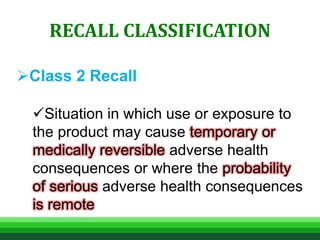
Class 2 Recall
Situation in which use or exposure to
the product may cause temporary or
medically reversible adverse health
consequences or where the probability
of serious adverse health consequences
is remote
RECALL CLASSIFICATION
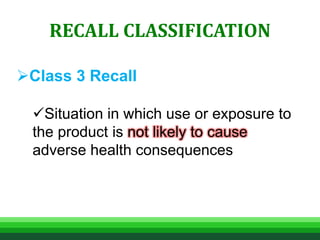
Class 3 Recall
Situation in which use or exposure to
the product is not likely to cause
adverse health consequences
14
WHO WILL
INITIATE
THE RECALL?
A. FIRM INITIATED RECALL
 Informs FDA of the voluntary recall
 The Marketing Authorization Holder
(MAH) is required to communicate with
its consignees and inform them of the
intended product/s for recall
A. FIRM INITIATED RECALL
 You must know the ff.:
1. Identity of the product
 Generic Name, Brand Name
 Dosage Form and Strength
 Registration No.
 Batch or Lot No.
 Date of Manufacture and Expiration
2. Reason for the removal
B. FDA ORDERED RECALL
 The Director General of the FDA may
order a firm to initiate a recall upon the
recommendation of Product Recall
Committee when the following
determinations has been made:
 Distributed product presents a safety
risk of illness or injury or gross consumer
deception
B. FDA ORDERED RECALL
 A firm has not initiated a recall of the
product
 An agency action is necessary or
advisable to protect the public health
and welfare
FDA ORDERED RECALL
 Firm shall be notified to order a recall,
and of the need to begin immediately a
recall of the product
 Notification will specify the ff.:
 Violation
 Health Hazard classification (Class I, II, or
III)
 Recall strategy
 Any other instructions appropriate
GENERAL PROCEDURE FOR
PRODUCT RECALL
20
MAH
• Notify FDA of a product recall
• State the full detail of the reason for conducting the recall (e.g. reason, batch/es
impacted, circumstances, etc.)
PRC
• Receipt of case report/communication from Marketing Authorization Holder
(MAH)
• Assess the health hazard
• Submit a written recommendation to the Director General for the issuance of recall
order
• Public Health Alert will be issued within 24 hours for cases that have been
determined as Class I or Class II Recall
GENERAL PROCEDURE FOR
PRODUCT RECALL
21
RFO
• In-depth inspection of responsible
establishment/production facilities where the
violation occurred
• Refer action done back to Product Recall Committee
(PRC)
RFO or
Legal or PRC
• In case the firm refuses to conduct the recall,
regulatory action will be pursued
• Upon determination that the recall process has been
completed, a written notification of acknowledged
completion will be given to the recalling firm
RECALL STRATEGY
The following elements shall be included in a
recall strategy:
1. Depth of Recall (distributor level, retailer
level)
2. Effectiveness Checks
 In developing a recall strategy, the duration to
complete the recall operation should be
considered.
RECALL STRATEGY
Duration of recall operation:
 Class I Recall – Seven (7) days
 Class II Recall – Fifteen (15) days
 Class III Recall – Thirty (30) days
RECALL STRATEGY
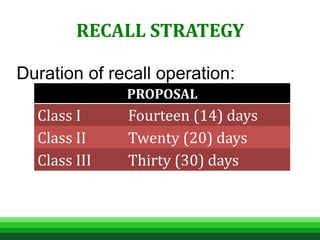
Duration of recall operation:
PROPOSAL
Class I Fourteen (14) days
Class II Twenty (20) days
Class III Thirty (30) days
PUBLIC HEALTH ALERT
 Issued within twenty-four (24) hours
after the duly signed PRO is received
by the representative of the MAH
 Purpose of alerting concerned
populations to serious health hazards
PUBLIC HEALTH ALERTHOW TO VIEW ADVISORIES?
UPDATED LIST OF ADVISORIES
FOR DRUG PRODUCTS AS OF 24
JUNE 2015
UPDATED LIST OF ADVISORIES
FOR DRUG PRODUCTS AS OF 24
JUNE 2015
• Product Information
– Generic name and/or Brand name
– Dosage form
– Dosage strength
– Registration No.
• Batch No. or Lot No. specified
• Importer or Distributor
• Manufacturer
SALIENT POINTS TO LOOK FOR
IN ADVISORIES
30
WHAT TO
CHECK IN
ADVISORIES?
Product Information?
Generic name
Brand name
Dosage form
Dosage strength
Registration No.
Batch No. or Lot No.?
Importer or Distributor?
Manufacturer?
Product Information?
Generic name
Brand name
Dosage form
Dosage strength
Registration No.
Batch No. or Lot No.?
Importer or Distributor?
Manufacturer?
Product Information?
Generic name
Brand name
Dosage form
Dosage strength
Registration No.
Batch No. or Lot No.?
Importer or Distributor?
Manufacturer?
Product Information?
Generic name
Brand name
Dosage form
Dosage strength
Registration No.
Batch No. or Lot No.?
Importer or Distributor?
Manufacturer?
Principal Product ?
e.g. DRP-282
Identical Product?
e.g. DRP-282-02
For more information:
Refer to
Administrative
Order No. 2005-0031
FDA Circular No.
2015-001
TERMINATION
OF PRODUCT
RECALL
ORDER
Seizure, multiple seizures or other
court action shall be undertaken by
FDA
REFUSAL OR
FAILURE OF FIRM
TO CONDUCT
PRODUCT RECALL
DISPOSITION OF RECALLED
PRODUCTS
 MAH will coordinate with FDA
 If the products are to be destroyed, the
destruction should be witnessed by a
FDA representative
• Proactive cooperation with the distributor
or MAH… Follow-up at all times
• Routine checking of advisories from the
FDA website
• Upon seeing the advisory, the stocks of the
drug product meant for recall must be
removed from the selling area within 24
hours and stored in a secured area
WHAT IS REQUIRED FROM
YOUR END?
• Must observe the recall duration:
► Return immediately the stocks of recalled
product/s to the distributor
► Proper documents must show the actual
quantity returned
• Product recalls must be treated ALWAYS AS
URGENT!
WHAT IS REQUIRED FROM
YOUR END?
“Drug safety is
everybody’s
concern”
THANK
YOU

Product recall overview

  • 1.
    PRODUCT RECALL Republic of thePhilippines Department of Health Food and Drug Administration
  • 2.
    Republic of thePhilippines Department of Health Food and Drug Administration What is PRODUCT RECALL?
  • 3.
    A recall iswhen a product is removed from the market… because it is either defective or potentially harmful. – US FDA Permanent removal of therapeutic goods from supply or use for reasons relating to deficiencies in the quality, safety or efficacy of goods. – Therapeutic Goods Administration, Australia
  • 4.
    4 There should bea system to recall from the market, promptly and effectively, products known or suspected to be defective. – WHO In order to protect public health… necessary to implement urgent measures such as the recall of one or more defective batch(es) of a medicinal product from the market. – European Medicines Agency (EMA)
  • 5.
    Republic of thePhilippines Department of Health Food and Drug Administration BUREAU CIRCULAR NO. 8, S. 2001 Guidelines to be Observed on the Implementation of Product Recall System
  • 6.
    B.C. No. 8, s.2001  Actions taken to remove a product from the market  Initiated by FDA or voluntarily done by company
  • 7.
    B.C. No. 8,s. 2001  Encompasses also labeling and/or promotional literature  Misbranded products still in violation of the law are included  Health risks evaluated by a Product Recall Committee
  • 8.
    HEALTH HAZARD EVALUATION Factorsto be considered: • Assessment of the likelihood of occurrence of the hazard • Assessment of the consequences of occurrence of hazard
  • 9.
    HEALTH HAZARD EVALUATION Factorsto be considered: • Assessment of the degree of seriousness of the health hazard • Whether any disease or injury has already occurred
  • 10.
    HEALTH HAZARD EVALUATION Factorsto be considered: • Whether any existing condition(s) could contribute to a clinical situation that could expose human or animal health hazard • Presents risk of gross deception to the public
  • 11.
    RECALL CLASSIFICATION Class 1Recall Situation in which there is a reasonable probability that the use or exposure to the product will cause serious adverse health consequences or death
  • 12.
    RECALL CLASSIFICATION Class 2Recall Situation in which use or exposure to the product may cause temporary or medically reversible adverse health consequences or where the probability of serious adverse health consequences is remote
  • 13.
    RECALL CLASSIFICATION Class 3Recall Situation in which use or exposure to the product is not likely to cause adverse health consequences
  • 14.
  • 15.
    A. FIRM INITIATEDRECALL  Informs FDA of the voluntary recall  The Marketing Authorization Holder (MAH) is required to communicate with its consignees and inform them of the intended product/s for recall
  • 16.
    A. FIRM INITIATEDRECALL  You must know the ff.: 1. Identity of the product  Generic Name, Brand Name  Dosage Form and Strength  Registration No.  Batch or Lot No.  Date of Manufacture and Expiration 2. Reason for the removal
  • 17.
    B. FDA ORDEREDRECALL  The Director General of the FDA may order a firm to initiate a recall upon the recommendation of Product Recall Committee when the following determinations has been made:  Distributed product presents a safety risk of illness or injury or gross consumer deception
  • 18.
    B. FDA ORDEREDRECALL  A firm has not initiated a recall of the product  An agency action is necessary or advisable to protect the public health and welfare
  • 19.
    FDA ORDERED RECALL Firm shall be notified to order a recall, and of the need to begin immediately a recall of the product  Notification will specify the ff.:  Violation  Health Hazard classification (Class I, II, or III)  Recall strategy  Any other instructions appropriate
  • 20.
    GENERAL PROCEDURE FOR PRODUCTRECALL 20 MAH • Notify FDA of a product recall • State the full detail of the reason for conducting the recall (e.g. reason, batch/es impacted, circumstances, etc.) PRC • Receipt of case report/communication from Marketing Authorization Holder (MAH) • Assess the health hazard • Submit a written recommendation to the Director General for the issuance of recall order • Public Health Alert will be issued within 24 hours for cases that have been determined as Class I or Class II Recall
  • 21.
    GENERAL PROCEDURE FOR PRODUCTRECALL 21 RFO • In-depth inspection of responsible establishment/production facilities where the violation occurred • Refer action done back to Product Recall Committee (PRC) RFO or Legal or PRC • In case the firm refuses to conduct the recall, regulatory action will be pursued • Upon determination that the recall process has been completed, a written notification of acknowledged completion will be given to the recalling firm
  • 22.
    RECALL STRATEGY The followingelements shall be included in a recall strategy: 1. Depth of Recall (distributor level, retailer level) 2. Effectiveness Checks  In developing a recall strategy, the duration to complete the recall operation should be considered.
  • 23.
    RECALL STRATEGY Duration ofrecall operation:  Class I Recall – Seven (7) days  Class II Recall – Fifteen (15) days  Class III Recall – Thirty (30) days
  • 24.
    RECALL STRATEGY Duration ofrecall operation: PROPOSAL Class I Fourteen (14) days Class II Twenty (20) days Class III Thirty (30) days
  • 25.
    PUBLIC HEALTH ALERT Issued within twenty-four (24) hours after the duly signed PRO is received by the representative of the MAH  Purpose of alerting concerned populations to serious health hazards
  • 26.
    PUBLIC HEALTH ALERTHOWTO VIEW ADVISORIES?
  • 27.
    UPDATED LIST OFADVISORIES FOR DRUG PRODUCTS AS OF 24 JUNE 2015
  • 28.
    UPDATED LIST OFADVISORIES FOR DRUG PRODUCTS AS OF 24 JUNE 2015
  • 29.
    • Product Information –Generic name and/or Brand name – Dosage form – Dosage strength – Registration No. • Batch No. or Lot No. specified • Importer or Distributor • Manufacturer SALIENT POINTS TO LOOK FOR IN ADVISORIES
  • 30.
  • 31.
    Product Information? Generic name Brandname Dosage form Dosage strength Registration No. Batch No. or Lot No.? Importer or Distributor? Manufacturer?
  • 32.
    Product Information? Generic name Brandname Dosage form Dosage strength Registration No. Batch No. or Lot No.? Importer or Distributor? Manufacturer?
  • 33.
    Product Information? Generic name Brandname Dosage form Dosage strength Registration No. Batch No. or Lot No.? Importer or Distributor? Manufacturer?
  • 34.
    Product Information? Generic name Brandname Dosage form Dosage strength Registration No. Batch No. or Lot No.? Importer or Distributor? Manufacturer? Principal Product ? e.g. DRP-282 Identical Product? e.g. DRP-282-02 For more information: Refer to Administrative Order No. 2005-0031 FDA Circular No. 2015-001
  • 35.
  • 36.
    Seizure, multiple seizuresor other court action shall be undertaken by FDA REFUSAL OR FAILURE OF FIRM TO CONDUCT PRODUCT RECALL
  • 37.
    DISPOSITION OF RECALLED PRODUCTS MAH will coordinate with FDA  If the products are to be destroyed, the destruction should be witnessed by a FDA representative
  • 38.
    • Proactive cooperationwith the distributor or MAH… Follow-up at all times • Routine checking of advisories from the FDA website • Upon seeing the advisory, the stocks of the drug product meant for recall must be removed from the selling area within 24 hours and stored in a secured area WHAT IS REQUIRED FROM YOUR END?
  • 39.
    • Must observethe recall duration: ► Return immediately the stocks of recalled product/s to the distributor ► Proper documents must show the actual quantity returned • Product recalls must be treated ALWAYS AS URGENT! WHAT IS REQUIRED FROM YOUR END?
  • 40.
  • 41.

Editor's Notes

  • #6 Since our bureau circular is still from 2001, we assure you that we are currently revising the said circular to be in line with our current practices.
  • #8 A recall decision does not depend solely on the health risk of the product. Misbranded products where no health hazard exists are still in violation of the law and should be recalled. 'Misbranding' means, in addition to definitions in existing laws, misinformation or misleading information on the label or other information materials authorized by the FDA. It shall not refer to copyright, trademark, or other intellectual property-like instruments.  If an article is alleged to be misbranded because the labeling is misleading, then in determining whether the labeling is misleading there shall be taken into account (among other things) not only representations made or suggested by statement, word, design, device, or any combination thereof, but also the extent to which the labeling fails to reveal facts material in the light of such representations or material with respect to consequences which may result from the use of the article to which the labeling relates under the conditions of use prescribed in the labeling thereof or under such conditions of use as are customary or usual MISBRANDED FOOD Section 15. A food shall be deemed to be misbranded: (a) If its labeling is false or misleading in any particular; (b) If it is offered for sale under the name of another food; (c) If it is an imitation of another food, unless its label bears in types of uniform size and prominence, the word "imitation" and, immediately thereafter, the name of the food imitated; (d) If its container is so made, formed, or filled as to be misleading; (e) If in package form unless it bears a label containing (1) the name and place of business of the manufacturer, packer, distributor; and (2) an accurate statement of the quantity of the contents in terms of weight, measure, numerial count: Provided, That under clause (2) of this paragraph reasonable variations shall be permitted, and exemptions as to small packages shall be established, by regulations prescribed by the Secretary. (f) If any word, statement, or other information required by or under authority of this Act to appear on the label or labeling is not prominently placed thereon with such conspicuousness (as compared with other words, statements, designs, or devices, in the labeling), and in such terms as to render it likely to be read and understood by the ordinary individual under customary conditions of purchase and use. (g) If it purports to be or is represented as a food for which a definition and standard of identity has been prescribed unless (1) it conforms to such definition and standard, and (2) its label bears the name of the food specified in the definition and standard, and, insofar as may be required by such regulations, the common names of optional ingredients (other than spices, flavoring, and coloring) present in such food. (h) If it purports to be or is represented as (1) A food for which a standard of quality has been prescribed by regulations as provided by Section thirteen, and its quality falls below such standard, unless its label bears, in such manner and form as such regulations specify, a statement that it falls below such standard; or (2) a food for which a standard or standards of fill of container have been prescribed by regulations as provided by Section thirteen and it falls below the standard of fill of container applicable thereto, unless its label bears, in such manner and form as such regulations specify, statement that if falls below such standard. (i) If it is not subject to the provisions of paragraph (g) of this section unless its label bears (1) the common or usual name of the food, if there be any, and (2) in case it is fabricated from two or more ingredients, the common or usual name of each such ingredient; except that spices, flavorings, and colorings, other than those sold as such, may be designated as spices, flavorings and colorings without naming each: Provided, That to the extent that compliance with the requirements of clause (2) of this paragraph is impracticable or results in deception or unfair competition, exemptions shall be established by regulations promulgated by the Secretary. (j) If it purports to be or is represented for special dietary uses, unless its label bears such information concerning its vitamin, mineral and other dietary properties as the Secretary determined to be, and by regulations prescribes as necessary in order fully to inform purchasers as to its value for such uses. (k) If it bears or contains any artificial flavoring, artificial coloring, or chemical preservative, unless it bears labeling stating that fact: Provided, That to the extent that compliance with the requirements of this paragraph is impracticable, exemptions shall be established by regulations promulgated by the Secretary. The provisions of this paragraph or paragraphs (g) and (i) with respect to artificial coloring shall not apply in the case of butter, cheese or ice cream.
  • #15 As I have stated earlier, there are two options on initiating the recall.
  • #16 EXPLAIN: what is MAH?... On the CPR presented to you… check for…
  • #19 Reasons that merit a product for recall examples are when a batch of an antibiotic is sent for testing at our FDA Central Laboratory and failed for example assay tests, since we are checking advisories of our drug regulatory authorities then we may recall a product if it is applicable to the philippines with the given batch nos., and many more.
  • #21 Public Health Alert or commonly known as an advisory.
  • #22 Public Health Alert or commonly known as an advisory.
  • #23 EFFECTIVENESS OF THE RECALL: This is where drugstores enter, a recall is not effective if all recipients of the recalled product do not cooperate with the MAH. If you receive the information to recall a product, reply immediately to the MAH that you have understood the information and you must remove from the selling areas the stocks of the product meant for recall. It is the recalling firm’s responsibility to assure that the recall is effective. Therefore, we recommend that you consider effectiveness checks for every recall. The purpose of an effectiveness check is to verify your recall notification letter was received by the customer, that the customer read and understood the letter and followed the recall instructions. The effectiveness check should also verify your recall reached the appropriate level in the distribution chain. The effectiveness check is your means of evaluating the effectiveness of your recall. If your effectiveness checks indicate that the recall notification was not received, read and/or instructions followed, then you should take necessary steps to make the recall effective. These steps may involve sending out a follow up notification that better identifies the product, better explains the problem and/or provides better instructions to customers
  • #24 Since, the duration is seemingly impossible given that we are an archipelago.
  • #25 We are currently proposing this duration for the product recall. However, please bear in mind always that the product must be removed from the selling area within twenty-four hours.
  • #35 This AO states that if the Principal Product or Mother CPR has a violation and needs to be recalled then the Identical Product or Baby CPR is affected.
  • #39 Since, the platform of FDA to inform the public is our website then we NEED you to check it routinely for you to be updated on matters products.