ICPHSO Midwest Regional 
Product Safety Training Workshop 
Sec. 15 Reporting Requirements, 
Corrective Action Plans, and 
Investigations 
Blake Rose, Lead Compliance Officer 
Views expressed in this presentation are those of the staff and do not necessarily 
represent the views of the Commission.
Office of Compliance 
• Regulatory Enforcement Division 
• Defect Investigations Division 
- Fast Track Team 
- Children’s Hazards Team 
- Electrical, Fire and Mechanical Hazards Team 
2
Agenda 
• Section 15 Reporting Obligations 
• Online Reporting 
• Conducting a Recall 
• Staff Determinations 
• Staff-Initiated Investigations 
3
Reporting Requirements 
4 
 Section 15(b) of the Consumer Product 
Safety Act establishes reporting 
requirements for manufacturers, importers, 
distributors and retailers of consumer 
products, over which the Commission has 
jurisdiction. 
 Each must notify the Commission 
immediately if it obtains information which 
reasonably supports the conclusion that a 
product distributed in commerce:
Reporting Requirements 
 (1) fails to comply with an applicable 
consumer product safety rule or with a 
voluntary consumer product safety standard 
upon which the Commission has relied, or 
5
Reporting Requirements 
 (2) fails to comply with any other rule, 
regulation, standard or ban under the CPSA or 
any other Act enforced by the Commission, 
including the: 
Flammable Fabrics Act; 
 Federal Hazardous Substances Act; 
 Children’s Gasoline Burn Prevention Act; 
 Virginia Graeme Baker Pool and Spa Safety Act; 
 Poison Prevention Packaging Act; 
 Refrigerator Safety Act; or 
6
Reporting Requirements 
 (3) contains a defect which could create a 
substantial product hazard, or 
 (4) creates an unreasonable risk of serious 
injury or death. 
7
How quickly must I report? 
* Firm must report “immediately” once 
information “reasonably supports the 
conclusion” that a safety issue exists. 
* “Immediately” means within 24 hours, but 
firms may conduct “reasonably expeditious” 
investigation. 
* Investigations should not usually exceed ten 
working days. 
8
Reporting Do’s and Don’ts 
* Don’t assume that an incident without 
injury means there’s no problem. 
* Do evaluate product failures to determine 
what could have occurred in worst case. 
* Don’t wait to finish exhaustive investigation 
before telling CPSC . 
9
FAQ 
What can happen if I don’t report? 
10
Civil Penalties ! 
11 
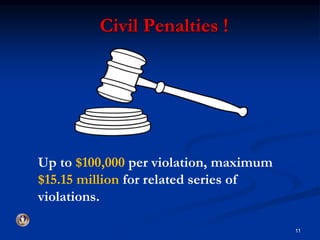
Up to $100,000 per violation, maximum 
$15.15 million for related series of 
violations.
Agenda 
• Section 15 Reporting Obligations 
• Online Reporting 
• Conducting a Recall 
• Staff Determinations 
• Staff-Initiated Investigations 
12
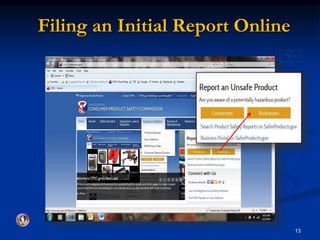
Filing an Initial Report Online 
Fig. 1 
13
Online Reporting 
14
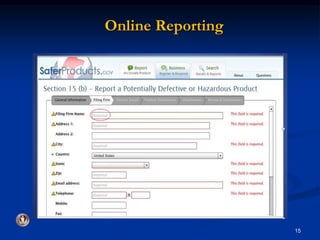
Online Reporting 
15
Online Reporting 
16
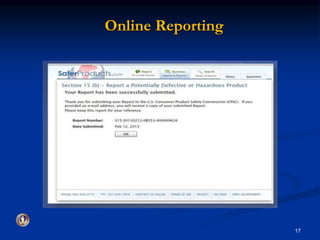
Online Reporting 
17
FAQ 
 Can I send an initial report by email? 
Section15@cpsc.gov 
 Can I send an initial report by fax or mail? 
Yes, but … 
18
Decision Point 
 Do Fast Track Recall: There’s a problem 
with my product, and I want to take 
corrective action by doing a full recall with 
the CPSC; 
OR 
 Proceed with Staff Determination: Because 
I don’t think this issue requires corrective 
action; I’m only willing to take limited 
action; or I’m unsure what to do. 
19
Agenda 
• Section 15 Reporting Obligations 
• Online Reporting 
• Conducting a Recall 
• Staff Determinations 
• Staff-Initiated Investigations 
20
Objectives of a Recall 
 To locate all defective products as quickly as 
possible; 
 To remove or correct defective products in the 
distribution chain and in the possession of 
consumers, and 
 To communicate accurate and understandable 
information in a timely manner to the public 
about the product defect, the hazard, and the 
corrective action. 
21
What is a Fast Track Recall? 
Requirements: 
Firm must initiate an acceptable consumer-level 
recall within 20 working days of report. 
Advantages: 
• Avoids written staff preliminary determination 
of defect and hazard with your product; 
• Reduces technical analysis (focus on notification 
and remedy); 
• Consumers get notice more quickly. 
22
Elements of a Recall 
 Stop production, distribution and retail sales; 
 Submit a Full Report and product samples; 
 Submit a proposed Corrective Action Plan 
(CAP) with remedy (refund/repair/replace); 
 Public notice (consumer letters, website notice, 
retail posters, press release, social media); 
 Monitoring of recall results. 
23
FAQ 
Can I be removed from the 
Fast Track Program? 
24
What is a Corrective Action Plan (CAP)? 
A detailed written proposal that spells out the 
steps the recalling firm will take to capture 
and correct defective products in the 
distribution chain, and in the hands of 
consumers. 
25
Coordination with Retailers 
*Early notificAat Rioenc;all 
*Lock out sales at register and 
online; 
*Isolate stock; 
*Post notices on website; 
*Display Recall Posters; 
*Identify consumer purchasers through 
credit card sales, extended warranty sales, 
etc.
Choosing a Remedy 
Options: 
 Refund 
 Replace 
 Repair 
27
Refund 
 Fastest and easiest for consumers; 
 Should be for full purchase price; 
 Recalled product needs to be returned to 
retailer or shipped back to recalling firm at 
no cost to consumers. 
28
Replacement 
 Must be a comparable product; 
 Staff will need to assess sample of proposed 
replacement, review test reports on product, 
and check for any incidents involving 
replacement product; 
 Recalled product needs to be returned to 
retailer or shipped back to recalling firm at 
no cost to consumers. 
29
Repair 
 Repair programs always need staff review; 
 Can be done by consumer, technician at 
home or local service facility, or pre-paid 
return to recalling firm; 
 If done by consumer, must be easy with 
clear instructions; 
 If tools are required, should be supplied by 
recalling firm. 
30
Consumer Notification 
Goal: To reach as many of the 
owners of the recalled products as 
possible, and provide incentive for 
them to stop using and correct the 
recalled product. 
31
Direct Notice is Best! 
 Email, letter or phone call to known 
purchasers of recalled product. 
* Online/phone purchases 
* Product/warranty registration 
* Replacement part/accessory purchases 
* Service requests 
* Extended warranty customers 
* Loyalty programs 
32
Retail Posters 
 Should be brief, eye-catching, and describe the 
product, the hazard, and what consumers need 
to do; 
 Include the terms “safety” and “recall” in the 
heading; 
 Use a color photo of the product; 
 Should be posted in several conspicuous 
locations in the store for a minimum of 120 
days. 
33
34
Toll-Free Recall Number 
 Have sufficient incoming lines to handle 
call volume; 
 Have live customer service representative 
access during core business hours; 
 Avoid extensive phone menus; 
 Staff will want to review script being used 
by customer service reps. 
35
Website 
 Clear, concise recall information easily 
located on home page or link from home 
page; 
 Online registration for recall; 
 Sufficient bandwidth to handle traffic. 
36
37
Public Notice 
 Press Release: joint notice with wide 
distribution using a standard format. 
 Recall Alert: similar in wording to a press 
release, but with limited distribution. Firm 
must be able to contact all consumers 
directly, and must submit a list of those 
consumers. 
 Video News Release: a video version of the 
written press release for use by the media. 
38
Public Notice 
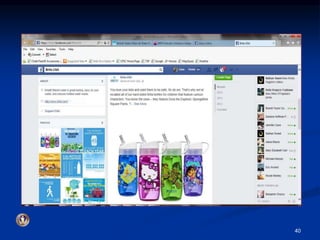
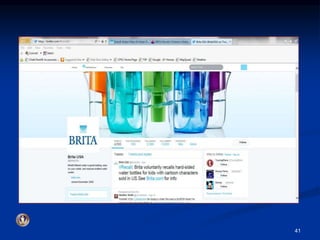
 Social Media: Twitter, Facebook, blogs, 
You Tube. CPSC Office of Communication 
may use Twitter and blogs in conjunction 
with a press release. Firms are expected to 
announce recalls on their media platforms. 
39
40
41
Surviving the Public Notice Process 
Know that: 
 This is a negotiation between the firm, CPSC 
Compliance Officer, and CPSC Office of 
Communication; 
 Office of Communication strives to issue fair, 
accurate and informative communications 
which are easy for consumers to understand and 
are presented in a consistent manner; 
42
 Submit a draft press release in Microsoft 
Word format using our standard captions. 
Recalls involving deaths will be in a narrative 
format. AP Stylebook is used as a guide. 
Don’t expect exceptions! 
 “Clearance” versions of the press release 
from the Office of Communication must still 
go through the agency approval process. On 
occasion, this may result in last-minute 
changes or a delay in the release date. 
43
Other Measures 
 Paid Advertisements 
* Specialty publications 
* National publications 
 Consumer Incentives 
* Gift cards 
* Store credit 
* Free or reduced-price accessories 
44
Reverse Logistics 
Reverse distribution or product return: 
How you get the product back from the 
distribution channel. 
The goal is to avoid having recalled 
products put back into commerce. 
45
 Need to know where your recalled 
products are at all times; 
 Need to ensure that third-party 
contractors and retailers are following the 
disposition program; 
 It is illegal to sell recalled products! 
46
Recall Monitoring 
 Recalling firm must submit Monthly 
Progress Reports which track: 
* Number of products corrected; 
* Reports of pre- and post-recall incidents; 
* Notification methods used. 
47
CPSC Staff Recall Monitoring 
 Field staff conducts Recall Verification 
Inspections at recalling firm; 
 Field staff and/or state investigators conduct 
Recall Checks at point of sale; 
 Internet Surveillance Unit checks for online 
sales of recalled products; 
 Compliance staff monitors correction results 
and new incidents to assess effectiveness 
48
FAQ 
What happens if I report but I don’t choose to 
do a Fast Track Recall? 
49
Agenda 
• Section 15 Reporting Obligations 
• Online Reporting 
• Conducting a Recall 
• Staff Determinations 
• Staff-Initiated Investigations 
50
Staff Determinations 
Staff investigates whether the product 
contains a defect, and whether that defect 
presents a risk of injury that rises to the level 
of a substantial product hazard. 
51
What is a defect? 
A flaw, fault, or irregularity that causes 
weakness, failure, or inadequacy in the form 
or function of a product. 
52
Defects can stem from: 
 Manufacturing 
 Production/assembly 
 Design 
 Materials used 
 Construction 
 Finish 
 Packaging 
 Warnings 
 Instructions 
 Failure to operate as intended 
53
Substantial Product Hazard (SPH) 
(1) A failure to comply with an applicable 
consumer product safety rule which creates a 
substantial risk of injury to the public, or 
(2) A product defect which creates a substantial 
risk of injury to the public. 
54
Factors to Consider 
 Pattern of defect 
 Number of defective products distributed in 
commerce 
 Severity of risk 
 Likelihood of injury 
55
Staff Assessment Tools 
 Incident analysis; 
 Staff technical evaluation of defect and risk by 
electrical, mechanical, chemical and fire science 
engineers, health scientists, and industrial 
psychologists; 
 Legal guidance from staff attorneys. 
56
Preliminary Determination (PD) 
 Staff’s finding on defect and substantial 
product hazard; 
 Decision reached by panel including the 
compliance officer, engineers, compliance 
attorney and Compliance management; 
 Firm is notified in writing of the decision. 
May result in a request for corrective action 
(recall). 
57
Agenda 
• Section 15 Reporting Obligations 
• Online Reporting 
• Conducting a Recall 
• Staff Determinations 
• Staff-Initiated Investigations 
58
Staff-Initiated Investigation 
An investigation launched by Compliance 
staff as a result of information it receives 
suggesting a possible product defect that 
could lead to a risk of injury. 
59
Sources 
 Consumer incident reports; 
 In-depth investigations by field staff; 
 News reports; 
 Notice from fire officials; 
 Website product reviews and complaints; 
 Trade complaints; 
 Congressional inquiries; 
 Medical examiner reports and death certificates; 
 Hospital reports. 
60
Process 
 As with the staff determination, investigation 
includes technical analysis of defect and hazard. 
Full Report may or may not be requested from 
firm. 
 If staff evaluation finds a defect and significant 
risk of injury, firm will be requested to take 
corrective action (recall). 
61
Civil Penalties ! 
62 
Up to $100,000 per violation, maximum 
$15.15 million for related series of 
violations.
Industry Guidance: 
www.cpsc.gov 
Business & Manufacturing 
Recall 
Guidance 
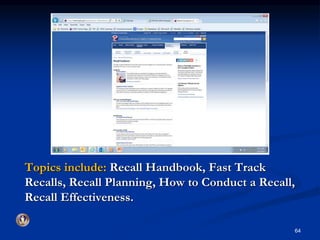
63
Topics include: Recall Handbook, Fast Track 
Recalls, Recall Planning, How to Conduct a Recall, 
Recall Effectiveness. 
64
The U.S. Consumer Product Safety Commission 
is charged with protecting the public from 
unreasonable risks of serious injury and death 
from over 15,000 types of products used by 
consumers. 
65
Contacts 
 Tanya Topka, Team Lead, Fast Track Team 
(301) 504-7594, ttopka@cpsc.gov 
 Blake Rose, Team Lead, Electrical, Fire and Mechanical 
Hazard Team 
(301) 504-7613, brose@cpsc.gov 
 Renae Rauchschwalbe, Team Lead, Children’s Hazards 
Team 
(301) 504-7664, rrauchschwalbe@cpsc.gov 
 Scott Simmons, Director, Defect Investigations Division 
(301) 504-7574, ssimmons@cpsc.gov 
66

Sec. 15 Reporting Requirements, Corrective Action Plans, and Investigations

  • 1.
    ICPHSO Midwest Regional Product Safety Training Workshop Sec. 15 Reporting Requirements, Corrective Action Plans, and Investigations Blake Rose, Lead Compliance Officer Views expressed in this presentation are those of the staff and do not necessarily represent the views of the Commission.
  • 2.
    Office of Compliance • Regulatory Enforcement Division • Defect Investigations Division - Fast Track Team - Children’s Hazards Team - Electrical, Fire and Mechanical Hazards Team 2
  • 3.
    Agenda • Section15 Reporting Obligations • Online Reporting • Conducting a Recall • Staff Determinations • Staff-Initiated Investigations 3
  • 4.
    Reporting Requirements 4  Section 15(b) of the Consumer Product Safety Act establishes reporting requirements for manufacturers, importers, distributors and retailers of consumer products, over which the Commission has jurisdiction.  Each must notify the Commission immediately if it obtains information which reasonably supports the conclusion that a product distributed in commerce:
  • 5.
    Reporting Requirements (1) fails to comply with an applicable consumer product safety rule or with a voluntary consumer product safety standard upon which the Commission has relied, or 5
  • 6.
    Reporting Requirements (2) fails to comply with any other rule, regulation, standard or ban under the CPSA or any other Act enforced by the Commission, including the: Flammable Fabrics Act;  Federal Hazardous Substances Act;  Children’s Gasoline Burn Prevention Act;  Virginia Graeme Baker Pool and Spa Safety Act;  Poison Prevention Packaging Act;  Refrigerator Safety Act; or 6
  • 7.
    Reporting Requirements (3) contains a defect which could create a substantial product hazard, or  (4) creates an unreasonable risk of serious injury or death. 7
  • 8.
    How quickly mustI report? * Firm must report “immediately” once information “reasonably supports the conclusion” that a safety issue exists. * “Immediately” means within 24 hours, but firms may conduct “reasonably expeditious” investigation. * Investigations should not usually exceed ten working days. 8
  • 9.
    Reporting Do’s andDon’ts * Don’t assume that an incident without injury means there’s no problem. * Do evaluate product failures to determine what could have occurred in worst case. * Don’t wait to finish exhaustive investigation before telling CPSC . 9
  • 10.
    FAQ What canhappen if I don’t report? 10
  • 11.
    Civil Penalties ! 11 Up to $100,000 per violation, maximum $15.15 million for related series of violations.
  • 12.
    Agenda • Section15 Reporting Obligations • Online Reporting • Conducting a Recall • Staff Determinations • Staff-Initiated Investigations 12
  • 13.
    Filing an InitialReport Online Fig. 1 13
  • 14.
  • 15.
  • 16.
  • 17.
  • 18.
    FAQ  CanI send an initial report by email? Section15@cpsc.gov  Can I send an initial report by fax or mail? Yes, but … 18
  • 19.
    Decision Point Do Fast Track Recall: There’s a problem with my product, and I want to take corrective action by doing a full recall with the CPSC; OR  Proceed with Staff Determination: Because I don’t think this issue requires corrective action; I’m only willing to take limited action; or I’m unsure what to do. 19
  • 20.
    Agenda • Section15 Reporting Obligations • Online Reporting • Conducting a Recall • Staff Determinations • Staff-Initiated Investigations 20
  • 21.
    Objectives of aRecall  To locate all defective products as quickly as possible;  To remove or correct defective products in the distribution chain and in the possession of consumers, and  To communicate accurate and understandable information in a timely manner to the public about the product defect, the hazard, and the corrective action. 21
  • 22.
    What is aFast Track Recall? Requirements: Firm must initiate an acceptable consumer-level recall within 20 working days of report. Advantages: • Avoids written staff preliminary determination of defect and hazard with your product; • Reduces technical analysis (focus on notification and remedy); • Consumers get notice more quickly. 22
  • 23.
    Elements of aRecall  Stop production, distribution and retail sales;  Submit a Full Report and product samples;  Submit a proposed Corrective Action Plan (CAP) with remedy (refund/repair/replace);  Public notice (consumer letters, website notice, retail posters, press release, social media);  Monitoring of recall results. 23
  • 24.
    FAQ Can Ibe removed from the Fast Track Program? 24
  • 25.
    What is aCorrective Action Plan (CAP)? A detailed written proposal that spells out the steps the recalling firm will take to capture and correct defective products in the distribution chain, and in the hands of consumers. 25
  • 26.
    Coordination with Retailers *Early notificAat Rioenc;all *Lock out sales at register and online; *Isolate stock; *Post notices on website; *Display Recall Posters; *Identify consumer purchasers through credit card sales, extended warranty sales, etc.
  • 27.
    Choosing a Remedy Options:  Refund  Replace  Repair 27
  • 28.
    Refund  Fastestand easiest for consumers;  Should be for full purchase price;  Recalled product needs to be returned to retailer or shipped back to recalling firm at no cost to consumers. 28
  • 29.
    Replacement  Mustbe a comparable product;  Staff will need to assess sample of proposed replacement, review test reports on product, and check for any incidents involving replacement product;  Recalled product needs to be returned to retailer or shipped back to recalling firm at no cost to consumers. 29
  • 30.
    Repair  Repairprograms always need staff review;  Can be done by consumer, technician at home or local service facility, or pre-paid return to recalling firm;  If done by consumer, must be easy with clear instructions;  If tools are required, should be supplied by recalling firm. 30
  • 31.
    Consumer Notification Goal:To reach as many of the owners of the recalled products as possible, and provide incentive for them to stop using and correct the recalled product. 31
  • 32.
    Direct Notice isBest!  Email, letter or phone call to known purchasers of recalled product. * Online/phone purchases * Product/warranty registration * Replacement part/accessory purchases * Service requests * Extended warranty customers * Loyalty programs 32
  • 33.
    Retail Posters Should be brief, eye-catching, and describe the product, the hazard, and what consumers need to do;  Include the terms “safety” and “recall” in the heading;  Use a color photo of the product;  Should be posted in several conspicuous locations in the store for a minimum of 120 days. 33
  • 34.
  • 35.
    Toll-Free Recall Number  Have sufficient incoming lines to handle call volume;  Have live customer service representative access during core business hours;  Avoid extensive phone menus;  Staff will want to review script being used by customer service reps. 35
  • 36.
    Website  Clear,concise recall information easily located on home page or link from home page;  Online registration for recall;  Sufficient bandwidth to handle traffic. 36
  • 37.
  • 38.
    Public Notice Press Release: joint notice with wide distribution using a standard format.  Recall Alert: similar in wording to a press release, but with limited distribution. Firm must be able to contact all consumers directly, and must submit a list of those consumers.  Video News Release: a video version of the written press release for use by the media. 38
  • 39.
    Public Notice Social Media: Twitter, Facebook, blogs, You Tube. CPSC Office of Communication may use Twitter and blogs in conjunction with a press release. Firms are expected to announce recalls on their media platforms. 39
  • 40.
  • 41.
  • 42.
    Surviving the PublicNotice Process Know that:  This is a negotiation between the firm, CPSC Compliance Officer, and CPSC Office of Communication;  Office of Communication strives to issue fair, accurate and informative communications which are easy for consumers to understand and are presented in a consistent manner; 42
  • 43.
     Submit adraft press release in Microsoft Word format using our standard captions. Recalls involving deaths will be in a narrative format. AP Stylebook is used as a guide. Don’t expect exceptions!  “Clearance” versions of the press release from the Office of Communication must still go through the agency approval process. On occasion, this may result in last-minute changes or a delay in the release date. 43
  • 44.
    Other Measures Paid Advertisements * Specialty publications * National publications  Consumer Incentives * Gift cards * Store credit * Free or reduced-price accessories 44
  • 45.
    Reverse Logistics Reversedistribution or product return: How you get the product back from the distribution channel. The goal is to avoid having recalled products put back into commerce. 45
  • 46.
     Need toknow where your recalled products are at all times;  Need to ensure that third-party contractors and retailers are following the disposition program;  It is illegal to sell recalled products! 46
  • 47.
    Recall Monitoring Recalling firm must submit Monthly Progress Reports which track: * Number of products corrected; * Reports of pre- and post-recall incidents; * Notification methods used. 47
  • 48.
    CPSC Staff RecallMonitoring  Field staff conducts Recall Verification Inspections at recalling firm;  Field staff and/or state investigators conduct Recall Checks at point of sale;  Internet Surveillance Unit checks for online sales of recalled products;  Compliance staff monitors correction results and new incidents to assess effectiveness 48
  • 49.
    FAQ What happensif I report but I don’t choose to do a Fast Track Recall? 49
  • 50.
    Agenda • Section15 Reporting Obligations • Online Reporting • Conducting a Recall • Staff Determinations • Staff-Initiated Investigations 50
  • 51.
    Staff Determinations Staffinvestigates whether the product contains a defect, and whether that defect presents a risk of injury that rises to the level of a substantial product hazard. 51
  • 52.
    What is adefect? A flaw, fault, or irregularity that causes weakness, failure, or inadequacy in the form or function of a product. 52
  • 53.
    Defects can stemfrom:  Manufacturing  Production/assembly  Design  Materials used  Construction  Finish  Packaging  Warnings  Instructions  Failure to operate as intended 53
  • 54.
    Substantial Product Hazard(SPH) (1) A failure to comply with an applicable consumer product safety rule which creates a substantial risk of injury to the public, or (2) A product defect which creates a substantial risk of injury to the public. 54
  • 55.
    Factors to Consider  Pattern of defect  Number of defective products distributed in commerce  Severity of risk  Likelihood of injury 55
  • 56.
    Staff Assessment Tools  Incident analysis;  Staff technical evaluation of defect and risk by electrical, mechanical, chemical and fire science engineers, health scientists, and industrial psychologists;  Legal guidance from staff attorneys. 56
  • 57.
    Preliminary Determination (PD)  Staff’s finding on defect and substantial product hazard;  Decision reached by panel including the compliance officer, engineers, compliance attorney and Compliance management;  Firm is notified in writing of the decision. May result in a request for corrective action (recall). 57
  • 58.
    Agenda • Section15 Reporting Obligations • Online Reporting • Conducting a Recall • Staff Determinations • Staff-Initiated Investigations 58
  • 59.
    Staff-Initiated Investigation Aninvestigation launched by Compliance staff as a result of information it receives suggesting a possible product defect that could lead to a risk of injury. 59
  • 60.
    Sources  Consumerincident reports;  In-depth investigations by field staff;  News reports;  Notice from fire officials;  Website product reviews and complaints;  Trade complaints;  Congressional inquiries;  Medical examiner reports and death certificates;  Hospital reports. 60
  • 61.
    Process  Aswith the staff determination, investigation includes technical analysis of defect and hazard. Full Report may or may not be requested from firm.  If staff evaluation finds a defect and significant risk of injury, firm will be requested to take corrective action (recall). 61
  • 62.
    Civil Penalties ! 62 Up to $100,000 per violation, maximum $15.15 million for related series of violations.
  • 63.
    Industry Guidance: www.cpsc.gov Business & Manufacturing Recall Guidance 63
  • 64.
    Topics include: RecallHandbook, Fast Track Recalls, Recall Planning, How to Conduct a Recall, Recall Effectiveness. 64
  • 65.
    The U.S. ConsumerProduct Safety Commission is charged with protecting the public from unreasonable risks of serious injury and death from over 15,000 types of products used by consumers. 65
  • 66.
    Contacts  TanyaTopka, Team Lead, Fast Track Team (301) 504-7594, ttopka@cpsc.gov  Blake Rose, Team Lead, Electrical, Fire and Mechanical Hazard Team (301) 504-7613, brose@cpsc.gov  Renae Rauchschwalbe, Team Lead, Children’s Hazards Team (301) 504-7664, rrauchschwalbe@cpsc.gov  Scott Simmons, Director, Defect Investigations Division (301) 504-7574, ssimmons@cpsc.gov 66