Dr. Vishnu A. Adole
Mahatma Gandhi Vidyamandir’s
Arts, Science and Commerce
College, Manmad
Rearrangement
Reactions
D R . V I S H N U A . A D O L E , M G V ' S A S C C O L L E G E , M A N M A D 2
This content is made for Undergraduate level as per SPPU, Pune Syllabus
Content
1. Introduction
2. Cross-over experiment
3. Pinacol-Pinacolone Rearrangement
4. Favorskii Rearrangement
5. Curtius Rearrangement
6. Beckman Rearrangement
7. Baeyer-Villiger Rearrangement
8. Claisen Rearrangement
D R . V I S H N U A . A D O L E , M G V ' S A S C C O L L E G E , M A N M A D 3
You should know reaction intermediates and transition state
before you start the journey of rearrangement reactions-
1. Carbocation
2. Carbanion
3. Carbene
4. Nitrene
5. Transition state
D R . V I S H N U A . A D O L E , M G V ' S A S C C O L L E G E , M A N M A D 4
INTRODUCTION
 Reactions are classified as addition, substitution, elimination, condensation,
rearrangement, pericyclic and redox reactions.
 Organic reactions usually end up with the products that are in the line with the most
accepted mechanisms. Consequently, the products are often called as Normal
products.
 In many cases, reactions lead to the formation of products by different reaction
pathways. These products are referred as rearranged products or abnormal products.
 The rearranged product is sometimes not only the abnormal but also the major one.
 This may occur from a plausible rearrangement occurring during the course of
reaction to fulfil the principle of minimum energy T.S. or intermediate.
 So, it becomes very important to understand each and every concept involved in the
rearrangement reactions. In rearrangement reactions atoms or group migrates from
one position to another, resulting in reorganization of starting material.
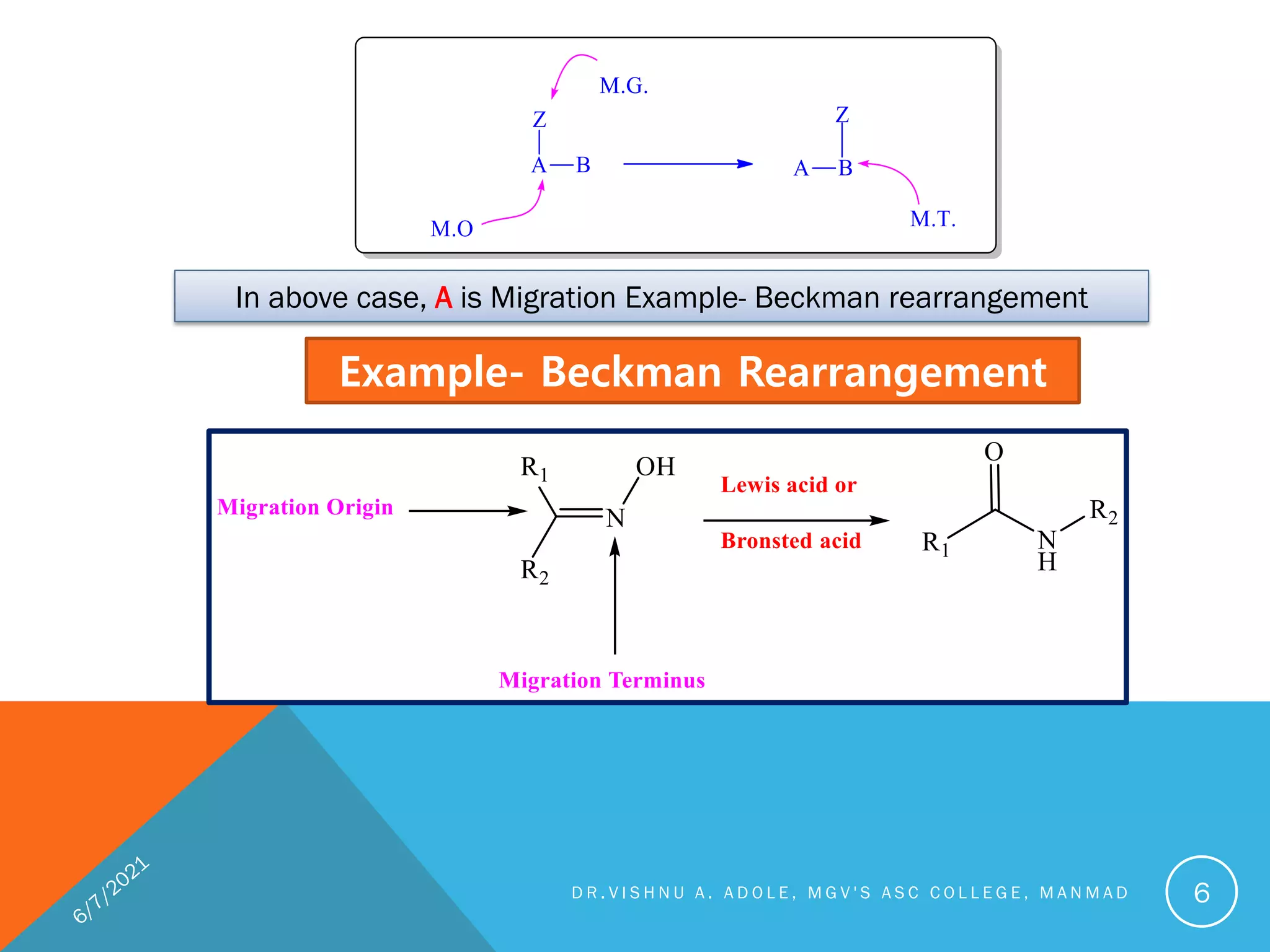
 The position from which the group or atom migrates is known as Migration Origin and
the position to which it migrates in rearrangement reaction is known as Migration
 Terminus.
D R . V I S H N U A . A D O L E , M G V ' S A S C C O L L E G E , M A N M A D 5
In above case, A is Migration Example- Beckman rearrangement
Example- Beckman Rearrangement
D R . V I S H N U A . A D O L E , M G V ' S A S C C O L L E G E , M A N M A D 6
CROSSOVER EXPERIMENT
 In rearrangement reactions, the important thing is to predict whether reaction
proceeds via intramolecular or intermolecular pathway.
 The solution for this is crossover experiment.
 In crossover experiment, mixture of starting products that differ from each other
only in one characteristic group are subjected to rearrangement reaction and
products are examined.
 The product then tells us whether reaction involves intramolecular or
intermolecular pathway.
 The intramolecular mechanism would form only normal products whereas
intermolecular mechanism would form normal along with cross products.
D R . V I S H N U A . A D O L E , M G V ' S A S C C O L L E G E , M A N M A D 7
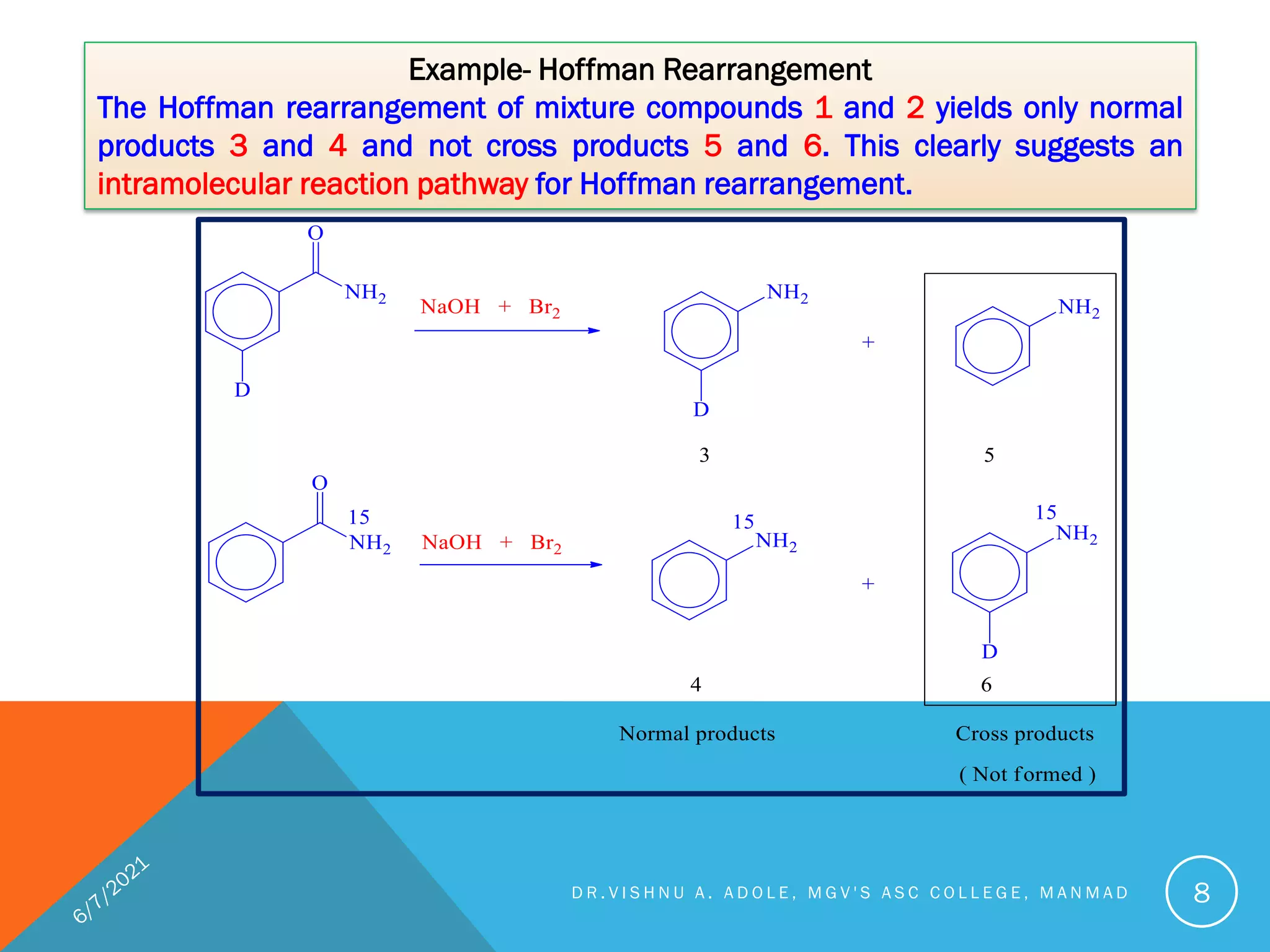
Example- Hoffman Rearrangement
The Hoffman rearrangement of mixture compounds 1 and 2 yields only normal
products 3 and 4 and not cross products 5 and 6. This clearly suggests an
intramolecular reaction pathway for Hoffman rearrangement.
D R . V I S H N U A . A D O L E , M G V ' S A S C C O L L E G E , M A N M A D 8
PINACOL – PINACOLONE
REARRANGEMENT
D R . V I S H N U A . A D O L E , M G V ' S A S C C O L L E G E , M A N M A D 9
PINACOL – PINACOLONE REARRANGEMENT
The acid catalyzed transformation of Vicinal diols [1, 2 diols] to ketones or
aldehydes is known as Pinacol - Pinacolone Rearrangement.
General reaction
D R . V I S H N U A . A D O L E , M G V ' S A S C C O L L E G E , M A N M A D 10
Mechanism
D R . V I S H N U A . A D O L E , M G V ' S A S C C O L L E G E , M A N M A D 11
Important features
D R . V I S H N U A . A D O L E , M G V ' S A S C C O L L E G E , M A N M A D 12
1. The rearrangement is intramolecular. The migrating group
starts forming bond with molecular terminus before
departing from molecular origin. This has been confirmed by
crossover experiment. No cross products are isolated in this
rearrangement.
D R . V I S H N U A . A D O L E , M G V ' S A S C C O L L E G E , M A N M A D 13
2. Stereo electric requirement:
The migrating and leaving group should be trans to each
other.
D R . V I S H N U A . A D O L E , M G V ' S A S C C O L L E G E , M A N M A D 14
3. If migrating atom is chiral, it retains its
configuration. The migrating group starts forming the
bond with migration terminus before it gets completely
detached from the molecular origin. Therefore,
retention of configuration is observed.
D R . V I S H N U A . A D O L E , M G V ' S A S C C O L L E G E , M A N M A D 15
4. Migratory aptitude
The ease with which particular group migrates in preference to another is known as its
migratory aptitude.
Migratory aptitude amongst aryl and alkyl groups:
The electron donating group at para and meta position increases migratory aptitude
while electron withdrawing groups decrease migratory aptitude. Due to steric
interference of ortho substituent, o-substituted aryls have less migratory aptitude than
para and meta substituted aryls. The migratory aptitude amongst some aryl groups,
D R . V I S H N U A . A D O L E , M G V ' S A S C C O L L E G E , M A N M A D 16
The migratory aptitude amongst the alkyl groups is,
The general migration order is,
D R . V I S H N U A . A D O L E , M G V ' S A S C C O L L E G E , M A N M A D 17
5. There are two important points about unsymmetrical diols in
pinacol-pinacolone rearrangement.
 Protonate that –OH which gives more stable carbocation.
 Migrate that group which is having more migratory aptitude i.e.
more electron rich or which is better to provide electron density
more readily. To explain this, let’s consider following two examples
D R . V I S H N U A . A D O L E , M G V ' S A S C C O L L E G E , M A N M A D 18
A B
D R . V I S H N U A . A D O L E , M G V ' S A S C C O L L E G E , M A N M A D 19
A B
D R . V I S H N U A . A D O L E , M G V ' S A S C C O L L E G E , M A N M A D 20
D R . V I S H N U A . A D O L E , M G V ' S A S C C O L L E G E , M A N M A D 21
Examples for practice
D R . V I S H N U A . A D O L E , M G V ' S A S C C O L L E G E , M A N M A D 22
D R . V I S H N U A . A D O L E , M G V ' S A S C C O L L E G E , M A N M A D 23
D R . V I S H N U A . A D O L E , M G V ' S A S C C O L L E G E , M A N M A D 24
D R . V I S H N U A . A D O L E , M G V ' S A S C C O L L E G E , M A N M A D 25
D R . V I S H N U A . A D O L E , M G V ' S A S C C O L L E G E , M A N M A D 26
FAVORSKII
REARRANGEMENT
D R . V I S H N U A . A D O L E , M G V ' S A S C C O L L E G E , M A N M A D 27
 The α-haloketones having at least one α -hydrogen on treatment with base in the
presence of a nucleophile undergo a rearrangement via cyclopropane to give
carboxylic acid and carboxylic acid derivatives is known as Favorskii
rearrangement.
 The nucleophiles can be alcohol, water or amines. Very strict requirement for a
Favorskii rearrangement is presence of α -hydrogen at non-halogenated α -
position.
FAVORSKII REARRANGEMENT
General reaction
D R . V I S H N U A . A D O L E , M G V ' S A S C C O L L E G E , M A N M A D 28
Mechanism
D R . V I S H N U A . A D O L E , M G V ' S A S C C O L L E G E , M A N M A D 29
When R is EWG Major
Minor
Important features
D R . V I S H N U A . A D O L E , M G V ' S A S C C O L L E G E , M A N M A D 30
1. The halogen substituent can be a chlorine, bromine or
iodine and the base is usually an alkoxide or hydroxide.
D R . V I S H N U A . A D O L E , M G V ' S A S C C O L L E G E , M A N M A D 31
2. Acyclic halo ketones give carboxylic acid derivative whereas cyclic
ketone give cyclic acid derivative with ring contraction.
Example
Compound A (2-chorocyclohexanone) gives compound B when subjected Favorskii
rearrangement with NaOMe / MeOH
A B
D R . V I S H N U A . A D O L E , M G V ' S A S C C O L L E G E , M A N M A D 32
D R . V I S H N U A . A D O L E , M G V ' S A S C C O L L E G E , M A N M A D 33
3. The reaction is regio-selective when goes through unsymmetrical cyclopropanone
intermediate. The unsymmetrical cyclopropanone opens in two ways leading to the
formation of mixture of two products in unequal amount.
The compound X on treatment with NaOMe/MeOH gives Y and Z .
X Y Z
D R . V I S H N U A . A D O L E , M G V ' S A S C C O L L E G E , M A N M A D 34
D R . V I S H N U A . A D O L E , M G V ' S A S C C O L L E G E , M A N M A D 35
Examples
D R . V I S H N U A . A D O L E , M G V ' S A S C C O L L E G E , M A N M A D 36
D R . V I S H N U A . A D O L E , M G V ' S A S C C O L L E G E , M A N M A D 37
D R . V I S H N U A . A D O L E , M G V ' S A S C C O L L E G E , M A N M A D 38
CURTIUS
REARRANGEMENT
D R . V I S H N U A . A D O L E , M G V ' S A S C C O L L E G E , M A N M A D 39
The thermal decomposition of acyl azide to isocynate is known as Curtius
rearrangement. If the reaction is carried out in the presence of water, alcohol or
amine, the products are amines, carbamates and urea derivatives respectively.
CURTIUS REARRANGEMENT
General reaction
Acyl azide can be prepared by several ways.
The most common reaction is reaction of acid chloride with alkali azide.
D R . V I S H N U A . A D O L E , M G V ' S A S C C O L L E G E , M A N M A D 40
Mechanism
D R . V I S H N U A . A D O L E , M G V ' S A S C C O L L E G E , M A N M A D 41
Examples
D R . V I S H N U A . A D O L E , M G V ' S A S C C O L L E G E , M A N M A D 42
D R . V I S H N U A . A D O L E , M G V ' S A S C C O L L E G E , M A N M A D 43
D R . V I S H N U A . A D O L E , M G V ' S A S C C O L L E G E , M A N M A D 44
BECKMANN
REARRANGEMENT
D R . V I S H N U A . A D O L E , M G V ' S A S C C O L L E G E , M A N M A D 45
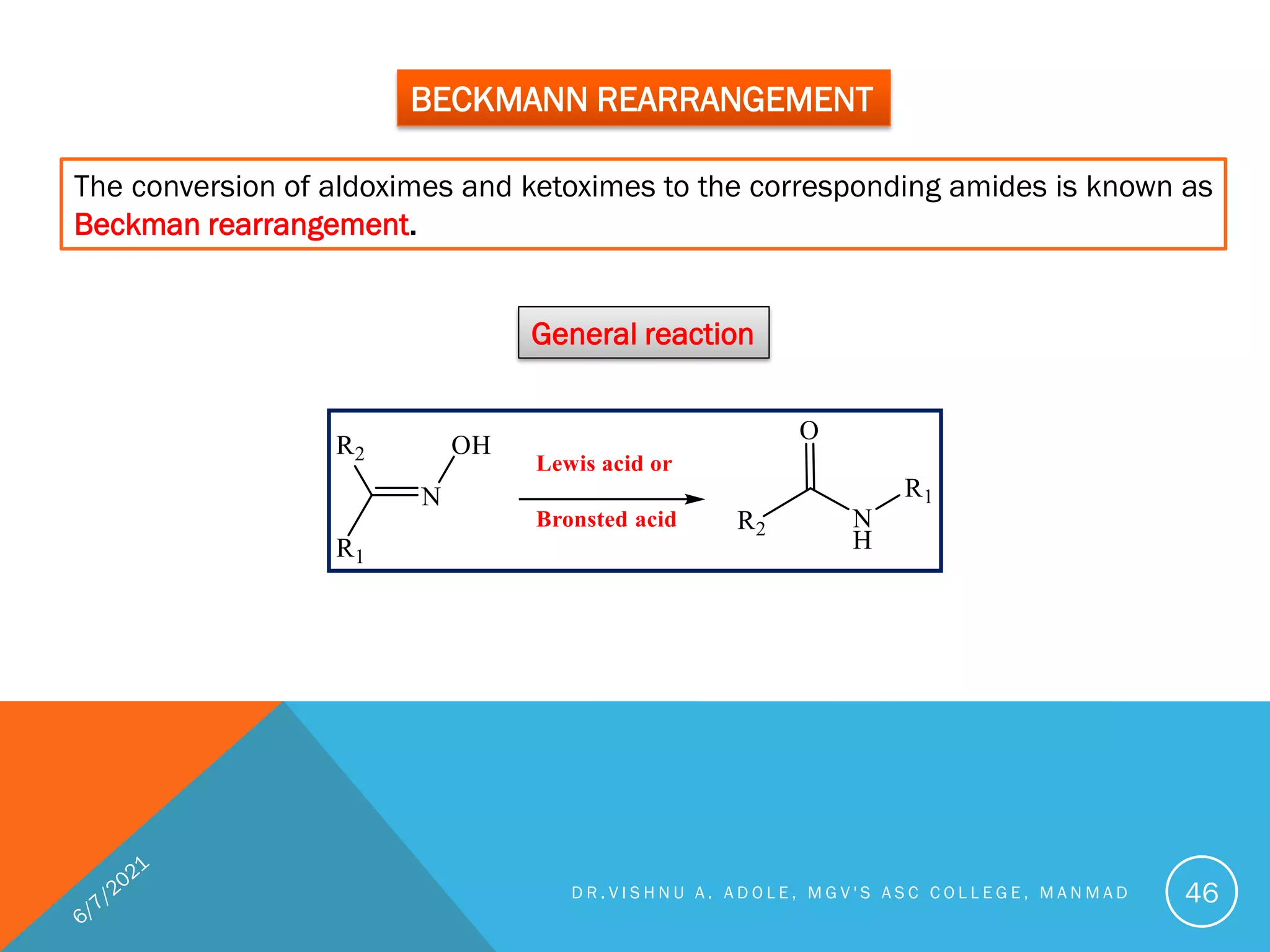
The conversion of aldoximes and ketoximes to the corresponding amides is known as
Beckman rearrangement.
BECKMANN REARRANGEMENT
General reaction
D R . V I S H N U A . A D O L E , M G V ' S A S C C O L L E G E , M A N M A D 46
Mechanism
D R . V I S H N U A . A D O L E , M G V ' S A S C C O L L E G E , M A N M A D 47
Stereo chemical aspect
Beckman rearrangement is often used as a method to determine the initial
configuration of oxime. Let’s observe oxime A and B (general structures are given).
The migratory group approaches nitrogen atom from side opposite to leaving group i.e.
the group which is anti to hydroxyl group migrates. Hence, in Beckman rearrangement
migration of the group depends upon its orientation and not on migratory aptitude.
D R . V I S H N U A . A D O L E , M G V ' S A S C C O L L E G E , M A N M A D 48
Cyclic ketones give lactams on Beckman rearrangement. Cyclopentanone gives δ-
lactam on Beckman rearrangement
Very important use of this method is a
preparation of very famous polymer nylon-6.
D R . V I S H N U A . A D O L E , M G V ' S A S C C O L L E G E , M A N M A D 49
D R . V I S H N U A . A D O L E , M G V ' S A S C C O L L E G E , M A N M A D 50
Beckman rearrangement starting from unsymmetrical ketones
Minor
Major
Less stable-Minor
More stable-Minor
D R . V I S H N U A . A D O L E , M G V ' S A S C C O L L E G E , M A N M A D 51
D R . V I S H N U A . A D O L E , M G V ' S A S C C O L L E G E , M A N M A D 52
D R . V I S H N U A . A D O L E , M G V ' S A S C C O L L E G E , M A N M A D 53
D R . V I S H N U A . A D O L E , M G V ' S A S C C O L L E G E , M A N M A D 54
BAEYER-VILLIGER
REARRANGEMENT
D R . V I S H N U A . A D O L E , M G V ' S A S C C O L L E G E , M A N M A D 55
BAEYER-VILLIGER REARRANGEMENT (Oxidation)
Baeyer-Villiger rearrangement involves the conversion of acyclic ketones into ester and
cyclic ketones into lactones by using peroxyacids.
General reaction
The overall reaction is
insertion of oxygen atom
between carbonyl group
and the adjacent alkyl or
aryl group.
D R . V I S H N U A . A D O L E , M G V ' S A S C C O L L E G E , M A N M A D 56
Mechanism
D R . V I S H N U A . A D O L E , M G V ' S A S C C O L L E G E , M A N M A D 57
The regio-selectivity of oxygen insertion depends upon the migratory aptitude and ability
of that group to stabilize positive charge in the transition state.
The group with more electron density can stabilize positive charge very well and therefore
migrates preferentially. The migratory aptitude of different groups is as follows:
3° alkyl >2° alkyl > phenyl > 1° alkyl > methyl
D R . V I S H N U A . A D O L E , M G V ' S A S C C O L L E G E , M A N M A D 58
Examples
D R . V I S H N U A . A D O L E , M G V ' S A S C C O L L E G E , M A N M A D 59
D R . V I S H N U A . A D O L E , M G V ' S A S C C O L L E G E , M A N M A D 60
D R . V I S H N U A . A D O L E , M G V ' S A S C C O L L E G E , M A N M A D 61
D R . V I S H N U A . A D O L E , M G V ' S A S C C O L L E G E , M A N M A D 62
D R . V I S H N U A . A D O L E , M G V ' S A S C C O L L E G E , M A N M A D 63
CLAISEN
REARRANGEMENT
D R . V I S H N U A . A D O L E , M G V ' S A S C C O L L E G E , M A N M A D 64
The thermal [3,3]-sigmatropic rearrangement of allyl-vinyl ethers to the corresponding
γ,δ-unsaturated carbonyl compound is called Claisen rearrangement. When allyl phenyl
ethers are used as reactants, the rearrangement is called as aromatic Claisen
rearrangement.
CLAISEN REARRANGEMENT
General reaction
Aliphatic Claisen rearrangement Aliphatic Claisen rearrangement
Allyl vinyl
ether
g,d-
unstaurated
aldehyde
Allyl phenyl
ether
o-Allyl phenol
D R . V I S H N U A . A D O L E , M G V ' S A S C C O L L E G E , M A N M A D 65
Mechanism
Aliphatic Claisen rearrangement
Aromatic Claisen rearrangement
D R . V I S H N U A . A D O L E , M G V ' S A S C C O L L E G E , M A N M A D 66
Examples
D R . V I S H N U A . A D O L E , M G V ' S A S C C O L L E G E , M A N M A D 67
D R . V I S H N U A . A D O L E , M G V ' S A S C C O L L E G E , M A N M A D 68
D R . V I S H N U A . A D O L E , M G V ' S A S C C O L L E G E , M A N M A D 69

Rearrangement reactions

  • 1.
    Dr. Vishnu A.Adole Mahatma Gandhi Vidyamandir’s Arts, Science and Commerce College, Manmad
  • 2.
    Rearrangement Reactions D R .V I S H N U A . A D O L E , M G V ' S A S C C O L L E G E , M A N M A D 2 This content is made for Undergraduate level as per SPPU, Pune Syllabus
  • 3.
    Content 1. Introduction 2. Cross-overexperiment 3. Pinacol-Pinacolone Rearrangement 4. Favorskii Rearrangement 5. Curtius Rearrangement 6. Beckman Rearrangement 7. Baeyer-Villiger Rearrangement 8. Claisen Rearrangement D R . V I S H N U A . A D O L E , M G V ' S A S C C O L L E G E , M A N M A D 3
  • 4.
    You should knowreaction intermediates and transition state before you start the journey of rearrangement reactions- 1. Carbocation 2. Carbanion 3. Carbene 4. Nitrene 5. Transition state D R . V I S H N U A . A D O L E , M G V ' S A S C C O L L E G E , M A N M A D 4
  • 5.
    INTRODUCTION  Reactions areclassified as addition, substitution, elimination, condensation, rearrangement, pericyclic and redox reactions.  Organic reactions usually end up with the products that are in the line with the most accepted mechanisms. Consequently, the products are often called as Normal products.  In many cases, reactions lead to the formation of products by different reaction pathways. These products are referred as rearranged products or abnormal products.  The rearranged product is sometimes not only the abnormal but also the major one.  This may occur from a plausible rearrangement occurring during the course of reaction to fulfil the principle of minimum energy T.S. or intermediate.  So, it becomes very important to understand each and every concept involved in the rearrangement reactions. In rearrangement reactions atoms or group migrates from one position to another, resulting in reorganization of starting material.  The position from which the group or atom migrates is known as Migration Origin and the position to which it migrates in rearrangement reaction is known as Migration  Terminus. D R . V I S H N U A . A D O L E , M G V ' S A S C C O L L E G E , M A N M A D 5
  • 6.
    In above case,A is Migration Example- Beckman rearrangement Example- Beckman Rearrangement D R . V I S H N U A . A D O L E , M G V ' S A S C C O L L E G E , M A N M A D 6
  • 7.
    CROSSOVER EXPERIMENT  Inrearrangement reactions, the important thing is to predict whether reaction proceeds via intramolecular or intermolecular pathway.  The solution for this is crossover experiment.  In crossover experiment, mixture of starting products that differ from each other only in one characteristic group are subjected to rearrangement reaction and products are examined.  The product then tells us whether reaction involves intramolecular or intermolecular pathway.  The intramolecular mechanism would form only normal products whereas intermolecular mechanism would form normal along with cross products. D R . V I S H N U A . A D O L E , M G V ' S A S C C O L L E G E , M A N M A D 7
  • 8.
    Example- Hoffman Rearrangement TheHoffman rearrangement of mixture compounds 1 and 2 yields only normal products 3 and 4 and not cross products 5 and 6. This clearly suggests an intramolecular reaction pathway for Hoffman rearrangement. D R . V I S H N U A . A D O L E , M G V ' S A S C C O L L E G E , M A N M A D 8
  • 9.
    PINACOL – PINACOLONE REARRANGEMENT DR . V I S H N U A . A D O L E , M G V ' S A S C C O L L E G E , M A N M A D 9
  • 10.
    PINACOL – PINACOLONEREARRANGEMENT The acid catalyzed transformation of Vicinal diols [1, 2 diols] to ketones or aldehydes is known as Pinacol - Pinacolone Rearrangement. General reaction D R . V I S H N U A . A D O L E , M G V ' S A S C C O L L E G E , M A N M A D 10
  • 11.
    Mechanism D R .V I S H N U A . A D O L E , M G V ' S A S C C O L L E G E , M A N M A D 11
  • 12.
    Important features D R. V I S H N U A . A D O L E , M G V ' S A S C C O L L E G E , M A N M A D 12
  • 13.
    1. The rearrangementis intramolecular. The migrating group starts forming bond with molecular terminus before departing from molecular origin. This has been confirmed by crossover experiment. No cross products are isolated in this rearrangement. D R . V I S H N U A . A D O L E , M G V ' S A S C C O L L E G E , M A N M A D 13
  • 14.
    2. Stereo electricrequirement: The migrating and leaving group should be trans to each other. D R . V I S H N U A . A D O L E , M G V ' S A S C C O L L E G E , M A N M A D 14
  • 15.
    3. If migratingatom is chiral, it retains its configuration. The migrating group starts forming the bond with migration terminus before it gets completely detached from the molecular origin. Therefore, retention of configuration is observed. D R . V I S H N U A . A D O L E , M G V ' S A S C C O L L E G E , M A N M A D 15
  • 16.
    4. Migratory aptitude Theease with which particular group migrates in preference to another is known as its migratory aptitude. Migratory aptitude amongst aryl and alkyl groups: The electron donating group at para and meta position increases migratory aptitude while electron withdrawing groups decrease migratory aptitude. Due to steric interference of ortho substituent, o-substituted aryls have less migratory aptitude than para and meta substituted aryls. The migratory aptitude amongst some aryl groups, D R . V I S H N U A . A D O L E , M G V ' S A S C C O L L E G E , M A N M A D 16
  • 17.
    The migratory aptitudeamongst the alkyl groups is, The general migration order is, D R . V I S H N U A . A D O L E , M G V ' S A S C C O L L E G E , M A N M A D 17
  • 18.
    5. There aretwo important points about unsymmetrical diols in pinacol-pinacolone rearrangement.  Protonate that –OH which gives more stable carbocation.  Migrate that group which is having more migratory aptitude i.e. more electron rich or which is better to provide electron density more readily. To explain this, let’s consider following two examples D R . V I S H N U A . A D O L E , M G V ' S A S C C O L L E G E , M A N M A D 18
  • 19.
    A B D R. V I S H N U A . A D O L E , M G V ' S A S C C O L L E G E , M A N M A D 19
  • 20.
    A B D R. V I S H N U A . A D O L E , M G V ' S A S C C O L L E G E , M A N M A D 20
  • 21.
    D R .V I S H N U A . A D O L E , M G V ' S A S C C O L L E G E , M A N M A D 21
  • 22.
    Examples for practice DR . V I S H N U A . A D O L E , M G V ' S A S C C O L L E G E , M A N M A D 22
  • 23.
    D R .V I S H N U A . A D O L E , M G V ' S A S C C O L L E G E , M A N M A D 23
  • 24.
    D R .V I S H N U A . A D O L E , M G V ' S A S C C O L L E G E , M A N M A D 24
  • 25.
    D R .V I S H N U A . A D O L E , M G V ' S A S C C O L L E G E , M A N M A D 25
  • 26.
    D R .V I S H N U A . A D O L E , M G V ' S A S C C O L L E G E , M A N M A D 26
  • 27.
    FAVORSKII REARRANGEMENT D R .V I S H N U A . A D O L E , M G V ' S A S C C O L L E G E , M A N M A D 27
  • 28.
     The α-haloketoneshaving at least one α -hydrogen on treatment with base in the presence of a nucleophile undergo a rearrangement via cyclopropane to give carboxylic acid and carboxylic acid derivatives is known as Favorskii rearrangement.  The nucleophiles can be alcohol, water or amines. Very strict requirement for a Favorskii rearrangement is presence of α -hydrogen at non-halogenated α - position. FAVORSKII REARRANGEMENT General reaction D R . V I S H N U A . A D O L E , M G V ' S A S C C O L L E G E , M A N M A D 28
  • 29.
    Mechanism D R .V I S H N U A . A D O L E , M G V ' S A S C C O L L E G E , M A N M A D 29 When R is EWG Major Minor
  • 30.
    Important features D R. V I S H N U A . A D O L E , M G V ' S A S C C O L L E G E , M A N M A D 30
  • 31.
    1. The halogensubstituent can be a chlorine, bromine or iodine and the base is usually an alkoxide or hydroxide. D R . V I S H N U A . A D O L E , M G V ' S A S C C O L L E G E , M A N M A D 31
  • 32.
    2. Acyclic haloketones give carboxylic acid derivative whereas cyclic ketone give cyclic acid derivative with ring contraction. Example Compound A (2-chorocyclohexanone) gives compound B when subjected Favorskii rearrangement with NaOMe / MeOH A B D R . V I S H N U A . A D O L E , M G V ' S A S C C O L L E G E , M A N M A D 32
  • 33.
    D R .V I S H N U A . A D O L E , M G V ' S A S C C O L L E G E , M A N M A D 33
  • 34.
    3. The reactionis regio-selective when goes through unsymmetrical cyclopropanone intermediate. The unsymmetrical cyclopropanone opens in two ways leading to the formation of mixture of two products in unequal amount. The compound X on treatment with NaOMe/MeOH gives Y and Z . X Y Z D R . V I S H N U A . A D O L E , M G V ' S A S C C O L L E G E , M A N M A D 34
  • 35.
    D R .V I S H N U A . A D O L E , M G V ' S A S C C O L L E G E , M A N M A D 35
  • 36.
    Examples D R .V I S H N U A . A D O L E , M G V ' S A S C C O L L E G E , M A N M A D 36
  • 37.
    D R .V I S H N U A . A D O L E , M G V ' S A S C C O L L E G E , M A N M A D 37
  • 38.
    D R .V I S H N U A . A D O L E , M G V ' S A S C C O L L E G E , M A N M A D 38
  • 39.
    CURTIUS REARRANGEMENT D R .V I S H N U A . A D O L E , M G V ' S A S C C O L L E G E , M A N M A D 39
  • 40.
    The thermal decompositionof acyl azide to isocynate is known as Curtius rearrangement. If the reaction is carried out in the presence of water, alcohol or amine, the products are amines, carbamates and urea derivatives respectively. CURTIUS REARRANGEMENT General reaction Acyl azide can be prepared by several ways. The most common reaction is reaction of acid chloride with alkali azide. D R . V I S H N U A . A D O L E , M G V ' S A S C C O L L E G E , M A N M A D 40
  • 41.
    Mechanism D R .V I S H N U A . A D O L E , M G V ' S A S C C O L L E G E , M A N M A D 41
  • 42.
    Examples D R .V I S H N U A . A D O L E , M G V ' S A S C C O L L E G E , M A N M A D 42
  • 43.
    D R .V I S H N U A . A D O L E , M G V ' S A S C C O L L E G E , M A N M A D 43
  • 44.
    D R .V I S H N U A . A D O L E , M G V ' S A S C C O L L E G E , M A N M A D 44
  • 45.
    BECKMANN REARRANGEMENT D R .V I S H N U A . A D O L E , M G V ' S A S C C O L L E G E , M A N M A D 45
  • 46.
    The conversion ofaldoximes and ketoximes to the corresponding amides is known as Beckman rearrangement. BECKMANN REARRANGEMENT General reaction D R . V I S H N U A . A D O L E , M G V ' S A S C C O L L E G E , M A N M A D 46
  • 47.
    Mechanism D R .V I S H N U A . A D O L E , M G V ' S A S C C O L L E G E , M A N M A D 47
  • 48.
    Stereo chemical aspect Beckmanrearrangement is often used as a method to determine the initial configuration of oxime. Let’s observe oxime A and B (general structures are given). The migratory group approaches nitrogen atom from side opposite to leaving group i.e. the group which is anti to hydroxyl group migrates. Hence, in Beckman rearrangement migration of the group depends upon its orientation and not on migratory aptitude. D R . V I S H N U A . A D O L E , M G V ' S A S C C O L L E G E , M A N M A D 48
  • 49.
    Cyclic ketones givelactams on Beckman rearrangement. Cyclopentanone gives δ- lactam on Beckman rearrangement Very important use of this method is a preparation of very famous polymer nylon-6. D R . V I S H N U A . A D O L E , M G V ' S A S C C O L L E G E , M A N M A D 49
  • 50.
    D R .V I S H N U A . A D O L E , M G V ' S A S C C O L L E G E , M A N M A D 50 Beckman rearrangement starting from unsymmetrical ketones Minor Major Less stable-Minor More stable-Minor
  • 51.
    D R .V I S H N U A . A D O L E , M G V ' S A S C C O L L E G E , M A N M A D 51
  • 52.
    D R .V I S H N U A . A D O L E , M G V ' S A S C C O L L E G E , M A N M A D 52
  • 53.
    D R .V I S H N U A . A D O L E , M G V ' S A S C C O L L E G E , M A N M A D 53
  • 54.
    D R .V I S H N U A . A D O L E , M G V ' S A S C C O L L E G E , M A N M A D 54
  • 55.
    BAEYER-VILLIGER REARRANGEMENT D R .V I S H N U A . A D O L E , M G V ' S A S C C O L L E G E , M A N M A D 55
  • 56.
    BAEYER-VILLIGER REARRANGEMENT (Oxidation) Baeyer-Villigerrearrangement involves the conversion of acyclic ketones into ester and cyclic ketones into lactones by using peroxyacids. General reaction The overall reaction is insertion of oxygen atom between carbonyl group and the adjacent alkyl or aryl group. D R . V I S H N U A . A D O L E , M G V ' S A S C C O L L E G E , M A N M A D 56
  • 57.
    Mechanism D R .V I S H N U A . A D O L E , M G V ' S A S C C O L L E G E , M A N M A D 57
  • 58.
    The regio-selectivity ofoxygen insertion depends upon the migratory aptitude and ability of that group to stabilize positive charge in the transition state. The group with more electron density can stabilize positive charge very well and therefore migrates preferentially. The migratory aptitude of different groups is as follows: 3° alkyl >2° alkyl > phenyl > 1° alkyl > methyl D R . V I S H N U A . A D O L E , M G V ' S A S C C O L L E G E , M A N M A D 58
  • 59.
    Examples D R .V I S H N U A . A D O L E , M G V ' S A S C C O L L E G E , M A N M A D 59
  • 60.
    D R .V I S H N U A . A D O L E , M G V ' S A S C C O L L E G E , M A N M A D 60
  • 61.
    D R .V I S H N U A . A D O L E , M G V ' S A S C C O L L E G E , M A N M A D 61
  • 62.
    D R .V I S H N U A . A D O L E , M G V ' S A S C C O L L E G E , M A N M A D 62
  • 63.
    D R .V I S H N U A . A D O L E , M G V ' S A S C C O L L E G E , M A N M A D 63
  • 64.
    CLAISEN REARRANGEMENT D R .V I S H N U A . A D O L E , M G V ' S A S C C O L L E G E , M A N M A D 64
  • 65.
    The thermal [3,3]-sigmatropicrearrangement of allyl-vinyl ethers to the corresponding γ,δ-unsaturated carbonyl compound is called Claisen rearrangement. When allyl phenyl ethers are used as reactants, the rearrangement is called as aromatic Claisen rearrangement. CLAISEN REARRANGEMENT General reaction Aliphatic Claisen rearrangement Aliphatic Claisen rearrangement Allyl vinyl ether g,d- unstaurated aldehyde Allyl phenyl ether o-Allyl phenol D R . V I S H N U A . A D O L E , M G V ' S A S C C O L L E G E , M A N M A D 65
  • 66.
    Mechanism Aliphatic Claisen rearrangement AromaticClaisen rearrangement D R . V I S H N U A . A D O L E , M G V ' S A S C C O L L E G E , M A N M A D 66
  • 67.
    Examples D R .V I S H N U A . A D O L E , M G V ' S A S C C O L L E G E , M A N M A D 67
  • 68.
    D R .V I S H N U A . A D O L E , M G V ' S A S C C O L L E G E , M A N M A D 68
  • 69.
    D R .V I S H N U A . A D O L E , M G V ' S A S C C O L L E G E , M A N M A D 69