Receptive Skill:
Reading.
Reading Makes
A Man Complete.
-Francis Bacon
“Reading is to mind
what exercise is to the
body”.
Richard Steel
Reading is all about:
Receiving and
Interpreting the
Written or the Printed
Message
Reading Process:
 A Complex Communicative Process-
includes:
Decoding,
Comprehending,
and
Response
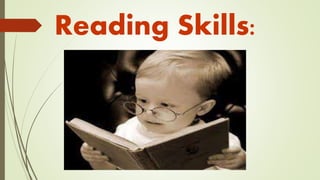
Reading Skills:
Include-
A. Vocabulary Skills
B. Eye Reading Skills
C. Extensive (Rapid)
Reading Skills
and
D. Intensive Reading
Skills
A. Vocabulary
Skills
Involve:
A. Word Meaning
Recognition
B. Guessing the Meaning
of Unknown Words
From Word Structure
and Context
B. Eye
Reading
Skills:
Effective Eye
Reading
Accurate Visual Perception
of Words and Phrases,
Complete Elimination of
Vocalisation.
Types of Reading:
on the basis of the
way or style we read. .
A. Motor Reading
B. Auditory Reading
C. Visual Reading
A. Motor Reading
Motor readers are those who move
the section of their body while
reading.
E.g. moving of hands or moving legs,
head etc….
If stopped, their comprehension level
decreases.
B. Auditory Reading
 Auditory readers listen to the words as they read.
 Auditory readers use vocals, forms of mumbles, vibration of the voice
while reading.
 Most times the reader will talk aloud reading the words and unaware of
his or her actions and rarely do they hear themselves.
 These readers are slow in reading.
C. Visual or Sight Reading
Sight readers can read faster than any
other type of reader, only because
they rely on visual images to get
messages.
While reading these kinds of readers
can visualize the event or imagine the
situation which they are reading.
These readers read fast and have good
Types of Reading:
on the basis of purpose. .
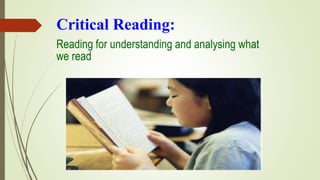
Critical Reading:
Reading for understanding and analysing what
we read
Critical Reading:
SQ3R Reading
SQ3R reading is for
understanding &
appreciation of the
text . SQ3R means:
S – Survey
Q – Question
R – Read
R – Recite
R - Review
Survey
You can read the title
Read the intro
Read each bold face heading and subheading
Review pictures or graphs
Review any reading aids in the chapter
Question
Reader has to ask questions to frame scope and
understanding of a text.
On the basis of the questions reader will decide that
he should read thoroughly or avoid it.
Turn boldface headings into one or more questions
and write the question down on the left side of your
paper
Read
Reading the sections thoroughly and concentrating
on all the details mentioned.
Special concentration and detailed reading is
required.
Recite
Reciting the material helps you concentrate and
learn as you read.
Reader must check whether he is able to
understand it or not.
He must recite the answers to the questions
formulated by him.
Review
Is required for various purposes.
Through review reader may analyze, explain,
compare and contrast.
This technique will help you to read the text
comprehensively and thoroughly.
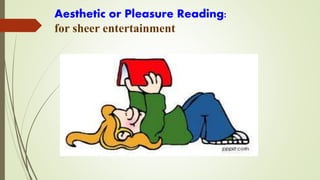
Aesthetic or Pleasure Reading:
for sheer entertainment
Types of
Reading
Skills:
I.
Extensive
Reading
II.
Intensive
Reading
I. Extensive (Rapid)
Reading Skills :
a) Prediction Technique
b) Scanning Skill
c) Skimming Skill
I. Extensive (Rapid)
Reading Skills :
 Is very broad, not limited to a text, a passage.
 Readers are allowed to collect supported material, articles related to
respective subject.
 Readers may be asked to write summary; in broader sense they may be asked
to prepare presentations on the same topic.
 This will enable students to involve in complex activities and they can gain
more knowledge.
a)Prediction
Techniques:
involves . .
Thinking ahead of the given information yet
to come in passage, enable the reader for
good comprehension.
Use of Index, Headings, Sub-headings,
To Guess The Information That A Text
Contains.
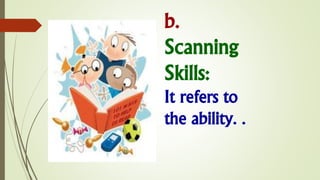
b.
Scanning
Skills:
It refers to
the ability. .
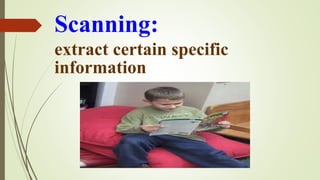
Scanning:
extract certain specific
information
 To locate specific information or facts as quickly as
possible, rather than trying to get all the information
on the page.
While scanning you need to concentrate on signal
words such as highlighted words in capital letters,
italicized words, words into brackets or inverted
commas.
B. Scanning Reading
c) Skimming Skills:
It refers to fast process
of reading a text
or passage . . .
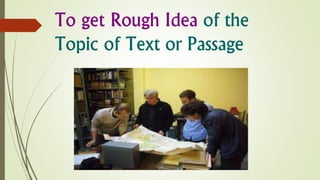
To get Rough Idea of the
Topic of Text or Passage
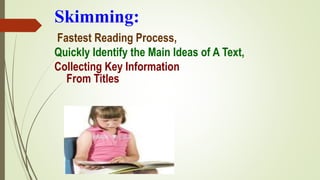
Skimming:
Fastest Reading Process,
Quickly Identify the Main Ideas of A Text,
Collecting Key Information
From Titles
It involves three main skills-
1. Identifying Central Idea,
2. Recognising Main Ideas,
3. Identifying The Writing
Patterns of The Passage/Text
3. Identifying the Writing
Patterns of the
Passage/Text:
involves
Discovering the Purpose
and Organisation of a Text
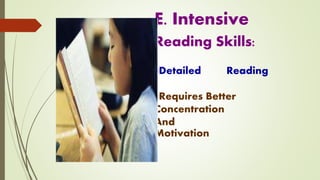
E. Intensive
Reading Skills:
#Detailed Reading
#Requires Better
Concentration
And
Motivation
E. Intensive
Reading Skills:
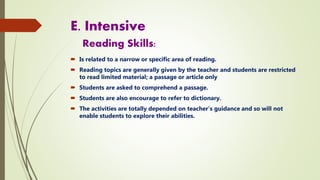
 Is related to a narrow or specific area of reading.
 Reading topics are generally given by the teacher and students are restricted
to read limited material; a passage or article only
 Students are asked to comprehend a passage.
 Students are also encourage to refer to dictionary.
 The activities are totally depended on teacher’s guidance and so will not
enable students to explore their abilities.
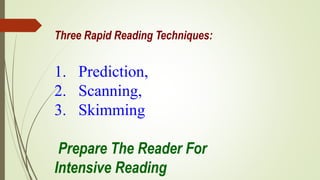
Three Rapid Reading Techniques:
1. Prediction,
2. Scanning,
3. Skimming
Prepare The Reader For
Intensive Reading
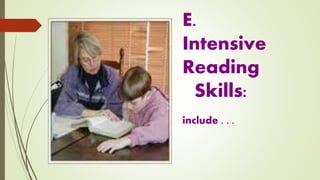
E.
Intensive
Reading
Skills:
include . . .
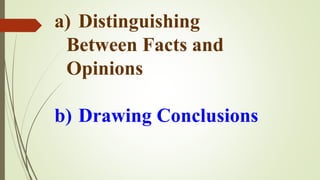
a) Distinguishing
Between Facts and
Opinions
b) Drawing Conclusions
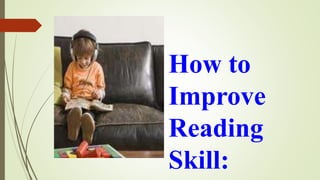
How to
Improve
Reading
Skill:
1.Concentrate while Reading
2.Try to Rapidly Recognise word
meaning
3. Motivate Yourself
4.Expand your Eye Span
5. Avoid Vocalisation and
Sub-vocalization
6. Read in Word Groups or
thought Units, instead
of word-by-word.
7. Maintain a Comfortable
posture
8. Put dictionary, thesaurus
near to reading table
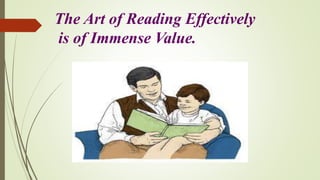
The Art of Reading Effectively
is of Immense Value.

Reading skill