Reading in the Digital Age: 
Transforming Strategies & Assessments 
1 
Kristen Girard 
Ph.D. student in School Psychology 
Sandra Sawaya 
Ph.D. student in Educational Psychology & Educational Technology 
College of Education 
Department of Counseling, Educational Psychology & Special Education
Introduction: Kristen 
2
Introduction: Kristen 
3
Introduction: Kristen 
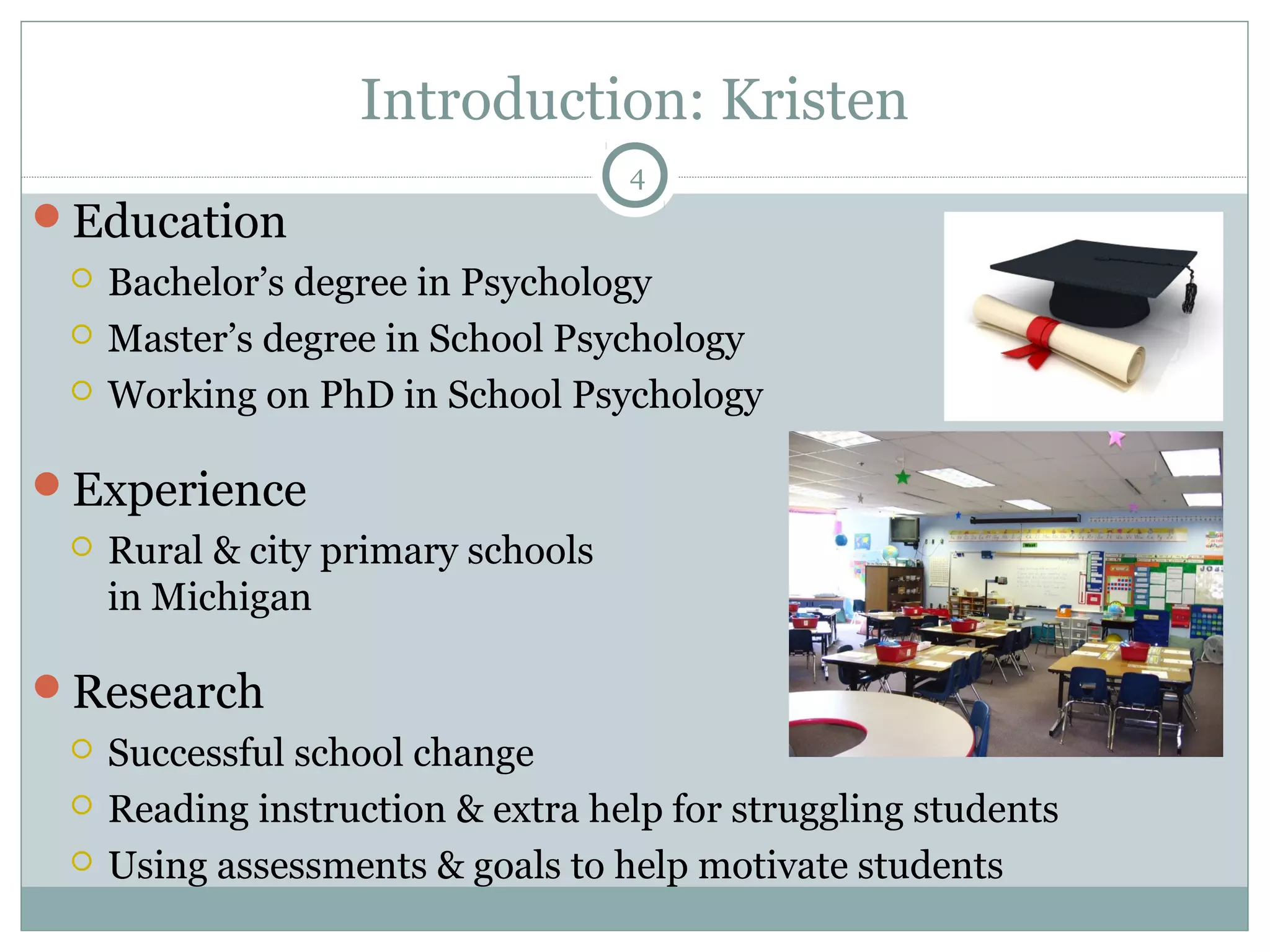
ļ‚—Education 
4 
ļ‚” Bachelor’s degree in Psychology 
ļ‚” Master’s degree in School Psychology 
ļ‚” Working on PhD in School Psychology 
ļ‚—Experience 
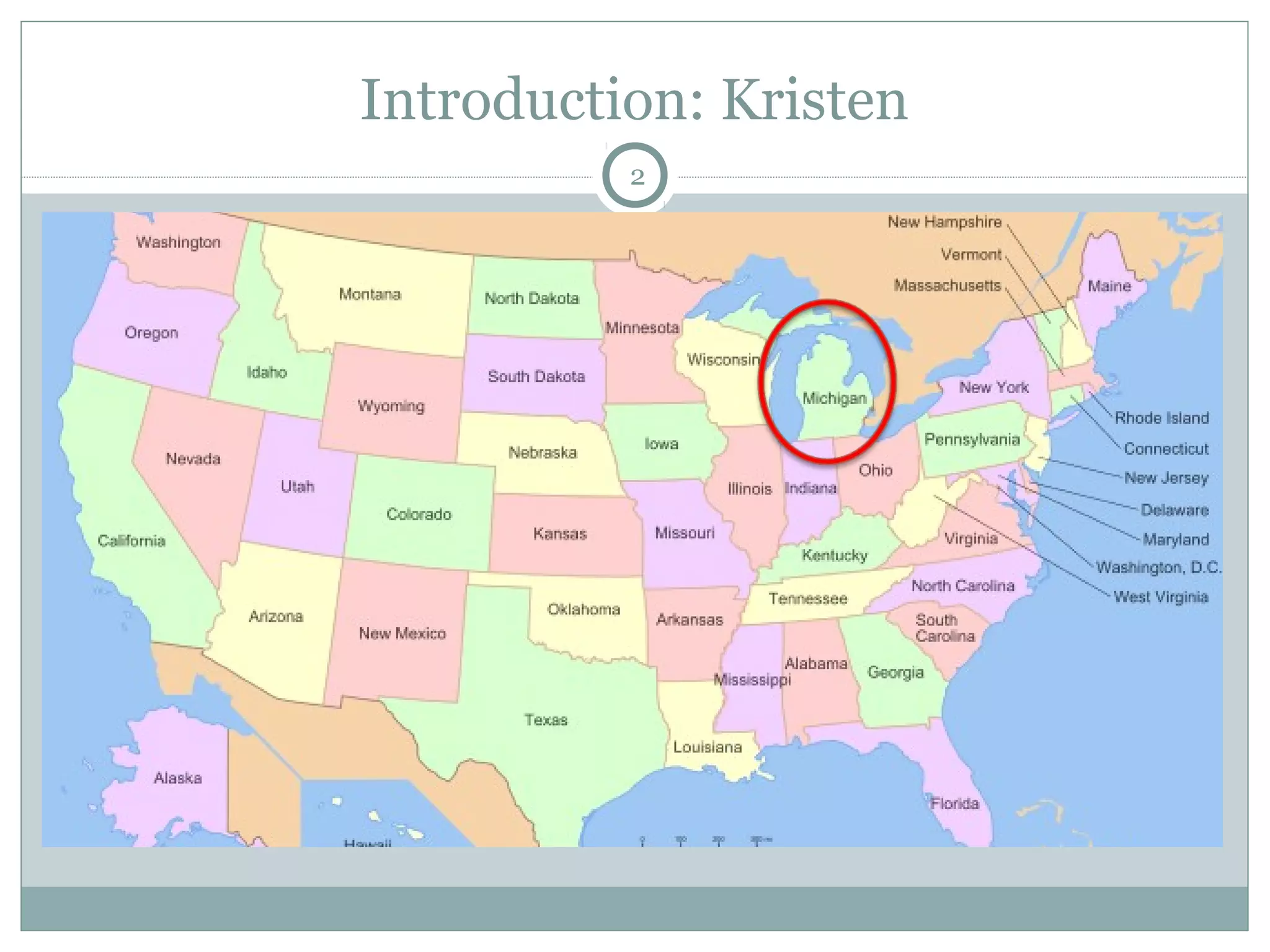
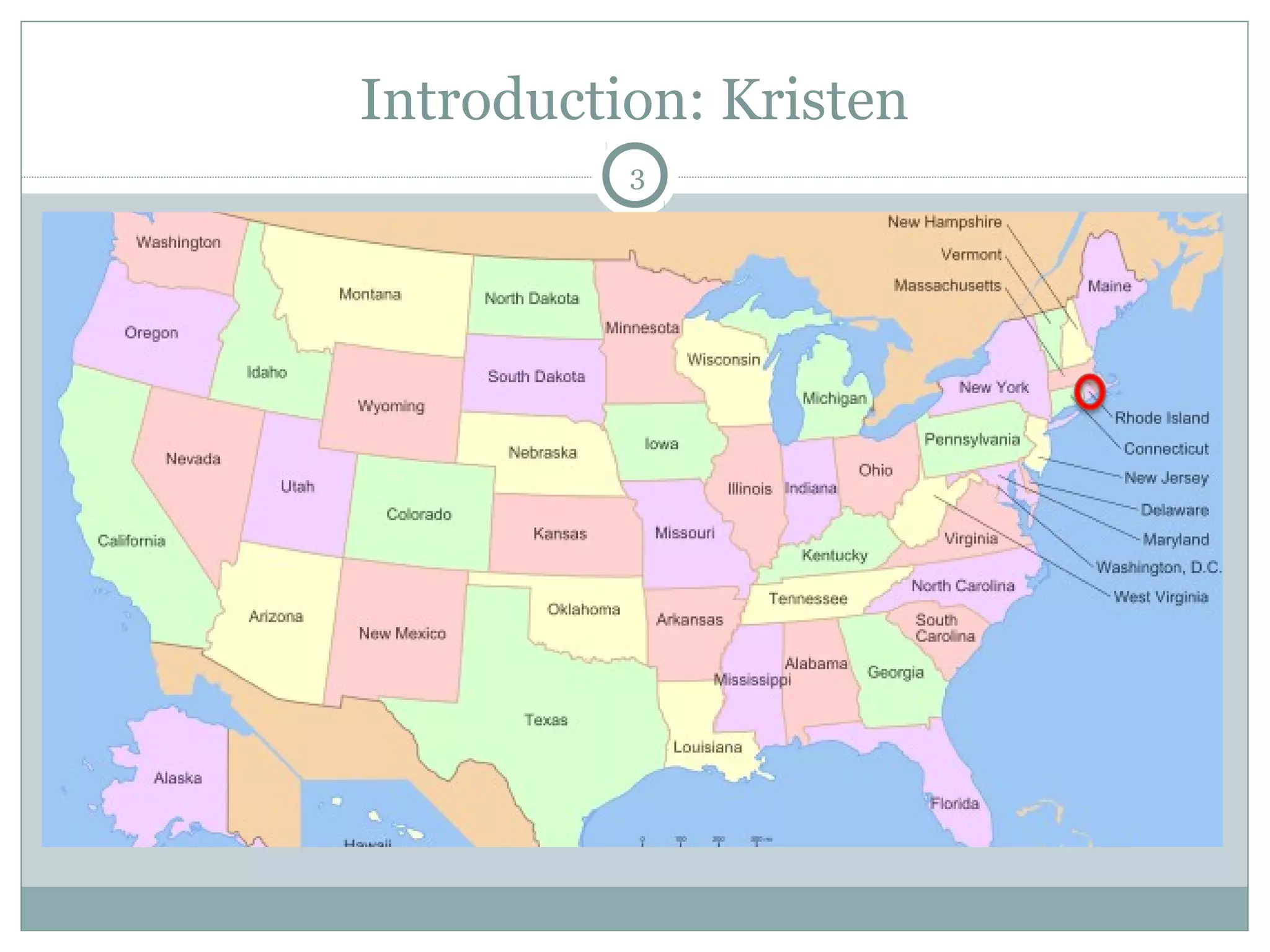
ļ‚” Rural & city primary schools 
in Michigan 
ļ‚—Research 
ļ‚” Successful school change 
ļ‚” Reading instruction & extra help for struggling students 
ļ‚” Using assessments & goals to help motivate students
Introduction: Kristen 
ļ‚—What do School Psychologists do in the schools? 
ļ‚” Help students who are struggling 
ļ‚” Work with teachers & parents to evaluate students for special 
education services 
ļ‚” Increase student achievement 
ļ‚” Collect and analyze data for school improvement & student 
outcomes 
ļ‚” And more! 
5
Introduction: Sandra 
ļ‚—What do Educational Psychologists do in the schools? 
ļ‚— Research 
ļ‚— How humans learn in educational settings 
ļ‚— Evaluating curricula and interventions 
ļ‚— Inform fields like 
ļ‚—School psychology 
ļ‚—Instructional design 
ļ‚—Special education 
ļ‚—Curriculum design 
ļ‚—Educational technology 
6
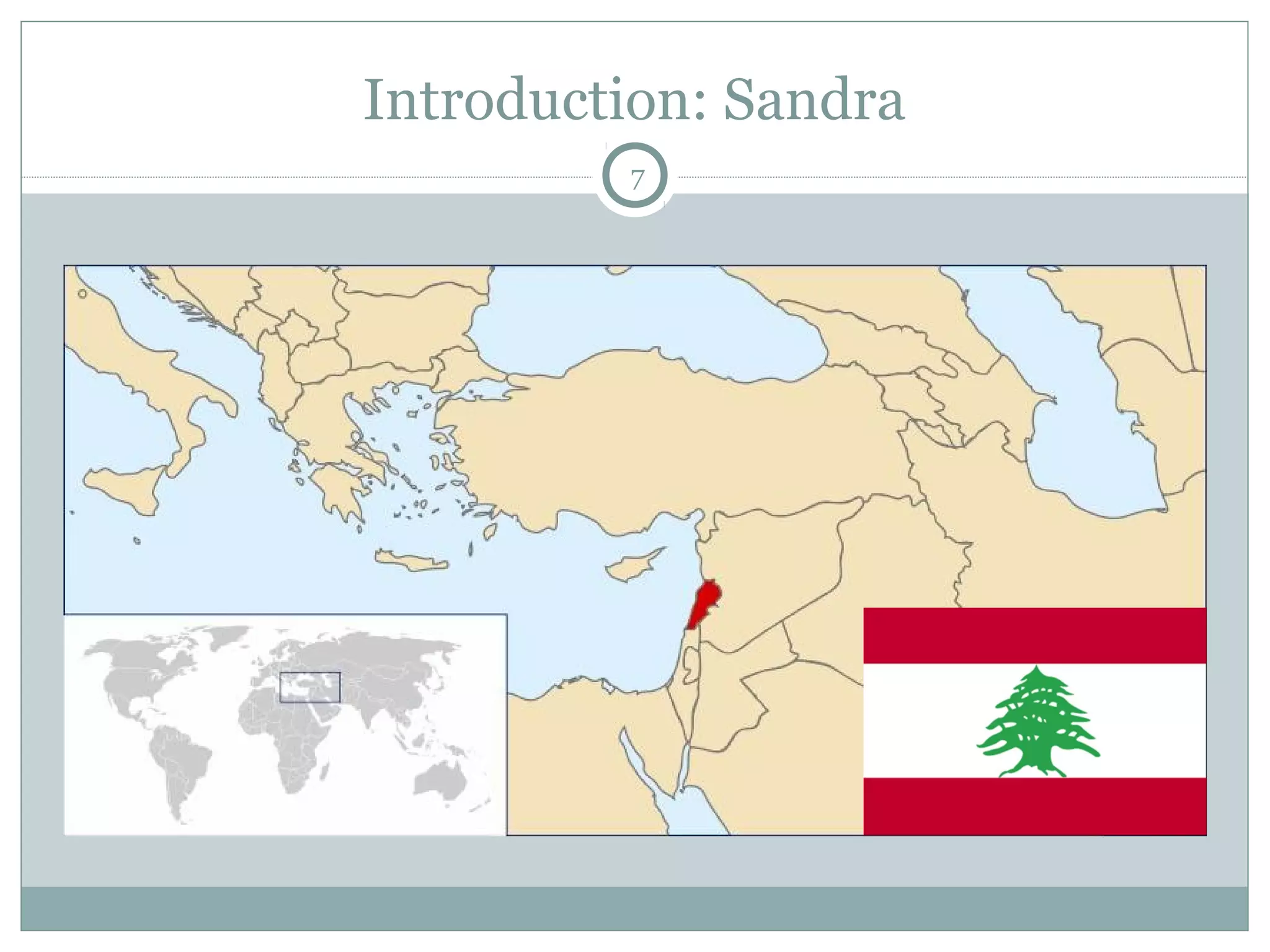
Introduction: Sandra 
7
Introduction: Sandra 
ļ‚—Education 
ļ‚” Finished second year in Educational Psychology and 
Educational Technology PhD program 
ļ‚” Background in Psychology and Special Education 
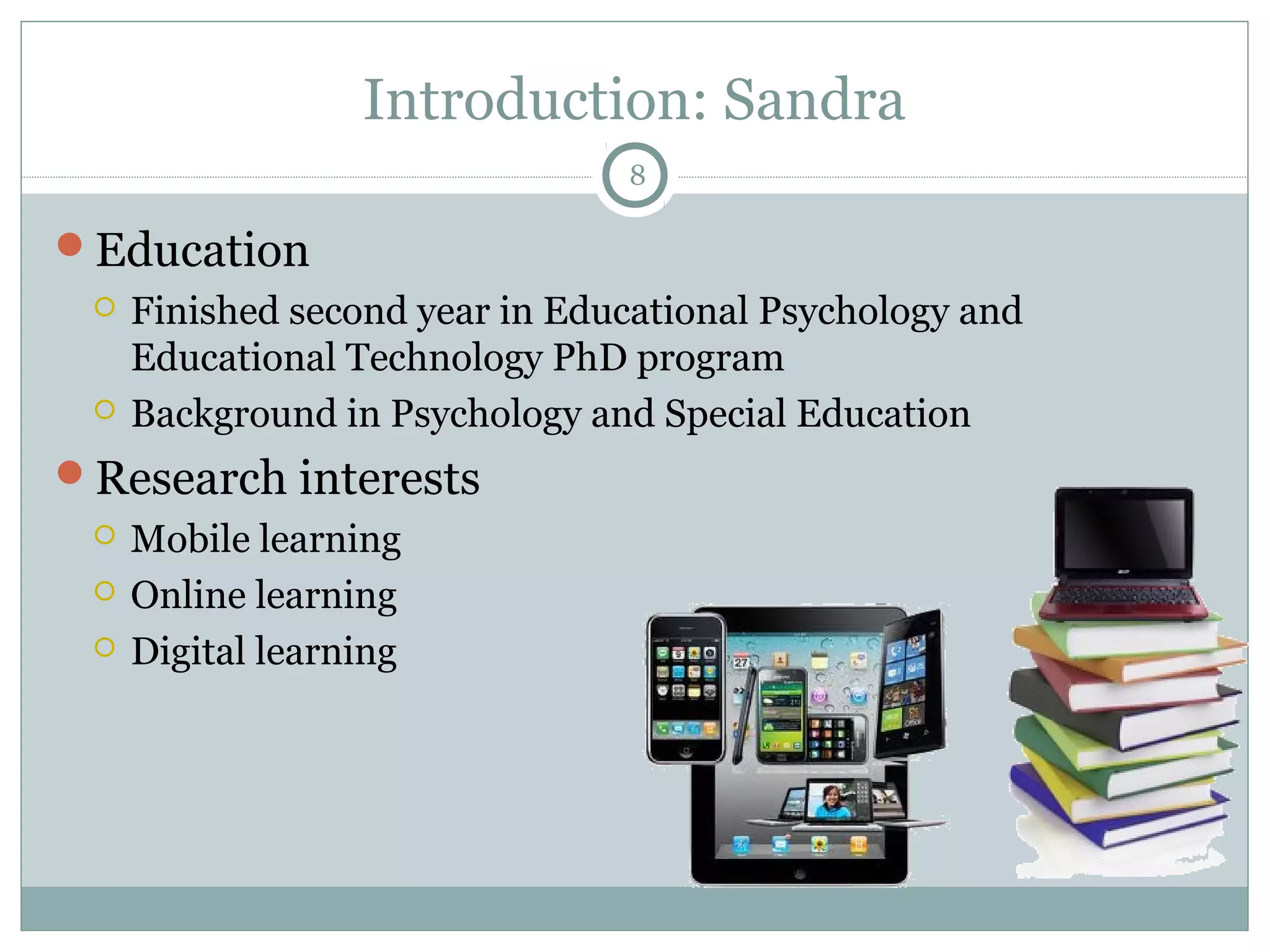
ļ‚—Research interests 
ļ‚” Mobile learning 
ļ‚” Online learning 
ļ‚” Digital learning 
8
Presentation Outline 
ļ‚—Introduction to Topic 
ļ‚” Reading Comprehension 
9 
ļ‚” Print Text Comprehension Strategies 
ļ‚—Digital Age: 
ļ‚” Transformation of Text 
ļ‚” Transformation of Strategies 
ļ‚—Assessment 
ļ‚” Examples of Print Text Reading Comprehension Measures 
ļ‚” Transformation of Assessments for Digital Age
We Hope You Will Learn 
10 
ļ‚—What is reading comprehension? 
ļ‚—What are reading comprehension strategies? 
ļ‚—What is digital text and online text? 
ļ‚—How is digital reading comprehension different from print 
reading comprehension? 
ļ‚—How are digital reading comprehension strategies different from 
print reading comprehension strategies? 
ļ‚—How does the U.S. use assessment tools to measure reading 
comprehension?
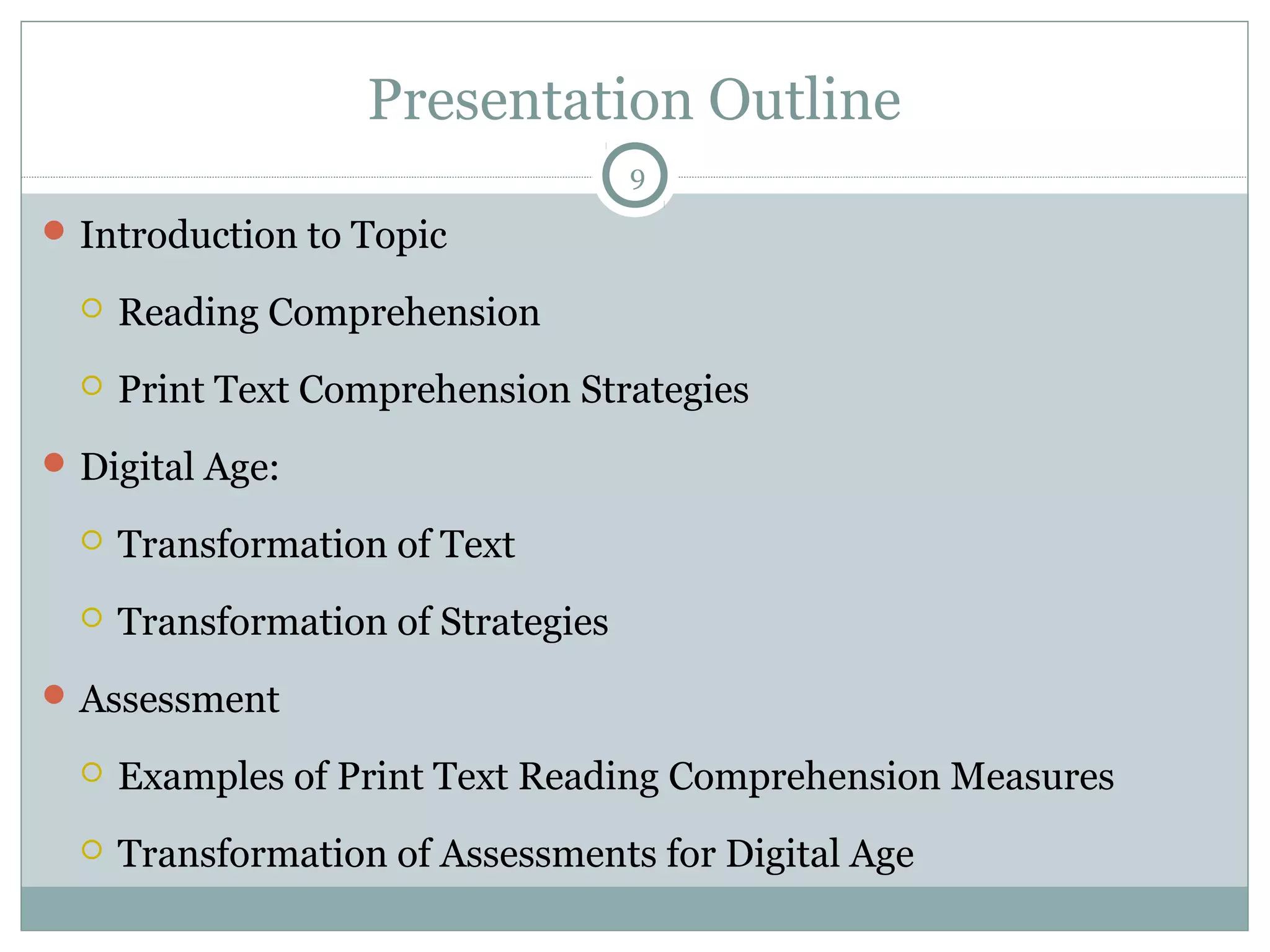
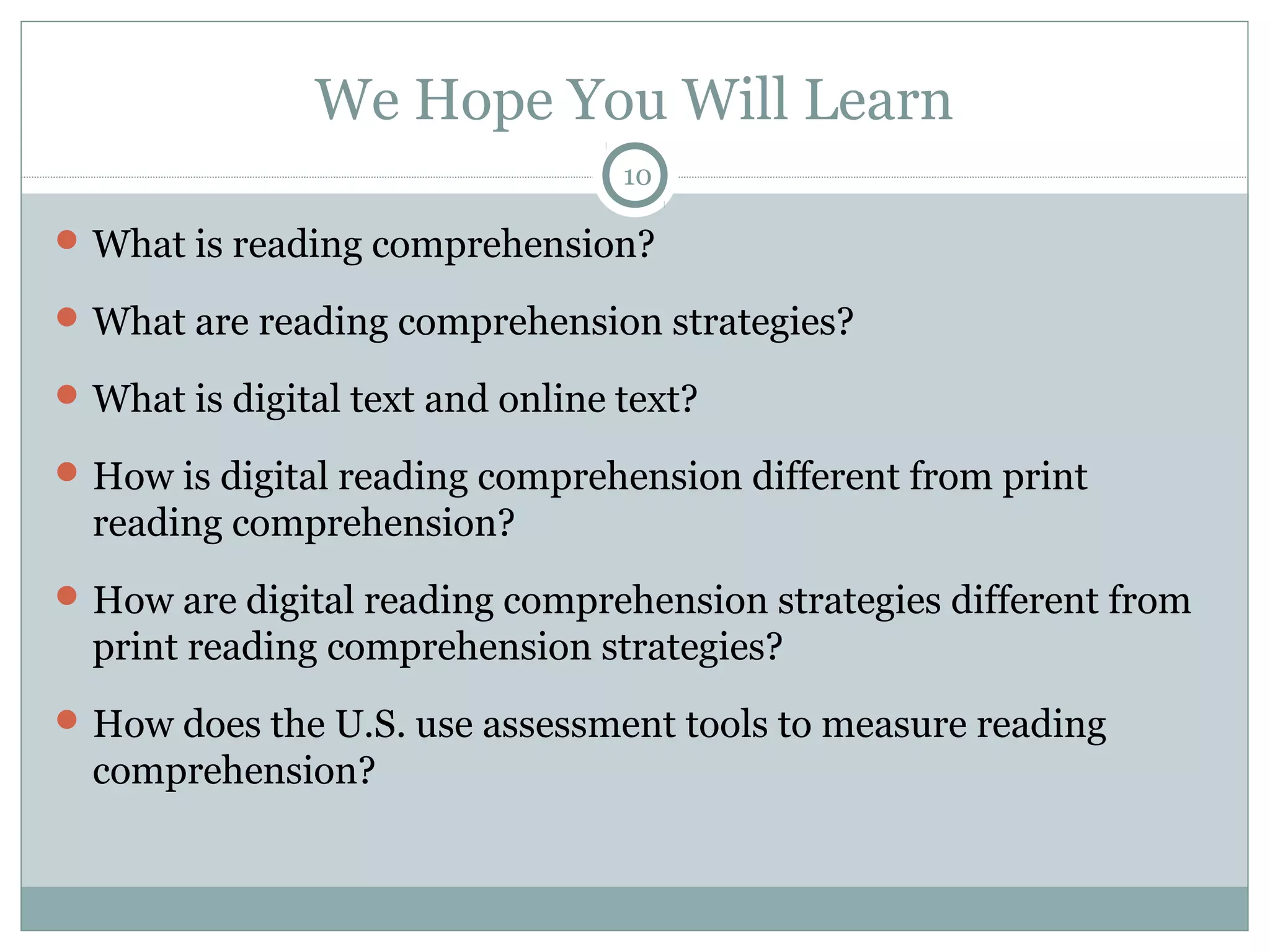
Text 
11 
Print Text Digital Text
Reading Comprehension 
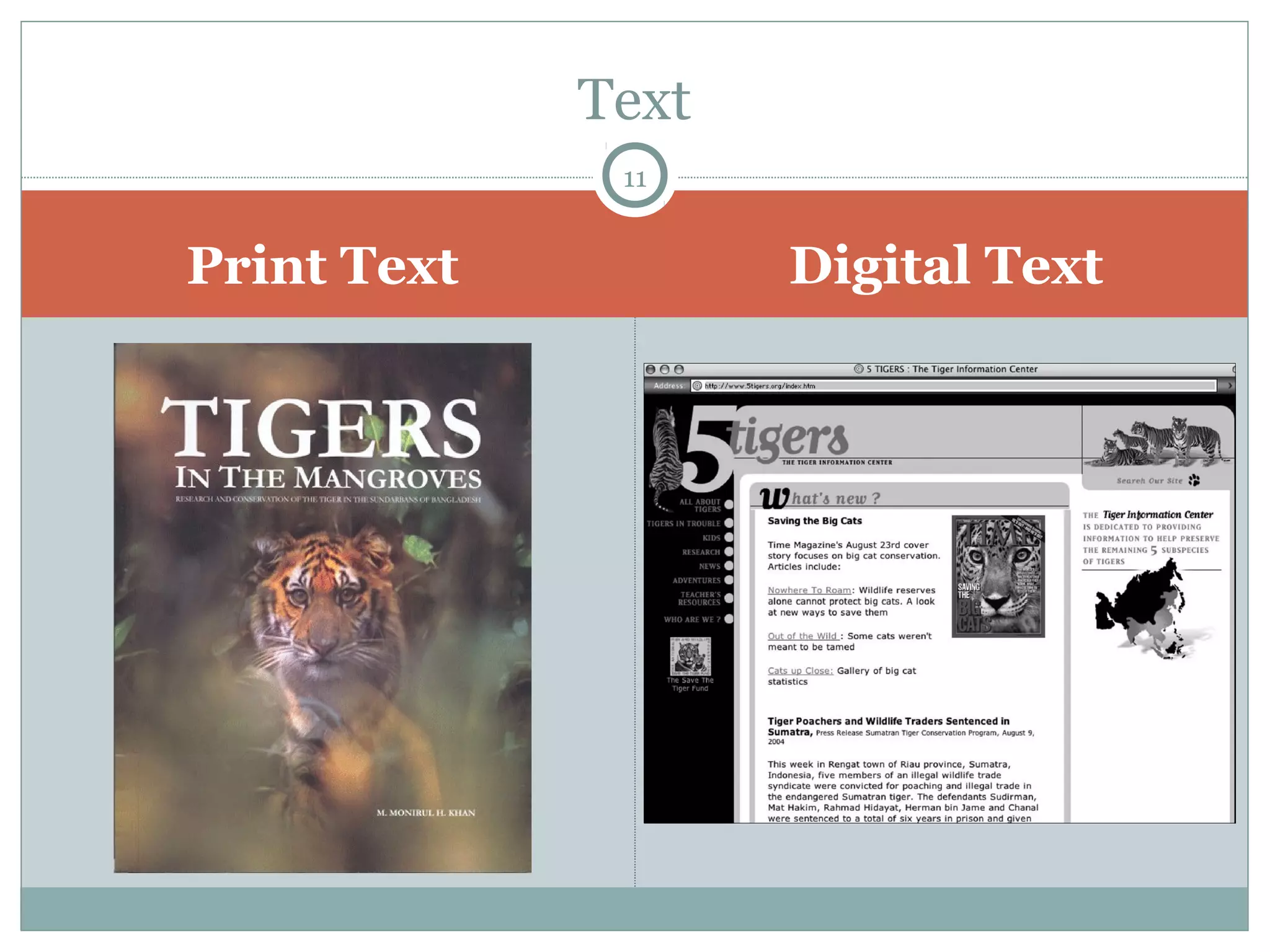
ļ‚—Reading is an important skill! 
12 
ļ‚—Student’s successful progress in reading & 
writing  success in school 
ļ‚—We need basic reading skills but we also 
need to understand what we read 
ļ‚—Understanding the meaning of what we read 
= READING COMPREHENSION
Purposes & Types of Reading 
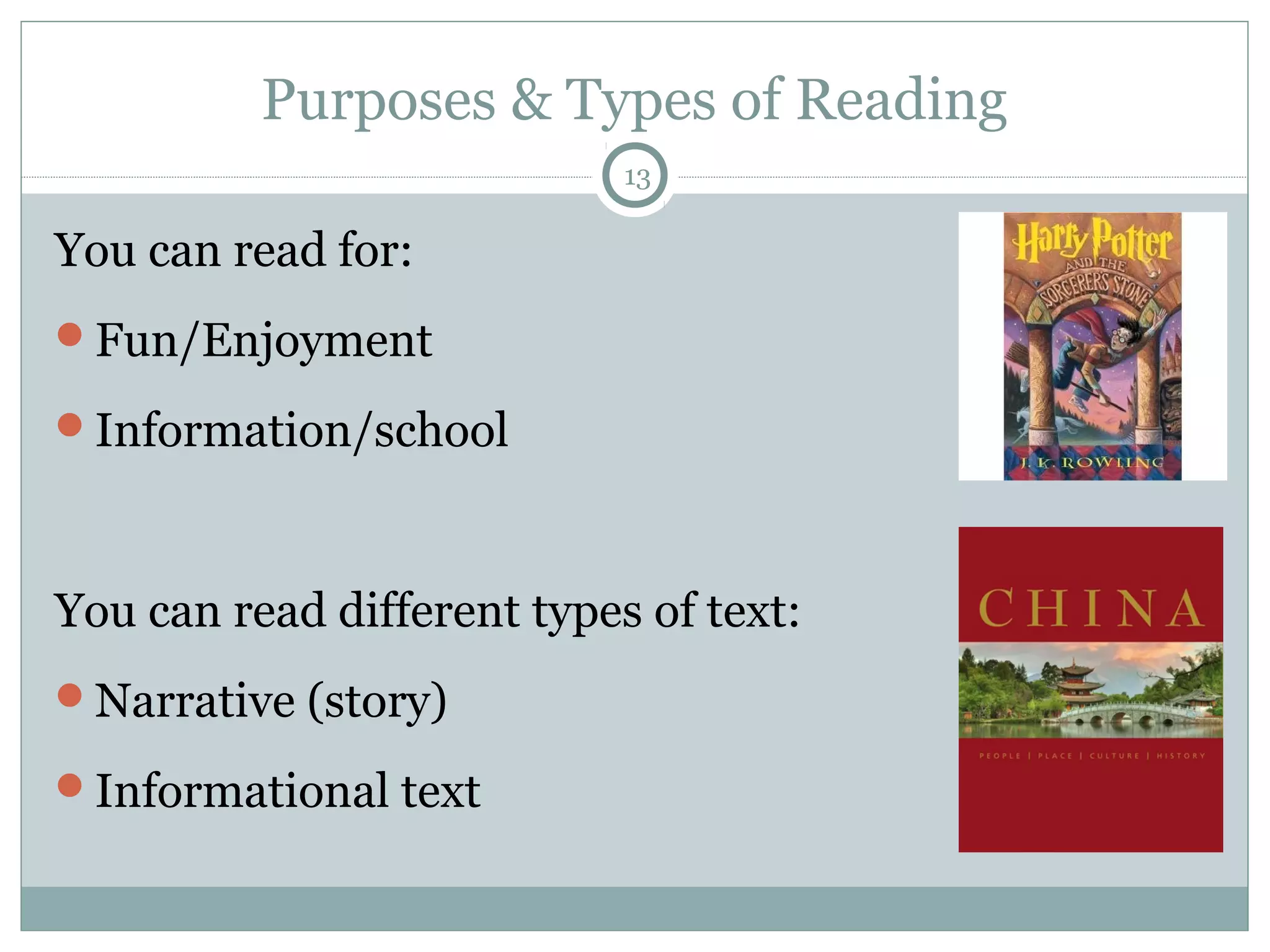
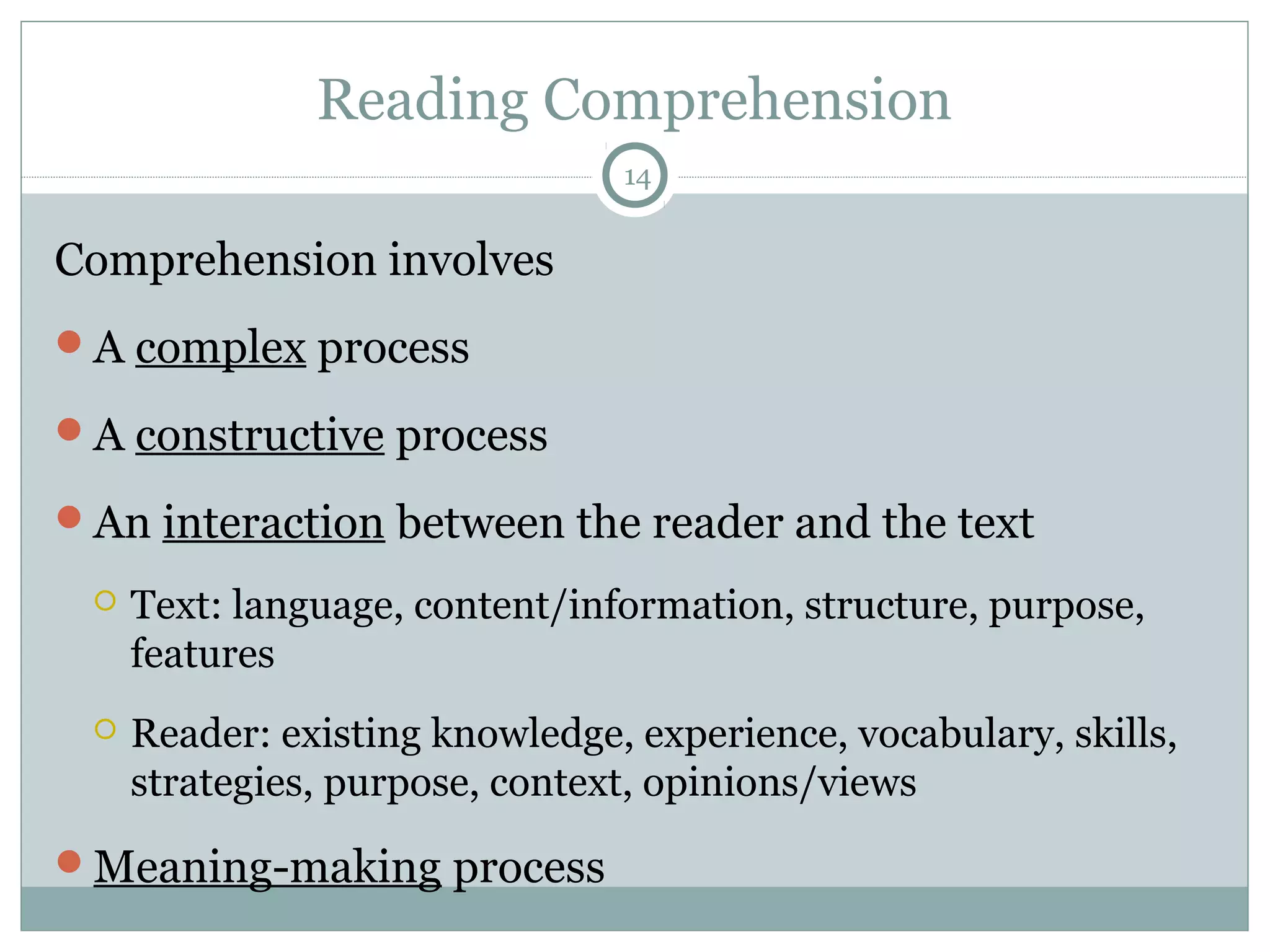
You can read for: 
ļ‚—Fun/Enjoyment 
ļ‚—Information/school 
13 
You can read different types of text: 
ļ‚—Narrative (story) 
ļ‚—Informational text
Reading Comprehension 
14 
Comprehension involves 
ļ‚—A complex process 
ļ‚—A constructive process 
ļ‚—An interaction between the reader and the text 
ļ‚” Text: language, content/information, structure, purpose, 
features 
ļ‚” Reader: existing knowledge, experience, vocabulary, skills, 
strategies, purpose, context, opinions/views 
ļ‚—Meaning-making process
Reading Comprehension Strategies 
15 
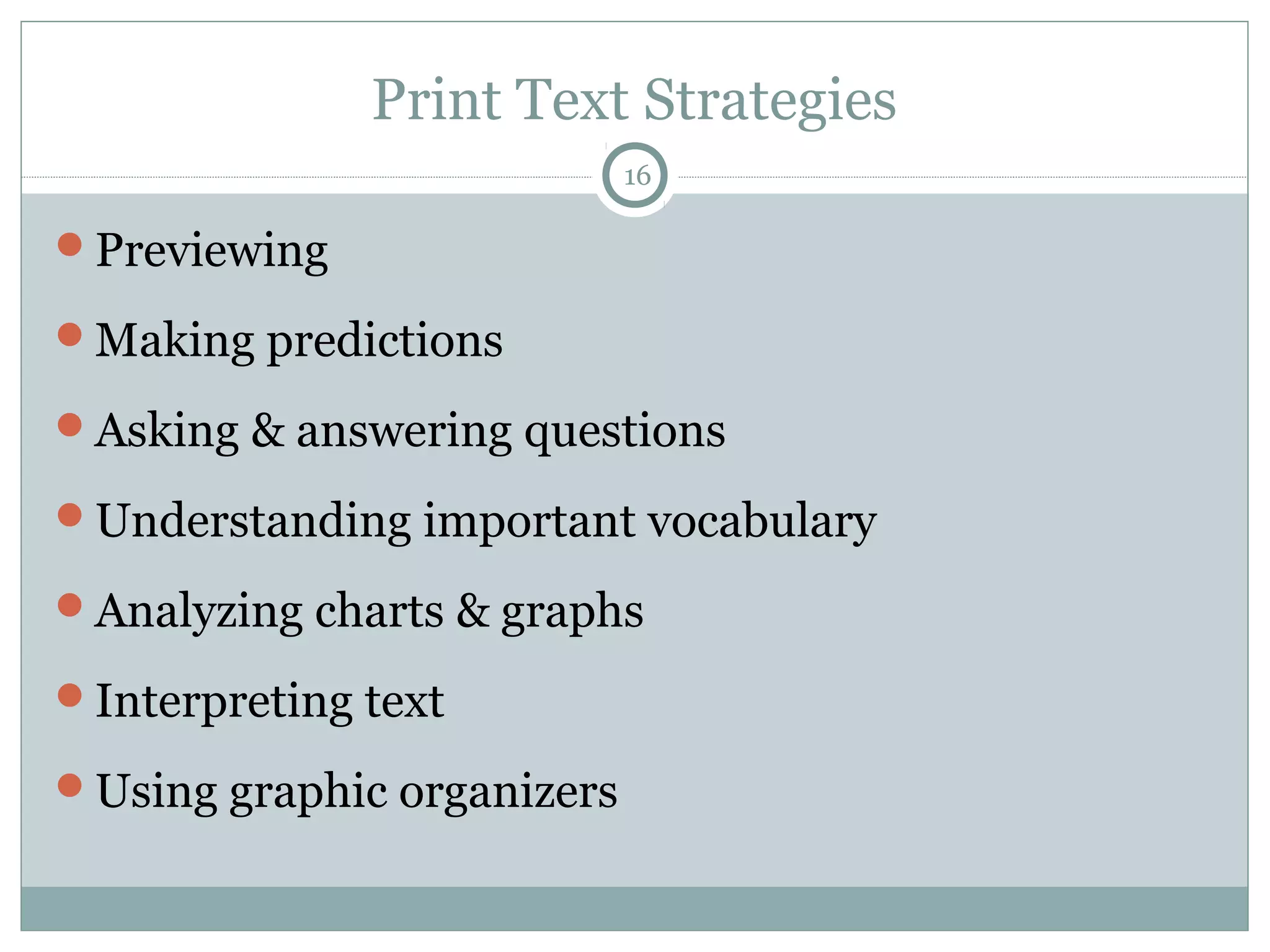
What do we mean by strategies? 
ļ‚—Sets of steps that good readers use 
ļ‚—Active processes 
ļ‚—Help to understand text 
ļ‚—Some develop naturally 
ļ‚—Students can be taught strategies 
through instruction
Print Text Strategies 
16 
ļ‚—Previewing 
ļ‚—Making predictions 
ļ‚—Asking & answering questions 
ļ‚—Understanding important vocabulary 
ļ‚—Analyzing charts & graphs 
ļ‚—Interpreting text 
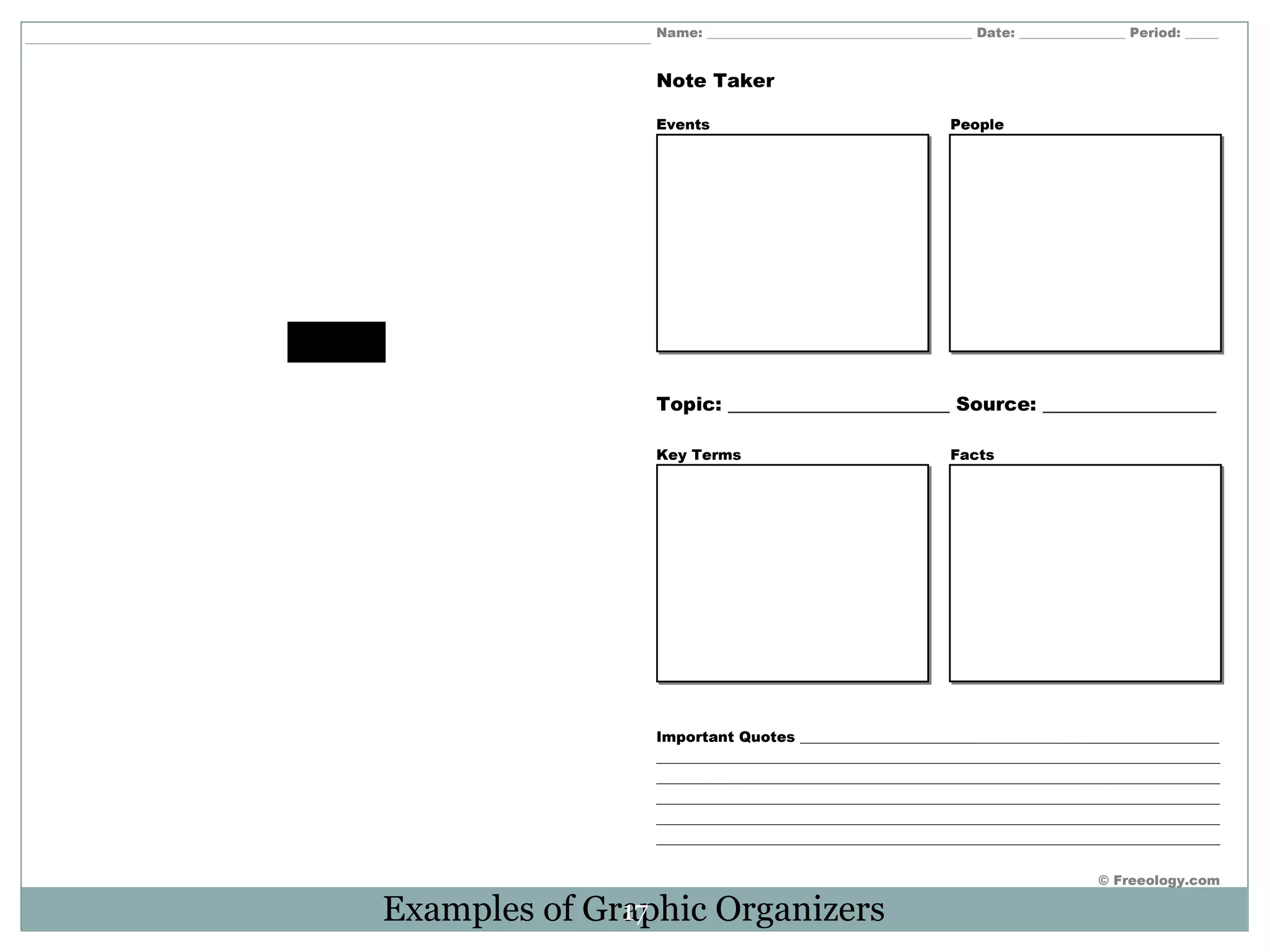
ļ‚—Using graphic organizers
Name: ________________________________________ Date: ________________ Period: _____ 
Ā© Freeology.com 
Note Taker 
Events People 
Topic: _______________________ Source: __________________ 
Key Terms Facts 
Important Quotes __________________________________________________________ 
______________________________________________________________________________ 
______________________________________________________________________________ 
______________________________________________________________________________ 
______________________________________________________________________________ 
______________________________________________________________________________ 
Examples of Gra17phic Organizers
Reading in the Digital Age 
18 
AGE OF TRANSFORMATION
Transformation of Text 
19 
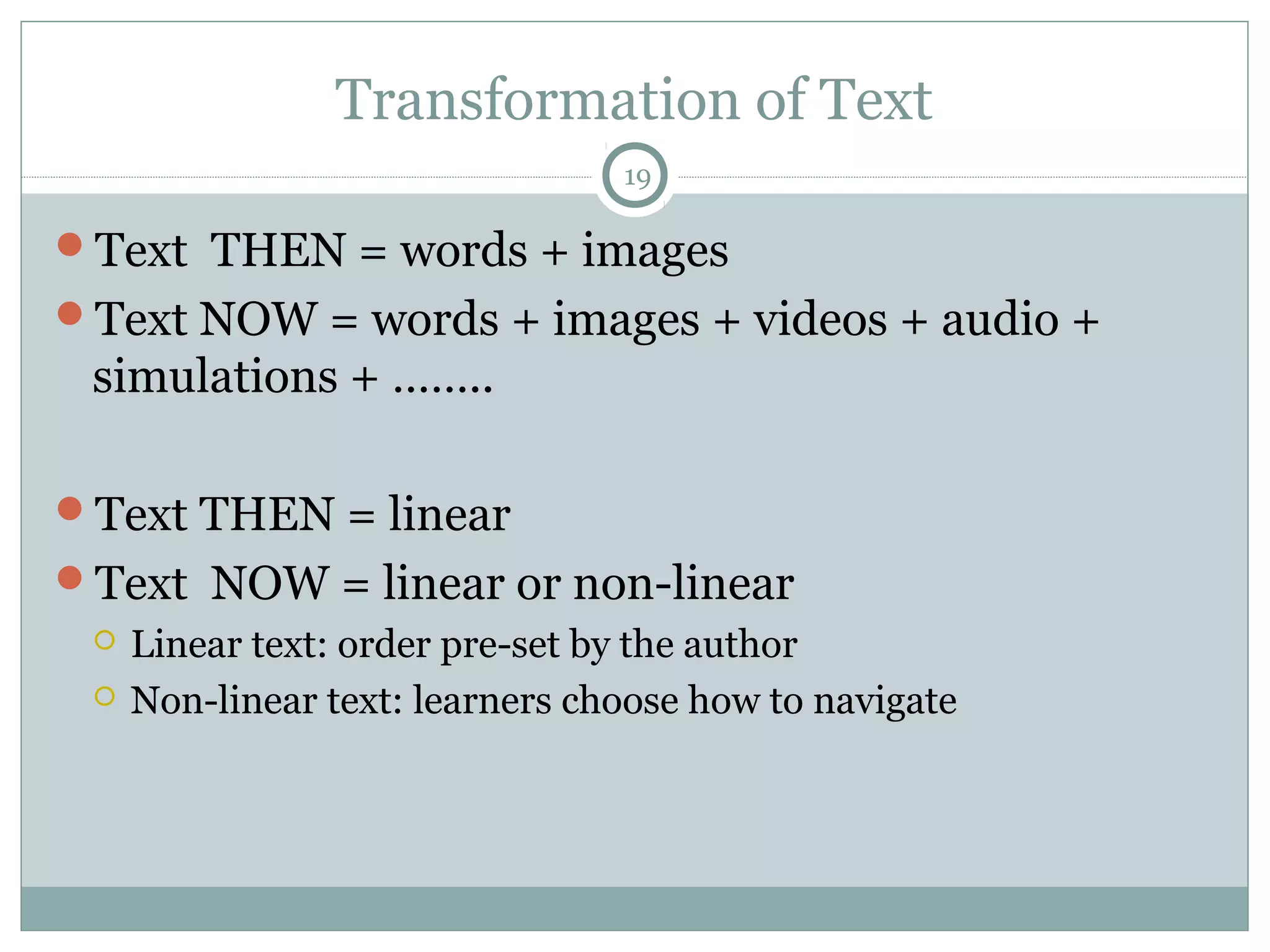
ļ‚—Text THEN = words + images 
ļ‚—Text NOW = words + images + videos + audio + 
simulations + …….. 
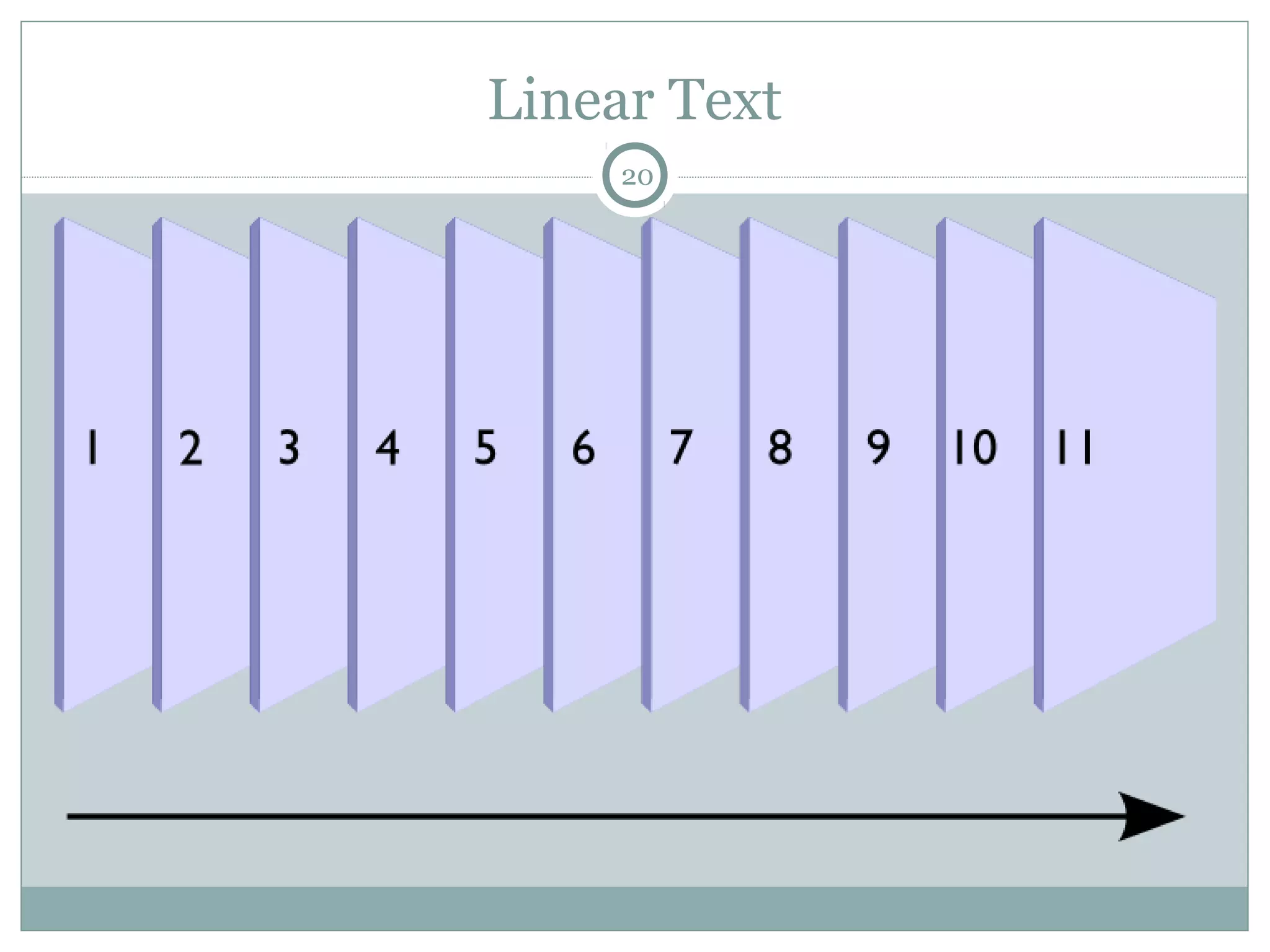
ļ‚—Text THEN = linear 
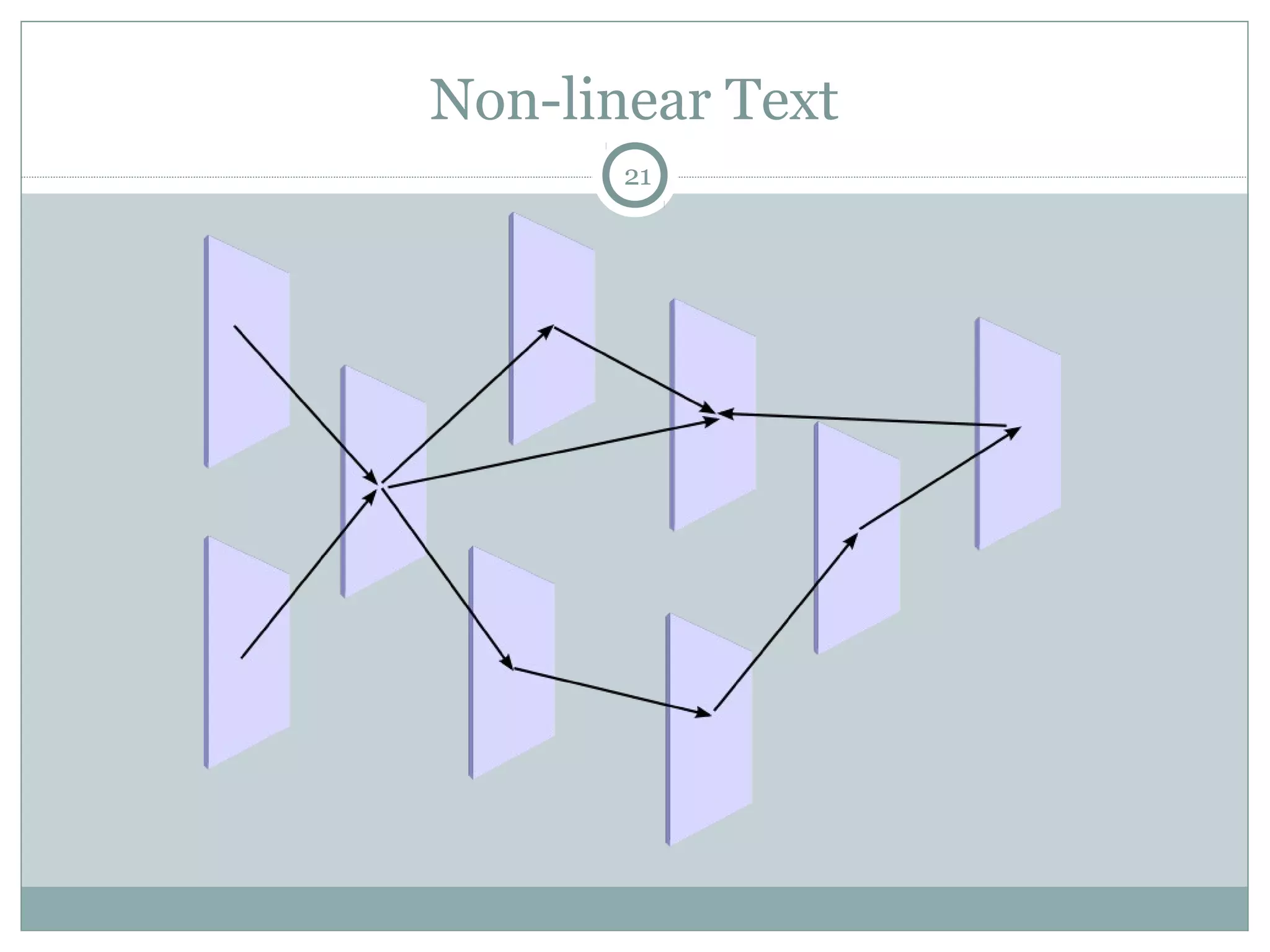
ļ‚—Text NOW = linear or non-linear 
ļ‚” Linear text: order pre-set by the author 
ļ‚” Non-linear text: learners choose how to navigate
Linear Text 
20
Non-linear Text 
21
Why do we have this transformation? 
22 
ļ‚—Reading THEN = only paper 
ļ‚—Reading NOW = paper + computer screens + phone 
screens + tablet screens 
ļ‚” Read one PDF with hundreds of pages 
ļ‚” Read a 500-page book on your iPad which is less than 1 cm 
thick 
ļ‚” Read by navigating the world wide web 
ļ‚—Digital tools are more flexible than paper 
ļ‚” Allow for non-linear text (example) 
ļ‚” Possibilities are limitless
Importance of Non-linear Text 
23 
ļ‚—Aligned with how we think 
ļ‚—We don’t think and process information linearly 
ļ‚—We think about many things at the same time 
ļ‚—We multitask 
ļ‚—We evaluate 
ļ‚—We hold many ideas in our head at once 
ļ‚—Our brains are wired to process many things at once
Transformation of Reading 
ļ‚—What you read 
ļ‚” Books/magazines/etc… 
ļ‚” Websites/blogs/etc… 
ļ‚—Where you read 
ļ‚” In class/at home 
ļ‚” On the go 
ļ‚—How you read 
24
Transformation of how you read 
25 
ļ‚—Affordances of the Web 
ļ‚—Many sources of information within your reach 
ļ‚—Interactions not only with text, but with hyperlinks, 
audio, video, simulations… 
ļ‚—Readers are more in control of the reading process 
ļ‚—We do not need to read linearly 
ļ‚—Interaction between the reader, text, and the Web 
ļ‚—Big question: When to stop? 
ļ‚” In print, author tells you when to stop 
ļ‚” Online, you are in control of what you read
Strategies for Online Reading 
ļ‚—Strategies for linear text 
26 
ļ‚” Open a website, read all of it, close it, open another one 
OR 
ļ‚—Strategies for non-linear text 
ļ‚” Open many websites 
ļ‚” Skim 
ļ‚” Scan 
ļ‚” Evaluate 
ļ‚” Keeping in mind the goal for reading
Assessment 
27
Assessment 
ļ‚—Assessment: 
ļ‚” Broad term 
ļ‚” Collecting information about 
a student’s behavior or skills 
ļ‚” Different methods 
 Reading records/files 
 Interviews 
 Observations 
 Tests & short measures 
28 
ļ‚—Purposes: 
ļ‚” Screening 
ļ‚” Progress monitoring 
ļ‚” Program evaluation 
ļ‚” Eligibility 
ļ‚—Use assessment data to 
compare student to self & 
compare student to 
others
Assessment of Reading Comprehension 
29 
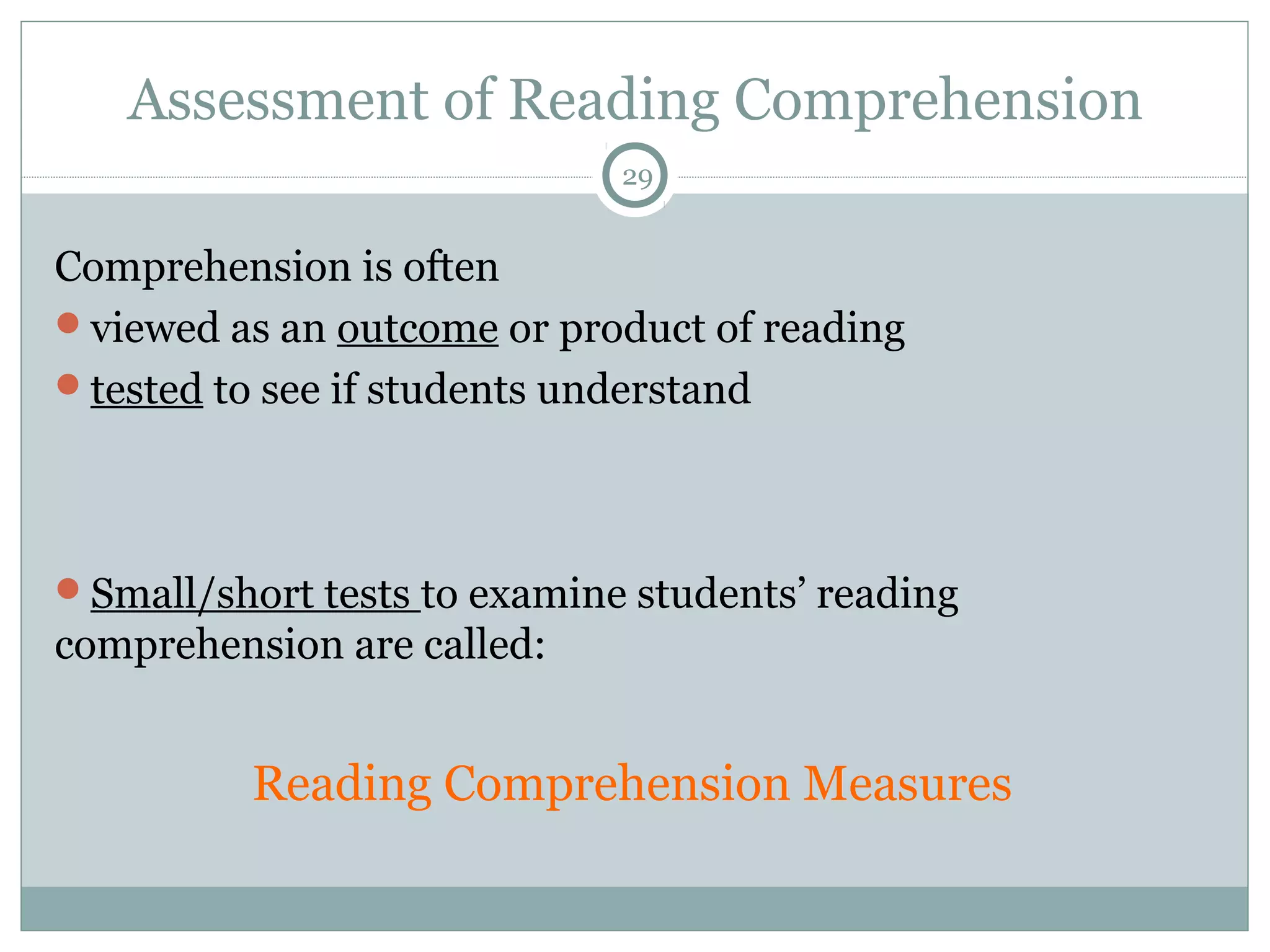
Comprehension is often 
ļ‚—viewed as an outcome or product of reading 
ļ‚—tested to see if students understand 
ļ‚—Small/short tests to examine students’ reading 
comprehension are called: 
Reading Comprehension Measures
Examples of 
Reading Comprehension Measures 
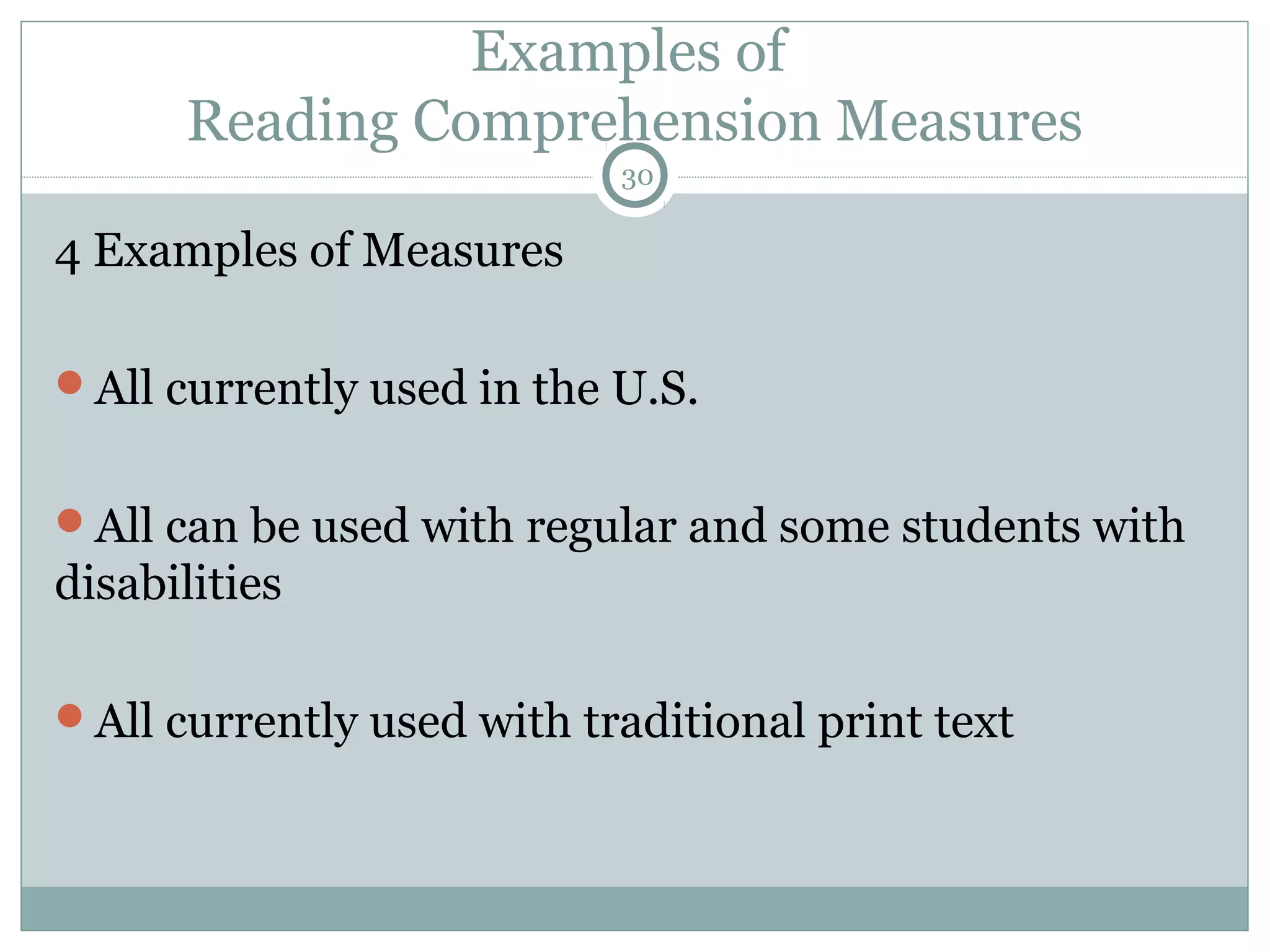
4 Examples of Measures 
30 
ļ‚—All currently used in the U.S. 
ļ‚—All can be used with regular and some students with 
disabilities 
ļ‚—All currently used with traditional print text
Examples of 
Reading Comprehension Measures 
31 
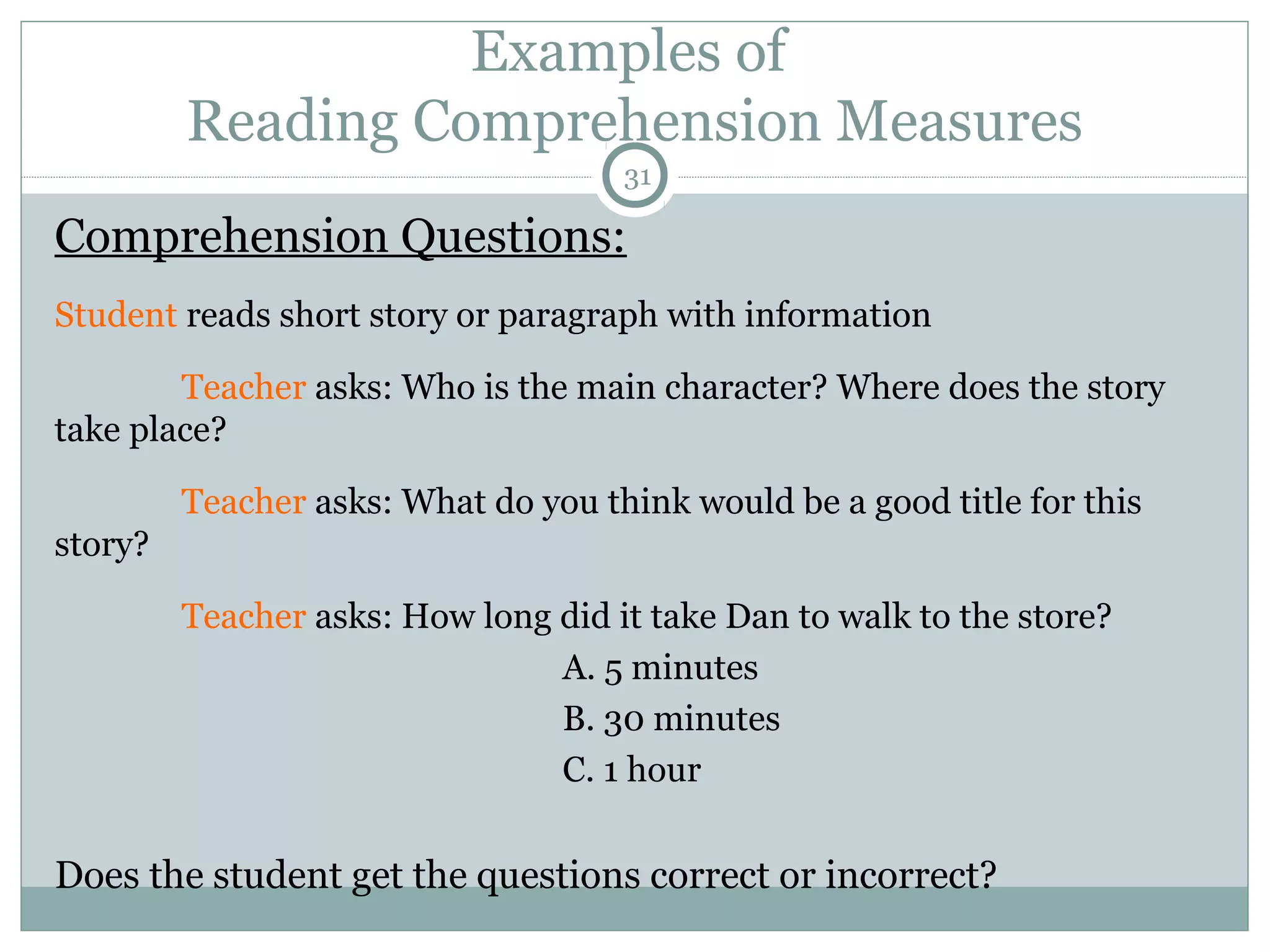
Comprehension Questions: 
Student reads short story or paragraph with information 
Teacher asks: Who is the main character? Where does the story 
take place? 
Teacher asks: What do you think would be a good title for this 
story? 
Teacher asks: How long did it take Dan to walk to the store? 
A. 5 minutes 
B. 30 minutes 
C. 1 hour 
Does the student get the questions correct or incorrect?
Examples of 
Reading Comprehension Measures 
32 
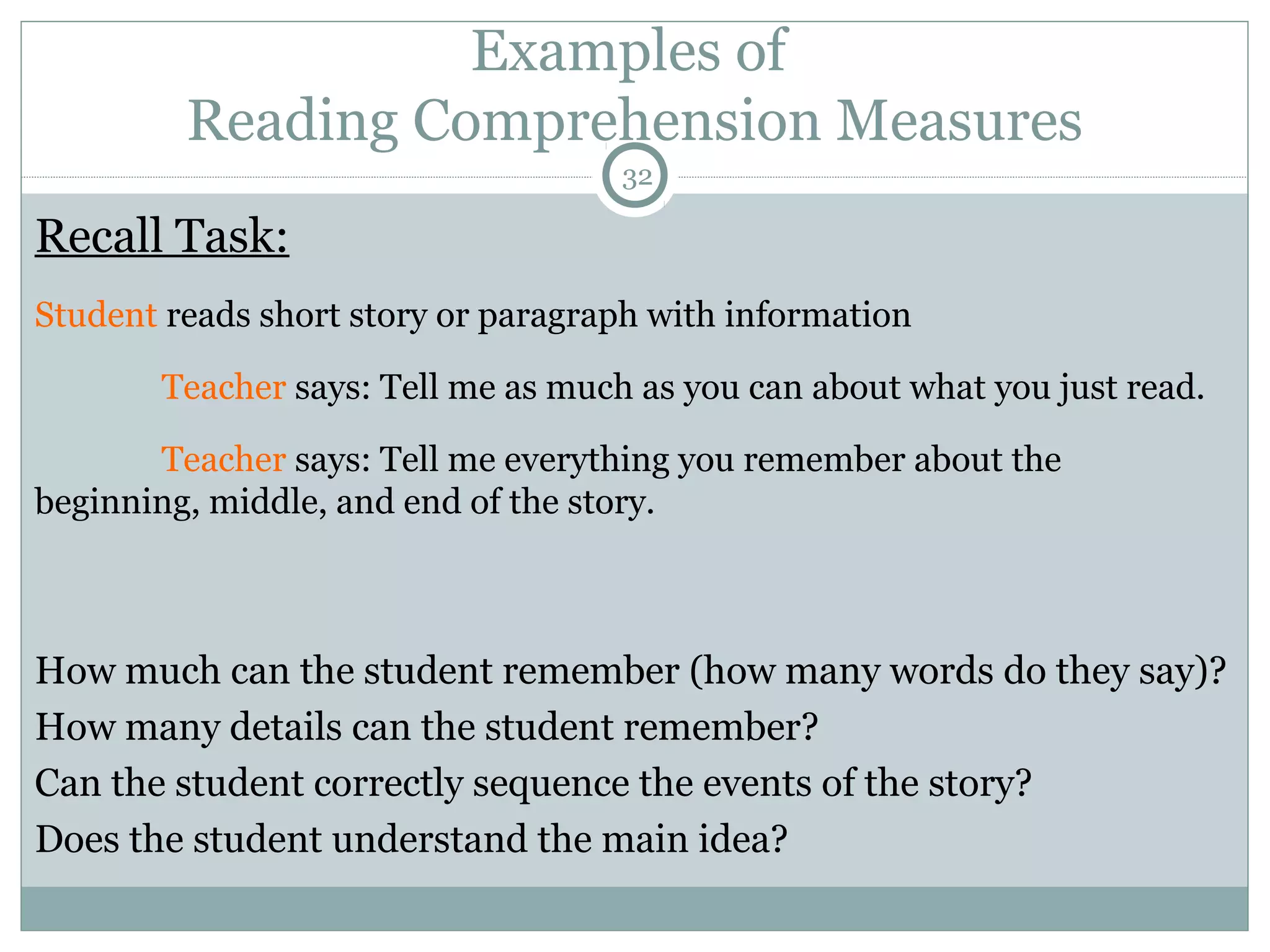
Recall Task: 
Student reads short story or paragraph with information 
Teacher says: Tell me as much as you can about what you just read. 
Teacher says: Tell me everything you remember about the 
beginning, middle, and end of the story. 
How much can the student remember (how many words do they say)? 
How many details can the student remember? 
Can the student correctly sequence the events of the story? 
Does the student understand the main idea?
Examples of 
Reading Comprehension Measures 
33 
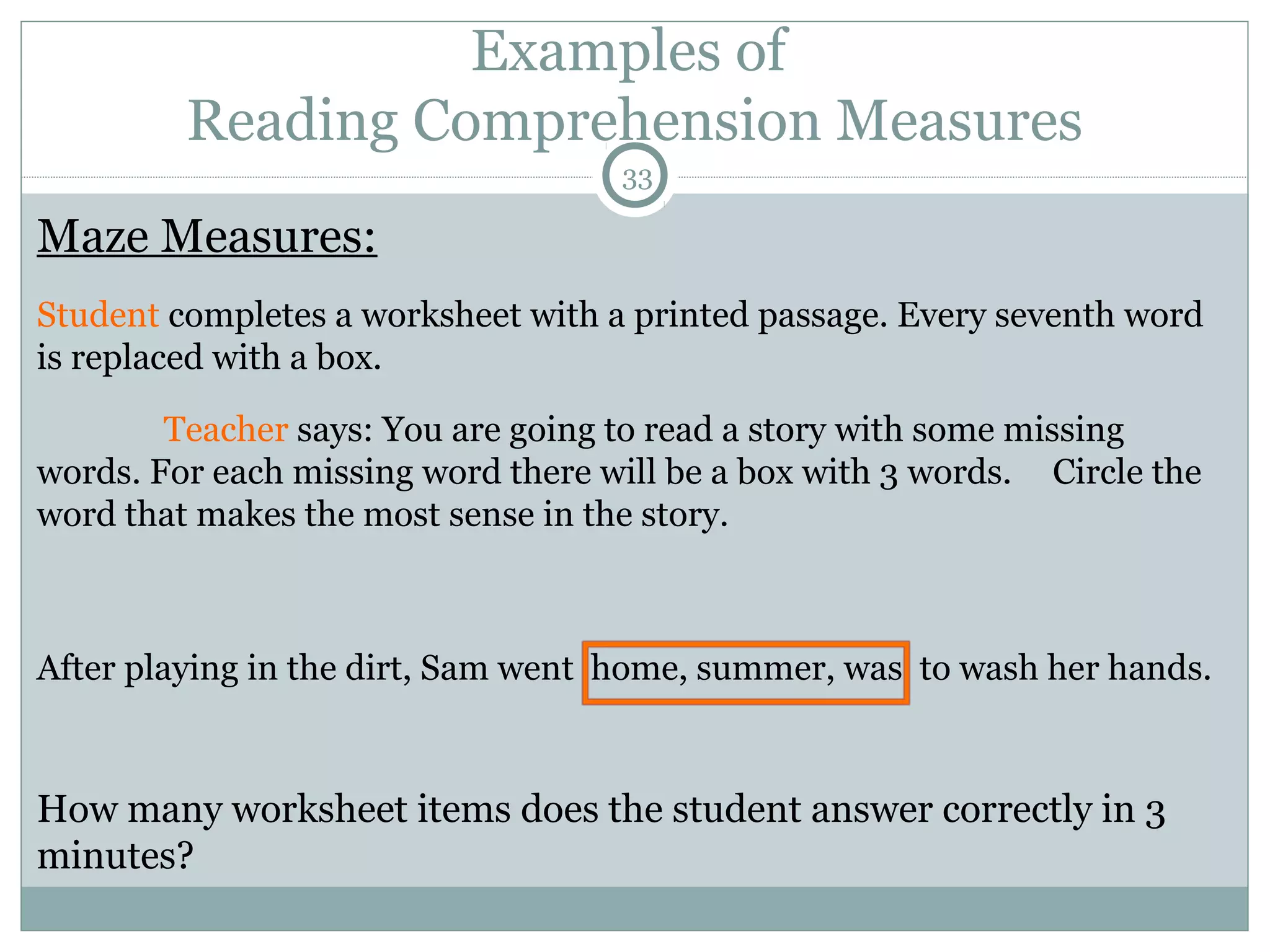
Maze Measures: 
Student completes a worksheet with a printed passage. Every seventh word 
is replaced with a box. 
Teacher says: You are going to read a story with some missing 
words. For each missing word there will be a box with 3 words. Circle the 
word that makes the most sense in the story. 
After playing in the dirt, Sam went home, summer, was to wash her hands. 
How many worksheet items does the student answer correctly in 3 
minutes?
Examples of 
Reading Comprehension Measures 
34 
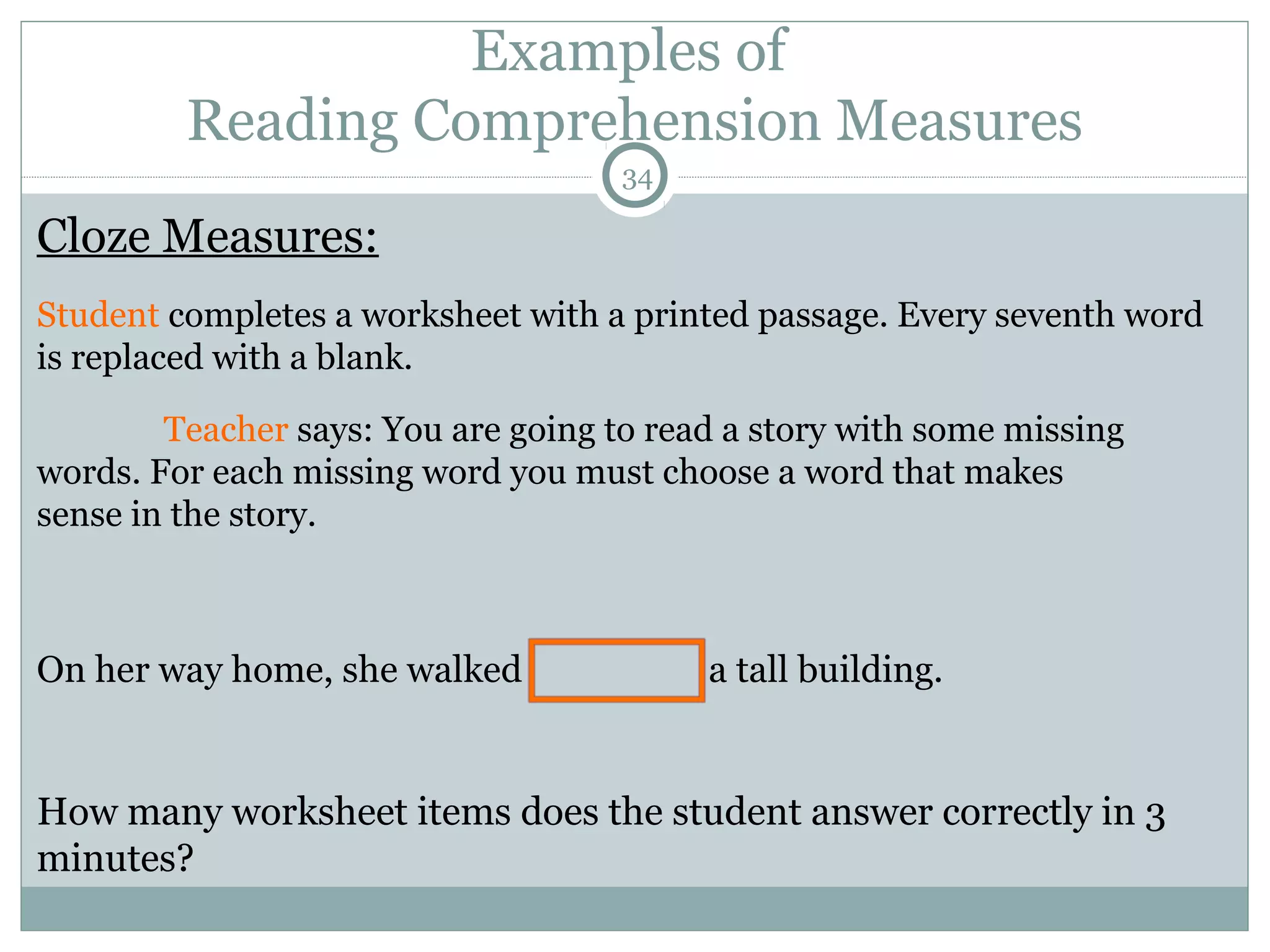
Cloze Measures: 
Student completes a worksheet with a printed passage. Every seventh word 
is replaced with a blank. 
Teacher says: You are going to read a story with some missing 
words. For each missing word you must choose a word that makes 
sense in the story. 
On her way home, she walked a tall building. 
How many worksheet items does the student answer correctly in 3 
minutes?
Assessing online reading 
35 
ļ‚—No measures to assess online reading 
comprehension 
ļ‚—Proposed methods 
ļ‚” Project-based: open-ended, aligned with how we think and 
learn 
ļ‚” Think-aloud
We Hope You Learned 
36 
ļ‚—What is reading comprehension? 
ļ‚—What are reading comprehension strategies? 
ļ‚—What is digital text and online text? 
ļ‚— How is digital reading comprehension different from print reading 
comprehension? 
ļ‚— How are digital reading comprehension strategies different from print 
reading comprehension strategies? 
ļ‚— How does the U.S. use assessment tools to measure reading 
comprehension? 
Questions?
References & Resources 
National Association of School Psychologists www.nasponline.org 
Coiro, J., & Dobler, E. (2007). Exploring the online reading comprehension strategies used by sixth-grade skilled 
readers to search for and locate information on the internet. Reading Research Quarterly, 42 (2), 214-257. 
doi: 10.1598/RRQ42.2.2 
International Reading Association (IRA) & National Association for the Education of Young Children (NAEYC) 
(adopted 1998). Learning to read and write: Developmentally appropriate practices for young children [a joint 
position statement]. Newark, DE and Washington, DC: Author. 
McNamara, T., Miller, D., & Bransford, J. D. (2000). Mental models and reading comprehension. In R. Barr, M. L. 
Kamil, P. B. Mosenthal & P. D. Pearson (Eds.), Handbook of reading research (Vol. 2, pp. 490-511). New 
York: Longman. 
Duke, N. K., & Carlisle, J. F. (2011). The development of comprehension. In M. L. Kamil, P. D. Pearson, E. B. Moje, 
and P. Afflerbach (Eds.), Handbook of Reading Research, Vol. IV. London: Routledge. 
RAND Reading Study Group. (2002). Reading for understanding: Toward an R & D program in reading 
comprehension. Santa Monica, CA: RAND. 
37

Reading in the Digital Age. China 2012

  • 1.
    Reading in theDigital Age: Transforming Strategies & Assessments 1 Kristen Girard Ph.D. student in School Psychology Sandra Sawaya Ph.D. student in Educational Psychology & Educational Technology College of Education Department of Counseling, Educational Psychology & Special Education
  • 2.
  • 3.
  • 4.
    Introduction: Kristen ļ‚—Education 4 ļ‚” Bachelor’s degree in Psychology ļ‚” Master’s degree in School Psychology ļ‚” Working on PhD in School Psychology ļ‚—Experience ļ‚” Rural & city primary schools in Michigan ļ‚—Research ļ‚” Successful school change ļ‚” Reading instruction & extra help for struggling students ļ‚” Using assessments & goals to help motivate students
  • 5.
    Introduction: Kristen ļ‚—Whatdo School Psychologists do in the schools? ļ‚” Help students who are struggling ļ‚” Work with teachers & parents to evaluate students for special education services ļ‚” Increase student achievement ļ‚” Collect and analyze data for school improvement & student outcomes ļ‚” And more! 5
  • 6.
    Introduction: Sandra ļ‚—Whatdo Educational Psychologists do in the schools? ļ‚— Research ļ‚— How humans learn in educational settings ļ‚— Evaluating curricula and interventions ļ‚— Inform fields like ļ‚—School psychology ļ‚—Instructional design ļ‚—Special education ļ‚—Curriculum design ļ‚—Educational technology 6
  • 7.
  • 8.
    Introduction: Sandra ļ‚—Education ļ‚” Finished second year in Educational Psychology and Educational Technology PhD program ļ‚” Background in Psychology and Special Education ļ‚—Research interests ļ‚” Mobile learning ļ‚” Online learning ļ‚” Digital learning 8
  • 9.
    Presentation Outline ļ‚—Introductionto Topic ļ‚” Reading Comprehension 9 ļ‚” Print Text Comprehension Strategies ļ‚—Digital Age: ļ‚” Transformation of Text ļ‚” Transformation of Strategies ļ‚—Assessment ļ‚” Examples of Print Text Reading Comprehension Measures ļ‚” Transformation of Assessments for Digital Age
  • 10.
    We Hope YouWill Learn 10 ļ‚—What is reading comprehension? ļ‚—What are reading comprehension strategies? ļ‚—What is digital text and online text? ļ‚—How is digital reading comprehension different from print reading comprehension? ļ‚—How are digital reading comprehension strategies different from print reading comprehension strategies? ļ‚—How does the U.S. use assessment tools to measure reading comprehension?
  • 11.
    Text 11 PrintText Digital Text
  • 12.
    Reading Comprehension ļ‚—Readingis an important skill! 12 ļ‚—Student’s successful progress in reading & writing  success in school ļ‚—We need basic reading skills but we also need to understand what we read ļ‚—Understanding the meaning of what we read = READING COMPREHENSION
  • 13.
    Purposes & Typesof Reading You can read for: ļ‚—Fun/Enjoyment ļ‚—Information/school 13 You can read different types of text: ļ‚—Narrative (story) ļ‚—Informational text
  • 14.
    Reading Comprehension 14 Comprehension involves ļ‚—A complex process ļ‚—A constructive process ļ‚—An interaction between the reader and the text ļ‚” Text: language, content/information, structure, purpose, features ļ‚” Reader: existing knowledge, experience, vocabulary, skills, strategies, purpose, context, opinions/views ļ‚—Meaning-making process
  • 15.
    Reading Comprehension Strategies 15 What do we mean by strategies? ļ‚—Sets of steps that good readers use ļ‚—Active processes ļ‚—Help to understand text ļ‚—Some develop naturally ļ‚—Students can be taught strategies through instruction
  • 16.
    Print Text Strategies 16 ļ‚—Previewing ļ‚—Making predictions ļ‚—Asking & answering questions ļ‚—Understanding important vocabulary ļ‚—Analyzing charts & graphs ļ‚—Interpreting text ļ‚—Using graphic organizers
  • 17.
    Name: ________________________________________ Date:________________ Period: _____ Ā© Freeology.com Note Taker Events People Topic: _______________________ Source: __________________ Key Terms Facts Important Quotes __________________________________________________________ ______________________________________________________________________________ ______________________________________________________________________________ ______________________________________________________________________________ ______________________________________________________________________________ ______________________________________________________________________________ Examples of Gra17phic Organizers
  • 18.
    Reading in theDigital Age 18 AGE OF TRANSFORMATION
  • 19.
    Transformation of Text 19 ļ‚—Text THEN = words + images ļ‚—Text NOW = words + images + videos + audio + simulations + …….. ļ‚—Text THEN = linear ļ‚—Text NOW = linear or non-linear ļ‚” Linear text: order pre-set by the author ļ‚” Non-linear text: learners choose how to navigate
  • 20.
  • 21.
  • 22.
    Why do wehave this transformation? 22 ļ‚—Reading THEN = only paper ļ‚—Reading NOW = paper + computer screens + phone screens + tablet screens ļ‚” Read one PDF with hundreds of pages ļ‚” Read a 500-page book on your iPad which is less than 1 cm thick ļ‚” Read by navigating the world wide web ļ‚—Digital tools are more flexible than paper ļ‚” Allow for non-linear text (example) ļ‚” Possibilities are limitless
  • 23.
    Importance of Non-linearText 23 ļ‚—Aligned with how we think ļ‚—We don’t think and process information linearly ļ‚—We think about many things at the same time ļ‚—We multitask ļ‚—We evaluate ļ‚—We hold many ideas in our head at once ļ‚—Our brains are wired to process many things at once
  • 24.
    Transformation of Reading ļ‚—What you read ļ‚” Books/magazines/etc… ļ‚” Websites/blogs/etc… ļ‚—Where you read ļ‚” In class/at home ļ‚” On the go ļ‚—How you read 24
  • 25.
    Transformation of howyou read 25 ļ‚—Affordances of the Web ļ‚—Many sources of information within your reach ļ‚—Interactions not only with text, but with hyperlinks, audio, video, simulations… ļ‚—Readers are more in control of the reading process ļ‚—We do not need to read linearly ļ‚—Interaction between the reader, text, and the Web ļ‚—Big question: When to stop? ļ‚” In print, author tells you when to stop ļ‚” Online, you are in control of what you read
  • 26.
    Strategies for OnlineReading ļ‚—Strategies for linear text 26 ļ‚” Open a website, read all of it, close it, open another one OR ļ‚—Strategies for non-linear text ļ‚” Open many websites ļ‚” Skim ļ‚” Scan ļ‚” Evaluate ļ‚” Keeping in mind the goal for reading
  • 27.
  • 28.
    Assessment ļ‚—Assessment: ļ‚”Broad term ļ‚” Collecting information about a student’s behavior or skills ļ‚” Different methods  Reading records/files  Interviews  Observations  Tests & short measures 28 ļ‚—Purposes: ļ‚” Screening ļ‚” Progress monitoring ļ‚” Program evaluation ļ‚” Eligibility ļ‚—Use assessment data to compare student to self & compare student to others
  • 29.
    Assessment of ReadingComprehension 29 Comprehension is often ļ‚—viewed as an outcome or product of reading ļ‚—tested to see if students understand ļ‚—Small/short tests to examine students’ reading comprehension are called: Reading Comprehension Measures
  • 30.
    Examples of ReadingComprehension Measures 4 Examples of Measures 30 ļ‚—All currently used in the U.S. ļ‚—All can be used with regular and some students with disabilities ļ‚—All currently used with traditional print text
  • 31.
    Examples of ReadingComprehension Measures 31 Comprehension Questions: Student reads short story or paragraph with information Teacher asks: Who is the main character? Where does the story take place? Teacher asks: What do you think would be a good title for this story? Teacher asks: How long did it take Dan to walk to the store? A. 5 minutes B. 30 minutes C. 1 hour Does the student get the questions correct or incorrect?
  • 32.
    Examples of ReadingComprehension Measures 32 Recall Task: Student reads short story or paragraph with information Teacher says: Tell me as much as you can about what you just read. Teacher says: Tell me everything you remember about the beginning, middle, and end of the story. How much can the student remember (how many words do they say)? How many details can the student remember? Can the student correctly sequence the events of the story? Does the student understand the main idea?
  • 33.
    Examples of ReadingComprehension Measures 33 Maze Measures: Student completes a worksheet with a printed passage. Every seventh word is replaced with a box. Teacher says: You are going to read a story with some missing words. For each missing word there will be a box with 3 words. Circle the word that makes the most sense in the story. After playing in the dirt, Sam went home, summer, was to wash her hands. How many worksheet items does the student answer correctly in 3 minutes?
  • 34.
    Examples of ReadingComprehension Measures 34 Cloze Measures: Student completes a worksheet with a printed passage. Every seventh word is replaced with a blank. Teacher says: You are going to read a story with some missing words. For each missing word you must choose a word that makes sense in the story. On her way home, she walked a tall building. How many worksheet items does the student answer correctly in 3 minutes?
  • 35.
    Assessing online reading 35 ļ‚—No measures to assess online reading comprehension ļ‚—Proposed methods ļ‚” Project-based: open-ended, aligned with how we think and learn ļ‚” Think-aloud
  • 36.
    We Hope YouLearned 36 ļ‚—What is reading comprehension? ļ‚—What are reading comprehension strategies? ļ‚—What is digital text and online text? ļ‚— How is digital reading comprehension different from print reading comprehension? ļ‚— How are digital reading comprehension strategies different from print reading comprehension strategies? ļ‚— How does the U.S. use assessment tools to measure reading comprehension? Questions?
  • 37.
    References & Resources National Association of School Psychologists www.nasponline.org Coiro, J., & Dobler, E. (2007). Exploring the online reading comprehension strategies used by sixth-grade skilled readers to search for and locate information on the internet. Reading Research Quarterly, 42 (2), 214-257. doi: 10.1598/RRQ42.2.2 International Reading Association (IRA) & National Association for the Education of Young Children (NAEYC) (adopted 1998). Learning to read and write: Developmentally appropriate practices for young children [a joint position statement]. Newark, DE and Washington, DC: Author. McNamara, T., Miller, D., & Bransford, J. D. (2000). Mental models and reading comprehension. In R. Barr, M. L. Kamil, P. B. Mosenthal & P. D. Pearson (Eds.), Handbook of reading research (Vol. 2, pp. 490-511). New York: Longman. Duke, N. K., & Carlisle, J. F. (2011). The development of comprehension. In M. L. Kamil, P. D. Pearson, E. B. Moje, and P. Afflerbach (Eds.), Handbook of Reading Research, Vol. IV. London: Routledge. RAND Reading Study Group. (2002). Reading for understanding: Toward an R & D program in reading comprehension. Santa Monica, CA: RAND. 37

Editor's Notes

  • #6Ā I know that School Psychology is not a field found in Chinese universities- similar to educational psychology but we are being trained to do research AND to work in the schools with teachers and students Struggling with social, emotional, learning, or behavioral problems – design and implement interventions Increase achievement by resolving barriers to learning
  • #10Ā FIX THIS IF WE CHANGE ORDER
  • #13Ā Important skill for school (Students need to be able to read to also succeed in math, social studies, science, and foreign language class) and for life Basic reading skills- English- knowing the letters of our alphabet and the sounds each letter makes, and knowing some of the most common words, knowing how the sounds go together to make words and words go together to make sentences, being able to fluently read text Reading comprehension & learning outcomes
  • #15Ā All these things work together to build meaning
  • #17Ā Fix this slide
  • #20Ā Digital devices and digital reading Highlights from e-reading survey
  • #21Ā Highlights from Coiro & Dobler (2007)
  • #23Ā From one website, you can access many links and thus many other websites
  • #29Ā Assessment- as defined by school psychology What do we mean by assessment- reviewing files/records we keep of students, interviewing teachers and parents, observing the student in class or at home, tests
  • #30Ā Comprehension questions, recall, cloze, and maze assessments
  • #32Ā Comprehension questions, recall, cloze, and maze assessments
  • #33Ā Comprehension questions, recall, cloze, and maze assessments
  • #34Ā Comprehension questions, recall, cloze, and maze assessments
  • #35Ā Comprehension questions, recall, cloze, and maze assessments
  • #36Ā Adapting assessment for digital text