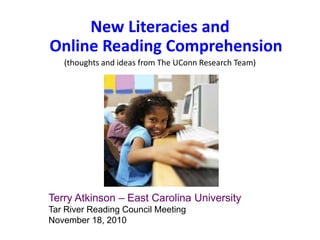
New Literacies and
Online Reading Comprehension
(thoughts and ideas from The UConn Research Team)
Terry Atkinson – East Carolina University
Tar River Reading Council Meeting
November 18, 2010
CHANGE
CHANGE
CHANGE
CHANGE
CHANGE
CHANGE
CHANGE
CHANGE
CHANGE
CHANGE
CHANGE
CHANGE
Important milestones in literacy
history…
• Late 2008-more than 1.5 billion individuals
using the Internet http://www.internetworldstats.com/stats.htm
• Online anyone can be a reader or writer
• “no other technology for reading, writing, and
communication has been adopted by so many
people, in so many places in so short a time”
(Leu, Zawilinski, Castek, Banerjee, Housand, Liu, and O’Neil, 2007)
The workplace has changed
• The business community reports significant productivity
gains due to Internet use for sharing information,
communicating, and solving problems
(van Ark, Inklaar, & McGuckin, 2003; Friedman, 2005; Matteucci, O’Mahony,
Robinson, & Zwick, 2005)
The likelihood that today’s students will
work for an international company, or
that a close acquaintance or someone in
their family will, is 100%.
(Zhao, 2009)
Students have changed
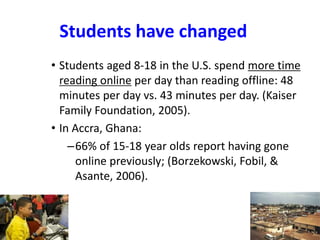
• Students aged 8-18 in the U.S. spend more time
reading online per day than reading offline: 48
minutes per day vs. 43 minutes per day. (Kaiser
Family Foundation, 2005).
• In Accra, Ghana:
–66% of 15-18 year olds report having gone
online previously; (Borzekowski, Fobil, &
Asante, 2006).
• Japan has broadband in nearly every
home that is 16 times faster than the
broadband in US homes for $22 per
month. (Bleha, 2005)
This generation’s defining technology for reading.
• Mexico is following e-Mexico, a
policy designed to provide every
citizen and every school with an
Internet connection (Ludlow, 2006).
This generation’s defining technology for reading.
The U.S. situation:
Not a single state in the U.S.
measures...
• ...students’ ability to read search
engine results during state reading
assessments.
• ...students’ ability to critically
evaluate information that is found
online to determine its reliability.
This generation’s defining technology for reading.
Not a single state measures...
• ...students’ ability to compose clear and
effective email messages in their state
writing assessment.
• Not a single state requires all students to
use a word processor on their state writing
assessment.*
*
See Russell & Plati, 1999; 2000; 2001. They report
effect sizes of .57 – 1.25 for word processor use on MCAS.
See also Russell & Tao, 2004 who report 19% more 4th grade
students classified as “Needs Improvement” would move up to the
“Proficient” performance level with word processors.
National Assessment of Educational
Progress (NAEP)
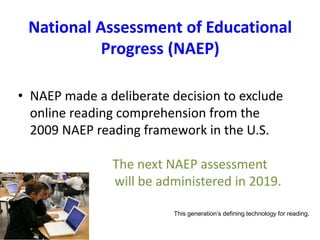
• NAEP made a deliberate decision to exclude
online reading comprehension from the
2009 NAEP reading framework in the U.S.
The next NAEP assessment
will be administered in 2019.
This generation’s defining technology for reading.
What can we
conclude?
• The Internet is this generation’s
defining technology for reading.
• Some states and nations place their
students at risk by continued
inaction or poorly informed public
policies.
What can we
conclude?
• No individual can keep up with the
many new literacies that appear
online
• Collaboration is key…new models of
instruction must allow students to
share their own insights..the
“EXPANDED ZPD”
ULTIMATELY…What can
we conclude?
• Because schools are not going to
magically morph into technology-rich
spaces with huge shifts in pedagogy in
the foreseeable future….
IT’S UP TO TEACHERS TO CHARGE AHEAD
INTO THE CLOUD…THE WEB 2.0 WORLD!
First, teachers must understand….
THE COMMON ELEMENTS OF NEW LITERACIES….
1. new technologies… require us to bring new potentials to
literacy tasks.
2. new literacies are central to full…participation in a global
community.
3. new literacies are deictic; they rapidly change as defining
technologies change.
4. new literacies are multiple, multimodal, and
multifaceted…they benefit from analysis that brings multiple
points of view to understanding them.
(Leu, O’Byrne, Zawilinski, McVerry, Everett-Cacopardo, 2009)
Online and Offline…
• reading comprehension are not the same.
If this were true, high-achieving offline
readers would always be high-achieving online
readers and vice versa.
• reading comprehension are not
ISOMORPHIC (having similar appearance, ignoring
finely-grained, but significant differences)
The New Literacies of Online
Reading Comprehension
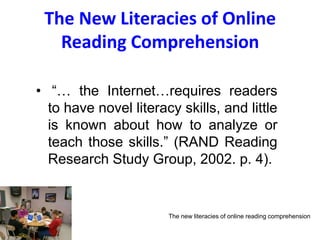
• “… the Internet…requires readers
to have novel literacy skills, and little
is known about how to analyze or
teach those skills.” (RAND Reading
Research Study Group, 2002. p. 4).
The new literacies of online reading comprehension
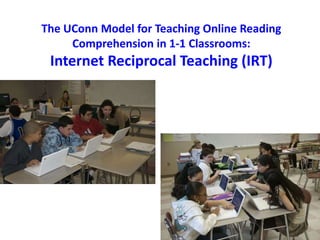
The UConn Model for Teaching Online Reading
Comprehension in 1-1 Classrooms:
Internet Reciprocal Teaching (IRT)
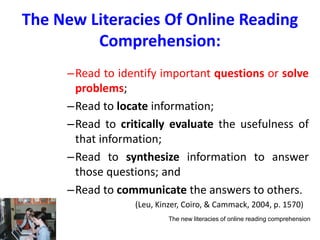
The New Literacies Of Online Reading
Comprehension:
–Read to identify important questions or solve
problems;
–Read to locate information;
–Read to critically evaluate the usefulness of
that information;
–Read to synthesize information to answer
those questions; and
–Read to communicate the answers to others.
(Leu, Kinzer, Coiro, & Cammack, 2004, p. 1570)
The new literacies of online reading comprehension
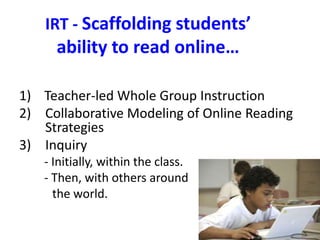
IRT - Scaffolding students’
ability to read online…
1) Teacher-led Whole Group Instruction
2) Collaborative Modeling of Online Reading
Strategies
3) Inquiry
- Initially, within the class.
- Then, with others around
the world.
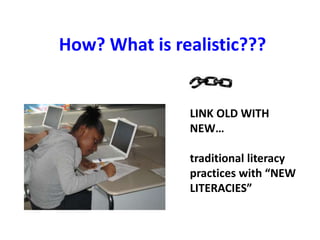
How? What is realistic???
LINK OLD WITH
NEW…
traditional literacy
practices with “NEW
LITERACIES”
Reality Recap…
1. The Internet is this generation’s defining
technology for reading and learning.
2. Current public policies may actually increase
reading achievement gaps.
3. NCLB-Students in poorest schools have less
Internet access at home and schools do not always
prepare them for new literacies of ORC at school.
4. Recent research: The Internet requires new
literacies -- additional online reading
comprehension (ORC) skills.
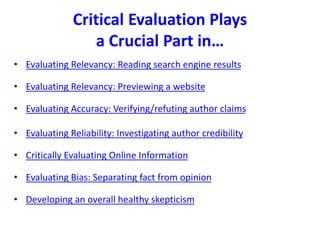
SO, where would we begin?
• Search engines
• Search basics
http://www.google.com/support/websearch/bin/a
nswer.py?hl=en&answer=136861&rd=1
• Reading and Evaluating Search Results
“new literacies”
“new literacies” + “Uconn”
“new literacies” – “Uconn”
Critical Evaluation Plays
a Crucial Part in…
• Evaluating Relevancy: Reading search engine results
• Evaluating Relevancy: Previewing a website
• Evaluating Accuracy: Verifying/refuting author claims
• Evaluating Reliability: Investigating author credibility
• Critically Evaluating Online Information
• Evaluating Bias: Separating fact from opinion
• Developing an overall healthy skepticism
Continuing the conversation…
• Article by Leu, D.J., O’Byrne, W.I., Zawilinski,
L., McVerry, J. G., Everett-Cacopardo, H., 2009.
Educational Researcher, 38, 4, 264-269. doi
10.3102/0013189X09336676. Available online
at:
http://edr.sagepub.com/content/38/4/264.full
.pdf+html
• Teacher’s Activity Guide
REFERENCES…
• Leu, D.J., O’Byrne, W.I., Zawilinski, L., McVerry, J. G., Everett-Cacopardo, H.,
2009. Educational Researcher, 38, 4, 264-269. doi
10.3102/0013189X09336676. Available online at:
http://edr.sagepub.com/content/38/4/264.full.pdf+html
• Leu D. J., Zawilinski, L. , Castek, J., Banerjee, M., Housand, B., Liu, Y. &
O’Neil, M., (2007). What is new about the new literacies of online reading
comprehension? In L. S. Rush, A. J. Eakle, & A. Berger (Eds.), Secondary
school literacy: What research reveals for classroom practice. Urbana, IL:
NCTE.
• Zhao, Y. (2009). Catching up or leading the way: Education in the age of
globalization. Alexandria, VA: ASCD.

TRRC

  • 1.
    New Literacies and OnlineReading Comprehension (thoughts and ideas from The UConn Research Team) Terry Atkinson – East Carolina University Tar River Reading Council Meeting November 18, 2010
  • 2.
  • 3.
    Important milestones inliteracy history… • Late 2008-more than 1.5 billion individuals using the Internet http://www.internetworldstats.com/stats.htm • Online anyone can be a reader or writer • “no other technology for reading, writing, and communication has been adopted by so many people, in so many places in so short a time” (Leu, Zawilinski, Castek, Banerjee, Housand, Liu, and O’Neil, 2007)
  • 4.
    The workplace haschanged • The business community reports significant productivity gains due to Internet use for sharing information, communicating, and solving problems (van Ark, Inklaar, & McGuckin, 2003; Friedman, 2005; Matteucci, O’Mahony, Robinson, & Zwick, 2005) The likelihood that today’s students will work for an international company, or that a close acquaintance or someone in their family will, is 100%. (Zhao, 2009)
  • 5.
    Students have changed •Students aged 8-18 in the U.S. spend more time reading online per day than reading offline: 48 minutes per day vs. 43 minutes per day. (Kaiser Family Foundation, 2005). • In Accra, Ghana: –66% of 15-18 year olds report having gone online previously; (Borzekowski, Fobil, & Asante, 2006).
  • 6.
    • Japan hasbroadband in nearly every home that is 16 times faster than the broadband in US homes for $22 per month. (Bleha, 2005) This generation’s defining technology for reading.
  • 7.
    • Mexico isfollowing e-Mexico, a policy designed to provide every citizen and every school with an Internet connection (Ludlow, 2006). This generation’s defining technology for reading.
  • 8.
    The U.S. situation: Nota single state in the U.S. measures... • ...students’ ability to read search engine results during state reading assessments. • ...students’ ability to critically evaluate information that is found online to determine its reliability. This generation’s defining technology for reading.
  • 9.
    Not a singlestate measures... • ...students’ ability to compose clear and effective email messages in their state writing assessment. • Not a single state requires all students to use a word processor on their state writing assessment.* * See Russell & Plati, 1999; 2000; 2001. They report effect sizes of .57 – 1.25 for word processor use on MCAS. See also Russell & Tao, 2004 who report 19% more 4th grade students classified as “Needs Improvement” would move up to the “Proficient” performance level with word processors.
  • 10.
    National Assessment ofEducational Progress (NAEP) • NAEP made a deliberate decision to exclude online reading comprehension from the 2009 NAEP reading framework in the U.S. The next NAEP assessment will be administered in 2019. This generation’s defining technology for reading.
  • 11.
    What can we conclude? •The Internet is this generation’s defining technology for reading. • Some states and nations place their students at risk by continued inaction or poorly informed public policies.
  • 12.
    What can we conclude? •No individual can keep up with the many new literacies that appear online • Collaboration is key…new models of instruction must allow students to share their own insights..the “EXPANDED ZPD”
  • 13.
    ULTIMATELY…What can we conclude? •Because schools are not going to magically morph into technology-rich spaces with huge shifts in pedagogy in the foreseeable future…. IT’S UP TO TEACHERS TO CHARGE AHEAD INTO THE CLOUD…THE WEB 2.0 WORLD!
  • 14.
    First, teachers mustunderstand…. THE COMMON ELEMENTS OF NEW LITERACIES…. 1. new technologies… require us to bring new potentials to literacy tasks. 2. new literacies are central to full…participation in a global community. 3. new literacies are deictic; they rapidly change as defining technologies change. 4. new literacies are multiple, multimodal, and multifaceted…they benefit from analysis that brings multiple points of view to understanding them. (Leu, O’Byrne, Zawilinski, McVerry, Everett-Cacopardo, 2009)
  • 15.
    Online and Offline… •reading comprehension are not the same. If this were true, high-achieving offline readers would always be high-achieving online readers and vice versa. • reading comprehension are not ISOMORPHIC (having similar appearance, ignoring finely-grained, but significant differences)
  • 16.
    The New Literaciesof Online Reading Comprehension • “… the Internet…requires readers to have novel literacy skills, and little is known about how to analyze or teach those skills.” (RAND Reading Research Study Group, 2002. p. 4). The new literacies of online reading comprehension
  • 17.
    The UConn Modelfor Teaching Online Reading Comprehension in 1-1 Classrooms: Internet Reciprocal Teaching (IRT)
  • 18.
    The New LiteraciesOf Online Reading Comprehension: –Read to identify important questions or solve problems; –Read to locate information; –Read to critically evaluate the usefulness of that information; –Read to synthesize information to answer those questions; and –Read to communicate the answers to others. (Leu, Kinzer, Coiro, & Cammack, 2004, p. 1570) The new literacies of online reading comprehension
  • 19.
    IRT - Scaffoldingstudents’ ability to read online… 1) Teacher-led Whole Group Instruction 2) Collaborative Modeling of Online Reading Strategies 3) Inquiry - Initially, within the class. - Then, with others around the world.
  • 20.
    How? What isrealistic??? LINK OLD WITH NEW… traditional literacy practices with “NEW LITERACIES”
  • 21.
    Reality Recap… 1. TheInternet is this generation’s defining technology for reading and learning. 2. Current public policies may actually increase reading achievement gaps. 3. NCLB-Students in poorest schools have less Internet access at home and schools do not always prepare them for new literacies of ORC at school. 4. Recent research: The Internet requires new literacies -- additional online reading comprehension (ORC) skills.
  • 22.
    SO, where wouldwe begin? • Search engines • Search basics http://www.google.com/support/websearch/bin/a nswer.py?hl=en&answer=136861&rd=1 • Reading and Evaluating Search Results “new literacies” “new literacies” + “Uconn” “new literacies” – “Uconn”
  • 23.
    Critical Evaluation Plays aCrucial Part in… • Evaluating Relevancy: Reading search engine results • Evaluating Relevancy: Previewing a website • Evaluating Accuracy: Verifying/refuting author claims • Evaluating Reliability: Investigating author credibility • Critically Evaluating Online Information • Evaluating Bias: Separating fact from opinion • Developing an overall healthy skepticism
  • 24.
    Continuing the conversation… •Article by Leu, D.J., O’Byrne, W.I., Zawilinski, L., McVerry, J. G., Everett-Cacopardo, H., 2009. Educational Researcher, 38, 4, 264-269. doi 10.3102/0013189X09336676. Available online at: http://edr.sagepub.com/content/38/4/264.full .pdf+html • Teacher’s Activity Guide
  • 25.
    REFERENCES… • Leu, D.J.,O’Byrne, W.I., Zawilinski, L., McVerry, J. G., Everett-Cacopardo, H., 2009. Educational Researcher, 38, 4, 264-269. doi 10.3102/0013189X09336676. Available online at: http://edr.sagepub.com/content/38/4/264.full.pdf+html • Leu D. J., Zawilinski, L. , Castek, J., Banerjee, M., Housand, B., Liu, Y. & O’Neil, M., (2007). What is new about the new literacies of online reading comprehension? In L. S. Rush, A. J. Eakle, & A. Berger (Eds.), Secondary school literacy: What research reveals for classroom practice. Urbana, IL: NCTE. • Zhao, Y. (2009). Catching up or leading the way: Education in the age of globalization. Alexandria, VA: ASCD.

Editor's Notes

  • #3 ----- Meeting Notes (11/17/10 19:58) -----None of us would argue with the fact that just as our world has experienced (and continues to experience) DRAMATIC CHANGES during the last two decades, so has how we read and write. Here's what I used to learn to read in ELEM school. Here is what I use to read now.....
  • #4 At this rate, > half of world’s population will be online in 7 years, MOST of world online in the next 10-15 yearsMention motivation…writing for REAL audiences highly impacts motivation
  • #22 Knobel and Lankshear document that it is the MOST efficient system in our history for delivering new technologies to read, write, and communicate!Poorer schools are under greatest pressure to raise test scores that have NOTHING to do with online reading comprehension (Henry, 2007)
  • #23 LINK OLD to NEWFRAMING THE INTERNET AS A LITERACY ISSUE, NOT A TECHNOLOGY ISSUE..INTERNET INSTRUCTION INTEGRATED INTO ALL SUBJECT AREAS, TAUGHT BY ALL TEACHERS