Saliency Detection: A Boolean Map Approach
IEEE International Conference on Computer
Vision (ICCV), 2013
Jianming Zhang , Stan Sclaroff
Department of Computer Science, Boston University
8/18/2014 1B31XM Advanced Image Analysis
Team Members : H.Kidane, I.Sadek, M.Elawady
Heriot Watt University
School of Electrical and Physical Sciences
Outline
• Introduction
• Related work
• Methodology
• Experiments
• Conclusion
• Future Work
8/18/2014 B31XM Advanced Image Analysis 2
Outline
• Introduction
• Related work
• Methodology
• Experiments
• Conclusion
• Future Work
8/18/2014 B31XM Advanced Image Analysis 3
• Goal
– Proposing a Boolean map based saliency . An image is represented in a
set of binary images by randomly thresholding the image’s color
channel. based on figure ground segregation
• What is saliency !
– Saliency at a given location = how different this location is from its
surround color, orientation, motion, depth etc (Koch an Ullman, 1985,
Itti et al. 1998). This is usually called (Bottom up saliency)
• Applications
– Image segmentation
– Object recognition
– Visual tracking
8/18/2014 B31XM Advanced Image Analysis 4
Introduction
8/18/2014 B31XM Advanced Image Analysis 5
Introduction
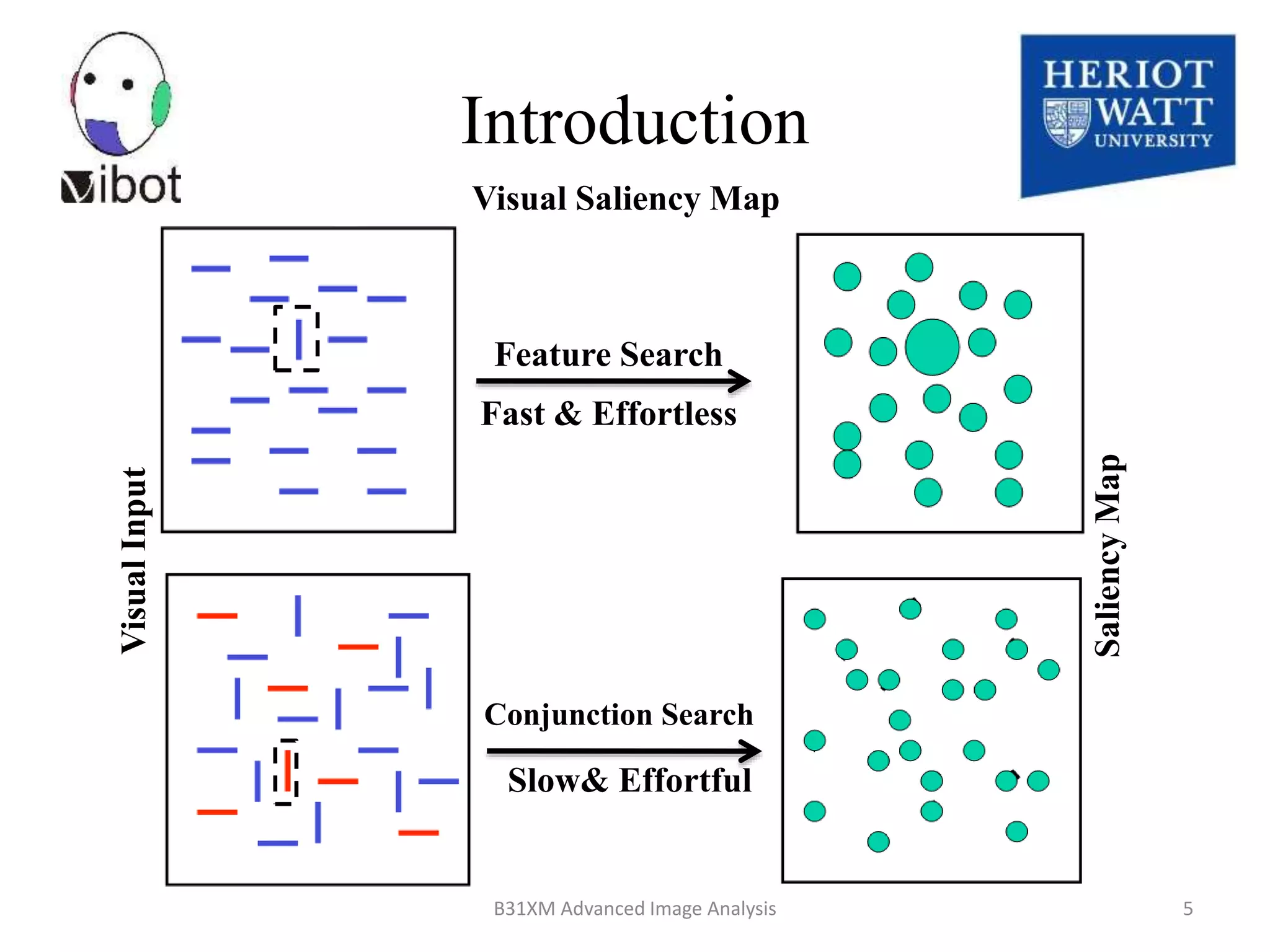
Feature Search
Fast & Effortless
Conjunction Search
Slow& Effortful
VisualInput
SaliencyMap
Visual Saliency Map
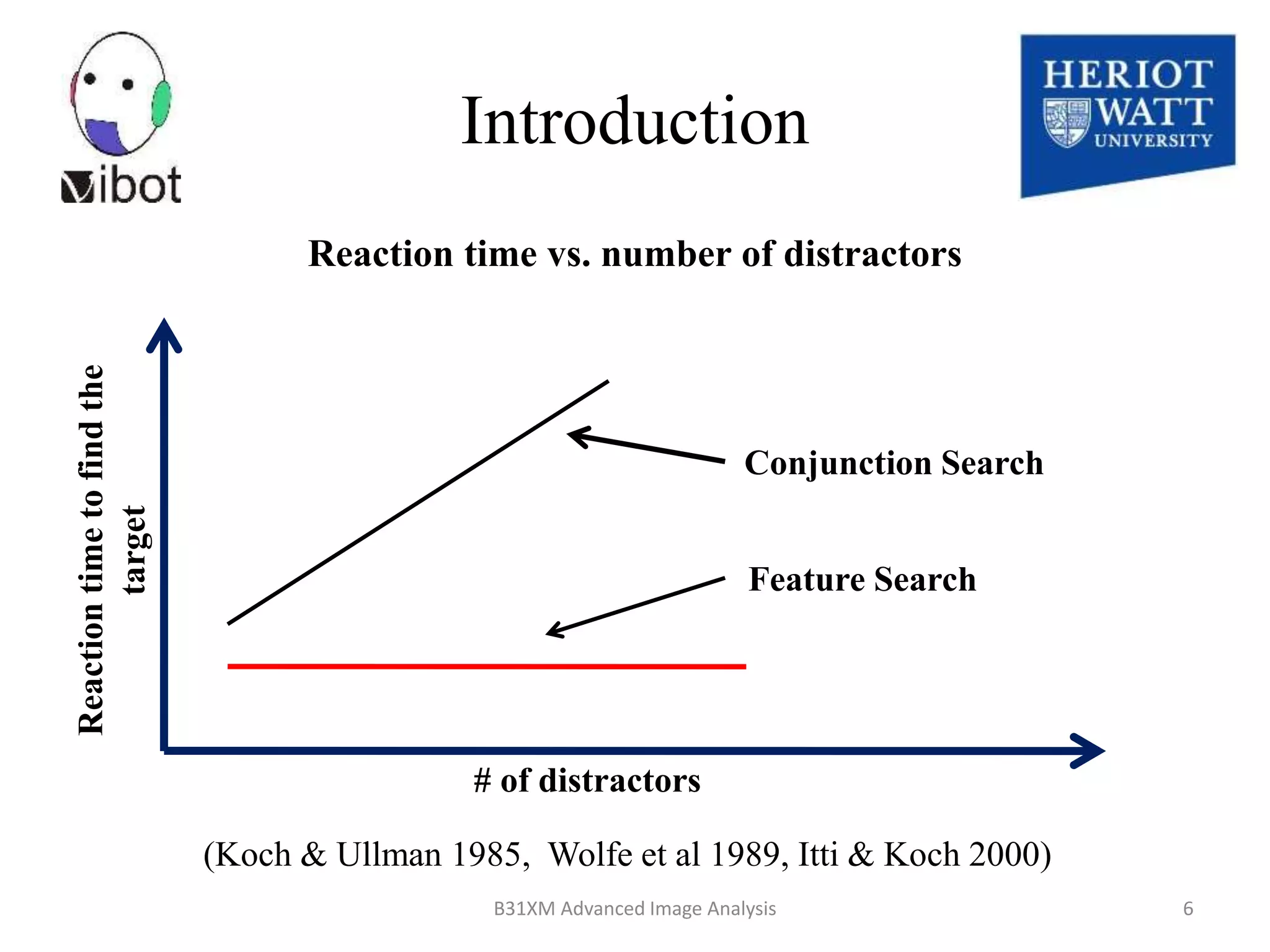
Reaction time vs. number of distractors
8/18/2014 B31XM Advanced Image Analysis 6
Introduction
Feature Search
Conjunction Search
Reactiontimetofindthe
target
# of distractors
(Koch & Ullman 1985, Wolfe et al 1989, Itti & Koch 2000)
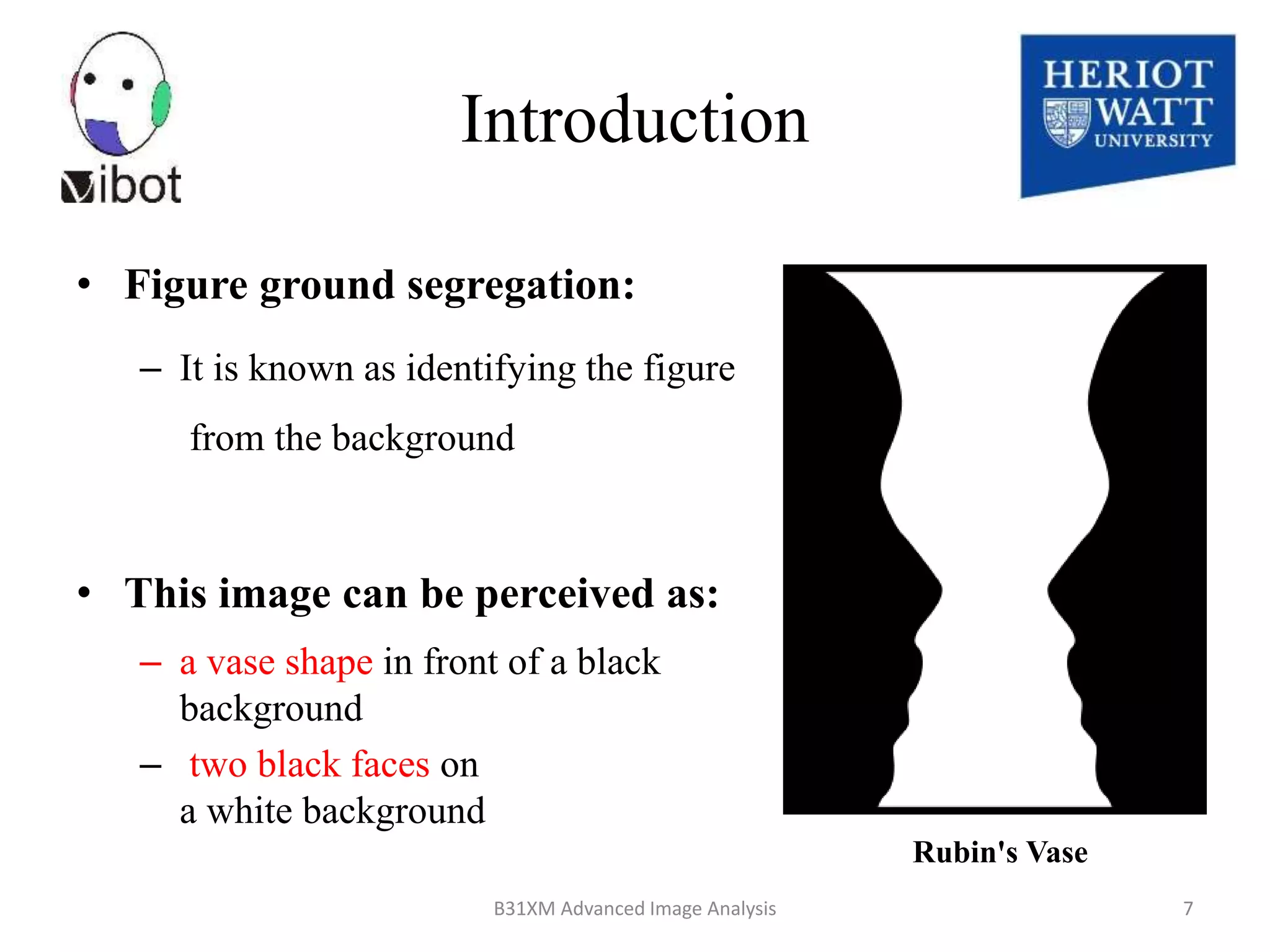
• Figure ground segregation:
– It is known as identifying the figure
from the background
• This image can be perceived as:
– a vase shape in front of a black
background
– two black faces on
a white background
8/18/2014 B31XM Advanced Image Analysis 7
Introduction
Rubin's Vase
Outlines
• Introduction
• Related work
• Methodology
• Experiments
• Conclusion
• Future Work
8/18/2014 B31XM Advanced Image Analysis 8
8/18/2014 B31XM Advanced Image Analysis 9
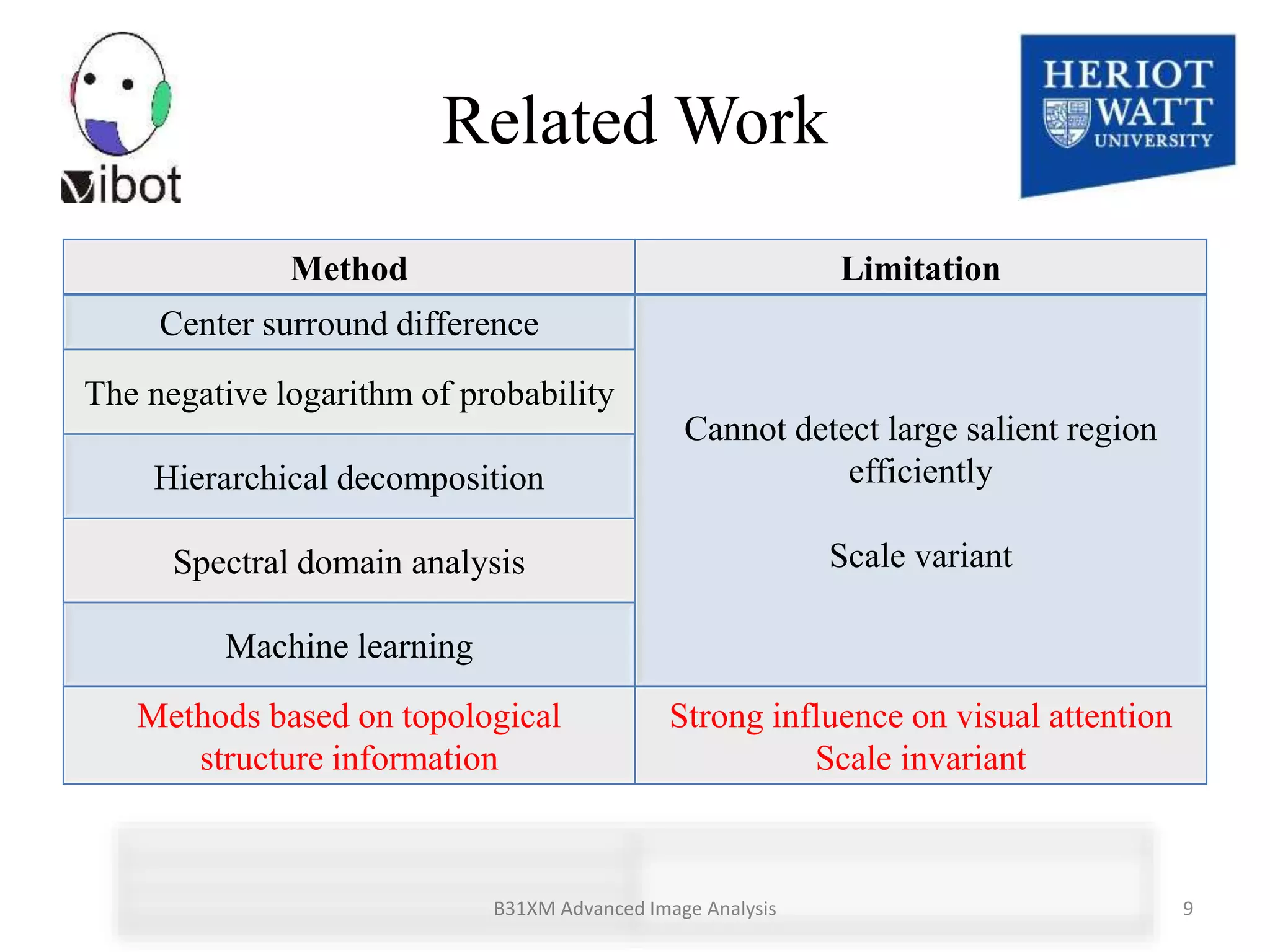
Related Work
Method Limitation
Center surround difference
Cannot detect large salient region
efficiently
Scale variant
The negative logarithm of probability
Hierarchical decomposition
Spectral domain analysis
Machine learning
Methods based on topological
structure information
Strong influence on visual attention
Scale invariant
Outline
• Introduction
• Related work
• Methodology
• Experiments
• Conclusion
• Future Work
8/18/2014 B31XM Advanced Image Analysis 10
8/18/2014 B31XM Advanced Image Analysis 11
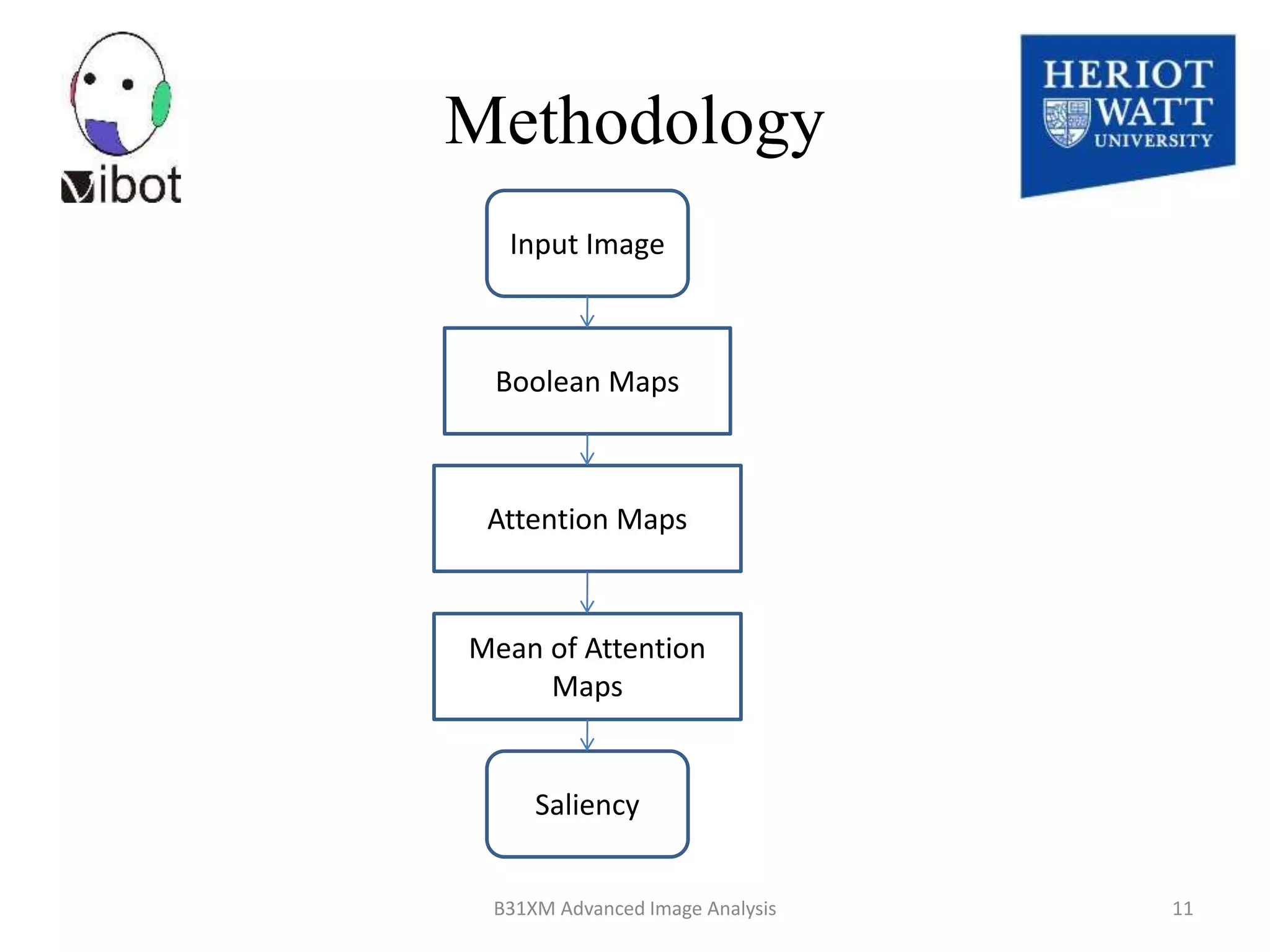
Methodology
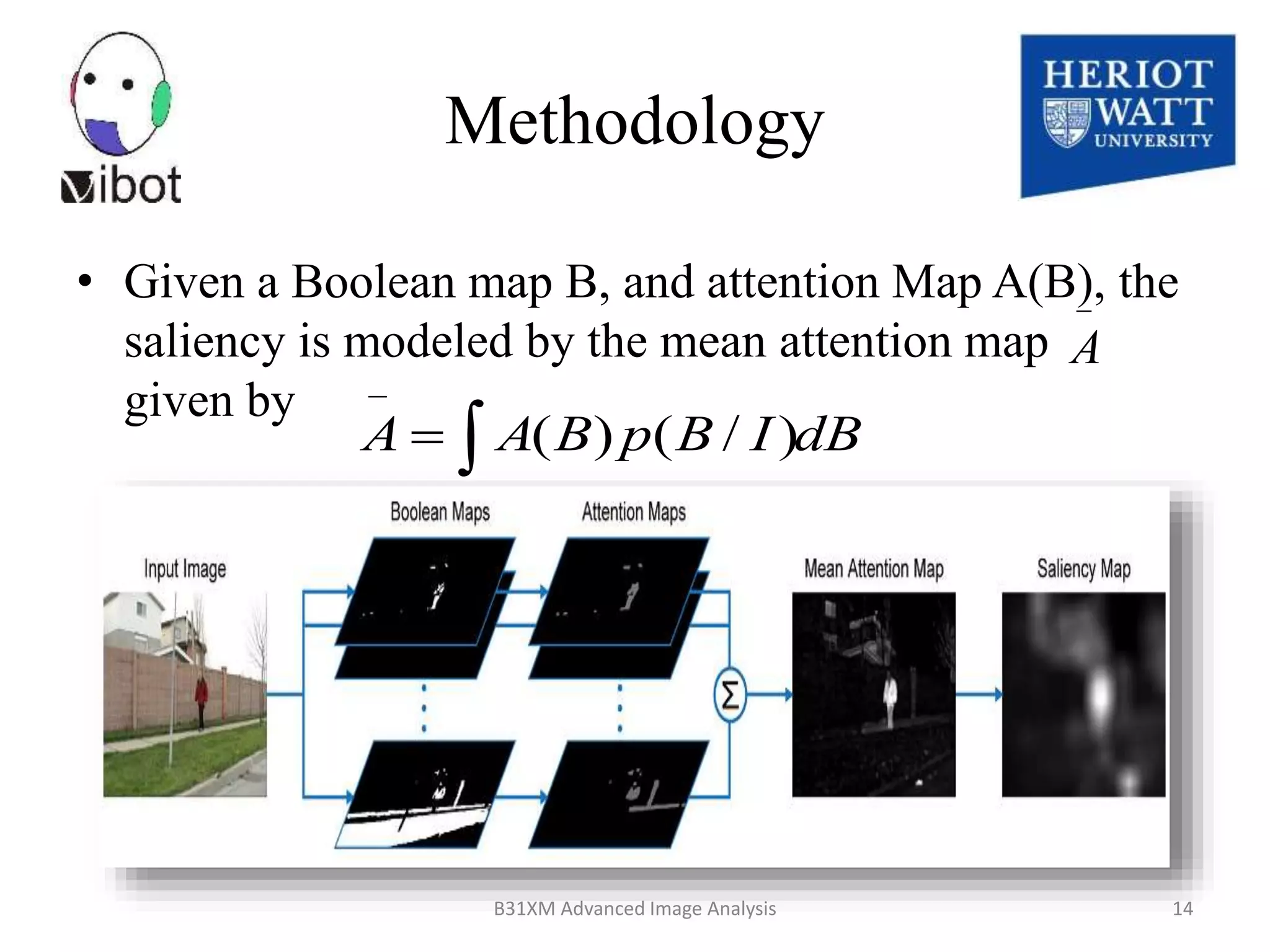
Input Image
Boolean Maps
Attention Maps
Saliency
Mean of Attention
Maps
It is generated by randomly thresholding an input image I
Where
donates feature map of I
Randomly generated threshold in the range [0, 255]
CIE lab color space (perceptual uniformity)
8/18/2014 B31XM Advanced Image Analysis 12
Boolean MAP
)),((  ITHRESHBi

)(I

Methodology
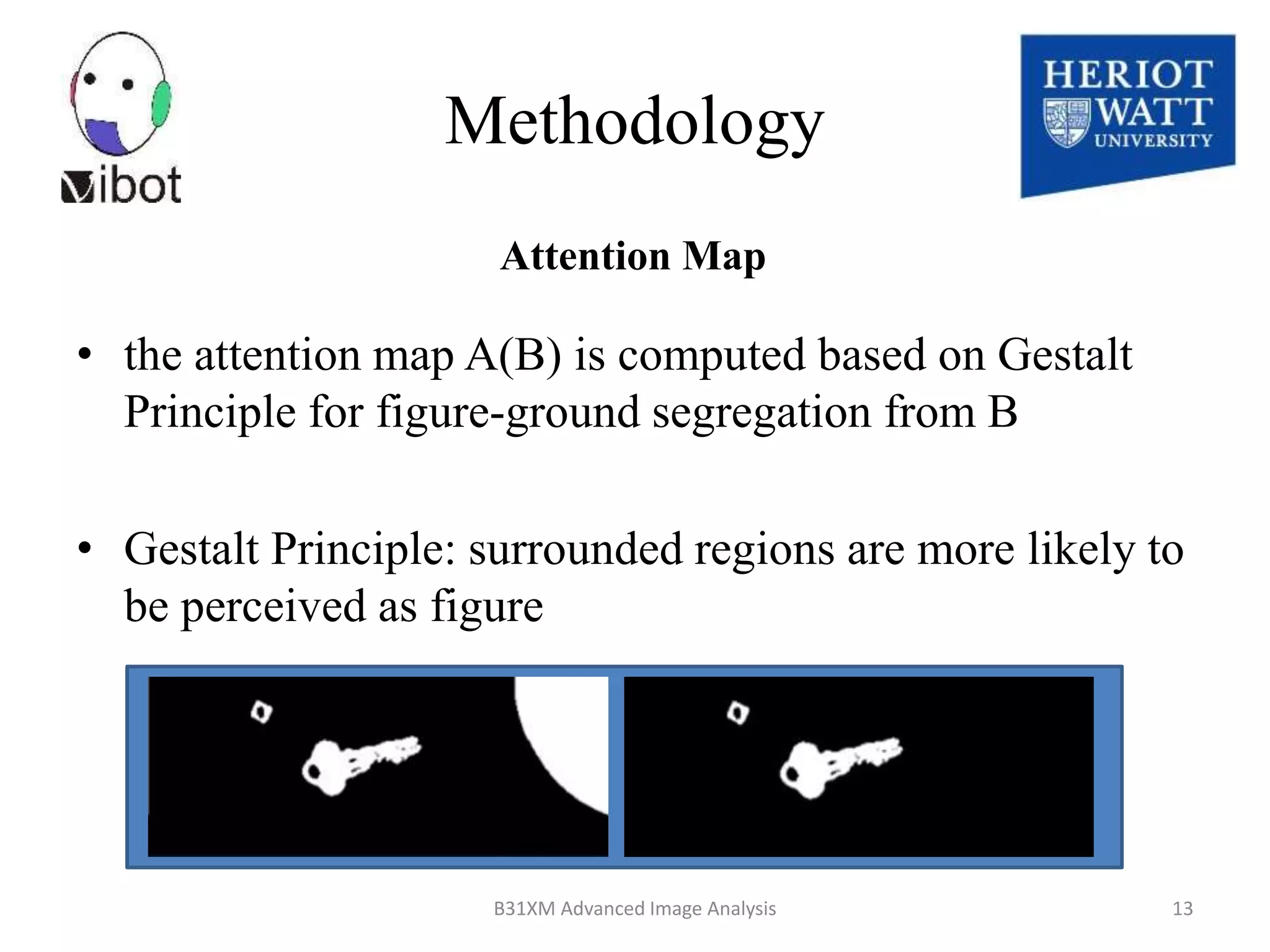
• the attention map A(B) is computed based on Gestalt
Principle for figure-ground segregation from B
• Gestalt Principle: surrounded regions are more likely to
be perceived as figure
8/18/2014 B31XM Advanced Image Analysis 13
Attention Map
Methodology
• Given a Boolean map B, and attention Map A(B), the
saliency is modeled by the mean attention map
given by
8/18/2014 B31XM Advanced Image Analysis 14

A
dBIBpBAA 

)/()(
Methodology
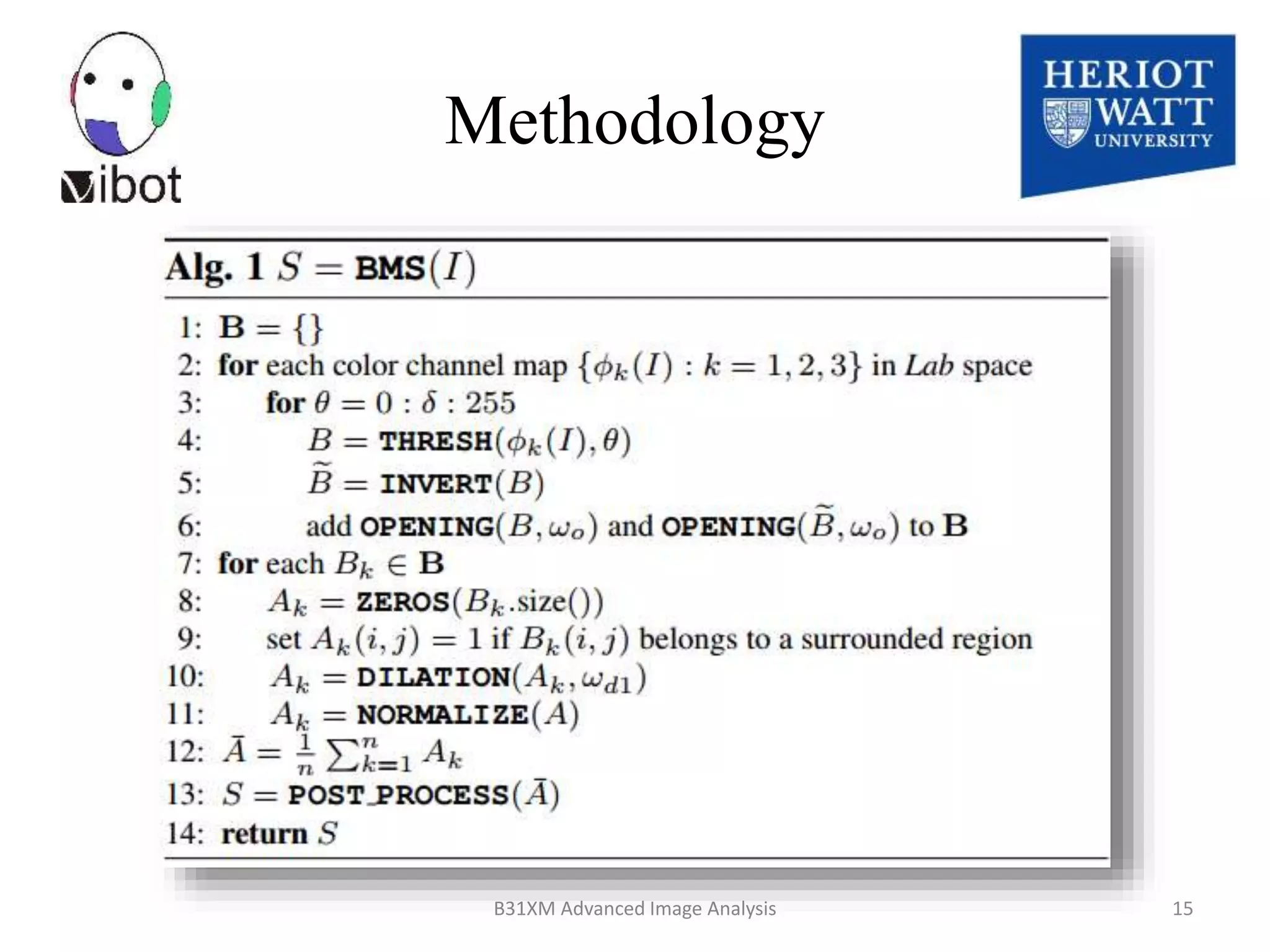
8/18/2014 B31XM Advanced Image Analysis 15
Methodology
Outline
• Introduction
• Related work
• Methodology
• Experiments
• Conclusion
• Future Work
8/18/2014 B31XM Advanced Image Analysis 16
8/18/2014 B31XM Advanced Image Analysis 17
Experiments
Experiments
Eye Fixation Prediction
Implementation
details
Width of image resizing 600
Width of kernel for opening operation 5
Sampling step size 8
Width of kernel for dilation operation 7
Width of kernel for opening operation
(before Gaussian blurring)
23
Standard deviation of Gaussian
blurring
20
Removing Small
peaks on mean
attention map
http://mentormate.com/
8/18/2014 18B31XM Advanced Image Analysis
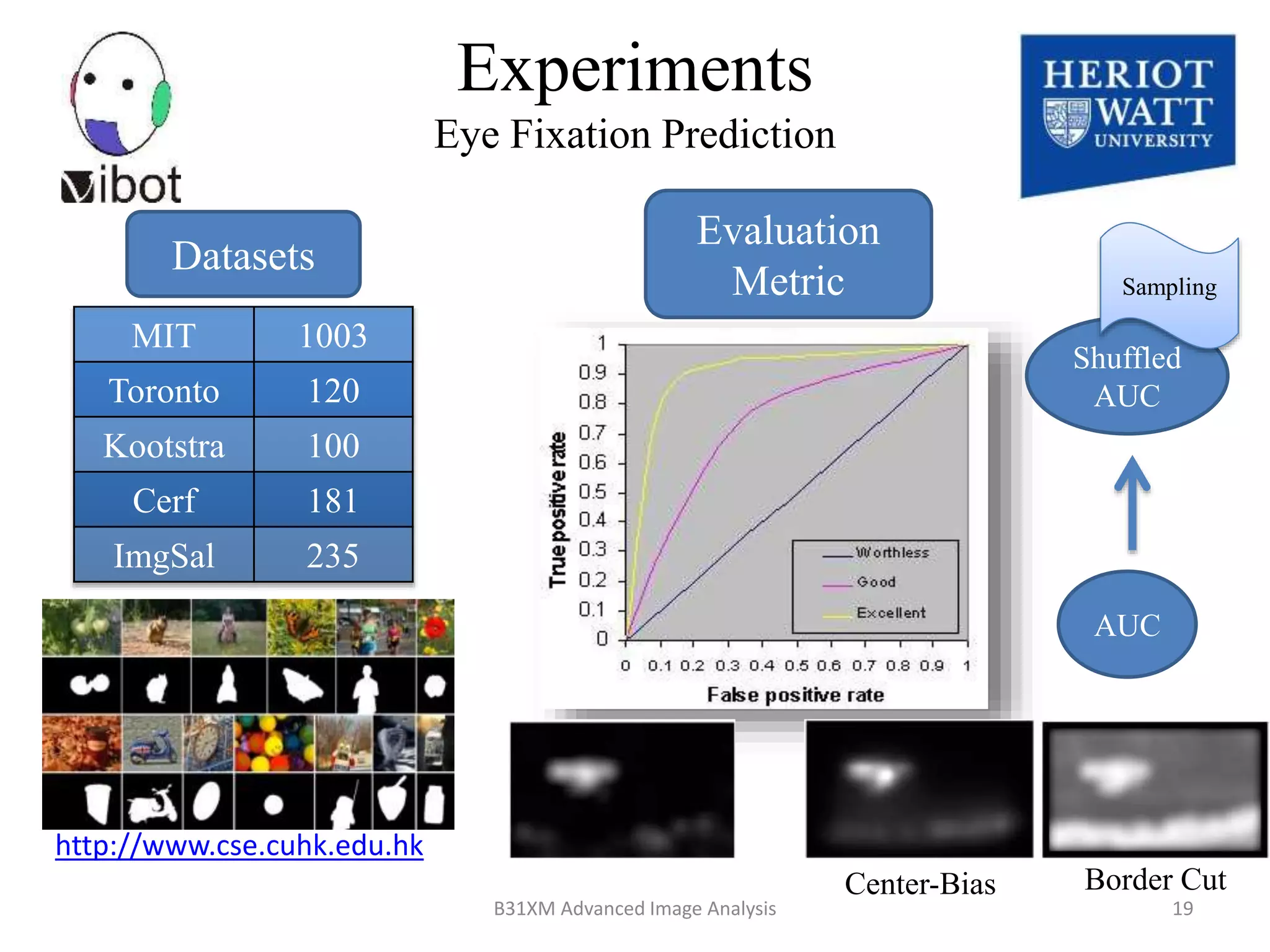
Datasets
MIT 1003
Toronto 120
Kootstra 100
Cerf 181
ImgSal 235
http://www.cse.cuhk.edu.hk
Evaluation
Metric
AUC
Shuffled
AUC
Border CutCenter-Bias
Sampling
Experiments
Eye Fixation Prediction
8/18/2014 19B31XM Advanced Image Analysis
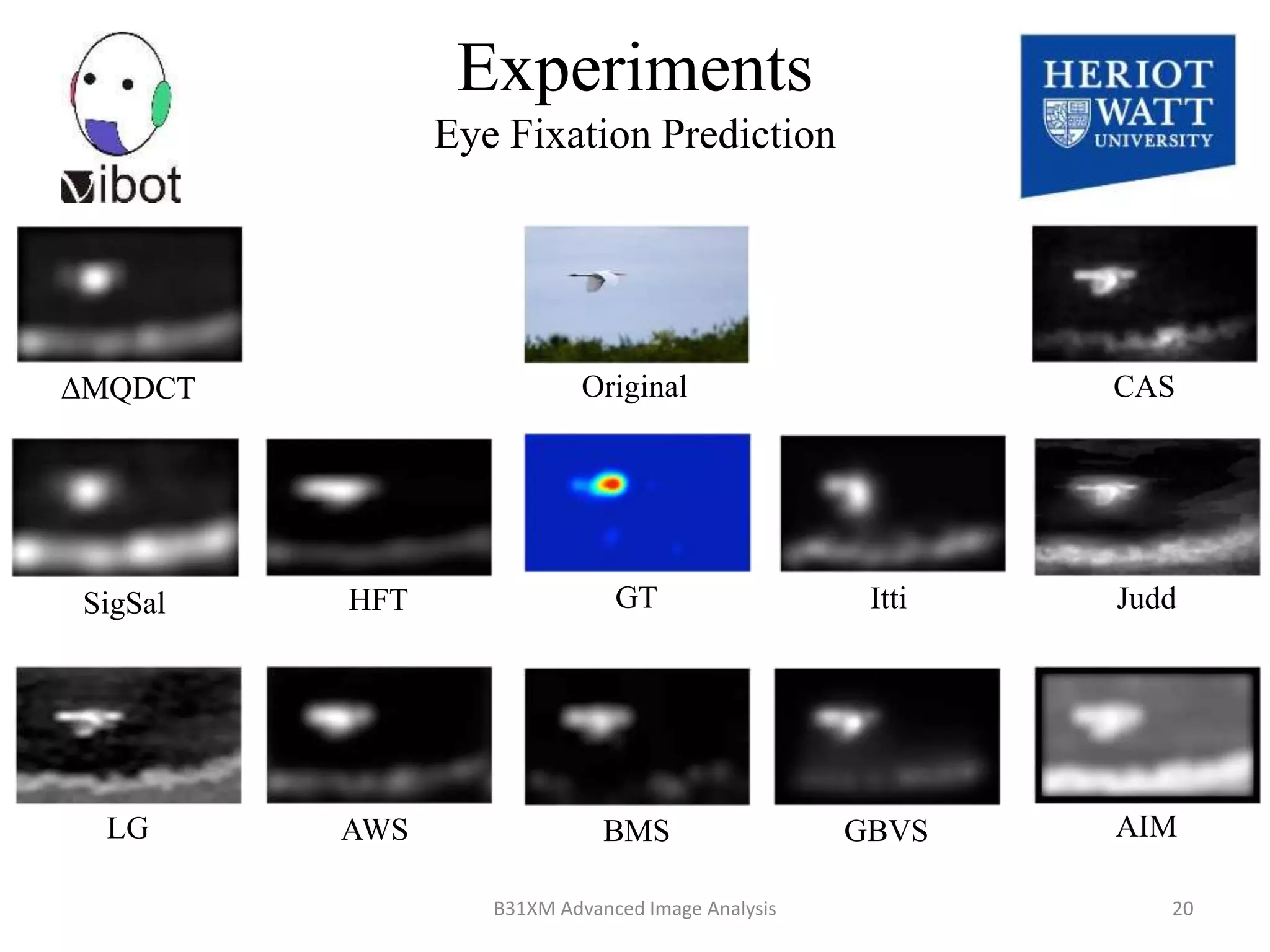
Original
GT
BMS
ΔMQDCT
SigSal
LG AWS
HFT
CAS
Judd
AIMGBVS
Itti
Experiments
Eye Fixation Prediction
8/18/2014 20B31XM Advanced Image Analysis
Original
GT
BMS
ΔMQDCT
SigSal
LG AWS
HFT
CAS
Judd
AIMGBVS
Itti
Experiments
Eye Fixation Prediction
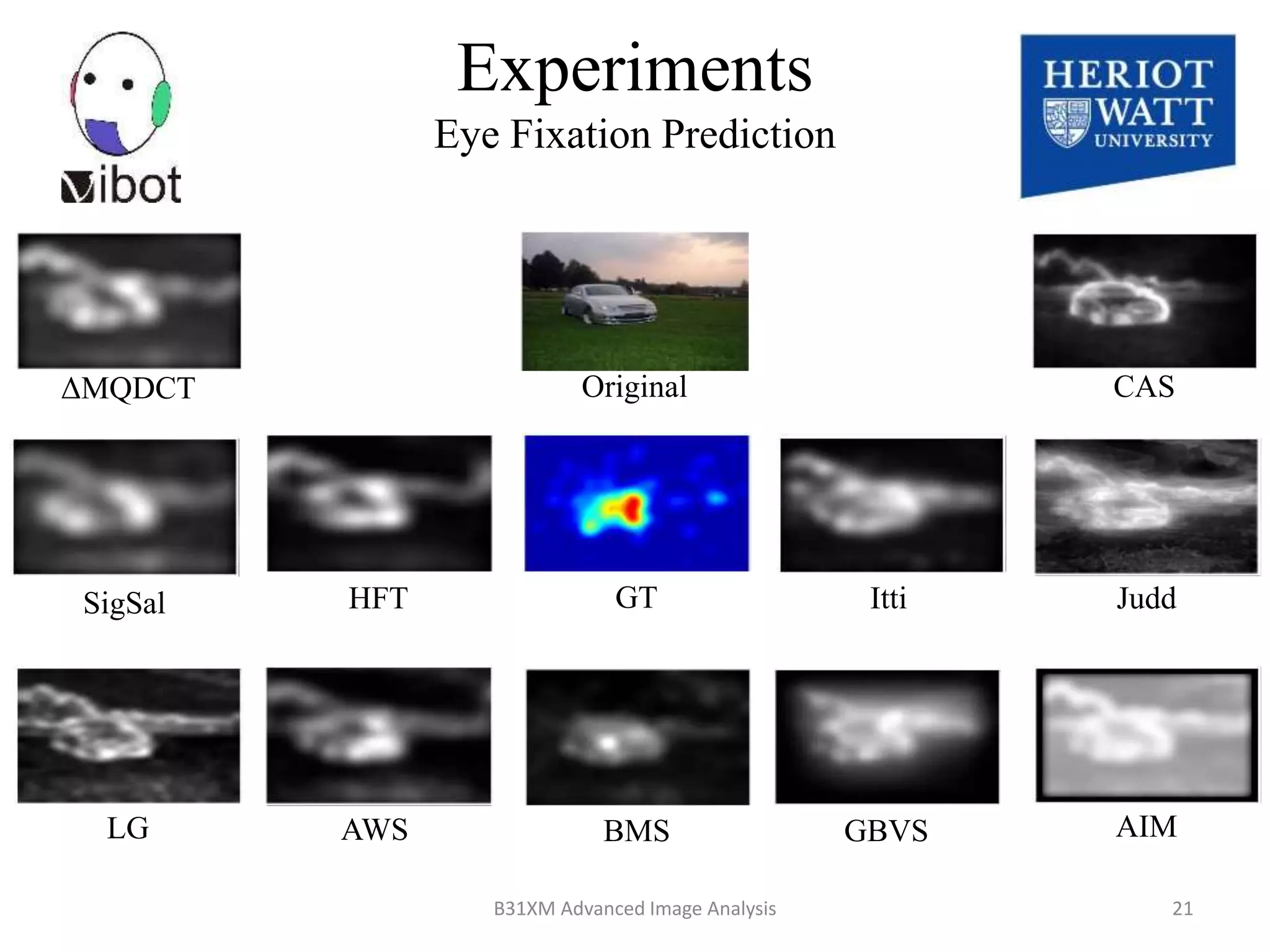
8/18/2014 21B31XM Advanced Image Analysis
Original
GT
BMS
ΔMQDCT
SigSal
LG AWS
HFT
CAS
Judd
AIMGBVS
Itti
Experiments
Eye Fixation Prediction
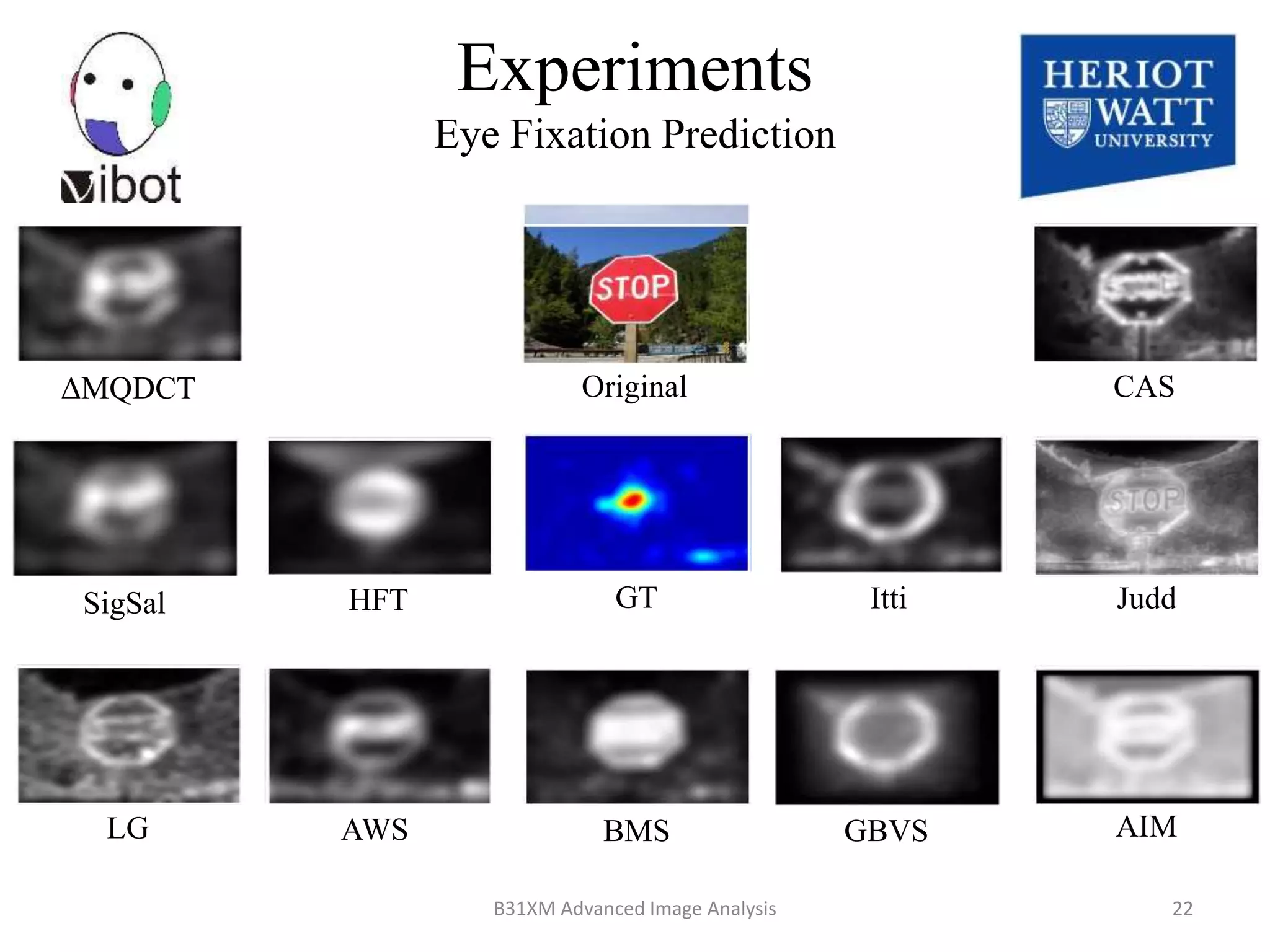
8/18/2014 22B31XM Advanced Image Analysis
Experiments
Eye Fixation Prediction
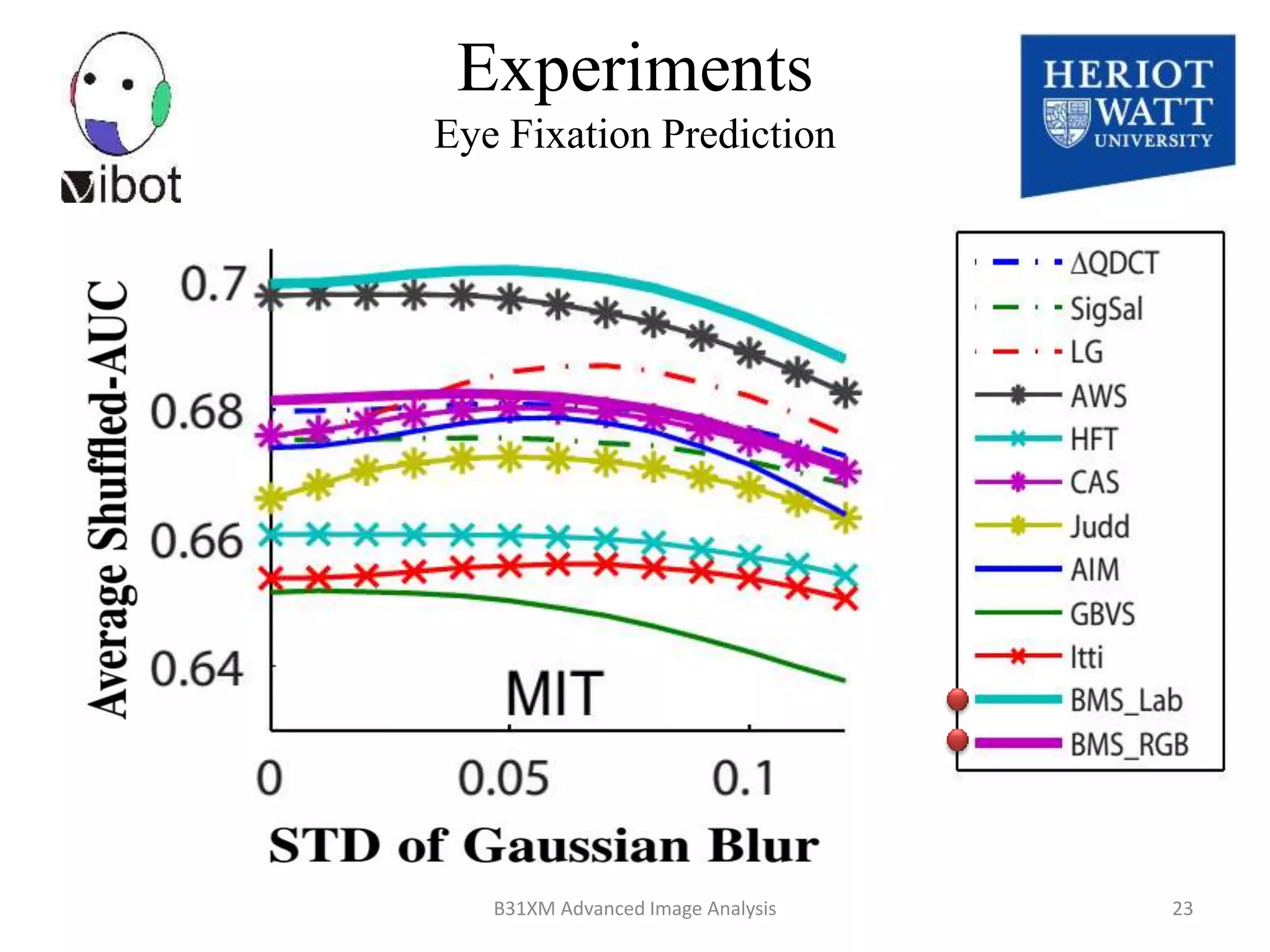
8/18/2014 23B31XM Advanced Image Analysis
Experiments
Eye Fixation Prediction
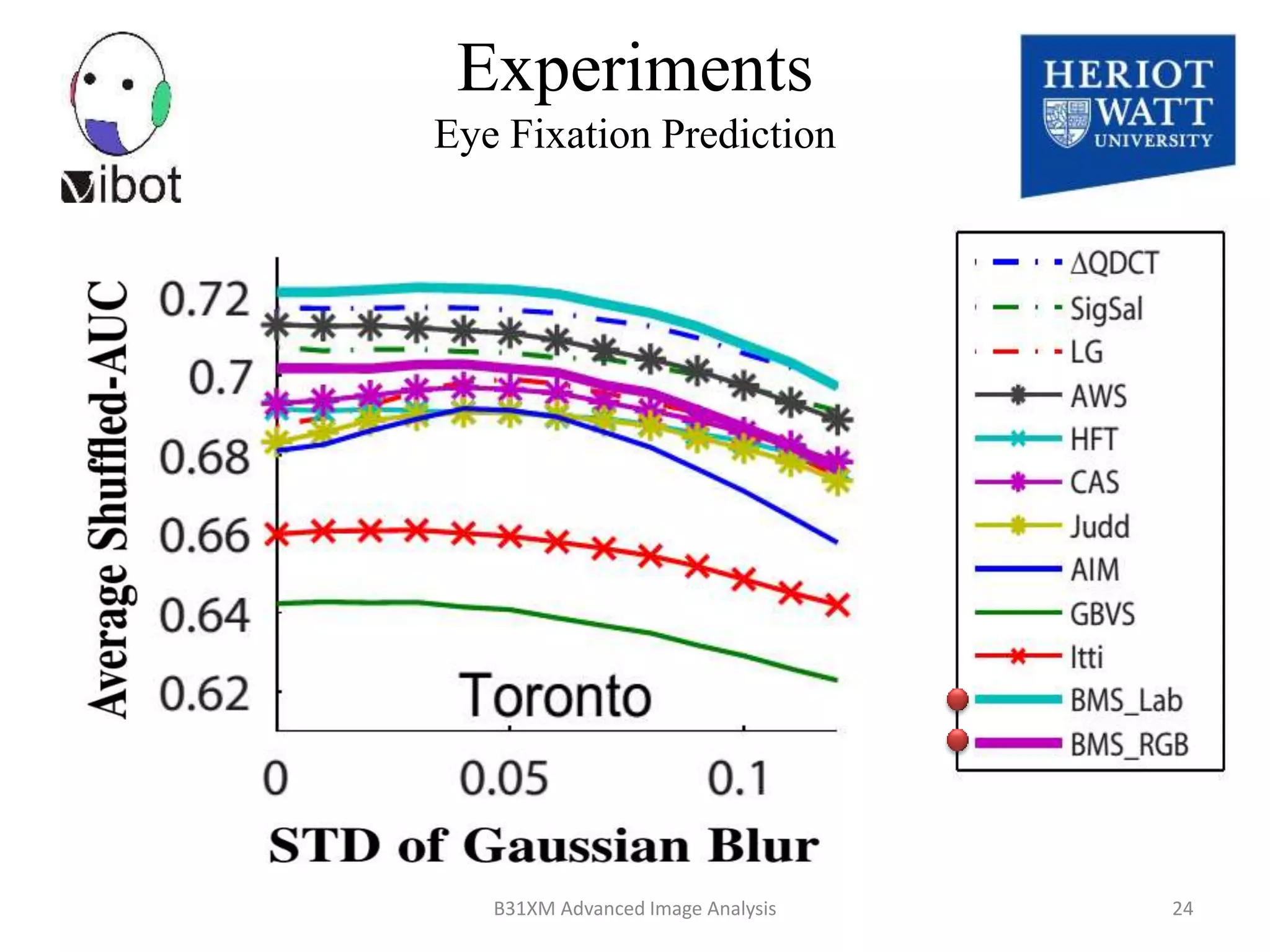
8/18/2014 24B31XM Advanced Image Analysis
Experiments
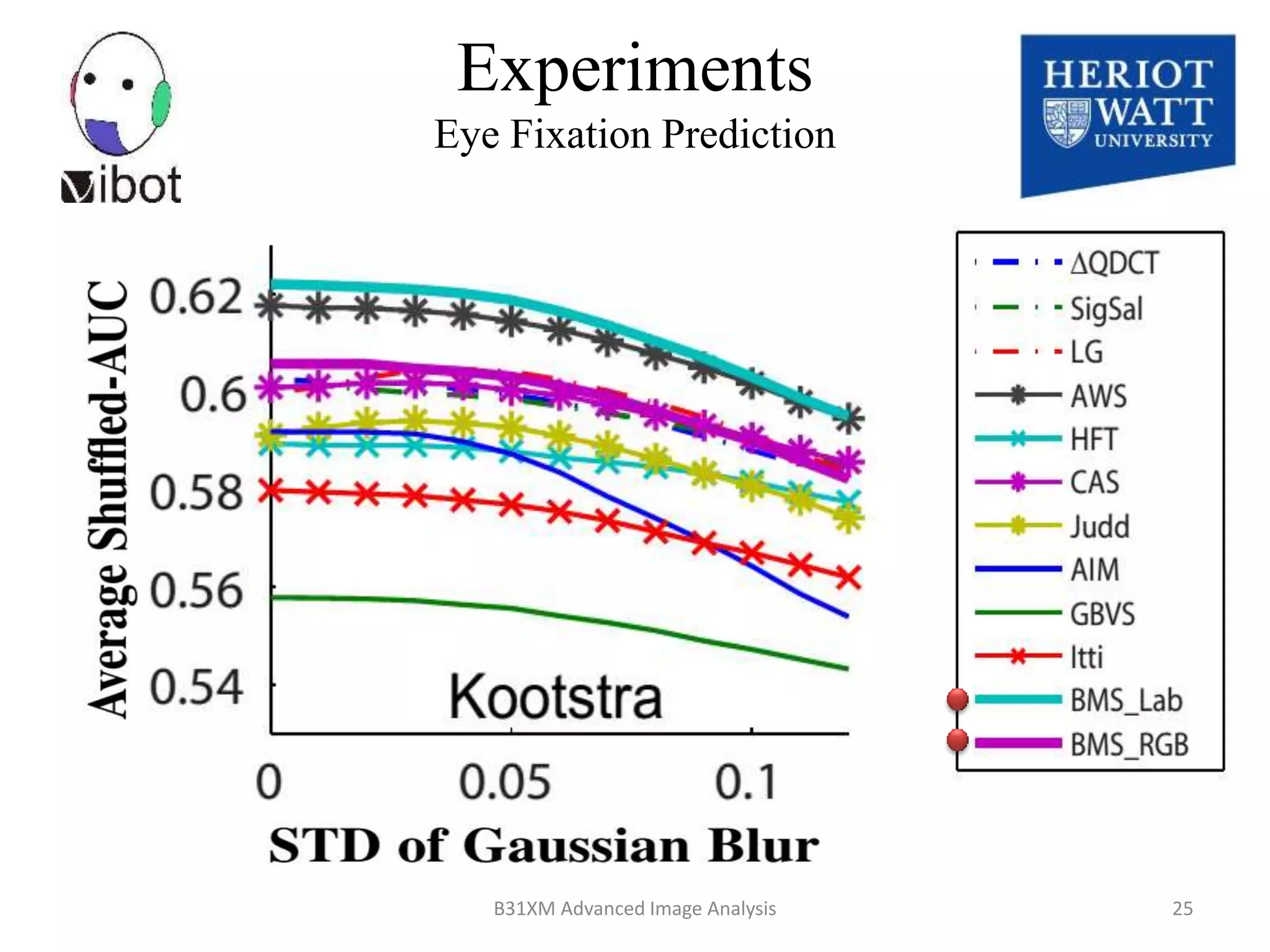
Eye Fixation Prediction
8/18/2014 25B31XM Advanced Image Analysis
Experiments
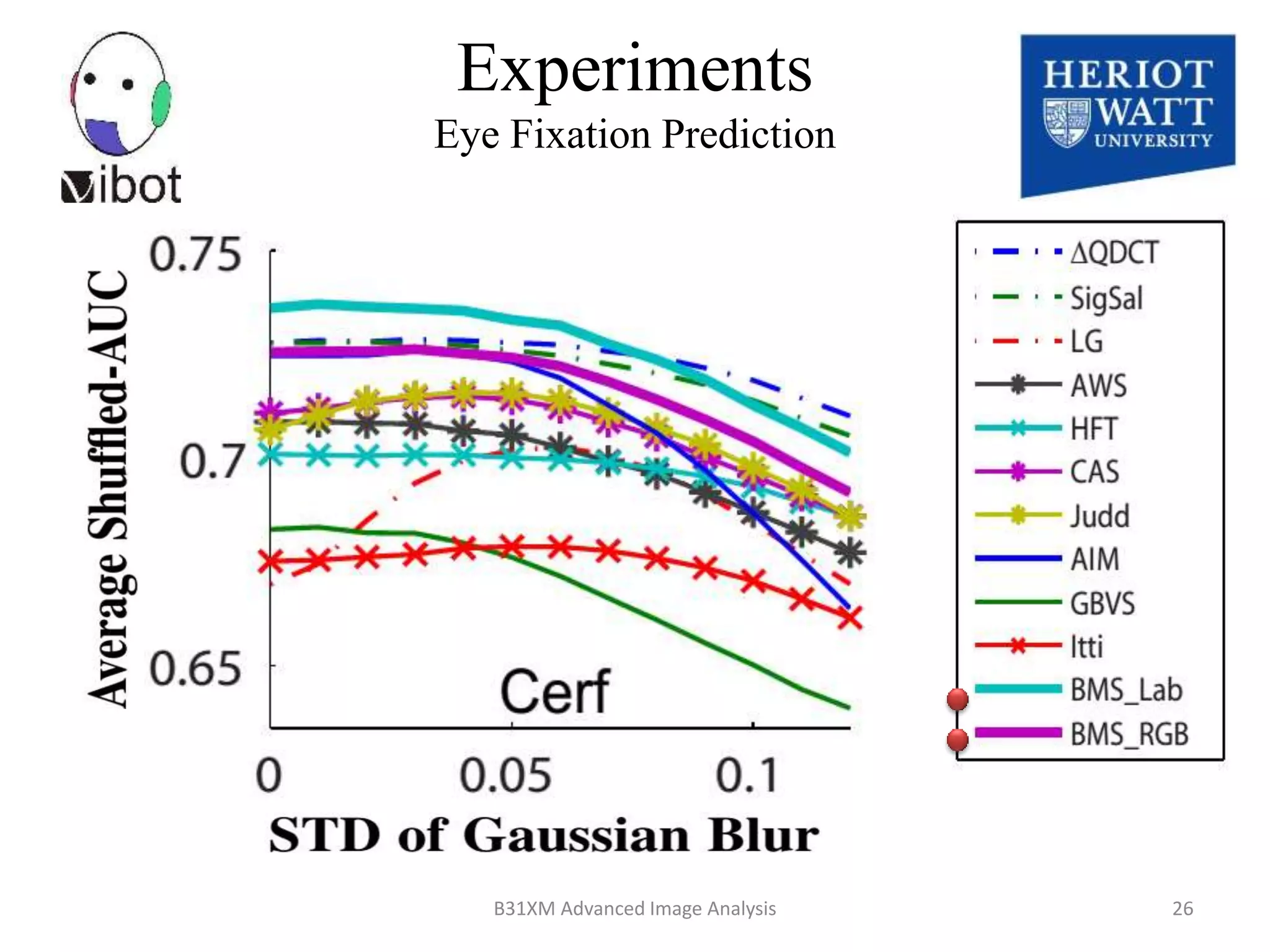
Eye Fixation Prediction
8/18/2014 26B31XM Advanced Image Analysis
Experiments
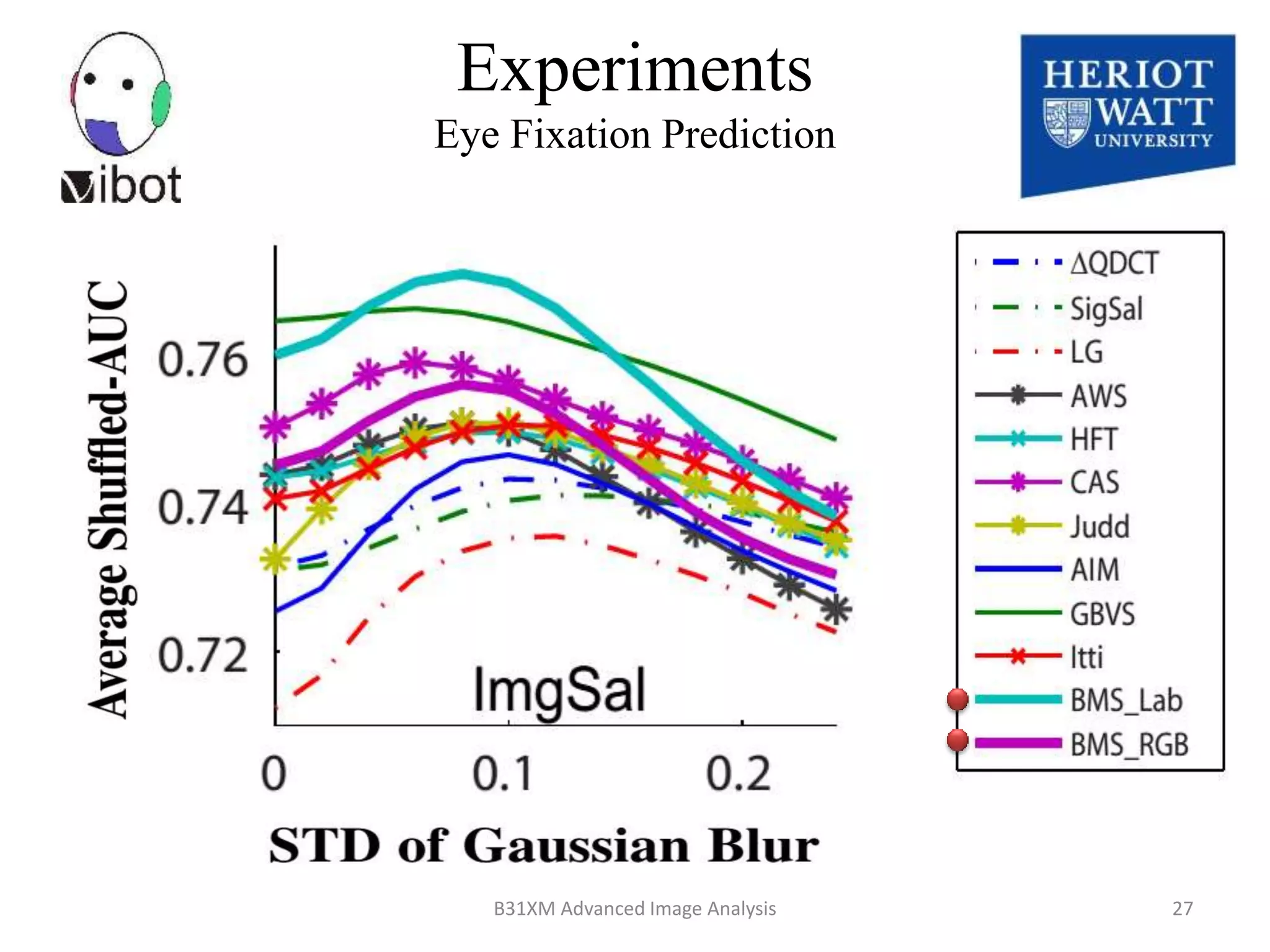
Eye Fixation Prediction
8/18/2014 27B31XM Advanced Image Analysis
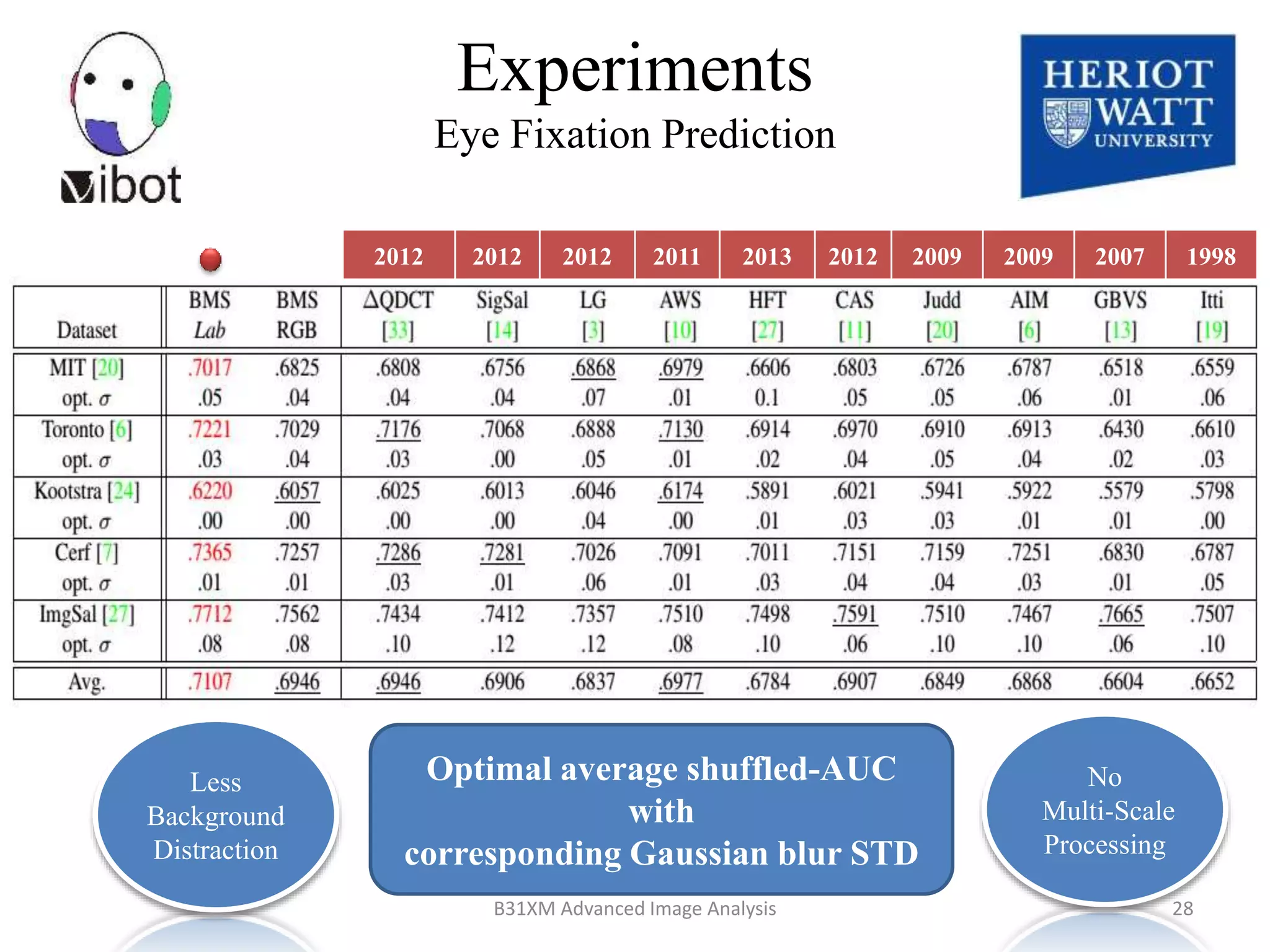
Optimal average shuffled-AUC
with
corresponding Gaussian blur STD
2012 2012 2012 2011 2013 2012 2009 2009 2007 1998
Less
Background
Distraction
No
Multi-Scale
Processing
Experiments
Eye Fixation Prediction
8/18/2014 28B31XM Advanced Image Analysis
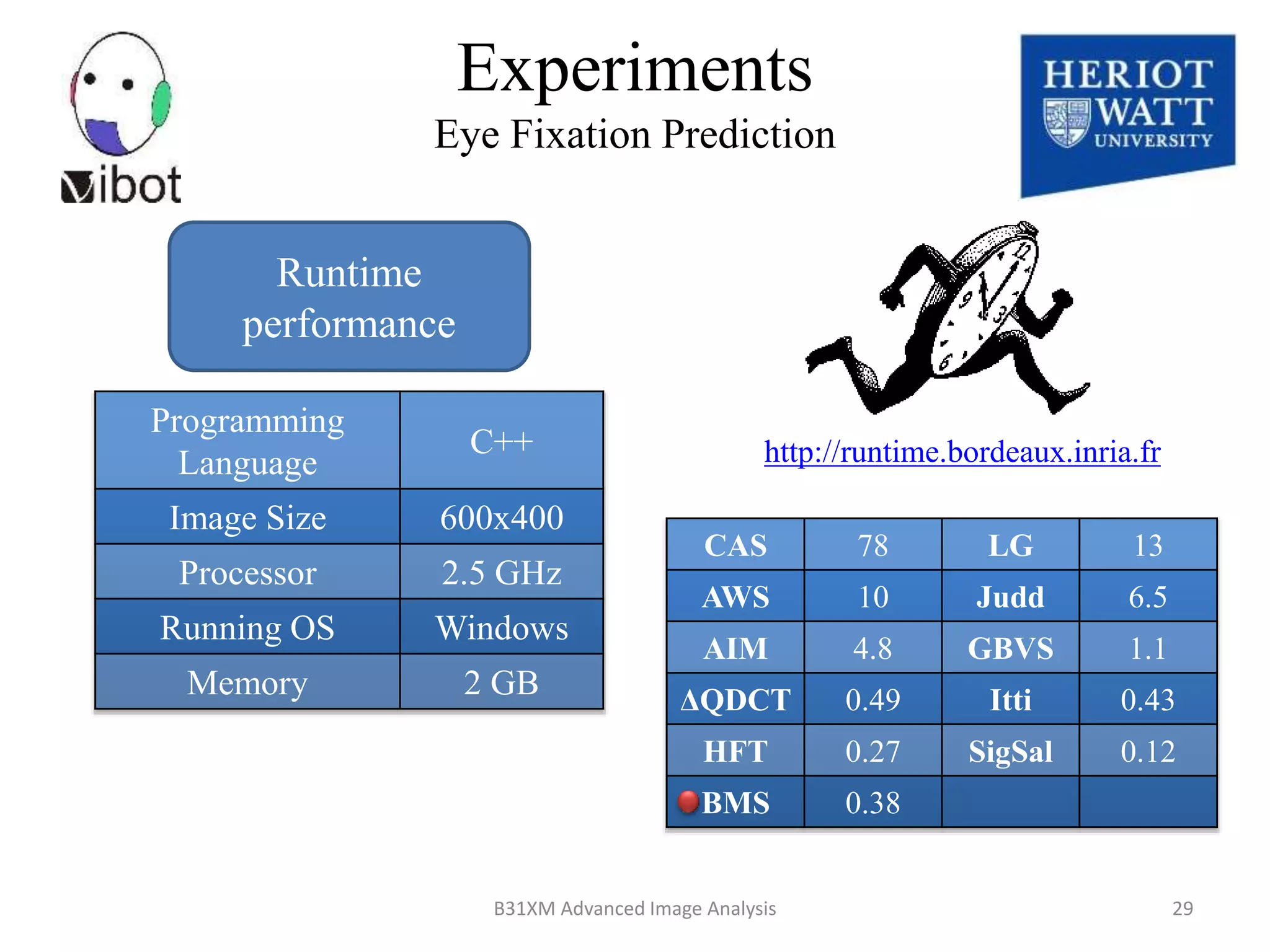
Runtime
performance
Programming
Language
C++
Image Size 600x400
Processor 2.5 GHz
Running OS Windows
Memory 2 GB
http://runtime.bordeaux.inria.fr
CAS 78 LG 13
AWS 10 Judd 6.5
AIM 4.8 GBVS 1.1
ΔQDCT 0.49 Itti 0.43
HFT 0.27 SigSal 0.12
BMS 0.38
Experiments
Eye Fixation Prediction
8/18/2014 29B31XM Advanced Image Analysis
Experiments
Salient Object Detection
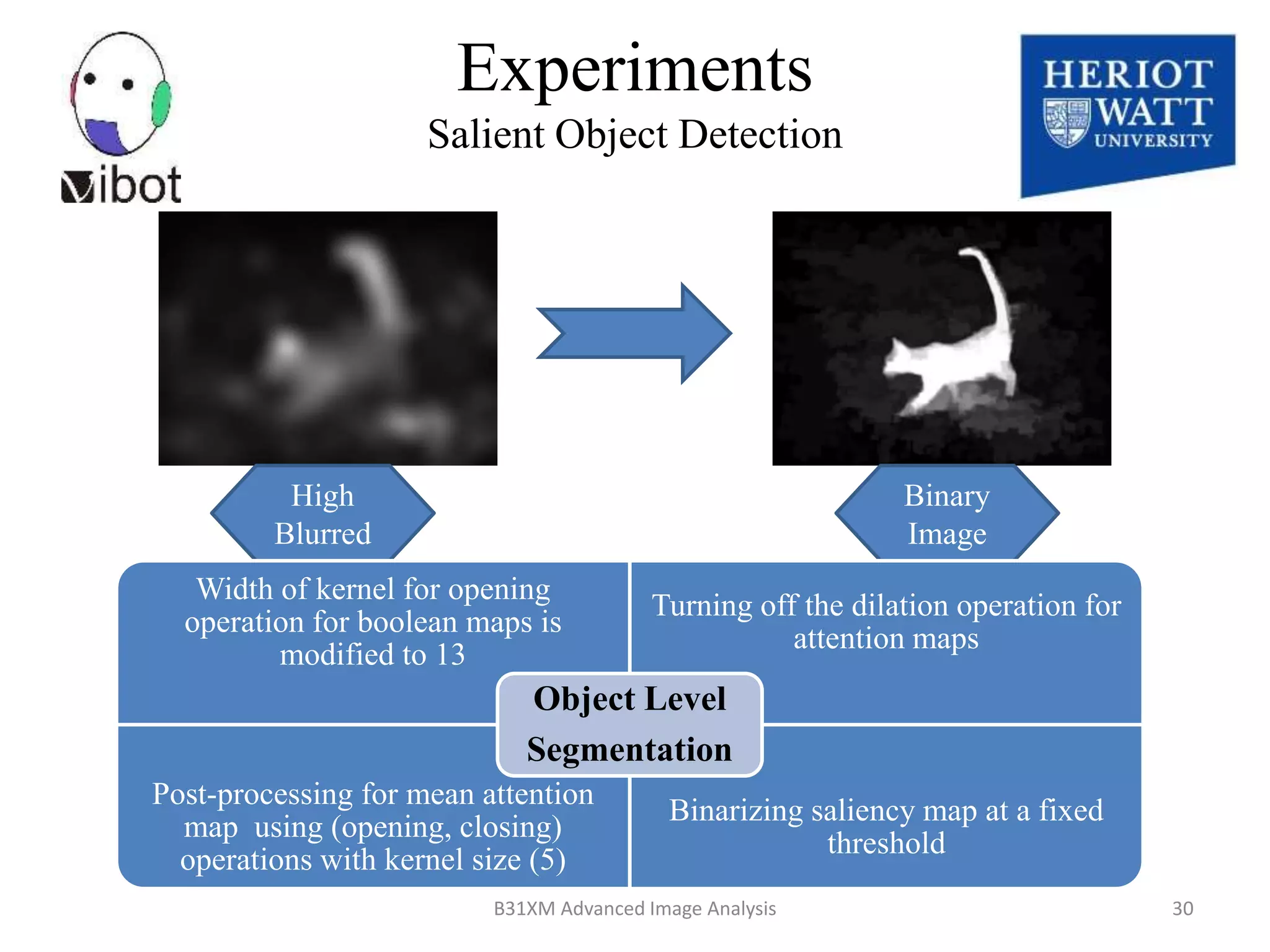
High
Blurred
Binary
Image
Width of kernel for opening
operation for boolean maps is
modified to 13
Turning off the dilation operation for
attention maps
Post-processing for mean attention
map using (opening, closing)
operations with kernel size (5)
Binarizing saliency map at a fixed
threshold
Object Level
Segmentation
8/18/2014 30B31XM Advanced Image Analysis
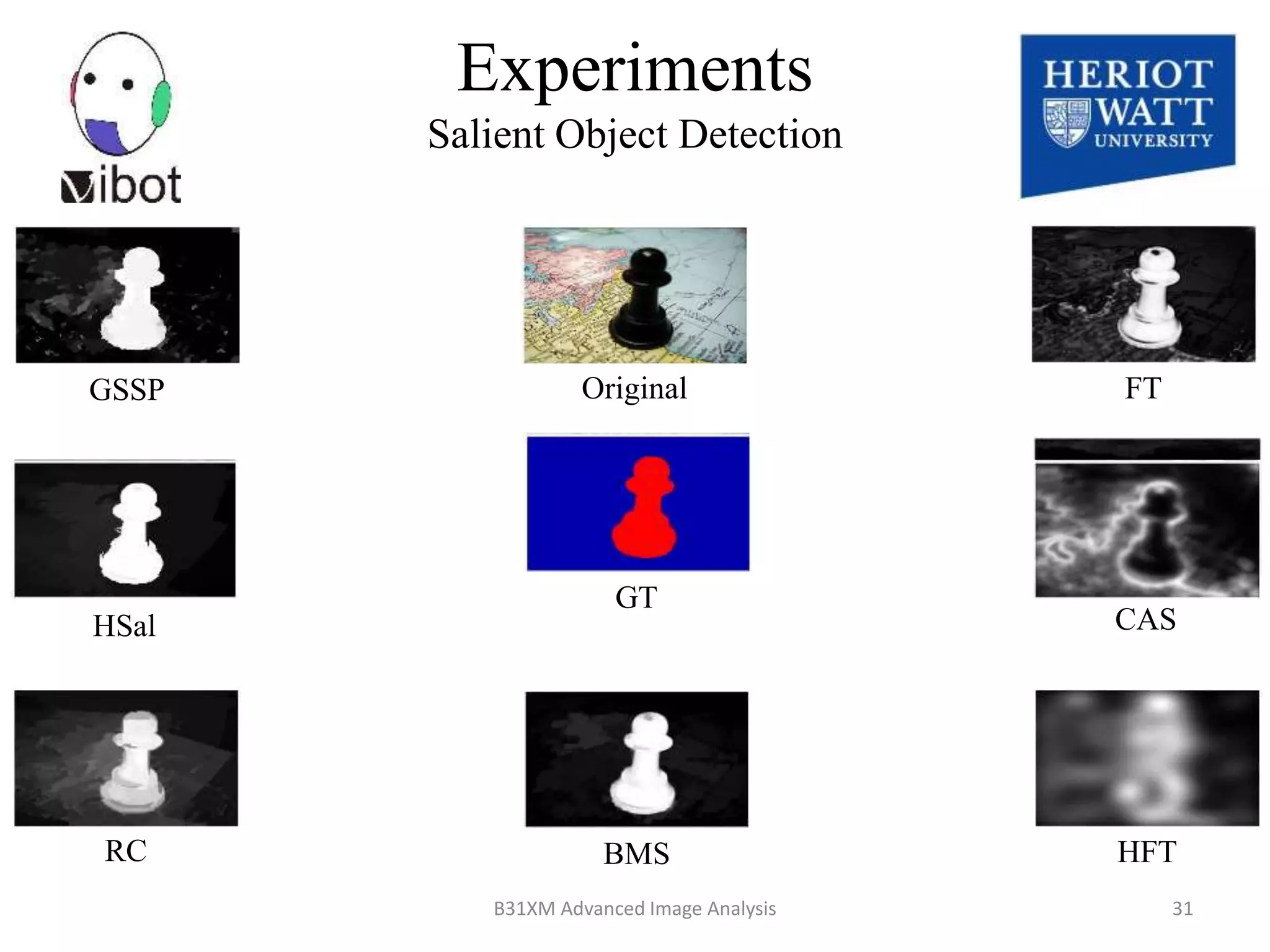
Original
GT
BMS
GSSP
HSal
RC
FT
CAS
HFT
Experiments
Salient Object Detection
8/18/2014 31B31XM Advanced Image Analysis
Experiments
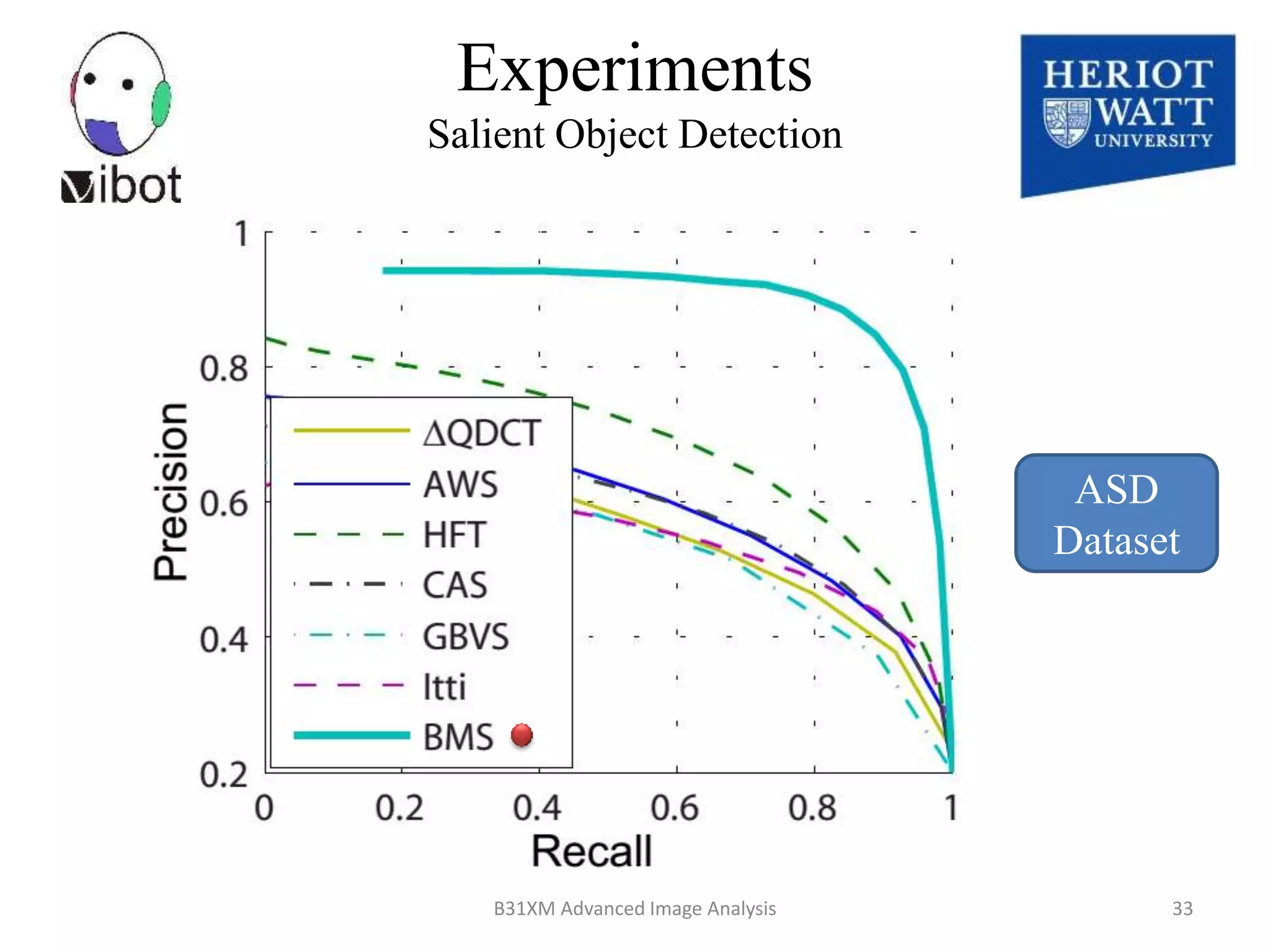
Salient Object Detection
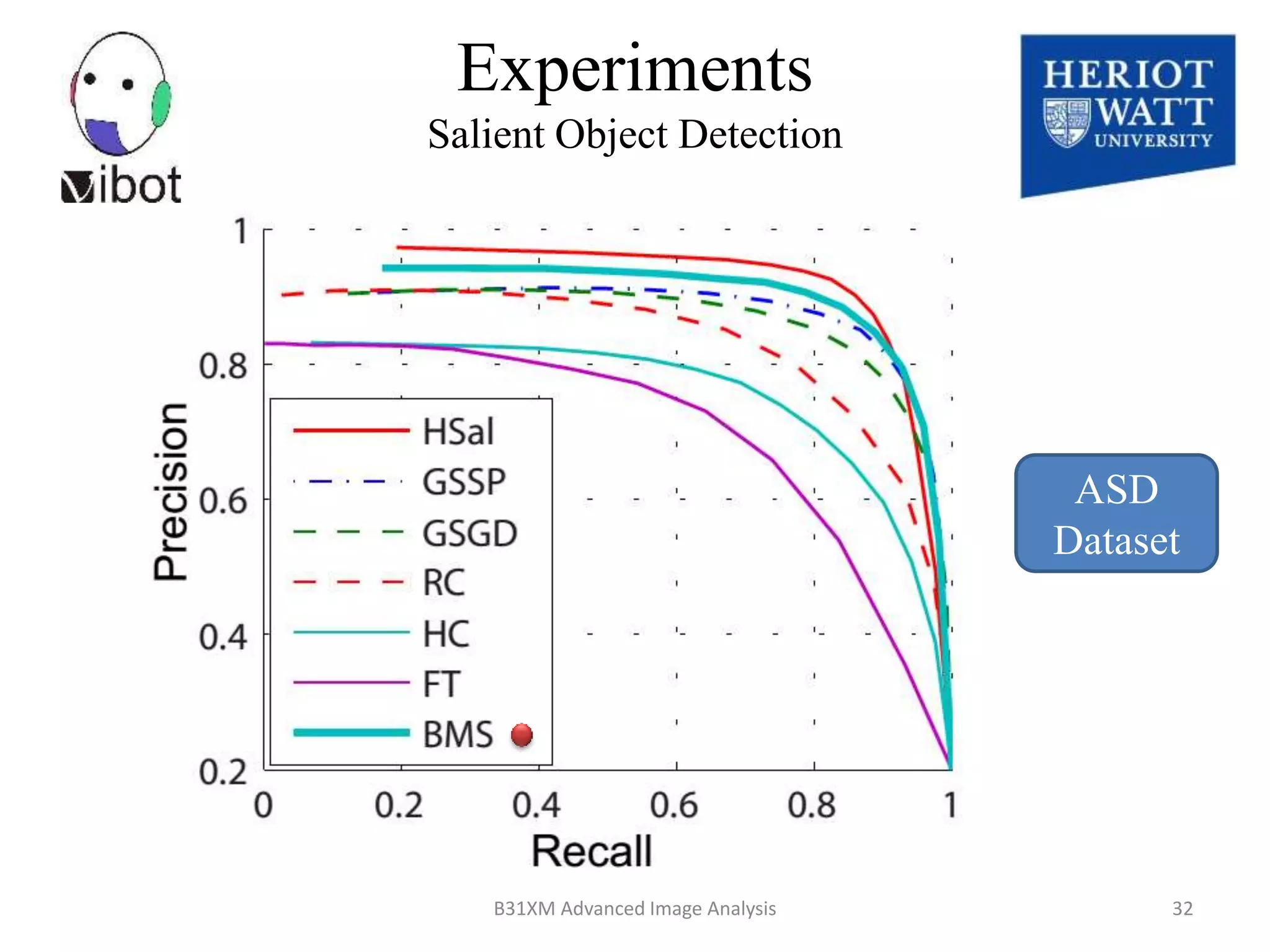
ASD
Dataset
8/18/2014 32B31XM Advanced Image Analysis
Experiments
Salient Object Detection
ASD
Dataset
8/18/2014 33B31XM Advanced Image Analysis
Outlines
• Introduction
• Related work
• Methodology
• Experiments
• Conclusion
• Future Work
8/18/2014 B31XM Advanced Image Analysis 34
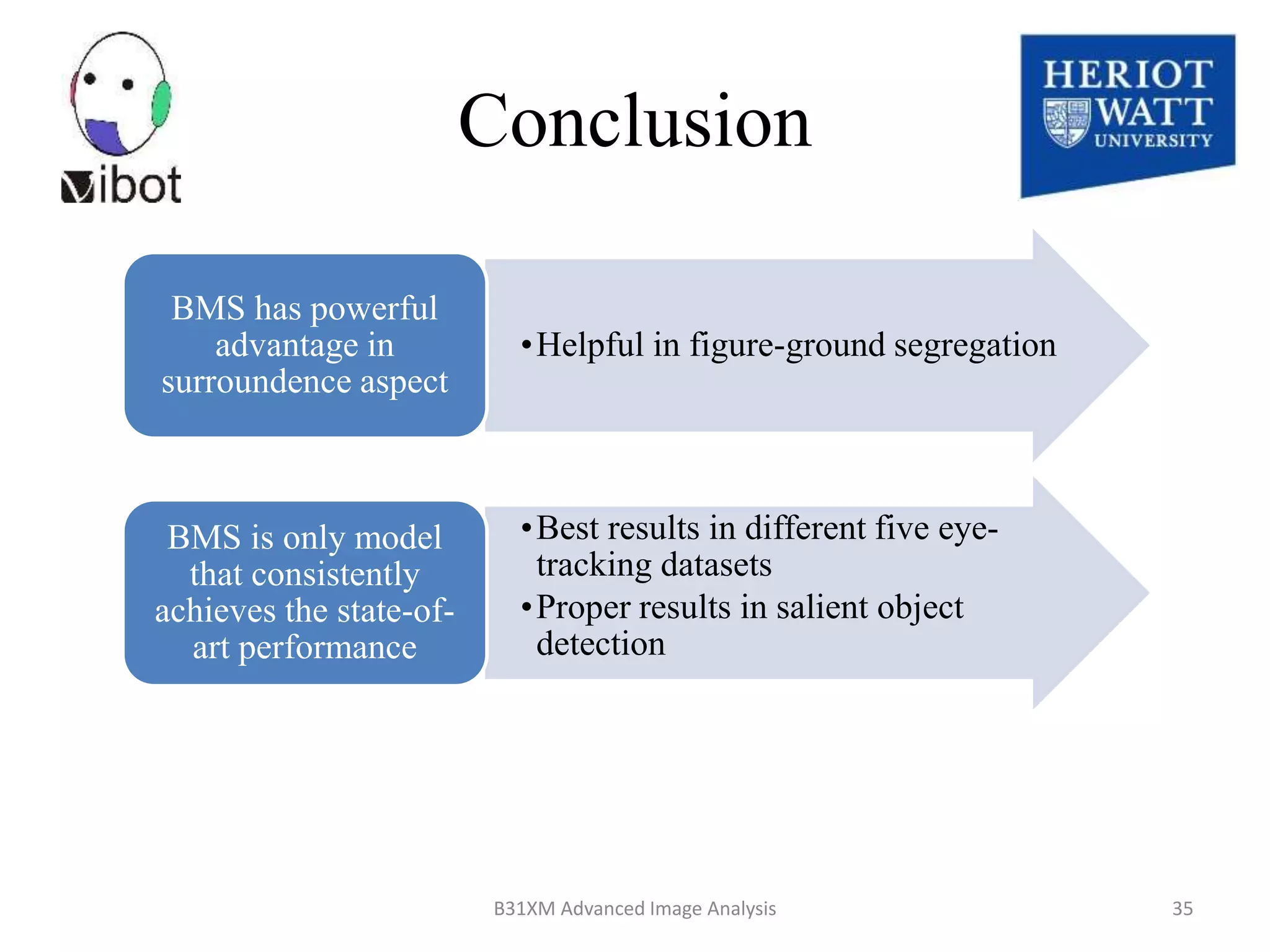
Conclusion
•Helpful in figure-ground segregation
BMS has powerful
advantage in
surroundence aspect
•Best results in different five eye-
tracking datasets
•Proper results in salient object
detection
BMS is only model
that consistently
achieves the state-of-
art performance
8/18/2014 35B31XM Advanced Image Analysis
Outlines
• Introduction
• Related work
• Methodology
• Experiments
• Conclusion
• Future Work
8/18/2014 B31XM Advanced Image Analysis 36
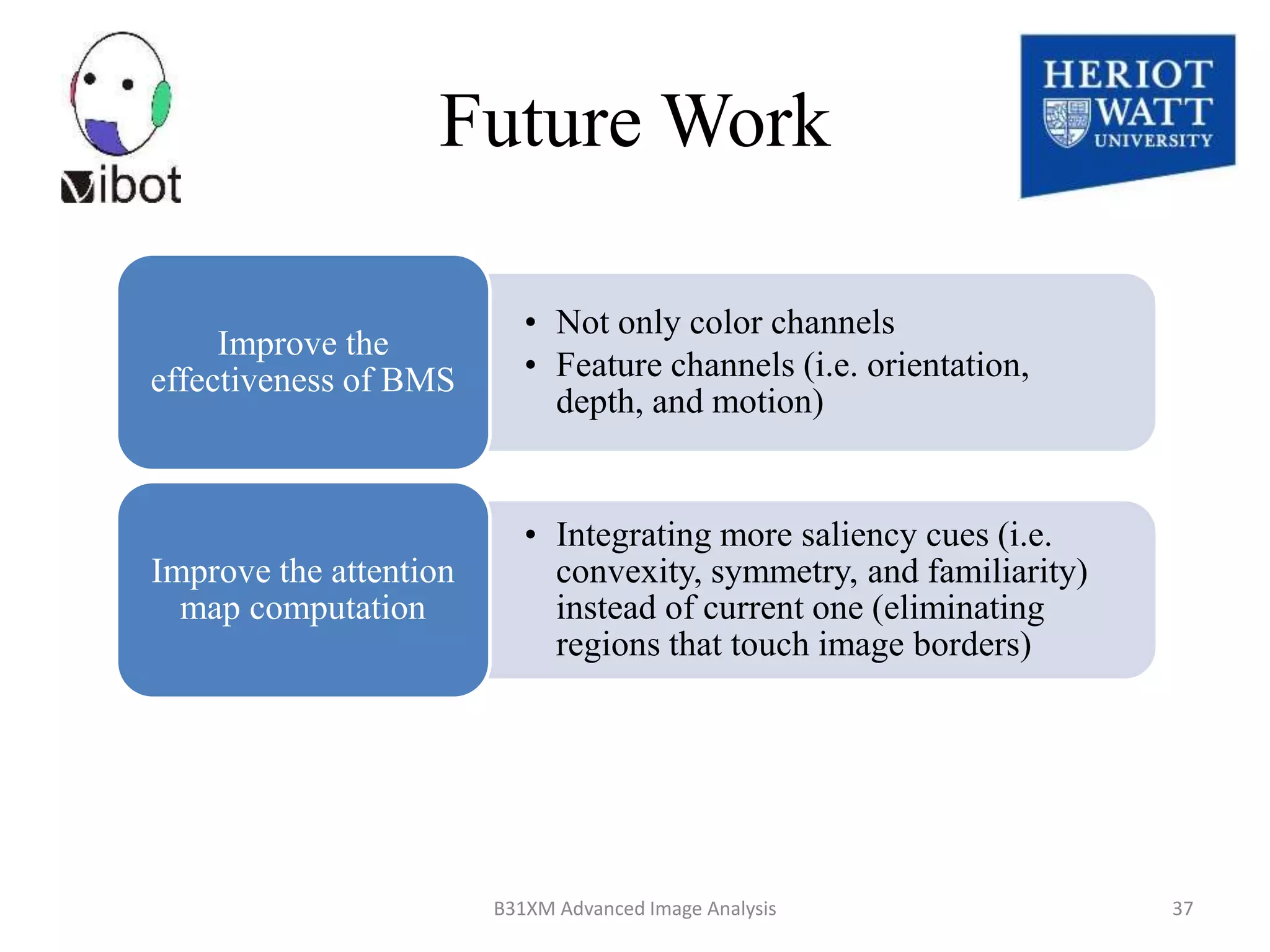
Future Work
• Not only color channels
• Feature channels (i.e. orientation,
depth, and motion)
Improve the
effectiveness of BMS
• Integrating more saliency cues (i.e.
convexity, symmetry, and familiarity)
instead of current one (eliminating
regions that touch image borders)
Improve the attention
map computation
8/18/2014 37B31XM Advanced Image Analysis
8/18/2014 B31XM Advanced Image Analysis 38

(Reading Group) Saliency Detection: A Boolean Map Approach