IPT – Intellectual Products & Technologies
Trayan Iliev, http://www.iproduct.org/
Angular 2 and TypeScript SPA
Development Course
Slide 1
Licensed under the Creative Commons Attribution-NonCommercial-NoDerivatives 4.0
International License
Developing SPA with Angular 2 and TypeScript
Trayan Iliev
IPT – Intellectual Products & Technologies
e-mail: tiliev@iproduct.org
web: http://www.iproduct.org
Oracle®, Java™ and JavaScript™ are trademarks or registered trademarks of Oracle and/or its affiliates.
Microsoft .NET, Visual Studio and Visual Studio Code are trademarks of Microsoft Corporation.
Other names may be trademarks of their respective owners.
IPT – Intellectual Products & Technologies
Trayan Iliev, http://www.iproduct.org/
Angular 2 and TypeScript SPA
Development Course
Slide 2
Licensed under the Creative Commons Attribution-NonCommercial-NoDerivatives 4.0
International License
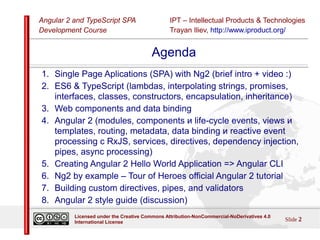
Agenda
1. Single Page Aplications (SPA) with Ng2 (brief intro + video :)
2. ES6 & TypeScript (lambdas, interpolating strings, promises,
interfaces, classes, constructors, encapsulation, inheritance)
3. Web components and data binding
4. Angular 2 (modules, components и life-cycle events, views и
templates, routing, metadata, data binding и reactive event
processing с RxJS, services, directives, dependency injection,
pipes, async processing)
5. Creating Angular 2 Hello World Application => Angular CLI
6. Ng2 by example – Tour of Heroes official Angular 2 tutorial
7. Building custom directives, pipes, and validators
8. Angular 2 style guide (discussion)
IPT – Intellectual Products & Technologies
Trayan Iliev, http://www.iproduct.org/
Angular 2 and TypeScript SPA
Development Course
Slide 3
Licensed under the Creative Commons Attribution-NonCommercial-NoDerivatives 4.0
International License
Intro to Angular 2 :)
ng-conf 2016 Conference Day 1:
https://www.youtube.com/watch?v=mAjjI35RcUE
IPT – Intellectual Products & Technologies
Trayan Iliev, http://www.iproduct.org/
Angular 2 and TypeScript SPA
Development Course
Slide 4
Licensed under the Creative Commons Attribution-NonCommercial-NoDerivatives 4.0
International License
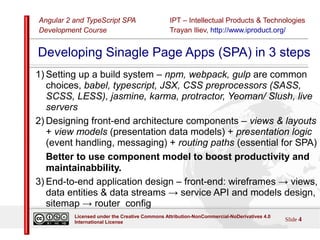
Developing Sinagle Page Apps (SPA) in 3 steps
1) Setting up a build system – npm, webpack, gulp are common
choices, babel, typescript, JSX, CSS preprocessors (SASS,
SCSS, LESS), jasmine, karma, protractor, Yeoman/ Slush, live
servers
2) Designing front-end architecture components – views & layouts
+ view models (presentation data models) + presentation logic
(event handling, messaging) + routing paths (essential for SPA)
Better to use component model to boost productivity and
maintainabbility.
3) End-to-end application design – front-end: wireframes → views,
data entities & data streams → service API and models design,
sitemap → router config
IPT – Intellectual Products & Technologies
Trayan Iliev, http://www.iproduct.org/
Angular 2 and TypeScript SPA
Development Course
Slide 5
Licensed under the Creative Commons Attribution-NonCommercial-NoDerivatives 4.0
International License
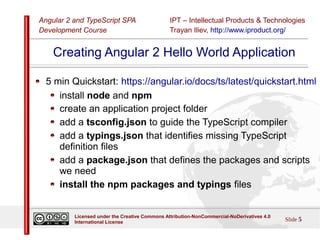
Creating Angular 2 Hello World Application
5 min Quickstart: https://angular.io/docs/ts/latest/quickstart.html
install node and npm
create an application project folder
add a tsconfig.json to guide the TypeScript compiler
add a typings.json that identifies missing TypeScript
definition files
add a package.json that defines the packages and scripts
we need
install the npm packages and typings files
IPT – Intellectual Products & Technologies
Trayan Iliev, http://www.iproduct.org/
Angular 2 and TypeScript SPA
Development Course
Slide 6
Licensed under the Creative Commons Attribution-NonCommercial-NoDerivatives 4.0
International License
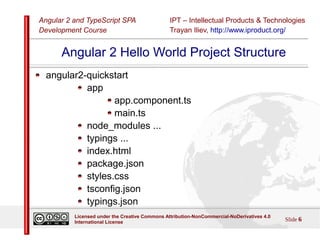
Angular 2 Hello World Project Structure
angular2-quickstart
app
app.component.ts
main.ts
node_modules ...
typings ...
index.html
package.json
styles.css
tsconfig.json
typings.json
IPT – Intellectual Products & Technologies
Trayan Iliev, http://www.iproduct.org/
Angular 2 and TypeScript SPA
Development Course
Slide 7
Licensed under the Creative Commons Attribution-NonCommercial-NoDerivatives 4.0
International License
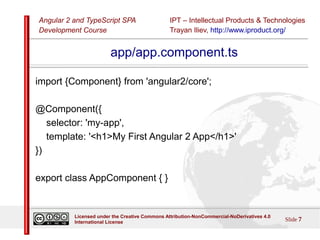
app/app.component.ts
import {Component} from 'angular2/core';
@Component({
selector: 'my-app',
template: '<h1>My First Angular 2 App</h1>'
})
export class AppComponent { }
IPT – Intellectual Products & Technologies
Trayan Iliev, http://www.iproduct.org/
Angular 2 and TypeScript SPA
Development Course
Slide 8
Licensed under the Creative Commons Attribution-NonCommercial-NoDerivatives 4.0
International License
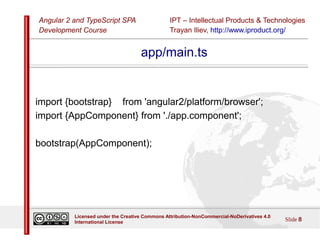
app/main.ts
import {bootstrap} from 'angular2/platform/browser';
import {AppComponent} from './app.component';
bootstrap(AppComponent);
IPT – Intellectual Products & Technologies
Trayan Iliev, http://www.iproduct.org/
Angular 2 and TypeScript SPA
Development Course
Slide 9
Licensed under the Creative Commons Attribution-NonCommercial-NoDerivatives 4.0
International License
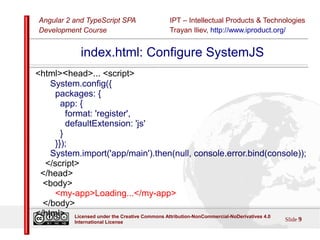
index.html: Configure SystemJS
<html><head>... <script>
System.config({
packages: {
app: {
format: 'register',
defaultExtension: 'js'
}
}});
System.import('app/main').then(null, console.error.bind(console));
</script>
</head>
<body>
<my-app>Loading...</my-app>
</body>
</html>
IPT – Intellectual Products & Technologies
Trayan Iliev, http://www.iproduct.org/
Angular 2 and TypeScript SPA
Development Course
Slide 10
Licensed under the Creative Commons Attribution-NonCommercial-NoDerivatives 4.0
International License
OR using Angular CLI
[https://github.com/angular/angular-cli]
npm install -g angular-cli
ng new PROJECT_NAME
cd PROJECT_NAME
ng serve
ng serve --port 4201 --live-reload-port 49153
Create Angular 2 compponents using CLI:
Component ng g component my-new-component
Directive ng g directive my-new-directive
Pipe ng g pipe my-new-pipe
Service ng g service my-new-service
IPT – Intellectual Products & Technologies
Trayan Iliev, http://www.iproduct.org/
Angular 2 and TypeScript SPA
Development Course
Slide 11
Licensed under the Creative Commons Attribution-NonCommercial-NoDerivatives 4.0
International License
Web Components
Make it possible to build widgets …which can be reused reliably
…and which won’t break pages if the next version of the
component changes internal implementation details.
[http://www.html5rocks.com/en/tutorials/webcomponents/shadowdom/]
4 emerging W3C specifications:
Custom elements – provide a way for authors to build their own
fully-featured DOM elements.
Shadow DOM – combining multiple DOM trees in one hierarchy
[http://www.html5rocks.com/en/tutorials/webcomponents/shadowdom/]
Template – declare fragments of HTML that can be cloned and
inserted in the document by script
HTML imports – <link rel="import" href="my-custom-cmp.html">
IPT – Intellectual Products & Technologies
Trayan Iliev, http://www.iproduct.org/
Angular 2 and TypeScript SPA
Development Course
Slide 12
Licensed under the Creative Commons Attribution-NonCommercial-NoDerivatives 4.0
International License
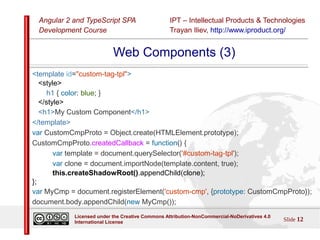
Web Components (3)
<template id="custom-tag-tpl">
<style>
h1 { color: blue; }
</style>
<h1>My Custom Component</h1>
</template>
var CustomCmpProto = Object.create(HTMLElement.prototype);
CustomCmpProto.createdCallback = function() {
var template = document.querySelector('#custom-tag-tpl');
var clone = document.importNode(template.content, true);
this.createShadowRoot().appendChild(clone);
};
var MyCmp = document.registerElement('custom-cmp', {prototype: CustomCmpProto});
document.body.appendChild(new MyCmp());
IPT – Intellectual Products & Technologies
Trayan Iliev, http://www.iproduct.org/
Angular 2 and TypeScript SPA
Development Course
Slide 13
Licensed under the Creative Commons Attribution-NonCommercial-NoDerivatives 4.0
International License
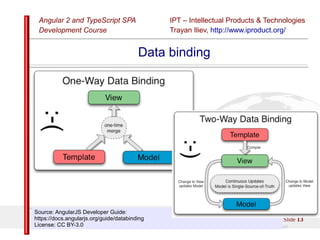
Data binding
Source: AngularJS Developer Guide:
https://docs.angularjs.org/guide/databinding
License: CC BY-3.0
IPT – Intellectual Products & Technologies
Trayan Iliev, http://www.iproduct.org/
Angular 2 and TypeScript SPA
Development Course
Slide 14
Licensed under the Creative Commons Attribution-NonCommercial-NoDerivatives 4.0
International License
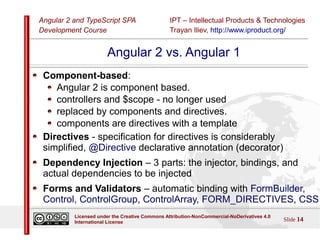
Angular 2 vs. Angular 1
Component-based:
Angular 2 is component based.
controllers and $scope - no longer used
replaced by components and directives.
components are directives with a template
Directives - specification for directives is considerably
simplified, @Directive declarative annotation (decorator)
Dependency Injection – 3 parts: the injector, bindings, and
actual dependencies to be injected
Forms and Validators – automatic binding with FormBuilder,
Control, ControlGroup, ControlArray, FORM_DIRECTIVES, CSS
IPT – Intellectual Products & Technologies
Trayan Iliev, http://www.iproduct.org/
Angular 2 and TypeScript SPA
Development Course
Slide 15
Licensed under the Creative Commons Attribution-NonCommercial-NoDerivatives 4.0
International License
Advantages of Angular 2
[http://angularjs.blogspot.bg/2015/11/highlights-from-angularconnect-2015.html]
Speed – Angular 2 is dramatically faster than Angular 1 with
support for fast initial loads through server-side pre-rendering,
offline compile for fast startup, and ultrafast change detection
and view caching for smooth virtual scrolling and snappy view
transitions.
Browsers – Angular 2 supports IE 9, 10, 11, Microsoft Edge,
Safari, Firefox, Chrome, Mobile Safari, and Android 4.1+.
Cross-platform – By learning Angular 2, you'll gain the core
knowledge you'll need to build for a full range of platforms
including desktop and mobile web, hybrid and native UI mobile
installed apps, and even installable desktop applications.
IPT – Intellectual Products & Technologies
Trayan Iliev, http://www.iproduct.org/
Angular 2 and TypeScript SPA
Development Course
Slide 16
Licensed under the Creative Commons Attribution-NonCommercial-NoDerivatives 4.0
International License
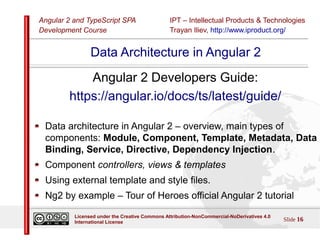
Data Architecture in Angular 2
Angular 2 Developers Guide:
https://angular.io/docs/ts/latest/guide/
Data architecture in Angular 2 – overview, main types of
components: Module, Component, Template, Metadata, Data
Binding, Service, Directive, Dependency Injection.
Component controllers, views & templates
Using external template and style files.
Ng2 by example – Tour of Heroes official Angular 2 tutorial
IPT – Intellectual Products & Technologies
Trayan Iliev, http://www.iproduct.org/
BG OUG Meeting – Pravetz
November 20, 2015
Slide 17
Licensed under the Creative Commons Attribution-NonCommercial-NoDerivs 3.0
Unported License
@Directive
Directives add behaviour to an existing DOM element. One
example use case for @Directive would be to add a highlight
on mouse hover. Example – log-on-click.directive.ts :
import {Directive} from 'angular2/core';
@Directive({
selector: "[myLogOnClick]",
host: {
'(click)': 'onClick()'
}
})
export class LogOnClickDirective {
onClick() { console.log('Element clicked!'); }
}
IPT – Intellectual Products & Technologies
Trayan Iliev, http://www.iproduct.org/
BG OUG Meeting – Pravetz
November 20, 2015
Slide 18
Licensed under the Creative Commons Attribution-NonCommercial-NoDerivs 3.0
Unported License
Even Better @Directive
[https://github.com/mgechev/angular2-style-guide]
import {Directive, HostListener} from 'angular2/core';
@Directive({
selector: "[myLogOnClick]",
})
export class LogOnClickDirective {
@HostListener('click')
onClick() { console.log('Element clicked!'); }
}
Prefer @HostListener and @HostBinding instead of the
host property of the @Directive and @Component
decorators
IPT – Intellectual Products & Technologies
Trayan Iliev, http://www.iproduct.org/
BG OUG Meeting – Pravetz
November 20, 2015
Slide 19
Licensed under the Creative Commons Attribution-NonCommercial-NoDerivs 3.0
Unported License
Simple (Demo) Tooltip @Directive
import {Directive, HostListener, Input} from 'angular2/core';
@Directive({
selector: '[myTooltip]',
host: {
'(mouseover)': 'show()'
}
})
export class TooltipDirective {
@Input('myTooltip') text: string;
show() {
alert(this.text);
}
}
<h1 myLogOnClick myTooltip="Enter new hero.">Hero Form</h1>
IPT – Intellectual Products & Technologies
Trayan Iliev, http://www.iproduct.org/
BG OUG Meeting – Pravetz
November 20, 2015
Slide 20
Licensed under the Creative Commons Attribution-NonCommercial-NoDerivs 3.0
Unported License
Custom pipes
import {Pipe, PipeTransform} from 'angular2/core';
@Pipe({ name: 'exponentialStrength' })
export class ExponentialStrengthPipe implements PipeTransform
{
transform(value: number, [exponent]): number {
var exp = parseFloat(exponent);
return Math.pow(value, isNaN(exp) ? 1 : exp);
}
}
Super power boost: {{2 | exponentialStrength: 10}}
IPT – Intellectual Products & Technologies
Trayan Iliev, http://www.iproduct.org/
BG OUG Meeting – Pravetz
November 20, 2015
Slide 21
Licensed under the Creative Commons Attribution-NonCommercial-NoDerivs 3.0
Unported License
Custom Validators
[https://github.com/daviddt/angular2-form-validation-example/]
import { Control } from "angular2/common";
interface ValidationResult {
[key: string]: boolean;
}
export class UsernameValidator {
static startsWithNumber(control: Control):ValidationResult {
if (control.value != "" && !isNaN(control.value.charAt(0))) {
return { "startsWithNumber": true };
}
return null;
}
IPT – Intellectual Products & Technologies
Trayan Iliev, http://www.iproduct.org/
BG OUG Meeting – Pravetz
November 20, 2015
Slide 22
Licensed under the Creative Commons Attribution-NonCommercial-NoDerivs 3.0
Unported License
Custom Validators Async (Promise)
[https://github.com/daviddt/angular2-form-validation-example/]
constructor(private builder: FormBuilder) {
this.username = new Control(
"",
Validators.compose([Validators.required,
UsernameValidator.startsWithNumber]),
UsernameValidator.usernameTaken
);
this.form = builder.group({
username: this.username
});
}
IPT – Intellectual Products & Technologies
Trayan Iliev, http://www.iproduct.org/
BG OUG Meeting – Pravetz
November 20, 2015
Slide 23
Licensed under the Creative Commons Attribution-NonCommercial-NoDerivs 3.0
Unported License
Custom Validators Async (Promise)
[https://github.com/daviddt/angular2-form-validation-example/]
static usernameTaken(control: Control):Promise<ValidationResult>
{
return new Promise((resolve, reject) => {
setTimeout(() => {
if (control.value === "David") {
resolve({ "usernameTaken": true })
} else {
resolve(null);
};
}, 1000);
});
}
IPT – Intellectual Products & Technologies
Trayan Iliev, http://www.iproduct.org/
BG OUG Meeting – Pravetz
November 20, 2015
Slide 24
Licensed under the Creative Commons Attribution-NonCommercial-NoDerivs 3.0
Unported License
Router-Demo Project (1)
[https://github.com/iproduct/Course-Angular-2]
@Component({
moduleId: module.id,
selector: 'router-demo-app',
templateUrl: 'router-demo.component.html',
directives: [ROUTER_DIRECTIVES],
providers: [ROUTER_PROVIDERS]})
@RouteConfig([
{ path: '/',component: OneComponent, as: 'One'},
{ aux: 'testAux1', component: OneComponent,
name: 'TestAux1', path: '/aux1'},
{ aux: 'testAux2', component: TwoComponent,
name: 'TestAux2',path: '/aux2'}])
export class RouterDemoAppComponent {
title = 'Hello from router-demo!';
}
IPT – Intellectual Products & Technologies
Trayan Iliev, http://www.iproduct.org/
BG OUG Meeting – Pravetz
November 20, 2015
Slide 25
Licensed under the Creative Commons Attribution-NonCommercial-NoDerivs 3.0
Unported License
Router-Demo Project (2)
[https://github.com/iproduct/Course-Angular-2]
<h1>Auxilliary Routing Example</h1><ul>
<li> <a [routerLink]="['./One']">Load in Default Outlet</a> </li>
<li> <a [routerLink]="['./One',['TestAux1']]">Load Cmp1 in Aux 1</a></li>
<li> <a [routerLink]="['./One',['TestAux2']]">Load Cmp2 in Aux 2</a></li>
</ul>
<div style="border: 1px solid red;">
<h3>Default Routing Outlet</h3>
<router-outlet></router-outlet>
</div>
<div style="border: 1px solid blue;">
<h3>Aux 1 Routing Outlet</h3>
<router-outlet name="testAux1"></router-outlet>
</div>
<div style="border: 1px solid green;">
<h3>Aux 2 Routing Outlet</h3>
<router-outlet name="testAux2"></router-outlet>
</div>
IPT – Intellectual Products & Technologies
Trayan Iliev, http://www.iproduct.org/
Angular 2 and TypeScript SPA
Development Course
Slide 26
Licensed under the Creative Commons Attribution-NonCommercial-NoDerivatives 4.0
International License
Angular 2 HTTP client: Injecting
HTTP_PROVIDERS services in app.component.ts
import {Component, provide} from 'angular2/core';
import { RouteConfig, ROUTER_DIRECTIVES, ROUTER_PROVIDERS }
from 'angular2/router';
import {HeroService} from './hero.service';
import {HeroesComponent} from './heroes.component';
import {HeroDetailComponent} from './hero-detail.component';
import {DashboardComponent} from './dashboard.component';
import {HTTP_PROVIDERS, XHRBackend} from 'angular2/http';
import {InMemoryBackendService, SEED_DATA}
from 'a2-in-memory-web-api/core'; //in-memory web api
import {HeroData} from './hero-data';
IPT – Intellectual Products & Technologies
Trayan Iliev, http://www.iproduct.org/
Angular 2 and TypeScript SPA
Development Course
Slide 27
Licensed under the Creative Commons Attribution-NonCommercial-NoDerivatives 4.0
International License
Angular 2 HTTP client: Injecting
HTTP_PROVIDERS services in app.component.ts
@Component({
selector: 'my-app',
directives: [ROUTER_DIRECTIVES],
providers: [HeroService, ROUTER_PROVIDERS, HTTP_PROVIDERS,
// in-mem server
provide(XHRBackend, { useClass: InMemoryBackendService })
provide(SEED_DATA, { useClass: HeroData }) // in-mem data
],
styleUrls: ['app/app.component.css'],
Template: `... `
})
export class AppComponent{
public title = 'Tour of Heroes';
}
Don't forget to declare directives to use!
IPT – Intellectual Products & Technologies
Trayan Iliev, http://www.iproduct.org/
Angular 2 and TypeScript SPA
Development Course
Slide 28
Licensed under the Creative Commons Attribution-NonCommercial-NoDerivatives 4.0
International License
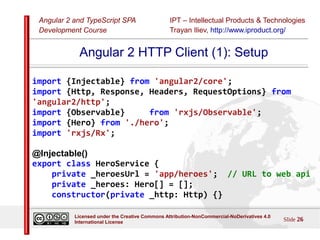
Angular 2 HTTP Client (1): Setup
import {Injectable} from 'angular2/core';
import {Http, Response, Headers, RequestOptions} from
'angular2/http';
import {Observable} from 'rxjs/Observable';
import {Hero} from './hero';
import 'rxjs/Rx';
@Injectable()
export class HeroService {
private _heroesUrl = 'app/heroes'; // URL to web api
private _heroes: Hero[] = [];
constructor(private _http: Http) {}
IPT – Intellectual Products & Technologies
Trayan Iliev, http://www.iproduct.org/
Angular 2 and TypeScript SPA
Development Course
Slide 29
Licensed under the Creative Commons Attribution-NonCommercial-NoDerivatives 4.0
International License
Angular 2 HTTP Client (2): Read
getHeroes(): Promise<Hero[]> {
return this._http.get(this._heroesUrl)
.map(response => <Hero[]>response.json().data)
.do(heroes => this._heroes = heroes)
.do(data => console.log(data))
.catch(this.handleErrorObservable).toPromise();
}
private handleErrorObservable(error: Response) {
// in real app we may send error to remote logging
console.error(error);
return Observable.throw(
error.json().error || 'Server error');
}
IPT – Intellectual Products & Technologies
Trayan Iliev, http://www.iproduct.org/
Angular 2 and TypeScript SPA
Development Course
Slide 30
Licensed under the Creative Commons Attribution-NonCommercial-NoDerivatives 4.0
International License
Angular 2 HTTP Client (3) :Cache
private getCachedHeroes(): Promise<Hero[]> {
return this._heroes ? Promise.resolve(this._heroes)
: this.getHeroes();
}
getHero(id: number): Promise<Hero> {
return Promise.resolve(this.getCachedHeroes())
.then(
heroes => heroes.filter(hero => hero.id === id)[0]
);
}
private handleErrorPromise(error: any) {
console.error(error);
return Promise.reject(error.message || error.json().error
|| 'Server error');
}
IPT – Intellectual Products & Technologies
Trayan Iliev, http://www.iproduct.org/
Angular 2 and TypeScript SPA
Development Course
Slide 31
Licensed under the Creative Commons Attribution-NonCommercial-NoDerivatives 4.0
International License
Angular 2 HTTP Client (4): Create
addHero(name: string): Promise<Hero> {
return this.getCachedHeroes()
.then(heroes => {
let nextHeroId = heroes.reduce((prevMaxId, next) =>
next.id > prevMaxId ? next.id : prevMaxId, 0) + 1;
let newHero = new Hero(nextHeroId, name);
let body = JSON.stringify({ name });
let headers = new Headers(
{ 'Content-Type': 'application/json' });
let options = new RequestOptions(
{ headers: headers });
return this._http.post(this._heroesUrl, body, options)
.toPromise()
.then(res => <Hero>res.json().data)
.catch(this.handleErrorPromise);
});
}
IPT – Intellectual Products & Technologies
Trayan Iliev, http://www.iproduct.org/
Angular 2 and TypeScript SPA
Development Course
Slide 32
Licensed under the Creative Commons Attribution-NonCommercial-NoDerivatives 4.0
International License
Angular 2 HTTP Client (5): Update
editHero(hero: Hero): Promise<void> {
let body = JSON.stringify( hero );
let headers=new Headers({'Content-Type': 'application/json'});
let options = new RequestOptions({ headers: headers });
return this._http.put(this._heroesUrl + "/" + hero.id, body,
options)
.toPromise().then(response => {
console.log(response);
if(response.status == 204) // No content
return Promise.resolve();
else
return Promise.reject('Error updating hero '
+ hero.id + ":" + hero.name + ' - status code:'
+ response.status
);
}).catch(this.handleErrorPromise);
}
IPT – Intellectual Products & Technologies
Trayan Iliev, http://www.iproduct.org/
Angular 2 and TypeScript SPA
Development Course
Slide 33
Licensed under the Creative Commons Attribution-NonCommercial-NoDerivatives 4.0
International License
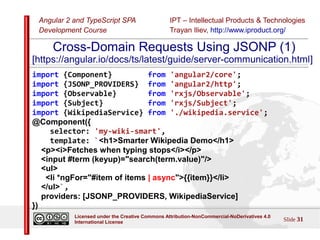
Cross-Domain Requests Using JSONP (1)
[https://angular.io/docs/ts/latest/guide/server-communication.html]
import {Component} from 'angular2/core';
import {JSONP_PROVIDERS} from 'angular2/http';
import {Observable} from 'rxjs/Observable';
import {Subject} from 'rxjs/Subject';
import {WikipediaService} from './wikipedia.service';
@Component({
selector: 'my-wiki-smart',
template: `<h1>Smarter Wikipedia Demo</h1>
<p><i>Fetches when typing stops</i></p>
<input #term (keyup)="search(term.value)"/>
<ul>
<li *ngFor="#item of items | async">{{item}}</li>
</ul>`,
providers: [JSONP_PROVIDERS, WikipediaService]
})
IPT – Intellectual Products & Technologies
Trayan Iliev, http://www.iproduct.org/
Angular 2 and TypeScript SPA
Development Course
Slide 34
Licensed under the Creative Commons Attribution-NonCommercial-NoDerivatives 4.0
International License
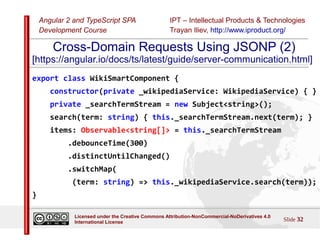
Cross-Domain Requests Using JSONP (2)
[https://angular.io/docs/ts/latest/guide/server-communication.html]
export class WikiSmartComponent {
constructor(private _wikipediaService: WikipediaService) { }
private _searchTermStream = new Subject<string>();
search(term: string) { this._searchTermStream.next(term); }
items: Observable<string[]> = this._searchTermStream
.debounceTime(300)
.distinctUntilChanged()
.switchMap(
(term: string) => this._wikipediaService.search(term));
}
IPT – Intellectual Products & Technologies
Trayan Iliev, http://www.iproduct.org/
Angular 2 and TypeScript SPA
Development Course
Slide 35
Licensed under the Creative Commons Attribution-NonCommercial-NoDerivatives 4.0
International License
Reactive Programming. Functional Programing
Reactive Programming [Wikipedia]: a programming paradigm
oriented around data flows and the propagation of change. This
means that it should be possible to express static or dynamic
data flows with ease in the programming languages used, and
that the underlying execution model will automatically propagate
changes through the data flow. Ex: a := b + c
Functional Programming [Wikipedia]: a programming
paradigm that treats computation as the evaluation of
mathematical functions and avoids changing-state and mutable
data. It is a declarative programming paradigm. Eliminating side
effects can make it much easier to understand and predict the
program behavior. Ex: book -> book.getAuthor().fullName()
IPT – Intellectual Products & Technologies
Trayan Iliev, http://www.iproduct.org/
Angular 2 and TypeScript SPA
Development Course
Slide 36
Licensed under the Creative Commons Attribution-NonCommercial-NoDerivatives 4.0
International License
Reactive Programming = Programming with
Asynchronous Data Streams
Functional Reactive Programming (FRP) [Wikipedia]: a
programming paradigm for reactive programming
(asynchronous dataflow programming) using the building blocks
of functional programming (e.g. map, reduce, filter). FRP has
been used for programming graphical user interfaces (GUIs),
robotics, and music, aiming to simplify these problems by
explicitly modeling time. Example (RxJava):
Observable.from(new String[]{"Reactive", "Extensions", "Java"})
.take(2).map(s -> s + " : on " + new Date())
.subscribe(s -> System.out.println(s));
Result: Reactive : on Wed Jun 17 21:54:02 GMT+02:00 2015
Extensions : on Wed Jun 17 21:54:02 GMT+02:00 2015
Good intro tutorial in RP using RxJS by Andre Staltz see: https://gist.github.com/staltz/868e7e9bc2a7b8c1f754
JS Fiddle of the demo: http://jsfiddle.net/staltz/8jFJH/48/
IPT – Intellectual Products & Technologies
Trayan Iliev, http://www.iproduct.org/
Angular 2 and TypeScript SPA
Development Course
Slide 37
Licensed under the Creative Commons Attribution-NonCommercial-NoDerivatives 4.0
International License
Definitions of Reactive Programming
Microsoft®
opens source polyglot project ReactiveX
(Reactive Extensions) [http://reactivex.io]:
Rx = Observables + LINQ + Schedulers :)
Supported Languages – Java: RxJava, JavaScript: RxJS, C#: Rx.NET,
C#(Unity): UniRx, Scala: RxScala, Clojure: RxClojure, C++: RxCpp,
Ruby: Rx.rb, Python: RxPY, Groovy: RxGroovy, JRuby: RxJRuby,
Kotlin: RxKotlin, Swift: RxSwift
ReactiveX for platforms and frameworks: RxNetty, RxAndroid, RxCocoa
Reactive Streams Specification
[http://www.reactive-streams.org/] used by Project Reactor
[http://projectreactor.io/, https://github.com/reactor/reactor]
IPT – Intellectual Products & Technologies
Trayan Iliev, http://www.iproduct.org/
Angular 2 and TypeScript SPA
Development Course
Slide 38
Licensed under the Creative Commons Attribution-NonCommercial-NoDerivatives 4.0
International License
RxJS – JS ReactiveX (Reactive Extensions)
[http://reactivex.io, https://github.com/ReactiveX]
ReactiveX is a polyglot library for composing asynchronous
event streams (observable sequences).
It extends the observer pattern by declarative composition of
functional transformations on events streams (e.g. map-filter-
reduce, etc.)
Abstracs away low-level concerns like concurrency,
synchronization, and non-blocking I/O.
Follows the next - error - completed event flow
Allows natural implementation of Redux design pattern
Alternative (together with promises) for solving “callback hell”
problem
IPT – Intellectual Products & Technologies
Trayan Iliev, http://www.iproduct.org/
Angular 2 and TypeScript SPA
Development Course
Slide 39
Licensed under the Creative Commons Attribution-NonCommercial-NoDerivatives 4.0
International License
Resources: RxMarbles and RxJS Coans
RxMarbles:
http://rxmarbles.com/
RxJS Coans:
https://github.com/Reactive-Extensions/RxJSKoans
IPT – Intellectual Products & Technologies
Trayan Iliev, http://www.iproduct.org/
Angular 2 and TypeScript SPA
Development Course
Slide 40
Licensed under the Creative Commons Attribution-NonCommercial-NoDerivatives 4.0
International License
Want to Learn More ...
Welcome to IPT's Course:
Angular 2 + TypeScript SPA Development
http://iproduct.org/angular2-typescript/
All Demos (Material Design, Ionic 2, Angular CLI)
are available from IPT's GitHub repo:
https://github.com/iproduct/Course-Angular-2
IPT – Intellectual Products & Technologies
Trayan Iliev, http://www.iproduct.org/
Angular 2 and TypeScript SPA
Development Course
Slide 41
Licensed under the Creative Commons Attribution-NonCommercial-NoDerivatives 4.0
International License
Thanks for Your Attention!
Questions?

IPT angular2 typescript SPA 2016

  • 1.
    IPT – IntellectualProducts & Technologies Trayan Iliev, http://www.iproduct.org/ Angular 2 and TypeScript SPA Development Course Slide 1 Licensed under the Creative Commons Attribution-NonCommercial-NoDerivatives 4.0 International License Developing SPA with Angular 2 and TypeScript Trayan Iliev IPT – Intellectual Products & Technologies e-mail: tiliev@iproduct.org web: http://www.iproduct.org Oracle®, Java™ and JavaScript™ are trademarks or registered trademarks of Oracle and/or its affiliates. Microsoft .NET, Visual Studio and Visual Studio Code are trademarks of Microsoft Corporation. Other names may be trademarks of their respective owners.
  • 2.
    IPT – IntellectualProducts & Technologies Trayan Iliev, http://www.iproduct.org/ Angular 2 and TypeScript SPA Development Course Slide 2 Licensed under the Creative Commons Attribution-NonCommercial-NoDerivatives 4.0 International License Agenda 1. Single Page Aplications (SPA) with Ng2 (brief intro + video :) 2. ES6 & TypeScript (lambdas, interpolating strings, promises, interfaces, classes, constructors, encapsulation, inheritance) 3. Web components and data binding 4. Angular 2 (modules, components и life-cycle events, views и templates, routing, metadata, data binding и reactive event processing с RxJS, services, directives, dependency injection, pipes, async processing) 5. Creating Angular 2 Hello World Application => Angular CLI 6. Ng2 by example – Tour of Heroes official Angular 2 tutorial 7. Building custom directives, pipes, and validators 8. Angular 2 style guide (discussion)
  • 3.
    IPT – IntellectualProducts & Technologies Trayan Iliev, http://www.iproduct.org/ Angular 2 and TypeScript SPA Development Course Slide 3 Licensed under the Creative Commons Attribution-NonCommercial-NoDerivatives 4.0 International License Intro to Angular 2 :) ng-conf 2016 Conference Day 1: https://www.youtube.com/watch?v=mAjjI35RcUE
  • 4.
    IPT – IntellectualProducts & Technologies Trayan Iliev, http://www.iproduct.org/ Angular 2 and TypeScript SPA Development Course Slide 4 Licensed under the Creative Commons Attribution-NonCommercial-NoDerivatives 4.0 International License Developing Sinagle Page Apps (SPA) in 3 steps 1) Setting up a build system – npm, webpack, gulp are common choices, babel, typescript, JSX, CSS preprocessors (SASS, SCSS, LESS), jasmine, karma, protractor, Yeoman/ Slush, live servers 2) Designing front-end architecture components – views & layouts + view models (presentation data models) + presentation logic (event handling, messaging) + routing paths (essential for SPA) Better to use component model to boost productivity and maintainabbility. 3) End-to-end application design – front-end: wireframes → views, data entities & data streams → service API and models design, sitemap → router config
  • 5.
    IPT – IntellectualProducts & Technologies Trayan Iliev, http://www.iproduct.org/ Angular 2 and TypeScript SPA Development Course Slide 5 Licensed under the Creative Commons Attribution-NonCommercial-NoDerivatives 4.0 International License Creating Angular 2 Hello World Application 5 min Quickstart: https://angular.io/docs/ts/latest/quickstart.html install node and npm create an application project folder add a tsconfig.json to guide the TypeScript compiler add a typings.json that identifies missing TypeScript definition files add a package.json that defines the packages and scripts we need install the npm packages and typings files
  • 6.
    IPT – IntellectualProducts & Technologies Trayan Iliev, http://www.iproduct.org/ Angular 2 and TypeScript SPA Development Course Slide 6 Licensed under the Creative Commons Attribution-NonCommercial-NoDerivatives 4.0 International License Angular 2 Hello World Project Structure angular2-quickstart app app.component.ts main.ts node_modules ... typings ... index.html package.json styles.css tsconfig.json typings.json
  • 7.
    IPT – IntellectualProducts & Technologies Trayan Iliev, http://www.iproduct.org/ Angular 2 and TypeScript SPA Development Course Slide 7 Licensed under the Creative Commons Attribution-NonCommercial-NoDerivatives 4.0 International License app/app.component.ts import {Component} from 'angular2/core'; @Component({ selector: 'my-app', template: '<h1>My First Angular 2 App</h1>' }) export class AppComponent { }
  • 8.
    IPT – IntellectualProducts & Technologies Trayan Iliev, http://www.iproduct.org/ Angular 2 and TypeScript SPA Development Course Slide 8 Licensed under the Creative Commons Attribution-NonCommercial-NoDerivatives 4.0 International License app/main.ts import {bootstrap} from 'angular2/platform/browser'; import {AppComponent} from './app.component'; bootstrap(AppComponent);
  • 9.
    IPT – IntellectualProducts & Technologies Trayan Iliev, http://www.iproduct.org/ Angular 2 and TypeScript SPA Development Course Slide 9 Licensed under the Creative Commons Attribution-NonCommercial-NoDerivatives 4.0 International License index.html: Configure SystemJS <html><head>... <script> System.config({ packages: { app: { format: 'register', defaultExtension: 'js' } }}); System.import('app/main').then(null, console.error.bind(console)); </script> </head> <body> <my-app>Loading...</my-app> </body> </html>
  • 10.
    IPT – IntellectualProducts & Technologies Trayan Iliev, http://www.iproduct.org/ Angular 2 and TypeScript SPA Development Course Slide 10 Licensed under the Creative Commons Attribution-NonCommercial-NoDerivatives 4.0 International License OR using Angular CLI [https://github.com/angular/angular-cli] npm install -g angular-cli ng new PROJECT_NAME cd PROJECT_NAME ng serve ng serve --port 4201 --live-reload-port 49153 Create Angular 2 compponents using CLI: Component ng g component my-new-component Directive ng g directive my-new-directive Pipe ng g pipe my-new-pipe Service ng g service my-new-service
  • 11.
    IPT – IntellectualProducts & Technologies Trayan Iliev, http://www.iproduct.org/ Angular 2 and TypeScript SPA Development Course Slide 11 Licensed under the Creative Commons Attribution-NonCommercial-NoDerivatives 4.0 International License Web Components Make it possible to build widgets …which can be reused reliably …and which won’t break pages if the next version of the component changes internal implementation details. [http://www.html5rocks.com/en/tutorials/webcomponents/shadowdom/] 4 emerging W3C specifications: Custom elements – provide a way for authors to build their own fully-featured DOM elements. Shadow DOM – combining multiple DOM trees in one hierarchy [http://www.html5rocks.com/en/tutorials/webcomponents/shadowdom/] Template – declare fragments of HTML that can be cloned and inserted in the document by script HTML imports – <link rel="import" href="my-custom-cmp.html">
  • 12.
    IPT – IntellectualProducts & Technologies Trayan Iliev, http://www.iproduct.org/ Angular 2 and TypeScript SPA Development Course Slide 12 Licensed under the Creative Commons Attribution-NonCommercial-NoDerivatives 4.0 International License Web Components (3) <template id="custom-tag-tpl"> <style> h1 { color: blue; } </style> <h1>My Custom Component</h1> </template> var CustomCmpProto = Object.create(HTMLElement.prototype); CustomCmpProto.createdCallback = function() { var template = document.querySelector('#custom-tag-tpl'); var clone = document.importNode(template.content, true); this.createShadowRoot().appendChild(clone); }; var MyCmp = document.registerElement('custom-cmp', {prototype: CustomCmpProto}); document.body.appendChild(new MyCmp());
  • 13.
    IPT – IntellectualProducts & Technologies Trayan Iliev, http://www.iproduct.org/ Angular 2 and TypeScript SPA Development Course Slide 13 Licensed under the Creative Commons Attribution-NonCommercial-NoDerivatives 4.0 International License Data binding Source: AngularJS Developer Guide: https://docs.angularjs.org/guide/databinding License: CC BY-3.0
  • 14.
    IPT – IntellectualProducts & Technologies Trayan Iliev, http://www.iproduct.org/ Angular 2 and TypeScript SPA Development Course Slide 14 Licensed under the Creative Commons Attribution-NonCommercial-NoDerivatives 4.0 International License Angular 2 vs. Angular 1 Component-based: Angular 2 is component based. controllers and $scope - no longer used replaced by components and directives. components are directives with a template Directives - specification for directives is considerably simplified, @Directive declarative annotation (decorator) Dependency Injection – 3 parts: the injector, bindings, and actual dependencies to be injected Forms and Validators – automatic binding with FormBuilder, Control, ControlGroup, ControlArray, FORM_DIRECTIVES, CSS
  • 15.
    IPT – IntellectualProducts & Technologies Trayan Iliev, http://www.iproduct.org/ Angular 2 and TypeScript SPA Development Course Slide 15 Licensed under the Creative Commons Attribution-NonCommercial-NoDerivatives 4.0 International License Advantages of Angular 2 [http://angularjs.blogspot.bg/2015/11/highlights-from-angularconnect-2015.html] Speed – Angular 2 is dramatically faster than Angular 1 with support for fast initial loads through server-side pre-rendering, offline compile for fast startup, and ultrafast change detection and view caching for smooth virtual scrolling and snappy view transitions. Browsers – Angular 2 supports IE 9, 10, 11, Microsoft Edge, Safari, Firefox, Chrome, Mobile Safari, and Android 4.1+. Cross-platform – By learning Angular 2, you'll gain the core knowledge you'll need to build for a full range of platforms including desktop and mobile web, hybrid and native UI mobile installed apps, and even installable desktop applications.
  • 16.
    IPT – IntellectualProducts & Technologies Trayan Iliev, http://www.iproduct.org/ Angular 2 and TypeScript SPA Development Course Slide 16 Licensed under the Creative Commons Attribution-NonCommercial-NoDerivatives 4.0 International License Data Architecture in Angular 2 Angular 2 Developers Guide: https://angular.io/docs/ts/latest/guide/ Data architecture in Angular 2 – overview, main types of components: Module, Component, Template, Metadata, Data Binding, Service, Directive, Dependency Injection. Component controllers, views & templates Using external template and style files. Ng2 by example – Tour of Heroes official Angular 2 tutorial
  • 17.
    IPT – IntellectualProducts & Technologies Trayan Iliev, http://www.iproduct.org/ BG OUG Meeting – Pravetz November 20, 2015 Slide 17 Licensed under the Creative Commons Attribution-NonCommercial-NoDerivs 3.0 Unported License @Directive Directives add behaviour to an existing DOM element. One example use case for @Directive would be to add a highlight on mouse hover. Example – log-on-click.directive.ts : import {Directive} from 'angular2/core'; @Directive({ selector: "[myLogOnClick]", host: { '(click)': 'onClick()' } }) export class LogOnClickDirective { onClick() { console.log('Element clicked!'); } }
  • 18.
    IPT – IntellectualProducts & Technologies Trayan Iliev, http://www.iproduct.org/ BG OUG Meeting – Pravetz November 20, 2015 Slide 18 Licensed under the Creative Commons Attribution-NonCommercial-NoDerivs 3.0 Unported License Even Better @Directive [https://github.com/mgechev/angular2-style-guide] import {Directive, HostListener} from 'angular2/core'; @Directive({ selector: "[myLogOnClick]", }) export class LogOnClickDirective { @HostListener('click') onClick() { console.log('Element clicked!'); } } Prefer @HostListener and @HostBinding instead of the host property of the @Directive and @Component decorators
  • 19.
    IPT – IntellectualProducts & Technologies Trayan Iliev, http://www.iproduct.org/ BG OUG Meeting – Pravetz November 20, 2015 Slide 19 Licensed under the Creative Commons Attribution-NonCommercial-NoDerivs 3.0 Unported License Simple (Demo) Tooltip @Directive import {Directive, HostListener, Input} from 'angular2/core'; @Directive({ selector: '[myTooltip]', host: { '(mouseover)': 'show()' } }) export class TooltipDirective { @Input('myTooltip') text: string; show() { alert(this.text); } } <h1 myLogOnClick myTooltip="Enter new hero.">Hero Form</h1>
  • 20.
    IPT – IntellectualProducts & Technologies Trayan Iliev, http://www.iproduct.org/ BG OUG Meeting – Pravetz November 20, 2015 Slide 20 Licensed under the Creative Commons Attribution-NonCommercial-NoDerivs 3.0 Unported License Custom pipes import {Pipe, PipeTransform} from 'angular2/core'; @Pipe({ name: 'exponentialStrength' }) export class ExponentialStrengthPipe implements PipeTransform { transform(value: number, [exponent]): number { var exp = parseFloat(exponent); return Math.pow(value, isNaN(exp) ? 1 : exp); } } Super power boost: {{2 | exponentialStrength: 10}}
  • 21.
    IPT – IntellectualProducts & Technologies Trayan Iliev, http://www.iproduct.org/ BG OUG Meeting – Pravetz November 20, 2015 Slide 21 Licensed under the Creative Commons Attribution-NonCommercial-NoDerivs 3.0 Unported License Custom Validators [https://github.com/daviddt/angular2-form-validation-example/] import { Control } from "angular2/common"; interface ValidationResult { [key: string]: boolean; } export class UsernameValidator { static startsWithNumber(control: Control):ValidationResult { if (control.value != "" && !isNaN(control.value.charAt(0))) { return { "startsWithNumber": true }; } return null; }
  • 22.
    IPT – IntellectualProducts & Technologies Trayan Iliev, http://www.iproduct.org/ BG OUG Meeting – Pravetz November 20, 2015 Slide 22 Licensed under the Creative Commons Attribution-NonCommercial-NoDerivs 3.0 Unported License Custom Validators Async (Promise) [https://github.com/daviddt/angular2-form-validation-example/] constructor(private builder: FormBuilder) { this.username = new Control( "", Validators.compose([Validators.required, UsernameValidator.startsWithNumber]), UsernameValidator.usernameTaken ); this.form = builder.group({ username: this.username }); }
  • 23.
    IPT – IntellectualProducts & Technologies Trayan Iliev, http://www.iproduct.org/ BG OUG Meeting – Pravetz November 20, 2015 Slide 23 Licensed under the Creative Commons Attribution-NonCommercial-NoDerivs 3.0 Unported License Custom Validators Async (Promise) [https://github.com/daviddt/angular2-form-validation-example/] static usernameTaken(control: Control):Promise<ValidationResult> { return new Promise((resolve, reject) => { setTimeout(() => { if (control.value === "David") { resolve({ "usernameTaken": true }) } else { resolve(null); }; }, 1000); }); }
  • 24.
    IPT – IntellectualProducts & Technologies Trayan Iliev, http://www.iproduct.org/ BG OUG Meeting – Pravetz November 20, 2015 Slide 24 Licensed under the Creative Commons Attribution-NonCommercial-NoDerivs 3.0 Unported License Router-Demo Project (1) [https://github.com/iproduct/Course-Angular-2] @Component({ moduleId: module.id, selector: 'router-demo-app', templateUrl: 'router-demo.component.html', directives: [ROUTER_DIRECTIVES], providers: [ROUTER_PROVIDERS]}) @RouteConfig([ { path: '/',component: OneComponent, as: 'One'}, { aux: 'testAux1', component: OneComponent, name: 'TestAux1', path: '/aux1'}, { aux: 'testAux2', component: TwoComponent, name: 'TestAux2',path: '/aux2'}]) export class RouterDemoAppComponent { title = 'Hello from router-demo!'; }
  • 25.
    IPT – IntellectualProducts & Technologies Trayan Iliev, http://www.iproduct.org/ BG OUG Meeting – Pravetz November 20, 2015 Slide 25 Licensed under the Creative Commons Attribution-NonCommercial-NoDerivs 3.0 Unported License Router-Demo Project (2) [https://github.com/iproduct/Course-Angular-2] <h1>Auxilliary Routing Example</h1><ul> <li> <a [routerLink]="['./One']">Load in Default Outlet</a> </li> <li> <a [routerLink]="['./One',['TestAux1']]">Load Cmp1 in Aux 1</a></li> <li> <a [routerLink]="['./One',['TestAux2']]">Load Cmp2 in Aux 2</a></li> </ul> <div style="border: 1px solid red;"> <h3>Default Routing Outlet</h3> <router-outlet></router-outlet> </div> <div style="border: 1px solid blue;"> <h3>Aux 1 Routing Outlet</h3> <router-outlet name="testAux1"></router-outlet> </div> <div style="border: 1px solid green;"> <h3>Aux 2 Routing Outlet</h3> <router-outlet name="testAux2"></router-outlet> </div>
  • 26.
    IPT – IntellectualProducts & Technologies Trayan Iliev, http://www.iproduct.org/ Angular 2 and TypeScript SPA Development Course Slide 26 Licensed under the Creative Commons Attribution-NonCommercial-NoDerivatives 4.0 International License Angular 2 HTTP client: Injecting HTTP_PROVIDERS services in app.component.ts import {Component, provide} from 'angular2/core'; import { RouteConfig, ROUTER_DIRECTIVES, ROUTER_PROVIDERS } from 'angular2/router'; import {HeroService} from './hero.service'; import {HeroesComponent} from './heroes.component'; import {HeroDetailComponent} from './hero-detail.component'; import {DashboardComponent} from './dashboard.component'; import {HTTP_PROVIDERS, XHRBackend} from 'angular2/http'; import {InMemoryBackendService, SEED_DATA} from 'a2-in-memory-web-api/core'; //in-memory web api import {HeroData} from './hero-data';
  • 27.
    IPT – IntellectualProducts & Technologies Trayan Iliev, http://www.iproduct.org/ Angular 2 and TypeScript SPA Development Course Slide 27 Licensed under the Creative Commons Attribution-NonCommercial-NoDerivatives 4.0 International License Angular 2 HTTP client: Injecting HTTP_PROVIDERS services in app.component.ts @Component({ selector: 'my-app', directives: [ROUTER_DIRECTIVES], providers: [HeroService, ROUTER_PROVIDERS, HTTP_PROVIDERS, // in-mem server provide(XHRBackend, { useClass: InMemoryBackendService }) provide(SEED_DATA, { useClass: HeroData }) // in-mem data ], styleUrls: ['app/app.component.css'], Template: `... ` }) export class AppComponent{ public title = 'Tour of Heroes'; } Don't forget to declare directives to use!
  • 28.
    IPT – IntellectualProducts & Technologies Trayan Iliev, http://www.iproduct.org/ Angular 2 and TypeScript SPA Development Course Slide 28 Licensed under the Creative Commons Attribution-NonCommercial-NoDerivatives 4.0 International License Angular 2 HTTP Client (1): Setup import {Injectable} from 'angular2/core'; import {Http, Response, Headers, RequestOptions} from 'angular2/http'; import {Observable} from 'rxjs/Observable'; import {Hero} from './hero'; import 'rxjs/Rx'; @Injectable() export class HeroService { private _heroesUrl = 'app/heroes'; // URL to web api private _heroes: Hero[] = []; constructor(private _http: Http) {}
  • 29.
    IPT – IntellectualProducts & Technologies Trayan Iliev, http://www.iproduct.org/ Angular 2 and TypeScript SPA Development Course Slide 29 Licensed under the Creative Commons Attribution-NonCommercial-NoDerivatives 4.0 International License Angular 2 HTTP Client (2): Read getHeroes(): Promise<Hero[]> { return this._http.get(this._heroesUrl) .map(response => <Hero[]>response.json().data) .do(heroes => this._heroes = heroes) .do(data => console.log(data)) .catch(this.handleErrorObservable).toPromise(); } private handleErrorObservable(error: Response) { // in real app we may send error to remote logging console.error(error); return Observable.throw( error.json().error || 'Server error'); }
  • 30.
    IPT – IntellectualProducts & Technologies Trayan Iliev, http://www.iproduct.org/ Angular 2 and TypeScript SPA Development Course Slide 30 Licensed under the Creative Commons Attribution-NonCommercial-NoDerivatives 4.0 International License Angular 2 HTTP Client (3) :Cache private getCachedHeroes(): Promise<Hero[]> { return this._heroes ? Promise.resolve(this._heroes) : this.getHeroes(); } getHero(id: number): Promise<Hero> { return Promise.resolve(this.getCachedHeroes()) .then( heroes => heroes.filter(hero => hero.id === id)[0] ); } private handleErrorPromise(error: any) { console.error(error); return Promise.reject(error.message || error.json().error || 'Server error'); }
  • 31.
    IPT – IntellectualProducts & Technologies Trayan Iliev, http://www.iproduct.org/ Angular 2 and TypeScript SPA Development Course Slide 31 Licensed under the Creative Commons Attribution-NonCommercial-NoDerivatives 4.0 International License Angular 2 HTTP Client (4): Create addHero(name: string): Promise<Hero> { return this.getCachedHeroes() .then(heroes => { let nextHeroId = heroes.reduce((prevMaxId, next) => next.id > prevMaxId ? next.id : prevMaxId, 0) + 1; let newHero = new Hero(nextHeroId, name); let body = JSON.stringify({ name }); let headers = new Headers( { 'Content-Type': 'application/json' }); let options = new RequestOptions( { headers: headers }); return this._http.post(this._heroesUrl, body, options) .toPromise() .then(res => <Hero>res.json().data) .catch(this.handleErrorPromise); }); }
  • 32.
    IPT – IntellectualProducts & Technologies Trayan Iliev, http://www.iproduct.org/ Angular 2 and TypeScript SPA Development Course Slide 32 Licensed under the Creative Commons Attribution-NonCommercial-NoDerivatives 4.0 International License Angular 2 HTTP Client (5): Update editHero(hero: Hero): Promise<void> { let body = JSON.stringify( hero ); let headers=new Headers({'Content-Type': 'application/json'}); let options = new RequestOptions({ headers: headers }); return this._http.put(this._heroesUrl + "/" + hero.id, body, options) .toPromise().then(response => { console.log(response); if(response.status == 204) // No content return Promise.resolve(); else return Promise.reject('Error updating hero ' + hero.id + ":" + hero.name + ' - status code:' + response.status ); }).catch(this.handleErrorPromise); }
  • 33.
    IPT – IntellectualProducts & Technologies Trayan Iliev, http://www.iproduct.org/ Angular 2 and TypeScript SPA Development Course Slide 33 Licensed under the Creative Commons Attribution-NonCommercial-NoDerivatives 4.0 International License Cross-Domain Requests Using JSONP (1) [https://angular.io/docs/ts/latest/guide/server-communication.html] import {Component} from 'angular2/core'; import {JSONP_PROVIDERS} from 'angular2/http'; import {Observable} from 'rxjs/Observable'; import {Subject} from 'rxjs/Subject'; import {WikipediaService} from './wikipedia.service'; @Component({ selector: 'my-wiki-smart', template: `<h1>Smarter Wikipedia Demo</h1> <p><i>Fetches when typing stops</i></p> <input #term (keyup)="search(term.value)"/> <ul> <li *ngFor="#item of items | async">{{item}}</li> </ul>`, providers: [JSONP_PROVIDERS, WikipediaService] })
  • 34.
    IPT – IntellectualProducts & Technologies Trayan Iliev, http://www.iproduct.org/ Angular 2 and TypeScript SPA Development Course Slide 34 Licensed under the Creative Commons Attribution-NonCommercial-NoDerivatives 4.0 International License Cross-Domain Requests Using JSONP (2) [https://angular.io/docs/ts/latest/guide/server-communication.html] export class WikiSmartComponent { constructor(private _wikipediaService: WikipediaService) { } private _searchTermStream = new Subject<string>(); search(term: string) { this._searchTermStream.next(term); } items: Observable<string[]> = this._searchTermStream .debounceTime(300) .distinctUntilChanged() .switchMap( (term: string) => this._wikipediaService.search(term)); }
  • 35.
    IPT – IntellectualProducts & Technologies Trayan Iliev, http://www.iproduct.org/ Angular 2 and TypeScript SPA Development Course Slide 35 Licensed under the Creative Commons Attribution-NonCommercial-NoDerivatives 4.0 International License Reactive Programming. Functional Programing Reactive Programming [Wikipedia]: a programming paradigm oriented around data flows and the propagation of change. This means that it should be possible to express static or dynamic data flows with ease in the programming languages used, and that the underlying execution model will automatically propagate changes through the data flow. Ex: a := b + c Functional Programming [Wikipedia]: a programming paradigm that treats computation as the evaluation of mathematical functions and avoids changing-state and mutable data. It is a declarative programming paradigm. Eliminating side effects can make it much easier to understand and predict the program behavior. Ex: book -> book.getAuthor().fullName()
  • 36.
    IPT – IntellectualProducts & Technologies Trayan Iliev, http://www.iproduct.org/ Angular 2 and TypeScript SPA Development Course Slide 36 Licensed under the Creative Commons Attribution-NonCommercial-NoDerivatives 4.0 International License Reactive Programming = Programming with Asynchronous Data Streams Functional Reactive Programming (FRP) [Wikipedia]: a programming paradigm for reactive programming (asynchronous dataflow programming) using the building blocks of functional programming (e.g. map, reduce, filter). FRP has been used for programming graphical user interfaces (GUIs), robotics, and music, aiming to simplify these problems by explicitly modeling time. Example (RxJava): Observable.from(new String[]{"Reactive", "Extensions", "Java"}) .take(2).map(s -> s + " : on " + new Date()) .subscribe(s -> System.out.println(s)); Result: Reactive : on Wed Jun 17 21:54:02 GMT+02:00 2015 Extensions : on Wed Jun 17 21:54:02 GMT+02:00 2015 Good intro tutorial in RP using RxJS by Andre Staltz see: https://gist.github.com/staltz/868e7e9bc2a7b8c1f754 JS Fiddle of the demo: http://jsfiddle.net/staltz/8jFJH/48/
  • 37.
    IPT – IntellectualProducts & Technologies Trayan Iliev, http://www.iproduct.org/ Angular 2 and TypeScript SPA Development Course Slide 37 Licensed under the Creative Commons Attribution-NonCommercial-NoDerivatives 4.0 International License Definitions of Reactive Programming Microsoft® opens source polyglot project ReactiveX (Reactive Extensions) [http://reactivex.io]: Rx = Observables + LINQ + Schedulers :) Supported Languages – Java: RxJava, JavaScript: RxJS, C#: Rx.NET, C#(Unity): UniRx, Scala: RxScala, Clojure: RxClojure, C++: RxCpp, Ruby: Rx.rb, Python: RxPY, Groovy: RxGroovy, JRuby: RxJRuby, Kotlin: RxKotlin, Swift: RxSwift ReactiveX for platforms and frameworks: RxNetty, RxAndroid, RxCocoa Reactive Streams Specification [http://www.reactive-streams.org/] used by Project Reactor [http://projectreactor.io/, https://github.com/reactor/reactor]
  • 38.
    IPT – IntellectualProducts & Technologies Trayan Iliev, http://www.iproduct.org/ Angular 2 and TypeScript SPA Development Course Slide 38 Licensed under the Creative Commons Attribution-NonCommercial-NoDerivatives 4.0 International License RxJS – JS ReactiveX (Reactive Extensions) [http://reactivex.io, https://github.com/ReactiveX] ReactiveX is a polyglot library for composing asynchronous event streams (observable sequences). It extends the observer pattern by declarative composition of functional transformations on events streams (e.g. map-filter- reduce, etc.) Abstracs away low-level concerns like concurrency, synchronization, and non-blocking I/O. Follows the next - error - completed event flow Allows natural implementation of Redux design pattern Alternative (together with promises) for solving “callback hell” problem
  • 39.
    IPT – IntellectualProducts & Technologies Trayan Iliev, http://www.iproduct.org/ Angular 2 and TypeScript SPA Development Course Slide 39 Licensed under the Creative Commons Attribution-NonCommercial-NoDerivatives 4.0 International License Resources: RxMarbles and RxJS Coans RxMarbles: http://rxmarbles.com/ RxJS Coans: https://github.com/Reactive-Extensions/RxJSKoans
  • 40.
    IPT – IntellectualProducts & Technologies Trayan Iliev, http://www.iproduct.org/ Angular 2 and TypeScript SPA Development Course Slide 40 Licensed under the Creative Commons Attribution-NonCommercial-NoDerivatives 4.0 International License Want to Learn More ... Welcome to IPT's Course: Angular 2 + TypeScript SPA Development http://iproduct.org/angular2-typescript/ All Demos (Material Design, Ionic 2, Angular CLI) are available from IPT's GitHub repo: https://github.com/iproduct/Course-Angular-2
  • 41.
    IPT – IntellectualProducts & Technologies Trayan Iliev, http://www.iproduct.org/ Angular 2 and TypeScript SPA Development Course Slide 41 Licensed under the Creative Commons Attribution-NonCommercial-NoDerivatives 4.0 International License Thanks for Your Attention! Questions?