November 16, 2018
BGOUG Autumn Conference
Reactive Java
for The Realtime
Trayan Iliev
tiliev@iproduct.org
http://iproduct.org
Copyright © 2003-2018 IPT - Intellectual
Products & Technologies
2
Reactive Javafor The Realtime
 Java data streaming for the (soft) realtime applicatins
 Async programming alternatives
 Introduction to FRP, Reactive Streams spec
 RxJava Project Reactor
 REST services with JAX-RS and Reactor
 End-to-end non-blocking reactive SOA with Netty
 Realtime event streaming to JS clients using SSE
 IoT event streaming demo
3
Reactive Javafor The Realtime
 Java data streaming for the (soft) realtime applicatins
 Async programming alternatives
 Introduction to FRP, Reactive Streams spec
 RxJava Project Reactor
 REST services with JAX-RS and Reactor
 End-to-end non-blocking reactive SOA with Netty
 Realtime event streaming to JS clients using SSE
 IoT event streaming demo
Best Explained in Code
About me
4
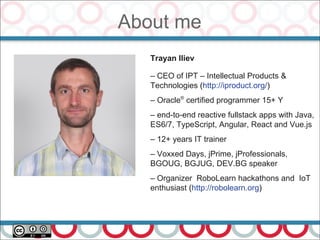
Trayan Iliev
– CEO of IPT – Intellectual Products &
Technologies (http://iproduct.org/)
– Oracle®
certified programmer 15+ Y
– end-to-end reactive fullstack apps with Java,
ES6/7, TypeScript, Angular, React and Vue.js
– 12+ years IT trainer
– Voxxed Days, jPrime, jProfessionals,
BGOUG, BGJUG, DEV.BG speaker
– Organizer RoboLearn hackathons and IoT
enthusiast (http://robolearn.org)
5
Since 2003: IT Education Evolved. Courses:
 Java SE/Web/EE, JPA / Hibernate, Spring 5
 Reactive event stream processing with Reactor /
RxJava / RxJS
 Node.js + Express + React + Redux + GraphQL
 Angular + TypeScript + GraphQL
 SOA & REST HATEOAS
 DDD & Reactive Microservices
IPT - Intellectual Products & Technologies
http://www.iproduct.org
Where to Find the Demo Code?
6
Reactive IoT demos available @ GitHub:
https://github.com/iproduct/reactive-demos-iot
YouTube Video for the IoT demo:
https://www.youtube.com/watch?v=AB3AWAfcy9U
Data / Event / Message Streams
7
“Conceptually, a stream is a (potentially never-ending)
flow of data records, and a transformation is an
operation that takes one or more streams as input,
and produces one or more output streams as a
result.”
Apache Flink: Dataflow Programming Model
Data Stream Programming
8
The idea of abstracting logic from execution is hardly
new -- it was the dream of SOA. And the recent
emergence of microservices and containers shows that
the dream still lives on.
For developers, the question is whether they want to
learn yet one more layer of abstraction to their coding.
On one hand, there's the elusive promise of a common
API to streaming engines that in theory should let you
mix and match, or swap in and swap out.
Tony Baer (Ovum) @ ZDNet - Apache Beam and Spark:
New coopetition for squashing the Lambda Architecture?
Realtime Event Processing
9
Distributed realtime event processing becomes a hot
topic:
 IoT,
 Service/process monitoring,
 Realtime analytics, fraud detection
 Click stream analytics
 Stock-trading analysis
 Supply chain and transportation alerts
 ...
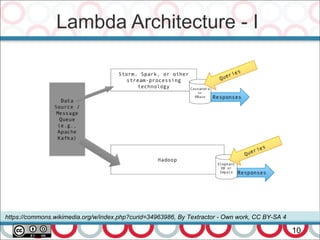
Lambda Architecture - I
10
https://commons.wikimedia.org/w/index.php?curid=34963986, By Textractor - Own work, CC BY-SA 4
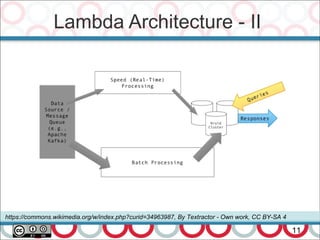
Lambda Architecture - II
11
https://commons.wikimedia.org/w/index.php?curid=34963987, By Textractor - Own work, CC BY-SA 4
Lambda Architecture - III
12
 Data-processing architecture designed to handle
massive quantities of data by using both batch- and
stream-processing methods
 Balances latency, throughput, fault-tolerance, big
data, real-time analytics, mitigates the latencies of
map-reduce
 Data model with an append-only, immutable data
source that serves as a system of record
 Ingesting and processing timestamped events that are
appended to existing events. State is determined from
the natural time-based ordering of the data.
Lambda Architecture: Projects - I
13
 Apache Spark is an open-source
cluster-computing framework. Spark
Streaming, Spark Mllib
 Apache Storm is a distributed
stream processing – streams DAG
 Apache Apex™ unified stream and
batch processing engine.
Lambda Architecture: Projects - II
 Apache Flink - open source stream
processing framework – Java, Scala
 Apache Kafka - open-source stream
processing (Kafka Streams), real-
time, low-latency, high-throughput,
massively scalable pub/sub
 Apache Beam – unified batch and
streaming, portable, extensible
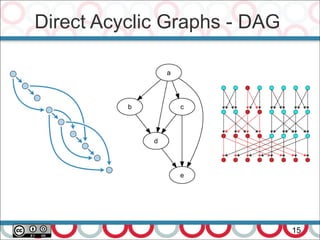
Direct Acyclic Graphs - DAG
15
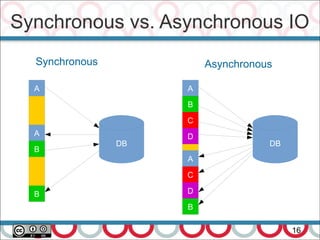
Synchronous vs. Asynchronous IO
16
DB
Synchronous
A
A
B
B
DB
Asynchronous
A
B
C
D
A
B
C
D
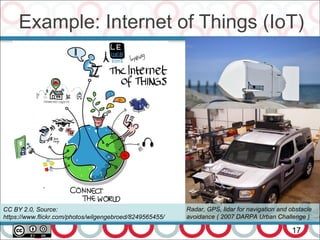
Example: Internet of Things (IoT)
17
CC BY 2.0, Source:
https://www.flickr.com/photos/wilgengebroed/8249565455/
Radar, GPS, lidar for navigation and obstacle
avoidance ( 2007 DARPA Urban Challenge )
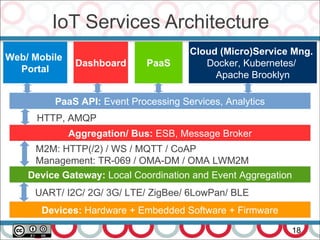
IoT Services Architecture
18
Devices: Hardware + Embedded Software + Firmware
UART/ I2C/ 2G/ 3G/ LTE/ ZigBee/ 6LowPan/ BLE
Aggregation/ Bus: ESB, Message Broker
Device Gateway: Local Coordination and Event Aggregation
M2M: HTTP(/2) / WS / MQTT / CoAP
Management: TR-069 / OMA-DM / OMA LWM2M
HTTP, AMQP
Cloud (Micro)Service Mng.
Docker, Kubernetes/
Apache Brooklyn
Web/ Mobile
Portal
PaaSDashboard
PaaS API: Event Processing Services, Analytics
19
 Performance is about 2 things (Martin Thompson –
http://www.infoq.com/articles/low-latency-vp ):
– Throughput – units per second, and
– Latency – response time
 Real-time – time constraint from input to response
regardless of system load.
 Hard real-time system if this constraint is not honored then
a total system failure can occur.
 Soft real-time system – low latency response with little
deviation in response time
 100 nano-seconds to 100 milli-seconds. [Peter Lawrey]
What's High Performance?
20
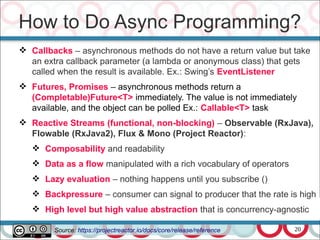
 Callbacks – asynchronous methods do not have a return value but take
an extra callback parameter (a lambda or anonymous class) that gets
called when the result is available. Ex.: Swing’s EventListener
 Futures, Promises – asynchronous methods return a
(Completable)Future<T> immediately. The value is not immediately
available, and the object can be polled Ex.: Callable<T> task
 Reactive Streams (functional, non-blocking) – Observable (RxJava),
Flowable (RxJava2), Flux & Mono (Project Reactor):
 Composability and readability
 Data as a flow manipulated with a rich vocabulary of operators
 Lazy evaluation – nothing happens until you subscribe ()
 Backpressure – consumer can signal to producer that the rate is high
 High level but high value abstraction that is concurrency-agnostic
How to Do Async Programming?
Source: https://projectreactor.io/docs/core/release/reference
Futures in Java 8 - I
21
 Future (implemented by FutureTask) – represents the
result of an cancelable asynchronous computation.
Methods are provided to check if the computation is
complete, to wait for its completion, and to retrieve the
result of the computation (blocking till its ready).
 RunnableFuture – a Future that is Runnable.
Successful execution of the run method causes Future
completion, and allows access to its results.
 ScheduledFuture – delayed cancelable action that
returns result. Usually a scheduled future is the result
of scheduling a task with a ScheduledExecutorService
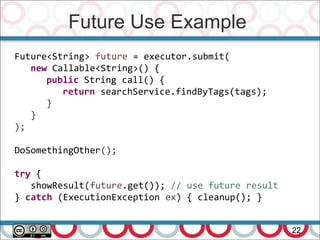
Future Use Example
22
Future<String> future = executor.submit(
new Callable<String>() {
public String call() {
return searchService.findByTags(tags);
}
}
);
DoSomethingOther();
try {
showResult(future.get()); // use future result
} catch (ExecutionException ex) { cleanup(); }
Futures in Java 8 - II
23
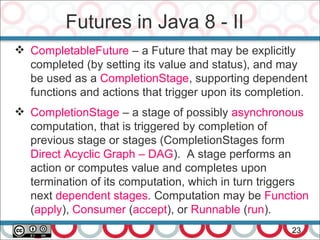
 CompletableFuture – a Future that may be explicitly
completed (by setting its value and status), and may
be used as a CompletionStage, supporting dependent
functions and actions that trigger upon its completion.
 CompletionStage – a stage of possibly asynchronous
computation, that is triggered by completion of
previous stage or stages (CompletionStages form
Direct Acyclic Graph – DAG). A stage performs an
action or computes value and completes upon
termination of its computation, which in turn triggers
next dependent stages. Computation may be Function
(apply), Consumer (accept), or Runnable (run).
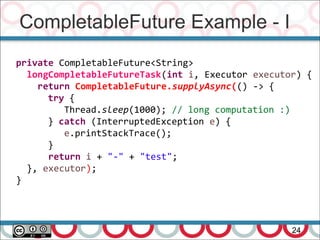
CompletableFuture Example - I
24
private CompletableFuture<String>
longCompletableFutureTask(int i, Executor executor) {
return CompletableFuture.supplyAsync(() -> {
try {
Thread.sleep(1000); // long computation :)
} catch (InterruptedException e) {
e.printStackTrace();
}
return i + "-" + "test";
}, executor);
}
CompletableFuture Example - II
25
ExecutorService executor = ForkJoinPool.commonPool();
//ExecutorService executor = Executors.newCachedThreadPool();
public void testlCompletableFutureSequence() {
List<CompletableFuture<String>> futuresList =
IntStream.range(0, 20).boxed()
.map(i -> longCompletableFutureTask(i, executor)
.exceptionally(t -> t.getMessage()))
.collect(Collectors.toList());
CompletableFuture<List<String>> results =
CompletableFuture.allOf(
futuresList.toArray(new CompletableFuture[0]))
.thenApply(v -> futuresList.stream()
.map(CompletableFuture::join)
.collect(Collectors.toList())
);
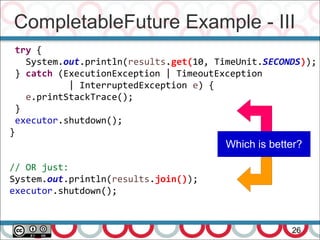
CompletableFuture Example - III
26
try {
System.out.println(results.get(10, TimeUnit.SECONDS));
} catch (ExecutionException | TimeoutException
| InterruptedException e) {
e.printStackTrace();
}
executor.shutdown();
}
// OR just:
System.out.println(results.join());
executor.shutdown();
Which is better?
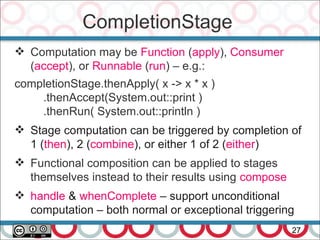
CompletionStage
27
 Computation may be Function (apply), Consumer
(accept), or Runnable (run) – e.g.:
completionStage.thenApply( x -> x * x )
.thenAccept(System.out::print )
.thenRun( System.out::println )
 Stage computation can be triggered by completion of
1 (then), 2 (combine), or either 1 of 2 (either)
 Functional composition can be applied to stages
themselves instead to their results using compose
 handle & whenComplete – support unconditional
computation – both normal or exceptional triggering
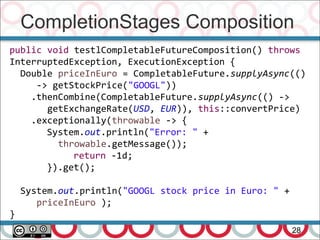
CompletionStages Composition
28
public void testlCompletableFutureComposition() throws
InterruptedException, ExecutionException {
Double priceInEuro = CompletableFuture.supplyAsync(()
-> getStockPrice("GOOGL"))
.thenCombine(CompletableFuture.supplyAsync(() ->
getExchangeRate(USD, EUR)), this::convertPrice)
.exceptionally(throwable -> {
System.out.println("Error: " +
throwable.getMessage());
return -1d;
}).get();
System.out.println("GOOGL stock price in Euro: " +
priceInEuro );
}
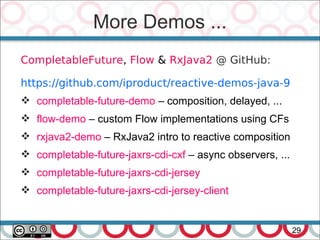
More Demos ...
29
CompletableFuture, Flow & RxJava2 @ GitHub:
https://github.com/iproduct/reactive-demos-java-9
 completable-future-demo – composition, delayed, ...
 flow-demo – custom Flow implementations using CFs
 rxjava2-demo – RxJava2 intro to reactive composition
 completable-future-jaxrs-cdi-cxf – async observers, ...
 completable-future-jaxrs-cdi-jersey
 completable-future-jaxrs-cdi-jersey-client
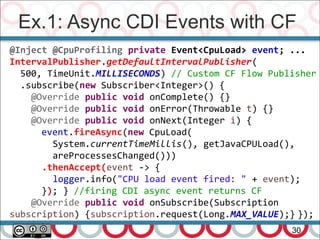
Ex.1: Async CDI Events with CF
30
@Inject @CpuProfiling private Event<CpuLoad> event; ...
IntervalPublisher.getDefaultIntervalPublisher(
500, TimeUnit.MILLISECONDS) // Custom CF Flow Publisher
.subscribe(new Subscriber<Integer>() {
@Override public void onComplete() {}
@Override public void onError(Throwable t) {}
@Override public void onNext(Integer i) {
event.fireAsync(new CpuLoad(
System.currentTimeMillis(), getJavaCPULoad(),
areProcessesChanged()))
.thenAccept(event -> {
logger.info("CPU load event fired: " + event);
}); } //firing CDI async event returns CF
@Override public void onSubscribe(Subscription
subscription) {subscription.request(Long.MAX_VALUE);} });
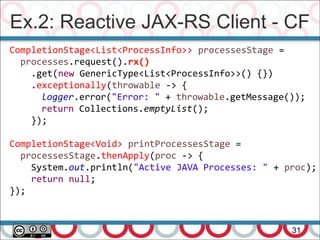
Ex.2: Reactive JAX-RS Client - CF
31
CompletionStage<List<ProcessInfo>> processesStage =
processes.request().rx()
.get(new GenericType<List<ProcessInfo>>() {})
.exceptionally(throwable -> {
logger.error("Error: " + throwable.getMessage());
return Collections.emptyList();
});
CompletionStage<Void> printProcessesStage =
processesStage.thenApply(proc -> {
System.out.println("Active JAVA Processes: " + proc);
return null;
});
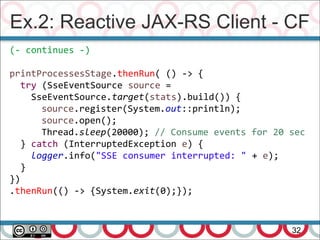
Ex.2: Reactive JAX-RS Client - CF
32
(- continues -)
printProcessesStage.thenRun( () -> {
try (SseEventSource source =
SseEventSource.target(stats).build()) {
source.register(System.out::println);
source.open();
Thread.sleep(20000); // Consume events for 20 sec
} catch (InterruptedException e) {
logger.info("SSE consumer interrupted: " + e);
}
})
.thenRun(() -> {System.exit(0);});
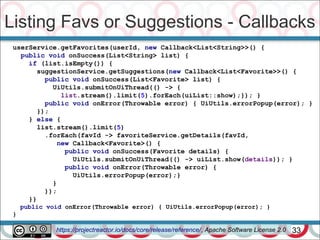
Listing Favs or Suggestions - Callbacks
33
userService.getFavorites(userId, new Callback<List<String>>() {
public void onSuccess(List<String> list) {
if (list.isEmpty()) {
suggestionService.getSuggestions(new Callback<List<Favorite>>() {
public void onSuccess(List<Favorite> list) {
UiUtils.submitOnUiThread(() -> {
list.stream().limit(5).forEach(uiList::show);}); }
public void onError(Throwable error) { UiUtils.errorPopup(error); }
});
} else {
list.stream().limit(5)
.forEach(favId -> favoriteService.getDetails(favId,
new Callback<Favorite>() {
public void onSuccess(Favorite details) {
UiUtils.submitOnUiThread(() -> uiList.show(details)); }
public void onError(Throwable error) {
UiUtils.errorPopup(error);}
}
));
}}
public void onError(Throwable error) { UiUtils.errorPopup(error); }
}
https://projectreactor.io/docs/core/release/reference/, Apache Software License 2.0
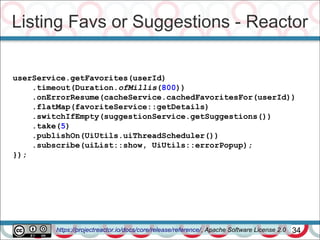
Listing Favs or Suggestions - Reactor
34
userService.getFavorites(userId)
.timeout(Duration.ofMillis(800))
.onErrorResume(cacheService.cachedFavoritesFor(userId))
.flatMap(favoriteService::getDetails)
.switchIfEmpty(suggestionService.getSuggestions())
.take(5)
.publishOn(UiUtils.uiThreadScheduler())
.subscribe(uiList::show, UiUtils::errorPopup);
});
https://projectreactor.io/docs/core/release/reference/, Apache Software License 2.0
Comb. Names & Stats – CompletableFuture
35
CompletableFuture<List<String>> ids = findIds();
CompletableFuture<List<String>> result = ids.thenComposeAsync(l -> {
Stream<CompletableFuture<String>> zip =
l.stream().map(i -> {
CompletableFuture<String> nameTask = findName(i);
CompletableFuture<Integer> statTask = findStat(i);
return nameTask.thenCombineAsync(statTask,
(name, stat) -> "Name " + name + " has stats " + stat); });
List<CompletableFuture<String>> combineList =
zip.collect(Collectors.toList());
CompletableFuture<String>[] combineArray =
combineList.toArray(new CompletableFuture[combineList.size()]);
CompletableFuture<Void> allDone =
CompletableFuture.allOf(combineArray);
return allDone.thenApply(v -> combineList.stream()
.map(CompletableFuture::join)
.collect(Collectors.toList()));
});
List<String> results = result.join();
https://projectreactor.io/docs/core/release/reference/, Apache Software License 2.0
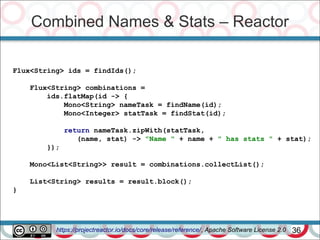
Combined Names & Stats – Reactor
36
Flux<String> ids = findIds();
Flux<String> combinations =
ids.flatMap(id -> {
Mono<String> nameTask = findName(id);
Mono<Integer> statTask = findStat(id);
return nameTask.zipWith(statTask,
(name, stat) -> "Name " + name + " has stats " + stat);
});
Mono<List<String>> result = combinations.collectList();
List<String> results = result.block();
}
https://projectreactor.io/docs/core/release/reference/, Apache Software License 2.0
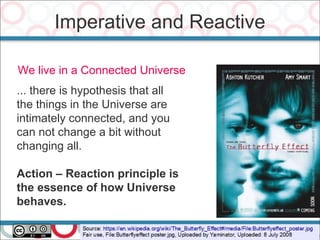
Imperative and Reactive
37
We live in a Connected Universe
... there is hypothesis that all
the things in the Universe are
intimately connected, and you
can not change a bit without
changing all.
Action – Reaction principle is
the essence of how Universe
behaves.
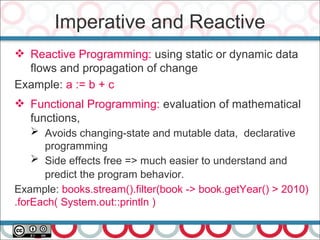
Imperative and Reactive
 Reactive Programming: using static or dynamic data
flows and propagation of change
Example: a := b + c
 Functional Programming: evaluation of mathematical
functions,
➢ Avoids changing-state and mutable data, declarative
programming
➢ Side effects free => much easier to understand and
predict the program behavior.
Example: books.stream().filter(book -> book.getYear() > 2010)
.forEach( System.out::println )
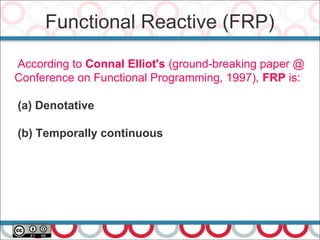
Functional Reactive (FRP)
39
According to Connal Elliot's (ground-breaking paper @
Conference on Functional Programming, 1997), FRP is:
(a) Denotative
(b) Temporally continuous
Reactive Programming
40
 Microsoft®
opens source polyglot project ReactiveX
(Reactive Extensions) [http://reactivex.io]:
Rx = Observables + LINQ + Schedulers :)
Java: RxJava, JavaScript: RxJS, C#: Rx.NET, Scala: RxScala,
Clojure: RxClojure, C++: RxCpp, Ruby: Rx.rb, Python: RxPY,
Groovy: RxGroovy, JRuby: RxJRuby, Kotlin: RxKotlin ...
 Reactive Streams Specification
[http://www.reactive-streams.org/] used by:
 (Spring) Project Reactor [http://projectreactor.io/]
 Actor Model – Akka (Java, Scala) [http://akka.io/]
Reactive Streams Spec.
41
 Reactive Streams – provides standard for
asynchronous stream processing with non-blocking
back pressure.
 Minimal set of interfaces, methods and protocols for
asynchronous data streams
 April 30, 2015: has been released version 1.0.0 of
Reactive Streams for the JVM (Java API,
Specification, TCK and implementation examples)
 Java 9+: java.util.concurrent.Flow
Reactive Streams Spec.
42
 Publisher – provider of potentially unbounded number
of sequenced elements, according to Subscriber(s)
demand.
Publisher.subscribe(Subscriber) => onSubscribe onNext*
(onError | onComplete)?
 Subscriber – calls Subscription.request(long) to
receive notifications
 Subscription – one-to-one Subscriber ↔ Publisher,
request data and cancel demand (allow cleanup).
 Processor = Subscriber + Publisher
FRP = Async Data Streams
43
 FRP is asynchronous data-flow programming using the
building blocks of functional programming (e.g. map,
reduce, filter) and explicitly modeling time
 Used for GUIs, robotics, and music. Example (RxJava):
Observable.from(
new String[]{"Reactive", "Extensions", "Java"})
.take(2).map(s -> s + " : on " + new Date())
.subscribe(s -> System.out.println(s));
Result:
Reactive : on Wed Jun 17 21:54:02 GMT+02:00 2015
Extensions : on Wed Jun 17 21:54:02 GMT+02:00 2015
Project Reactor
44
 Reactor project allows building high-performance (low
latency high throughput) non-blocking asynchronous
applications on JVM.
 Reactor is designed to be extraordinarily fast and can
sustain throughput rates on order of 10's of millions of
operations per second.
 Reactor has powerful API for declaring data
transformations and functional composition.
 Makes use of the concept of Mechanical Sympathy
built on top of Disruptor / RingBuffer.
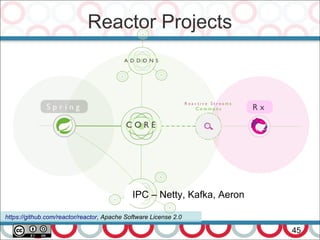
Reactor Projects
45
https://github.com/reactor/reactor, Apache Software License 2.0
IPC – Netty, Kafka, Aeron
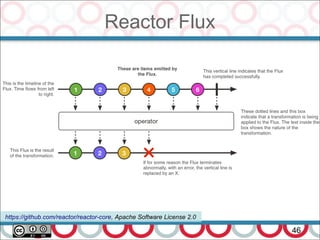
Reactor Flux
46
https://github.com/reactor/reactor-core, Apache Software License 2.0
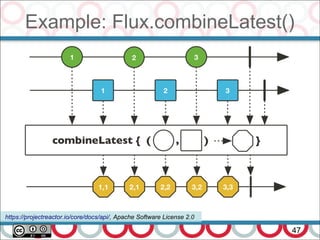
Example: Flux.combineLatest()
47
https://projectreactor.io/core/docs/api/, Apache Software License 2.0
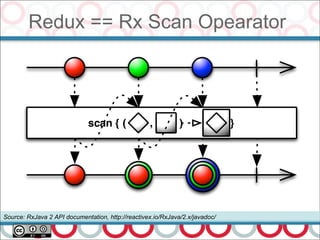
Source: RxJava 2 API documentation, http://reactivex.io/RxJava/2.x/javadoc/
Redux == Rx Scan Opearator
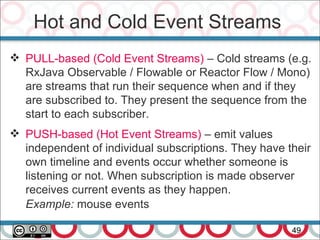
Hot and Cold Event Streams
49
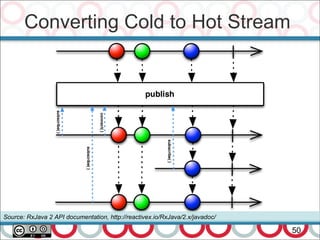
 PULL-based (Cold Event Streams) – Cold streams (e.g.
RxJava Observable / Flowable or Reactor Flow / Mono)
are streams that run their sequence when and if they
are subscribed to. They present the sequence from the
start to each subscriber.
 PUSH-based (Hot Event Streams) – emit values
independent of individual subscriptions. They have their
own timeline and events occur whether someone is
listening or not. When subscription is made observer
receives current events as they happen.
Example: mouse events
Converting Cold to Hot Stream
50
Source: RxJava 2 API documentation, http://reactivex.io/RxJava/2.x/javadoc/
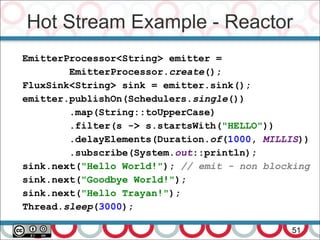
Hot Stream Example - Reactor
51
EmitterProcessor<String> emitter =
EmitterProcessor.create();
FluxSink<String> sink = emitter.sink();
emitter.publishOn(Schedulers.single())
.map(String::toUpperCase)
.filter(s -> s.startsWith("HELLO"))
.delayElements(Duration.of(1000, MILLIS))
.subscribe(System.out::println);
sink.next("Hello World!"); // emit - non blocking
sink.next("Goodbye World!");
sink.next("Hello Trayan!");
Thread.sleep(3000);
Reactor: Best Expalined in Code
52
Lets see some Reactive IoT demos @ GitHub:
https://github.com/iproduct/reactive-demos-iot
YouTube Video for the IoT demo:
https://www.youtube.com/watch?v=AB3AWAfcy9U
Druid Distributed Data Store (Java)
53
https://commons.wikimedia.org/w/index.php?curid=33899448 By Fangjin Yang - sent to me personally, GFDL
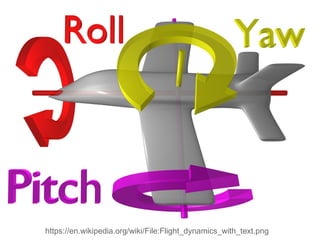
https://en.wikipedia.org/wiki/File:Flight_dynamics_with_text.png
Druid Distributed Data Store (Java)
54
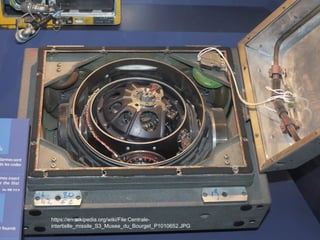
https://commons.wikimedia.org/w/index.php?curid=33899448 By Fangjin Yang - sent to me personally, GFDLhttps://en.wikipedia.org/wiki/File:Centrale-
intertielle_missile_S3_Musee_du_Bourget_P1010652.JPG
55
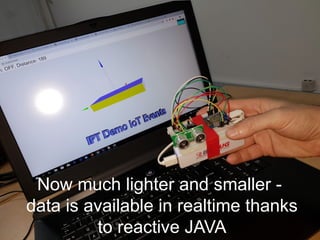
Now much lighter and smaller -
data is available in realtime thanks
to reactive JAVA
Example: IPTPI - RPi + Ardunio Robot
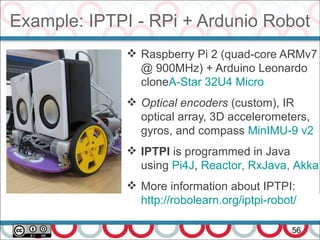
56
 Raspberry Pi 2 (quad-core ARMv7
@ 900MHz) + Arduino Leonardo
cloneA-Star 32U4 Micro
 Optical encoders (custom), IR
optical array, 3D accelerometers,
gyros, and compass MinIMU-9 v2
 IPTPI is programmed in Java
using Pi4J, Reactor, RxJava, Akka
 More information about IPTPI:
http://robolearn.org/iptpi-robot/
IPTPI Hot Event Streams Example
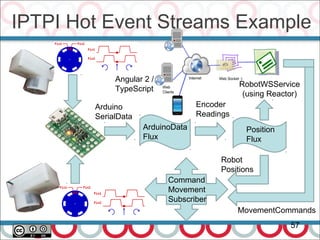
57
Encoder
Readings
ArduinoData
Flux
Arduino
SerialData
Position
Flux
Robot
Positions
Command
Movement
Subscriber
RobotWSService
(using Reactor)
Angular 2 /
TypeScript
MovementCommands
Interested?-> Welcome to IPT Spring 5 &
Reactor Course
58
Thank’s for Your Attention!
59
Trayan Iliev
CEO of IPT – Intellectual Products
& Technologies
http://iproduct.org/
http://robolearn.org/
https://github.com/iproduct
https://twitter.com/trayaniliev
https://www.facebook.com/IPT.EACAD
https://plus.google.com/+IproductOrg

IPT Reactive Java IoT Demo - BGOUG 2018

  • 1.
    November 16, 2018 BGOUGAutumn Conference Reactive Java for The Realtime Trayan Iliev tiliev@iproduct.org http://iproduct.org Copyright © 2003-2018 IPT - Intellectual Products & Technologies
  • 2.
    2 Reactive Javafor TheRealtime  Java data streaming for the (soft) realtime applicatins  Async programming alternatives  Introduction to FRP, Reactive Streams spec  RxJava Project Reactor  REST services with JAX-RS and Reactor  End-to-end non-blocking reactive SOA with Netty  Realtime event streaming to JS clients using SSE  IoT event streaming demo
  • 3.
    3 Reactive Javafor TheRealtime  Java data streaming for the (soft) realtime applicatins  Async programming alternatives  Introduction to FRP, Reactive Streams spec  RxJava Project Reactor  REST services with JAX-RS and Reactor  End-to-end non-blocking reactive SOA with Netty  Realtime event streaming to JS clients using SSE  IoT event streaming demo Best Explained in Code
  • 4.
    About me 4 Trayan Iliev –CEO of IPT – Intellectual Products & Technologies (http://iproduct.org/) – Oracle® certified programmer 15+ Y – end-to-end reactive fullstack apps with Java, ES6/7, TypeScript, Angular, React and Vue.js – 12+ years IT trainer – Voxxed Days, jPrime, jProfessionals, BGOUG, BGJUG, DEV.BG speaker – Organizer RoboLearn hackathons and IoT enthusiast (http://robolearn.org)
  • 5.
    5 Since 2003: ITEducation Evolved. Courses:  Java SE/Web/EE, JPA / Hibernate, Spring 5  Reactive event stream processing with Reactor / RxJava / RxJS  Node.js + Express + React + Redux + GraphQL  Angular + TypeScript + GraphQL  SOA & REST HATEOAS  DDD & Reactive Microservices IPT - Intellectual Products & Technologies http://www.iproduct.org
  • 6.
    Where to Findthe Demo Code? 6 Reactive IoT demos available @ GitHub: https://github.com/iproduct/reactive-demos-iot YouTube Video for the IoT demo: https://www.youtube.com/watch?v=AB3AWAfcy9U
  • 7.
    Data / Event/ Message Streams 7 “Conceptually, a stream is a (potentially never-ending) flow of data records, and a transformation is an operation that takes one or more streams as input, and produces one or more output streams as a result.” Apache Flink: Dataflow Programming Model
  • 8.
    Data Stream Programming 8 Theidea of abstracting logic from execution is hardly new -- it was the dream of SOA. And the recent emergence of microservices and containers shows that the dream still lives on. For developers, the question is whether they want to learn yet one more layer of abstraction to their coding. On one hand, there's the elusive promise of a common API to streaming engines that in theory should let you mix and match, or swap in and swap out. Tony Baer (Ovum) @ ZDNet - Apache Beam and Spark: New coopetition for squashing the Lambda Architecture?
  • 9.
    Realtime Event Processing 9 Distributedrealtime event processing becomes a hot topic:  IoT,  Service/process monitoring,  Realtime analytics, fraud detection  Click stream analytics  Stock-trading analysis  Supply chain and transportation alerts  ...
  • 10.
    Lambda Architecture -I 10 https://commons.wikimedia.org/w/index.php?curid=34963986, By Textractor - Own work, CC BY-SA 4
  • 11.
    Lambda Architecture -II 11 https://commons.wikimedia.org/w/index.php?curid=34963987, By Textractor - Own work, CC BY-SA 4
  • 12.
    Lambda Architecture -III 12  Data-processing architecture designed to handle massive quantities of data by using both batch- and stream-processing methods  Balances latency, throughput, fault-tolerance, big data, real-time analytics, mitigates the latencies of map-reduce  Data model with an append-only, immutable data source that serves as a system of record  Ingesting and processing timestamped events that are appended to existing events. State is determined from the natural time-based ordering of the data.
  • 13.
    Lambda Architecture: Projects- I 13  Apache Spark is an open-source cluster-computing framework. Spark Streaming, Spark Mllib  Apache Storm is a distributed stream processing – streams DAG  Apache Apex™ unified stream and batch processing engine.
  • 14.
    Lambda Architecture: Projects- II  Apache Flink - open source stream processing framework – Java, Scala  Apache Kafka - open-source stream processing (Kafka Streams), real- time, low-latency, high-throughput, massively scalable pub/sub  Apache Beam – unified batch and streaming, portable, extensible
  • 15.
  • 16.
    Synchronous vs. AsynchronousIO 16 DB Synchronous A A B B DB Asynchronous A B C D A B C D
  • 17.
    Example: Internet ofThings (IoT) 17 CC BY 2.0, Source: https://www.flickr.com/photos/wilgengebroed/8249565455/ Radar, GPS, lidar for navigation and obstacle avoidance ( 2007 DARPA Urban Challenge )
  • 18.
    IoT Services Architecture 18 Devices:Hardware + Embedded Software + Firmware UART/ I2C/ 2G/ 3G/ LTE/ ZigBee/ 6LowPan/ BLE Aggregation/ Bus: ESB, Message Broker Device Gateway: Local Coordination and Event Aggregation M2M: HTTP(/2) / WS / MQTT / CoAP Management: TR-069 / OMA-DM / OMA LWM2M HTTP, AMQP Cloud (Micro)Service Mng. Docker, Kubernetes/ Apache Brooklyn Web/ Mobile Portal PaaSDashboard PaaS API: Event Processing Services, Analytics
  • 19.
    19  Performance isabout 2 things (Martin Thompson – http://www.infoq.com/articles/low-latency-vp ): – Throughput – units per second, and – Latency – response time  Real-time – time constraint from input to response regardless of system load.  Hard real-time system if this constraint is not honored then a total system failure can occur.  Soft real-time system – low latency response with little deviation in response time  100 nano-seconds to 100 milli-seconds. [Peter Lawrey] What's High Performance?
  • 20.
    20  Callbacks –asynchronous methods do not have a return value but take an extra callback parameter (a lambda or anonymous class) that gets called when the result is available. Ex.: Swing’s EventListener  Futures, Promises – asynchronous methods return a (Completable)Future<T> immediately. The value is not immediately available, and the object can be polled Ex.: Callable<T> task  Reactive Streams (functional, non-blocking) – Observable (RxJava), Flowable (RxJava2), Flux & Mono (Project Reactor):  Composability and readability  Data as a flow manipulated with a rich vocabulary of operators  Lazy evaluation – nothing happens until you subscribe ()  Backpressure – consumer can signal to producer that the rate is high  High level but high value abstraction that is concurrency-agnostic How to Do Async Programming? Source: https://projectreactor.io/docs/core/release/reference
  • 21.
    Futures in Java8 - I 21  Future (implemented by FutureTask) – represents the result of an cancelable asynchronous computation. Methods are provided to check if the computation is complete, to wait for its completion, and to retrieve the result of the computation (blocking till its ready).  RunnableFuture – a Future that is Runnable. Successful execution of the run method causes Future completion, and allows access to its results.  ScheduledFuture – delayed cancelable action that returns result. Usually a scheduled future is the result of scheduling a task with a ScheduledExecutorService
  • 22.
    Future Use Example 22 Future<String>future = executor.submit( new Callable<String>() { public String call() { return searchService.findByTags(tags); } } ); DoSomethingOther(); try { showResult(future.get()); // use future result } catch (ExecutionException ex) { cleanup(); }
  • 23.
    Futures in Java8 - II 23  CompletableFuture – a Future that may be explicitly completed (by setting its value and status), and may be used as a CompletionStage, supporting dependent functions and actions that trigger upon its completion.  CompletionStage – a stage of possibly asynchronous computation, that is triggered by completion of previous stage or stages (CompletionStages form Direct Acyclic Graph – DAG). A stage performs an action or computes value and completes upon termination of its computation, which in turn triggers next dependent stages. Computation may be Function (apply), Consumer (accept), or Runnable (run).
  • 24.
    CompletableFuture Example -I 24 private CompletableFuture<String> longCompletableFutureTask(int i, Executor executor) { return CompletableFuture.supplyAsync(() -> { try { Thread.sleep(1000); // long computation :) } catch (InterruptedException e) { e.printStackTrace(); } return i + "-" + "test"; }, executor); }
  • 25.
    CompletableFuture Example -II 25 ExecutorService executor = ForkJoinPool.commonPool(); //ExecutorService executor = Executors.newCachedThreadPool(); public void testlCompletableFutureSequence() { List<CompletableFuture<String>> futuresList = IntStream.range(0, 20).boxed() .map(i -> longCompletableFutureTask(i, executor) .exceptionally(t -> t.getMessage())) .collect(Collectors.toList()); CompletableFuture<List<String>> results = CompletableFuture.allOf( futuresList.toArray(new CompletableFuture[0])) .thenApply(v -> futuresList.stream() .map(CompletableFuture::join) .collect(Collectors.toList()) );
  • 26.
    CompletableFuture Example -III 26 try { System.out.println(results.get(10, TimeUnit.SECONDS)); } catch (ExecutionException | TimeoutException | InterruptedException e) { e.printStackTrace(); } executor.shutdown(); } // OR just: System.out.println(results.join()); executor.shutdown(); Which is better?
  • 27.
    CompletionStage 27  Computation maybe Function (apply), Consumer (accept), or Runnable (run) – e.g.: completionStage.thenApply( x -> x * x ) .thenAccept(System.out::print ) .thenRun( System.out::println )  Stage computation can be triggered by completion of 1 (then), 2 (combine), or either 1 of 2 (either)  Functional composition can be applied to stages themselves instead to their results using compose  handle & whenComplete – support unconditional computation – both normal or exceptional triggering
  • 28.
    CompletionStages Composition 28 public voidtestlCompletableFutureComposition() throws InterruptedException, ExecutionException { Double priceInEuro = CompletableFuture.supplyAsync(() -> getStockPrice("GOOGL")) .thenCombine(CompletableFuture.supplyAsync(() -> getExchangeRate(USD, EUR)), this::convertPrice) .exceptionally(throwable -> { System.out.println("Error: " + throwable.getMessage()); return -1d; }).get(); System.out.println("GOOGL stock price in Euro: " + priceInEuro ); }
  • 29.
    More Demos ... 29 CompletableFuture,Flow & RxJava2 @ GitHub: https://github.com/iproduct/reactive-demos-java-9  completable-future-demo – composition, delayed, ...  flow-demo – custom Flow implementations using CFs  rxjava2-demo – RxJava2 intro to reactive composition  completable-future-jaxrs-cdi-cxf – async observers, ...  completable-future-jaxrs-cdi-jersey  completable-future-jaxrs-cdi-jersey-client
  • 30.
    Ex.1: Async CDIEvents with CF 30 @Inject @CpuProfiling private Event<CpuLoad> event; ... IntervalPublisher.getDefaultIntervalPublisher( 500, TimeUnit.MILLISECONDS) // Custom CF Flow Publisher .subscribe(new Subscriber<Integer>() { @Override public void onComplete() {} @Override public void onError(Throwable t) {} @Override public void onNext(Integer i) { event.fireAsync(new CpuLoad( System.currentTimeMillis(), getJavaCPULoad(), areProcessesChanged())) .thenAccept(event -> { logger.info("CPU load event fired: " + event); }); } //firing CDI async event returns CF @Override public void onSubscribe(Subscription subscription) {subscription.request(Long.MAX_VALUE);} });
  • 31.
    Ex.2: Reactive JAX-RSClient - CF 31 CompletionStage<List<ProcessInfo>> processesStage = processes.request().rx() .get(new GenericType<List<ProcessInfo>>() {}) .exceptionally(throwable -> { logger.error("Error: " + throwable.getMessage()); return Collections.emptyList(); }); CompletionStage<Void> printProcessesStage = processesStage.thenApply(proc -> { System.out.println("Active JAVA Processes: " + proc); return null; });
  • 32.
    Ex.2: Reactive JAX-RSClient - CF 32 (- continues -) printProcessesStage.thenRun( () -> { try (SseEventSource source = SseEventSource.target(stats).build()) { source.register(System.out::println); source.open(); Thread.sleep(20000); // Consume events for 20 sec } catch (InterruptedException e) { logger.info("SSE consumer interrupted: " + e); } }) .thenRun(() -> {System.exit(0);});
  • 33.
    Listing Favs orSuggestions - Callbacks 33 userService.getFavorites(userId, new Callback<List<String>>() { public void onSuccess(List<String> list) { if (list.isEmpty()) { suggestionService.getSuggestions(new Callback<List<Favorite>>() { public void onSuccess(List<Favorite> list) { UiUtils.submitOnUiThread(() -> { list.stream().limit(5).forEach(uiList::show);}); } public void onError(Throwable error) { UiUtils.errorPopup(error); } }); } else { list.stream().limit(5) .forEach(favId -> favoriteService.getDetails(favId, new Callback<Favorite>() { public void onSuccess(Favorite details) { UiUtils.submitOnUiThread(() -> uiList.show(details)); } public void onError(Throwable error) { UiUtils.errorPopup(error);} } )); }} public void onError(Throwable error) { UiUtils.errorPopup(error); } } https://projectreactor.io/docs/core/release/reference/, Apache Software License 2.0
  • 34.
    Listing Favs orSuggestions - Reactor 34 userService.getFavorites(userId) .timeout(Duration.ofMillis(800)) .onErrorResume(cacheService.cachedFavoritesFor(userId)) .flatMap(favoriteService::getDetails) .switchIfEmpty(suggestionService.getSuggestions()) .take(5) .publishOn(UiUtils.uiThreadScheduler()) .subscribe(uiList::show, UiUtils::errorPopup); }); https://projectreactor.io/docs/core/release/reference/, Apache Software License 2.0
  • 35.
    Comb. Names &Stats – CompletableFuture 35 CompletableFuture<List<String>> ids = findIds(); CompletableFuture<List<String>> result = ids.thenComposeAsync(l -> { Stream<CompletableFuture<String>> zip = l.stream().map(i -> { CompletableFuture<String> nameTask = findName(i); CompletableFuture<Integer> statTask = findStat(i); return nameTask.thenCombineAsync(statTask, (name, stat) -> "Name " + name + " has stats " + stat); }); List<CompletableFuture<String>> combineList = zip.collect(Collectors.toList()); CompletableFuture<String>[] combineArray = combineList.toArray(new CompletableFuture[combineList.size()]); CompletableFuture<Void> allDone = CompletableFuture.allOf(combineArray); return allDone.thenApply(v -> combineList.stream() .map(CompletableFuture::join) .collect(Collectors.toList())); }); List<String> results = result.join(); https://projectreactor.io/docs/core/release/reference/, Apache Software License 2.0
  • 36.
    Combined Names &Stats – Reactor 36 Flux<String> ids = findIds(); Flux<String> combinations = ids.flatMap(id -> { Mono<String> nameTask = findName(id); Mono<Integer> statTask = findStat(id); return nameTask.zipWith(statTask, (name, stat) -> "Name " + name + " has stats " + stat); }); Mono<List<String>> result = combinations.collectList(); List<String> results = result.block(); } https://projectreactor.io/docs/core/release/reference/, Apache Software License 2.0
  • 37.
    Imperative and Reactive 37 Welive in a Connected Universe ... there is hypothesis that all the things in the Universe are intimately connected, and you can not change a bit without changing all. Action – Reaction principle is the essence of how Universe behaves.
  • 38.
    Imperative and Reactive Reactive Programming: using static or dynamic data flows and propagation of change Example: a := b + c  Functional Programming: evaluation of mathematical functions, ➢ Avoids changing-state and mutable data, declarative programming ➢ Side effects free => much easier to understand and predict the program behavior. Example: books.stream().filter(book -> book.getYear() > 2010) .forEach( System.out::println )
  • 39.
    Functional Reactive (FRP) 39 Accordingto Connal Elliot's (ground-breaking paper @ Conference on Functional Programming, 1997), FRP is: (a) Denotative (b) Temporally continuous
  • 40.
    Reactive Programming 40  Microsoft® openssource polyglot project ReactiveX (Reactive Extensions) [http://reactivex.io]: Rx = Observables + LINQ + Schedulers :) Java: RxJava, JavaScript: RxJS, C#: Rx.NET, Scala: RxScala, Clojure: RxClojure, C++: RxCpp, Ruby: Rx.rb, Python: RxPY, Groovy: RxGroovy, JRuby: RxJRuby, Kotlin: RxKotlin ...  Reactive Streams Specification [http://www.reactive-streams.org/] used by:  (Spring) Project Reactor [http://projectreactor.io/]  Actor Model – Akka (Java, Scala) [http://akka.io/]
  • 41.
    Reactive Streams Spec. 41 Reactive Streams – provides standard for asynchronous stream processing with non-blocking back pressure.  Minimal set of interfaces, methods and protocols for asynchronous data streams  April 30, 2015: has been released version 1.0.0 of Reactive Streams for the JVM (Java API, Specification, TCK and implementation examples)  Java 9+: java.util.concurrent.Flow
  • 42.
    Reactive Streams Spec. 42 Publisher – provider of potentially unbounded number of sequenced elements, according to Subscriber(s) demand. Publisher.subscribe(Subscriber) => onSubscribe onNext* (onError | onComplete)?  Subscriber – calls Subscription.request(long) to receive notifications  Subscription – one-to-one Subscriber ↔ Publisher, request data and cancel demand (allow cleanup).  Processor = Subscriber + Publisher
  • 43.
    FRP = AsyncData Streams 43  FRP is asynchronous data-flow programming using the building blocks of functional programming (e.g. map, reduce, filter) and explicitly modeling time  Used for GUIs, robotics, and music. Example (RxJava): Observable.from( new String[]{"Reactive", "Extensions", "Java"}) .take(2).map(s -> s + " : on " + new Date()) .subscribe(s -> System.out.println(s)); Result: Reactive : on Wed Jun 17 21:54:02 GMT+02:00 2015 Extensions : on Wed Jun 17 21:54:02 GMT+02:00 2015
  • 44.
    Project Reactor 44  Reactorproject allows building high-performance (low latency high throughput) non-blocking asynchronous applications on JVM.  Reactor is designed to be extraordinarily fast and can sustain throughput rates on order of 10's of millions of operations per second.  Reactor has powerful API for declaring data transformations and functional composition.  Makes use of the concept of Mechanical Sympathy built on top of Disruptor / RingBuffer.
  • 45.
    Reactor Projects 45 https://github.com/reactor/reactor, ApacheSoftware License 2.0 IPC – Netty, Kafka, Aeron
  • 46.
  • 47.
  • 48.
    Source: RxJava 2API documentation, http://reactivex.io/RxJava/2.x/javadoc/ Redux == Rx Scan Opearator
  • 49.
    Hot and ColdEvent Streams 49  PULL-based (Cold Event Streams) – Cold streams (e.g. RxJava Observable / Flowable or Reactor Flow / Mono) are streams that run their sequence when and if they are subscribed to. They present the sequence from the start to each subscriber.  PUSH-based (Hot Event Streams) – emit values independent of individual subscriptions. They have their own timeline and events occur whether someone is listening or not. When subscription is made observer receives current events as they happen. Example: mouse events
  • 50.
    Converting Cold toHot Stream 50 Source: RxJava 2 API documentation, http://reactivex.io/RxJava/2.x/javadoc/
  • 51.
    Hot Stream Example- Reactor 51 EmitterProcessor<String> emitter = EmitterProcessor.create(); FluxSink<String> sink = emitter.sink(); emitter.publishOn(Schedulers.single()) .map(String::toUpperCase) .filter(s -> s.startsWith("HELLO")) .delayElements(Duration.of(1000, MILLIS)) .subscribe(System.out::println); sink.next("Hello World!"); // emit - non blocking sink.next("Goodbye World!"); sink.next("Hello Trayan!"); Thread.sleep(3000);
  • 52.
    Reactor: Best Expalinedin Code 52 Lets see some Reactive IoT demos @ GitHub: https://github.com/iproduct/reactive-demos-iot YouTube Video for the IoT demo: https://www.youtube.com/watch?v=AB3AWAfcy9U
  • 53.
    Druid Distributed DataStore (Java) 53 https://commons.wikimedia.org/w/index.php?curid=33899448 By Fangjin Yang - sent to me personally, GFDL https://en.wikipedia.org/wiki/File:Flight_dynamics_with_text.png
  • 54.
    Druid Distributed DataStore (Java) 54 https://commons.wikimedia.org/w/index.php?curid=33899448 By Fangjin Yang - sent to me personally, GFDLhttps://en.wikipedia.org/wiki/File:Centrale- intertielle_missile_S3_Musee_du_Bourget_P1010652.JPG
  • 55.
    55 Now much lighterand smaller - data is available in realtime thanks to reactive JAVA
  • 56.
    Example: IPTPI -RPi + Ardunio Robot 56  Raspberry Pi 2 (quad-core ARMv7 @ 900MHz) + Arduino Leonardo cloneA-Star 32U4 Micro  Optical encoders (custom), IR optical array, 3D accelerometers, gyros, and compass MinIMU-9 v2  IPTPI is programmed in Java using Pi4J, Reactor, RxJava, Akka  More information about IPTPI: http://robolearn.org/iptpi-robot/
  • 57.
    IPTPI Hot EventStreams Example 57 Encoder Readings ArduinoData Flux Arduino SerialData Position Flux Robot Positions Command Movement Subscriber RobotWSService (using Reactor) Angular 2 / TypeScript MovementCommands
  • 58.
    Interested?-> Welcome toIPT Spring 5 & Reactor Course 58
  • 59.
    Thank’s for YourAttention! 59 Trayan Iliev CEO of IPT – Intellectual Products & Technologies http://iproduct.org/ http://robolearn.org/ https://github.com/iproduct https://twitter.com/trayaniliev https://www.facebook.com/IPT.EACAD https://plus.google.com/+IproductOrg