1
Functional Eccentric
      Training


                       2
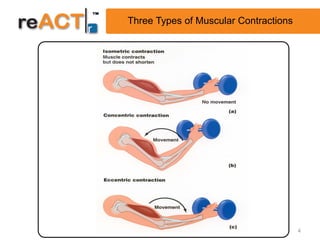
Three Types of Muscular Contractions


• Concentric – Muscle Shortening under
  tension

• Isometric – muscle tension without any
  change in length

• Eccentric aka “negative” – muscle
  lengthens under tension


                                                       3
Three Types of Muscular Contractions


                                       4
Concentric Contraction

Concentric contractions occur whenever you
are projecting force externally such as:

    • lifting any object against gravity
    • Performing an exercise on a machine where the
      weight stack is moving up
    • Throwing anything
    • Jumping up, sideways or forward
    • The push off phase of running.


                                                      5
Isometric Contractions

Isometric contractions occur whenever you
are stabilizing or preventing movement such
as:

  • Rotator cuff muscles of the shoulder contract
    isometrically to hold the head of the humerus into the
    glenoid fossa while larger muscles like Pecs move
    arm.

  • Torso musculature contracts isometrically to maintain
    the core in rigid alignment during most movments
    including lifting, jump, throwing, etc.
                                                             6
Eccentric Contractions

Eccentric contractions occur whenever you
are absorbing force and decelerating such
as:
  • Landing from a jump and landing phase of walking and
    running
  • Walking down stairs
  • Cutting/changing direction rapidly while running
  • Stopping quickly while running
  • Absorbing bumps while skiing
  • Decelerating arm when throwing                     7
Eccentric Contractions
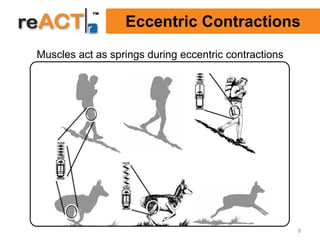
Muscles act as springs during eccentric contractions


                                                       8
Eccentric Contractions

            Muscles as Springs
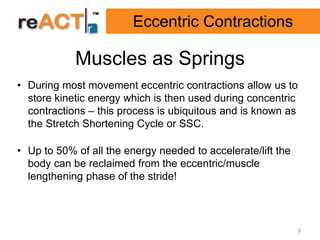
• During most movement eccentric contractions allow us to
  store kinetic energy which is then used during concentric
  contractions – this process is ubiquitous and is known as
  the Stretch Shortening Cycle or SSC.

• Up to 50% of all the energy needed to accelerate/lift the
  body can be reclaimed from the eccentric/muscle
  lengthening phase of the stride!


                                                              9
Eccentric Contractions

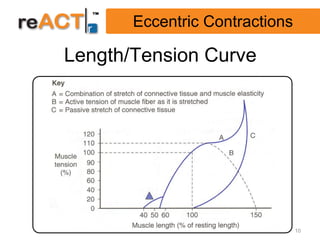
Length/Tension Curve


                                10
Elftman Principle

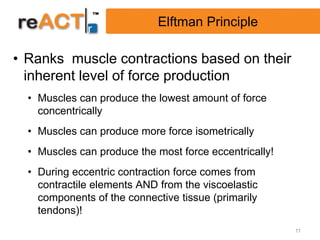
• Ranks muscle contractions based on their
  inherent level of force production
  • Muscles can produce the lowest amount of force
    concentrically
  • Muscles can produce more force isometrically
  • Muscles can produce the most force eccentrically!
  • During eccentric contraction force comes from
    contractile elements AND from the viscoelastic
    components of the connective tissue (primarily
    tendons)!
                                                        11
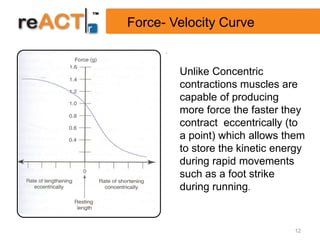
Force- Velocity Curve


        Unlike Concentric
        contractions muscles are
        capable of producing
        more force the faster they
        contract eccentrically (to
        a point) which allows them
        to store the kinetic energy
        during rapid movements
        such as a foot strike
        during running.


                                12
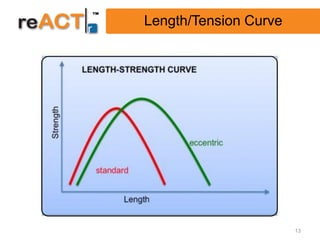
Length/Tension Curve


                       13
Length/Tension Curve


     Eccentric Training moves the
        Length/Tension Curve
• Eccentric training increases a muscle’s
  ability to produce force at a longer length!

• This is one of the ways eccentric training
  prevents injury!

                                                 14
Effects of Eccentric Training

Eccentric exercise is thought to optimize the
alignment of myofibrils (contractile elements within
muscle fibers) allowing maximum leverage.

  • This process helps explain the benefits of eccentric
    exercise in the treatment of tendonitis.

  • Eccentric exercise causes hypertrophy of tendons and
    connective tissue increasing the tendons strength,
    resistance to injury, and ability to store energy during
    movement.


                                                           15
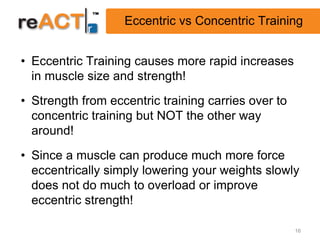
Eccentric vs Concentric Training


• Eccentric Training causes more rapid increases
  in muscle size and strength!
• Strength from eccentric training carries over to
  concentric training but NOT the other way
  around!
• Since a muscle can produce much more force
  eccentrically simply lowering your weights slowly
  does not do much to overload or improve
  eccentric strength!

                                                     16
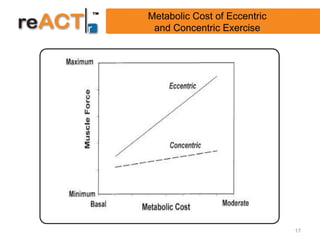
Metabolic Cost of Eccentric
 and Concentric Exercise


                              17
Eccentrics and Metabolic Demand


• Eccentric Training requires a much lower level of
  oxygen and cardiovascular work/stress and a
  lower rate of perceived exertion for any given
  level of force production/workload.
• Eccentric exercise has been proven to be ideal
  for seniors and those with decreased
  cardiovascular capacity because it quickly and
  safely builds muscles and decreases fall risk
  significantly!


                                                   18
Concerns with Eccentric Training

Eccentric Training can cause significant delayed
onset muscular soreness, acute decreases in
strength, and acute reduction in proprioceptive
ability.

These negative effects can be eliminated by:

  • Gradual introduction and increases in interval
    and total eccentric loading time

  • Slow and gradual increase in intensity/load
    during eccentric training.
                                                     19
DOMS and Training
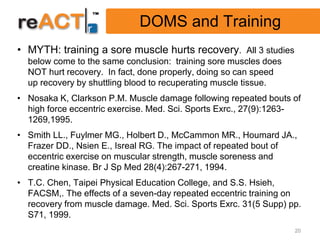
• MYTH: training a sore muscle hurts recovery. All 3 studies
  below come to the same conclusion: training sore muscles does
  NOT hurt recovery. In fact, done properly, doing so can speed
  up recovery by shuttling blood to recuperating muscle tissue.
• Nosaka K, Clarkson P.M. Muscle damage following repeated bouts of
  high force eccentric exercise. Med. Sci. Sports Exrc., 27(9):1263-
  1269,1995.
• Smith LL., Fuylmer MG., Holbert D., McCammon MR., Houmard JA.,
  Frazer DD., Nsien E., Isreal RG. The impact of repeated bout of
  eccentric exercise on muscular strength, muscle soreness and
  creatine kinase. Br J Sp Med 28(4):267-271, 1994.
• T.C. Chen, Taipei Physical Education College, and S.S. Hsieh,
  FACSM,. The effects of a seven-day repeated eccentric training on
  recovery from muscle damage. Med. Sci. Sports Exrc. 31(5 Supp) pp.
  S71, 1999.
                                                                  20
Eccentric Training and
                       Anterior Cruciate Ligament Injury


• ACL tears are serious frequently requiring surgery, and
  rehabilitation of ACL injury is challenging!

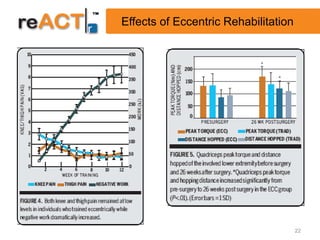
• Research shows that appropriate eccentric exercise for
  ACL rehab is well tolerated and greatly accelerates
  increases in muscle mass, strength and in hopping ability
  compared to regular exercises!


                                                            21
Effects of Eccentric Rehabilitation


                                      22
Eccentric Exercise and Health


A study has shown that one weekly half hour bout
of eccentric exercise done for 8 weeks produces
significant health benefits including:
  • Significant improvements in Resting Energy
    Expenditure
  • Increased Fat Utilization
  • Improved Blood Lipid Profiles
  • Decreased Insulin Resistance!

                                                     23
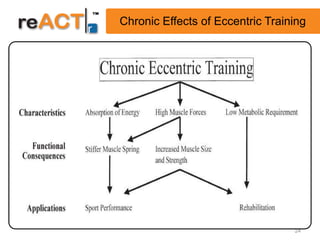
Chronic Effects of Eccentric Training


                                  24
S.A.I.D. Principle

• Specific Adaptation to Imposed Demand is the
  key principle to keep in mind when designing
  exercise and rehab programs!

• The more specific the program relative to desired
  outcomes the better results!

• An important aspect of program specificity is to
  include specific conditioning relative to muscle
  contraction type based on movement/sport
  requirements.
                                                     25
S.A.I.D. Principle

• To properly train a person for activities/sports
  requiring eccentric contractions the program must
  include eccentric training!

• Since most activities and all sports require
  eccentric strength – eccentric training should be
  part of everyone’s training program!

• However most equipment and programs include
  NO effective eccentric loading!


                                                      26
Existing Eccentric Training Methods


Trainers have devised ways to train eccentric
muscle strength and endurance.
However these methods pose several challenges
to implementation
  • Many, such as plyometrics, ballistic training,
    and heavy negatives pose significant risk of
    injury and require careful preparation and
    skilled coaching.
  • Others use highly specialized, expensive
    equipment
                                                          27
28
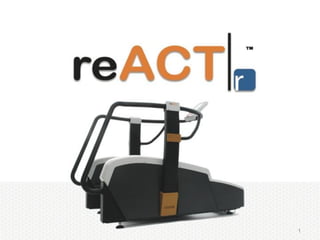
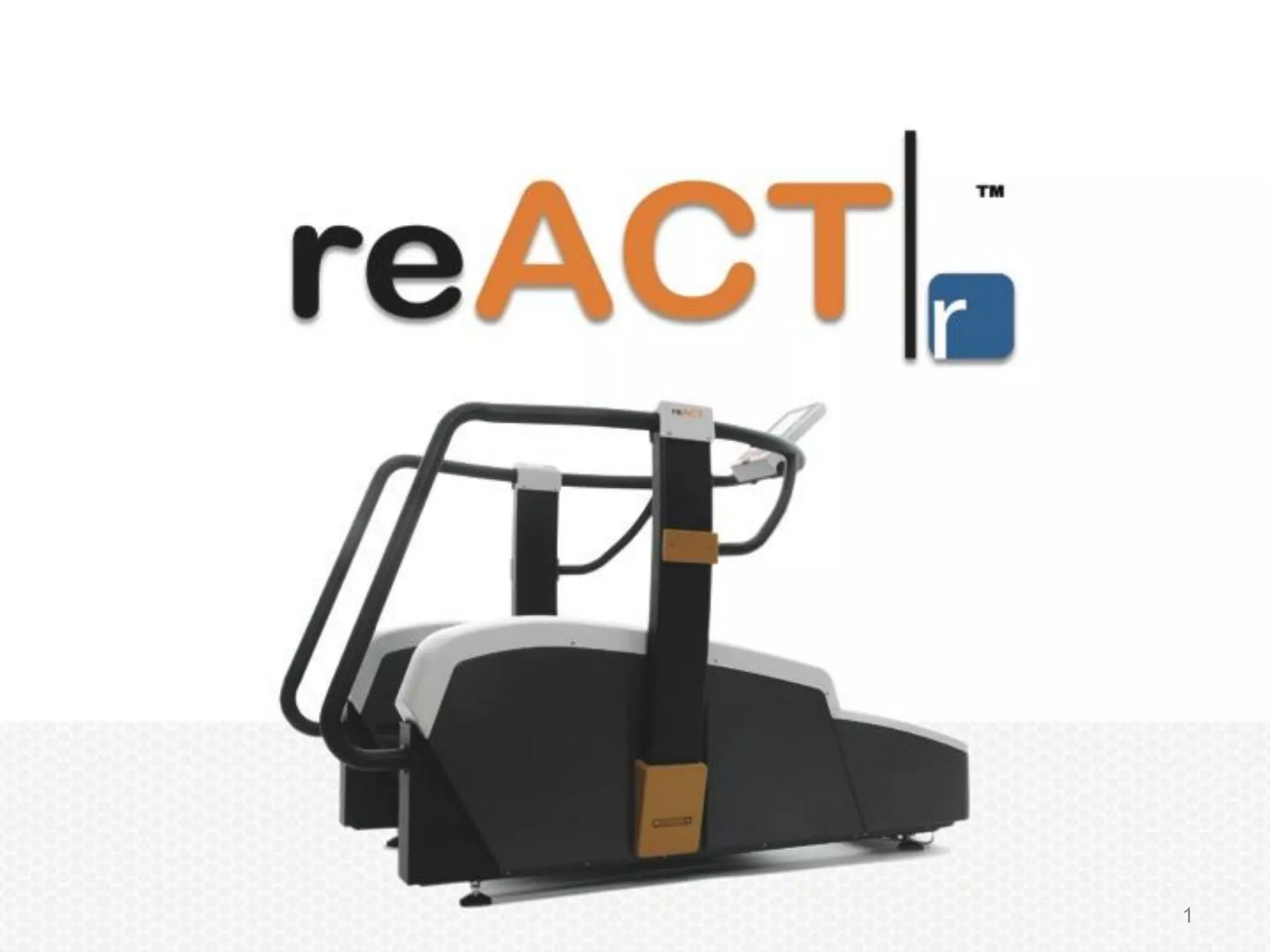
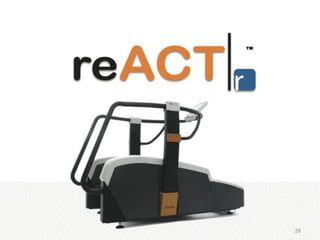
reACT Motion
• Reverse Bicycle Motion/Platform Changes Pitch
  During Rotation
• Forces Legs to Absorb Energy with no impact
• Vertical Ellipse to Horizontal Ellipse
• No Impact with full Range of Motion
• Full control of movement speed
• Safe and secure


                                                29
Validation


• 6 NFL Football Teams
• US Olympic Center at Lake Placid
• US Olympic Ski Team at Park City
• Navy SEALS
• Gonzaga University Basketball Team

                                       30
reAct Pro Sports

•   Houston Texans-NFL
•   Indianapolis Colts-NFL
•   Miami Dolphins-NFL
•   New York Giants –NFL
•   Tennessee Titan-NFL
•   Washington Redskins-NFL
•   Chicago Cubs-MLB
•   Seattle Sonics (Okalahoma City Thunder) -NBA


                                                   31
Acclimitization and Initial Progressions

– The average new user will require 1 – 5 sessions to become
  acclimatized to reACT so that they learn the basic
  movements; get through any initial DOMS (delayed onset
  muscular soreness); and have adapted so they no longer
  experience DOMS.

– Until this acclimatization has taken place it is better to be
  careful with intensity (keep speeds between 40-50; use a
  work/rest ration of 1:2; and gradually progress number of
  total sets and exercises).

– As a general rule, after acclimatization is complete initially
  focus on volume progressions such as increased number of
  sets, exercises, and set time.


                                                                  32
Intensity Progressions


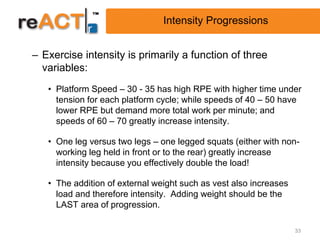
– Exercise intensity is primarily a function of three
  variables:
   • Platform Speed – 30 - 35 has high RPE with higher time under
     tension for each platform cycle; while speeds of 40 – 50 have
     lower RPE but demand more total work per minute; and
     speeds of 60 – 70 greatly increase intensity.

   • One leg versus two legs – one legged squats (either with non-
     working leg held in front or to the rear) greatly increase
     intensity because you effectively double the load!

   • The addition of external weight such as vest also increases
     load and therefore intensity. Adding weight should be the
     LAST area of progression.

                                                                   33
Work/Rest Ratio Progressions


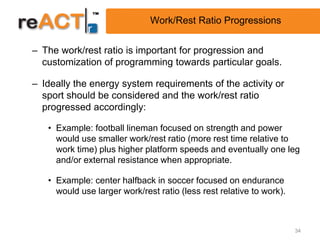
– The work/rest ratio is important for progression and
  customization of programming towards particular goals.

– Ideally the energy system requirements of the activity or
  sport should be considered and the work/rest ratio
  progressed accordingly:

   • Example: football lineman focused on strength and power
     would use smaller work/rest ratio (more rest time relative to
     work time) plus higher platform speeds and eventually one leg
     and/or external resistance when appropriate.

   • Example: center halfback in soccer focused on endurance
     would use larger work/rest ratio (less rest relative to work).


                                                                      34
reACT Acute Training Variables


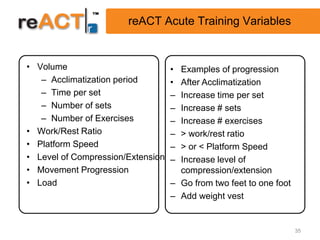
• Volume                           • Examples of progression
   – Acclimatization period        • After Acclimatization
   – Time per set                  – Increase time per set
   – Number of sets                – Increase # sets
   – Number of Exercises           – Increase # exercises
• Work/Rest Ratio                  – > work/rest ratio
• Platform Speed                   – > or < Platform Speed
• Level of Compression/Extension   – Increase level of
• Movement Progression               compression/extension
• Load                             – Go from two feet to one foot
                                   – Add weight vest


                                                                    35
First Session for New Client


– Start clients facing forward with two feet parallel and
  shoulder width apart with firm grip on handrails

– Start using manual program set for intensity/speed of 40
  RPM and allow client to “ride” without flexing or extending at
  hip/knee/ankle so client feels safe on machine.

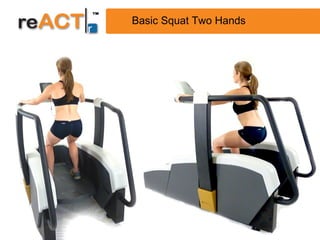
– After client is comfortable riding progress to having them do
  the basic squat (flex knees/hips/ankles as platform moves
  up to absorb while holding on then extend as platform
  moves down).

– Use short work intervals no longer than 30 Seconds with 1
  minute off between sets. Do only 3 - 5 sets initially to avoid
  excessive DOMS.
                                                               36
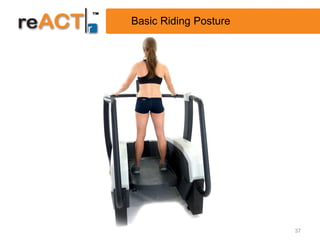
Basic Riding Posture


                       37
Basic Squat Two Hands


                        38
Speed/Intensity Recommendations


– Initially when learning reACT using a speed of 40 RPM
  is recommended for short intervals (< 1 Min.)
– For the average person a speed of 30 RPM will
  actually be associated with a much higher RPE (Rate
  of Perceived Exertion) than faster speeds of 40 – 50.
– So RPE is high for slow speed of 30; moderate for
  speeds of 40 – 50; and then high again at speeds
  greater than 50.
– Speeds from 60 - 70 are advanced and not for
  beginners!


                                                          39
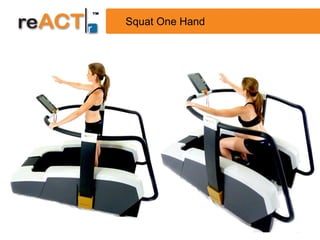
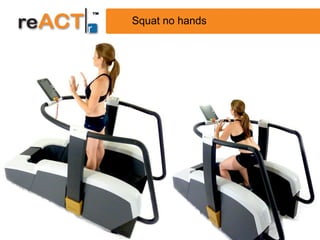
Initial Exercise Progressions

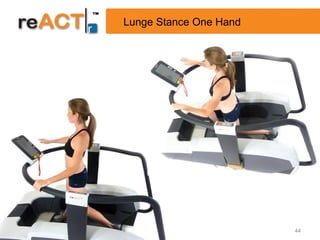
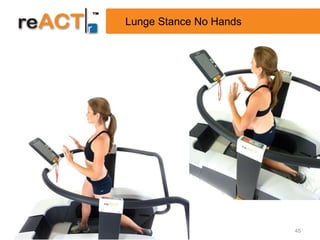
– The first suggested progression is to go from two
  hands holding on to one hand or two hands lightly
  touching until your client can perform the basic squat
  NOT holding on at all.

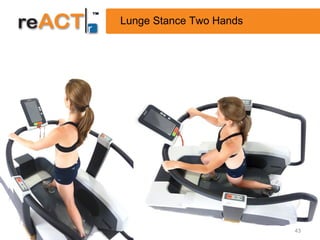
– Once your client can perform basic squat exercise
  without support you can begin teaching a lunge stance.

– Note that it is appropriate to have clients hold on with
  both hands again when learning new postures.


                                                             40
Squat One Hand


                 41
Squat no hands


                 42
Lunge Stance Two Hands


                         43
Lunge Stance One Hand


                        44
Lunge Stance No Hands


                        45
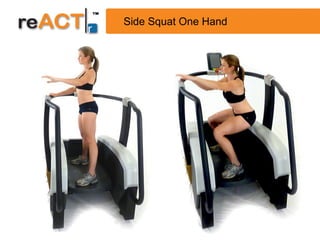
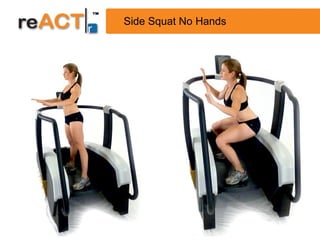
Side Facing Posture Progressions


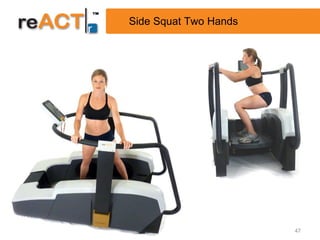
– When your client has learned the front facing postures
  they can begin to learn the side facing squat.

– As with all new postures the side facing
  snowboard/skateboard/surf squat exercise should be
  taught with your client holding on again with
  progression to full compression and extension without
  holding on.


                                                       46
Side Squat Two Hands


                       47
Side Squat One Hand


                      48
Side Squat No Hands


                      49
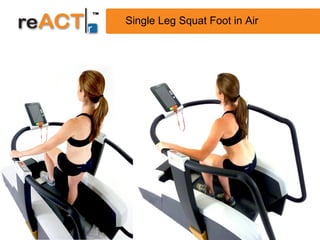
Single Leg Squat Progression


– After learning forward & side facing postures the last
  posture progression is the single leg Squat.

– Have your client face forward with one foot on the
  platform and the other foot placed onto the standing
  foot so that the toes are touching the top of standing
  foot) while holding on with both hands. The client
  compresses and extends with one leg from this secure
  position.

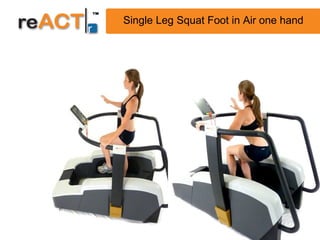
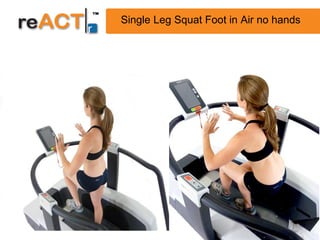
– Progress to point where your client holds one foot up in
  the air as other leg compresses and extends fully
  without holding on with hands.

                                                           50
Single Leg Squat Foot in Air


                               51
Single Leg Squat Foot in Air one hand


                                   52
Single Leg Squat Foot in Air no hands


                                   53
Advanced Exercises
After mastering all front, side facing and single leg squat
exercises a client can be progressed through advanced
exercises including (these are ADVANCED exercises that
should only be done with trainer supervision):

      • The squat exercise holding on with eyes closed and
        hands holding on. Progress slowly so that your client
        can perform this challenge with one hand and then no
        hands. Then you can progress to other postures for
        maximum proprioceptive benefit!

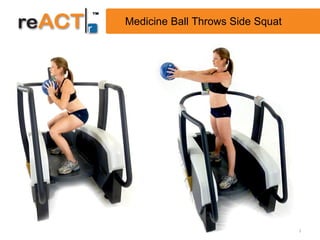
      • Begin to teach integrated functional movement patterns
        with an upper body component like medicine ball throws
        and catches.


                                                                54
Medicine Ball Throws Side Squat


                                  55
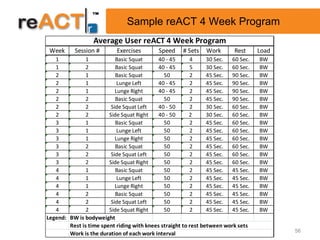
Sample reACT 4 Week Program
                  Average User reACT 4 Week Program
 Week     Session #        Exercises       Speed     # Sets   Work       Rest     Load
   1           1           Basic Squat     40 - 45       4      30 Sec. 60 Sec.   BW
   1           2           Basic Squat     40 - 45       5      30 Sec. 60 Sec.   BW
   2           1           Basic Squat        50         2      45 Sec. 90 Sec.   BW
   2           1            Lunge Left     40 - 45       2      45 Sec. 90 Sec.   BW
   2           1           Lunge Right     40 - 45       2      45 Sec. 90 Sec.   BW
   2           2           Basic Squat        50         2      45 Sec. 90 Sec.   BW
   2           2         Side Squat Left   40 - 50       2      30 Sec. 60 Sec.   BW
   2           2        Side Squat Right   40 - 50       2      30 Sec. 60 Sec.   BW
   3           1           Basic Squat        50         2      45 Sec. 60 Sec.   BW
   3           1            Lunge Left        50         2      45 Sec. 60 Sec.   BW
   3           1           Lunge Right        50         2      45 Sec. 60 Sec.   BW
   3           2           Basic Squat        50         2      45 Sec. 60 Sec.   BW
   3           2         Side Squat Left      50         2      45 Sec. 60 Sec.   BW
   3           2        Side Squat Right      50         2      45 Sec. 60 Sec.   BW
   4           1           Basic Squat        50         2      45 Sec. 45 Sec.   BW
   4           1            Lunge Left        50         2      45 Sec. 45 Sec.   BW
   4           1           Lunge Right        50         2      45 Sec. 45 Sec.   BW
   4           2           Basic Squat        50         2      45 Sec. 45 Sec.   BW
   4           2         Side Squat Left      50         2      45 Sec. 45 Sec.   BW
   4           2        Side Squat Right      50         2      45 Sec. 45 Sec.   BW
Legend: BW is bodyweight
        Rest is time spent riding with knees straight to rest between work sets
                                                                                         56
        Work is the duration of each work interval
References/Bibliography

• Kent E . Timm, Clinical Applications of Eccentric Exercise Isokinetics
  and Plyometrics. Hong Kong Physiother. J. 1991/1992; 13: 1 -4
• Standish WD, Rubinovich RM, Curwin S (1986) : Eccentric exercise
  in chronic tendinitis. Clin Orthop 208: 65-68
• Timm KE, Davies GJ (1991) : Eccentric exercise . In : Duncan P (ed),
  Proceedings of the Annual Conference of the American Physical
  Therapy Association, Boston, MA. : American Physical Therapy
  Association
• Standish WD, Rubinovich RM, Curwin S (1986) : Eccentric exercise
  in chronic tendinitis. Clin Orthop 208: 65-68.
•   Elftman H (1966) : Biomechanics of muscle. J Bone Jt Surg 48A:
    363-370 .
• Kaneko M, Komi PV, Aura O (1984) : Mechanical efficiency
  ofconcentric and eccentric exercises performed with medium to fast
  contraction rates. Scand J Sports Sci 6: 15-20.
                                                                       57
References/Bibliography


• Friden J, Seger J, Sjostrom M, Eckblom B (1983) : Adaptive response in
  human skeletal muscle subjected to prolonged eccentric training . Int JSports
  Med4: 177-183 .
• Daniel Lorenz; Michael Reiman: the role and Implementation of Eccentric
  Training in Athletic Rehabilitation: Tendinopathy, Hamstring Strains, and ACL
  Reconstruction. The International Journal of Sports Physical Therapy|Volume
  6, Number 1| March 2011 | Page 27
• Nelson RT. (2006). A comparison of the immediate effects of eccentric
  training vs. static stretch on hamstring flexibility in high school & college
  athletes. North American Journal of Sports Physical Therapy, 1(2):56 – 61.6.
• Pashalis, Vassilis, Nikolaidis; Michalis G.; Theodorou, Anastasios A.;
  Panayiotou, George; Fatouros, Ioannis G.; Koutedakis, Yiannis; Jamurtas,
  Athanasios: A Weekly Bout of Eccentric Exercise Is Sufficient to Induce
  Health-Promoting Effects. Medicine & Science in Sports & Exercise: January
  2011 - Volume 43 - Issue 1 - pp 64-73

                                                                             58
References/Bibliography
•   LaStayo PC, Ewy GA, Pierotti DD, Johns RK, Lindstedt; S. The positive effects of negative work:
    increased muscle strength and decreased fall risk in a frail elderly population. J Gerontol A Biol Sci
    Med Sci. 2003;58:M419-424

•   LaStayo PC, Pierotti DJ, Pifer J, Hoppeler H, Lindstedt; SL. Eccentric ergometry: increases in
    locomotor muscle size and strength at low training intensities. Am J Physiol Regul Integr Comp
    Physiol. 2000;278:R1282-1288.

•   Lastayo PC, Reich TE, Urquhart M, Hoppeler H, Lindstedt SL. Chronic eccentric exercise:
    improvements in muscle strength can occur with little demand for oxygen. Am J Physiol.
    1999;276:R611-615.

•   Lindstedt SL, LaStayo PC, Reich TE. When active muscles lengthen: properties and consequences
    of eccentric contractions. News Physiol Sci. 2001;16:256-261.

•   J. Parry Gerber, Robin L. Marcus, Leland E. Dibble, Patrick E. Greis, Robert T. Burks and Paul C.
    LaStayo. Effects of Early Progressive Eccentric Exercise on Muscle Structure After Anterior
    Cruciate Ligament Reconstruction. J. Bone Joint Surg. Am. 89:559-570, 2007.
    doi:10.2106/JBJS.F.00385


                                                                                                        59
References/Bibliography
•   J. Parry Gerber, Robin L. Marcus, Leland E. Dibble, and Paul C. LaStayo. The Use of Eccentrically
    Biased Resistance Exercise to Mitigate Muscle Impairments Following Anterior Cruciate Ligament
    Reconstruction: A Short Review. Sports Health: A Multidisciplinary Approach January 2009 1:31-
    38;doi:10.1177/1941738108327531

•   J. Parry Gerber, Robin L. Marcus, Leland E. Dibble, Patrick E. Greis, Robert T. Burks and Paul C.
    LaStayo. Effects of Early Progressive Eccentric Exercise on Muscle Structure After Anterior
    Cruciate Ligament Reconstruction. J. Bone Joint Surg. Am. 89:559-570, 2007.
    doi:10.2106/JBJS.F.00385

•   Nosaka K, Clarkson P.M. Muscle damage following repeated bouts of high force eccentric exercise.
    Med. Sci. Sports Exrc., 27(9):1263-1269,1995.

•   Smith LL., Fuylmer MG., Holbert D., McCammon MR., Houmard JA., Frazer DD., Nsien E., Isreal
    RG. The impact of repeated bout of eccentric exercise on muscular strength, muscle soreness and
    creatine kinase. Br J Sp Med 28(4):267-271, 1994.

•   T.C. Chen, Taipei Physical Education College, and S.S. Hsieh, FACSM,. The effects of a seven-day
    repeated eccentric training on recovery from muscle damage. Med. Sci. Sports Exrc. 31(5 Supp) pp.
    S71, 1999.


                                                                                                    60
References/Bibliography
•   T.E. Reich, S. L. Lindstedt, P. C. Lastayo, D. J. Pierotti. Is the spring quality of muscle plastic? Am J
    Physiol Regulatory Integrative Comp Physiol 278: R1661–R1666, 2000

•   Taylor CR. Force development during sustained locomotion: a determinant of gait, speed and
    metabolic power. J Exp Biol 115:253–262, 1985

•   Johnson, B. L., J. W. Adamaczyk, and K. O. Tennoe. A comparison of concentric and eccentric
    muscle training. Med. Sci.Sports Exerc. 8: 35–38, 1976. 19.

•   D. A., and O. M. Rutherford. Human muscle strength training: the effects of three different regimes
    and the nature of the resultant changes. J. Physiol. (Lond.) 391: 1–11, 1987. 20.

•   Komi, P. V., and E. R. Buskirk. Effect of eccentric and concentric muscle conditioning on tension
    and electrical activity of human muscle. Ergonomics 15: 417–434, 1972.

•   Abbott, B. C., B. Bigland, and J. M. Ritchie. The physiological cost of negative work. J. Physiol.
    (Lond.) 117: 380–390, 1952.

•   Friden, J. Adaptive response in human skeletal muscle subjected to prolonged eccentric training.
    Int. J. Sports Med. 4:177–183, 1983.


                                                                                                          61
References/Bibliography
•   Clarkson, P. M., K. Nosaka, and B. Braun. Muscle function after exercise induced muscle damage
    and rapid adaptation.Med. Sci. Sports Exerc. 24: 512–520, 1992.

•   Ebbeling, C. B., and P. M. Clarkson. Muscle adaptation prior to recovery following eccentric
    exercise. Eur. J. Appl. Physiol. 60:26–31, 1990

•   Friden, J., M. Sjostrom, and B. Ekblom. Myofibrillar damage following intense eccentric exercise in
    man. Int. J. Sports Med. 4:170–176, 1983.

•   Golden, C., and G. A. Dudley. Strength after bouts of eccentric or concentric actions. Med. Sci.
    Sports Exerc. 24: 926–933, 1992.

•   Johnson, B. L., J. W. Adamaczyk, and K. O. Tennoe. A comparison of concentric and eccentric
    muscle training. Med. Sci. Sports Exerc. 8: 35–38, 1976.

•   Paul C. LaStayo,Gordon A. Ewy,David D. Pierotti,Richard K. Johns,Stan Lindstedt. The Positive
    Effects of Negative Work: Increased Muscle Strength and Decreased Fall Risk in a Frail Elderly
    Population. Journal of Gerontology: MEDICAL SCIENCES Copyright 2003 by The Gerontological
    Society of America 2003, Vol. 58A, No. 5, 419–424


                                                                                                       62
References/Bibliography
•   S. L. Lindstedt, P. C. LaStayo, T. E. Reich. When Active Muscles Lengthen: Properties and
    Consequences of Eccentric Contractions. News Physiol. Sci. • Volume 16 • December 2001
•   Alfredson, H., Pietilä, T., Jonnson, P., Lorentzon, R. (1998), Heavy-load eccentric calf muscle
    training for the treatment of chronic achilles tendinosis. The American Journal of Sports Medicine
    26(3):360-366.
•   Brandenburg, J., Docherty, D. (2002), The effects of accentuated eccentric loading on strength,
    muscle hypertrophy, and neural adaptations in trained individuals. Journal of Strength and
    Conditioning Research 16(1):25-32.
•   Doan, B., Newton, R., Marsit, J., Triplett-McBride, T., Koziris, P., Fry, A., Kraemer, W. (2002),
    Effects of increased eccentric loading on bench press 1RM. Journal of Strength and Conditioning
    Research 16(1):9-13.
•   Mroig, K O’Brien, G Kirk, R Murray, P McKinnon, B Shadgan, W D Reid. The effects of eccentric
    versus concentric resistance training on muscle strength and mass in healthy adults: a systematic
    review with meta-analysis. Br J Sports Med 2009;43:556-568 doi:10.1136/bjsm.2008.051417


                                                                                                         63

Re Act Eccentric Training Course Linked In

  • 1.
  • 2.
  • 3.
    Three Types ofMuscular Contractions • Concentric – Muscle Shortening under tension • Isometric – muscle tension without any change in length • Eccentric aka “negative” – muscle lengthens under tension 3
  • 4.
    Three Types ofMuscular Contractions 4
  • 5.
    Concentric Contraction Concentric contractionsoccur whenever you are projecting force externally such as: • lifting any object against gravity • Performing an exercise on a machine where the weight stack is moving up • Throwing anything • Jumping up, sideways or forward • The push off phase of running. 5
  • 6.
    Isometric Contractions Isometric contractionsoccur whenever you are stabilizing or preventing movement such as: • Rotator cuff muscles of the shoulder contract isometrically to hold the head of the humerus into the glenoid fossa while larger muscles like Pecs move arm. • Torso musculature contracts isometrically to maintain the core in rigid alignment during most movments including lifting, jump, throwing, etc. 6
  • 7.
    Eccentric Contractions Eccentric contractionsoccur whenever you are absorbing force and decelerating such as: • Landing from a jump and landing phase of walking and running • Walking down stairs • Cutting/changing direction rapidly while running • Stopping quickly while running • Absorbing bumps while skiing • Decelerating arm when throwing 7
  • 8.
    Eccentric Contractions Muscles actas springs during eccentric contractions 8
  • 9.
    Eccentric Contractions Muscles as Springs • During most movement eccentric contractions allow us to store kinetic energy which is then used during concentric contractions – this process is ubiquitous and is known as the Stretch Shortening Cycle or SSC. • Up to 50% of all the energy needed to accelerate/lift the body can be reclaimed from the eccentric/muscle lengthening phase of the stride! 9
  • 10.
  • 11.
    Elftman Principle • Ranksmuscle contractions based on their inherent level of force production • Muscles can produce the lowest amount of force concentrically • Muscles can produce more force isometrically • Muscles can produce the most force eccentrically! • During eccentric contraction force comes from contractile elements AND from the viscoelastic components of the connective tissue (primarily tendons)! 11
  • 12.
    Force- Velocity Curve Unlike Concentric contractions muscles are capable of producing more force the faster they contract eccentrically (to a point) which allows them to store the kinetic energy during rapid movements such as a foot strike during running. 12
  • 13.
  • 14.
    Length/Tension Curve Eccentric Training moves the Length/Tension Curve • Eccentric training increases a muscle’s ability to produce force at a longer length! • This is one of the ways eccentric training prevents injury! 14
  • 15.
    Effects of EccentricTraining Eccentric exercise is thought to optimize the alignment of myofibrils (contractile elements within muscle fibers) allowing maximum leverage. • This process helps explain the benefits of eccentric exercise in the treatment of tendonitis. • Eccentric exercise causes hypertrophy of tendons and connective tissue increasing the tendons strength, resistance to injury, and ability to store energy during movement. 15
  • 16.
    Eccentric vs ConcentricTraining • Eccentric Training causes more rapid increases in muscle size and strength! • Strength from eccentric training carries over to concentric training but NOT the other way around! • Since a muscle can produce much more force eccentrically simply lowering your weights slowly does not do much to overload or improve eccentric strength! 16
  • 17.
    Metabolic Cost ofEccentric and Concentric Exercise 17
  • 18.
    Eccentrics and MetabolicDemand • Eccentric Training requires a much lower level of oxygen and cardiovascular work/stress and a lower rate of perceived exertion for any given level of force production/workload. • Eccentric exercise has been proven to be ideal for seniors and those with decreased cardiovascular capacity because it quickly and safely builds muscles and decreases fall risk significantly! 18
  • 19.
    Concerns with EccentricTraining Eccentric Training can cause significant delayed onset muscular soreness, acute decreases in strength, and acute reduction in proprioceptive ability. These negative effects can be eliminated by: • Gradual introduction and increases in interval and total eccentric loading time • Slow and gradual increase in intensity/load during eccentric training. 19
  • 20.
    DOMS and Training •MYTH: training a sore muscle hurts recovery. All 3 studies below come to the same conclusion: training sore muscles does NOT hurt recovery. In fact, done properly, doing so can speed up recovery by shuttling blood to recuperating muscle tissue. • Nosaka K, Clarkson P.M. Muscle damage following repeated bouts of high force eccentric exercise. Med. Sci. Sports Exrc., 27(9):1263- 1269,1995. • Smith LL., Fuylmer MG., Holbert D., McCammon MR., Houmard JA., Frazer DD., Nsien E., Isreal RG. The impact of repeated bout of eccentric exercise on muscular strength, muscle soreness and creatine kinase. Br J Sp Med 28(4):267-271, 1994. • T.C. Chen, Taipei Physical Education College, and S.S. Hsieh, FACSM,. The effects of a seven-day repeated eccentric training on recovery from muscle damage. Med. Sci. Sports Exrc. 31(5 Supp) pp. S71, 1999. 20
  • 21.
    Eccentric Training and Anterior Cruciate Ligament Injury • ACL tears are serious frequently requiring surgery, and rehabilitation of ACL injury is challenging! • Research shows that appropriate eccentric exercise for ACL rehab is well tolerated and greatly accelerates increases in muscle mass, strength and in hopping ability compared to regular exercises! 21
  • 22.
    Effects of EccentricRehabilitation 22
  • 23.
    Eccentric Exercise andHealth A study has shown that one weekly half hour bout of eccentric exercise done for 8 weeks produces significant health benefits including: • Significant improvements in Resting Energy Expenditure • Increased Fat Utilization • Improved Blood Lipid Profiles • Decreased Insulin Resistance! 23
  • 24.
    Chronic Effects ofEccentric Training 24
  • 25.
    S.A.I.D. Principle • SpecificAdaptation to Imposed Demand is the key principle to keep in mind when designing exercise and rehab programs! • The more specific the program relative to desired outcomes the better results! • An important aspect of program specificity is to include specific conditioning relative to muscle contraction type based on movement/sport requirements. 25
  • 26.
    S.A.I.D. Principle • Toproperly train a person for activities/sports requiring eccentric contractions the program must include eccentric training! • Since most activities and all sports require eccentric strength – eccentric training should be part of everyone’s training program! • However most equipment and programs include NO effective eccentric loading! 26
  • 27.
    Existing Eccentric TrainingMethods Trainers have devised ways to train eccentric muscle strength and endurance. However these methods pose several challenges to implementation • Many, such as plyometrics, ballistic training, and heavy negatives pose significant risk of injury and require careful preparation and skilled coaching. • Others use highly specialized, expensive equipment 27
  • 28.
  • 29.
    reACT Motion • ReverseBicycle Motion/Platform Changes Pitch During Rotation • Forces Legs to Absorb Energy with no impact • Vertical Ellipse to Horizontal Ellipse • No Impact with full Range of Motion • Full control of movement speed • Safe and secure 29
  • 30.
    Validation • 6 NFLFootball Teams • US Olympic Center at Lake Placid • US Olympic Ski Team at Park City • Navy SEALS • Gonzaga University Basketball Team 30
  • 31.
    reAct Pro Sports • Houston Texans-NFL • Indianapolis Colts-NFL • Miami Dolphins-NFL • New York Giants –NFL • Tennessee Titan-NFL • Washington Redskins-NFL • Chicago Cubs-MLB • Seattle Sonics (Okalahoma City Thunder) -NBA 31
  • 32.
    Acclimitization and InitialProgressions – The average new user will require 1 – 5 sessions to become acclimatized to reACT so that they learn the basic movements; get through any initial DOMS (delayed onset muscular soreness); and have adapted so they no longer experience DOMS. – Until this acclimatization has taken place it is better to be careful with intensity (keep speeds between 40-50; use a work/rest ration of 1:2; and gradually progress number of total sets and exercises). – As a general rule, after acclimatization is complete initially focus on volume progressions such as increased number of sets, exercises, and set time. 32
  • 33.
    Intensity Progressions – Exerciseintensity is primarily a function of three variables: • Platform Speed – 30 - 35 has high RPE with higher time under tension for each platform cycle; while speeds of 40 – 50 have lower RPE but demand more total work per minute; and speeds of 60 – 70 greatly increase intensity. • One leg versus two legs – one legged squats (either with non- working leg held in front or to the rear) greatly increase intensity because you effectively double the load! • The addition of external weight such as vest also increases load and therefore intensity. Adding weight should be the LAST area of progression. 33
  • 34.
    Work/Rest Ratio Progressions –The work/rest ratio is important for progression and customization of programming towards particular goals. – Ideally the energy system requirements of the activity or sport should be considered and the work/rest ratio progressed accordingly: • Example: football lineman focused on strength and power would use smaller work/rest ratio (more rest time relative to work time) plus higher platform speeds and eventually one leg and/or external resistance when appropriate. • Example: center halfback in soccer focused on endurance would use larger work/rest ratio (less rest relative to work). 34
  • 35.
    reACT Acute TrainingVariables • Volume • Examples of progression – Acclimatization period • After Acclimatization – Time per set – Increase time per set – Number of sets – Increase # sets – Number of Exercises – Increase # exercises • Work/Rest Ratio – > work/rest ratio • Platform Speed – > or < Platform Speed • Level of Compression/Extension – Increase level of • Movement Progression compression/extension • Load – Go from two feet to one foot – Add weight vest 35
  • 36.
    First Session forNew Client – Start clients facing forward with two feet parallel and shoulder width apart with firm grip on handrails – Start using manual program set for intensity/speed of 40 RPM and allow client to “ride” without flexing or extending at hip/knee/ankle so client feels safe on machine. – After client is comfortable riding progress to having them do the basic squat (flex knees/hips/ankles as platform moves up to absorb while holding on then extend as platform moves down). – Use short work intervals no longer than 30 Seconds with 1 minute off between sets. Do only 3 - 5 sets initially to avoid excessive DOMS. 36
  • 37.
  • 38.
  • 39.
    Speed/Intensity Recommendations – Initiallywhen learning reACT using a speed of 40 RPM is recommended for short intervals (< 1 Min.) – For the average person a speed of 30 RPM will actually be associated with a much higher RPE (Rate of Perceived Exertion) than faster speeds of 40 – 50. – So RPE is high for slow speed of 30; moderate for speeds of 40 – 50; and then high again at speeds greater than 50. – Speeds from 60 - 70 are advanced and not for beginners! 39
  • 40.
    Initial Exercise Progressions –The first suggested progression is to go from two hands holding on to one hand or two hands lightly touching until your client can perform the basic squat NOT holding on at all. – Once your client can perform basic squat exercise without support you can begin teaching a lunge stance. – Note that it is appropriate to have clients hold on with both hands again when learning new postures. 40
  • 41.
  • 42.
  • 43.
  • 44.
  • 45.
  • 46.
    Side Facing PostureProgressions – When your client has learned the front facing postures they can begin to learn the side facing squat. – As with all new postures the side facing snowboard/skateboard/surf squat exercise should be taught with your client holding on again with progression to full compression and extension without holding on. 46
  • 47.
  • 48.
  • 49.
    Side Squat NoHands 49
  • 50.
    Single Leg SquatProgression – After learning forward & side facing postures the last posture progression is the single leg Squat. – Have your client face forward with one foot on the platform and the other foot placed onto the standing foot so that the toes are touching the top of standing foot) while holding on with both hands. The client compresses and extends with one leg from this secure position. – Progress to point where your client holds one foot up in the air as other leg compresses and extends fully without holding on with hands. 50
  • 51.
    Single Leg SquatFoot in Air 51
  • 52.
    Single Leg SquatFoot in Air one hand 52
  • 53.
    Single Leg SquatFoot in Air no hands 53
  • 54.
    Advanced Exercises After masteringall front, side facing and single leg squat exercises a client can be progressed through advanced exercises including (these are ADVANCED exercises that should only be done with trainer supervision): • The squat exercise holding on with eyes closed and hands holding on. Progress slowly so that your client can perform this challenge with one hand and then no hands. Then you can progress to other postures for maximum proprioceptive benefit! • Begin to teach integrated functional movement patterns with an upper body component like medicine ball throws and catches. 54
  • 55.
    Medicine Ball ThrowsSide Squat 55
  • 56.
    Sample reACT 4Week Program Average User reACT 4 Week Program Week Session # Exercises Speed # Sets Work Rest Load 1 1 Basic Squat 40 - 45 4 30 Sec. 60 Sec. BW 1 2 Basic Squat 40 - 45 5 30 Sec. 60 Sec. BW 2 1 Basic Squat 50 2 45 Sec. 90 Sec. BW 2 1 Lunge Left 40 - 45 2 45 Sec. 90 Sec. BW 2 1 Lunge Right 40 - 45 2 45 Sec. 90 Sec. BW 2 2 Basic Squat 50 2 45 Sec. 90 Sec. BW 2 2 Side Squat Left 40 - 50 2 30 Sec. 60 Sec. BW 2 2 Side Squat Right 40 - 50 2 30 Sec. 60 Sec. BW 3 1 Basic Squat 50 2 45 Sec. 60 Sec. BW 3 1 Lunge Left 50 2 45 Sec. 60 Sec. BW 3 1 Lunge Right 50 2 45 Sec. 60 Sec. BW 3 2 Basic Squat 50 2 45 Sec. 60 Sec. BW 3 2 Side Squat Left 50 2 45 Sec. 60 Sec. BW 3 2 Side Squat Right 50 2 45 Sec. 60 Sec. BW 4 1 Basic Squat 50 2 45 Sec. 45 Sec. BW 4 1 Lunge Left 50 2 45 Sec. 45 Sec. BW 4 1 Lunge Right 50 2 45 Sec. 45 Sec. BW 4 2 Basic Squat 50 2 45 Sec. 45 Sec. BW 4 2 Side Squat Left 50 2 45 Sec. 45 Sec. BW 4 2 Side Squat Right 50 2 45 Sec. 45 Sec. BW Legend: BW is bodyweight Rest is time spent riding with knees straight to rest between work sets 56 Work is the duration of each work interval
  • 57.
    References/Bibliography • Kent E. Timm, Clinical Applications of Eccentric Exercise Isokinetics and Plyometrics. Hong Kong Physiother. J. 1991/1992; 13: 1 -4 • Standish WD, Rubinovich RM, Curwin S (1986) : Eccentric exercise in chronic tendinitis. Clin Orthop 208: 65-68 • Timm KE, Davies GJ (1991) : Eccentric exercise . In : Duncan P (ed), Proceedings of the Annual Conference of the American Physical Therapy Association, Boston, MA. : American Physical Therapy Association • Standish WD, Rubinovich RM, Curwin S (1986) : Eccentric exercise in chronic tendinitis. Clin Orthop 208: 65-68. • Elftman H (1966) : Biomechanics of muscle. J Bone Jt Surg 48A: 363-370 . • Kaneko M, Komi PV, Aura O (1984) : Mechanical efficiency ofconcentric and eccentric exercises performed with medium to fast contraction rates. Scand J Sports Sci 6: 15-20. 57
  • 58.
    References/Bibliography • Friden J,Seger J, Sjostrom M, Eckblom B (1983) : Adaptive response in human skeletal muscle subjected to prolonged eccentric training . Int JSports Med4: 177-183 . • Daniel Lorenz; Michael Reiman: the role and Implementation of Eccentric Training in Athletic Rehabilitation: Tendinopathy, Hamstring Strains, and ACL Reconstruction. The International Journal of Sports Physical Therapy|Volume 6, Number 1| March 2011 | Page 27 • Nelson RT. (2006). A comparison of the immediate effects of eccentric training vs. static stretch on hamstring flexibility in high school & college athletes. North American Journal of Sports Physical Therapy, 1(2):56 – 61.6. • Pashalis, Vassilis, Nikolaidis; Michalis G.; Theodorou, Anastasios A.; Panayiotou, George; Fatouros, Ioannis G.; Koutedakis, Yiannis; Jamurtas, Athanasios: A Weekly Bout of Eccentric Exercise Is Sufficient to Induce Health-Promoting Effects. Medicine & Science in Sports & Exercise: January 2011 - Volume 43 - Issue 1 - pp 64-73 58
  • 59.
    References/Bibliography • LaStayo PC, Ewy GA, Pierotti DD, Johns RK, Lindstedt; S. The positive effects of negative work: increased muscle strength and decreased fall risk in a frail elderly population. J Gerontol A Biol Sci Med Sci. 2003;58:M419-424 • LaStayo PC, Pierotti DJ, Pifer J, Hoppeler H, Lindstedt; SL. Eccentric ergometry: increases in locomotor muscle size and strength at low training intensities. Am J Physiol Regul Integr Comp Physiol. 2000;278:R1282-1288. • Lastayo PC, Reich TE, Urquhart M, Hoppeler H, Lindstedt SL. Chronic eccentric exercise: improvements in muscle strength can occur with little demand for oxygen. Am J Physiol. 1999;276:R611-615. • Lindstedt SL, LaStayo PC, Reich TE. When active muscles lengthen: properties and consequences of eccentric contractions. News Physiol Sci. 2001;16:256-261. • J. Parry Gerber, Robin L. Marcus, Leland E. Dibble, Patrick E. Greis, Robert T. Burks and Paul C. LaStayo. Effects of Early Progressive Eccentric Exercise on Muscle Structure After Anterior Cruciate Ligament Reconstruction. J. Bone Joint Surg. Am. 89:559-570, 2007. doi:10.2106/JBJS.F.00385 59
  • 60.
    References/Bibliography • J. Parry Gerber, Robin L. Marcus, Leland E. Dibble, and Paul C. LaStayo. The Use of Eccentrically Biased Resistance Exercise to Mitigate Muscle Impairments Following Anterior Cruciate Ligament Reconstruction: A Short Review. Sports Health: A Multidisciplinary Approach January 2009 1:31- 38;doi:10.1177/1941738108327531 • J. Parry Gerber, Robin L. Marcus, Leland E. Dibble, Patrick E. Greis, Robert T. Burks and Paul C. LaStayo. Effects of Early Progressive Eccentric Exercise on Muscle Structure After Anterior Cruciate Ligament Reconstruction. J. Bone Joint Surg. Am. 89:559-570, 2007. doi:10.2106/JBJS.F.00385 • Nosaka K, Clarkson P.M. Muscle damage following repeated bouts of high force eccentric exercise. Med. Sci. Sports Exrc., 27(9):1263-1269,1995. • Smith LL., Fuylmer MG., Holbert D., McCammon MR., Houmard JA., Frazer DD., Nsien E., Isreal RG. The impact of repeated bout of eccentric exercise on muscular strength, muscle soreness and creatine kinase. Br J Sp Med 28(4):267-271, 1994. • T.C. Chen, Taipei Physical Education College, and S.S. Hsieh, FACSM,. The effects of a seven-day repeated eccentric training on recovery from muscle damage. Med. Sci. Sports Exrc. 31(5 Supp) pp. S71, 1999. 60
  • 61.
    References/Bibliography • T.E. Reich, S. L. Lindstedt, P. C. Lastayo, D. J. Pierotti. Is the spring quality of muscle plastic? Am J Physiol Regulatory Integrative Comp Physiol 278: R1661–R1666, 2000 • Taylor CR. Force development during sustained locomotion: a determinant of gait, speed and metabolic power. J Exp Biol 115:253–262, 1985 • Johnson, B. L., J. W. Adamaczyk, and K. O. Tennoe. A comparison of concentric and eccentric muscle training. Med. Sci.Sports Exerc. 8: 35–38, 1976. 19. • D. A., and O. M. Rutherford. Human muscle strength training: the effects of three different regimes and the nature of the resultant changes. J. Physiol. (Lond.) 391: 1–11, 1987. 20. • Komi, P. V., and E. R. Buskirk. Effect of eccentric and concentric muscle conditioning on tension and electrical activity of human muscle. Ergonomics 15: 417–434, 1972. • Abbott, B. C., B. Bigland, and J. M. Ritchie. The physiological cost of negative work. J. Physiol. (Lond.) 117: 380–390, 1952. • Friden, J. Adaptive response in human skeletal muscle subjected to prolonged eccentric training. Int. J. Sports Med. 4:177–183, 1983. 61
  • 62.
    References/Bibliography • Clarkson, P. M., K. Nosaka, and B. Braun. Muscle function after exercise induced muscle damage and rapid adaptation.Med. Sci. Sports Exerc. 24: 512–520, 1992. • Ebbeling, C. B., and P. M. Clarkson. Muscle adaptation prior to recovery following eccentric exercise. Eur. J. Appl. Physiol. 60:26–31, 1990 • Friden, J., M. Sjostrom, and B. Ekblom. Myofibrillar damage following intense eccentric exercise in man. Int. J. Sports Med. 4:170–176, 1983. • Golden, C., and G. A. Dudley. Strength after bouts of eccentric or concentric actions. Med. Sci. Sports Exerc. 24: 926–933, 1992. • Johnson, B. L., J. W. Adamaczyk, and K. O. Tennoe. A comparison of concentric and eccentric muscle training. Med. Sci. Sports Exerc. 8: 35–38, 1976. • Paul C. LaStayo,Gordon A. Ewy,David D. Pierotti,Richard K. Johns,Stan Lindstedt. The Positive Effects of Negative Work: Increased Muscle Strength and Decreased Fall Risk in a Frail Elderly Population. Journal of Gerontology: MEDICAL SCIENCES Copyright 2003 by The Gerontological Society of America 2003, Vol. 58A, No. 5, 419–424 62
  • 63.
    References/Bibliography • S. L. Lindstedt, P. C. LaStayo, T. E. Reich. When Active Muscles Lengthen: Properties and Consequences of Eccentric Contractions. News Physiol. Sci. • Volume 16 • December 2001 • Alfredson, H., Pietilä, T., Jonnson, P., Lorentzon, R. (1998), Heavy-load eccentric calf muscle training for the treatment of chronic achilles tendinosis. The American Journal of Sports Medicine 26(3):360-366. • Brandenburg, J., Docherty, D. (2002), The effects of accentuated eccentric loading on strength, muscle hypertrophy, and neural adaptations in trained individuals. Journal of Strength and Conditioning Research 16(1):25-32. • Doan, B., Newton, R., Marsit, J., Triplett-McBride, T., Koziris, P., Fry, A., Kraemer, W. (2002), Effects of increased eccentric loading on bench press 1RM. Journal of Strength and Conditioning Research 16(1):9-13. • Mroig, K O’Brien, G Kirk, R Murray, P McKinnon, B Shadgan, W D Reid. The effects of eccentric versus concentric resistance training on muscle strength and mass in healthy adults: a systematic review with meta-analysis. Br J Sports Med 2009;43:556-568 doi:10.1136/bjsm.2008.051417 63