











Video Lecture and E-Content Created by
R.D.SIVAKUMAR,M.Sc.,M.Phil.,M.Tech.,
Assistant Professor of Computer Science &
Assistant Professor and Head, Department of M.Com.(CA),
Ayya Nadar Janaki Ammal College,
Sivakasi – 626 124.
Mobile: 099440-42243
e-mail : sivamsccsit@gmail.com website: www.rdsivakumar.blogspot.in
COMPUTER SYSTEM ARCHITECTURE
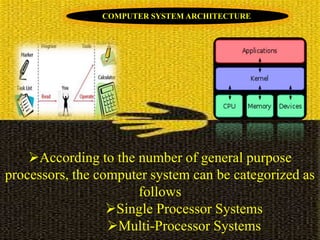
According to the number of general purpose
processors, the computer system can be categorized as
follows
Single Processor Systems
Multi-Processor Systems
COMPUTER SYSTEM ARCHITECTURE
More systems use a single processor.
If there is only one general-purpose CPU then the system is
a single processor system
Single Processor system capable of executing a general
purpose instruction set.
SINGLE PROCESSOR SYSTEMS
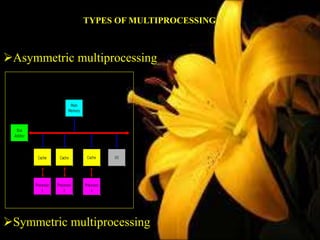
TYPES OF MULTIPROCESSING
Asymmetric multiprocessing
Symmetric multiprocessing
Multiprocessor systems have two or more processors in
close communication.
Multiprocessor systems share the computer bus, clock,
memory and peripheral devices.
Multiprocessor systems also known as parallel systems
or tightly coupled systems.
MULTIPROCESSOR SYSTEMS
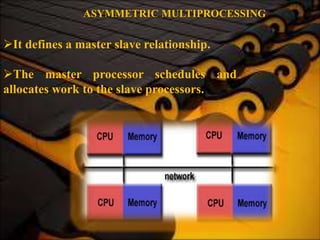
ASYMMETRIC MULTIPROCESSING
It defines a master slave relationship.
The master processor schedules and
allocates work to the slave processors.
SYMMETRIC MULTIPROCESSING
Each processor performs all tasks.
ADVANTAGES OF MULTIPROCESSING SYSTEMS
Throughput
Economics of Scale
Increased Reliability
THROUGHPUT
Number of instructions executed per
second.
Multiprocessor can also save money compared to multiple single
systems, because the processor can share peripherals storage and
power supplies.
ECONOMICS OF SCALE
If functions can be distributed properly
among several processors, then the failure
of one processor will not half the system,
only slow it down.
INCREASED RELIABILITY
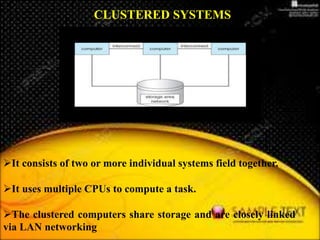
It consists of two or more individual systems field together.
It uses multiple CPUs to compute a task.
The clustered computers share storage and are closely linked
via LAN networking
CLUSTERED SYSTEMS
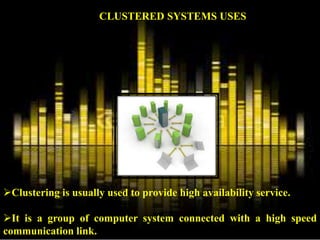
Clustering is usually used to provide high availability service.
It is a group of computer system connected with a high speed
communication link.
CLUSTERED SYSTEMS USES
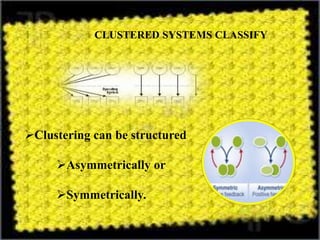
Clustering can be structured
Asymmetrically or
Symmetrically.
CLUSTERED SYSTEMS CLASSIFY
In asymmetric clustering, one
machine is in hot-standby mode
while the other is running
applications.
ASYMMETRICALLY CLUSTERING
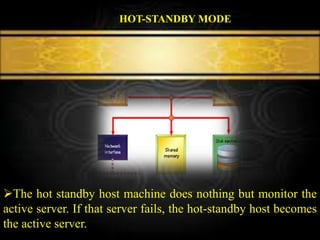
The hot standby host machine does nothing but monitor the
active server. If that server fails, the hot-standby host becomes
the active server.
HOT-STANDBY MODE
In symmetric mode, two or more hosts are running
applications and are monitoring each other.
SYMMETRIC MODE
Thank you..

Computer System Architecture-R.D.Sivakumar

  • 1.
    Video Lecture andE-Content Created by R.D.SIVAKUMAR,M.Sc.,M.Phil.,M.Tech., Assistant Professor of Computer Science & Assistant Professor and Head, Department of M.Com.(CA), Ayya Nadar Janaki Ammal College, Sivakasi – 626 124. Mobile: 099440-42243 e-mail : sivamsccsit@gmail.com website: www.rdsivakumar.blogspot.in COMPUTER SYSTEM ARCHITECTURE
  • 2.
    According to thenumber of general purpose processors, the computer system can be categorized as follows Single Processor Systems Multi-Processor Systems COMPUTER SYSTEM ARCHITECTURE
  • 3.
    More systems usea single processor. If there is only one general-purpose CPU then the system is a single processor system Single Processor system capable of executing a general purpose instruction set. SINGLE PROCESSOR SYSTEMS
  • 4.
    TYPES OF MULTIPROCESSING Asymmetricmultiprocessing Symmetric multiprocessing
  • 5.
    Multiprocessor systems havetwo or more processors in close communication. Multiprocessor systems share the computer bus, clock, memory and peripheral devices. Multiprocessor systems also known as parallel systems or tightly coupled systems. MULTIPROCESSOR SYSTEMS
  • 6.
    ASYMMETRIC MULTIPROCESSING It definesa master slave relationship. The master processor schedules and allocates work to the slave processors.
  • 7.
  • 8.
    ADVANTAGES OF MULTIPROCESSINGSYSTEMS Throughput Economics of Scale Increased Reliability
  • 9.
  • 10.
    Multiprocessor can alsosave money compared to multiple single systems, because the processor can share peripherals storage and power supplies. ECONOMICS OF SCALE
  • 11.
    If functions canbe distributed properly among several processors, then the failure of one processor will not half the system, only slow it down. INCREASED RELIABILITY
  • 12.
    It consists oftwo or more individual systems field together. It uses multiple CPUs to compute a task. The clustered computers share storage and are closely linked via LAN networking CLUSTERED SYSTEMS
  • 13.
    Clustering is usuallyused to provide high availability service. It is a group of computer system connected with a high speed communication link. CLUSTERED SYSTEMS USES
  • 14.
    Clustering can bestructured Asymmetrically or Symmetrically. CLUSTERED SYSTEMS CLASSIFY
  • 15.
    In asymmetric clustering,one machine is in hot-standby mode while the other is running applications. ASYMMETRICALLY CLUSTERING
  • 16.
    The hot standbyhost machine does nothing but monitor the active server. If that server fails, the hot-standby host becomes the active server. HOT-STANDBY MODE
  • 17.
    In symmetric mode,two or more hosts are running applications and are monitoring each other. SYMMETRIC MODE
  • 18.