RDBMS
RECOVERY
SYSTEM
BY
CM.UVASHREE
IMSC(CS)
RECOVERY SYSTEM
Failure Classification
Storage Structure
Recovery and Atomicity
Log-Based Recovery
Shadow Paging
Recovery With Concurrent Transactions
Buffer Management
Failure with Loss of Nonvolatile Storage
Advanced Recovery Techniques
Failure Classification:
 Transaction failure :
– Logical errors: transaction cannot complete due to
some internal error condition
– System errors: the database system must terminate
an active transaction due to an error condition (e.g.,
deadlock)
 System crash: a power failure or other hardware or
software failure causes the system to crash. It is
assumed that non-volatile storage contents are not
corrupted.
 Disk failure: a head crash or similar failure destroys
all or part of disk storage
Storage Structure
 Volatile storage:
– does not survive system crashes
– examples: main memory, cache memory
 Nonvolatile storage:
– survives system crashes
– examples: disk, tape
 Stable storage:
_a mythical form of storage that survives all failures
_ approximated by maintaining multiple copies on
distinct nonvolatile media
Stable-Storage Implementation
Maintain multiple copies of each block on separate disks;
copies can be at remote sites to protect against disasters such
as fire or flooding.
 Failure during data transfer can result in inconsistent copies
 Protecting storage media from failure during data transfer (one
solution):
– Execute output operation as follows (assuming two copies
of each block):
1. Write the information onto the first physical block.
2. When the first write successfully completes, write the
same information onto the second physical block.
3. The output is completed only after the second write
successfully completes.
Data access
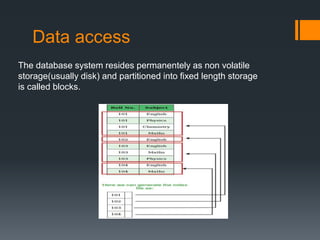
The database system resides permanentely as non volatile
storage(usually disk) and partitioned into fixed length storage
is called blocks.
Data Access
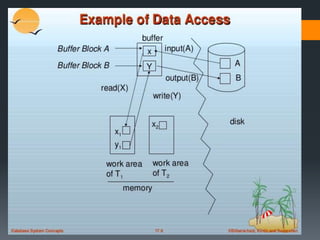
Physical blocks are those blocks residing on the disk. Buffer
blocks are the blocks residing temporarily in main memory.
Block movements between disk and main memory are initiated
through the following two operations:
– input(B) transfers the physical block B to main memory.
– output(B) transfers the buffer block B to the disk, and
replaces the appropriate physical block there.
 Each transaction Ti has its private work-area in which local
copies of all data items accessed and updated by it are kept.
Ti ’s local copy of a data item X is called xi .
We assume, for simplicity, that each data item fits in, and is
stored inside, a single block.
Transaction transfers data items between system buffer
blocks
and its private work-area using the following operations :
– read(X) assigns the value of data item X to the local
variable xi .
– write(X) assigns the value of local variable xi to data item X
in the buffer block.
– both these commands may necessitate the issue of an
input(BX ) instruction before the assignment, if the block BX
in which X resides is not already in memory.
Transactions perform read(X ) while accessing X for the first
time; all subsequent accesses are to the local copy. After last
access, transaction executes write(X ).
output(BX ) need not immediately follow write(X). System
can
perform the output operation when it deems fit.
Recovery and Atomicity
Consider transaction Ti that transfers $50 from account A to
account B; goal is either to perform all database modifications
made by Ti or none at all.
 Several output operations may be required for Ti (to output A
and B). A failure may occur after one of these modifications
have been made but before all of them are made.
 To ensure atomicity despite failures, we first output
information
describing the modifications to stable storage without
modifying the database itself.
 We study two approaches:
– log-based recovery, and
– shadow-paging
 We assume (initially) that transactions run serially, that is, one
after the other.
Log-Based Recovery
 A log is kept on stable storage. The log is a sequence of log
records, and maintains a record of update activities on the
database.
 When transaction Ti starts, it registers itself by writing a
< Ti start > log record
 Before Ti executes write(X ), a log record < Ti, X, V1, V2 > is
written, where V1 is the value of X before the write, and V2 is
the value to be written to X .
 When Ti finishes it last statement, the log record
< Ti commit > is written.
 We assume for now that log records are written directly to
stable storage (that is, they are not buffered)
Deferred Database Modification
This scheme ensures atomicity despite failures by recording all
modifications to log, but deferring all the writes to after partial
commit.
Assume that transactions execute serially
Transaction starts by writing < Ti start > record to log.
 A write(X ) operation results in a log record < Ti, X, V > being
written, where V is the new value for X . The write is not
performed on X at this time, but is deferred.
 When Ti partially commits, < Ti commit > is written to the log
Finally, log records are used to actually execute the previously
deferred writes.
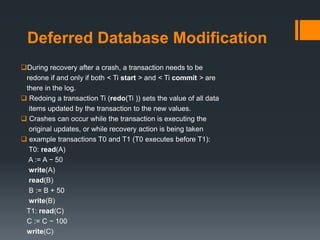
Deferred Database Modification
During recovery after a crash, a transaction needs to be
redone if and only if both < Ti start > and < Ti commit > are
there in the log.
 Redoing a transaction Ti (redo(Ti )) sets the value of all data
items updated by the transaction to the new values.
 Crashes can occur while the transaction is executing the
original updates, or while recovery action is being taken
 example transactions T0 and T1 (T0 executes before T1):
T0: read(A)
A := A − 50
write(A)
read(B)
B := B + 50
write(B)
T1: read(C)
C := C − 100
write(C)
Immediate Database Modification
This scheme allows database updates of an uncommitted
transaction to be made as the writes are issued; since undoing
may be needed, update logs must have both old value and
new value
 Update log record must be written before database item is
written
 Output of updated blocks can take place at any time before or
after transaction commit
 Order in which blocks are output can be different from the
order in which they are written.
Immediate Database
Modification
Recovery procedure has two operations instead of one :
– undo(Ti ) restores the value of all data items updated by Ti
to their old values, going backwards from the last log record
for Ti
– redo(Ti ) sets the value of all data items updated by Ti to
the new values, going forward from the first log record for Ti
 When recovering after failure:
– Transaction Ti needs to be undone if the log contains the
record < Ti start>, but does not contain the record <Ti
commit>.
– Transaction Ti needs to be redone if the log contains both
the record < Ti start> and the record <Ti commit>
Undo operations are performed first, then redo operations
Checkpoints
Problems in recovery procedure as discussed earlier :
1. searching the entire log is time-consuming
2. we might unnecessarily redo transactions which have
already output their updates to the database.
 Streamline recovery procedure by periodically performing
checkpointing
1. Output all log records currently residing in main memory
onto stable storage.
2. Output all modified buffer blocks to the disk.
3. Write a log record <checkpoint> onto stable storage.
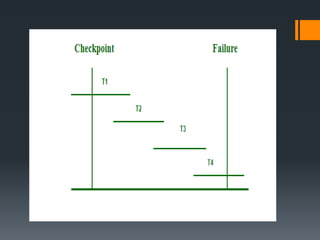
Checkpoints
During recovery we need to consider only the most recent
transaction Ti that started before the checkpoint, and
transactions that started after Ti .
 Scan backwards from end of log to find the most recent
<checkpoint> record
Continue scanning backwards till a record <Ti start> is found.
Need only consider the part of log following above start
record. Earlier part of log can be ignored during recovery, and
can be erased whenever desired.
 For all transactions (starting from Ti or later) with no
<Ti commit>, execute undo(Ti ). (Done only in case of
immediate modification.)
 Scanning forward in the log, for all transactions starting from Ti
or later with a <Ti commit>, execute redo(Ti ).
Shadow Paging
 Alternative to log-based recovery
Idea: maintain two page tables during the lifetime of a
transaction
– the current page table, and the shadow page table
 Store the shadow page table in nonvolatile storage, such that
state of the database prior to transaction execution may be
recovered. Shadow page table is never modified during
execution
 To start with, both the page tables are identical. Only current
page table is used for data item accesses during execution of
the transaction.
 Whenever any page is about to be written for the first time, a
copy of this page is made onto an unused page. The current
page table is then made to point to the copy, and the update is
performed on the copy
Shadow Paging
Advantages of shadow-paging over log-based schemes – no
overhead of writing log records; recovery is trivial
Disadvantages :
–Commit overhead is high (many pages need to be flushed)
_ Data gets fragmented (related pages get separated)
– After every transaction completion, the database pages
containing old versions of modified data need to be garbage
collected and put into the list of unused pages
– Hard to extend algorithm to allow transactions to run
concurrently
Example of shadow paging
Recovery With Concurrent
Transactions
We modify the log-based recovery schemes to allow multiple
transactions to execute concurrently.
– All transactions share a single disk buffer and a single log
– A buffer block can have data items updated by one or more
Transactions
We assume concurrency control using strict two-phase locking;
ie. the updates of uncommitted transactions should not be
visible to other transactions
Logging is done as described earlier. Log records of different
transactions may be interspersed in the log.
The checkpointing technique and actions taken on recovery
have to be changed, since several transactions may be active
when a checkpoint is performed.
Recovery With Concurrent
Transactions (Cont.)
Checkpoints are performed as before, except that the
checkpoint log record is now of the form <checkpoint L>,
where L is the list of transactions active at the time of the
checkpoint.
When the system recovers from a crash, it first does the
following:
1. Initialize undo-list and redo-list to empty
2. Scan the log backwards from the end, stopping when the
first <checkpoint L> record is found. For each record
found during the scan:
– if the record is <Ti commit>, add Ti to redo-list
– if the record is <Ti start>, then if Ti is not in redo-list,
add Ti to undo-list
3. For every Ti in L, if Ti is not in redo-list, add Ti to undo-list
 At this point undo-list consists of incomplete transactions which
must be undone, and redo-list consists of finished transactions
that must be redone.
Recovery now continues as follows:
4. Scan log backwards from most recent record, stopping
when < Ti start > records have been encountered for
every Ti in undo-list.
During the scan, perform undo for each log record that
belongs to a transaction in undo-list.
5. Locate the most recent <checkpoint L> record.
6. Scan log forwards from the <checkpoint L> record till the
end of the log.
During the scan, perform redo for each log record that
belongs to a transaction on redo-list.
recovery system

recovery system

  • 1.
  • 2.
    RECOVERY SYSTEM Failure Classification StorageStructure Recovery and Atomicity Log-Based Recovery Shadow Paging Recovery With Concurrent Transactions Buffer Management Failure with Loss of Nonvolatile Storage Advanced Recovery Techniques
  • 3.
    Failure Classification:  Transactionfailure : – Logical errors: transaction cannot complete due to some internal error condition – System errors: the database system must terminate an active transaction due to an error condition (e.g., deadlock)  System crash: a power failure or other hardware or software failure causes the system to crash. It is assumed that non-volatile storage contents are not corrupted.  Disk failure: a head crash or similar failure destroys all or part of disk storage
  • 4.
    Storage Structure  Volatilestorage: – does not survive system crashes – examples: main memory, cache memory  Nonvolatile storage: – survives system crashes – examples: disk, tape  Stable storage: _a mythical form of storage that survives all failures _ approximated by maintaining multiple copies on distinct nonvolatile media
  • 5.
    Stable-Storage Implementation Maintain multiplecopies of each block on separate disks; copies can be at remote sites to protect against disasters such as fire or flooding.  Failure during data transfer can result in inconsistent copies  Protecting storage media from failure during data transfer (one solution): – Execute output operation as follows (assuming two copies of each block): 1. Write the information onto the first physical block. 2. When the first write successfully completes, write the same information onto the second physical block. 3. The output is completed only after the second write successfully completes.
  • 7.
    Data access The databasesystem resides permanentely as non volatile storage(usually disk) and partitioned into fixed length storage is called blocks.
  • 8.
    Data Access Physical blocksare those blocks residing on the disk. Buffer blocks are the blocks residing temporarily in main memory. Block movements between disk and main memory are initiated through the following two operations: – input(B) transfers the physical block B to main memory. – output(B) transfers the buffer block B to the disk, and replaces the appropriate physical block there.  Each transaction Ti has its private work-area in which local copies of all data items accessed and updated by it are kept. Ti ’s local copy of a data item X is called xi . We assume, for simplicity, that each data item fits in, and is stored inside, a single block.
  • 10.
    Transaction transfers dataitems between system buffer blocks and its private work-area using the following operations : – read(X) assigns the value of data item X to the local variable xi . – write(X) assigns the value of local variable xi to data item X in the buffer block. – both these commands may necessitate the issue of an input(BX ) instruction before the assignment, if the block BX in which X resides is not already in memory. Transactions perform read(X ) while accessing X for the first time; all subsequent accesses are to the local copy. After last access, transaction executes write(X ). output(BX ) need not immediately follow write(X). System can perform the output operation when it deems fit.
  • 11.
    Recovery and Atomicity Considertransaction Ti that transfers $50 from account A to account B; goal is either to perform all database modifications made by Ti or none at all.  Several output operations may be required for Ti (to output A and B). A failure may occur after one of these modifications have been made but before all of them are made.  To ensure atomicity despite failures, we first output information describing the modifications to stable storage without modifying the database itself.  We study two approaches: – log-based recovery, and – shadow-paging  We assume (initially) that transactions run serially, that is, one after the other.
  • 12.
    Log-Based Recovery  Alog is kept on stable storage. The log is a sequence of log records, and maintains a record of update activities on the database.  When transaction Ti starts, it registers itself by writing a < Ti start > log record  Before Ti executes write(X ), a log record < Ti, X, V1, V2 > is written, where V1 is the value of X before the write, and V2 is the value to be written to X .  When Ti finishes it last statement, the log record < Ti commit > is written.  We assume for now that log records are written directly to stable storage (that is, they are not buffered)
  • 13.
    Deferred Database Modification Thisscheme ensures atomicity despite failures by recording all modifications to log, but deferring all the writes to after partial commit. Assume that transactions execute serially Transaction starts by writing < Ti start > record to log.  A write(X ) operation results in a log record < Ti, X, V > being written, where V is the new value for X . The write is not performed on X at this time, but is deferred.  When Ti partially commits, < Ti commit > is written to the log Finally, log records are used to actually execute the previously deferred writes.
  • 14.
    Deferred Database Modification Duringrecovery after a crash, a transaction needs to be redone if and only if both < Ti start > and < Ti commit > are there in the log.  Redoing a transaction Ti (redo(Ti )) sets the value of all data items updated by the transaction to the new values.  Crashes can occur while the transaction is executing the original updates, or while recovery action is being taken  example transactions T0 and T1 (T0 executes before T1): T0: read(A) A := A − 50 write(A) read(B) B := B + 50 write(B) T1: read(C) C := C − 100 write(C)
  • 15.
    Immediate Database Modification Thisscheme allows database updates of an uncommitted transaction to be made as the writes are issued; since undoing may be needed, update logs must have both old value and new value  Update log record must be written before database item is written  Output of updated blocks can take place at any time before or after transaction commit  Order in which blocks are output can be different from the order in which they are written.
  • 16.
    Immediate Database Modification Recovery procedurehas two operations instead of one : – undo(Ti ) restores the value of all data items updated by Ti to their old values, going backwards from the last log record for Ti – redo(Ti ) sets the value of all data items updated by Ti to the new values, going forward from the first log record for Ti  When recovering after failure: – Transaction Ti needs to be undone if the log contains the record < Ti start>, but does not contain the record <Ti commit>. – Transaction Ti needs to be redone if the log contains both the record < Ti start> and the record <Ti commit> Undo operations are performed first, then redo operations
  • 17.
    Checkpoints Problems in recoveryprocedure as discussed earlier : 1. searching the entire log is time-consuming 2. we might unnecessarily redo transactions which have already output their updates to the database.  Streamline recovery procedure by periodically performing checkpointing 1. Output all log records currently residing in main memory onto stable storage. 2. Output all modified buffer blocks to the disk. 3. Write a log record <checkpoint> onto stable storage.
  • 18.
    Checkpoints During recovery weneed to consider only the most recent transaction Ti that started before the checkpoint, and transactions that started after Ti .  Scan backwards from end of log to find the most recent <checkpoint> record Continue scanning backwards till a record <Ti start> is found. Need only consider the part of log following above start record. Earlier part of log can be ignored during recovery, and can be erased whenever desired.  For all transactions (starting from Ti or later) with no <Ti commit>, execute undo(Ti ). (Done only in case of immediate modification.)  Scanning forward in the log, for all transactions starting from Ti or later with a <Ti commit>, execute redo(Ti ).
  • 20.
    Shadow Paging  Alternativeto log-based recovery Idea: maintain two page tables during the lifetime of a transaction – the current page table, and the shadow page table  Store the shadow page table in nonvolatile storage, such that state of the database prior to transaction execution may be recovered. Shadow page table is never modified during execution  To start with, both the page tables are identical. Only current page table is used for data item accesses during execution of the transaction.  Whenever any page is about to be written for the first time, a copy of this page is made onto an unused page. The current page table is then made to point to the copy, and the update is performed on the copy
  • 21.
    Shadow Paging Advantages ofshadow-paging over log-based schemes – no overhead of writing log records; recovery is trivial Disadvantages : –Commit overhead is high (many pages need to be flushed) _ Data gets fragmented (related pages get separated) – After every transaction completion, the database pages containing old versions of modified data need to be garbage collected and put into the list of unused pages – Hard to extend algorithm to allow transactions to run concurrently
  • 22.
  • 23.
    Recovery With Concurrent Transactions Wemodify the log-based recovery schemes to allow multiple transactions to execute concurrently. – All transactions share a single disk buffer and a single log – A buffer block can have data items updated by one or more Transactions We assume concurrency control using strict two-phase locking; ie. the updates of uncommitted transactions should not be visible to other transactions Logging is done as described earlier. Log records of different transactions may be interspersed in the log. The checkpointing technique and actions taken on recovery have to be changed, since several transactions may be active when a checkpoint is performed.
  • 24.
    Recovery With Concurrent Transactions(Cont.) Checkpoints are performed as before, except that the checkpoint log record is now of the form <checkpoint L>, where L is the list of transactions active at the time of the checkpoint. When the system recovers from a crash, it first does the following: 1. Initialize undo-list and redo-list to empty 2. Scan the log backwards from the end, stopping when the first <checkpoint L> record is found. For each record found during the scan: – if the record is <Ti commit>, add Ti to redo-list – if the record is <Ti start>, then if Ti is not in redo-list, add Ti to undo-list 3. For every Ti in L, if Ti is not in redo-list, add Ti to undo-list
  • 25.
     At thispoint undo-list consists of incomplete transactions which must be undone, and redo-list consists of finished transactions that must be redone. Recovery now continues as follows: 4. Scan log backwards from most recent record, stopping when < Ti start > records have been encountered for every Ti in undo-list. During the scan, perform undo for each log record that belongs to a transaction in undo-list. 5. Locate the most recent <checkpoint L> record. 6. Scan log forwards from the <checkpoint L> record till the end of the log. During the scan, perform redo for each log record that belongs to a transaction on redo-list.