





Understanding Isolation Levels
By Hieu Nguyen
Which isolation
level our database
currently is?
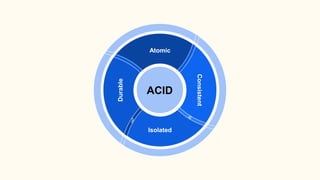
ACID
Vestibulum congue
ACID
Durable
Isolated
Consistent
Atomic
Vestibulum congue
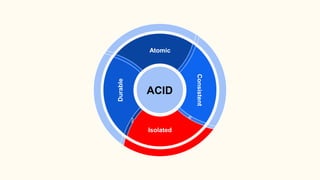
ACID
Durable
Isolated
Consistent
Atomic
Isolation ● A transaction is invisible to other
transactions before it is
completed
Isolation
● A transaction is invisible to other
transactions before it is
completed
● The statement above is usually
true
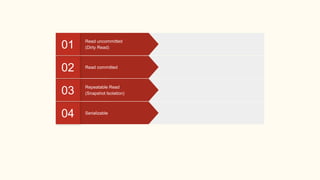
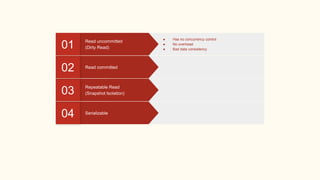
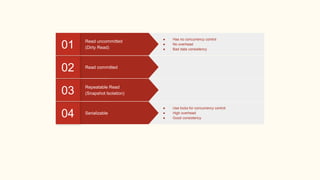
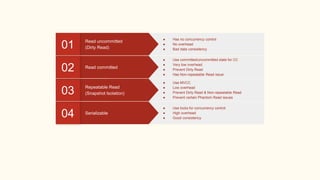
Isolation Levels
Serializable
04
Repeatable Read
(Snapshot Isolation)03
Read committed
02
Read uncommitted
(Dirty Read)01
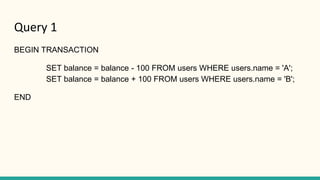
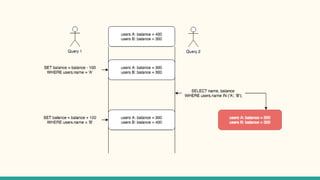
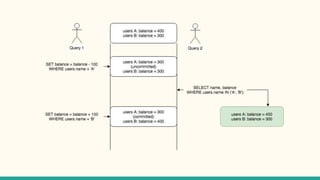
Query 1
BEGIN TRANSACTION
SET balance = balance - 100 FROM users WHERE users.name = 'A';
SET balance = balance + 100 FROM users WHERE users.name = 'B';
END
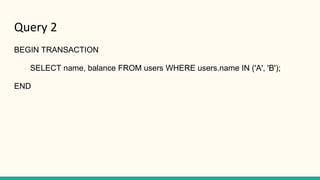
Query 2
BEGIN TRANSACTION
SELECT name, balance FROM users WHERE users.name IN ('A', 'B');
END
Serializable
04
Repeatable Read
(Snapshot Isolation)03
Read committed
02
Read uncommitted
(Dirty Read)01
● Has no concurrency control
● No overhead
● Bad data consistency
Serializable
04
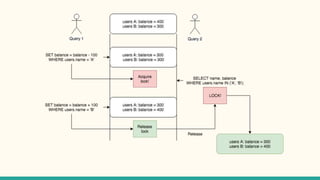
● Use locks for concurrency control
● High overhead
● Good consistency
Repeatable Read
(Snapshot Isolation)03
Read committed
02
Read uncommitted
(Dirty Read)01
● Has no concurrency control
● No overhead
● Bad data consistency
Serializable
04
● Use locks for concurrency control
● High overhead
● Good consistency
Repeatable Read
(Snapshot Isolation)03
Read committed
02
Read uncommitted
(Dirty Read)01
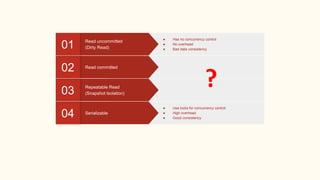
● Has no concurrency control
● No overhead
● Bad data consistency
?
Serializable
04
● Use locks for concurrency control
● High overhead
● Good consistency
Repeatable Read
(Snapshot Isolation)03
Read committed
02
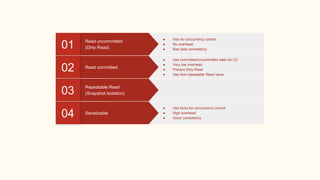
● Use committed/uncommitted state for CC
● Very low overhead
● Prevent Dirty Read
● Has Non-repeatable Read issue
Read uncommitted
(Dirty Read)01
● Has no concurrency control
● No overhead
● Bad data consistency
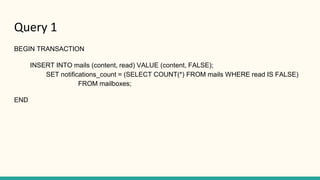
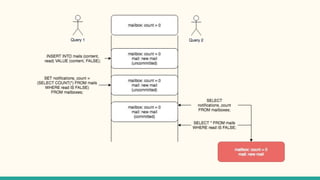
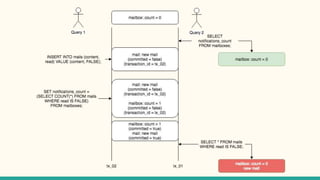
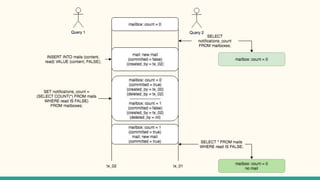
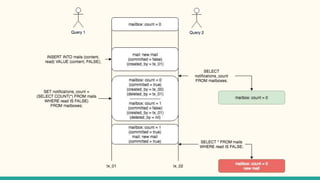
Query 1
BEGIN TRANSACTION
INSERT INTO mails (content, read) VALUE (content, FALSE);
SET notifications_count = (SELECT COUNT(*) FROM mails WHERE read IS FALSE)
FROM mailboxes;
END
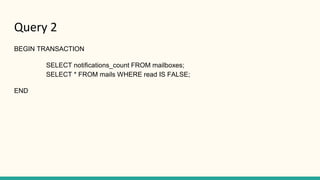
Query 2
BEGIN TRANSACTION
SELECT notifications_count FROM mailboxes;
SELECT * FROM mails WHERE read IS FALSE;
END
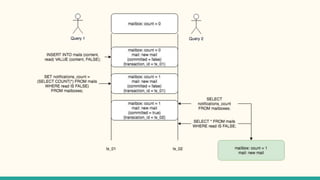
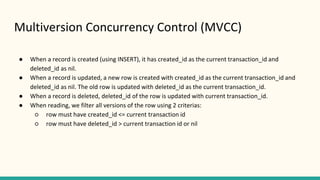
Multiversion Concurrency Control (MVCC)
● When a record is created (using INSERT), it has created_id as the current transaction_id and
deleted_id as nil.
● When a record is updated, a new row is created with created_id as the current transaction_id and
deleted_id as nil. The old row is updated with deleted_id as the current transaction_id.
● When a record is deleted, deleted_id of the row is updated with current transaction_id.
● When reading, we filter all versions of the row using 2 criterias:
○ row must have created_id <= current transaction id
○ row must have deleted_id > current transaction id or nil
Serializable
04
● Use locks for concurrency control
● High overhead
● Good consistency
Repeatable Read
(Snapshot Isolation)03
● Use MVCC
● Low overhead
● Prevent Dirty Read & Non-repeatable Read
● Prevent certain Phantom Read issues
Read committed
02
● Use committed/uncommitted state for CC
● Very low overhead
● Prevent Dirty Read
● Has Non-repeatable Read issue
Read uncommitted
(Dirty Read)01
● Has no concurrency control
● No overhead
● Bad data consistency
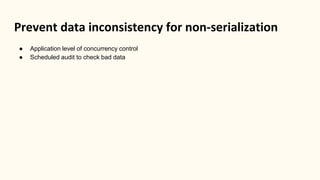
Prevent data inconsistency for non-serialization
● Application level of concurrency control
● Scheduled audit to check bad data
Usage
Read
uncommitted
● Not recommend
● Should only be used in very
special cases
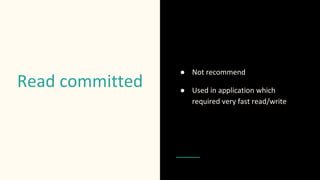
Read committed
● Not recommend
● Used in application which
required very fast read/write
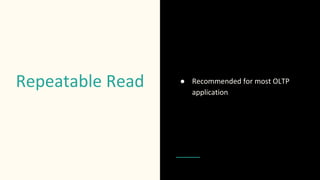
Repeatable Read ● Recommended for most OLTP
application
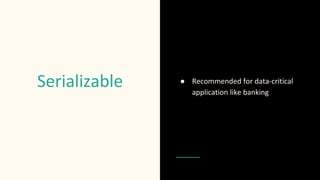
Serializable ● Recommended for data-critical
application like banking
Conclusion
Conclusion
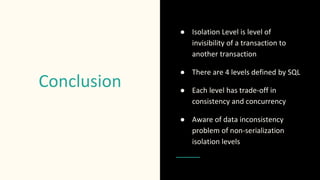
● Isolation Level is level of
invisibility of a transaction to
another transaction
● There are 4 levels defined by SQL
● Each level has trade-off in
consistency and concurrency
● Aware of data inconsistency
problem of non-serialization
isolation levels
Thank you for listening!

Understanding isolation levels

Editor's Notes

  • #13 Dirty Read: poloniex issue with mongoDB
  • #15 Use locks for concurrency control Acquire locks when write/or read Only released after the transaction finishes
  • #18 Add a committed field to every record
  • #22 Non-repeatable Read
  • #24 Non-repeatable Read
  • #27 Phantom read
  • #31 This is the default level of MongoDB. Oracle does not supports this level. Example: external logging system
  • #32 This is the default setting in PostgreSQL, SQL Server and Oracle Example: Chat application
  • #33 Default level of MySQL InnoDB Example: e-commerce, CRUD app
  • #34 MySQL, SQL Server and Oracle supports this level. PostgreSQL only has this level from version 9.5. MongoDB does not support this level (supports serializable only in single document).