Opportunities and Challenges of
Working together in Resilience
10 February 2015
Analysis of the key opportunities and
challenges of working together to
strengthen resilience and stability in
complex protracted crisis such as the
Syrian crisis
Objective of presentation
Overview and impact of Syria crisis
 Syria crisis now in its fifth year with no prospect for a
political solution in sight;
 The crisis defies conventional conflict resolution
approaches, and challenges aid responses and
coordination mechanisms;
 Impact on host countries has been unprecedented with
repercussions on stability of the whole region;
 The crisis is now a regional and global security problem
with a refugee dimension.
The case of Jordan
Part I
 Jordan is the smallest economy in the Middle East
with insufficient supplies of water, oil and other natural
resources;
 Jordan currently hosts close to 620,000 Syrian
refugees, 84% of whom reside in host communities;
 The humanitarian impact of the Syria crisis is now also
significantly felt as a development impact in Jordan;
The case of Jordan
Part II
 Responding to the crisis through exclusively a
humanitarian approach is no longer adequate;
 Assistance to refugees and hosting communities
need to be equally prioritized to enhance
cohesion.
What is Resilience Based Approach?
 A set of principles and a conceptual framework for
building resilience against shocks and stresses that
supports sustainable human development;
 Defined as the ability of individuals, households,
communities and societies to cope with the adverse
impacts of shocks and stresses, to recover from them
and bring about transformational change that supports
sustainable human development;
 Represents a strategic shift in response to the Syria
crisis and builds on existing national crisis response
plans.
Opportunities of Resilience Based
Approach (Part I)
 Does not replace humanitarian assistance gradually
reduces needs of beneficiaries for longer-term
emergency assistance and helps people to develop
a sustainable livelihood;
 Promotes national leadership and ownership in
bridging humanitarian, resilience and development;
 Contributes to build strong and innovative
partnerships among stakeholders– host countries,
donors and aid organizations;
Opportunities of Resilience Based
Approach (Part II)
 Enables host Governments and international partners to
adapt assistance to the specific context and ensures that
planning is informed by short and longer-term perspectives;
 It helps to identify activities and sectors in humanitarian
assistance that can be responsibly transitioned to increase
delivery through national institutions with appropriate
international support;
 It enhances coordination among aid organizations and
linkages between sectors of work to minimize duplication of
efforts and incorporate medium and long-term vision in
projects.
Why adopt the resilience based
approach?
 It will optimize existing resources by investing in more
durable solutions and avoiding parallel mechanisms;
 It will strengthen infrastructures and national
capacities that are more sustainable over the long
term;
 It will strengthen the capacity of individuals, host
communities, and states to cope with and recover
from possible future shocks;
 It will reduce the cost of the international response in
the medium term.
Key elements of the Regional Refugee and
Resilience Plan (3RP)
Part I
 The 3RP is an inclusive model to deliver effective,
comprehensive and coordinated responses to strengthen
social cohesion and build the resilience of people,
communities and national systems;
 A global first for the UN in terms of crisis response;
 A country driven process with regional coherence, one
plan, five country chapters;
Key elements of the Regional Refugee and
Resilience Plan (3RP)
Part II
 A broad regional partnership strategy (close to 200
partners);
 Platform for advocacy, fundraising, information
management and monitoring;
 A regional evidence based knowledge platform to support
implementation of national plans through assessments,
research support, and other services to fill critical
knowledge gaps.
Two interconnected components
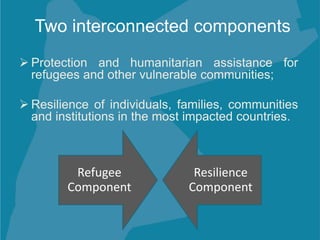
 Protection and humanitarian assistance for
refugees and other vulnerable communities;
 Resilience of individuals, families, communities
and institutions in the most impacted countries.
Refugee
Component
Resilience
Component
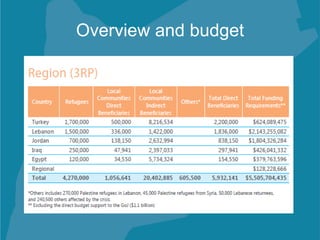
Overview and budget
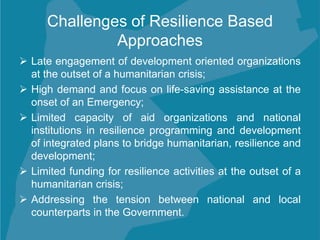
Challenges of Resilience Based
Approaches
 Late engagement of development oriented organizations
at the outset of a humanitarian crisis;
 High demand and focus on life-saving assistance at the
onset of an Emergency;
 Limited capacity of aid organizations and national
institutions in resilience programming and development
of integrated plans to bridge humanitarian, resilience and
development;
 Limited funding for resilience activities at the outset of a
humanitarian crisis;
 Addressing the tension between national and local
counterparts in the Government.
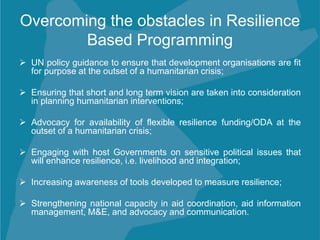
Overcoming the obstacles in Resilience
Based Programming
 UN policy guidance to ensure that development organisations are fit
for purpose at the outset of a humanitarian crisis;
 Ensuring that short and long term vision are taken into consideration
in planning humanitarian interventions;
 Advocacy for availability of flexible resilience funding/ODA at the
outset of a humanitarian crisis;
 Engaging with host Governments on sensitive political issues that
will enhance resilience, i.e. livelihood and integration;
 Increasing awareness of tools developed to measure resilience;
 Strengthening national capacity in aid coordination, aid information
management, M&E, and advocacy and communication.
Thank you

Rchc jordan presentation_fao_cairo_resiliencebasedapproach_final

  • 1.
    Opportunities and Challengesof Working together in Resilience 10 February 2015
  • 2.
    Analysis of thekey opportunities and challenges of working together to strengthen resilience and stability in complex protracted crisis such as the Syrian crisis Objective of presentation
  • 3.
    Overview and impactof Syria crisis  Syria crisis now in its fifth year with no prospect for a political solution in sight;  The crisis defies conventional conflict resolution approaches, and challenges aid responses and coordination mechanisms;  Impact on host countries has been unprecedented with repercussions on stability of the whole region;  The crisis is now a regional and global security problem with a refugee dimension.
  • 4.
    The case ofJordan Part I  Jordan is the smallest economy in the Middle East with insufficient supplies of water, oil and other natural resources;  Jordan currently hosts close to 620,000 Syrian refugees, 84% of whom reside in host communities;  The humanitarian impact of the Syria crisis is now also significantly felt as a development impact in Jordan;
  • 5.
    The case ofJordan Part II  Responding to the crisis through exclusively a humanitarian approach is no longer adequate;  Assistance to refugees and hosting communities need to be equally prioritized to enhance cohesion.
  • 6.
    What is ResilienceBased Approach?  A set of principles and a conceptual framework for building resilience against shocks and stresses that supports sustainable human development;  Defined as the ability of individuals, households, communities and societies to cope with the adverse impacts of shocks and stresses, to recover from them and bring about transformational change that supports sustainable human development;  Represents a strategic shift in response to the Syria crisis and builds on existing national crisis response plans.
  • 7.
    Opportunities of ResilienceBased Approach (Part I)  Does not replace humanitarian assistance gradually reduces needs of beneficiaries for longer-term emergency assistance and helps people to develop a sustainable livelihood;  Promotes national leadership and ownership in bridging humanitarian, resilience and development;  Contributes to build strong and innovative partnerships among stakeholders– host countries, donors and aid organizations;
  • 8.
    Opportunities of ResilienceBased Approach (Part II)  Enables host Governments and international partners to adapt assistance to the specific context and ensures that planning is informed by short and longer-term perspectives;  It helps to identify activities and sectors in humanitarian assistance that can be responsibly transitioned to increase delivery through national institutions with appropriate international support;  It enhances coordination among aid organizations and linkages between sectors of work to minimize duplication of efforts and incorporate medium and long-term vision in projects.
  • 9.
    Why adopt theresilience based approach?  It will optimize existing resources by investing in more durable solutions and avoiding parallel mechanisms;  It will strengthen infrastructures and national capacities that are more sustainable over the long term;  It will strengthen the capacity of individuals, host communities, and states to cope with and recover from possible future shocks;  It will reduce the cost of the international response in the medium term.
  • 10.
    Key elements ofthe Regional Refugee and Resilience Plan (3RP) Part I  The 3RP is an inclusive model to deliver effective, comprehensive and coordinated responses to strengthen social cohesion and build the resilience of people, communities and national systems;  A global first for the UN in terms of crisis response;  A country driven process with regional coherence, one plan, five country chapters;
  • 11.
    Key elements ofthe Regional Refugee and Resilience Plan (3RP) Part II  A broad regional partnership strategy (close to 200 partners);  Platform for advocacy, fundraising, information management and monitoring;  A regional evidence based knowledge platform to support implementation of national plans through assessments, research support, and other services to fill critical knowledge gaps.
  • 12.
    Two interconnected components Protection and humanitarian assistance for refugees and other vulnerable communities;  Resilience of individuals, families, communities and institutions in the most impacted countries. Refugee Component Resilience Component
  • 13.
  • 14.
    Challenges of ResilienceBased Approaches  Late engagement of development oriented organizations at the outset of a humanitarian crisis;  High demand and focus on life-saving assistance at the onset of an Emergency;  Limited capacity of aid organizations and national institutions in resilience programming and development of integrated plans to bridge humanitarian, resilience and development;  Limited funding for resilience activities at the outset of a humanitarian crisis;  Addressing the tension between national and local counterparts in the Government.
  • 15.
    Overcoming the obstaclesin Resilience Based Programming  UN policy guidance to ensure that development organisations are fit for purpose at the outset of a humanitarian crisis;  Ensuring that short and long term vision are taken into consideration in planning humanitarian interventions;  Advocacy for availability of flexible resilience funding/ODA at the outset of a humanitarian crisis;  Engaging with host Governments on sensitive political issues that will enhance resilience, i.e. livelihood and integration;  Increasing awareness of tools developed to measure resilience;  Strengthening national capacity in aid coordination, aid information management, M&E, and advocacy and communication.
  • 16.