Disaster Risk Reduction
The Sendai Framework
Disaster risk reduction aims to reduce socio-economic
vulnerabilities to disaster and well as dealing with the
environmental and other hazards that trigger them.
Less than one per cent of total relief aid goes to disaster risk
reduction, despite estimates that every dollar spent on
preparedness saves seven dollars in response.
The Third UN World Conference on Disaster Risk Reduction
was held in Sendai, Japan from 14 to 18 March 2015.
At the time, the 10-year-old Hyogo Framework came to an
end and was replaced by the Sendai Framework (2015-2030).
The Sendai Framework is a 15-year non-binding agreement
which recognises that the State has the primary role to
reduce disaster risk but that responsibility should be shared
with other stakeholders including local government and the
private sector.
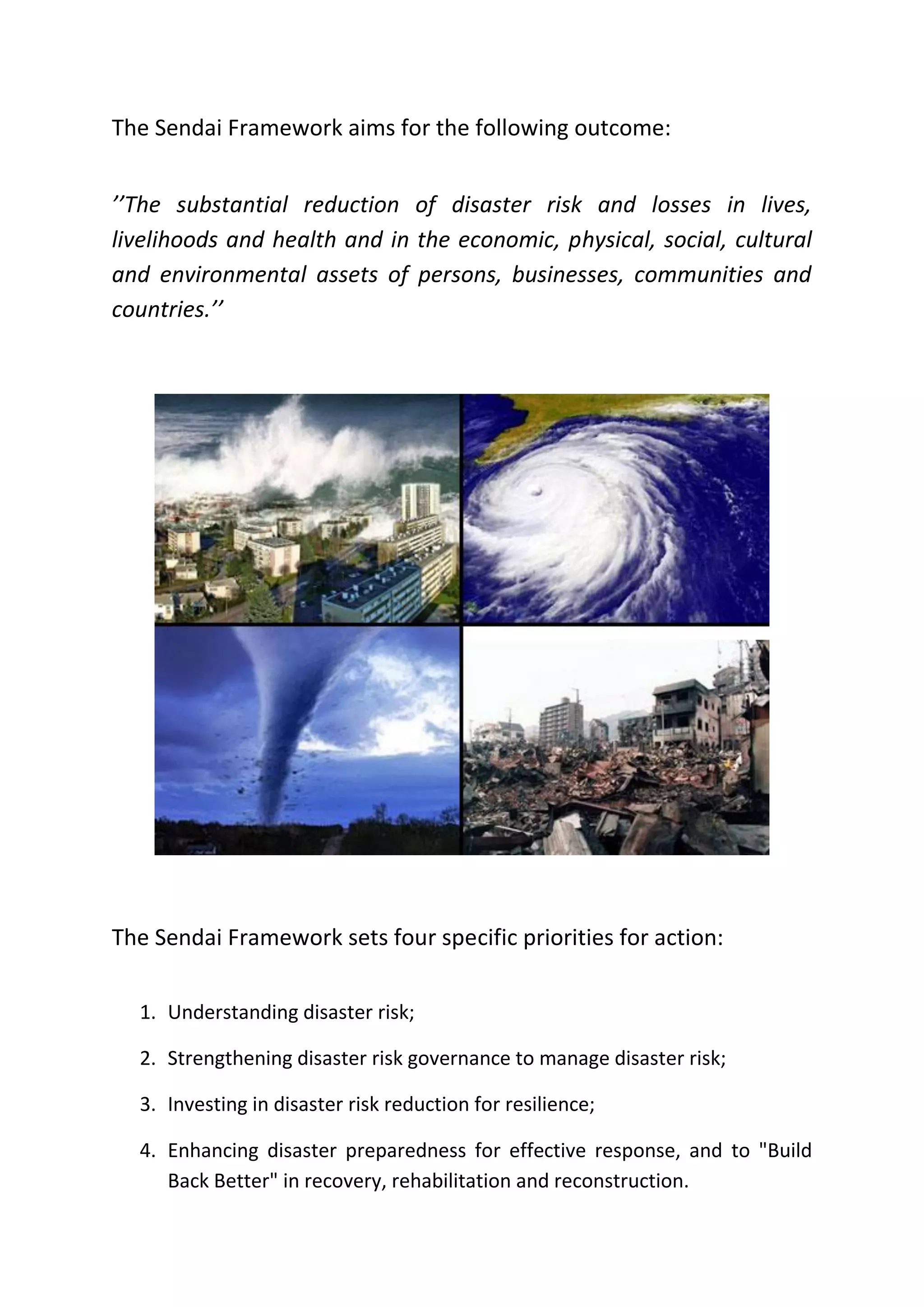
The Sendai Framework aims for the following outcome:
’’The substantial reduction of disaster risk and losses in lives,
livelihoods and health and in the economic, physical, social, cultural
and environmental assets of persons, businesses, communities and
countries.’’
The Sendai Framework sets four specific priorities for action:
1. Understanding disaster risk;
2. Strengthening disaster risk governance to manage disaster risk;
3. Investing in disaster risk reduction for resilience;
4. Enhancing disaster preparedness for effective response, and to "Build
Back Better" in recovery, rehabilitation and reconstruction.
The Sendai Framework seven global targets:
1. Substantially reduce global disaster mortality by 2030;
2. Substantially reduce the number of affected people globally by 2030;
3. Reduce direct disaster economic loss in relation to global gross domestic
product by 2030;
4. Substantially reduce disaster damage to critical infrastructure and
disruption of basic services, among them health and educational facilities,
including through developing their resilience by 2030;
5. Substantially increase the number of countries with national and local
disaster risk reduction strategies by 2020;
6. Substantially enhance international cooperation to developing countries
through adequate and sustainable support to complement their national
actions for implementation of the framework by 2030;
7. Substantially increase the availability of and access to multi-hazard early
warning systems and disaster risk information and assessments to the
people by 2030.
Read more about disaster risk reduction here.

Disaster Risk Reduction: The Sendai Framework

  • 1.
    Disaster Risk Reduction TheSendai Framework Disaster risk reduction aims to reduce socio-economic vulnerabilities to disaster and well as dealing with the environmental and other hazards that trigger them. Less than one per cent of total relief aid goes to disaster risk reduction, despite estimates that every dollar spent on preparedness saves seven dollars in response.
  • 2.
    The Third UNWorld Conference on Disaster Risk Reduction was held in Sendai, Japan from 14 to 18 March 2015. At the time, the 10-year-old Hyogo Framework came to an end and was replaced by the Sendai Framework (2015-2030). The Sendai Framework is a 15-year non-binding agreement which recognises that the State has the primary role to reduce disaster risk but that responsibility should be shared with other stakeholders including local government and the private sector.
  • 3.
    The Sendai Frameworkaims for the following outcome: ’’The substantial reduction of disaster risk and losses in lives, livelihoods and health and in the economic, physical, social, cultural and environmental assets of persons, businesses, communities and countries.’’ The Sendai Framework sets four specific priorities for action: 1. Understanding disaster risk; 2. Strengthening disaster risk governance to manage disaster risk; 3. Investing in disaster risk reduction for resilience; 4. Enhancing disaster preparedness for effective response, and to "Build Back Better" in recovery, rehabilitation and reconstruction.
  • 4.
    The Sendai Frameworkseven global targets: 1. Substantially reduce global disaster mortality by 2030; 2. Substantially reduce the number of affected people globally by 2030; 3. Reduce direct disaster economic loss in relation to global gross domestic product by 2030; 4. Substantially reduce disaster damage to critical infrastructure and disruption of basic services, among them health and educational facilities, including through developing their resilience by 2030; 5. Substantially increase the number of countries with national and local disaster risk reduction strategies by 2020; 6. Substantially enhance international cooperation to developing countries through adequate and sustainable support to complement their national actions for implementation of the framework by 2030; 7. Substantially increase the availability of and access to multi-hazard early warning systems and disaster risk information and assessments to the people by 2030. Read more about disaster risk reduction here.