Introducing DBI -The Objectives
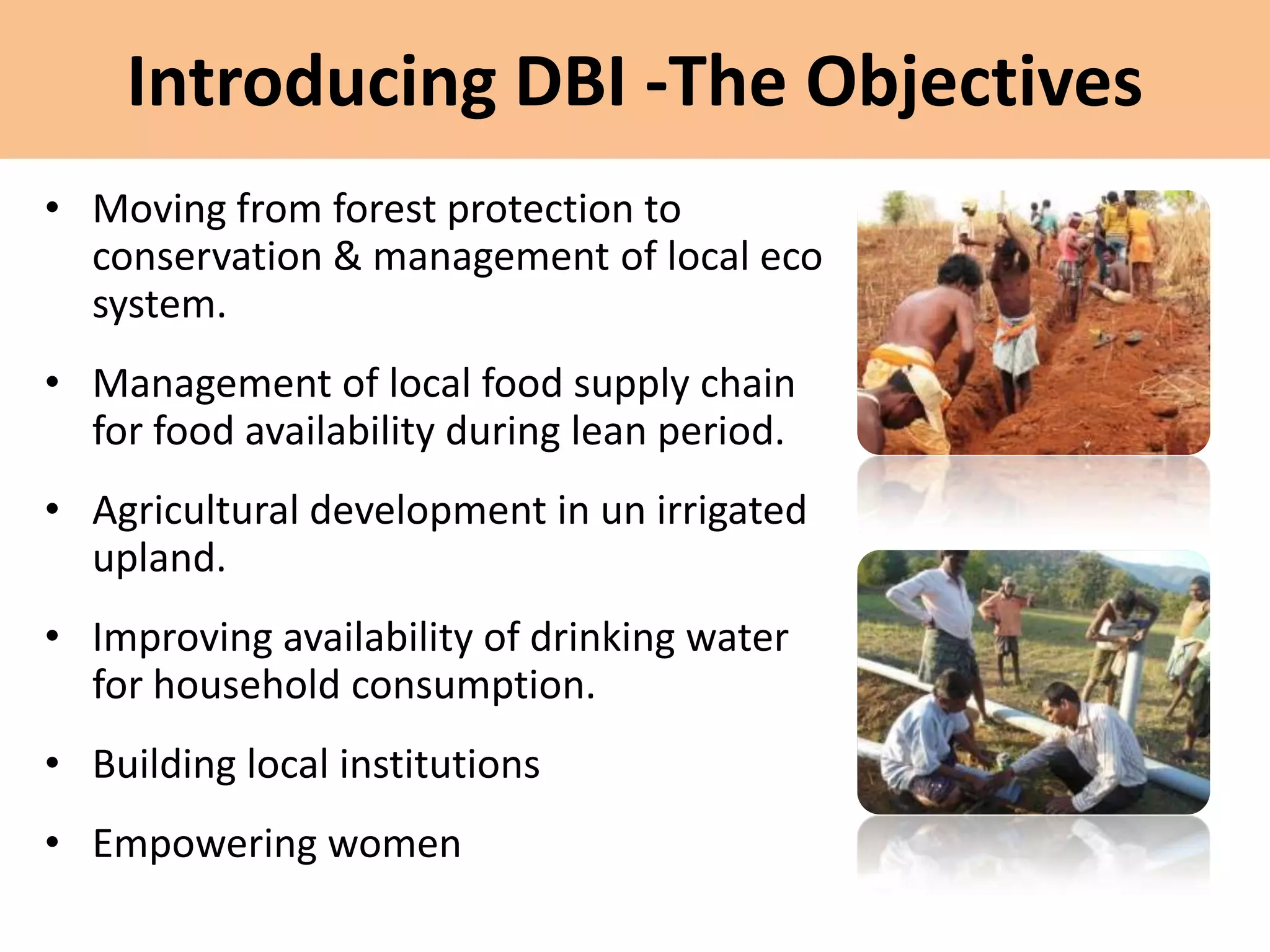
• Moving from forest protection to
conservation & management of local eco
system.
• Management of local food supply chain
for food availability during lean period.
• Agricultural development in un irrigated
upland.
• Improving availability of drinking water
for household consumption.
• Building local institutions
• Empowering women
Intervention
• RCDC intervened with DBI in two phases in 8 tribal habitations
and eco sensible hotspots.
• 1st Phase started as new experience in the year 2012.
• 1st phase intervention focused only on DBI.
• The 1st intervention produced good result with notable
community contribution in 4 villages of 2 districts.
• The 2nd phase was implemented in 4 villages from 2014 and
continuing .
• 2nd phase includes both DBI and Hydraulic Ram Pump.
1st Phase Implementation
 Gandhamardan Hill Area
 75% tribal communities
 Total command area:
303 Acre
 Total beneficiaries: 180
HH
 Total sanctioned
budget:1892000/-
 Community
contribution: 24000/-
 Cost per Acre: 6244/-
PROJECT OBJECTIVES:
• To provide assured source of irrigation to the un-
irrigated uplands of poor and marginalized farmers.
• To provide irrigation to Kharif crops and irrigation to
Rabi and Summer crops.
• To enhance and strengthen livelihood portfolios of the
local communities through supporting improvement in
farm lands, in-situ moisture conservation and better
agricultural practices.
• Empowering the farmers, especially the tribals to
enhance their food security, to increase their income
and help in the overall improvement of their livelihood
issues
• People adopting sustainable practices for development
of agriculture and allied services
• Strengthen Institutional capacity of PRI and Government
agencies.
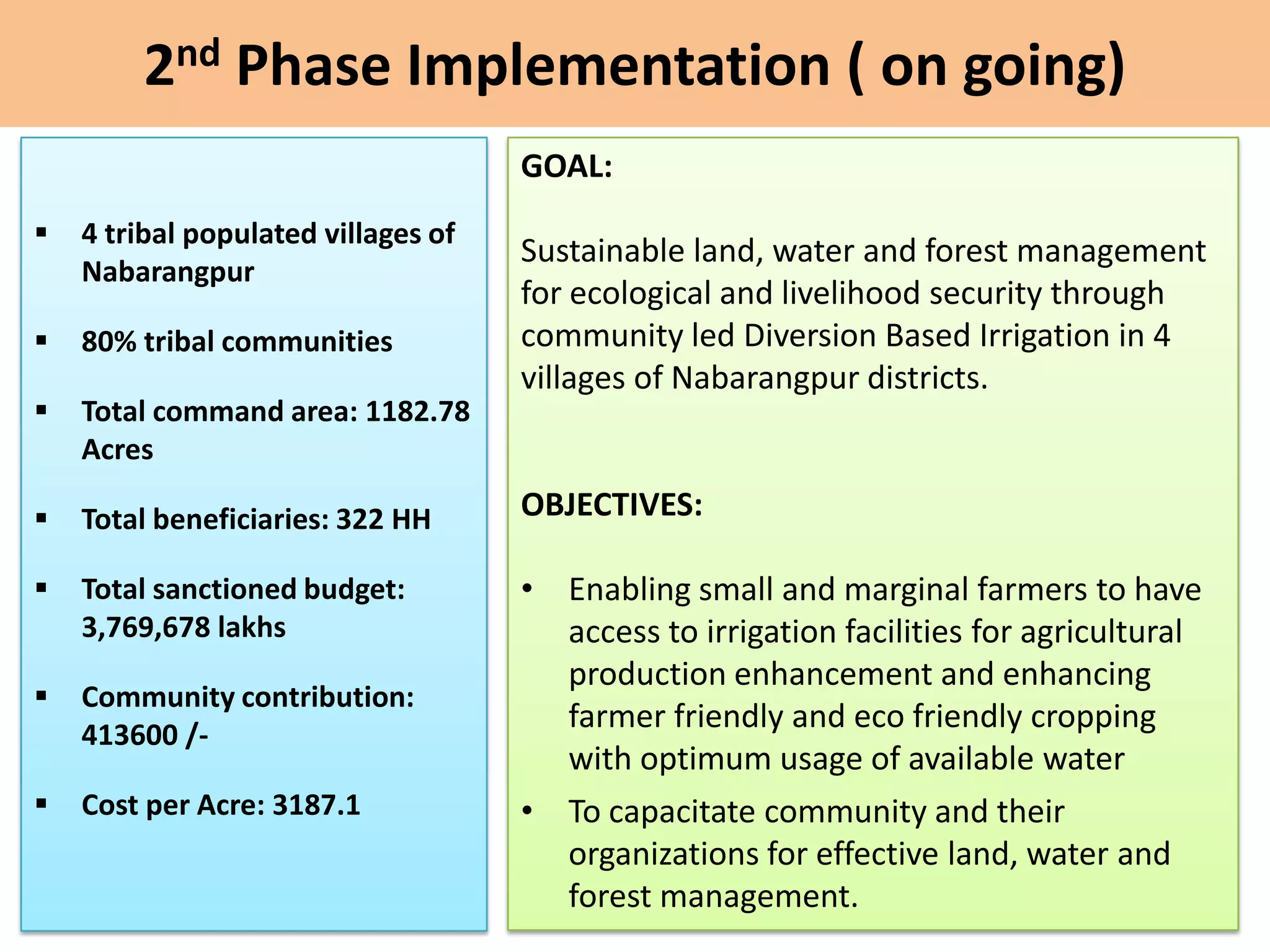
2nd Phase Implementation ( on going)
 4 tribal populated villages of
Nabarangpur
 80% tribal communities
 Total command area: 1182.78
Acres
 Total beneficiaries: 322 HH
 Total sanctioned budget:
3,769,678 lakhs
 Community contribution:
413600 /-
 Cost per Acre: 3187.1
GOAL:
Sustainable land, water and forest management
for ecological and livelihood security through
community led Diversion Based Irrigation in 4
villages of Nabarangpur districts.
OBJECTIVES:
• Enabling small and marginal farmers to have
access to irrigation facilities for agricultural
production enhancement and enhancing
farmer friendly and eco friendly cropping
with optimum usage of available water
• To capacitate community and their
organizations for effective land, water and
forest management.
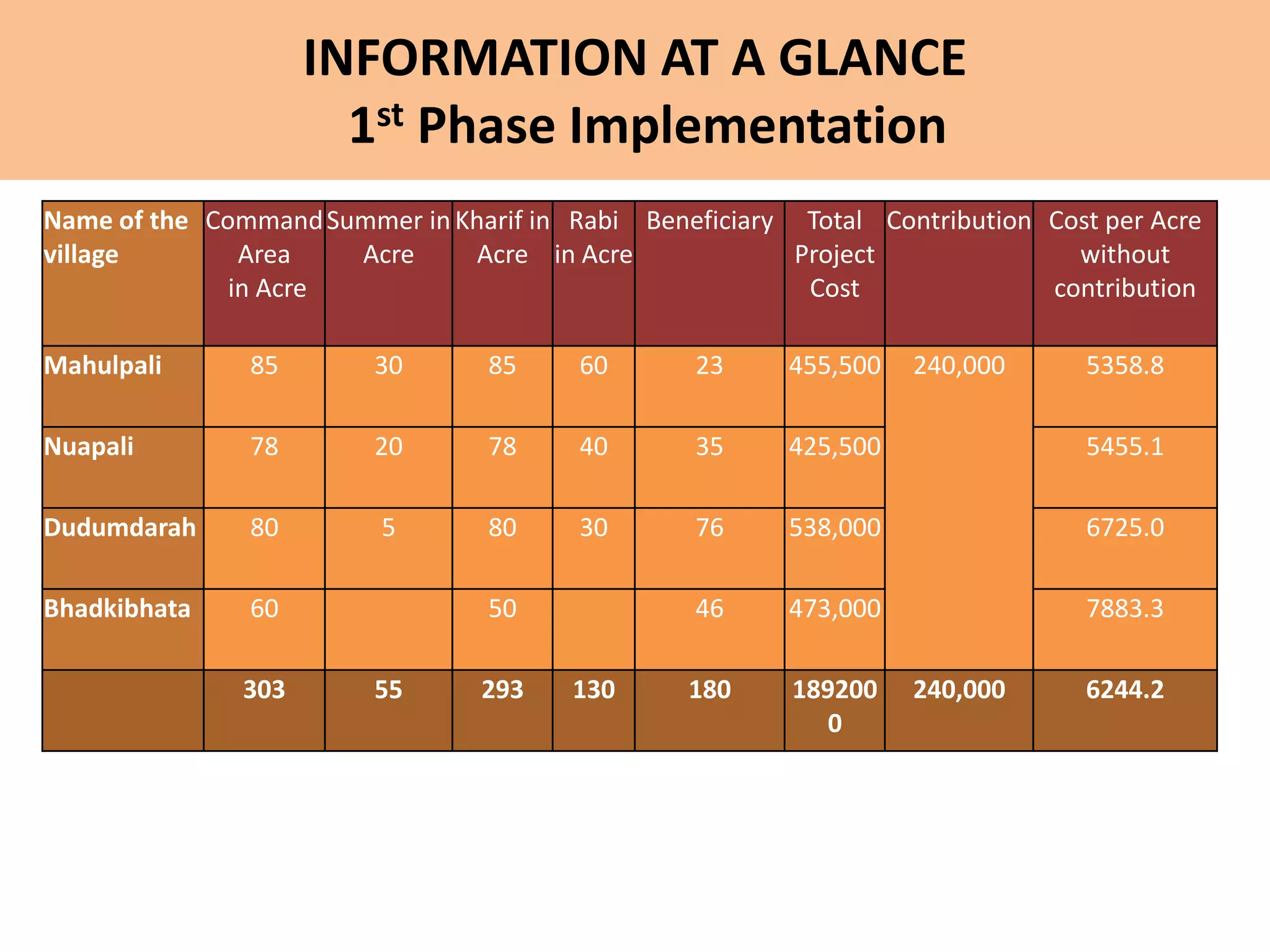
INFORMATION AT A GLANCE
1st Phase Implementation
Name of the
village
Command
Area
in Acre
Summer in
Acre
Kharif in
Acre
Rabi
in Acre
Beneficiary Total
Project
Cost
Contribution Cost per Acre
without
contribution
Mahulpali 85 30 85 60 23 455,500 240,000 5358.8
Nuapali 78 20 78 40 35 425,500 5455.1
Dudumdarah 80 5 80 30 76 538,000 6725.0
Bhadkibhata 60 50 46 473,000 7883.3
303 55 293 130 180 189200
0
240,000 6244.2
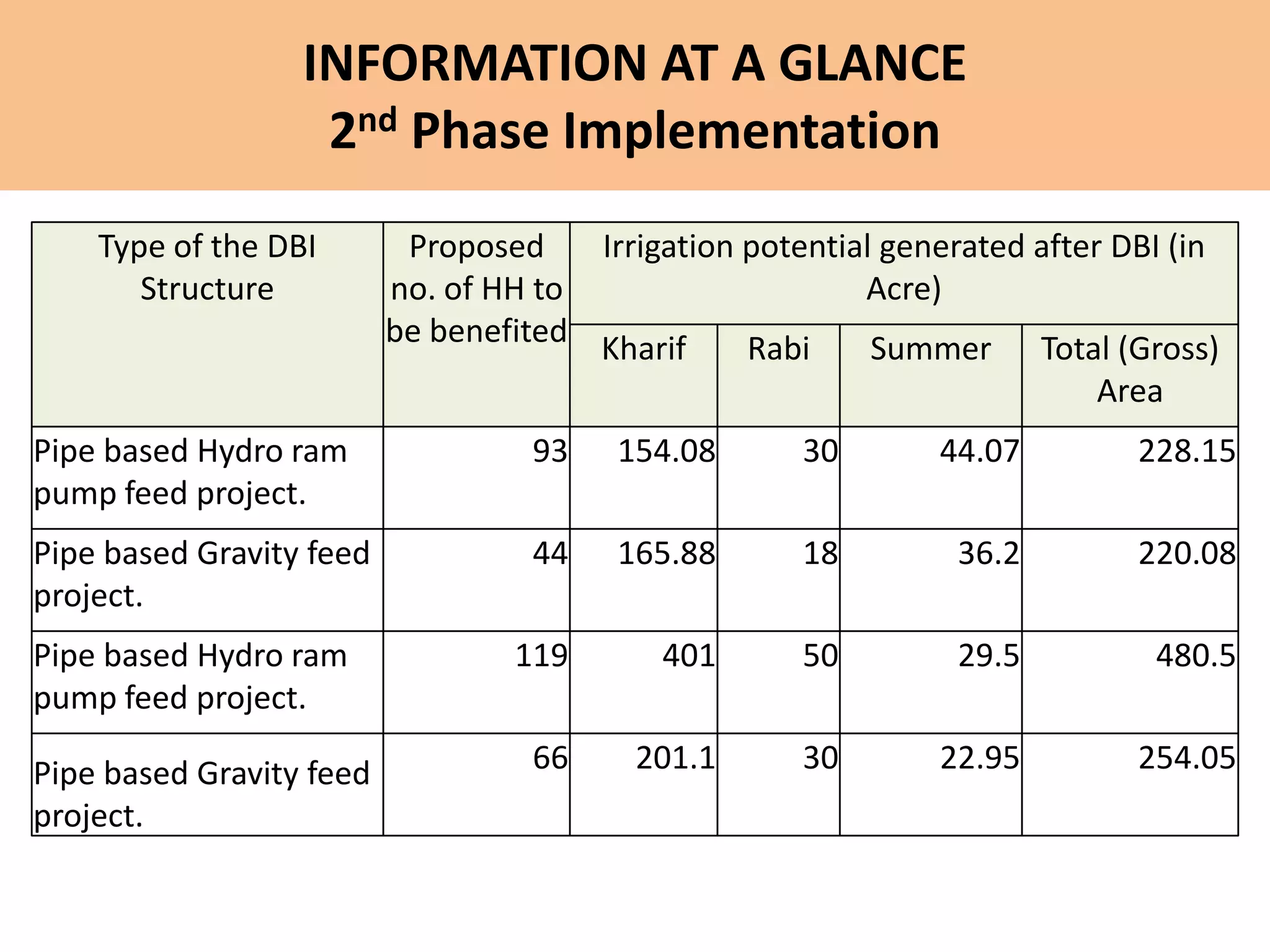
INFORMATION AT A GLANCE
2nd Phase Implementation
Type of the DBI
Structure
Proposed
no. of HH to
be benefited
Irrigation potential generated after DBI (in
Acre)
Kharif Rabi Summer Total (Gross)
Area
Pipe based Hydro ram
pump feed project.
93 154.08 30 44.07 228.15
Pipe based Gravity feed
project.
44 165.88 18 36.2 220.08
Pipe based Hydro ram
pump feed project.
119 401 50 29.5 480.5
Pipe based Gravity feed
project.
66 201.1 30 22.95 254.05
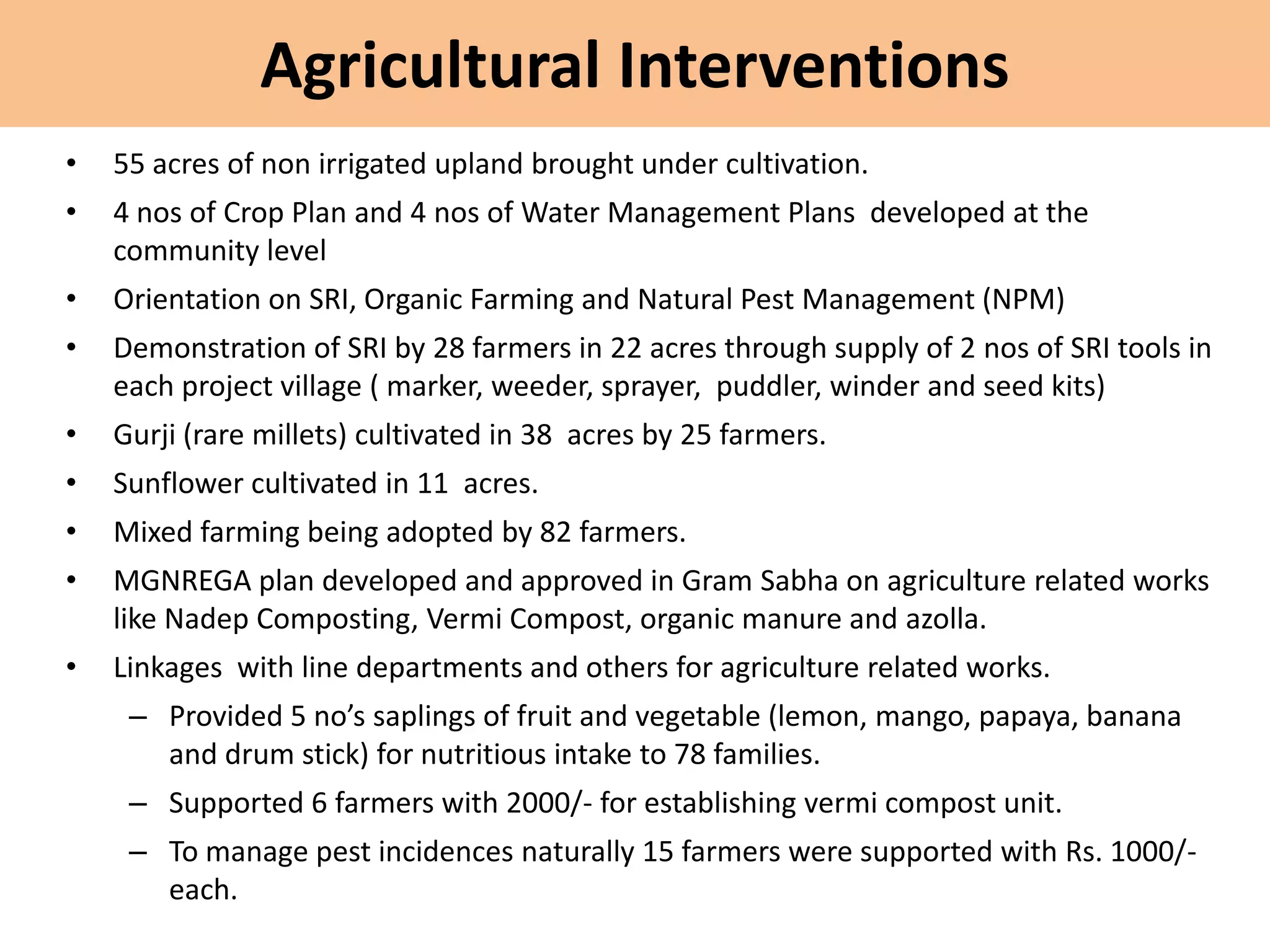
Agricultural Interventions
• 55 acres of non irrigated upland brought under cultivation.
• 4 nos of Crop Plan and 4 nos of Water Management Plans developed at the
community level
• Orientation on SRI, Organic Farming and Natural Pest Management (NPM)
• Demonstration of SRI by 28 farmers in 22 acres through supply of 2 nos of SRI tools in
each project village ( marker, weeder, sprayer, puddler, winder and seed kits)
• Gurji (rare millets) cultivated in 38 acres by 25 farmers.
• Sunflower cultivated in 11 acres.
• Mixed farming being adopted by 82 farmers.
• MGNREGA plan developed and approved in Gram Sabha on agriculture related works
like Nadep Composting, Vermi Compost, organic manure and azolla.
• Linkages with line departments and others for agriculture related works.
– Provided 5 no’s saplings of fruit and vegetable (lemon, mango, papaya, banana
and drum stick) for nutritious intake to 78 families.
– Supported 6 farmers with 2000/- for establishing vermi compost unit.
– To manage pest incidences naturally 15 farmers were supported with Rs. 1000/-
each.
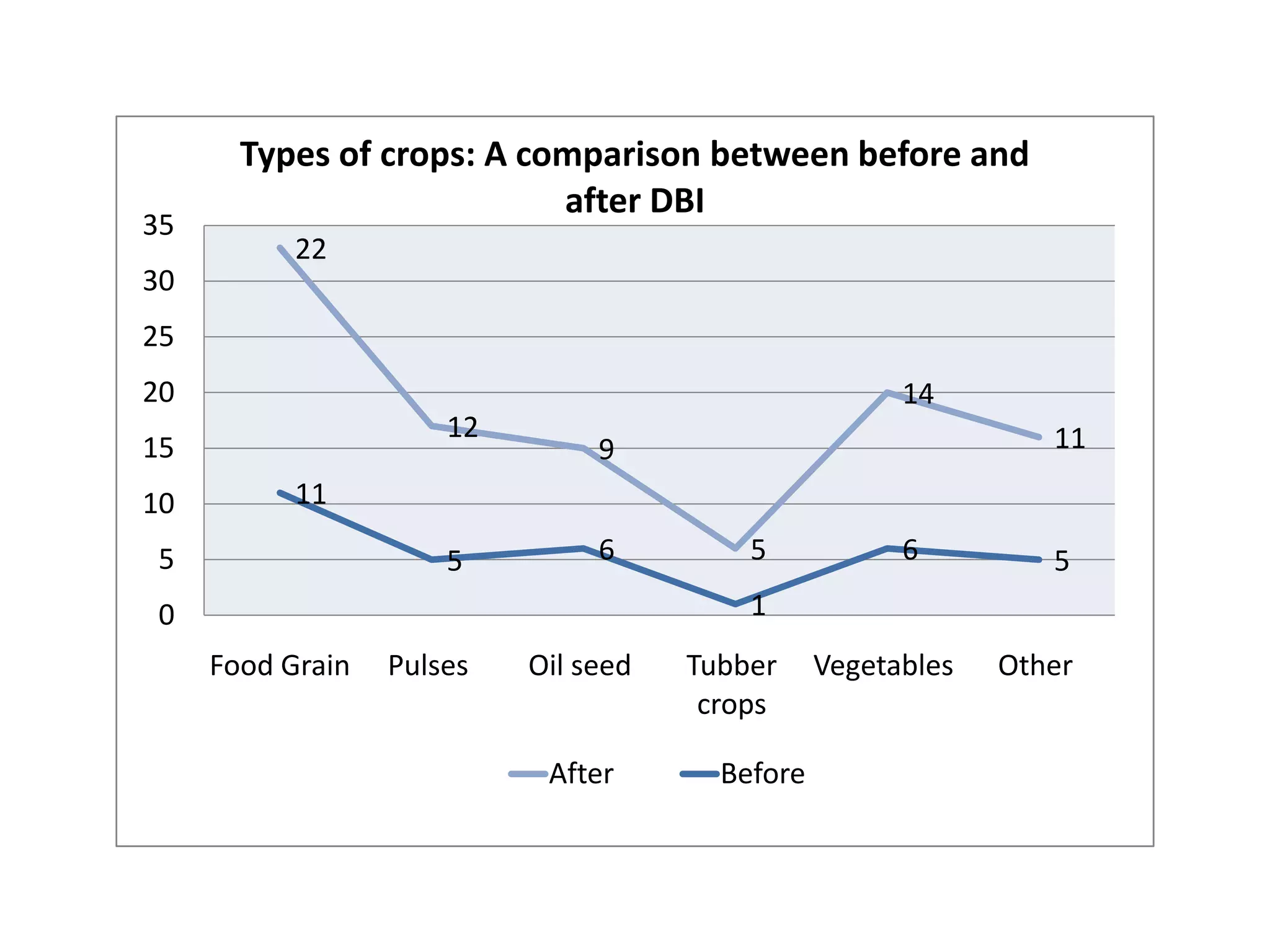
11
5 6
1
6 5
22
12
9
5
14
11
0
5
10
15
20
25
30
35
Food Grain Pulses Oil seed Tubber
crops
Vegetables Other
Types of crops: A comparison between before and
after DBI
After Before
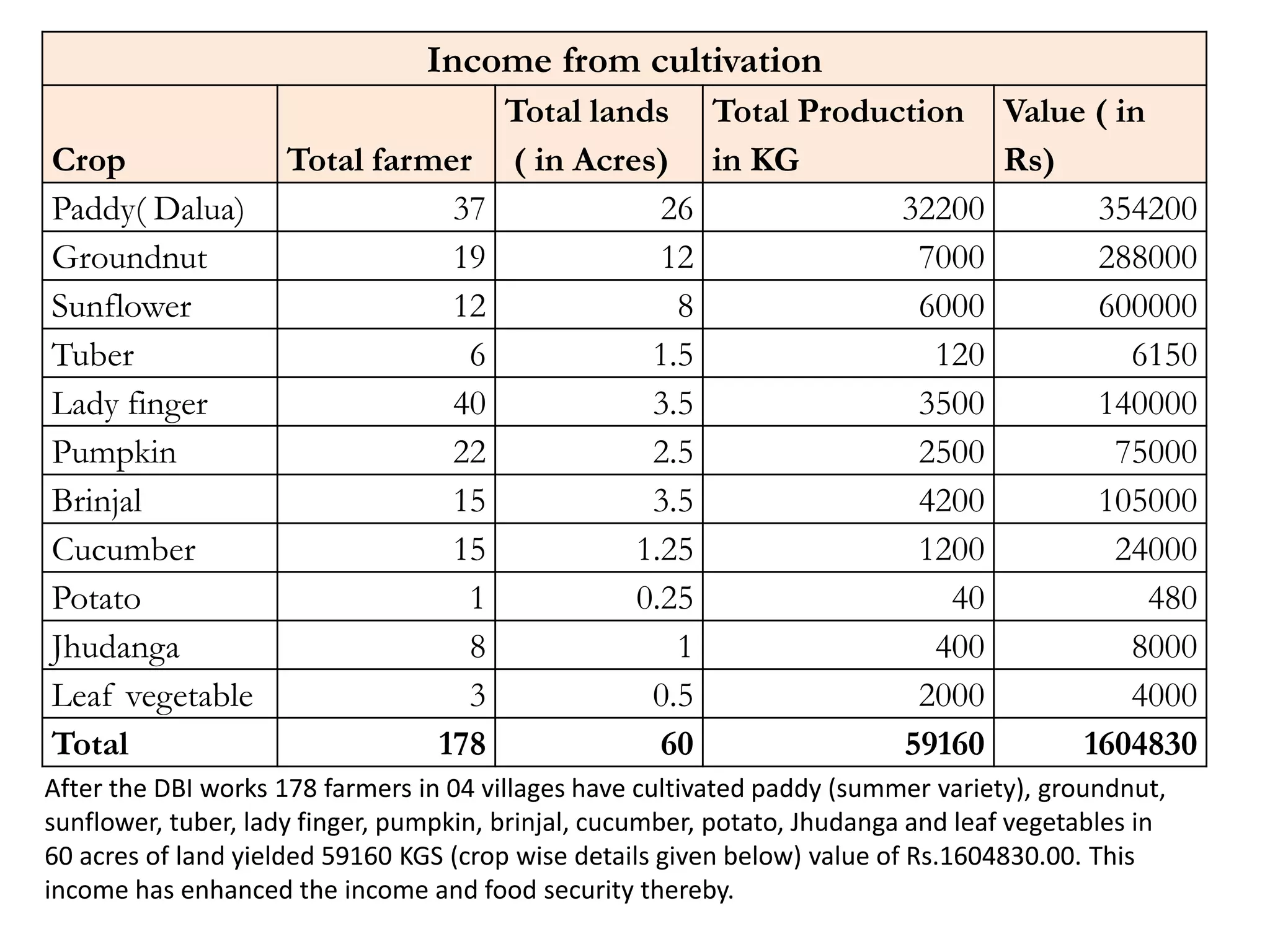
Income from cultivation
Crop Total farmer
Total lands
( in Acres)
Total Production
in KG
Value ( in
Rs)
Paddy( Dalua) 37 26 32200 354200
Groundnut 19 12 7000 288000
Sunflower 12 8 6000 600000
Tuber 6 1.5 120 6150
Lady finger 40 3.5 3500 140000
Pumpkin 22 2.5 2500 75000
Brinjal 15 3.5 4200 105000
Cucumber 15 1.25 1200 24000
Potato 1 0.25 40 480
Jhudanga 8 1 400 8000
Leaf vegetable 3 0.5 2000 4000
Total 178 60 59160 1604830
After the DBI works 178 farmers in 04 villages have cultivated paddy (summer variety), groundnut,
sunflower, tuber, lady finger, pumpkin, brinjal, cucumber, potato, Jhudanga and leaf vegetables in
60 acres of land yielded 59160 KGS (crop wise details given below) value of Rs.1604830.00. This
income has enhanced the income and food security thereby.
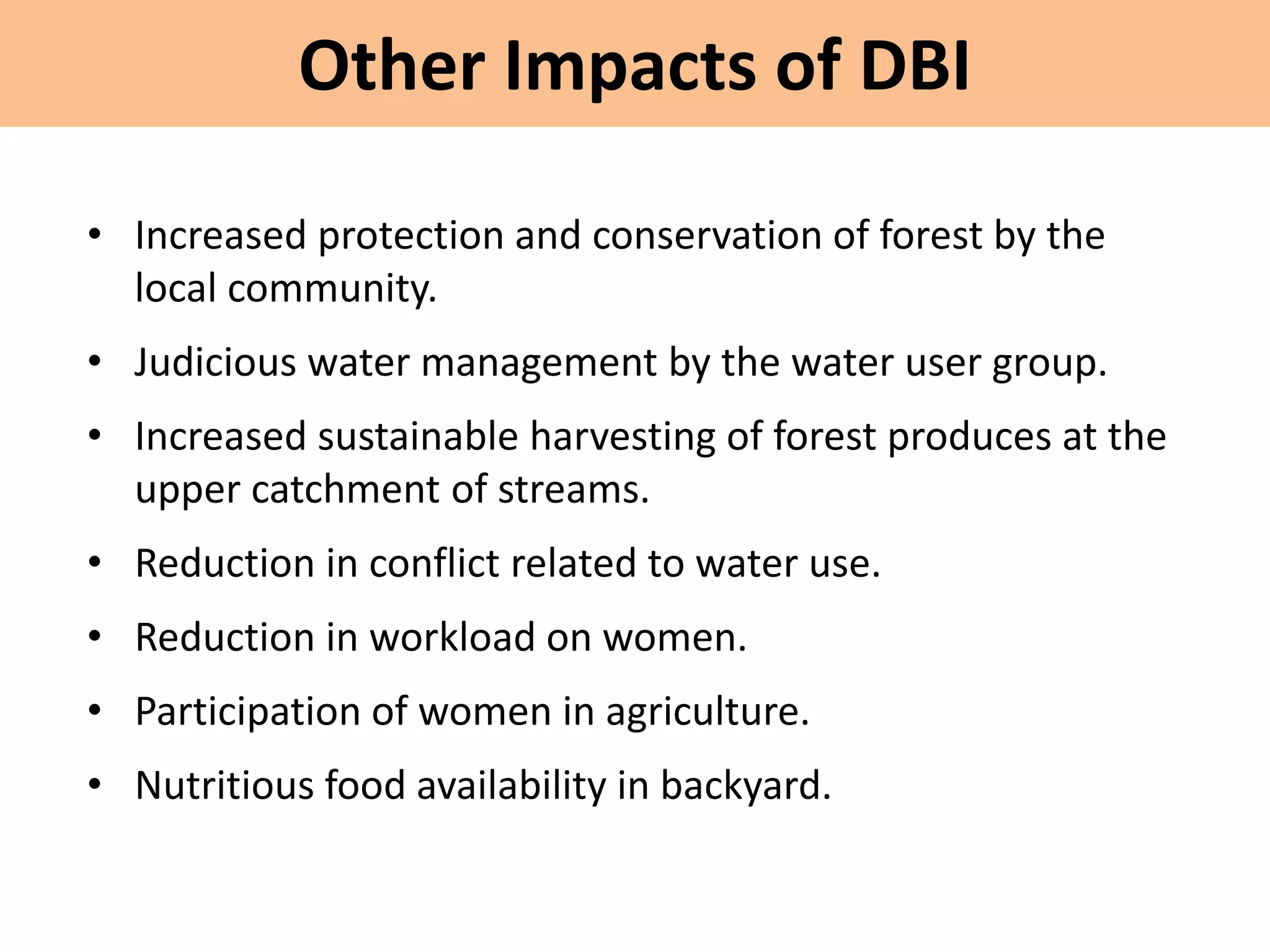
Other Impacts of DBI
• Increased protection and conservation of forest by the
local community.
• Judicious water management by the water user group.
• Increased sustainable harvesting of forest produces at the
upper catchment of streams.
• Reduction in conflict related to water use.
• Reduction in workload on women.
• Participation of women in agriculture.
• Nutritious food availability in backyard.
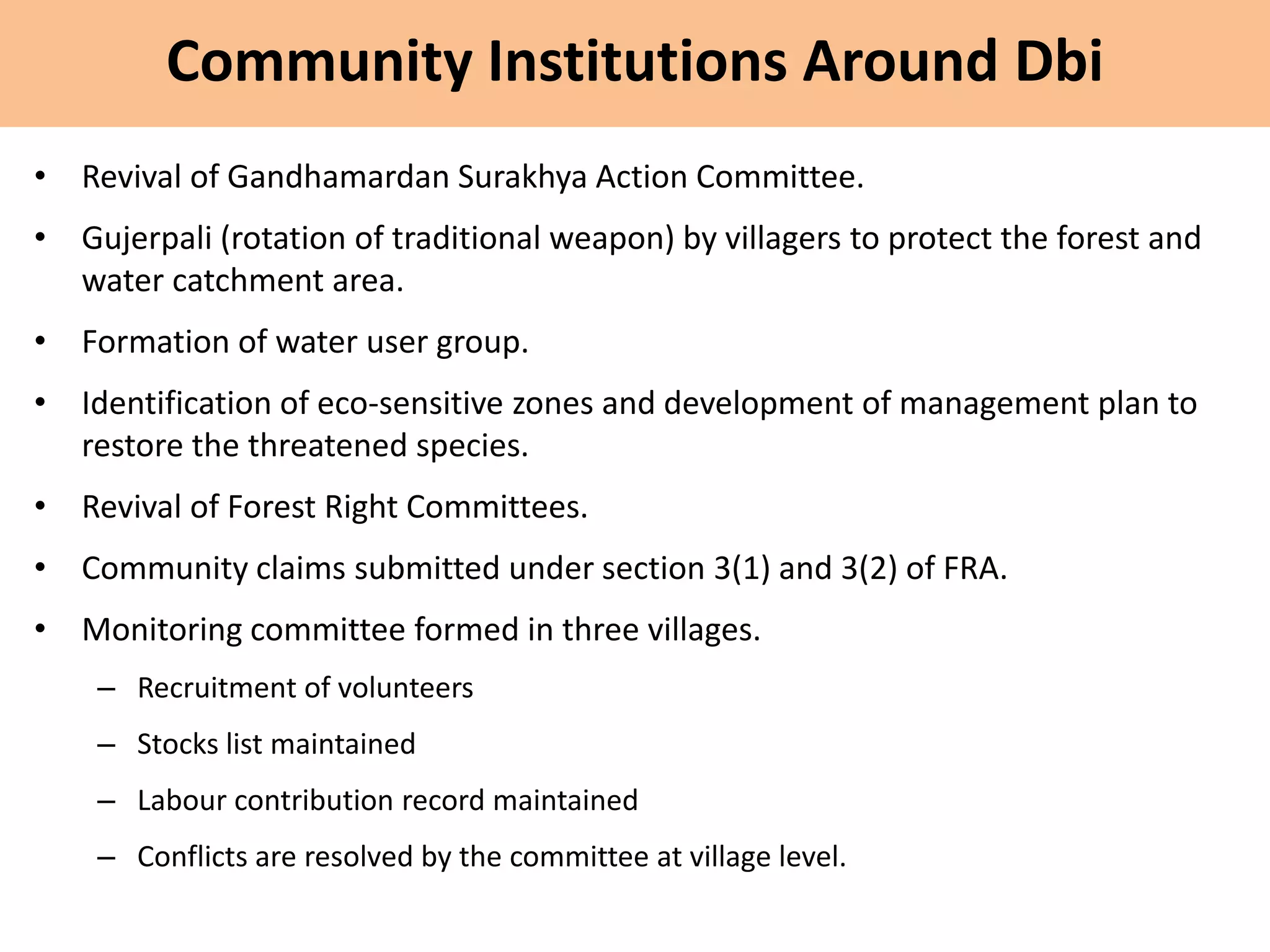
Community Institutions Around Dbi
• Revival of Gandhamardan Surakhya Action Committee.
• Gujerpali (rotation of traditional weapon) by villagers to protect the forest and
water catchment area.
• Formation of water user group.
• Identification of eco-sensitive zones and development of management plan to
restore the threatened species.
• Revival of Forest Right Committees.
• Community claims submitted under section 3(1) and 3(2) of FRA.
• Monitoring committee formed in three villages.
– Recruitment of volunteers
– Stocks list maintained
– Labour contribution record maintained
– Conflicts are resolved by the committee at village level.
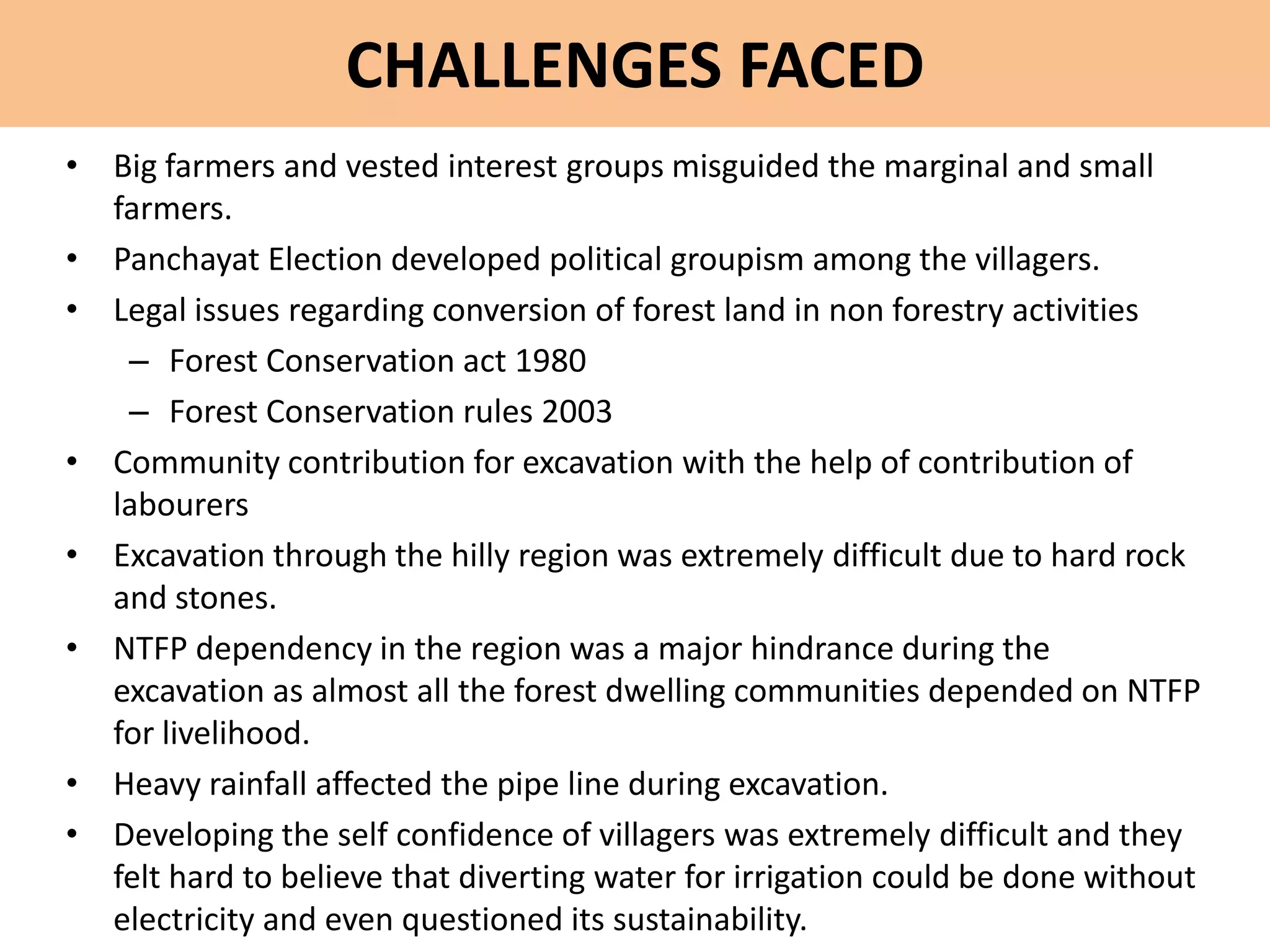
CHALLENGES FACED
• Big farmers and vested interest groups misguided the marginal and small
farmers.
• Panchayat Election developed political groupism among the villagers.
• Legal issues regarding conversion of forest land in non forestry activities
– Forest Conservation act 1980
– Forest Conservation rules 2003
• Community contribution for excavation with the help of contribution of
labourers
• Excavation through the hilly region was extremely difficult due to hard rock
and stones.
• NTFP dependency in the region was a major hindrance during the
excavation as almost all the forest dwelling communities depended on NTFP
for livelihood.
• Heavy rainfall affected the pipe line during excavation.
• Developing the self confidence of villagers was extremely difficult and they
felt hard to believe that diverting water for irrigation could be done without
electricity and even questioned its sustainability.
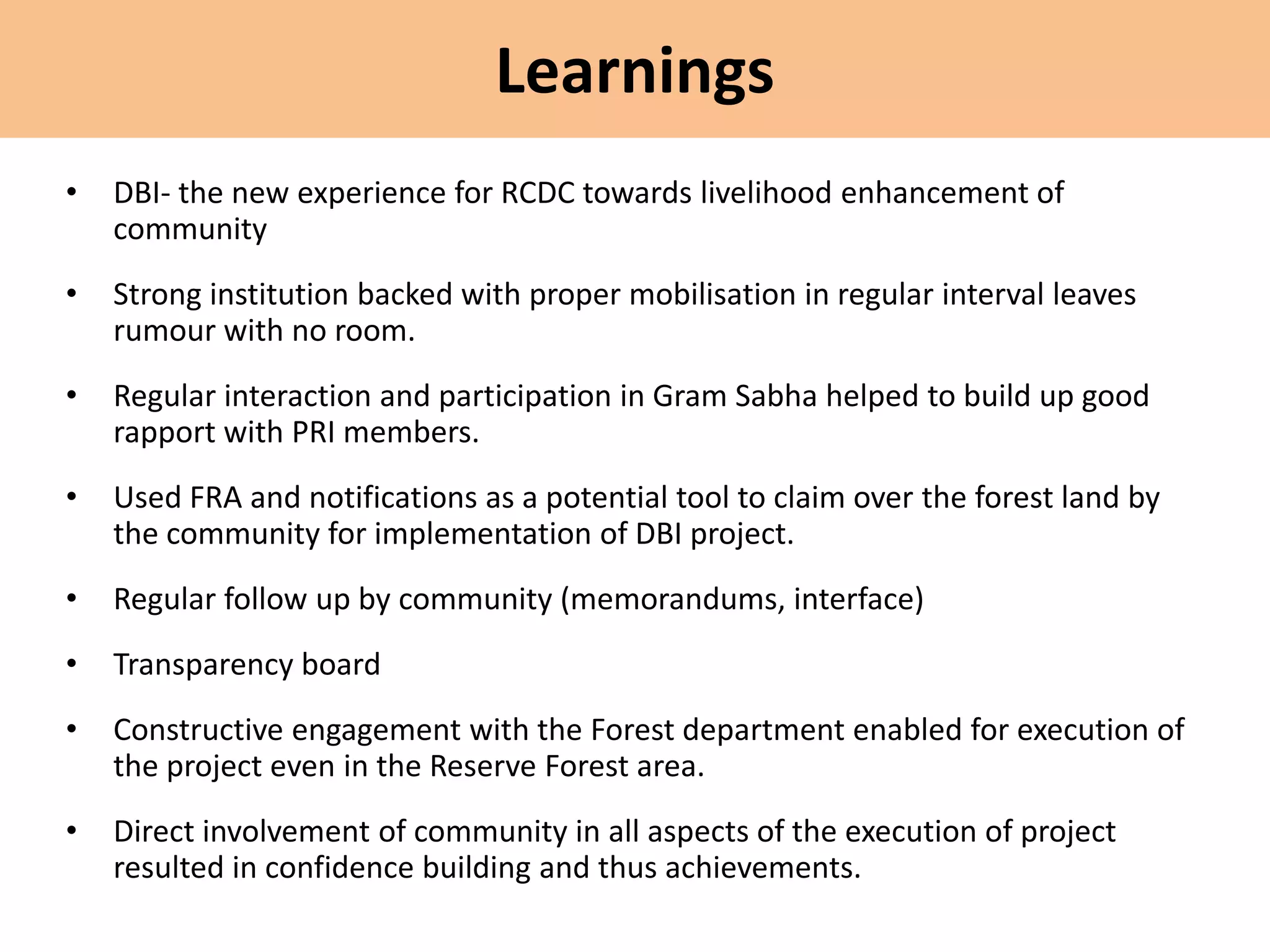
Learnings
• DBI- the new experience for RCDC towards livelihood enhancement of
community
• Strong institution backed with proper mobilisation in regular interval leaves
rumour with no room.
• Regular interaction and participation in Gram Sabha helped to build up good
rapport with PRI members.
• Used FRA and notifications as a potential tool to claim over the forest land by
the community for implementation of DBI project.
• Regular follow up by community (memorandums, interface)
• Transparency board
• Constructive engagement with the Forest department enabled for execution of
the project even in the Reserve Forest area.
• Direct involvement of community in all aspects of the execution of project
resulted in confidence building and thus achievements.
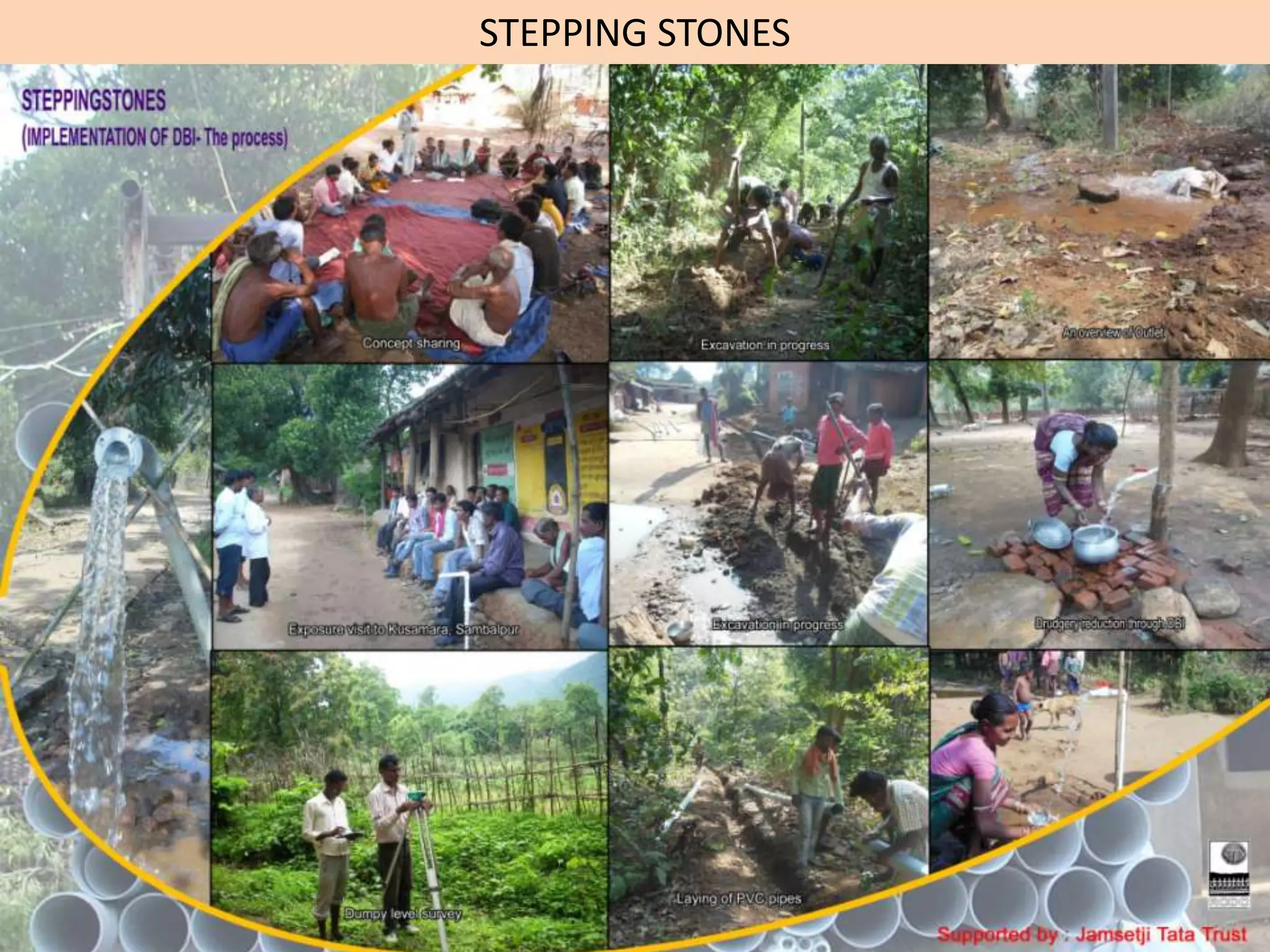
STEPPING STONES
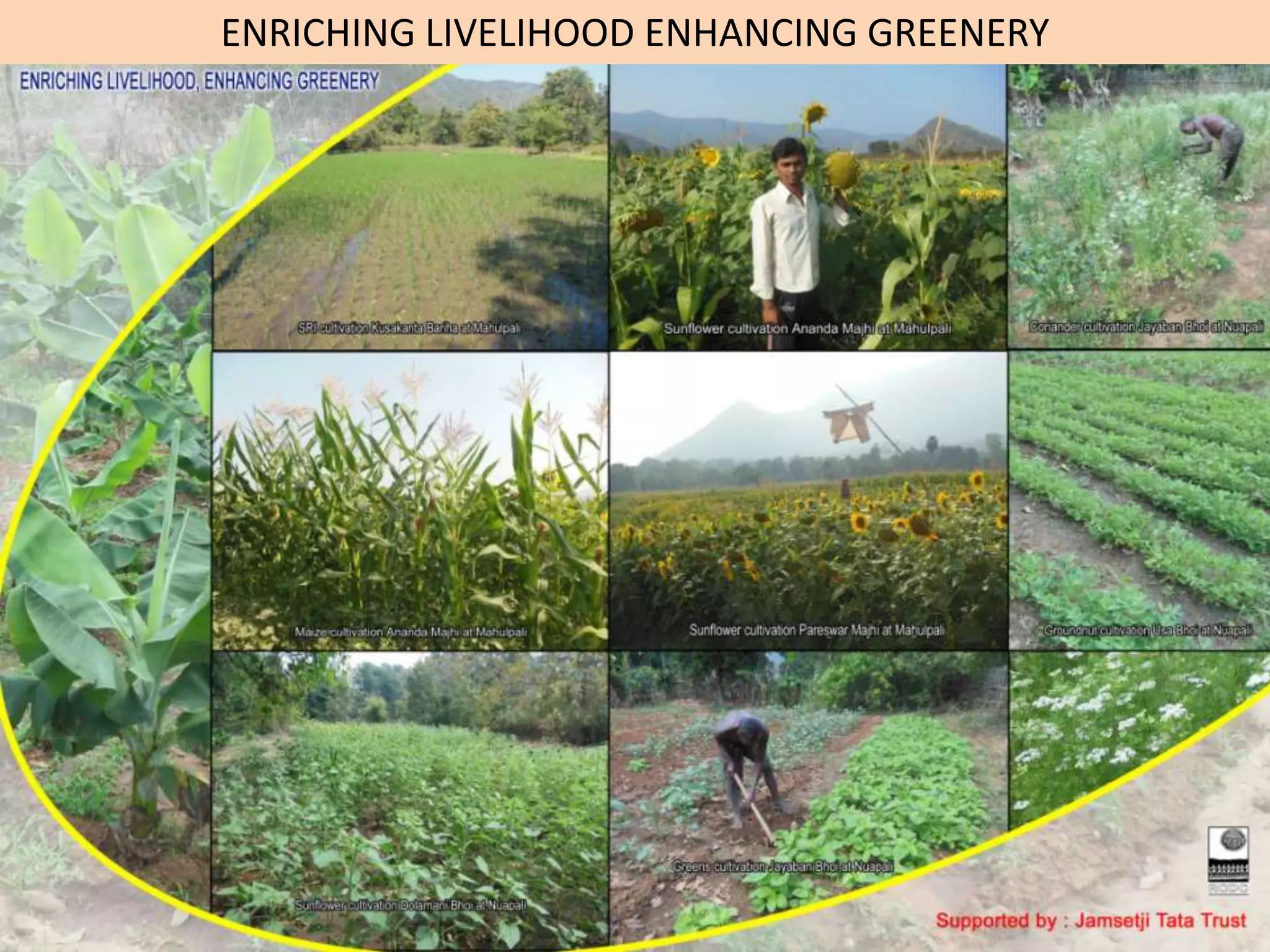
ENRICHING LIVELIHOOD ENHANCING GREENERY
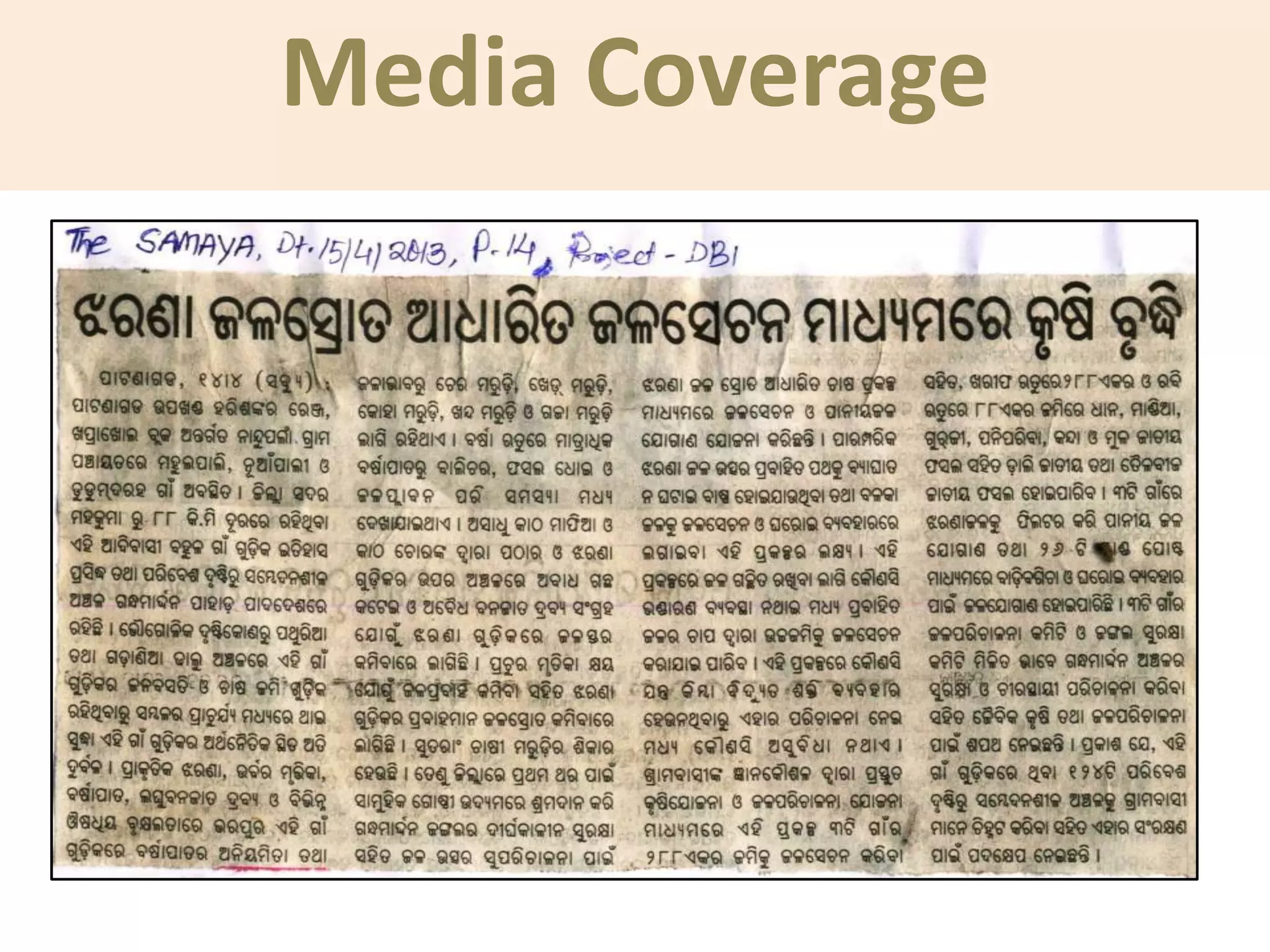
Media Coverage
Rcdc experience on dbi

Rcdc experience on dbi

  • 2.
    Introducing DBI -TheObjectives • Moving from forest protection to conservation & management of local eco system. • Management of local food supply chain for food availability during lean period. • Agricultural development in un irrigated upland. • Improving availability of drinking water for household consumption. • Building local institutions • Empowering women
  • 3.
    Intervention • RCDC intervenedwith DBI in two phases in 8 tribal habitations and eco sensible hotspots. • 1st Phase started as new experience in the year 2012. • 1st phase intervention focused only on DBI. • The 1st intervention produced good result with notable community contribution in 4 villages of 2 districts. • The 2nd phase was implemented in 4 villages from 2014 and continuing . • 2nd phase includes both DBI and Hydraulic Ram Pump.
  • 4.
    1st Phase Implementation Gandhamardan Hill Area  75% tribal communities  Total command area: 303 Acre  Total beneficiaries: 180 HH  Total sanctioned budget:1892000/-  Community contribution: 24000/-  Cost per Acre: 6244/- PROJECT OBJECTIVES: • To provide assured source of irrigation to the un- irrigated uplands of poor and marginalized farmers. • To provide irrigation to Kharif crops and irrigation to Rabi and Summer crops. • To enhance and strengthen livelihood portfolios of the local communities through supporting improvement in farm lands, in-situ moisture conservation and better agricultural practices. • Empowering the farmers, especially the tribals to enhance their food security, to increase their income and help in the overall improvement of their livelihood issues • People adopting sustainable practices for development of agriculture and allied services • Strengthen Institutional capacity of PRI and Government agencies.
  • 5.
    2nd Phase Implementation( on going)  4 tribal populated villages of Nabarangpur  80% tribal communities  Total command area: 1182.78 Acres  Total beneficiaries: 322 HH  Total sanctioned budget: 3,769,678 lakhs  Community contribution: 413600 /-  Cost per Acre: 3187.1 GOAL: Sustainable land, water and forest management for ecological and livelihood security through community led Diversion Based Irrigation in 4 villages of Nabarangpur districts. OBJECTIVES: • Enabling small and marginal farmers to have access to irrigation facilities for agricultural production enhancement and enhancing farmer friendly and eco friendly cropping with optimum usage of available water • To capacitate community and their organizations for effective land, water and forest management.
  • 6.
    INFORMATION AT AGLANCE 1st Phase Implementation Name of the village Command Area in Acre Summer in Acre Kharif in Acre Rabi in Acre Beneficiary Total Project Cost Contribution Cost per Acre without contribution Mahulpali 85 30 85 60 23 455,500 240,000 5358.8 Nuapali 78 20 78 40 35 425,500 5455.1 Dudumdarah 80 5 80 30 76 538,000 6725.0 Bhadkibhata 60 50 46 473,000 7883.3 303 55 293 130 180 189200 0 240,000 6244.2
  • 7.
    INFORMATION AT AGLANCE 2nd Phase Implementation Type of the DBI Structure Proposed no. of HH to be benefited Irrigation potential generated after DBI (in Acre) Kharif Rabi Summer Total (Gross) Area Pipe based Hydro ram pump feed project. 93 154.08 30 44.07 228.15 Pipe based Gravity feed project. 44 165.88 18 36.2 220.08 Pipe based Hydro ram pump feed project. 119 401 50 29.5 480.5 Pipe based Gravity feed project. 66 201.1 30 22.95 254.05
  • 8.
    Agricultural Interventions • 55acres of non irrigated upland brought under cultivation. • 4 nos of Crop Plan and 4 nos of Water Management Plans developed at the community level • Orientation on SRI, Organic Farming and Natural Pest Management (NPM) • Demonstration of SRI by 28 farmers in 22 acres through supply of 2 nos of SRI tools in each project village ( marker, weeder, sprayer, puddler, winder and seed kits) • Gurji (rare millets) cultivated in 38 acres by 25 farmers. • Sunflower cultivated in 11 acres. • Mixed farming being adopted by 82 farmers. • MGNREGA plan developed and approved in Gram Sabha on agriculture related works like Nadep Composting, Vermi Compost, organic manure and azolla. • Linkages with line departments and others for agriculture related works. – Provided 5 no’s saplings of fruit and vegetable (lemon, mango, papaya, banana and drum stick) for nutritious intake to 78 families. – Supported 6 farmers with 2000/- for establishing vermi compost unit. – To manage pest incidences naturally 15 farmers were supported with Rs. 1000/- each.
  • 9.
    11 5 6 1 6 5 22 12 9 5 14 11 0 5 10 15 20 25 30 35 FoodGrain Pulses Oil seed Tubber crops Vegetables Other Types of crops: A comparison between before and after DBI After Before
  • 10.
    Income from cultivation CropTotal farmer Total lands ( in Acres) Total Production in KG Value ( in Rs) Paddy( Dalua) 37 26 32200 354200 Groundnut 19 12 7000 288000 Sunflower 12 8 6000 600000 Tuber 6 1.5 120 6150 Lady finger 40 3.5 3500 140000 Pumpkin 22 2.5 2500 75000 Brinjal 15 3.5 4200 105000 Cucumber 15 1.25 1200 24000 Potato 1 0.25 40 480 Jhudanga 8 1 400 8000 Leaf vegetable 3 0.5 2000 4000 Total 178 60 59160 1604830 After the DBI works 178 farmers in 04 villages have cultivated paddy (summer variety), groundnut, sunflower, tuber, lady finger, pumpkin, brinjal, cucumber, potato, Jhudanga and leaf vegetables in 60 acres of land yielded 59160 KGS (crop wise details given below) value of Rs.1604830.00. This income has enhanced the income and food security thereby.
  • 11.
    Other Impacts ofDBI • Increased protection and conservation of forest by the local community. • Judicious water management by the water user group. • Increased sustainable harvesting of forest produces at the upper catchment of streams. • Reduction in conflict related to water use. • Reduction in workload on women. • Participation of women in agriculture. • Nutritious food availability in backyard.
  • 12.
    Community Institutions AroundDbi • Revival of Gandhamardan Surakhya Action Committee. • Gujerpali (rotation of traditional weapon) by villagers to protect the forest and water catchment area. • Formation of water user group. • Identification of eco-sensitive zones and development of management plan to restore the threatened species. • Revival of Forest Right Committees. • Community claims submitted under section 3(1) and 3(2) of FRA. • Monitoring committee formed in three villages. – Recruitment of volunteers – Stocks list maintained – Labour contribution record maintained – Conflicts are resolved by the committee at village level.
  • 13.
    CHALLENGES FACED • Bigfarmers and vested interest groups misguided the marginal and small farmers. • Panchayat Election developed political groupism among the villagers. • Legal issues regarding conversion of forest land in non forestry activities – Forest Conservation act 1980 – Forest Conservation rules 2003 • Community contribution for excavation with the help of contribution of labourers • Excavation through the hilly region was extremely difficult due to hard rock and stones. • NTFP dependency in the region was a major hindrance during the excavation as almost all the forest dwelling communities depended on NTFP for livelihood. • Heavy rainfall affected the pipe line during excavation. • Developing the self confidence of villagers was extremely difficult and they felt hard to believe that diverting water for irrigation could be done without electricity and even questioned its sustainability.
  • 14.
    Learnings • DBI- thenew experience for RCDC towards livelihood enhancement of community • Strong institution backed with proper mobilisation in regular interval leaves rumour with no room. • Regular interaction and participation in Gram Sabha helped to build up good rapport with PRI members. • Used FRA and notifications as a potential tool to claim over the forest land by the community for implementation of DBI project. • Regular follow up by community (memorandums, interface) • Transparency board • Constructive engagement with the Forest department enabled for execution of the project even in the Reserve Forest area. • Direct involvement of community in all aspects of the execution of project resulted in confidence building and thus achievements.
  • 15.
  • 16.
  • 17.