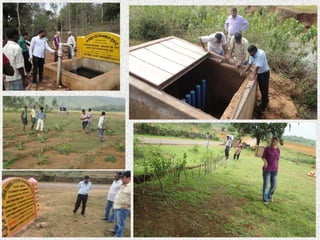
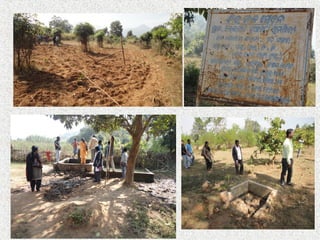
Pragati Koraput- An overview
VISION:VISION:
To build such a self-reliant society,
free from hunger and exploitation,
where everyone irrespective of caste,
creed, sex and language have right to
dignified means of livelihood and
through collective action ensure socio-
economic justice and ecological balance.
MISSION:MISSION:
To facilitate and strengthen vibrant
people’s organizations at different
levels of society that will protect,
utilize, control and manage local
resources and through collective
action, ensure dynamic socio-
economic change for sustainable
development by advocating for pro-
poor governance and bring women,
children, tribals and downtrodden, to
the mainstream of the society.CORE VALUESCORE VALUES
–Transparency in all aspects.
– Commitment to render selfless service to the poor.
–Accountability to the Society.
–Work with team spirit.
–Punctuality.
–Participatory approach in all aspects.
–Sensitive towards women.
–Secular in spirit
Establishment – 26th
January 1992
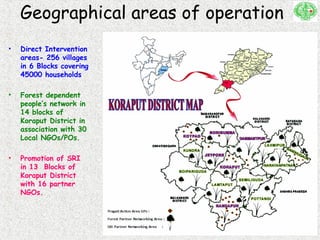
Geographical areas of operation
• Direct Intervention
areas- 256 villages
in 6 Blocks covering
45000 households
• Forest dependent
people’s network in
14 blocks of
Koraput District in
association with 30
Local NGOs/POs.
• Promotion of SRI
in 13 Blocks of
Koraput District
with 16 partner
NGOs.
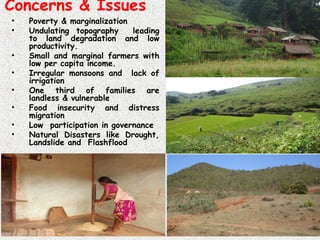
Concerns & Issues
• Poverty & marginalization
• Undulating topography leading
to land degradation and low
productivity.
• Small and marginal farmers with
low per capita income.
• Irregular monsoons and lack of
irrigation
• One third of families are
landless & vulnerable
• Food insecurity and distress
migration
• Low participation in governance
• Natural Disasters like Drought,
Landslide and Flashflood
Core Thematic areas of Intervention
• Empowerment of People’s Organisations
• Natural Resource management
• Sustainable Agriculture
• Empowerment of women & mainstreaming gender
• Disaster Risk Reduction & climate change
• Action Research & Documentation
Strategy
• Working through People’ organizations
• Demonstrating utilization and management of natural
resources.
• Linkage with PRIs and line departments
• Convergence with Govt. Programmes
• Networking with NGOs and POs at local, state, national,
international level organisation.
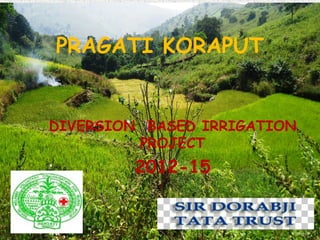
PRAGATI KORAPUT
DIVERSION BASED IRRIGATION
PROJECT
2012-15
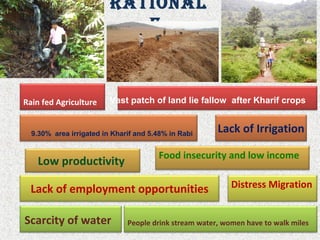
Rational
e
Rain fed Agriculture
Lack of Irrigation
Low productivity
Food insecurity and low income
Lack of employment opportunities Distress Migration
Scarcity of water People drink stream water, women have to walk miles
Vast patch of land lie fallow after Kharif crops
9.30% area irrigated in Kharif and 5.48% in Rabi
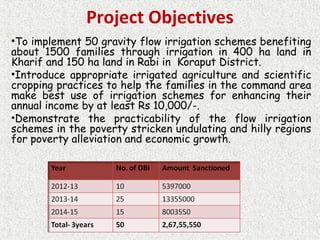
Project Objectives
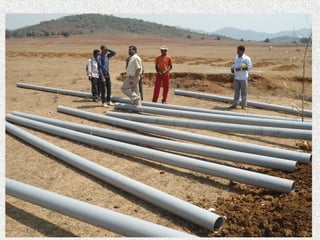
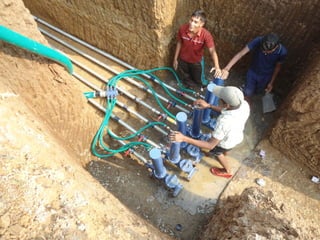
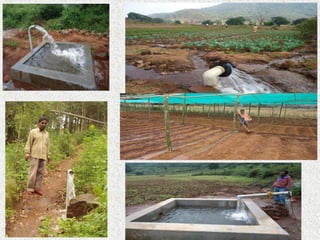
•To implement 50 gravity flow irrigation schemes benefiting
about 1500 families through irrigation in 400 ha land in
Kharif and 150 ha land in Rabi in Koraput District.
•Introduce appropriate irrigated agriculture and scientific
cropping practices to help the families in the command area
make best use of irrigation schemes for enhancing their
annual income by at least Rs 10,000/-.
•Demonstrate the practicability of the flow irrigation
schemes in the poverty stricken undulating and hilly regions
for poverty alleviation and economic growth.
 
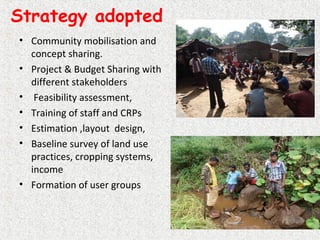
Strategy adopted
• Community mobilisation and
concept sharing.
• Project & Budget Sharing with
different stakeholders
• Feasibility assessment,
• Training of staff and CRPs
• Estimation ,layout design,
• Baseline survey of land use
practices, cropping systems,
income
• Formation of user groups
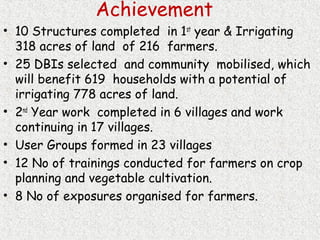
Achievement
• 10 Structures completed in 1st
year & Irrigating
318 acres of land of 216 farmers.
• 25 DBIs selected and community mobilised, which
will benefit 619 households with a potential of
irrigating 778 acres of land.
• 2nd
Year work completed in 6 villages and work
continuing in 17 villages.
• User Groups formed in 23 villages
• 12 No of trainings conducted for farmers on crop
planning and vegetable cultivation.
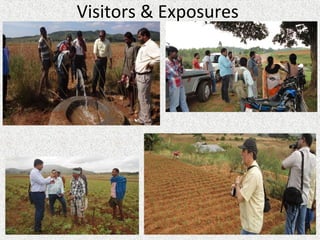
• 8 No of exposures organised for farmers.
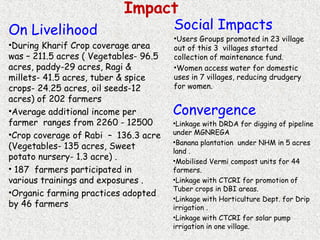
Impact
On Livelihood
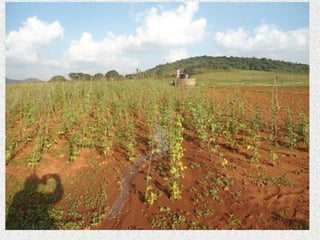
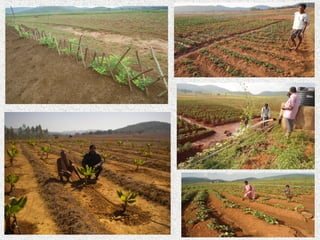
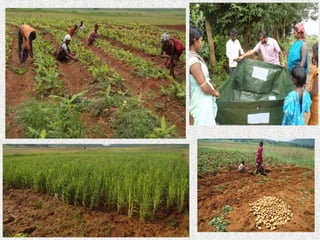
•During Kharif Crop coverage area
was – 211.5 acres ( Vegetables- 96.5
acres, paddy-29 acres, Ragi &
millets- 41.5 acres, tuber & spice
crops- 24.25 acres, oil seeds-12
acres) of 202 farmers
•Average additional income per
farmer ranges from 2260 - 12500
•Crop coverage of Rabi – 136.3 acre
(Vegetables- 135 acres, Sweet
potato nursery- 1.3 acre) .
• 187 farmers participated in
various trainings and exposures .
•Organic farming practices adopted
by 46 farmers
Social Impacts
•Users Groups promoted in 23 village
out of this 3 villages started
collection of maintenance fund.
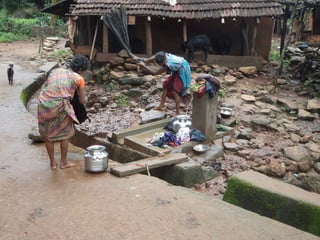
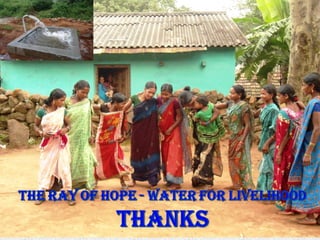
•Women access water for domestic
uses in 7 villages, reducing drudgery
for women.
Convergence
•Linkage with DRDA for digging of pipeline
under MGNREGA
•Banana plantation under NHM in 5 acres
land .
•Mobilised Vermi compost units for 44
farmers.
•Linkage with CTCRI for promotion of
Tuber crops in DBI areas.
•Linkage with Horticulture Dept. for Drip
irrigation .
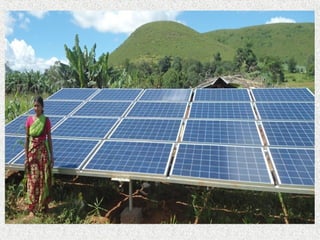
•Linkage with CTCRI for solar pump
irrigation in one village.
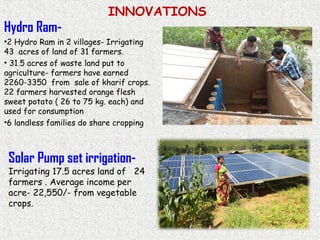
INNOVATIONS
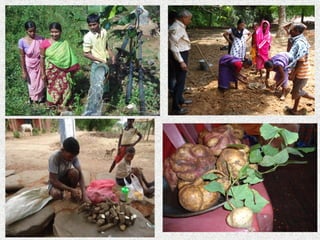
Hydro Ram-
•2 Hydro Ram in 2 villages- Irrigating
43 acres of land of 31 farmers.
• 31.5 acres of waste land put to
agriculture- farmers have earned
2260-3350 from sale of kharif crops.
22 farmers harvested orange flesh
sweet potato ( 26 to 75 kg. each) and
used for consumption
•6 landless families do share cropping
Solar Pump set irrigation-
Irrigating 17.5 acres land of 24
farmers . Average income per
acre- 22,550/- from vegetable
crops.
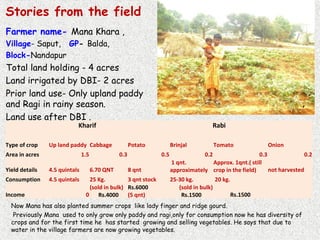
Stories from the field
Farmer name- Mana Khara ,
Village- Saput, GP- Balda,
Block-Nandapur
Total land holding - 4 acres
Land irrigated by DBI- 2 acres
Prior land use- Only upland paddy
and Ragi in rainy season.
Land use after DBI .
  Kharif Rabi
Type of crop Up land paddy Cabbage Potato Brinjal Tomato Onion
Area in acres 1.5 0.3 0.5 0.2 0.3 0.2
Yield details 4.5 quintals 6.70 QNT 8 qnt
1 qnt.
approximately
Approx. 1qnt.( still
crop in the field) not harvested
Consumption 4.5 quintals 25 Kg. 3 qnt stock 25-30 kg. 20 kg.
Income 0
(sold in bulk)
Rs.4000
Rs.6000
(5 qnt)
(sold in bulk)
Rs.1500 Rs.1500
Now Mana has also planted summer crops like lady finger and ridge gourd.
Previously Mana used to only grow only paddy and ragi,only for consumption now he has diversity of
crops and for the first time he has started growing and selling vegetables. He says that due to
water in the village farmers are now growing vegetables.
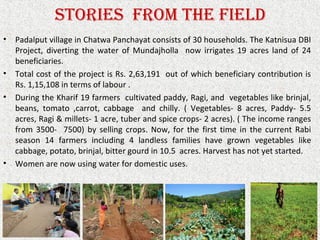
StorieS from the field
• Padalput village in Chatwa Panchayat consists of 30 households. The Katnisua DBI 
Project,  diverting  the  water  of  Mundajholla    now  irrigates  19  acres  land  of  24 
beneficiaries.
• Total cost of the project is Rs. 2,63,191  out of which beneficiary contribution is 
Rs. 1,15,108 in terms of labour .
• During the Kharif 19 farmers  cultivated paddy, Ragi, and  vegetables like brinjal, 
beans,  tomato  ,carrot,  cabbage    and  chilly.  (  Vegetables-  8  acres,  Paddy-  5.5 
acres, Ragi & millets- 1 acre, tuber and spice crops- 2 acres). ( The income ranges 
from 3500-  7500) by selling crops. Now, for the first time in the current Rabi 
season  14  farmers  including  4  landless  families  have  grown  vegetables  like 
cabbage, potato, brinjal, bitter gourd in 10.5  acres. Harvest has not yet started.
• Women are now using water for domestic uses.
ChallengeS
• Community mobilization for contribution
• Handholding support to user groups
• Skill building (Maintenance of Structure/institution)
• Conflict management
• Timely availability of resources.
• Open grazing
Visitors & Exposures
Prgati koraput 25th march 2014

Prgati koraput 25th march 2014

  • 2.
    Pragati Koraput- Anoverview VISION:VISION: To build such a self-reliant society, free from hunger and exploitation, where everyone irrespective of caste, creed, sex and language have right to dignified means of livelihood and through collective action ensure socio- economic justice and ecological balance. MISSION:MISSION: To facilitate and strengthen vibrant people’s organizations at different levels of society that will protect, utilize, control and manage local resources and through collective action, ensure dynamic socio- economic change for sustainable development by advocating for pro- poor governance and bring women, children, tribals and downtrodden, to the mainstream of the society.CORE VALUESCORE VALUES –Transparency in all aspects. – Commitment to render selfless service to the poor. –Accountability to the Society. –Work with team spirit. –Punctuality. –Participatory approach in all aspects. –Sensitive towards women. –Secular in spirit Establishment – 26th January 1992
  • 3.
    Geographical areas ofoperation • Direct Intervention areas- 256 villages in 6 Blocks covering 45000 households • Forest dependent people’s network in 14 blocks of Koraput District in association with 30 Local NGOs/POs. • Promotion of SRI in 13 Blocks of Koraput District with 16 partner NGOs.
  • 4.
    Concerns & Issues •Poverty & marginalization • Undulating topography leading to land degradation and low productivity. • Small and marginal farmers with low per capita income. • Irregular monsoons and lack of irrigation • One third of families are landless & vulnerable • Food insecurity and distress migration • Low participation in governance • Natural Disasters like Drought, Landslide and Flashflood
  • 5.
    Core Thematic areasof Intervention • Empowerment of People’s Organisations • Natural Resource management • Sustainable Agriculture • Empowerment of women & mainstreaming gender • Disaster Risk Reduction & climate change • Action Research & Documentation Strategy • Working through People’ organizations • Demonstrating utilization and management of natural resources. • Linkage with PRIs and line departments • Convergence with Govt. Programmes • Networking with NGOs and POs at local, state, national, international level organisation.
  • 6.
    PRAGATI KORAPUT DIVERSION BASEDIRRIGATION PROJECT 2012-15
  • 7.
    Rational e Rain fed Agriculture Lackof Irrigation Low productivity Food insecurity and low income Lack of employment opportunities Distress Migration Scarcity of water People drink stream water, women have to walk miles Vast patch of land lie fallow after Kharif crops 9.30% area irrigated in Kharif and 5.48% in Rabi
  • 8.
    Project Objectives •To implement50 gravity flow irrigation schemes benefiting about 1500 families through irrigation in 400 ha land in Kharif and 150 ha land in Rabi in Koraput District. •Introduce appropriate irrigated agriculture and scientific cropping practices to help the families in the command area make best use of irrigation schemes for enhancing their annual income by at least Rs 10,000/-. •Demonstrate the practicability of the flow irrigation schemes in the poverty stricken undulating and hilly regions for poverty alleviation and economic growth.  
  • 9.
    Strategy adopted • Communitymobilisation and concept sharing. • Project & Budget Sharing with different stakeholders • Feasibility assessment, • Training of staff and CRPs • Estimation ,layout design, • Baseline survey of land use practices, cropping systems, income • Formation of user groups
  • 10.
    Achievement • 10 Structurescompleted in 1st year & Irrigating 318 acres of land of 216 farmers. • 25 DBIs selected and community mobilised, which will benefit 619 households with a potential of irrigating 778 acres of land. • 2nd Year work completed in 6 villages and work continuing in 17 villages. • User Groups formed in 23 villages • 12 No of trainings conducted for farmers on crop planning and vegetable cultivation. • 8 No of exposures organised for farmers.
  • 11.
    Impact On Livelihood •During KharifCrop coverage area was – 211.5 acres ( Vegetables- 96.5 acres, paddy-29 acres, Ragi & millets- 41.5 acres, tuber & spice crops- 24.25 acres, oil seeds-12 acres) of 202 farmers •Average additional income per farmer ranges from 2260 - 12500 •Crop coverage of Rabi – 136.3 acre (Vegetables- 135 acres, Sweet potato nursery- 1.3 acre) . • 187 farmers participated in various trainings and exposures . •Organic farming practices adopted by 46 farmers Social Impacts •Users Groups promoted in 23 village out of this 3 villages started collection of maintenance fund. •Women access water for domestic uses in 7 villages, reducing drudgery for women. Convergence •Linkage with DRDA for digging of pipeline under MGNREGA •Banana plantation under NHM in 5 acres land . •Mobilised Vermi compost units for 44 farmers. •Linkage with CTCRI for promotion of Tuber crops in DBI areas. •Linkage with Horticulture Dept. for Drip irrigation . •Linkage with CTCRI for solar pump irrigation in one village.
  • 12.
    INNOVATIONS Hydro Ram- •2 HydroRam in 2 villages- Irrigating 43 acres of land of 31 farmers. • 31.5 acres of waste land put to agriculture- farmers have earned 2260-3350 from sale of kharif crops. 22 farmers harvested orange flesh sweet potato ( 26 to 75 kg. each) and used for consumption •6 landless families do share cropping Solar Pump set irrigation- Irrigating 17.5 acres land of 24 farmers . Average income per acre- 22,550/- from vegetable crops.
  • 13.
    Stories from thefield Farmer name- Mana Khara , Village- Saput, GP- Balda, Block-Nandapur Total land holding - 4 acres Land irrigated by DBI- 2 acres Prior land use- Only upland paddy and Ragi in rainy season. Land use after DBI .   Kharif Rabi Type of crop Up land paddy Cabbage Potato Brinjal Tomato Onion Area in acres 1.5 0.3 0.5 0.2 0.3 0.2 Yield details 4.5 quintals 6.70 QNT 8 qnt 1 qnt. approximately Approx. 1qnt.( still crop in the field) not harvested Consumption 4.5 quintals 25 Kg. 3 qnt stock 25-30 kg. 20 kg. Income 0 (sold in bulk) Rs.4000 Rs.6000 (5 qnt) (sold in bulk) Rs.1500 Rs.1500 Now Mana has also planted summer crops like lady finger and ridge gourd. Previously Mana used to only grow only paddy and ragi,only for consumption now he has diversity of crops and for the first time he has started growing and selling vegetables. He says that due to water in the village farmers are now growing vegetables.
  • 14.
    StorieS from thefield • Padalput village in Chatwa Panchayat consists of 30 households. The Katnisua DBI  Project,  diverting  the  water  of  Mundajholla    now  irrigates  19  acres  land  of  24  beneficiaries. • Total cost of the project is Rs. 2,63,191  out of which beneficiary contribution is  Rs. 1,15,108 in terms of labour . • During the Kharif 19 farmers  cultivated paddy, Ragi, and  vegetables like brinjal,  beans,  tomato  ,carrot,  cabbage    and  chilly.  (  Vegetables-  8  acres,  Paddy-  5.5  acres, Ragi & millets- 1 acre, tuber and spice crops- 2 acres). ( The income ranges  from 3500-  7500) by selling crops. Now, for the first time in the current Rabi  season  14  farmers  including  4  landless  families  have  grown  vegetables  like  cabbage, potato, brinjal, bitter gourd in 10.5  acres. Harvest has not yet started. • Women are now using water for domestic uses.
  • 15.
    ChallengeS • Community mobilizationfor contribution • Handholding support to user groups • Skill building (Maintenance of Structure/institution) • Conflict management • Timely availability of resources. • Open grazing
  • 27.